Arq Bras Cardiol volume 75, (nº 5), 2000
Bayerl et al Stent implantation in diabetic patients
3 6 5
Hospital São Joaquim da Real e Benemérita Sociedade Portuguesa de Beneficência Mailing address: Denis Moulin Bayerl – Rua Maestro Cardim, 769 - 1o Subsolo,
Bl. I – S/71 – 01323-900 – São Paulo, SP, Brazil English Version by Stela Maris C. Gandour
Objective – To assess whether coronary stenting in
diabetic patients provides in-hospital results and clinical evolution similar to those in nondiabetic patients.
Methods – From July ‘97 to April ’99 we performed
coronary stent implantation in 386 patients with coronary heart disease, who were divided into two groups: diabetic patients and nondiabetic patients. The in-hospital results and the clinical evolution of each group were retrospecti-vely analyzed.
Results – The nondiabetic group comprised 305
(79%) patients and the diabetic group 81 (21%) patients. Basic clinical and angiographic characteristics were si-milar. Angiographic success was in diabetics = 96.6% vs in nondiabetics = 97.9% (p=ns). Among the major com-plications in the in-hospital phase, the rate of myocardial infarction was higher in the diabetic group (7.4% vs 1.9%) (p=0.022). In the follow-up, a favorable and homogeneous evolution occurred in regard to asymptomatic patients, myocardial infarction, and death in the groups. A greater need for revascularization, however, existed in the diab-etic patients (15% vs 2.4%, p<0.001).
Conclusion – Coronary stenting in diabetic patients
is an efficient procedure, with a high angiographic and clinical success rate similar to that in nondiabetic pa-tients. Diabetic patients, however, had a higher incidence of in-hospital myocardial infarction and a greater need for additional myocardial revascularization.
Key words: diabetes mellitus, coronary artery disease, coronary stent
Arq Bras Cardiol, volume 75 (nº 5), 365-368, 2000
Denis Moulin Bayerl, Erasmo Siqueira, Isaac Moscoso, Elise Santos, Alexandre Maeda, O scar Bittencourt, M. Fernanda Mauro, Salvador Cristovão, Adnan Salman, Gustavo Sanches,
José Armando Mangione
São Paulo - SP - Brazil
Coronary Stent Implantation in Diabetic versus Nondiabetic
Patients. Early and Late Outcomes
Original Article
Diabetes mellitus and atherosclerosis have a reciprocal relation as diabetes is one of the major risk factors for the development of atherosclerosis, which is the major cause of mortality in this group of patients.
Studies based on pathological and angiographic evi-dence 1,2 show a higher severity and extension of the
coro-nary atherosclerotic disease in diabetic patients with a con-sequent unfavorable clinical evolution in the long-term.
Controversies in regard to the best strategy for myo-cardial revascularization in diabetic patients still occur. Per-cutaneous intervention through balloon catheter angio-plasty has some disadvantages such as a smaller capacity for complete revascularization due to the unfavorable an-giographic profile and the high incidence of restenosis re-sulting in high morbidity and late mortality 3-5.
In this context, coronary stenting is a useful therapeu-tical option because it not only reduces the incidence of res-tenosis and allows a more complete revascularization, but also facilitates the approach of more complex lesions with greater safety and a lower rate of complications 6,7.
Our study aims to assess in-hospital results and the late clinical outcome of diabetic and nondiabetic patients undergoing coronary stenting.
Methods
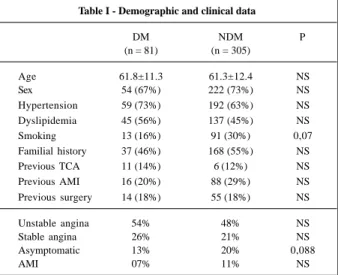
In our service at the Hospital da Beneficência Portu-guesa de São Paulo, 430 stents were implanted in 386 pa-tients from July ’97 to April ’99. The nondiabetic group comprised 305 (79%) patients who received 340 stents, and the diabetic group comprised 81 (21%) patients, 12 (14.8%) of whom were insulin-dependent patients, receiving 90 stents. The mean age was 61 years, and males prevailed in both groups (Table I).
3 6 6
Bayerl et al
Stent implantation in diabetic patients
Arq Bras Cardiol volume 75, (nº 5), 2000
to demographic and basic clinical characteristics (Table I). In both groups, the prevailing clinical status was unstable angina, and in the nondiabetic group asymptomatic pa-tients predominated (Table I).
Three days prior to the procedure, when clinically pos-sible, the patients received 500mg/day of ticlopidine and 200mg/day of acetylsalicylic acid for 30 days and during the entire period of follow-up, respectively. In the catheteriza-tion laboratory, after selective catheterizacatheteriza-tion of the coro-nary artery, 10,000 U of heparin were administered into the coronary artery.
Stents were implanted after conventional balloon catheter angioplasty of the target lesion, using final pressu-res routinely >10 atmosphepressu-res.
Angiographic success was defined as residual lesion <20% in the presence of TIMI III flow, and the clinical success was defined as the angiographic success in the ab-sence of major complications (acute myocardial infarction, need for emergency myocardial revascularization, and death). Major vascular complications were defined as those complications requiring surgical repair at the site of punc-ture or bleeding with a hemoglobin level fall >5g/dL.
The percentage stenosis and the minimum and reference luminal diameters of the artery were analyzed before and imme-diately after the procedure through quantitative digital angio-graphy, using the online system Toshiba DEF 1000A.
Clinical follow-up was performed through out patient visits, direct telephone contact with the patient, or with the assistant physician.
Continuous variables were expressed as mean and standard deviation and assessed using the paired and non-paired Student t tests. Categorical variables presented as percentages were analyzed through the chi-square test. A p value <0.05 was considered significant.
Results
Angiographic and clinical successes were similar:
96.6% and 97.9%, respectively, for the diabetic group, and 92.6% and 96.4%, respectively, for the nondiabetic group (p=ns).
Angiographic characteristics were similar in regard to the artery treated, complexity, and length of the lesions (Table II). A quantitative digital analysis showed no diffe-rences, except in the minimum luminal diameter after the pro-cedure, which tended to be smaller in the diabetic group (Table III).
During the in-hospital evolution, the diabetic group showed a higher rate of acute myocardial infarction 7.4% vs 1.9% (p=0.022), (fig. 1) in spite of having a similar incidence of Q and non-Q acute myocardial infarctions when separa-tely analyzed (Table IV). No emergency myocardial revascu-larization was required, and 2 (0.6%) patients in the nondia-betic group died due to subacute thrombosis of the stent. Major vascular complications were also similar in both groups (Table IV).
In the diabetic group, the mean clinical follow-up was 10.8±6.12 months, and it was performed in 73 (90%) patients. In the nondiabetic group, the mean clinical follow-up was 11.08±6.31 months (p=ns), and it was performed in 287 (94%) patients. No difference was observed in the inciden-ce of asymptomatic patients (90.4% vs 93%) or in the
inci-Table I - Demographic and clinical data
DM NDM P
(n = 81) (n = 305)
Age 61.8±11.3 61.3±12.4 NS
Sex 54 (67%) 222 (73%) NS
Hypertension 59 (73%) 192 (63%) NS Dyslipidemia 45 (56%) 137 (45%) NS
Smoking 13 (16%) 91 (30%) 0,07
Familial history 37 (46%) 168 (55%) NS Previous TCA 11 (14%) 6 (12%) NS Previous AMI 16 (20%) 88 (29%) NS Previous surgery 14 (18%) 55 (18%) NS
Unstable angina 54% 48% NS
Stable angina 26% 21% NS
Asymptomatic 13% 20% 0,088
AMI 07% 11% NS
DM- diabetes mellitus; NDM- nondiabetic; TCA- transluminal coronary angioplasty; AMI – acute myocardial infarction.
Table II – Angiographic characteristics
DM NDM p
Vessel treated (n=90) (n=340)
AD 38% 37% NS
RC 33% 31% NS
NS 10% 11% NS
SVBG 14% 15% NS
Type of lesion
A 04% 04% NS
B1 29% 24% NS
B2 38% 34% NS
C 29% 32% NS
Length
< 10 mm 21% 24% NS
between 10 e 20 mm 47% 53% NS
> 20 mm 32% 24% NS
DM- diabetes mellitus; NDM- nondiabetic; LAD – left anterior descen-ding coronary artery; RC – right coronary artery; Cx- circumflex coronary artery; SVBG- saphenous vein bypass graft.
Table III – Data from quantitative digital angiography
DM NDM P
(n = 90) (n = 340)
Pre RLD (mm) 3.09±0.42 3.15±0.54 NS Pre MLD (mm) 0.80±0.48 0.88±1.64 NS Post MLD (mm) 3.20±0.39 3.29±0.30 0.064 % stenose pre 89.3±8.87 88.4±10.7 NS % stenose pos 1.30±8.37 2.03±10.7 NS
Arq Bras Cardiol volume 75, (nº 5), 2000
Bayerl et al Stent implantation in diabetic patients
3 6 7
dence of patients with stable angina (6.8% vs 5.0%) and unstable angina (2.7% vs 1.3%) between the diabetic and nondiabetic groups, respectively. Rates of acute myocardial infarction and death were also similar; the diabetic group, ho-wever, required more myocardial revascularization (15% vs 2.4%) (p<0.001). This directly influenced the occurrence of major cardiac events in the diabetic group (p<0.0001) (fig. 2).
Discussion
The presence of diabetes mellitus in patients with co-ronary atherosclerotic disease is a marker of poor prognosis, representing a challenge to clinicians, intervention cardio-logists, and cardiac surgeons.
The metabolic and endothelial changes present in dia-betic patients and the higher chance of rupture of the plaque, thrombus formation, and exacerbation of the intimal hyperplasia are determinant factors of a higher incidence of complications and restenosis in these patients when they
undergo percutaneous coronary interventions 4,8,9-11. In
ad-dition, diabetic patients have more severe angiographic and clinical profiles and usually have associated diseases, such as hypertension, dyslipidemia, coagulopathies, and ne-phropathies, therefore requiring a strict control because these factors influence the occurrence of cardiovascular events during follow-up 12,13.
Randomized studies, such as BARI 14 and CABRI 15, in
patients with multivessel lesions have shown a higher sur-vival rate for diabetic patients undergoing surgery, as com-pared with those treated with coronary balloon angioplasty. The EAST study 16, however, has shown no difference in
patient survival at the end of 5 years for both procedures. Another study 17 recently published analyzing
pati-ents who met the criteria for randomization but who did not take part in the BARI Study has shown a similar mortality rate for diabetic patients undergoing balloon catheter angioplasty and surgery. Some distinct basic and angiogra-phic characteristics were observed in the diabetic control group when compared with the randomized group, as fol-lows: higher degree of education, better quality of life, lower incidence of smoking, and lower degree of left ventricular dysfunction. They also reported that in the control group, the diabetic patients undergoing balloon catheter angio-plasty had a lower incidence of triple vessel coronary athe-rosclerotic disease when compared with the group under-going surgery.
The role played by coronary stents in the treatment of diabetic patients has not been totally established. In our study, where we report our experience with coronary sten-ting, we observed a high rate of clinical and angiographic success for both groups. In the in-hospital phase, however, the incidence of major cardiac events was higher in the dia-betic group, basically due to a higher incidence of acute myocardial infarction in this group. This may be explained by the higher predisposition to rupture of the atheromatous plaque in these patients with consequent formation of a pla-telet thrombus, in addition to changes in the coagulation system 1,2,3,7,8,13. It is worth stressing that emergency
myo-cardial revascularization was not required for any group, showing the efficiency of stenting in this context.
Clinical follow-up showed a favorable evolution be-cause more than 90% of the patients of both groups were asymptomatic. The same occurred with the incidence of acute myocardial infarction and late deaths, but more myo-cardial revascularizations were required in the diabetic group. Studies by Tilli et al 18, Kastrati et al 19, and Abizaid et
al 20 have shown a need two times greater for
revasculariza-tion of the target lesion (RTL) by the end of 6 months in dia-betic patients undergoing stenting. Its employment, howe-ver, shows a clear superiority in relation to the primary suc-cess, clinical evolution, and rate of restenosis, as compared with conventional balloon catheter angioplasty 21-23.
More recently, the use of adjunctive pharmacological therapy, mainly inhibitors of the receptors of platelet glyco-protein IIb/IIIa, has shown additional benefit in the percuta-neous treatment of diabetic patients, as shown in the
Table IV - Incidence of in-hospital complications
DM NDM P
(n=81) (n=305)
Any AMI 7,4% 1,9% 0.022
Q AMI 2,5% 0,6% NS
Non-Q AMI 4,9% 1,3% NS
Emergency MR 0 0
Death 0 0,6% NS
Vascular complications 6,1% 7,8% NS
DM- diabetes mellitus; NDM- nondiabetic; AMI- acute myocardial infarction; MR- myocardial revascularization.
Fig.1 – In-hospital results.
IAM 7.4
1.9
Fig. 2 – NMR – need for myocardial revascularization; MCE – major cardiac events.
death cardiac death
NMR MCE
AMI
1.7% 0.7%
2.7% 1.7%
15.0% 17.7%
4.8%
2.4%
3 6 8
Bayerl et al
Stent implantation in diabetic patients
Arq Bras Cardiol volume 75, (nº 5), 2000
TENT Study 24. In this study, administration of abciximab
as-sociated with coronary stenting caused a 50% reduction in the need for RTL in that group of patients by the end of 6 months, and this benefit remained after one year, evolving in a manner similar to that of nondiabetic patients.
We believe, as reported by Centemero et al 25, that the
mere presence of diabetes mellitus should not determine the type of revascularization (percutaneous or surgical). Other factors should be considered as follows: presence of asso-ciated comorbidities; type of clinical presentation of the dia-betes; patient’s age; morphological and angiographic cha-racteristics of the lesions; extension of the coronary athe-rosclerotic disease; presence of ventricular dysfunction; and the social, economical, and cultural level of the patient.
Finally, we should await the conclusion of randomized studies (ARTS, SOS), which including the analysis of sub-groups, such as diabetic patients, will provide important
in-1. Ledet T. Histological and histochemical changes in the coronary arteries of old diabetic patients. Diabetologia 1968; 4: 268-72.
2. Vigorita VJ, Moore GW, Huthins GM, et al. Absence of correlation between coro-nary arterial atherosclerosis and severity or duration of diabetes mellitus of adult onset. Am J Cardiol 1980; 46: 535-42.
3. Ellis SG, Vandormael MG, Cowley MJ, et al. Coronary morphologic and clinical determinants of procedural outcome with angioplasty for multivessel coronary disease: implications for patient selection. Circulation 1990; 82: 1193-202. 4. Weintraub WS, Kasinsky AS, Brown CL, et al. Can restenosis after coronary
an-gioplasty be predicted from clinical variables? J Am Coll Cardiol 1993; 21: 6-14. 5. Willian W, O‘Neill FACC. Multivessel Balloon Angioplasty should be
aban-doned in Diabetic patients! J Am Coll Cardiol 1998; 31: 20-2.
6. Abizaid A, Kornowski R, Mintz G, et al. The influence of diabetis mellitus on acu-te and laacu-te outcomes following coronary sacu-tent implantation. J Am Coll Cardiol 1998; 32: 584-9.
7. Chaves A, Centemero MP, Pinto I. Diabetes mellitus e evolução pós implante de
stents coronarianos. Rev Soc Cardiol ESP 1997; 7(supl B): B-36.
8. Aronson D, Bloomgaredn Z, Nayfield EJ. Potential mechanisms promoting res-tenosis in diabetic patients. J Am Coll Cardiol 1996; 27: 528-35.
9. Carrozza JP, Kuntz RE, Fishman F, et al. Restenosis after injury caused by coronary stenting in patients with diabetes mellitus. Ann Intern Med, 1993; 118: 344-9. 10. Kornowsky R, Mintz GS, Kent KM, et al. Increased restsnosis in diabetes
melli-tus after coronary intervention is due to exaggerated intimal hyperplasia. Circu-lation 1997; 95: 1366-9.
11. Stein B, Weintraub WS, Gebhart S, et al. Influence of diabetes mellitus on early and late outcome after percutaneous transluminal coronary angioplasty. Circula-tion 1995; 91: 979-89.
12. Sowers JR, Epstein M. Diabetes mellitus and associated hypertension, vascular disease, and nephropaty. Hypertension 1995; 26: 869-79.
13. Webster MW, Scott RS. What cardiologists need know about diabetes. Lancet 1997; 350: 23-7.
14. The Bypass Angioplasty Revascularization Investigation (BARI) Investiga-tors. Comparison of coronary bypass surgery with angioplasty in patients with multivessel disease. N Engl J Med 1996; 335: 217-25.
References
15. CABRI Trial Participants. Coronary Angioplasty versus Bypass Revasculariza-tion InvestigaRevasculariza-tions (CABRI): results during the first year. Lancet 1995; 346: 1179-83.
16. Weintraub WS, Boccuzzi S, Morris DC, et al. Coronary surgery and coronary an-gioplasty in diabetics: diet therapy, oral hypoglycemics and insulin. Circulati-on 1997; 96(suppl I): I-23.
17. Detre KM, Guo P, Holubkov R, et al. Coronary revascularization in diabetic pa-tients. a comparison of the randomized and observational components of the By-pass Angioplasty Revascularization Investigation (BARI). Circulation 1999; 99: 633-40.
18. Tilli FV, Aliabadi D, Bowers T, et al. Optimal coronary stenting in diabetics: available percutaneous alternative to cardiac surgery. J Am Coll Cardiol 1997; 29(suppl A): A-455.
19. Kastrati A, Schoming A, Elezi S, et al. Predictive factors of restenosis after coro-nary stent placement. J Am Coll Cardiol, 1997; 30: 1428-36.
20. Abizaid A, Mehran R, Bucher TA, et al. Does diabetes influence clinical recurrence after coronary stent implantation? J Am Coll Cardiol 1997; 29(suppl-A): A-188. 21. Savage MP, Fischman DL, Slota P, et al. Coronary intervention in the diabetic pa-tient: improved outcome following stent implantation versus balloon angio-plasty. J Am Coll Cardiol 1997; 30: 1428-36.
22. Van Belle E, Bauters C, Hubert E, et al. Angiographic follow-up after coronary stenting or balloon angioplasty in diabetic patients. Circulation 1997; 96(suppl I): I-323.
23. Van Belle E, Bauters C, Hubert E, et al. Restonosis rates in diabetic patients. A comparison of coronary stenting and balloon angioplasty in native coronary ves-sels. Circulation 1997; 96: 1454-60.
24. EPISTENT Investigators. Randomised placebo-controlled and balloon-angio-plasty-controlled trial to asses safety of coronary stenting with use of platelet glycoprotein-IIb/IIIa blockade. Lancet 1998; 352: 87-92.
25. Centemero M, Sousa AGMR, Chaves A, et al. Revascularização percutânea no paciente diabético. Rev Soc Cardiol ESP 1998; 8: 936-45.
26. Borness GW, Peterson ED, Ohman EW, et al. Relationship between diabetes mellitus and long-term survival after bypass and angioplasty. Circulation 1997; 96: 2551-5.
formation about the efficacy of stent implantation versus surgery in patients with multivessel lesions.
The recent ARTS Study 26 comparing the efficacy of