(1) Universidade Federal de Santa Maria (UFSM), Santa Maria, Rio Grande do Sul, Brasil.
(2) Universidade de São Paulo (FOB/USP), Bauru, São Paulo, Brasil.
Research grant agency: CAPES; CNPq; FAPERGS
Graduate Program in Human Communication Disorders at Federal University of Santa Maria/UFSM.
Conlict of interest: non-existent
Stomatognatic system changes in dysphonic individuals
Alterações de sistema estomatognático em indivíduos disfônicos
Carla Aparecida Cielo(1)
Vanessa Veis Ribeiro(2)
Mara Keli Christmann(1)
Joziane Padilha de Moraes Lima(1)
Andrielle de Bitencourt Pacheco-Rubim(1)
Carla Franco Hoffmann(1)
Ângela Leusin Mattiazzi(1)
Received on: March 24, 2015 Accepted on: July 22, 2015
Mailing address:
Vanessa Veis Ribeiro UFSM - Av. Roraima nº 1000 Cidade Universitária - Bairro Camobi Prédio 26 - 4º andar -
Departamento de Fonoaudiologia Santa Maria – RS – Brasil CEP: 97105-900
E-mail: [email protected]
ABSTRACT
Purpose: to verify the presence of disorders of the stomatognathic system and its association with sex, profession, allergies report and diagnosing of type of dysphonia of the dysphonic individuals who sought treatment in a speech therapy clinical school.
Methods: quantitative and retrospective study, through the database. Sample of 69 subjects of records of both sexes, aged between 19 and 44 years. Data were collected on age, gender, profession, report of allergies, diagnosis of the type of dysphonia, respiratory tract and antroposcópica evaluation of the stomatognathic system: occlusion, horizontal and transverse bite disorders, width and depth of the hard palate, breathing mode and voltage lips, tongue and cheeks.
Results: 28,99% (n=20) were professional voice users; 33,33% (n=23) showed allergies; mixed respi-ratory type with 75,36% (n=52), followed by the top with 20,29% (n=14) and costodiafragmatic abdo -minal with 4,35% (n=3); functional dysphonia (n=42; 66,67%), followed by organicofuncional (n=19; 23,54%) and organic (n=8; 11,59%). In association os stomatognathic system disorders with types and mode breathing, dysphonia types, professional voice and allergies report were no signiicance, only fema-les with no vertical bite changes.
Conclusion: patients were predominantly women; grown ups; not voice professionals; with functional dysphonia; no history of allergies or stomatognathic system disorders; with appropriate type and mode breathing, with only female association with no vertical bite changes.
Keywords: Dysphonia; Voice Disorders; Speech, Language and Hearing Sciences; Stomatognathic System; Voice
RESUMO
Objetivo: veriicar a presença de alterações do sistema estomatognático e sua associação com o sexo, proissão, relato de alergias e diagnóstico fonoaudiológico do tipo de disfonia em indivíduos disfônicos que procuraram atendimento em uma clínica-escola fonoaudiológica.
Métodos: estudo quantitativo e retrospectivo, por meio de banco de dados. Amostra de 69 prontuários de sujeitos de ambos os sexos, com idades entre 19 e 44 anos. Coletaram-se dados sobre faixa etária, sexo, proissão, relato de alergias, diagnóstico fonoaudiológico do tipo de disfonia, tipo respiratório e dados da avaliação antroposcópica do sistema estomatognático: oclusão, alterações horizontais e transversais de mordida, largura e profundidade do palato duro, modo respiratório e tensão de lábios, língua e bochechas. Resultados: 28,99% (n=20) eram proissionais da voz; 33,33% (n=23) relataram alergias; tipo respi-ratório misto com 75,36% (n=52), seguido pelo superior com 20,29% (n=14) e costodiafragmaticoa -bdominal com 4,35% (n=3); tipo de disfonia funcional (n=42; 66,67%), seguido pelo organofuncional (n=19; 23,54%) e orgânico (n=8; 11,59%). Nas associações de alterações do sistema estomatognático com tipos e modos respiratórios, tipos de disfonia, proissionais da voz e relato de alergias não houve signiicâncias, apenas do sexo feminino com ausência de alterações verticais de mordida.
Conclusão: os pacientes estudados eram predominantemente mulheres; adultos; não proissionais da voz; com disfonia funcional; sem relato de alergias ou alterações de sistema estomatognático; com tipo e modo respiratórios adequados, havendo associação apenas do sexo feminino com ausência de altera-ções verticais de mordida.
INTRODUCTION
The stomatognathic system (SS) consists of different
structures such as ixed bones of the head, jaw, hyoid, sternum, muscles of mastication, swallowing, facial,
among others1-3. Such structures are of great relevance to the SS functions (speaking, breathing, swallowing, sucking and voice) are carried out smoothly along with
the central nervous system and peripheral control1,4,5. There must be balance between the skull and the
cervical spine to the stability of head position and support of dynamic activities. Thus, it is possible to
mobilize the skull moving bones, cartilage, joints and
muscles to perform the functions. In the case of vocal
production, which is one of SS functions, it is still
necessary to have mastery of content to be transmitted and integrity of the vocal apparatus6,7.
With regard to speech, it is known that the SS operates as a voice ilter, because the tongue, lips, pharynx and nasal cavity modify the voice quality by acting as resonators. Thus, changes in the conigu
-ration of these structures, as well as in the muscles that
make up the vocal apparatus or aids that act indirectly, as postural, functional and / or tone changes simulta-neously interfere in the performance of functions of breathing, phonation, articulation and resonance8.
These data elucidate the orofacial motor and the voice have a close relation, both on anatomical, functional, physiological features as neuromuscular2.
Thus, knowledge about the physiology of these aspects is required in the vocal rehabilitation process in order to recognize the association between these two
areas of Speech Therapy9,10. The integrated view of SS
structures and vocal production can subsidize speech and language therapy, helping to optimize results and reducing treatment time.
Considering the above, this study aimed to verify the presence of the stomatognathic system changes and its
association with gender, profession, report of allergies,
respiratory type and speech and language diagnosis
of the type of dysphonia in dysphonic individuals who
sought treatment at a speech therapy school clinic.
Consent (IC). The study was approved by the Ethics
Committee of the institution of origin under number 23081.016945 / 2010-76.
The inclusion criteria for subjects were: speech therapy diagnosis of dysphonia, aged between 18 and 44 years old and both genders. The records whose data were incomplete, or had evidence of neuro -logical diseases, syndromes, psychiatric, metabolic or endocrine issues, laryngeal surgery history and / or any surgical procedure of head and neck, registration of hearing loss, speech therapy and / or orthodontic regis-tration and smoking habits and alcohol consumption
were excluded from the survey11.
Considering the age group, 315 subjects were found, of whom 158 were discarded because they
did not contain in the records all the necessary
evalu-ations for this study. They were excluded even: 36
report of orthodontic or speech therapy for voice and / or orofacial motor prior to assessment in school clinic; 29 by smoking and / or alcohol abuse; 17 by a history
of endocrine or metabolic diseases; 4 with hearing loss and 2 for dental laws. Thus, the sample totaled 69 records, of whom 58 (84.06%) were female subjects and 11 male (15.94%), aged between 19 and 44 years
(mean 27.07 years).
The variables considered for collection of survey
data from medical records of patients were: profession (being classiied in “voice professional” or “no voice professional “), allergies report (presence or absence);
speech diagnosing the type of dysphonia, respiratory type and SS assessment data (data of anthroposcopic evaluation of the stomatognathic system: occlusion,
horizontal and transverse bite changes, width and
depth of the hard palate, breathing mode and lips, tongue and cheeks tension ).
The speech therapy diagnostic provided classii -cation of the type of dysphonia (functional,
organo-functional or organic) and it was based on the ENT diagnosis and the indings of the speech clinical
evaluation6.
For the evaluation of the SS, we used a protocol adapted from school clinic. The data were considered
Rev. CEFAC. 2016 Maio-Jun; 18(3):613-625
open bite) and transverse bite changes (absent, unilateral posterior crossbite and bilateral posterior crossbite)12. As for the morphology of the hard palate, width and depth aspects were analyzed (normal or
altered)12.
For the evaluation of lips, tongue and cheeks
muscle tension, touch tests were performed with gloved inger and resistance tests with a tongue depressor. Tension was considered as normal or altered for each
structure12.
The diagnosis of breathing mode (nasal or oral) was
carried out by analyzing the lips posture throughout anamnesis and assessment in order to verify if the
patient remained with half-open or open lips indicative of oral or oronasal breathing, or if it remained with occluded lips, indicative of nasal breathing. Also, we used the Glatzel mirror was gently placed below the nostrils to observe the nasal low, which assisted in the information about the existence of nasal obstruction. Finally, the nasal possibility test was carried out that the patient should remain with a sip of water in the mouth
in order to check the ability to maintain nasal breathing.
So the breathing mode was classiied as nasal when the subject did not present indicative of blocking the upper airway and proper posture of lips and showed the possibility of nasal breath for over two minutes, the reverse of the information enabled the classiication in
breathing oral or oronasal mode12.
All patients had undergone ENT examination which included visual inspection of the larynx, which is considered ENT diagnostic of laryngeal condition for
further conclusion of the speech diagnosis.
Data were tabulated and the variables were
described and analyzed statistically using the Person’s
Chi- Square nonparametric test. 5% signiicance level was adopted.
RESULTS
With regard to the occupation of the 69 subjects studied, it was found that 28.99% (n = 20) were voice
professional individuals. Regarding allergic factors,
33.33% (n = 23) had allergy, and these, 65.22% (n = 15) reported rhinitis, 8.69% (n = 2) sinusitis, 4.35% (n = 1) bronchitis, 13.04% (n = 3) rhinitis and sinusitis, and 4.35% (n = 1) rhinitis and asthma. The predominant respiratory type was mixed with 75.36% (n = 52), followed by the superior with 20.29% (n = 14) and diaphragmatic breathing with 4.35% (n = 3). The predominant dysphonia was functional (n = 42; 66.67%), followed by organofunctional (n = 19; 23.54%) and organic (n = 8; 11.59%).
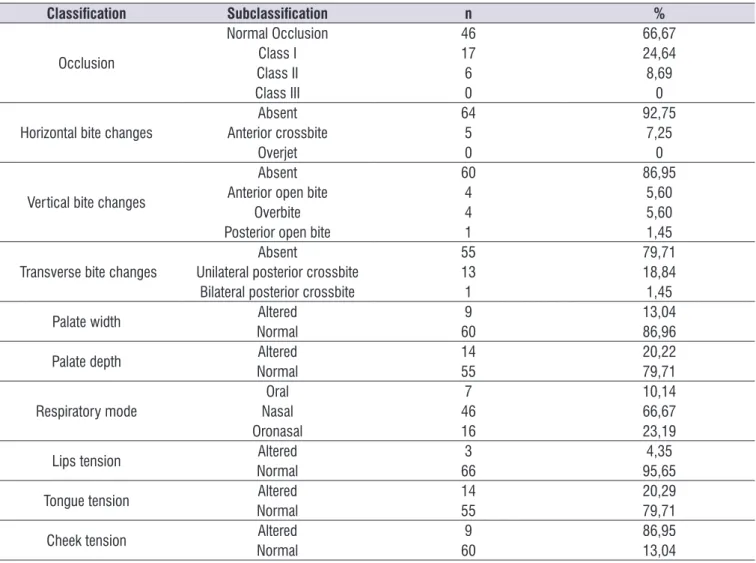
Table 1 shows the descriptive results of the evalu -ation of the stomatognathic system.
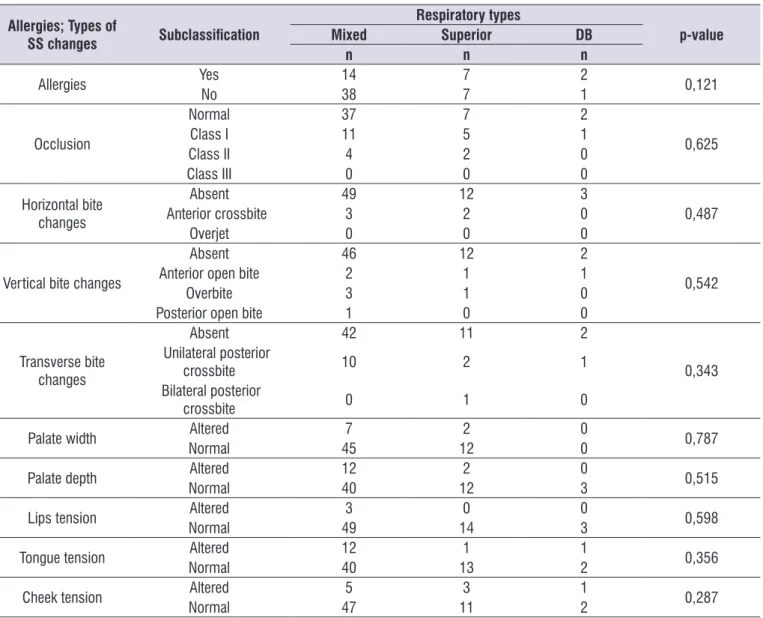
Table 2 shows the association between the respi -ratory type and reporting of presence of allergies and SS changes.
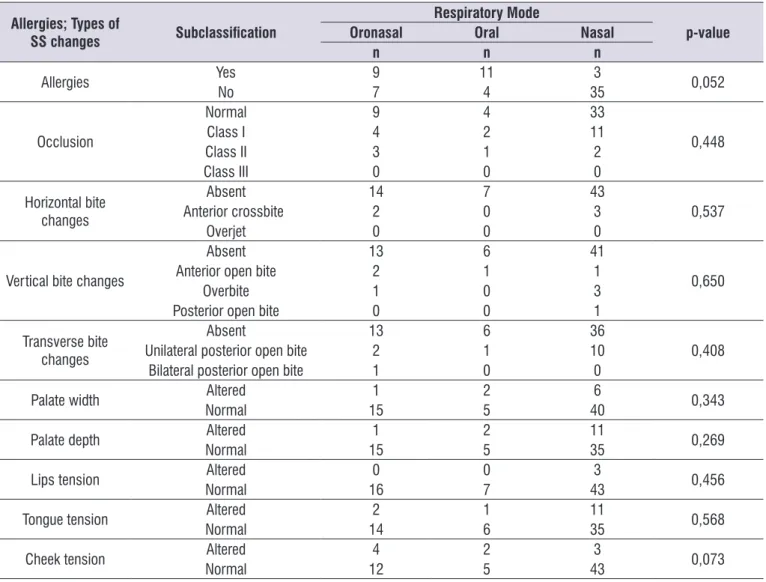
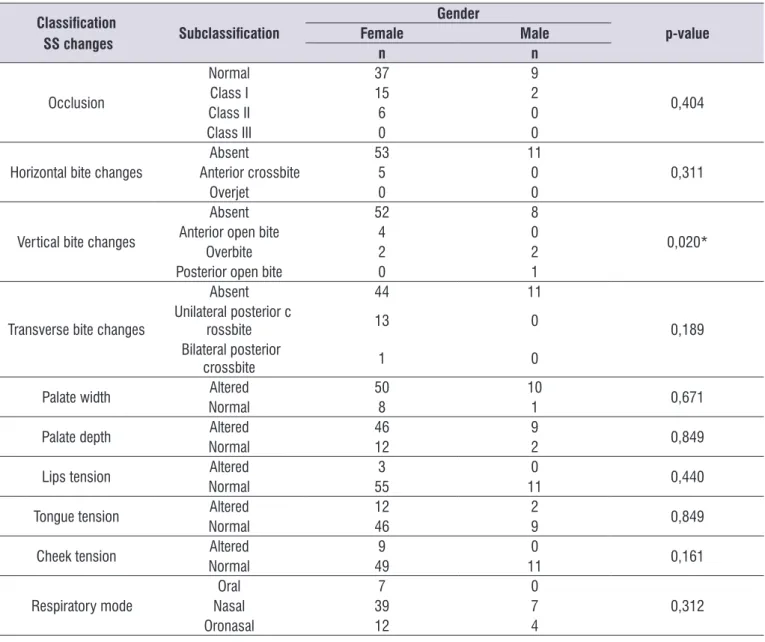
It is observed in Table 3, the association between
respiratory mode and reporting of presence of allergies and SS changes.
It is visualized, in Table 4, the association between
speech diagnosis of the types of dysphonia and reporting of presence of allergies, SS changes and the respiratory type.
Table 5 shows the association between voice
professional and types of dysphonia, a reporting of allergies and SS changes.
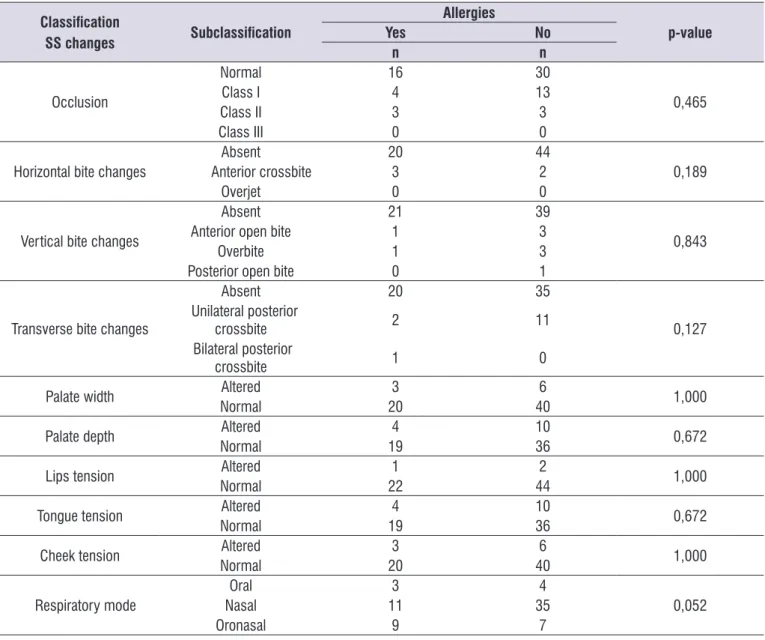
Table 6 displays the association between reporting
of presence of allergies and SS changes.
It is observed in Table 7 the association between
Table 1. Descriptive results of the evaluation of the stomatognathic system
Classiication Subclassiication n %
Occlusion
Normal Occlusion 46 66,67
Class I 17 24,64
Class II 6 8,69
Class III 0 0
Horizontal bite changes
Absent 64 92,75
Anterior crossbite 5 7,25
Overjet 0 0
Vertical bite changes
Absent 60 86,95
Anterior open bite 4 5,60
Overbite 4 5,60
Posterior open bite 1 1,45
Transverse bite changes
Absent 55 79,71
Unilateral posterior crossbite 13 18,84
Bilateral posterior crossbite 1 1,45
Palate width Altered 9 13,04
Normal 60 86,96
Palate depth Altered 14 20,22
Normal 55 79,71
Respiratory mode
Oral 7 10,14
Nasal 46 66,67
Oronasal 16 23,19
Lips tension Altered 3 4,35
Normal 66 95,65
Tongue tension Altered 14 20,29
Normal 55 79,71
Cheek tension Altered 9 86,95
Normal 60 13,04
Descriptive analysis.
Rev. CEFAC. 2016 Maio-Jun; 18(3):613-625
Table 2. Association between the respiratory type and reporting of presence of allergies and stomatognathic system changes
Allergies; Types of
SS changes Subclassiication
Respiratory types
p-value
Mixed Superior DB
n n n
Allergies Yes 14 7 2 0,121
No 38 7 1
Occlusion
Normal 37 7 2
0,625
Class I 11 5 1
Class II 4 2 0
Class III 0 0 0
Horizontal bite changes
Absent 49 12 3
0,487
Anterior crossbite 3 2 0
Overjet 0 0 0
Vertical bite changes
Absent 46 12 2
0,542
Anterior open bite 2 1 1
Overbite 3 1 0
Posterior open bite 1 0 0
Transverse bite changes
Absent 42 11 2
0,343 Unilateral posterior
crossbite 10 2 1
Bilateral posterior
crossbite 0 1 0
Palate width Altered 7 2 0 0,787
Normal 45 12 0
Palate depth Altered 12 2 0 0,515
Normal 40 12 3
Lips tension Altered 3 0 0 0,598
Normal 49 14 3
Tongue tension Altered 12 1 1 0,356
Normal 40 13 2
Cheek tension Altered 5 3 1 0,287
Normal 47 11 2
* Statistically signiicant results (p ≤ 0.05) - Chi-Square test
Table 3. Association between the respiratory mode and reporting of presence of allergies and stomatognathic system changes
Allergies; Types of
SS changes Subclassiication
Respiratory Mode
p-value
Oronasal Oral Nasal
n n n
Allergies Yes 9 11 3 0,052
No 7 4 35
Occlusion
Normal 9 4 33
0,448
Class I 4 2 11
Class II 3 1 2
Class III 0 0 0
Horizontal bite changes
Absent 14 7 43
0,537
Anterior crossbite 2 0 3
Overjet 0 0 0
Vertical bite changes
Absent 13 6 41
0,650
Anterior open bite 2 1 1
Overbite 1 0 3
Posterior open bite 0 0 1
Transverse bite changes
Absent 13 6 36
0,408
Unilateral posterior open bite 2 1 10
Bilateral posterior open bite 1 0 0
Palate width Altered 1 2 6 0,343
Normal 15 5 40
Palate depth Altered 1 2 11 0,269
Normal 15 5 35
Lips tension Altered 0 0 3 0,456
Normal 16 7 43
Tongue tension Altered 2 1 11 0,568
Normal 14 6 35
Cheek tension Altered 4 2 3 0,073
Normal 12 5 43
Rev. CEFAC. 2016 Maio-Jun; 18(3):613-625
Table 4. Association between the speech diagnosis of the types of dysphonia and reporting of presence of allergies, the stomatognathic system changes and the respiratory type
Allergies; Types of SS changes Respiratory type
Subclassiication
Type of dysphonia
p-value organofunctional Functional Organic
n n n
Allergies Yes 7 13 3 0,871
No 12 29 5
Occlusion
Normal 13 27 6
0,806
Class I 5 10 2
Class II 1 5 0
Class III 0 0 0
Horizontal bite changes
Absent 16 40 8
0,215
Anterior crossbite 2 3 0
Overjet 0 0 0
Vertical bite changes
Absent 16 37 7
0,851
Anterior open bite 1 2 1
Overbite 2 2 0
Posterior open bite 0 1 0
Transverse bite changes
Absent 15 35 5
0,332
Unilateral posterior crossbite 3 7 3
Bilateral posterior crossbite 1 0 0
Palate width Altered 3 5 1 0,915
Normal 16 37 7
Palate depth Altered 5 8 1 0,681
Normal 14 34 7
Lips tension Altered 1 2 0 0,286
Normal 17 41 8
Tongue tension Altered 4 9 1 0,843
Normal 15 33 7
Cheek tension Altered 2 7 0 0,408
Normal 17 35 8
Respiratory mode
Oral 3 4 0
0,623
Nasal 13 28 5
Oronasal 3 10 3
Respiratory type
Mixed 13 33 6
0,864
Superior 5 7 2
DB 1 2 0
* Statistically signiicant results (p ≤ 0.05) - Chi-Square test
Table 5. Association between voice professional and types of dysphonia, a reporting of allergies and stomatognathic system changes
Types of dysphonia, Allergies and SS
changes Subclassiication
Voice professional
p-value
No Yes
n n
Type of dysphonia
Organofunctional 12 7
0,871
Functional 32 10
Organic 5 3
Allergies Yes 16 7 0,851
No 33 13
Occlusion
Normal 32 14
0,782
Class I 12 5
Class II 5 1
Class III 0 0
Horizontal bite changes
Absent 45 19
0,645 Anterior
crossbite 4 1
Overjet 0 0
Vertical bite changes
Absent 42 18
0,246
Anterior open bite 4 0
Overbite 3 1
Posterior open bite 0 1
Transverse bite changes
Absent 40 15
0,279 Unilateral posterior
crossbite 9 4
Bilateral posterior
crossbite 0 1
Palate width Altered 7 2 0,631
Normal 42 18
Palate depth Altered 11 3 0,485
Normal 38 17
Lips tension Altered 2 1 0,865
Normal 47 19
Tongue tension Altered 10 4 0,969
Normal 39 16
Cheek tension Altered 5 4 0,273
Normal 44 16
Respiratory mode
Oral 5 2
0,686
Nasal 34 12
Oronasal 10 6
Respiratory type
Mixed 38 14
0,801
Superior 9 5
DB 2 1
* Statistically signiicant results (p ≤ 0.05) - Chi-Square test
Rev. CEFAC. 2016 Maio-Jun; 18(3):613-625
Table 6. Association between reporting of presence of allergies and stomatognathic system changes
Classiication
SS changes Subclassiication
Allergies
p-value
Yes No
n n
Occlusion
Normal 16 30
0,465
Class I 4 13
Class II 3 3
Class III 0 0
Horizontal bite changes
Absent 20 44
0,189
Anterior crossbite 3 2
Overjet 0 0
Vertical bite changes
Absent 21 39
0,843
Anterior open bite 1 3
Overbite 1 3
Posterior open bite 0 1
Transverse bite changes
Absent 20 35
0,127 Unilateral posterior
crossbite 2 11
Bilateral posterior
crossbite 1 0
Palate width Altered 3 6 1,000
Normal 20 40
Palate depth Altered 4 10 0,672
Normal 19 36
Lips tension Altered 1 2 1,000
Normal 22 44
Tongue tension Altered 4 10 0,672
Normal 19 36
Cheek tension Altered 3 6 1,000
Normal 20 40
Respiratory mode
Oral 3 4
0,052
Nasal 11 35
Oronasal 9 7
had oral breathing mode (Table 3), which meets the
literature.
There is a relation between the complaints of allergic
and / or digestive disorders and dysphonia, since these are co-factors for the establishment of dysphonia
and laryngeal injury14. In this work, this relation was not observed, with predominance of subjects with
independent functional dysphonia have allergies or not
DISCUSSION
The relation between voice disorders and allergic changes involving the upper airways encom -passes mainly changes the resonance and vocal
projection, causing laryngeal effort as a compensatory
mechanism2.
Table 7. Association between gender and stomatognathic system changes
Classiication
SS changes Subclassiication
Gender
p-value
Female Male
n n
Occlusion
Normal 37 9
0,404
Class I 15 2
Class II 6 0
Class III 0 0
Horizontal bite changes
Absent 53 11
0,311
Anterior crossbite 5 0
Overjet 0 0
Vertical bite changes
Absent 52 8
0,020*
Anterior open bite 4 0
Overbite 2 2
Posterior open bite 0 1
Transverse bite changes
Absent 44 11
0,189 Unilateral posterior c
rossbite 13 0
Bilateral posterior
crossbite 1 0
Palate width Altered 50 10 0,671
Normal 8 1
Palate depth Altered 46 9 0,849
Normal 12 2
Lips tension Altered 3 0 0,440
Normal 55 11
Tongue tension Altered 12 2 0,849
Normal 46 9
Cheek tension Altered 9 0 0,161
Normal 49 11
Respiratory mode
Oral 7 0
0,312
Nasal 39 7
Oronasal 12 4
Rev. CEFAC. 2016 Maio-Jun; 18(3):613-625 respiratory type changes occurred in subjects with
functional dysphonia (Table 4).
This inding suggests that, in the studied group,
SS changes did not interfere directly in dysphonia
presented by the subjects, but could be acting together with other vocal and laryngeal features such as auxiliary in worsening of voice changes or prognosis, without setting a direct relation between type of dysphonia and a speciic SS change. In another survey, also found no change in vocal quality of mouth breathers who had SS changes compared to the vocal quality of a control group of nose breathers without SS changes, agreeing with the results of this study9.
A work that evaluated the activity of masticatory muscles through electromyography in two groups of women, and the study group with dysphonia and the control group without dysphonia, showed that even in the jaw rest, dysphonic women had the masticatory musculature activity signiicantly increased when
compared to the control group,18 possibly because
most dysphonic individuals presents muscle
hyper-tension. However, another study found that even in the absence of pain, subjects with symptoms of
temporomandibular disorders can present acoustic voice changes, as the vocal production relates to all the
muscles and inluences the movement of the larynx, or
because of functions disorganization of the
temporo-mandibular join occurs overload at the laryngeal level19. In this study, most subjects presented with normal muscle tension, however, it is known that the evaluation through touch is subjective and prone to failure, but it is still the most widely used in school clinic practices for easy access and low value (Table 1).
There was no association between voice profes
-sional and non-profes-sional with SS changes, respi
-ratory type and type of dysphonia. However, most voice professional subjects (minority in the sample)
did not present SS changes, but the predominant
respiratory type was mixed and the type of dysphonia was functional (Table 5). In the voice professional, an
impairment that affects the air function can negatively
inluence loudness, pitch and voice quality as well as
the temporal aspects of emission2,10,16,17,20,21.
Inadequate respiratory type can impair vocal
production considering that does not have the
necessary air support, which creates stress and
overload the other levels of vocal production as laryngeal21,22. In this survey, the predominant type in the entire sample was mixed, where there is little movement of the upper and lower chest regions being
digestive system structures. Thus, posture, tone
and mobility of SS organs directly inluence the joint and interfere with vocal projection in laryngeal and pharyngeal adjustments and therefore they have some relation with the voice quality and the resonance
system2. The tongue position in the oral cavity affects
the resonance of the voice, the body tongue in anterior and high position can produce a childish voice, as the
tongue in a retracted position, can produce a mufled resonance with more severe pitch2.
Although the larynx to be a key body for voice production, it is known that other structures have an equal importance to the production of a normal voice, among which we highlight the muscles of the abdomen, thoracic cavity, lungs, pharynx, oral and nasal cavity,
and changes to these structures can cause vocal dysfunctions2. In the present study, the percentage majority had nasal breathing and mixed respiratory
type (Table 1). Research that analyzed the type and breathing mode of future professionals of voice and spoken and sung voice professional also found nasal
and mixed type mode, corroborating the indings of this
investigation15-17.
The nasal breathing is considered essential for the
proper functioning of the larynx and other structures and SS functions, since the mixed respiratory type is not ideal, however, it is considered acceptable in subjects that do not have great vocal demand as voice
professionals2,6. It was not found in this survey relation between the SS changes with the type (Table 2) and the breathing mode (Table 3). These data were expected, considering that most of the subjects (28.99%) was
not voice professional and could perform daily
activ-ities without automated diaphragmatic breathing. Nevertheless, it is known that diaphragmatic breathing
is essential for a normotensive voice production and optimal for voice professional6,15-17.
In this study, the percentage majority had functional
dysphonia, characterized by disorders of the vocal behavior, and can be the primary type by misuse of
the voice, secondary by vocal inadequacies or psycho -genic order6. It is believed that this type of dysphonia is what may have greater inluence on SS, consid -ering that SS is directly or indirectly part of the vocal production6, however, this claim was not conirmed in this survey. Nevertheless, comparing the types of dysphonia, the major SS changes in the aspects
of horizontal, vertical and transverse bite changes;
6. Behlau M. Voz: o livro do especialista. Rio de Janeiro: Revinter, 2001.
7. Bonatto MTRL, Silva MAA, Costa HO. A relação entre respiração e sistema sensório-motor oral em crianças disfônicas. Rev CEFAC. 2004;6(1):58-66. 8. Garcia RAS, Campiotto AR. Distúrbios vocais x
distúrbios musculares orais: possíveis relações. Pró-Fono R Atual Cient. 1995;7(2):33-9.
9. Viegas D, Viegas F, Atherino CCT, Baeck HE. Parâmetros vocais em respiradores orais. Rev CEFAC. 2010;12(5):820-30.
10. Nishimura CM, Gimenez SRML. Peril da fala do
respirador oral. Rev CEFAC. 2010;12(3):505 8.
11. Colton RH, Casper JK, Leonard R. Compreendendo
os problemas de voz: uma perspectiva isiológica
ao diagnóstico e ao tratamento. Rio de Janeiro: Revinter, 2010.
12. Genaro KF, Berretin-Felix G, Rehder MIBC e
Marquesan IQ. Avaliação miofuncional
orofacial-protocolo MBGR. Rev CEFAC. 2009;11(2):237-55. 13. Lemos CM, Willo NS, Mion OG, Júnior JFM.
Alterações funcionais do sistema estomatognático em pacientes com rinite alérgica: estudo caso-controle. Braz J Otorhinolaryngol. 2009;75(2):268-74.
14. Cielo CA, Finger LS, Roman-Niehues G, Deuschle
VP, Siqueira MA. Disfonia organofuncional e queixas de distúrbos alérgicos e/ou digestivos. Rev
CEFAC. 2009;11(3):431-9.
15. Soares EB, Brito CMCP. Peril vocal do guia de
turismo. Rev CEFAC. 2006;8(4):501 8.
16. Soares EB, Brito CMCP. Hábito e peril vocal em
coralistas. Acta ORL. 2009;27(1):28 35.
17. Cielo CA, Hoffmann CF, Scherer T, Christmann M.
Tipo e modo respiratório de futuros proissionais da
voz. Rev Saúde. 2013;39(1):121 30.
18. Rodrigues-Bigaton D, Schwarzenbeck A, Berni KC, Guirro RR, Silvério KC. Activation pattern masticatory
muscles in dysphonics woman. Electromyogr Clin Neurophysiol. 2010;50(6):289-94.
19. Boton LM, Morisso MF, Silva AMT, Cielo CA. Dor muscular em cabeça e pescoço e medidas vocais acústicas de fonte glótica. Rev CEFAC.
accepted for individuals who do not have great vocal
demand and use their voice only in everyday speech. But it is contraindicated for professional vocal use, as
insuficient air support can cause imbalance between
respiratory, phonation, resonant and articulation levels,
as well as fatigue, vocal instability and lack of ar6,16,17. These factors may inluence the type of dysphonia, and
they are usually related to functional dysphonia, and
subsequently the organofunctional. Such statements agree with the indings of this study (Table 5) in which, although no signiicant association, most dysphonic subjects had functional dysphonia type, followed by
organofunctional and organic.
Regarding the signiicant association found among women with no vertical bite changes data were not
found in the literature that could base this aspect, so it
is suggested more studies to clarify this inding.
CONCLUSION
The studied dysphonic patients were predominantly women; adults; no voice professionals; no history of allergies; with functional dysphonia; SS without changes; with proper type and mode of breathing and there was no SS changes association with the type of
dysphonia, type and mode of breathing or voice
profes-sionals, only female with no vertical bite changes.
REFERENCES
1. Rehder MI, Ferreira LP, Bei-Lopes DM, Limongi SCO. Inter-relações entre voz e motricidade oral. In:
Ferreira LP, Bei-Lopes DM, Limongi SCO. (Org.).
Tratado de fonoaudiologia. São Paulo: Roca, 2004. p.59-64.
2. Tavares JG, Silva VA, Alves EHA. Considerações teóricas sobre a relação entre respiração oral e disfonia. Rev Soc Bras Fonoaudiol.
2008;13(4):405 10.
Rev. CEFAC. 2016 Maio-Jun; 18(3):613-625 futuros proissionais da voz. Rev CEFAC.
2013;15(3):622-30.
22. Silvério KCA, Pereira EC, Menoncin LM, Dias CAS,
Santos CLG, Schwartzman PP. Avaliação vocal
e cervicoescapular em militares instrumentistas de sopro. Rev Soc Bras Fonoaudiol.