ISSN 1517-7076 artigo 11701, pp.301-306, 2016
Corresponding Author: S.K. ZHENG Received on: 24/06/2015 Accepted on: 20/01/2016
10.1590/S1517-707620160002.0029
First Principles Study on the Electronic
Structure and Optical Property of
Nd-C Codoped Anatase TiO
2Yi Wu 1, Yan Tian 2 Shukai Zheng 1,3
1
Research Center for Computational Materials & Device Simulations, College of Electronic & Information Engineering, Hebei University, Baoding 071002, P.R. China
2School of Microelectronics, Xidian University, Xi’an 710071,
P.R. China 3
Analytical Chemistry Department, Campus Universitario de Rabanales, Universidad de Córdoba, Córdoba 14071, Spain e-mail: [email protected]
ABSTRACT
Band structures, density of states, and absorption spectra of pure, Nd doped, C doped, and Nd-C codoped TiO2 are calculated using first-principles based on density functional theory. Calculation results show that Nd 4f state forms empty impurity energy levels below conduction band, and C 2p state together with Nd 2f state forms occupied impurity energy levels with higher density than that of single doped TiO2 above valence band. Consequently, more electrons in occupied energy levels can be excited by visible light to empty Nd 4f states rather than Ti 3d states, resulting in further enhancement of visible light absorption and absorption edge red shift. In addition, the impurity energy levels act as carriers trap centers, thus decreasing the recombination rate of carriers.
Keywords: Nd-C co-doping; Anatase TiO2; first-principles
1. INTRODUCTION
It’s well known that anatase TiO2 is an excellent photocatalyst due to its nontoxicity, physical and chemical stability, low cost and high photocatalytic activity. However, anatase TiO2 has a relatively wide band gap(Eg=3.23eV), and only the ultraviolet light whose photon energy exceeds the band gap of TiO2 can excite photogenerated electron-hole pairs.
Furthermore, TiO2 has a high carriers recombination rate, leading to photogenerated carriers can not be made full use of. These two problems limit the wide applications of TiO2. To solve these problems, researchers made great efforts and found that doping appropriate impurities into TiO2 is an effective and practical approach to cause visible light response and reduce carriers recombination rate.
Through years of development, the dopants change from metal ions[1-7] to nonmetal ions[8-10], and the doping method develop from single doping to codoping[11-14]. Carbon is one of the most adopted nonmetal dopants both in single doping and codoping. For instance, SAKTHIVEL et al.[15] accidentally achieved C doped anatase TiO2 during their work on N doped TiO2, and found that it was much more active than N doped TiO2 in degradation of 4-chlorophenol with visible light irradiation. IRIE et al.[16] fabricated carbon-doped anatase TiO2 by oxidative annealing of TiC, in which carbon atoms were at substitutional sites of oxygen atoms.Experimental results indicated that the as-prepared carbon-doped TiO2 had a smaller band gap, its absorption edge had a red shift, and showed visible light photocatalytic activity. Rare earth metal ions doped TiO2 is also one of the research focus[7,17,18]. LI et al.[19] synthesized Nd3+ doped anatase TiO2 nanoparticles, and found it being superior to undoped TiO2 nanoparticles in degrading 2-chlorophenol with visible light irradiation.
302 oxygen vacancies. Therefore, the photocatalytic activity of Nd-C codoped TiO2 was superior to single doped TiO2. By far as we know, there have no reports concentrate on the theorytical calculations of the Nd-C codoped TiO2.
So in this paper, using first principles based on density functional theory (DFT), we firstly calculated the band structures, density of states and optical absorption spectra of Nd-C codoped TiO2. In addition, the related properties of Nd doped TiO2, C doped TiO2 and pure TiO2[21] were also calculated. By comparing the electronic structures differences between Nd-C codoped TiO2 and the pure and single doped TiO2, we investigate the mechanism of further improvement as mentioned above from the electronic structure point of view.
2. MATERIALS AND METHODS
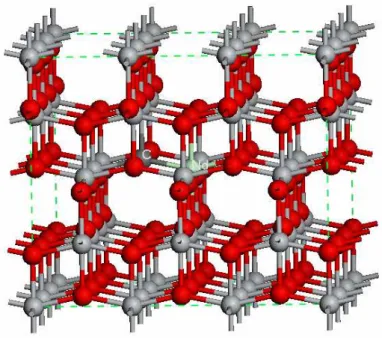
In this study, Nd-C codoped anatase TiO2 is modeled using a 3×3×1 anatase TiO2 supercell, in which one O atom is replaced by C atom, and one Nd atom substitutes for one Ti atom, as shown in Figure 1. Our calculations are performed using CASTEP program[22]. The interaction between ion core and valence electrons is described by ultrasoft pseudopotential, and the Perdew-Burke-Ernzerhof (PBE) generalized gradient approximation (GGA) is employed to describe the exchange-correlation energy for valence electrons. The electron wave functions are expanded in plane wave basis set with a cutoff energy of 360 eV. The k-points for Brillouin zone sampling is set as 2×2×2. The band structure, density of states, and optical absorption spectra are calculated based on geometry optimized crystal structure. The calculations of corresponding properties of pure and single doped TiO2 are performed using the same method as that of Nd-C codoped TiO2.
Figure 1: Structural model of Nd-C codoped TiO2
3. RESULTS AND DISCUSSION
The band structures and density of states (DOS) near Fermi level for pure, Nd doped, C doped, and Nd-C codoped TiO2 are shown in Figure 2. Fermi level is chosen at zero. It can be seen from Figure 2 that doping does not change band gap significantly, just gives rise to a slight band gap broadening. Therefore, the band gap is not the dominant factor which influences optical absorption. However, the dopants introduce impurity energy levels in the band gap, these gap levels can cause remarkable influence on optical absorption.
In Nd doped TiO2, Nd 4f states have two density of states peaks, forming a series of intensive impurity energy levels below conduction band and an isolated energy level at Fermi level, respectively. The impurity energy levels below conduction band are above Fermi level, so they are not occupied by electrons. Electrons in valence band can absorb photons whose energy are smaller than band gap energy, and transit to the empty Nd 4f state, therefore, visible light absorption of Nd doped TiO2 is enhanced by the introduction of Nd 4f state.
303 trap centers have a strong ability to capture electrons, but poor for holes. When electrons are captured by electron trap centers, holes can hardly recombine with the trapped electrons, and it takes a long time to release trapped electrons by visible light irradiation to conduction band, thus decreasing carriers recombination rate and prolonging carriers lifetime. For C doped TiO2, C 2p state hybridizes with O 2p and Ti 3d states, forming three impurity energy levels in band gap, one is below conduction band, one is above valence band, and the other at Fermi level.
Our calculated band structure is in agreement with that of Li et al.[23] in general. The impurity energy level below conduction band lies above Fermi level, so it is lack of electrons, and the one above valence band is blow Fermi level, then is occupied by electrons. Hence, the electrons of valence band and occupied impurity energy level can be excited to conduction band and empty impurity energy level, extending optical absorption range to visible light region.
As with Nd doped TiO2, impurity energy levels below conduction band and above valence band play a role of electrons trap centers and holes trap centers, respectively, consequently inhibit carriers recombination and increase carriers lifetime.Nevertheless, the impurity energy level located at Fermi level is deep in band gap, and when C doping concentration is high enough it may become an effective carriers recombination center, this may be one reason for the existence of optimal C doping concentration[24].
As for Nd-C codoped TiO2, Nd 4f state remains two density of state peaks, the higher one is below conduction band and forms several impurity energy levels as Nd doped TiO2, the lower one is above valence band, together with C 2p state forms an impurity energy band rather than an isolated energy level as Nd doped TiO2. Because the density of state peak above valence band is much bigger than that of Nd and C single doped TiO2, electrons of corresponding impurity energy levels have a larger probability to be excited to empty Nd 4f and Ti 3d states by visible light. In addition, electrons and holes trap centers can capture more carriers due to increase of impurity energy levels concentration, decreasing carrier recombination rate and prolonging carriers lifetime in further. As a consequence, visible light absorption and quantum efficiency of Nd-C codoped TiO2 is enhanced compared with Nd and C single doped TiO2.
-3 -2 -1 0 1 2 3 4 -3 -2 -1 0 1 2 3 4
0 20 40 60 80 100 120 140 160
En e rg y /e V
G F Q Z G
CBM
VBM
Eg=2.20 eV
(a) DOS/eV-1 Ti 3d O 2p TDOS -3 -2 -1 0 1 2 3 -3 -2 -1 0 1 2 3
0 2 4 6 8 10 12 14 16 18 20
E
ne
rg
y
/eV
G F Q Z G
CBM
VBM
Eg=2.23 eV
304
Figure 2: Structural mode Band structures and density of states for (a) pure[21] TiO2 (b) Nd doped TiO2 (c) C doped TiO2
(d) Nd-C codoped TiO2
The polycrystalline model of TiO2 was used to calculate the absorption spectra of the different systems. Because GGA method has the disadvantage of band gap underestimation, we used a “scissor operation” of 1.0 eV to move the absorption edge of pure anatase TiO2 to 3.2 eV. The optical calculations were based on the ground state of the electrons. The calculated absorption spectra for pure, Nd doped, C doped, and Nd-C codoped TiO2 are shown in Figure 3. From Figure 3 it can be seen that the absorption edge of all the doped TiO2 shifts to visible light region with respect to pure TiO2, and Nd-C codoped TiO2 has a greatest red shift extent. As all the doped TiO2 have a wider band gap than pure TiO2, the red shift should be caused by impurity energy levels. The empty impurity energy levels below conduction band form a new conduction band minimum (CBM), and the occupied impurity energy levels above valence band act as new valence band maximum (VBM), it seems like the band gap is narrowed, so the absorption edge shifts to visible light region [19]. Figure 2 also shows that Nd-C codoped TiO2 has a more intense visible light absorption than pure and single doped TiO2, which is in agreement with experimental result [20].
-3 -2 -1 0 1 2 3
-3 -2 -1 0 1 2 3
0 2 4 6 8 10 12 14
E
ne
rg
y
/eV
G F Q Z G
CBM
VBM
Eg=2.26 eV
(c)
DOS/eV-1 C 2p Ti 3d O 2p TDOS
-3 -2 -1 0 1 2 3
-3 -2 -1 0 1 2 3
0 2 4 6 8 10 12 14 16 18 20
E
ne
rg
y
/eV
G F Q Z G
CBM
VBM
Eg=2.28 eV
(d)
305
Figure 3:Absorption spectra for pure, Nd doped, C doped, and Nd-C codoped TiO2
4. CONCLUSIONS
We have calculated the band structures, density of states, and absorption spectra of pure, Nd doped, C doped, and Nd-C codoped TiO2 using first-principles based on density functional theory. Nd 4f state forms empty impurity energy levels below conduction band, and C 2p state together with Nd 4f state forms occupied im-purity energy levels with higher density than single doped TiO2 above valence band.
Consequently, more electrons in the occupied energy levels can be excited by visible light to empty Nd 4f state rather than Ti 3d state, resulting in further enhancement of visible light absorption and absorption edge red shift. Also, the impurity energy levels act as carriers trap centers, decreasing carriers recombination rate.
5. ACKNOWLEDGMENTS
The authors would like to express highly appreciation to Professor Baoting Liu at Hebei University for pro-viding the CASTEP software and discussing the calculated results. This work is supported by the China Scholarship Council ([2014]-3012).
6. BIBLIOGRAPHY
[1] YU, J., XIANG, Q., ZHOU, M. “Preparation, characterization and visible-light-driven photocatalytic ac-tivity of Fe-doped titania nanorods and first-principles study for electronic structures”, Applied Catalysis B Environmental, v.90, n.3, pp.595–602, Aug, 2009.
[2] YU, X., LU, Z., SI, N., et al., “Preparation of rare earth metal ion/TiO2 Hal-conducting polymers by ions imprinting technique and its photodegradation property on tetracycline”, Applied Clay Science, v.99, n.9, pp.125–130, Sep, 2014
[3] ZHANG, S., CHEN, Y., YU, Y., et al., “Synthesis, characterization of Cr-doped TiO2 nanotubes with high photocatalytic activity”, Journal of Nanoparticle Research, v.10, n.5, pp.871–875, May, 2008.
[4] CHAO, C., CHO, M, LEE, Y. “Core-shell CuO@TiO2 nanorods as a highly stable anode material for lithium-ion batteries”, Materials Letters, v.140, n.1, pp.111–114, Feb, 2015.
[5] SONG, H.J., KIM, J.C., ROH, H.S. et al., “Anion-controlled synthesis of TiO2 nano-aggregates for Li ion battery electrodes”, Materials Characterization, v.96, n.1, pp.13–20, Oct, 2014.
[6] ROBLES, M.J., MENDOZA, M.E., DAVILA, M.M. et al. ,“Influence of Ni doping on the structural, optical and textural properties of TiO2 nanocrystals prepared via an ultrasound assisted sol–gel method”, Journal of Sol-Gel Science and Technology, v.69, n.3, pp.571–579, Mar, 2014.
200 250 300 350 400 450 500 550 600 650 700 750 800
Ab
so
rp
tio
n
/a
.u
.
wavelength/nm
PureTiO
2
Nd-TiO
2
306 [7] BINGHAM, S., DAOUD, W.A., “Recent advances in making nano-sized TiO2 visible-light active through rare-earth metal doping”, Journal of Materials Chemistry, v.7, n.7, pp.2041–2050, Jun, 2011. [8] GOMATHI, D., KAVITHA, R., “A review on non metal ion doped titania for the photocatalytic degrada-tion of organic pollutants under UV/solar light: Role of photogenerated charge carrier dynamics in enhancing the activity”, Applied Catalysis B:environmental, v.140, n.8, pp.559–587, Aug, 2013.
[9] ATANELOV, J., GRUBER, C., MOHN, P., “The electronic and magnetic structure of p -element (C,N) doped rutile-TiO2: a hybrid DFT study”, Computational Materials Science, v.98, n.15, pp.42–50, Feb, 2015. [10] HASSAN, M. E., CONG, L., LIU, G. et al., “Synthesis and characterization of C-doped TiO2 thin films for visible-light-induced photocatalytic degradation of methyl orange”, Applied Surface Science, v.294, n.1, pp.89–94, Mar, 2014.
[11] CONG, Y, ZHANG, J, CHEN, F. et al., “Preparation, photocatalytic activity, and mechanism of Nano -TiO2 co-doped with nitrogen and iron (III)”, Journal of Physical Chemistry C, v.111, n.28, pp.10618–10623, Jun, 2007.
[12] LIU, J., HAN, R., ZHAO, Y. et al., “Enhanced photoactivity of V-N codoped TiO2 derived from a two-Step hydrothermal procedure for the degradation of PCP-Na under visible light irradiation”, Journal of Physical Chemistry C, v.115, n.11, pp.4507–4515, Mar, 2011.
[13] WU, N., WANG, Y., LEI, Y. et al., “Preparation and photocatalytic activity of N-Ag co-doped TiO2/C porous ultrafine fibers mat”, Ceramics International, v.40, n.1, pp.2017–2022, Jan, 2014.
[14] PATEL, N., JAISWAL, R., WARANG, T. et al., “Efficient photocatalytic degradation of organic water pollutants using V–N-codoped TiO2 thin films”, Applied Catalysis B Environmental, v.150, n.1, pp.74–81, May, 2014.
[15] SAKTHIVEL, S., KISCH, H., “Daylight photocatalysis by carbon-modified titanium dioxide”, An-gewandte Chemie International Edition, v.42, n.40, pp.4908–4911, Oct, 2003.
[16] IRIE, H., WATANABE, Y., HASHIMOTO, K. “Carbon-doped anatase TiO2 powders as a visible-light sensitive photocatalyst”, Chemistry Letters, v.32, n.8, pp.772–773, Aug, 2003.
[17] PAN, J.W., LI, C., ZHAO, Y.F. et al., “Electronic properties of TiO2 doped with Sc, Y, La, Zr, Hf, V, Nb and Ta”, Chemical Physics Letters, v.628, n.16, pp.43–48, May, 2015.
[18] BIAN, L., SONG, M.X., ZHOU, T.L. et al., “Band gap calculation and photo catalytic activity of rare earths doped rutile TiO2”, Journal of Rare Earths, v.27, n.8, pp.461–468, Aug, 2009.
[19] LI, W., WANG, Y., LIN, H. et al., “Band gap tailoring of Nd3+-doped TiO2 nanoparticles”, Applied Physics Letters, v.83, n.20, pp.4143–4145, Nov, 2003.
[20] WU, X., YIN, S., DONG, Q. et al., “Photocatalytic properties of Nd and C codoped TiO2 with the whole range of visible light absorption”, Journal of Physical Chemistry C., v.117, n.16, pp.8345–8352, Mar, 2013. [21] ZHENG, S.K., WU, G.H., LIU, L., “First-principles calculations on Hg-doped anatase TiO2 with and without O vacancy”, Solid State Communications, v.165, n.7, pp.15–18, Jul, 2013.
[22] WANG, Y., ZHANG, R., LI, J. et al., “First-principles study on transition metal-doped anatase TiO2”, Nanoscale Research Letters, v.9, n.4, pp.105–110, Jan, 2014.
[23] LI, N., YAO, K. L., LI, L. et al., “Effect of carbon/hydrogen species incorporation on electronic struc-ture of anatase-TiO2”, Journal of Applied Physics, v.110, n.7, pp.073513–073513, May, 2011.