INTRODUCTION
The main goal of the present paper is the pyro-expansion of black slate while material used in sculpture, and the accomplishment of this desideratum involves the double crossing of fundamental information provided by the scientifi c fi elds of geology and materials science with concepts and practices of the fi elds of art and sculpture.
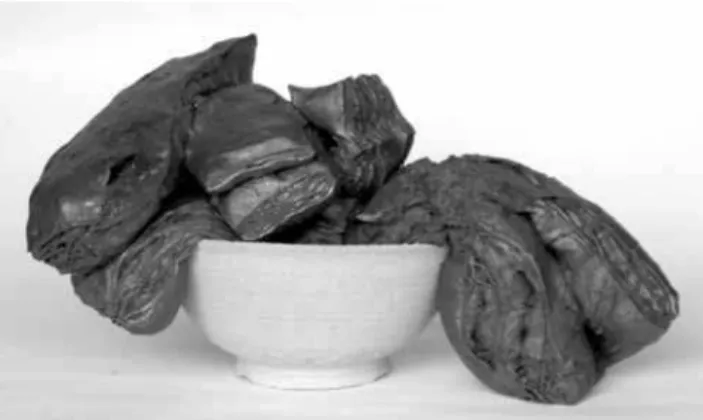
In fact the pyroplastic process to which the black slate is submitted is similar to the ordinary ceramic process. If properly fi red the black slate initial volume can expand four times, becoming transformed into a new and distinct material in terms of composition (mineral and chemical), structure and color (Fig. 1).
The behavior of black slate pyro-expansion is expressed itself in a language that tells us its own identity and narrative
Pyro-expanded black slate in sculptural art
(Ardósia piroexpandida em arte escultórica)
J. C. e Costa1, T. Almeida2, C. S. F. Gomes3
1PhD student in the Faculty of fi ne arts of the University of Porto (FBAUP) and researcher at the i2ADS (Institute for Research in Art, Design and Society), 4000 - Porto, Portugal
2Lecturer in FBAUP and researcher of the VICARTE (Research Unit for the Glass and Ceramics Arts) FCT\UNL, Campus Universitário da Caparica, Caparica, Portugal 2829-516
3Full Professor (retired) and researcher of the Research Unit GeoBioTec of FCT (Foundation for Science and Technology), University of Aveiro, Aveiro, Portugal 3810-193
Abstract
Black slate transformed through a pyroplastic process named pyro-expansion or exfoliation has been explored in the present work in order to be used as sculptural material. Black slate is a highly fi ssile, fi ne grained and organic matter rich rock that is the product of the action of low-grade regional metamorphism on black shale (a sedimentary clay and organic matter rich, also fi ssile and fi ne grained rock). Black slate if fi red at an adequate fi ring rate up to the temperature range 1000 ºC-1240 ºC shows great potential for the manufacture of sculptural pieces. The technical possibilities of the shaping or conformation of pyro-expanded black slate have also been studied, including the reactions that take place when two different black slate pieces are closely associated with each other, or when black slate pieces are closely associated to other materials, such as metals and ceramics. These interactions, while associating different materials that react with each other, emphasize the unique characteristics of new sculptural compositions increasing the plastic capacities of the pyro-expanded black slate. Some examples of the associations referred to will be shown, which highlight the close functional relationship between art and science; research involves the approach to new techniques and materials, looking at the development of unique plastic confi gurations.
Keywords: black slate, pyroplastic expansion, exfoliation, sculptural art, geology, ceramics.
Resumo
No presente artigo são divulgados os resultados da investigação do comportamento para fi ns escultóricos da ardósia (rocha de cor
negra, granularidade fi na e clivagem fi na que resulta da acção de metamorfi smo regional de baixo grau sobre rocha sedimentar,
argilito laminado rico em matéria orgânica) transformada piroplasticamente. O material resultante é denominado ardósia
piro-expandida ou exfoliada, depois da ardósia natural ser tratada termicamente a temperaturas até 1000 °C-1240 ºC. A investigação
subjacente fez uso e desenvolveu conhecimentos do domínio da geologia, mais especifi camente dos materiais geológicos,
aplicando-os à escultura e procurando responder aaplicando-os objectivaplicando-os e requisitaplicando-os desta arte. São divulgadas, também, as paplicando-ossibilidades técnicas de conformação dependentes das interacções que acontecem no decorrer do processo piroplástico, quer entre diferentes elementos de ardósia, quer entre elementos de ardósia e elementos de metal ou, ainda, entre elementos de ardósia e elementos de cerâmica. Estas interacções, ao associarem elementos distintos, naturalmente com respostas térmicas distintas, condicionam a conformação conjunta do sistema selecionado e enfatizam a singularidade da composição escultórica resultante, alargando consideravelmente as capacidades plásticas (no sentido artístico) da ardósia. São apresentados alguns exemplos destas composições escultóricas que
evidenciam a relação científi ca e funcional entre arte e ciência.
in an objective and explicit way, and with an intense expressiveness that surprises ourselves.
Pyro-expanded black slate as an industrial material is basically considered to belong to the category of light aggregates, materials used in the production of light concrete structures, category into which pyro-expanded materials, such as clay, clay shale, vermiculite, perlite and others are classifi ed. These materials are also used as soil composing elements in gardens, fi lling materials in building construction, thermal and acoustic insulation materials, and as water fi ltering materials.
Research knowledge and development of light aggregates manufacture begun in 1908 and was patented in the US, in 1918. Their pyroplastic transformation takes place in rotative kilns at temperatures above 1000 ºC [1]. Besides the specifi c characteristics of pyro-expanded black slate which allow for different applications, we highlight its expressive potentialities and hold it as a material with good qualities for sculpture work. The use of this material in sculpture has been very incipient up to the present, and we do not know any written record describing the specifi c technical procedures of the respective pyroplastic process. This paper and the research we are carrying out responds to the absence of the information referred to. In fact this paper describes the way black slate behaves when fi red to temperatures up to 1000 ºC-1240 ºC. It also describes different technical possibilities of pyro-expanded black slate shaping or conformation taking advantage of the interactions of the association of different black slate elements and of the association of black
slate elements with ceramics or metal elements.
MATERIALS AND METHODS
Black slate is a rock that results from the action of regional metamorphism of low-grade, and is characterized by fi ne granularity, fi ne lamination, low density, soft touch, and black or dark gray color. The starting geological material is a laminated clay or shale rich in organic matter and in clay minerals (fi ne grained hydrous phyllosilicates). These phyllosilicates are responsible by the original fi ne lamination that persists and is enhanced after pyro-expansion.
The main chemical components of black slates are currently determined using XRF (X-ray Fluorescence): SiO2 (52%-60%), Al2O3 (20%-25%) and Fe2O3 + FeO (6%-10%). FeO content corresponding to iron in the reduced form Fe2+ is dominant relatively to Fe2O3 content, corresponding to iron in the oxidize form Fe3+. Carbon (C) and sulfur (S) are also signifi cant components of the black slates. The black slate being investigated was supplied by an enterprise involved in quarrying and processing works of black slate, and whose activities are located in Campo, Valongo (northwest Portugal). The average chemical composition of Valongo black slate being used in the experiences we had carried out are disclosed in the present paper as follows: SiO2-53.3%, Al2O3-24.03%, Fe2O3 + FeO-8.79%, K2O-3.06, MgO-2.08%. Small quantities of other elements are also present. Also it contains 4.47 % (in weight) of carbon and 5.12% of L.I. (loss on ignition), the last value corresponding to the gaseous evolution of volatile constituents, water vapor, CO2 and SO3 [2].
The aforementioned investigation was carried out at the Fine Arts Faculty of the Universidade do Porto having sculpture design and production as its main goal and scope. The Faculty has several electric kilns with digital thermostats to fi re and produce ceramic pieces; therefore, the results of the fi ring process are the simple cross control of the indicated temperatures with the physical/sensorial record. The lack of scientifi c experience is compensated by the pertinence in what sculptural accomplishment is concerned.
Black slate thermal expansion is the result of gases formation - CO2, SO3 and H2O - accumulated in gas pockets, gases which are derived from the decomposition of organic matter, hydrous fi ne grained phyllosilicates (clay minerals, such as illite, kaolinite, chlorite, here referred by decreasing content), and chloritoids, muscovite, pyrite, gypsum, calcite, dolomite, goethite and hematite. Some of the evolved gases could become sealed inside the inorganic mass constituting the fi red black slate piece [3]. Iron oxidation itself, from Fe2+ to Fe3+, during the ceramic process, contributes although in less degree, for the thermal expansion. The fundamental reactions that promote black slate expansion take place within the temperature range 400 ºC-800 ºC, and essentially consist of the aforementioned evolved gases; from 800 ºC onwards the vitrifi cation phase is initiated and progressively developed, resulting in the formation of an essentially alkaline alumino-silicate glass that provides gas retention in Figure 1: Black slate piece at room temperature (A) with dimensions
21 cm x 13.5 cm x 3 cm and after pyroplastic expansion up to 1200 °C (B) with dimensions 22 cm x 13.5 cm x 12 cm.
[Figura 1: Peça de ardósia preta na temperatura ambiente (A) com dimensões 21 cm x 13,5 cm x 3 cm e após a expansão pyroplástica
the most internal parts of black slate pieces [4]. Despite gases liberation taking place at temperatures less than 800 ºC, black slate expansion increases up to 1050 ºC-1150 ºC, being the highest when temperature reaches the maximum temperature value. As far as temperature increases and provides gases dilatation, this gas phase presses the glassy material that acquires and develops plasticity and elasticity. Gases can migrate up to the external surfaces of the pyro-expanded black slate pieces and escape to the kiln atmosphere. The created porous structures can be observed at the microscope. Fig. 2 shows one scanning electron micrograph of pyro-expanded black slate from Valongo fi red at 1180 ºC. SEM studies were carried out at the Laboratory of Electron Microscopy, in the Department of Materials Science of the University of Aveiro, using one Hitachi equipment, model S4100 and micro-analyzed by Energy Dispersive Spectroscopy (EDS).
Black slate submission to procedures proper of the ceramics fi ring facilitates the integration of expanded and exfoliated black slate within the practices of artistic ceramics. In fact, the investigation being carried out took
into account the current practices of the ceramic process, that is, the black slate was submitted to the heating conditions proper of ceramic fi ring in electric kilns.
In the adopted fi ring cycle, the thermal gradient was 100 ºC/h up to the temperature of 300 ºC being reached; afterwards the thermal gradient was increased on a constant rate till the maximum fi ring temperature being attained, and soaking took place during 10 min. Temperature increase from 300 ºC up to 1000 ºC did last about 3 h, and from 1000 ºC to 1240 ºC did last 2 h (Fig. 3).
RESULTS AND DISCUSSION
Two of the most signifi cant factors involved in the process of black slate pyro-expansion have been studied: 1) the temperature at which the slate is submitted, named slate free pyroplastic expansion; 2) the constraints caused by both interactions between different elements of slate and between these elements and ceramic or metal elements, named slate constrained pyroplastic expansion.
Free pyroplastic expansion
Black slate behavior when subjected to high temperatures exposes some variation, because the slate does not always have the same composition or a quite similar structure and, however, there is a strong degree of proximity of results.
When black slate is submitted to temperatures over 1050 ºC expansion takes place, and the overlapping fi ne structural blades proper of this type of rock, become separated from each other, but without being individualized (Fig. 4). Black slate expansion takes place and increases as far as the individual blades of the original piece get far off, that is, assuming an initial parallelepiped shape, the opposed faces parallel to lamination, and apparently constituted by one thick blade alone, will not exhibit signifi cant changes of area during fi ring, whereas the four other faces perpendicular to lamination, showing the fi ne slate lamination, increase in area up to four times, approximately.
After fi ring at 1000 ºC, the color of the black slate changes from black to rose and rusty-red, but the fi red
Figure 4: Black slate fi red up to 1050 °C; dimensions 25 cm x 21 cm x 3 cm.
[Figura 4: Ardósia preta submetida a 1050 °C; dimensões 25 cm
x 21 cm x 3 cm.]
Figure 2: Scanning electron microscopy micrograph of a fracture surface of the Valongo black slate fi red at 1180 ºC.
[Figura 2: Micrografi a de microscopia eletrônica de varredura de
uma superfície de fratura de ardósia preta de Valongo submetida a 1180 ºC.]
Figure 3: Heating curve of the adopted fi ring cycle.
[Figura 3: Curva de aquecimento do ciclo de cozedura adotado.]
1400
1200 1000 800
600 400
200 0
0
Time (h)
T
emperature (ºC)
piece keeps its shape. At 1080 ºC the black slate piece can expand 100% or even more depending upon how the black slate piece is positioned inside the kiln, since in case the black slate piece lies down on a face perpendicular to the lamination, expansion amplitude is higher than when the piece lies down on a face parallel to the lamination.
After firing, the black slate piece approximately maintains the initial shape. For instance, if the initial shape is parallelepiped the shape is more or less maintained, in spite of the thickness increase proportional to dilatation. Increasing the fi ring temperature the black slate piece becomes darker and maintains the rusty-red color, but gains in gloss and shows a silky sheen due to the parallel orientation of the very fi ne grained philosilicates minerals. On the external faces pimples are developed making the texture of these surfaces looking like the bark of some trees (Fig. 5). The internal structure of the piece persists but the overlapping blades lose their original perfect connection, whereas their hardness and mechanical resistance increase. The relationship between volume and weight is proportional to dilatation, the original material changes to a less dense and light material.
At 1150 ºC the piece shape initiates a radical transformation expressed by bending. The piece texture looking like the bark of a tree gets thinner and dense and the shape of the fi nal product is quite different from the original shape. Also, in terms of internal structure made of overlapped blades, it changes to a spongy structure that is observed from 1130 ºC on, although keeping mainly a vestigial skin of the precedent structure. The surface of this skin shows a more uniform gloss reminding the gloss of the leather, and its relief is accentuated. This skin shows ragged areas with peepholes through which peeps and overfl ows the characteristic spongy interior (Fig. 6). The most internal zone of this spongy structure exhibits black color, and as far as it gets close to the surface changes to grey, and to light red very close to the surface. These color changes indicate either the easy access or diffi cult access of oxygen during fi ring.
The black slate did lose some hardness and mechanical
resistance becoming fragile and brittle, but acquires a very expressive telluric character, refl ecting the intensity and impetuosity of the ceramic fi ring process (Fig. 6). Slate has changed into a lighter material than when it was fi red at 1100 ºC. At 1150 ºC the pieces of pyro-expanded black slate, in case they are put in contact, become bond to each other, and they could weld to iron or ceramic elements or objects. Hence, when black slate pieces are placed inside the kiln it is important to separate or isolate the bases of black slate pieces from the kiln fl oor. If fi red at 1150 ºC or at higher temperatures, black slate changes into a material easy to saw.
Fired at 1240 ºC the proper structure of the slate blades starts to split and their skin is ripped apart showing the sandy and porous texture of its internal fully spongy mass. The shape change that takes place is still more radical and unforeseen (Fig. 7), but the black slate recovers hardness and mechanical resistance.
Figure 5: Black slate fi red up to 1100 °C; dimensions 16 cm x 7 cm x 8.5 cm.
[Figura 5: Ardósia preta submetida a 1100 °C; dimensões 16 cm
x 7 cm x 8,5 cm.]
Figure 6: Black slate fi red up to 1150 °C; dimensions 26.5 cm x 21 cm x 11 cm.
[Figura 6: Ardósia preta submetida a 1150 °C; dimensões 26,5 cm
x 21 cm x 11 cm.]
Figure 7: Black slate fi red up to 1240 °C; dimensions 12 cm x 10 cm x 8.5 cm.
[Figura 7: Ardósia preta submetida a 1240 °C; dimensões 12 cm
Comparing the obtained results with the results obtained after fi ring at 1150 ºC, volumes are approximately the same, that is, maximum dilatation essentially happens at 1150 ºC or even at slightly lower temperature. Also, the relationship between volume and weight do not substantially changes in the temperature range 1150 ºC-1240 ºC. If different black slate pieces being in contact are fi red at 1240 ºC, due to vitrifi cation they become fi rmly welded to each other or to metal or ceramic pieces.
The initial compact volume of the black slate piece is progressively lost, becoming expanded and opening up its interior; it will be diffi cult to recognize the initial piece aspect, volume and shape.
Black slate expansion amplitude is primarily correlated with the fi ring maximum temperature as well as with the dimension of the tested pieces. Factors such as mass and weight (this factor depends on piece positioning) infl uence expansion amplitude. The effects of both temperature factor and dimension factor require further and thorough investigation in order to be better understood.
Constrained pyroplastic expansion
Expansion during fi ring allows black slate elements to interact between themselves, in terms of shaping process; this may happen in two different ways - assemblies (1) and mortises (2).
(1) Assemblies are based on the fact that black slate pieces stick together, in case they are in contact during fi ring; they stick more strongly if the contact is strengthened by some kind of pressure, such as the weight of an element on the other. Black slate pieces can expand and stick together in just one fi ring (Fig. 8) or they can be expanded previously, and later submitted to a second fi ring for pieces assemblage. This latter option allows composing in a more safe way, since the second fi re doesn’t imply a
radical change in volume or shape.
The assemblies can integrate elements of other materials showing good refractory characteristics, such as ceramics or metals that could become bonded to the pyro-expanded black slate when brought into contact with it.
(2) – The mortises of a black slate piece in another one are carried out by cutting an entrance in one piece or in both pieces; the cut width must be related to the thickness of the piece to be incased; in mortises adjacent areas, expansion is mutually constrained, providing rich expressiveness (Fig. 9).
In what the participation of ceramics elements is concerned, three types of relations between pyro-expanded black slate elements and ceramic elements have been explored; ceramic elements with the function of molding the shape of pyro-expanded black slate elements (3); black slate elements incased in ceramic containers and expanded afterwards (4); and black slate elements stuck into ceramics elements and then expanded (5).
(3) - At 1150 ºC black slate has already attained its maximum expansion acquiring the shape of its supporting surface, and ceramic molds covered with a separator can be used in pyro-expanded slate shaping process.
(4) - A black slate piece partially placed inside a ceramics container having its expansion partially limited by both size and available internal space of the ceramic container space; since part of the black slate piece stays out of the container it fully expands, and most probably falls and folds down; in this situation both ceramic container and black slate pieces stick together (Fig. 10).
(5) - If black slate pieces are stuck to a ceramic wet body, in case this is moist enough to present some degree of plasticity, the incased parts hardly expand, but again the outer parts freely expand; the ceramic body must be thick enough to support the pressure exerted by the slate during the pyro-expansion process.
With regard to the participation of iron elements, the relation that pyro-expanded black slate elements and iron Figure 8: Pyro-expanded black slate fi red up to 1160 ºC; dimensions
19 cm x 15 cm x 15 cm.
[Figura 8: Ardósia preta piro-expandida a 1160 ºC; dimensões 19 cm x 15 cm x 15 cm.]
Figure 9: Pyro-expanded black slate fi red up to 1200 ºC; dimensions 36 cm x 23 cm x 15 cm.
elements fi red together establish between themselves is marked by the type of iron element that is used; two types of relations between iron and pyro-expanded black slate elements are presented: screws with the respective nuts (6), and wire (7).
(6) - The screw and the respective nut condition and limit the expansion of black slate elements, providing an effect similar to “button that presses the center of the cushion”.
(7) - A wire piece, 2.5 mm thick, placed all around the parallelepiped black slate, provides a “belting” effect (Fig. 11); black slate expansion has pressed and strained the iron wire, confi guring in this case a mutual shaping.
The possibilities of interactions presented here are a not exhaustive survey of elementary solutions that combined make possible an increasing complexity and sophistication of the pyro-expanded slate sculptural work.
CONCLUSIONS
The pyro-expanded black slate provides evidence of both original structure and geologic formation, and shows its migrating identity, since a natural stone has changed into a ceramic material. Its acquired structure gets close to the structure exhibited by some pyroclastic volcanic rocks, as pumice, that bear gas pockets, fact that confers to them
fl oating capacity in water. The technical process involved in black slate pyroplastic exfoliation, the refractoriness being acquired, and its chemical composition indicate that the pyro-expanded slate is a ceramic material. The existence of iron is fundamental for the transformation process, since it condition black slate fusion temperature, diminishing it, and causing the metallic aspect exhibited by their surfaces. Pyro-expanded black slate clarifi es in a surprisingly way the relationships between stone, ceramics and iron, in natural context. The confi guration of the sculptural products based on pyro-expanded black slate depends upon the following factors: 1. experience and artistic sensibility of the sculptor; 2. mineralogical and chemical specifi cities; 3. lamination degree (fi ne or coarse) specifi cities; 4. thermal process specifi cities (maximum fi ring temperature, fi ring rhythm, and more or less oxidizing fi ring atmosphere); 5. initial confi guration of black slate pieces; 6. in composite pieces (for instance, black slate-metal, black slate-ceramics) the associated metal or ceramic pieces could locally constraint black slate expansibility. Finally the aspect of both external and internal surfaces of the sculptural products based on pyro-expanded black slate, which is expressed by varied red dyes and by more or less silky textures, depends upon the specifi cities of the initial black slate and upon the specifi cities of the thermal treatment. The research and work being carried out shows that the pyro-expanded black slate is a geomaterial characterized for its sculptoric vocation, due to its capability and expressive richness, identifi able with its telluric and unforseen nature, violent, savage, and primeval. The uncertainity of its fi nal conformation do not recommends black slate as design material for precisely shaped goods; however, it can be used as raw material for the manufacture of objects not requiring a precise shape, otherwise a strong expression according to the characteristics of the exfoliated or pyro-expanded black slate. One of the emerging trends in the panorama of contemporary art is the notorious increment verifi ed in the relationship between art and science; more and more art works are based on scientifi c information and processes [5-7], the herewith disclosed research being a good example of such.
REFERENCES
[1] http://www.escsi.org/uploadedFiles/Technical_Docs/ General_Information/7600.1%20Lightweight%20Ag, in http://www.escsi.org, (site of Expanded shale, clay and slate Institute), consulted on 10/10/2010, p. 5.
[2] L. M. G Catarino, “Xistos ardosíferos - caracterização e recuperação de desperdícios”, Tese Dr., Faculdade Figure 10: Assemblage of ceramic and pyro-expanded black slate
fi red up to 1240 ºC; dimensions 14.5 cm x 16 cm x 18 cm.
[Figura 10: Montagem de cerâmica e ardósia preta piro-expandida a 1240 ºC; dimensões 14,5 cm x 16 cm x 18 cm.]
Figure 11: Assemblage of iron wire and pyro-expanded black slate
fi red up to 1220 ºC; dimensions 14 cm x 12 cm x 9 cm.
de Ciências e Tecnologia da Universidade de Coimbra, Coimbra, Portugal (1999) p 69.
[3] C. S. F. Gomes, Argilas Aplicações na Indústria, Ed. Universidade de Aveiro, Aveiro, Portugal (2002) p 214. [4] A. C. Moura, J. Grade, “Contribuição para o estudo de xistos ardosíferos de Valongo”, in Estudos, Notas e Trabalhos S. F. M., XXIII, 3-4 (1977) p 257.
[5] S. Wilson, “Information arts - Intersections of art,
science and technology”, Ed. The MIT Press, Cambridge - Mass, USA (2002) p. 3.
[6] S. Ede, “Art & Science”, Ed. I. B.Taurus, Great Britain (2005) p. 2.
[7] J. F. Laiglesia, J. Loeck, M. R. Caeiro, La cultura transversal - Colaboraciones entre arte, ciencia e tecnologia; Ed. Universidade de Vigo, Vigo, Spain (2010).