*e-mail: [email protected]
A X-ray Study of β-Phase and Molecular Orientation in Nucleated
and Non-Nucleated Injection Molded Polypropylene Resins
Marcia Maria Favaro, Marcia Cristina Branciforti, Rosario Elida Suman Bretas*
Department of Materials Engineering, Federal University of São Carlos – UFSCar,
Rod. Washington Luís, Km 235, 13565-905 São Carlos - SP, Brazil
Received: June 9, 2009; Revised: October 8, 2009
The development of α and β-phases and the molecular orientation of injection molded disks of two isotactic polypropylene (i-PP) resins were studied by wide angle X-ray diffraction (WAXD) and pole igures. A nucleated (NPP) and non-nucleated (HPP) polymers were analyzed. The main proposal of this article was the comprehensive study of the interrelations between the processing conditions, phase contents and PP α-phase molecular orientation of injection molded PP resins. In both resins, it was observed that the α-phase was present in all regions along the thickness while the β-phase was present mainly in the external layers, decreasing from the surface to the core; however this last phase was present in a very small amount in the NPP resin. For both polymers, the orientation of the macromolecules c-axis was higher along the low direction (RD) than along the transverse direction (TD). The b-axis of the PP α-phase molecules was oriented to the thickness direction (ND). The orientation of the c-axis along RD and b-axis along ND of the NPP samples was considerably higher than of the HPP samples, due to the NPP faster crystallization kinetics. For both polymers, the most inluential processing parameters on the molecular orientation were the mold temperature and low rate. The results indicate that, as the mold temperature increased, the characteristic molecular orientation of PP α-phase, with c-axis along RD and b-axis along ND, decreased. With increase in the low rate an increase of the c-axis molecular orientation of the samples along RD was observed.
Keywords: X-ray pole figures, molecular orientation, injection molding, polypropylene, β-PP
1. Introduction
During injection molding, polymer crystallization occurs mainly under shear and elongation rates, but also under quiescent conditions, depending on the low characteristics. Thus, the developed morphol-ogy relects these low patterns, and usually is composed of differ-ent and characteristic layers along the thickness of the sample1-9. In
the case of semi crystalline thermoplastics with fast crystallization kinetics, this morphology is known as “skin-core” and is formed by three main zones4-6,10-16:
• Skin:Composedofafrozenlayer(developedwhenthemolten
polymer reaches the mold walls) and a low induced layer (de-veloped during the illing stage as a consequence of the super-cooling promoted by the frozen layer). In the low induced layer, the lamellas grow perpendicular to the direction of the illing, with the thickness of the layer being controlled by the cooling rate and tensions imposed to the molten polymer;
• Transitionzone:Alayersituatedbetweentheskinandthecore.
In this zone an increasing quantity of orientation caused by the shear rates is observed, which produces deformed spherulites in the low direction; and
• Core:Thecenterlayer.Amaximumvelocityisdevelopedat
the center, therefore the shear rates will be zero or very low and the core will present the typical morphology of quiescent conditions.
In the case of i-PP, it is known that when it crystallizes under quiescent conditions three different crystalline structures (α, β and γ) will develop. However, in the presence of low, it is observed12
that the i-PP chains orient, creating ibrillar nucleus. It has also be shown1 that the quantity of β phase in i-PP samples processed in a
slit die decrease with the decreasing of the shear rate imposed during the crystallization process;
In the literature17-21 was revealed the promising mechanical
prop-erties of β-form in i-PP articles and it was also exposed that when special crystallization procedures are used or, in particular, speciic nucleators as N,N’-dicyclohexylnaphthalene-2,6-dicarboxamide and sodium benzoate are added, the β-form can become as predominant crystalline form in common i-PP articles. Dong and cowokers17
demonstrated that the sodium benzoate shows apparently versatile nucleating characteristic on the crystallization behavior of i-PP and that this nucleating activity is highly dependent on processing pa-rameters. However, sodium benzoate is less effective than traditional β-nucleating agent on inducing β- crystal form in i-PP;
In injection molded morphologies a gradient of molecular orien-tation along the sample thickness is also observed which is related to the deformation rates and temperature gradients. The maximum orientation value is usually obtained in the transition zone, being almost zero in the center of the molded sample, as a result of the shear rates, which are maximum near the wall and zero in the center. This molecular orientation gradient is responsible for the improved properties in the orientation direction; on the other hand, the properties along the perpendicular direction usually are worse22-25.
The parameters that affect the molecular orientation are: shear and elongation tensions imposed to the molten polymer during their solidiication, processing conditions (injection and mold tempera-tures, packing pressure and low rate, among others) and intrinsic characteristics of the polymer (relaxation time, crystallization ki-netics and chains rigidity, for example22-33). However, the complete
Table 1. Properties of the polypropylene resins.
HPP NPP
Meltlowindex(230°C)(g/10min)(*) 3.5 3.5
Density(23°C)(g/cm3) (*) 0.905 0.905
Weight average molecular weight (MW) (g.mol–1)(*) 425,200 412,900
Molecular weight distribution (*) (M
W/Mn) 8.4 8.7
Melting temperature (Tm)(°C)(**) 171.4 168.9
Crystallizationtemperature(Tc)(°C) (**) 103.8 123.5
*asgivenbythesupplier;**asmeasuredbymodulateddifferentialscanningcalorimetry(modelQ-100fromTAInstruments,40°C/min).
It is well known that polypropylene under extensional or shear low results in samples exhibiting bimodal orientation34. This
distinc-tive bimodal orientation is unique to isotactic polyproplylene and is attributed to the crystallographic branching of “daughter” lamellae growing epitaxially with their a- and c-axes parallel to the c- and a-axes of the “parent” lamellae respectively35,36. Kumaraswamy and
coworkers37 demonstrated that PP crystallites that presents highly
oriented structures, where cross-hatched daughter lamellae appear almost immediately, grows simultaneous and in proportion to its par-ent lamellae. They also demonstrated that the morphology of the skin consists of parent lamellae that radiate out from threads along the low direction consistent with the model of Liedauer and coworkers38.
Thus, in this work the inluence of some injection molding processing conditions on the development of α-and β-phases and on the molecular orientation of two i-PP, one with nucleating agent and the other without, were studied by wide angle X-ray diffraction (WAXD) and pole igures. Therefore, the main proposal of this ar-ticle was the comprehensive study of the interrelations between the processing conditions, phase contents and PP α-phase molecular orientation of injection molded PP resins.
2. Experimental
2.1. Materials
Two i-PP resins, from Braskem®S.A.,Brazil,wereusedinthis
work. The irst resin, named HPP, was a homopolymer without nu-cleating agent. The second resin, named NPP, had sodium benzoate as nucleating agent in the concentration up to the critical concentra-tion at which the β-form content reaches the saturation level19,20,39.
Properties of both resins are shown in Table 1.
2.2. Injection molding
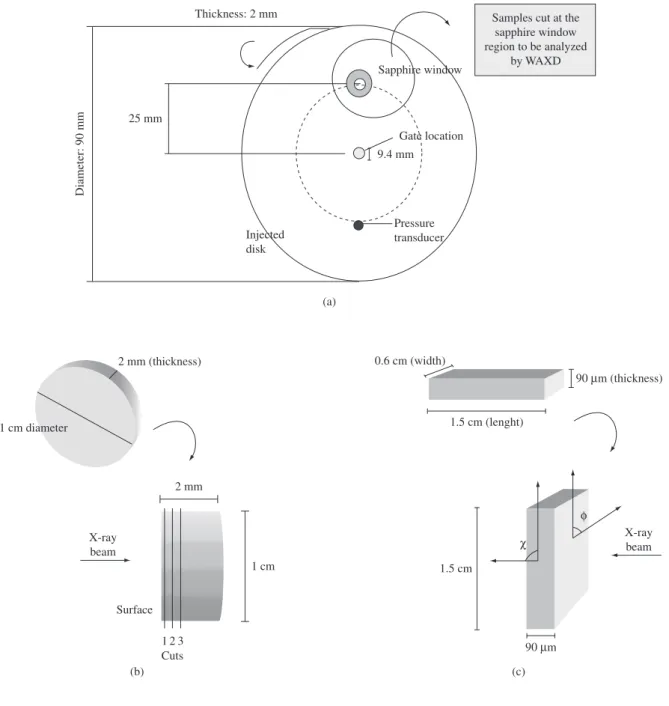
The polymers were injection molded in a machine from Ar-burg Allrounder, model 270 V, with a closing force of 300 kN and screw diameter of 25 mm. The mold was cooled using a unit from HB THERM, model HBW 140. An iron-constantan thermocouple was used to check the mold temperature periodically. The mold
cavity had disk geometry, with diameter of 90 mm and thickness of 2 mm, a sapphire window to optically monitor each injection molded cycle and a pressure transducer, as already described in our previous work40. The polymer was injected through the center of the cavity,
as shown in Figure 1a.
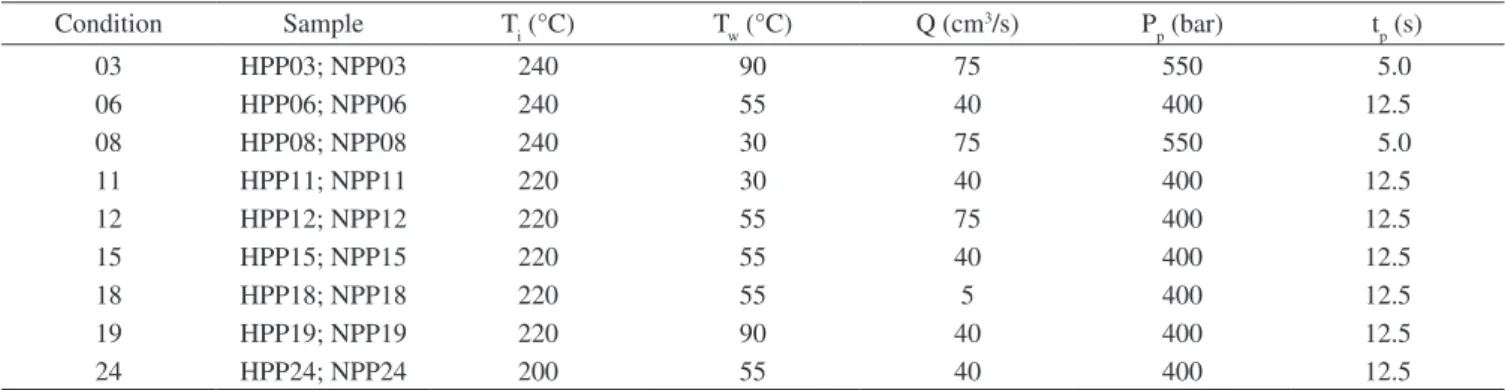
During the injection molding, the following parameters were changed: injection temperature (Ti), mold temperature (TW), injec-tion low rate (Q), packing pressure (Pp) and packing time (tp). The processing window of the polymers was determined after inding a compromise between the polymers properties and the injection mold-ing machine characteristics that guaranteed useful injected articles and reliable optical sensor signals, as already described40. Table 2 shows
the analyzed molding conditions. These analyzed conditions were chosen based on early study40 that shows that the mold temperature
and low rate are the parameters that affected most the kinetics of crystallization of these polymers in this particular disk geometry.
2.3. Crystalline phase analysis
To analyze the type of i-PP phases by WAXD, a disk of 1 cm of diameter and 2 mm of thickness, at the sapphire window region of the injected sample was cut. The WAXD experiments were done
us-ingaSiemens®D5005equipment,withNi-ilteredCuKα radiation,
between5°and50°,atarateof0.05°/3s.Thedisksweremicrotomed
to remove layers of 90, 160 and 240 µm of thickness. After each layer removal, a WAXD run was done on the reminiscent surfaces, designed as 1st, 2nd and 3rd cuts, respectively, as shown in Figure 1b.
All X-ray diffractograms were normalized with respect to sample thickness and incident beam intensity.
In order to known the true layer analyzed by X-ray, the penetration of the X-ray beam was calculated using the following equation41:
I Iinc
e MAC e
=exp− ⋅µ =exp− ρ⋅ (1)
where: I is the transmitted intensity, Iinc is the incident intensity, µ is the polymer absorption coeficient, e is the sample thickness (or
pen-etrationdepth),MACistheweightabsorptioncoeficientandρ is the
polymerdensity.TheparameterMACwascalculatedfromreference
30, and it was found to be 4.001.
2.4. Molecular orientation by WAXD pole figures
To measure the molecular orientation of the i-PP, samples of 15 mm length, 6 mm width and 90 µm thickness were cut at the sapphire window region, as shown in Figure 1c.
The molecular orientation of the samples was evaluated by the spatial distribution of the diffracted intensity of the (110) and (040) crystallographic planes, which relect at 2θ = 14.1 and 16.8°, respectively.
Table 2. Molding conditions.
Condition Sample Ti(°C) Tw(°C) Q (cm3/s) P
p (bar) tp (s)
03 HPP03; NPP03 240 90 75 550 5.0
06 HPP06; NPP06 240 55 40 400 12.5
08 HPP08; NPP08 240 30 75 550 5.0
11 HPP11; NPP11 220 30 40 400 12.5
12 HPP12; NPP12 220 55 75 400 12.5
15 HPP15; NPP15 220 55 40 400 12.5
18 HPP18; NPP18 220 55 5 400 12.5
19 HPP19; NPP19 220 90 40 400 12.5
24 HPP24; NPP24 200 55 40 400 12.5
Table 3. Penetration of the X-ray beam along the thickness.
Thickness of the removed layer (µm)
Depth of X-ray penetration (µm)
Region
0 (surface) 885 A
90 (1st cut) 975 B
160 (2nd cut) 1045 C
The pole igures were obtained using a high-resolution X-ray
diffraction beamline, XRD2, of the Brazilian Synchrotron Light Laboratory(LNLS).Thebeamenergywastunedto8049.9eV.The
incident beam was collimated by a 3 × 1.6 mm diffraction slit coupled with a 0.5 mm slit located just before the detector. Data were obtained using a six-circle diffractometer with a cradle by rotating the sample at scanning angles of 0 ≤φ≤ 360° and tilting the sample between 0° ≤χ≤ 90°; these angles are shown in Figure 1c. An angle step of 5° for φ and χ was used during the measurements. Exposition times
wereadjustedinagreementwithintensities.Correctionbackground,
absorption effects and the connection of both experimental methods were performed by the Polo® 2003 software before plotting the pole
igures.
From the intensities of the (110) and (040) crystalline planes, the macromolecules j-axis orientations along the radial or low direction (RD), the transverse direction (TD) and the normal direction (ND) were calculated; the average square cosine of φj (where φj is the angle between the j-axis and the chosen direction) or <cos2φ
j,RD>,
<cos2φ
j,TD> and <cos 2φ
j,ND> were obtained. Finally, the three
orienta-tion factors (f) were obtained using the following equations:
fj D, =3<cos j D, > −1
2
2ϕ
(2)
fa RD, +fb TD, + fc ND, =1 (3) where: j corresponds to the crystallographic axes (j = a, b or c) and
D is the reference direction (D = RD, TD or ND). f= 1.0 represents parallel orientation along the reference axis; f = –0.5, perpendicular orientation with respect to the reference axis, and f = 0 represents an isotropic sample30,41.
3. Results and Discussions
3.1. Crystalline phase analyses
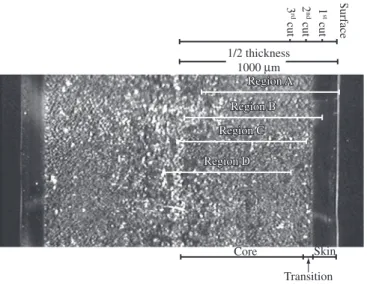
From Equation 1 using 2θ = 16.1° (crystallographic plane of i-PP β phase), the penetration depth was found to be 885 µm. Table 3 shows the calculated depth of X-ray penetration after the removal of each layer while Figure 2 shows the regions of penetration of each WAXD analyses after layer removal.
It can be observed, therefore, that when the irst surface was analyzed the diffractograms were a result of the X-rays interaction with the whole skin and transition zones and part of the core; when the 1st cut was analyzed, the diffractograms were result of the X-rays
interaction with part of the skin zone, the whole transition zone and
part of the core, and so on. Some typical diffractograms of these
surfaces are shown in Figure 3. It can be observed that all samples had α- and β-phases, as expected since the shear and temperature gradients can induce the formation of α-phaseand/orevenβ-phase Figure 2. Regions where the WAXD analyses were done.
Figure 3. Diffractograms along the thickness of samples a) HPP15 and b) NPP15.
Table 4. Diffraction peaks of the i-PP samples25,26
2θ (°) Crystallineplane
(hkl)
i-PP phase
14.1 (110) α
16.1 (300) β
16.8 (040) α
18.5 (130) α
21.2 (111) α
21.8 (301) β
during the molding process. However, it is well known that the α-phase is a dominant crystalline modiication42. The characteristics
diffraction peaks for these phases are shown in Table 4. The α- and β-phases could become dominant when some special agents (as α- or β-nucleants) are added, in our case should be emphasized that the sodium benzoate nucleating agent present in the used NPP resin, is a conventional α-form nucleator and can also induce β-form iPP under certain conditions, been than less effective17.Crystallization
in a temperature gradient or in sheared or strained melt encourages the development of the β-phase in commercial iPP42.
The amount of each phase along the thickness of the injected samples was analyzed using three diffraction peaks [(110) and (040) planes for the α-phase and (300) plane for the β-phase]. The α-phase planes were chosen because they were the most intense, while the β-phase plane was chosen because they was the only plane of pure the β-phase that appeared in the studied 2θ range. The (301) β-peak is overlapped with (111) α- peak, these relections appearing at angle 2θ = 21.3 and 21.8o respectively, so close. It should be emphasized
that WAXD proiles are known to be affected by crystal orientation. In general, if the a-, b- or c-axes of the crystals are aligned perpen-dicular to the surface of the injected sample, the relection intensity of the (h00), (0k0) or (00l) planes are strong in the diffraction when the X-ray beam is parallel to the low direction.
From Figure 3, it can be observed that the intensity of the (300) plane (β-phase) decreased signiicantly from the surface to the core (3rd cut) of the samples for both materials. On the other hand, the
peaks corresponding to the α-phase remained constant along the thickness of the samples.
The same behavior was observed at all injection molding condi-tions for both materials, as shown in Figure 4; that is, the α-phase was present in all layers of the injected samples, while the β-phase decreased from the surface to the core. The formation of the β-phase, among other factors, is dependent of the shear level imposed to the polymer during the injection molding; it is known1,22 that its amount
decreases with the decrease in shear rate, as conirmed by our re-sults. Table 5 shows the measured intensities of the (300) peak at all studied conditions.
It is also observed that in the HPP the amount of β-phase was higher than in the NPP, which is probably related to the NPPs crys-tallization kinetics. NPP has a faster cryscrys-tallization than the HPP; therefore, the crystallization and solidiication of the layers in the NPP occurred quicker than in the HPP which made the NPP macro-molecules to be submitted to shear rates for shorter periods of time than the HPP macromolecules.
Another conirmation of the observation that the formation of the β-phase is triggered by the level and duration of the shear rate can be obtained if the mold temperature is changed42; for example,
if conditions 11, 15 and 19 are analyzed, it can be observed that the amount of β-phase at the surface increases with the increase in mold temperature. At the mold walls, as the mold temperature increases, the crystallization or solidiication time also increases; therefore, the macromolecules chains will be sheared during longer times as the mold temperature increases and higher amounts of β-phase will be formed. On the other hand, at the core, because the shear rates are zero, no β-phase will be produced, independent of the mold temperature. The low β-phase at the core region in the NPP samples is probably due to the nucleating agent effect.
3.2. Molecular orientation by pole figures
Analyzing all the diffractograms, it was also observed that in this study two processing parameters which most inluence the molecular orientation were the mold temperature (TW) and the injection low rate (Q). In other words, crystallization temperature and shear rate are most inluential parameters on molecular orientation. Many stud-ies have been extended to other aspects such chain length (which is related to the relaxation time), entanglements, and interfacial stress. In this work, in order to investigate the inluence of TW and Q on the orientation of the HPP and NPP samples, the molecular orientation of samples injected at conditions 03, 08, 12, 15 and 18 was evaluated. To shorten the amount of experimental work, measurements were done only on the sample surface (skin layer). Details about the inluence of processing parameters on the level of molecular orientation along the samples thickness of injection molded PP has already been discussed in the literature24,34,43,44.
The pole igures were plotted in a bi-dimensional (2D) projec-tion with the RD and TD in the plane and the ND perpendicular to
theRD/TDplane.Thepoledensitieswereindicatedinsidethepole
igures near the isolines. Figure 5 shows the obtained WAXD pole igures of the (110) and (040) relections of the α-phase of all non-nucleated samples. The results of the non-nucleated samples are shown in Figure 6. By comparison between Figure 5 and Figure 6 it can be seen that the pole igures for all samples have similar shape, but with different pole density.
In all samples there is a strong characteristic of the c-axis parallel to RD and the b-axis perpendicular to RD. In the (110) plane pole igures, two maxima are observed. One indicates that a major fraction of the
(110)planeshasitsnormalparalleltotheND/TDplane,thatis,perpen -dicular to the low direction, which corresponds to a c-axis orientation in the low direction. The other maximum indicates that a signiicant amount (but minor fraction) of (110) planes has its normal parallel to the low direction which corresponds to named a*-axis orientation in the low direction2,36,37. In this case, the a*-axis is oriented parallel to
theRDandthec-axisispreferentiallyorientedintheRD/TDplane.
Table 5. Intensity of the (300) peak of all the studied conditions.
Intensity of the (300) peak at the surface (cps)
Condition 06 11 12 15 18 19 24
HPP 626.27 401.79 543.43 399.58 432.45 979.16 461.03
NPP 641.21 110.27 302.98 100.00 96.49 184.73 357.62
Intensity of the (300) peak at 3rd cut (cps)
Condition 06 11 12 15 18 19 24
HPP 193.71 0 154.49 112.54 0 0 80.08
Figure 5. 2D projection of the WAXD pole igures for the (040) and (110) planes of the (a) HPP03 (b) HPP08 (c) HPP12 (d) HPP15 (e) HPP18 samples.
However, from the pole densities it is possible to observe that the c-axis orientation of the lamellae is higher in the low direction than in the a*-axis orientation. This speciic bimodal crystalline orientation has been discussed in the literature31,32,44. Mendoza and coworkers24 described that
the two components (a*-axis component and c-axis component) have a large orientation distribution, the a*-axis lamellae could nucleate locally on the c-axis lamellae which have the same crystallographic b-axis.
The molecular orientation factors of the i-PP b- and c-axis were calculated along all three directions (RD, TD and ND) from the pole
igures and are shown in Table 6. The orientation of the crystalline phase was moderate for all samples. Regarding the inluence of some processing parameter, it can be observed that:
3.2.1. Influence of the polymer
⋅ε45. Therefore, we will focus mainly on the elongational
deforma-tion acting on the disk, as shown in Figure 7. If it is assumed that
Vz=0 (which will make fC,ND≈ 0),then the elongation rates acting on the macromolecules will only be ⋅εrr and ⋅εθθ. ⋅εrr ≠0, because Vrwill change with r (the low area perpendicular to r is increasing with r
and consequently Vr is decreasing with r) while ⋅εθθ ≠0 due to the accelerating “fountain low”. Both rates can be calculated from:
εrr r
V r
=2∆
∆ or εθθ=2 θθ ∆
∆
V
;
from this geometry it can be observed that ∆Vr > ∆Vθand ⋅εrr >⋅εθθ ,thus the orientation along RD ≡r will be higher than along TD ≡θ, as observed.
The orientation of the c-axis along RD and b-axis along ND of the NPP samples was considerably higher than of the HPP samples; the NPP due to its faster crystallization kinetics and consequently its faster solidiication; this solidiication will cause a decrease in the low area perpendicular to r and consequently an increase in the velocity and an increase in orientation levels.
3.2.2. Influence of mold temperature
It can be observed that, in general, as the mold temperature increased, the characteristic molecular orientation of PP, with c-axis along RD and b-axis along ND, decreased. With the increase of mold temperature, the difference between injection and mold temperature decreased, the cooling was slower and the macromolecules relaxed faster, which resulted in low orientation degree.
3.2.3. Influence of the injection flow rate
With the increase of the injection low rate, an increase of the c-axis molecular orientation of the samples along RD was observed. There was also an increase of the b-axis orientation along ND with the increase in low rate. As the low rate increased, the low veloci-ties increased increasing the distinctive molecular orientation of PP. These results agree with earlier results22.
4. Conclusions
WAXD analyses and WAXD pole igures of injection molded disks of two i-PP resins, HPP and NPP, as a function of different processing conditions showed that:
• Inbothresins,independentlyoftheinjectionmoldingcondi -tions, the α-phase was present in all regions along the thick-ness. On the other hand, the amount of β-phase was high in the HPP resin at all molding conditions but low in the NPP resin; this phase decreased along the thickness, decreasing with the decrease in shear rate. Therefore, the formation of the β-phase is triggered by the level and duration of the shear rate;
• For both polymers, the orientation of the macromolecules
c-axis was higher along RD than along TD. The b-axis was oriented to the thickness direction, ND. The orientation of the c-axis along RD and b-axis along ND of the NPP samples was considerably higher than of the HPP samples, due to the NPP faster crystallization kinetics; and
• For both polymers, the most inluential processing param -eters on the molecular orientation were the mold temperature and low rate; it was observed that, as the mold temperature increased, the characteristic molecular orientation of PP de-creased, due to the decrease of the cooling rate and the increase of the macromolecules relaxation process, and as the injection low rate increased, an increase of the distinctive orientation of PP was observed due to the increase of the low velocities. Table 6. Calculatedmolecularorientationfactorsoftheb-andc-axesalongtheradial(RD),transverse(TD)andnormal(ND)directions.
Condition f c, RD f c, TD f c, ND f b, RD f b, TD f b, ND
HPP NPP HPP NPP HPP NPP HPP NPP HPP NPP HPP NPP
03 0.34 0.41 0.08 0.04 –0.45 –0.45 –0.28 –0.32 0.02 0.02 0.27 0.30
08 0.34 0.40 0.01 0.05 –0.35 –0.45 –0.23 –0.29 0.01 –0.01 0.22 0.30
12 0.35 0.43 0.07 0.07 –0.42 –0.50 –0.10 –0.32 –0.06 –0.01 0.15 0.33
15 0.35 0.39 0.08 0.05 –0.43 –0.44 –0.09 –0.32 –0.06 0.01 0.16 0.30
18 0.28 0.32 0.07 0.12 –0.36 –0.44 –0.04 –0.28 –0.07 –0.02 0.11 0.30
Figure 7. a)Schemeofthelowalongthethreemaindirections;andb)Com -ponents of the deformation rates, where Vr, Vθ and Vz are the components of the velocity in the r, θ and z directions, respectively.
γ γ θ γ θ θ θ θ θ
rz r z
r r z z V z V r r r V r r V V z r V =∂ ∂ + ∂ ∂ = ∂ ∂ + ∂ ∂ =∂ ∂ + ∂ ∂
( ) 1
1 ε ε ε θ θθ θ rr r zz z r V r V z r V V r = ∂ ∂ = ∂ ∂ = ∂ ∂ + 2 2
Acknowledgements
The authors are grateful to FAPESP for the inancial aid, to BraskemS.A.forthepolymersdonationandtoJ.MariniandM.
K. Bertolino for the help with the drawings. This work was also
supportedbytheLNLSunderproposalD10A-XRD2-4621.Special
thanks are given to Dr. G. Kellerman for the helpful WAXD experi-mental discussions.
References
1. Farah M and Bretas RES. Characterization of i-PP Shear-Induced CrystallizationLayersDevelopedinaSlitDie.Journal of Applied Polymer Science. 2004; 91(6):3528-3541.
2. Pantani R, Coccorullo I, SperanzaV andTitomanlio G. Modeling of morphology evolution in the injection molding process of thermoplastic polymers. Progress in Polymer Science. 2005; 30(12):1185-1222. 3. Pantani R, Coccorullo I, SperanzaV andTitomanlio G. Morphology
evolution during injection molding: Effect of packing pressure. Polymer. 2007; 48(9):2778-2790.
4. Viana JC.Development of the skin layer in injection moulding: phenomenological model. Polymer. 2004; 45(3):993-1005.
5. VianaJC,CunhaAMandBillonN.TheThermomechanicalenvironment and the microestruture of an injection moulded polypropylene copolymer.
Polymer. 2002; 43(15):4185-4196.
6. Favaro MM. Monitoramento da cristalização de resinas de polipropileno duranteamoldagemporinjeção.[DissertaçãodeMestrado].SãoCarlos: UniversidadedeSãoCarlos;2005.
7. Zhu PW and Edward G. Morphological distribution of injection-moulded isotactic polypropylene: a study of synchrotron small angle X-ray scattering. Polymer. 2004; 45(8):2603-2613.
8. Pöstch G and Michaeli W. In injection molding: an introduction. New York: Hanser; 1995.
9. Rosato DV and Rosato DV. In injection molding handbook. New York: Van Nostrand Reinhold; 1986.
10. YuY and White JL. Structure Development in Injection Molding of Isotactic Polyproylene, its Blends, Compounds and Dynamic Vulcanizates. International Polymer Processing. 2003; 18(4):388-397. 11. ChoiDandWhiteJL.ComparisonofStructuredevelopmentinInjection
Molding of Isotactic and Syndiotactic Polypropylenes. Polymer Engineering and Science. 2002; 42(8):1642-1656.
12. VargaJJ.Supermolecularstructureofisotacticpolypropylene.Journal ofMaterials Science. 1992; 27(10):2557-2579.
13. Karger KJ. In polypropylene: an A-Z reference. Dordrecht: Kluwer Academic Publishers; 1998.
14. Kumaraswamy G,Verma RK, Kornfield JA and Hsiao BS. Shear-EnhancedCrystallizationinIsotacticPolypropylene.In-SituSynchrotron SAXSandWAXD. Macromolecules. 2004; 37(24):9005-9017. 15. RajeshH,SomaniLYandHsiaoBS.Effects of high molecular weight
species on shear-induced orientation and crystallization of isotactic polypropylene. Polymer. 2006; 47(15):5657-5668.
16. ScudlaJ,EichhornKJ,RaabM,SchmidtP,JehnichenDandHaussler L. The effect of speciic nucleation on molecular and supermolecular orientation in isotactic polypropylene. Macromolecular Symposia. 2002; 184(1):371-387.
17. DongM,GuoZ,SuZandYuJJ.Studyofthecrystallizationbehaviors of isotactic polypropylene with sodium benzoate as a speciic versatile nucleating agent. Journal of Polymer Science: Part B Polymer Physics. 2008; 46(12):1183-1192.
18. CermakR,ObadalM,PonizilP,PolaskovaM,StoklasaKandLengalova A. Injection-moulded α- and β-polypropylenes:I.Structurevs.processing parameters. European Polymer Journal. 2005; 41(8):1838-1845. 19. ObadalM,CermakR,BaranN,StoklasaKandSimonikJ.ImpactStrength
of β-Nucleated Polypropylene. InternationalPolymer Processing. 2004; 19(1):35-39.
20. ObadalM,CermakR,HabrovaV,StoklasaKandSimonıkJ.Tensile and Flexural Properties of β-Nucleated Polypropylenes. International Polymer Processing. 2004; 19(1):308-312.
21. Varga J, Breining A and Ehrenstein GW. Injection Moulding of a Commercialβ-Nucleated Polypropylene. International Polymer Processing. 1999; 14(4):358-364.
22. AlmeidaAM,BrancifortiMCandBretasRES.Avaliação da orientação molecular de moldados de polipropileno utilizando iguras de pólo obtidas por difração de raios X. Polímeros: Ciência e Tecnologia. 2007; 17(1):28-36.
23. Zhu PW, Phillips A, Tung J and Edward G. Orientation distribution of sheared isotactic polypropylene plates through thickness in the presence of sodium benzoate. Journal of Applied Physics. 2005; 97(10):104908.
24. MendozaR,RégnierG,SeilerWandLebrunJL.Spatialdistributionof molecular orientation in injection molded iPP: inluence of processing conditions. Polymer. 2003; 44(11):3363-3373.
25. Aurrekoetxea J, Sarrionandia MA, Urrutibeascoa I and Maspoch ML. Effects of injection moulding induced morphology on the fracture behaviour of virgin and recycled polypropylene. Polymer. 2003;44(22):6959-6964.
26. Ward IM. In structure and properties of oriented polymers. London: AppliedSciencePublishers;1975.
27. BogerA,HeiseB,TrollC,MartiOandRiegerB.Orientationofthe α- and γ-modiication of elastic polypropylene at uniaxial stretching.
European Polymer Journal. 2007; 43(8):3573-3586.
28. Scudla J, Raab M, Eichhorn KJ and StrachotaA. Formation and transformation of hierarchical structure of -nucleated polypropylene characterized by X-ray diffraction, differential scanning calorimetry and scanning electron microscopy. Polymer. 2003; 44(16):4655-4664.
29. KechA, Ludwig HC, Möginger B, Eyerer P and Christiansen JC. Mechanical Properties of Isotactic Polypropylene with Oriented and Cross-hatched Lamellae Structure.International Polymer Processing. 2000; 15(2):202-207.
30. Wilchinsky ZW. On Crystal Orientation in Polycrystalline Materials.
Journal of Applied Physics. 1959; 30(5):792-803.
31. Fujiyama M and Wakino T. Structures and properties of injection moldingsofcrystallizationnucleator-addedpolypropylenes.I.Structure-property relationships. Journal of Applied Polymer Science. 1991; 42(10):2739-2740.
32. FujiyamaMandWakinoT.Crystalorientationininjectionmoldingof talc-illed polypropylene. Journal of Applied Polymer Science. 1991; 42(1):9-20.
33. MendozaR,RégnierG,SeilerWandLebrunJL.Spatialdistributionof molecular orientation in injection molded iPP: inluence of processing conditions. Polymer 2003; 44(11):3363-3373.
34. ClarkESandSpruiellJE.Unlimitedlexlifeinthemolded-inhingein polypropylene: a structural hypothesis. Polymer Engineering and Science. 1976; 16(3):176-181.
35. Lovinger AJ. Microstructure and unit-cell orientation in -polypropylene.
Journal of Polymer Science: Part B Polymer Physics. 1983; 21(1):97-105.
36. Basset DC and Olley RH. On the lamellar morphology of isotactic polypropylene spherulites. Polymer. 1984; 25(7):935-943.
37. Kumaraswamy G, Verma RK, Issaian AM, Wang P, Kornield JA, Yeh F etal.Shear-enhancedcrystallizationinisotacticpolypropylene.Polymer. 2000; 41(25):8931-8940. (part 2, Analysis of the formation of the oriented “skin”).
38. Liedauer S, Eder G, Janeschitz-Kriegl H, Jerschow P, GeymayerW and Ingolic E. On the Kinetics of Shear Induced Crystallization in Polypropylene. International Polymer Processing. 1993; 8(3):236-244.
40. FavaroMM,MarinelliAL,FarahMandBretasRES.Opticalmonitoring of polypropylene crystallization during injection molding. Polymer Engineering and Science. 2008; 48(2):257-266.
41. Alexander LE. In X-ray diffraction methods in polymer science. New York:JohnWileyandSons;1969.
42. Varga JJ. β-modiication of isotactic polypropylene: preparation, structure, processing, properties and application. Journal ofMacromolecular Science: Part B Physics. 2002; 41(4-6):1121-1171.
43. Tadmor Z. Molecular orientation in injection molding. Journal of Applied Polymer Science. 1974; 18(6):1753-1772.
44. Isayev AI. Orientation development in the injection molding of amorphous polymers. Polymer Engineering and Science. 1983; 23(5):271-284. 45. SilvaLB,UekiM,FarahM,BarrosoVC,MaiaJMandBretasRES.
TransientshearandelongationalbehaviorofblendsofPETwithaLCP.