Liquid Phase Sintering of Silicon Carbide with AlN/Y
2O
3,
Al
2O
3/Y
2O
3and SiO
2/Y
2O
3Additions
Kurt Strecker
a, Sebastião Ribeiro
a, Daniela Camargo
a, Rui Silva
b*,
Joaquim Vieira
b, Filipe Oliveira
ba
Faculdade de Engenharia Química de Lorena, Departamento de Engenharia de Materiais, C.P. 116, 12600-000 Lorena - SP, Brazil
b
Universidade de Aveiro, Departamento de Cerâmica e Vidro, 3810 Aveiro, Portugal
Received: January 20, 1999 Revised: August 3, 1999
In this work, the influence of the additive system on the liquid phase sintering of silicon carbide has been investigated. The additives employed were mixtures of AlN/Y2O3, Al2O3/Y2O3 and
SiO2/Y2O3. The total additive content was fixed at 20 vol.-%, maintaining the Y2O3 content in each
additive system at 35 vol.-%. Cold isostatically pressed samples were sintered at 1900, 2000 and 2100 °C under Ar atmosphere during 30min. The most promising results have been obtained by samples with AlN/Y2O3 additions sintered at 2000 °C, exhibiting the smallest weight loss of about
6% and the highest flexural strengths of about 433 MPa. Samples with Al2O3/Y2O3 and SiO2/Y2O3
additions exhibited high weight loss, because of reactions of Al2O3 and SiO2 with the SiC matrix,
forming gaseous species such as Al2O, SiO and CO, resulting in depletion of the liquid phase, and, consequently, in inferior final densities and mechanical properties. Concerning the SiO2/Y2O3
additive system, the reactions seem to be completed already at temperatures below 1900 °C, turning this additive mixture unsuitable. The microstructural analysis indicated only the presence of the β-SiC phase for all samples; no phase transformation of the β-SiC into α-SiC has been observed.
Keywords:silicon carbide, liquid phase sintering, microstructure
1. Introduction
Silicon carbide, SiC, is a covalent compound of low density, high hardness, high thermal stability – decompo-sition occurs at 2300 °C – and good thermal conductivity, resulting in a good thermal shock resistance. Furthermore, SiC is relatively stable in aggressive environment. Because of these properties SiC ceramics is widely used in refracto-ries and heat exchangers. Other applications include abra-sives and heating elements. Only its relatively low fracture toughness is a limiting factor for a wider range of applica-tions as a structural ceramic.
Due to its covalent nature of bonding, the production of dense, monolithic SiC ceramics without sintering aids is impossible. The most common additives used are small quantities of C and B or Al and their compounds, such as B4C1-4. In such way it is possible to densify SiC at
tempera-tures between 2100 and 2300 °C up to 99%. The materials obtained – denominated SSiC (sintered silicon carbide) – consist basically of α-SiC grains without an intergranular
phase and due to the strong interfacial bonding of the grains a transcristalline fracture mode prevails, resulting in a low fracture toughness of about 3 - 4 MPa m1/2.
In the last decade were considered the liquid phase sintering of SiC, using oxide mixtures as additives5-9. These materials, called LPS-SiC (liquid phase sintered silicon carbide), can be densified at temperatures below 2100 °C. Besides a lower sintering temperature, the LPS-SiC mate-rials exhibit another interesting aspect as compared to SSiC, which is that the fracture toughness can be increased by the control of the phase transformation of β-SiC into
α-SiC, leading to elongated α-SiC grains formation and resulting in situ reinforcement, similar to Si3N4 ceramics10.
The mechanisms contributing to the increase of the fracture toughness are crack deflection and crack bridging11, caused by the microstructural modifications, as well as internal stresses created by the different thermal expansion coeffi-cients of the SiC matrix and the secondary intergranular phase12.
Even though the majority of the published works report the use of Al2O3/Y2O3 mixtures as sintering additives, other
compounds can be also used as sintering aids, as shown by K. Negita13. However, weight loss due to the evaporation of the additives remains a major problem in liquid phase sintering of SiC ceramics.
The principal objective of the present work is to com-pare the influence of the additive systems AlN/Y2O3,
Al2O3/Y2O3 and SiO2/Y2O3 on the liquid phase sintering
of SiC ceramics, the microstructure and the mechanical properties.
2. Experimental
The starting powders used in this study were β-SiC B20, Y2O3 Grade Fine and AlN all by H. C. Starck and SiO2 of
Merck. Three powder mixtures with three different combi-nations of sintering additives, AlN/Y2O3, Al2O3/Y2O3 and
SiO2/Y2O3, were prepared by attrition milling in isopropilic
alcohol. The additive content was fixed at 20 vol.-% of the total mixture and the Y2O3 content in the additive systems
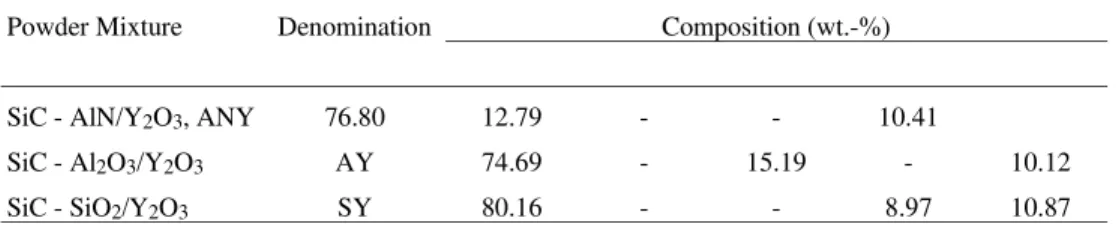
was kept constant at 35 vol.-%. The overall compositions of the different powder mixtures as well as their denomi-nations are presented in Table 1.
After homogenization, the powder mixtures were dried in a rotoevaporator and deagglomerated by sieving. Particle size distribution was measured by sedigraphy (SYM-PATEC HELOS). Samples of approximately 4 x 4 x 50 mm3 were pressed first uniaxially under 20 MPa and then isostatically under 300 MPa. Green density of the pressed samples were determined.
The samples were sintered in a furnace with a graphite heating element under Ar atmosphere, using grafite cruci-bles and SiC powder as powder bed. The heating rate employed was 10 K/min up to the maximum sintering temperatures of 1900, 2000 and 2100 °C, with a holding time of 30 min. The cooling rate has been the same until the inertia of the furnace prevailed.
The sintered samples were characterized for final den-sity determined by the Archimedes method, weight loss during sintering and linear shrinkage. Prior to the mechani-cal and microstructural characterization, the samples were grinded and polished with diamond paste. Phase analysis was accomplished by X-ray diffraction, using CuKα
-radia-tion. Young’s modulus was determined by the acoustic resonance method, and the Vickers hardness was
deter-mined under a load of 9.81 N. Strength was evaluated by the 3-point flexural strength measurements.
Microstructural characterization by scanning electron microscopy (SEM) was conducted on fracture surfaces and on polished surfaces using backscattered electrons in order to obtain the necessary contrast between the SiC grains and the intergranular phase. Relative contents of Y, Al and Si of samples sintered at 2100 °C were determined by EDS analysis.
3. Results and Discussion
Figure 1 shows the particle size distributions of the three different powder mixtures prepared by attrition mill-ing. The average particle size of all three powders is about 0.75 µm. The distribution curves are very similar, indicat-ing the efficiency of attrition millindicat-ing and the homogeneity of the three powder mixtures prepared.
The green, theoretical and relative densities of the com-pacted samples prior to intering are resumed in Table 2. The calculations of the theoretical density were based on the rule of mixtures.
The results of the weight loss (∆m/m0) during sintering,
linear shrinkage (∆l/l0), and final relative densities (ρrel) of
the sintered samples are presented graphically in Figs. 2 -4. As it can be seen, the samples with Al2O3/Y2O3 and
SiO2/Y2O3 additions suffer extremely high weight loss of
up to 19.7 and 15.5%, respectively at the sintering tempera-ture of 2100 °C. This may be explained by the interaction between silicon carbide and the additives resulting in
gase-Table 1. Denomination and composition of the powder mixtures prepared.
Powder Mixture Denomination Composition (wt.-%)
SiC - AlN/Y2O3, ANY 76.80 12.79 - - 10.41
SiC - Al2O3/Y2O3 AY 74.69 - 15.19 - 10.12
SiC - SiO2/Y2O3 SY 80.16 - - 8.97 10.87
ous species formation, such as SiO, Al2O, CO and CO214,15.
In the case of SiO2/Y2O3 additions the reactions seem to be
completed below 1900 °C, as can be concluded by the almost constant weight loss at all sintering temperatures (Fig. 2). In the case of Al2O3 additions the reactions proceed
up to 2100 °C, causing a constant increase of weight loss. The higher weight losses observed for the AY samples in relation to the SY samples are due to the higher initial Al2O3
weight content in comparison to the initial SiO2 content
(Table 1). On the other hand, samples with the AlN/Y2O2
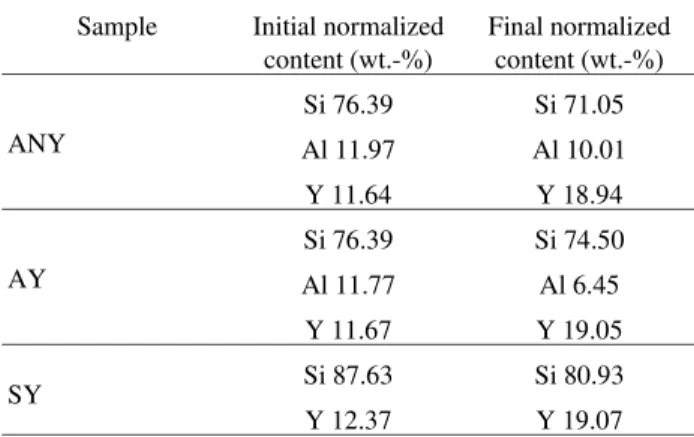
additive system exhibited only minor weight loss, thus maintaining a higher liquid phase content during sintering. These findings are confirmed by EDS analysis of polished surfaces, as shown in Table 3, where the normalized rela-tive contents of Si, Al and Y in the starting powder mixtures (calculated) and after sintering at 2100 °C are listed.
Although the O and C contents could not be analyzed by this method and although these analysis do not represent an overall quantitative analysis of the samples, the trends described above are confirmed, i.e. the Si and Al contents diminish due to the reactions between SiO2 and Al2O3 with
SiC, leading to an increase of the Y content. Higher loss of Al is observed for Al2O3/Y2O3 system in comparison with
the AlN/Y2O3 one, which is in agreement with the weight
loss presented in Fig. 2. Si loss was highest for the SY samples.
As it can be seen from Figs. 3 and 4, the highest densification was achieved for the samples with AlN/Y2O3
additives, sintered at 2000 and 2100 °C, although they exhibited a smaller linear shrinkage as the samples with Al2O3/Y2O3 additives. For the samples sintered at 1900 °C,
the highest density was achieved by samples with
Al2O3/Y2O3 additives. This behavior can be explained by
the higher refractoriness of the AlN as compared to Al2O3,
which therefore needs higher sintering temperatures for complete densification. In the case of the SY samples, the linear shrinkage as well as the final relative densities are significantly lower as compared with other samples due to the loss of SiO2 additive at temperatures below 1900 °C.
Considering all these observations, it can be concluded that the AlN/Y2O3 additive system is the most adequate for
the liquid phase sintering of SiC ceramics. The weight losses might be reduced even further by the use of an appropriate powder bed. A sintering temperature of 2000 °C is sufficient to obtain high densification, while higher temperatures cause lower final densities due to increasing weight loss caused by evaporation of the addi-Table 2. Green density, theoretical density and relative green density of the compacted samples.
Sample Theoretical density [g/cm3] Green density [g/cm3] Relative green density [%]
ANY 3.294 2.07 63.04
AY 3.404 2.07 60.63
SY 3.102 1.95 63.01
Figure 2. Weight loss of the samples vs. sintering temperature.
Figure 4. Relative density of the samples vs. sintering temperature.
tives. Furthermore, the final densities might be improved by longer sintering time.
The results of the Youngs modulus E, Vickers hardness HV1 and flexural strength measurements are presented in Figs. 5 and 6, respectively. Due to the high porosity of the samples with SiO2/Y2O3 additions no meaningful hardness
measurements were possible.
As can be observed in Fig. 5, the samples with AlN/Y2O3 additions reach their highest flexural strengths
of about 430 MPa after sintering at 2000 °C. The other two materials had lower flexural strength, due to their lower final densities. The Young’s modulus values plottet vs.
sintering temperature in Fig. 6 exhibit similar trends to the ones of the final density of the sintered samples, demon-strating the direct influence of porosity on the elastic be-havior.
The phase analysis of the sintered samples at 2100 °C by X ray diffraction revealed only the β-SiC phase in all cases. Trace amounts of the Al5Y3O12 phase appeared in
the case of Al2O3 and AlN additions. No secondary
cris-talline phase was identified in the case of SiO2 additions.
Figure 7 shows a X-ray diffractogram of a sample with Al2O3/Y2O3 additions sintered at 2100 °C. No phase
trans-formation of β-SiC into α-SiC has been observed, probably due to the high purity in terms of the initial α-SiC phase content of the SiC starting powder and due to the short sintering time of only 30 min.
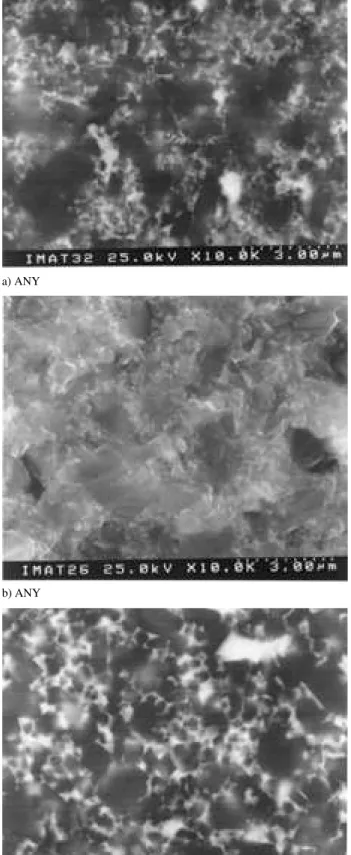
The microstructures of polished and fracture surfaces of the samples sintered at 2100 °C are shown in Fig. 8. In the case of AlN/Y2O3 and Al2O3/Y2O3 quite similar
structures are observed. Both exhibit a fine grained micro-structure of equiaxial SiC grains with grain size smaller than 2 µm. No exaggerated grain growth or typically elon-gated α-SiC grains have been observed, being in agreement with the results of the X ray analysis. In comparison, the samples with SiO2/Y2O3 additions exhibit significant grain
growth in relation to the other two compositions, with grain sizes between 3 to 5 µm. Again, no phase transformation of β-SiC into α-SiC has been observed in this case. The fracture surfaces are quite smooth, indicating a predomi-nantly transcristalline fracture mode, leading to low frac-ture toughness. No definitive conclusion can be drawn in the case of the SiO2/Y2O3 doped samples, because of their
very low densities. Table 3. Relative content of Si, Al and Y in the starting powders
(calculated) and after sintering at 2100 °C (determined by EDS analysis).
Sample Initial normalized content (wt.-%)
Final normalized content (wt.-%)
ANY
Si 76.39 Si 71.05 Al 11.97 Al 10.01
Y 11.64 Y 18.94
AY
Si 76.39 Si 74.50
Al 11.77 Al 6.45 Y 11.67 Y 19.05
SY Si 87.63 Si 80.93
Y 12.37 Y 19.07
Figure 6. Youngs modulus of the sintered samples vs. sintering tempera-ture.
Figure 5. Flexural strength of the samples vs. sintering temperature.
Figure 8. Microstructures (left) and fracture surfaces (right) of the samples sintered at 2100 °C, with additions of AlN/Y2O3 (a, b), Al2O3/Y2O3 (c, d) and SiO2/Y2O3 (e, f).
e) SY b) ANY
d) AY a) ANY
4. Conclusions
Considering the results presented, it is concluded that the additive system based on the AlN/Y2O3 mixture is the
most adequate for the liquid phase sintering of SiC. Due to the higher refractoriness of AlN, in relation to Al2O3,
samples with AlN addition reach the highest densities at higher sintering temperatures. The weight losses of these samples might be reduced using powder beds with identical compositions, resulting in higher densities and hence in improvement of mechanical properties. The SiO2/Y2O3
system is inadequate for the liquid phase sintering of SiC ceramics, due to the SiO2 loss at low temperatures.
The fact that no β-SiC to α-SiC phase transformation has been observed, may be explained by the short sintering time of only 30 min and by the absence of α-SiC grains in the starting powder, which hinders the nucleation of the
α-SiC phase. To induce the phase transition of β-SiC into
α-SiC a prolonged heat treatment or the use of α-SiC seeds seems to be necessary.
In the case of the SiO2/Y2O3 additive system, an
inten-sive grain growth has been observed as compared to the two other additive systems investigated. The high porosity of this samples indicates that the grain growth probably occurs via an evaporation – condensation mechanism.
Considering the final relative density of about 95% of the samples with AlN/Y2O3 additions and their flexural
strengths of about 430 MPa, the high potencial of LPS-SiC as a structural ceramic material was demonstrated in this work.
Acknowledgement
The authors would like to thank the financial support by CAPES-ICCTI under grant no. 019/97 and by FAPESP under grant no. 95/06378-5.
References
1. Prochazka, S. Proceedings of the Conference on Ce-ramics for High Performance Applications, Hyanuis,
MA, 1973. Burke, J.J.; Gorum, A.E.; Katz, R.M., eds., Brook Hill Publishing Co., p. 7-13, 1975.
2. Prochazka, S. Special Ceramics 6, British Ceramic Res. Assoc., Stoke-on-Trent, p. 171-181, 1975. 3. Johnson, C.A., Prochazka, S. Ceramic
Microstruc-tures ‘76, edited by Fulrath and Park, p. 366-378, 1977.
4. Murata, Y.; Smoak, R.H. Proceedings of the Interna-tional Symposium of Factors in Densification and Sintering of Oxide and Non-oxide Ceramics, October 3-6, Hakone, Japão, p. 382-399, 1978.
5. Cutler, R.A.; Jackson, T.B. Ceramic Materials and Components for Engines. Proceedings of the Third International Symposium. Tennery,V.J., ed., The American Ceramic Society, Westerville, OH, p. 309-318, 1989.
6. Cordery, L.; Niesz, D.E.; Shanefield, D. J. Sintering of Advanced Ceramics, v. 7, Handwerker, C.A.; Blen-dell, J.E.; Kaysser, W.A., eds., The American Ceramic Society, Westerville, OH, p. 618-636, 1990.
7. Kim, D.H., Kim, C.H. J. Am. Ceram. Soc., v. 73, n. 5, p. 1431-1434, 1990.
8. Chia, K.Y., Lau, S.K. Ceram. Eng. Sci. Proc., v. 12, n. 9-10, p. 1845-1861, 1991.
9. Kim, Y.W. et al. J. Am. Ceram. Soc., v. 78, n. 11, p. 3145-3148, 1995.
10. Tani, E. et al. J. Am. Ceram. Bull., v. 65, n. 9, p. 1311-1315, 1986.
11. Lee, S.K. et al. J. Am. Ceram. Soc., v. 78, n. 1, p. 65-70, 1995.
12. Padture, N.P. J. Am. Ceram. Soc., v. 77, n. 2, p. 519-523, 1994.
13. Negita, K. J. Am. Ceram. Soc., v. 69, p. C-308 - C-310, 1986.
14. Jacobson, N.S. J. Am. Ceram. Soc., v. 75, p. 1603-1611, 1992.