A Master Thesis presented as part of the requirements for the Award of a
Masters‟ Double Degree in Management from the NOVA –
School of Business
and Economics and SGH Warszawa
–
Warsaw School of Economics.
The Effects of mega-events on city branding
–
The
example of Warsaw and Euro 2012
Written by Gonçalo Maria Pinheiro Machado de Almeida e Vasconcelos,
#55296
A Project carried out in the Institute of International Management and
Marketing under the direction of:
Dr. Izabela Kowalik
1
TABLE OF CONTENTS
INTRODUCTION………3
1 – From place marketing to city branding………..………...3
1.1- Place marketing………3
1.1.1 – Place marketing process……….4
1.1.2 –Image‟s role in place marketing……….6
1.1.2.1 – Theoretical framework –Image‟s communication………..6
1.2 – City Branding………...7
1.2.1 – The brand and its components………8
1.2.2 – Branding places as products………...9
1.2.2.1 – Branding as geographic nomenclature………...9
1.2.2.2 – Product-place co-branding………...9
1.2.2.3 – Branding as part of place management………...10
2 – Event marketing………..………...11
2.1 – Definition………..11
2.1.1 – Integrated marketing communication………...11
2.2 – Event selection………..12
2.2.1 – Objectives of event marketing………...12
2.3 – Advantages and disadvantages of event marketing………..13
2.4 –Evaluation of an event‟s success………...13
2.4.1 – How to measure the effects of event marketing………...13
2.4.2 – When to evaluate event marketing………...13
3 – Mega-events –definition and potential impact……….………..…...14
3.1 – Mega-events phenomenon………14
3.2 – Distinctive traits of mega-events………..14
3.2.1 – Significant alterations in the locality‟s cycle of activities………15
3.2.2 – Global media participation………...15
2
3.4 – Impact of mega-events………..16
4 – UEFA Euro championship 2012 as a mega-event example………..……...17
4.1 – Euro 2012 - organizing requirements………...…………18
4.2 –Costs directly related with the organization of the event…………..………19
4.2.1 – Organizing costs in Poland ………...19
4.3 – Forecasts for the Euro 2012………..………20 4.4 – Theoretical context of UEFA Euro 2012 event organization ………..………21
5 – Warsaw as host city of the mega-event………...…...21
5.1 – Warsaw and the Euro 2012 – preparations to receive the event ………..21
5.1.1 – Potential impacts resulting from the organization of the Euro 2012………23 5.1.2 – Objectives connected with hosting the Euro 2012 ………..24 5.2 – Warsaw branding approach………...………...25
5.2.1 – Target groups of event marketing used by Warsaw ………...25
5.2.2 – Warsaw positioning changes – new image………...26
5.2.3 –Warsaw‟s image communication for the Euro 2012………27
CONCLUSION………..28
APPENDIXES………...29
3
INTRODUCTION
It has never been more important for cities to express the attributes, values and beliefs that form their personality as in the present days of global competition.
Positive image creation is one of the main objectives of modern politicians and, therefore, one of the subjects in which they allocate more time and resources. It relies on the enhancement of local features that make a city stand out among competitors, marketing its key attributes, whether they are cultural, social, economic or technological. Much like with products,
marketing of places is used to attract and retain “place customers” and to form a brand image
which can be immediately associated to that place, whenever someone refers to it.
One of the marketing tools used to increase a city‟s visibility and, at the same time, provide
financial resources for urban regeneration and improvement of a city‟s image is the hosting of
mega-events. Major sporting and entertainment events such as FIFA World Cup, Olympic Games, Formula One or UEFA European Football Championships have become items of top agenda for governments around the world.
These kinds of events can be significant catalysts for change, elevating the host‟s cities and countries global image and allowing them to substantially grow economic, political and socially wise. They have the ability to conciliate agendas and cooperation among different actors towards a common cause. The fixed deadlines are a stimulus for the completion of planned projects that would otherwise take a longer time to be concluded. And, with the whole world watching, it provides a strong incentive to do things right.
Having lived in Warsaw for the past year I was able to observe the changes a city goes through in order to adequately receive an event of the dimension of a European football championship, and I found interesting to understand how those changes will influence the future of the city. I will try to demonstrate how such an event can work as a major marketing instrument for Warsaw, offering basic standards for the city to improve, and the possibility to renovate the brand image that is associated with it.
1
–
From place marketing to city branding
1.1 – Place marketing
Places have long felt the need to differentiate themselves from each other, to assert their individuality in pursuit of various economic, political or socio-psychological objectives. The conscious attempt of governments to shape a specifically designed place identity and promote it to identified markets, whether external or internal is almost as old as civic government itself.
“A place‟s potential depends not so much on a place‟s location, climate, and natural
resources as it does on its human will, skill, energy, values, and organization. For a place to succeed, it must be able to carry out the following fundamental tasks:
Interpreting what is happening in the broad environment.
Understanding the needs, wants, and behavior choices of specific internal and external constituencies.
Building a realistic vision of what the place can be. Creating an actionable plan to complement the vision. Building internal consensus and
Evaluating at each stage the progress being achieved with the action plan.” 1
4
According to Kotler‟s definition of a place‟s potential, it is perceived that places, at a certain level, can be considered as huge public organizations and thereby they need to be promoted, just like public and private organizations are.
There are, however, some reservations when considering the similarities between places and public organizations, since places like countries, cities, etc., have different goals and a broader range of issues to strategize than private and public organizations do.
All things considered, nonetheless, it becomes clear that there is nowadays, a strong consensus regarding the suitability of marketing for places, and that places, undeniably, should be marketed, by the persons responsible for that, as efficiently as firms market their products or services.
According to Kotler (2002), when a place is being marketed it is being designed to satisfy the needs of its target markets. It can be considered successful when citizens and businesses are pleased with their community, and the expectations of visitors and investors are met.
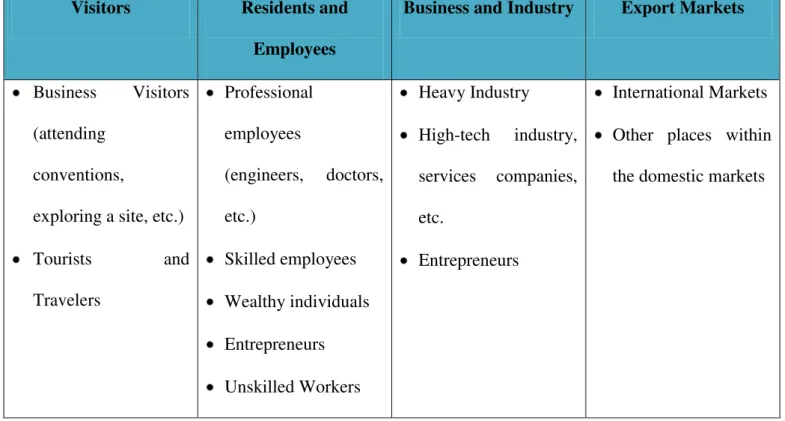
When considering the potential target markets of place marketing one is considering the so called “place customers”. These can be very different, according to the needs of the place, namely: producers of goods and services, outside investment and export markets, tourism and hospitality, corporate headquarters and regional offices and new residents.2
Each place should have the ability to correctly and effectively define and communicate its added value and competitive advantages to the desired targets.
Places often compete for the attraction and retention of a given kind of place customers. It is crucial, therefore, that localities acknowledge that no two places use their strategies, resources, or define their products and plans in the same way. Places differ in their histories, cultures, politics, leadership style, and in the ways of managing public-private relationships. The place marketing strategies have to contrast from place to place, according to its needs. According to Kotler strategic place marketing is the most adaptive and productive way of approaching the problems of places. Moreover, the essence of the marketing concept is to
understand customer‟s wants and needs. It actively contributes to the effective organization of
the resources used to achieve the desired targets, by producing added value. 1.1.1 – Place Marketing Process
A process is a set of activities designed to produce a specific output for a particular order, done by a customer or a market. Basically it is the transformation of an input into an output, sustained by a structure that indicates how it is done.
According to Kotler (1997) the place marketing process consists in analyzing marketing opportunities, developing marketing strategies, planning marketing programs, and managing the marketing effort.
The process of place marketing starts with the creation of the vision and mission statements of
a place, together with the strategic analysis of that place. Without a proper prior analysis it‟s
impossible to develop a good marketing strategy. One of the analyzing methods more commonly used for a place is its SWOT analysis, which summarizes and makes visible the strengths, weaknesses, opportunities and threats of a place and its surrounding environment. Each marketing process is formed by a number of elements, namely resources, products, marketing strategies and measures, customer populations, segmentation and global strategies. In the place marketing process framework these elements are divided into three perspectives: producers, market and consumers. According to this framework, each of the elements is differently associated with the marketing process, when comparing with traditional marketing. Ashworth and Voogd (1994), state that the differences between the elements‟ association
determine the distinctive character of place marketing.
2
5 The choice of place marketing strategies depends highly on the goals that the organization wants to achieve. Each strategy requires a different mix of marketing activities, and numerous strategies may be simultaneous.
Through place marketing locations are marketed as if they were products, to a wide variety of groups of customers with different purposes for each group.
A “place product” can be produced by either public or private organizations. Customers are
free to choose between comparable products on the place market. The intangibility of non-business products, the non-monetary price of purchase, the lack of frequency of purchase and behavioral reinforcement, the need to market an entire but heterogeneous market are features
of a place product. Moreover, the political element is also strongly involved in the place‟s
decision process.
Ashworth and Voogd (1990) suggested that the marketing mix for place marketing should be different from the one found in traditional business applications, and it should be defined as a combination of at least the following set of measures: Promotional measures; Spatial-functional measures; Organizational measures; and financial measures.
According to them, “the scope and effectiveness of city marketing is largely determined by
the selection and application of the appropriate combination of these measures”3
Other point of view is Kotler‟s (1999) one. According to him there are four fundamental basic
approaches according to each places could improve the conditions of life, investment and visibility of its place product, basically, to build competitive advantage. A place should be developed as:
Place as a character (Design) – Appealing urban design makes a positive statement about a place, because it reflects how values and decision-making combine on issues affecting development.
Place as a fixed environment (Infrastructures) – Basic infrastructures compatible with the natural environment makes the urban design possible, but do not guarantee place‟s growth per se. Nonetheless its absence can be a serious problem. Infrastructure development needs to be in sync with the overall place development priorities. The strategies for the urban planning must deal wisely and creatively with each of the infrastructure related proposals.
Place as a service provider (Basic services) – Successful places are obliged to have
good public services. Those services can be marketed as the place‟s primary attention
and product. In every place, the development in terms of security, education and customer attractions must be constant.
Place as entertainment and recreation (Attractions) – An attractive place must have several institutions which provide recreational tools for those who are there. Restaurants, parks, zoos, sport arenas are the traditional institutions that provide this kind of entertaining activities.
In order to be successful, place marketing has to be strong both in the strategic and in the marketing implementation/operational aspects.
Marketing implementation is the process that turns marketing plans into action assignments and ensures that they are executed in a manner that accomplishes the plan‟s stated objectives. Kotler considers that good implementation skills are critical to the overall success of an organization. In order to correctly implement a marketing plan, one needs to properly recognize and diagnose a problem, assess the level in which that problem exist and, after implementing the plan, properly evaluate the results.
6 The relation between the ability to design and implement marketing plans defines the global place marketing strategy. This relation defines the four basic environments in which place marketing can take place.4
When planning place marketing, one has to be able to identify the positioning a place occupies and find ways to change that positioning by designing and implementing strategies. Authors Hubbard and Hall (1998) describe a generic entrepreneurial model of city governance that has to follow a set of specific measures, in order to re-position the image of a place. The measures are the following: Advertising and Promotion; Large-scale physical redevelopment; Public art and civic statuary; Cultural regeneration; Public – private partnerships; and
organize Mega – events.
All of the previous measures have the ability to change a place‟s positioning and therefore change the image that places‟ customers may have of that locality.
1.1.2 –Image’s role in Place Marketing
A vital role within place‟s marketing mix is the one played by the image formulation and image communication. Many authors believe that the main objective of place marketing and
all its central activities is not the place “itself”, but the image it reflects. According to them is not the city but the image that has to be planned.
Author Kampschulte (1999) states that “the image of the city is best described as the link
between real, objective space and its perception”5. Other author, Vermeulen (2002), further
adds that the image originates only in part from a physical reality and is based on prejudices, desires and memories that take shape in the collective memory.
A place‟s image is communicated not only by promotion, but also through the rest of the
marketing actions. For instance, as authors Ashworth and Voogd (1990) stated, “Measures
operating in spatial design features will contribute towards urban images and thus reinforce,
or contradict, promotional measures”.
This thought regarding the communicative effect happens due to the acknowledgement that one needs to combine and coordinate every set of marketing measures, because of their inter-correlation. The quality of one marketing measure will always bring implications to the
effectiveness of the others. Furthermore, it comes from the notion that a place‟s image is the
result of various and often conflicting messages sent by that place, which are later formed separately in the minds of each individual receiver of those messages.
Authors Hubbard and Hall (1998) conclude that “the manipulation of city images, cultures
and experiences has become probably the most important part of the political armory of urban
governors and their coalition partners in the entrepreneurial era”6.
1.1.2.1 – Theoretical framework –Image’s communication
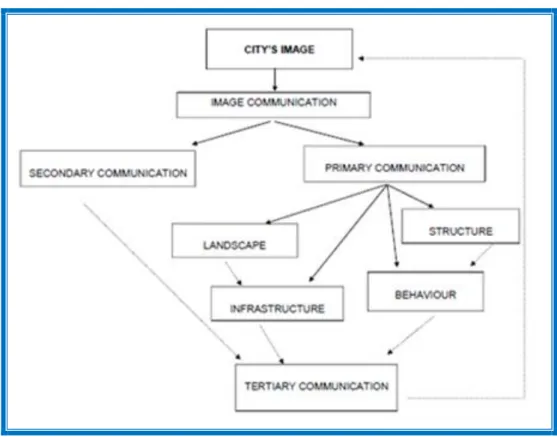
As perceived from the previous section, the main function of the marketing of places is to project a place as a series of perceptions and images. It is the most important thing to be planned and consequently marketed. Everything that happens in a given place, or is done by that place, transfers messages about that place‟s image. That transfer is done through three distinct types of communication: primary, secondary and tertiary.7
The city image comes from the way it is communicated to the target audience, by these three types of communication.
Primary communication is the communication related with a place‟s “actions”, even if
communication isn‟t the main goal of these actions. It is basically the first things that are visible for the audience when it is present in that place. It is divided into four major areas:
4 Appendix 2 – Place marketing environments
5Kampshulte A, 1999;”Image As An Instrument of Urban Management”, p.229
7
Landscape Strategies; Infrastructure Projects; Organizational Structure; and Place Behavior.
The landscape strategies are related to the decisions relevant to architecture, green spaces, urban design, heritage planning and public spaces in general inside a city. In Kotler‟s
marketing theory (section 1.1.1) this area is similar to “Place as character“(design).
Infrastructure projects are related with projects that are developed to create, improve or give a distinguishing character to the numerous types of infrastructures that are needed in a city. It can be associated, for instance, with the easy accessibility to major monuments or relevant visiting spots or with the existence of an adequately large airport, and also with the existence and sufficiency of a suitable number of cultural centers, conference facilities, gathering locations, etc. Once again, comparing it with Kotler‟s marketing theory this area has a similar meaning to “Place as fixed environment” (infrastructure).
Organizational structure is the area related with, for instance, community development
networks and citizens‟ participation in the decision making processes. Likewise it is also associated with the establishment of public-private partnerships.
At last, the area called place‟s behavior is the one related with issues such as the future vision that places‟ leaders have for the place, and the strategy adopted or the financial incentives provided to the stakeholders in order to follow that vision. Two major topics within this are the types of services the place wants to provide, along with their effectiveness. Moreover, this area of the primary image communication is also concerned with the number and types of events (such as festivals, sportive or leisure events) organized in the place.
The ability to communicate an image of a place relies on the skills, innovativeness and imagination of every place-marketer or administrator. They are the ones who have the obligation to enrich this communication with new ideas, practices and techniques.
Secondary communication is the type of communication that is formally intended to be used to transmit a given image. It takes place through well-known marketing practices like
advertising, public relations, usage of a logo, graphic design, etc. It‟s compared to the
promotion variable of the usual marketing mix, being described as the communication component of corporate identity. (Balmer, 2002)
Nonetheless, secondary communication has to be in complete consonance with the rest of the
marketing communication components and in total harmony with the place‟s reality. It is only
done when there is something worthy of being promoted. Moreover, it has to be built upon the
place‟s communicative competences. According to Grabow (1998), “the communicative
competence of a city is a key factor and vital requirement for all phases of successful urban
marketing”8.
Finally, tertiary communication is the type of communication that is related with word-of-mouth, visiting or living experiences, personal opinions of the place, etc. This communication
is reinforced by the media and also by competitors‟ communication. Opposite to the other two
types of communications this one isn‟t controlled by marketers, but by anyone who‟s
referring to that given place. However, it is constantly linked with the other two types.
The main goal of all the marketing process and, namely, the image communication‟s process is to create and reinforce a positive tertiary communication. That happens especially in the
case of the place‟s own residents, who, according to Kavaratzis (2008) are at the same time the most important target audience of city branding and the most important city marketers. 1.2 – City branding
As stated in section 1.1.2 above, the image reflected by a city, region or nation is more and more the principal objective of place marketing because, at simplest, encounters between places and their users occur through perceptions and images. As author Cova (1996) states
8
“…the job of post-modern marketing is to identify the cultural meanings and images that are
intended for the product”. 9This notion of marketing is, therefore, highly correlated with the
notion of branding. In a very broad way, place branding is merely the application of product branding to places.
Nowadays, is increasingly more important to focus specifically upon the application of branding to places, while defining the instruments of urban planning and management.
This happens, according to Holloway and Hubbard (2001), because interactions with places occur through direct experience of the environment or indirectly through media representations. Nonetheless, the critical part of this process is the way that the information received is assimilated, forming stable and learnt mental images of a place. Branding deals specifically with such mental images.
Branding provides a product with a specific and more distinctive identity, and that is exactly what place marketing is increasingly attempting to do. It further delivers a base for identifying and uniting a range of images desired for a place and the meanings that come associated with those images, resuming, it provides the place with its brand. Managing a
place‟s brand is no more than an attempt to influence and treat the mental images of a place in a way that is considered favorable to the present circumstances and future needs of the place.
1.2.1 –The brand and its components
“…the brand is a multidimensional construct whereby managers augment products or services
with values and this facilitates the process by which consumers confidently recognize and
appreciate these values”10.
Other authors, like Simoes and Dibb (2001) further state that “a brand embodies a whole set
of physical and socio-psychological attributes and beliefs which are associated with the
product”11.
Hankinson and Cowking (1993), for instance, state that “a brand is a product or a service
made distinctive by its positioning relative to the competition and by its personality, which comprises a unique combination of functional attributes and symbolic values”12.
All these definitions have similar and distinguishing points, which become helpful in order to get a clear view of what a product brand is. In city branding one adapts these definitions and associates them to a given city.
A brand is based on one side by the activities a company does and on the other side by the perceptions of the consumers. It is created by the interface of these two sides, since each of them is formed by a number of elements that are necessary for the construction of a brand. Thus, one might say that a brand is created by the agglomeration of several components. A brand, as well as a place brand, is composed by three major components: brand identity, brand positioning and brand image13.
For the one who markets a product the main goal when creating a brand is to develop features and beneficial attributes that are seen as impregnated in that brand. Furthermore, they may choose to stress symbolic, experimental, social and emotional values, creating the brand identity. Nonetheless, these elements alone are not enough to create a brand, as it needs to be
associated to the consumer‟s perception of the quality and values. Branding is a mode of
communication and therefore it‟s imperative that the communicators position and differentiate
their brand in the way in which they want the consumers to perceive it. In this aspect it is crucial the concept of brand image, since it incorporates perceptions of quality and values as well as brand associations and feelings. Furthermore, a brand plays a vital role in the
9Cova B., 1996; “The Postmodern Explained to Managers: Implications for Marketing”, p.20 10Chernatony & Dall‟Olmo Riley,1998; "Modelling the components of the brand", p.4 11Simoes C and Dibb S, 2001;” Rethinking the Brand Concept: New Brand Orientation”, p.26 12Hankinson G. and Cowking P., 1993;”Branding in Action”, p.33
9 construction of what a company considers to be its prototypal consumer, being considered therefore a valuable asset of a company.
1.2.2 – Branding places as products
According to Kavaratzis (2008) place branding has been practiced, consciously or unconsciously, for as long as cities have competed with each other for trade, populations, wealth, prestige or power.
In the author‟s opinion, much like products, places can easily possess the characteristics of identity, differentiation and image that were referred in section 1.2.1. Therefore places can also be managed in order to maximize their equity, values and awareness, from the
consumer‟s point of view. They state that the importance of image for the user/consumer of the place is what connects place branding to cultural geography.
As seen in the section above, branding attributes added values to the product, differentiating it. All branding tries to endow a product with a specific and more distinctive identity (Cova 1996) and that is what, basically, most place marketing intends to do for the places. A place needs to be differentiated through a unique brand identity if it wants firstly, to be recognized as existing, secondly, to be perceived in the minds of place users as having qualities superior to those of competitors and, finally, to be consumed in a way that is corresponding to the objectives that were set for that place.
Places can, therefore, be marketed as branded products if their intrinsic and distinctive characteristics as place products are understood and if they are marketed in order to point out these characteristics.
Author Kavaratzis states that there are three sorts of place branding, each of them with very different objectives. The three sorts are the following: Geographic nomenclature; Product-place co-branding; and branding as a form of Product-place management.
1.2.2.1 – Branding as geographical nomenclature
This kind of branding is different from the one we will apply in this thesis. It occurs when a physical product is named after a geographical location. The most notorious case of this sort
of branding is the sparkling wine “Champagne”, which is named after a region of France. It‟s nothing more than a copyrighted brand name. There is no conscious attempt in linking any attributes of the place to the product, which, per se, gains nothing from the association. A place becomes just a name for a specific brand or, in other cases, a generic name for a
production process. The place has no other significance and doesn‟t determine nor the locus
of production nor any other transferable assets.
Nonetheless there are cases where it is difficult not to name the product from its location, since the geographical location is a crucial part of what‟s being sold. In these particular cases the sort of branding moves away from the first one to the second and third‟s ones, because the
production locus is typical from that given place. 1.2.2.2 – Product-place co-branding
Co-branding of a product and a place occurs when one attempts to market a physical product by associating it with a place that is assumed to have the attributes considered beneficial to the image of the product.
A clear example of that are the famous “Swiss watches”. When comparing with the
“Champagne” example of place nomenclature stated in the section 1.2.1, since the objective in this case is to transfer to the watches characteristics of reliability and meticulousness that are often associated with the Swiss people, and, in the case of watches are assumed to be desirable attributes.
Nonetheless, this can be considered also a dangerous branding practice, since place images have both a positive and a negative image, and they can be very instable. Taking the example
10 but they can also be associated to characteristics such as prudence, discretion and creative monotony, which are also often associated with the people from Switzerland, and are, in this case, undesirable attributes in the production of watches.
These place associations can very rapidly change, shifting from positive to negative associations.
Other effect of place branding associated with product-place co-branding is the place of origin affect. According to Jaffe and Nebenzahl (2001), “the research on country-of-origin effect addresses how national symbols and other origin cues affect buyer perceptions and attitudes
towards the products and services of a specific country”14.
According to the authors Papadopoulos and Heslop (2002) marketers, “…in order to differentiate their brands, (…) often use country associations”15. Take for instance the car
manufacturing industry. Some countries, has for instance Japan and Germany have a very good reputation in this industry, which makes the cars with German and Japanese brands be considered as very good.
This effect generates another one, which is the hallo effect. A consumer has an image of a given country on his mind when having the first contact with their local products. A consumer makes inferences about the level of significant product characteristics through the prism of the place where the product is manufactured.
1.2.2.3 – Branding as part of place management
Finally, place branding can also act as a form of place management, since one of the major objectives of place management strategies is to change or improve the way places are perceived by specific or general groups of users, creating a recognizable place identity and image. For instance, regarding a city‟s urban renewal, author Florian (2002) states that: “…it
includes the creation of an identity with its own experiential value, which is profoundly original and impossible to copy. This touches upon such points as structure, programming, functions, the sort of actions and activities that characterize the image of the city, events and
in the last resort the chemistry of the people who operate there.”16 Much like urban renewal,
most of the continuous decisions taken by place management have the ability to change
people‟s perception of a given place. Nevertheless, a city is simultaneously a place of
residence and a place of work for the people who live in it; a destination for people that visit it; and a place of opportunity for the people that invest in it. The group of possible stakeholders for a city is therefore, very diverse, as are the images that each group has regarding that city.
Is, thus, a place able to create a brand which covers this wide multitude of stakeholders and audiences? According to authors Chematony and Dall‟Olmo Riley (1998) it is, as long as the values that are developed as the core of the brand are bound together by a vision which gives them meaning, impetus and direction. Despite of the highly diverse number of a city‟s
stakeholders, the core of the city‟s brand has to be viewed as the same by all of them, in order
to achieve consistency in the messages sent by the city. The core of the brand is attached to universal values, such as social responsibility, environmental care, sustainability, progressiveness, innovation, quality, trust, etc. Each stakeholder can, however, have different images regarding the global view of a city brand, individually benefiting from it in a different way than other stakeholders.
They do so associating the place with “stories” about it, at their own way. According to
Kavaratzis (2004) these stories need to be related to a place, as consequences of planned and
designed strategic interventions; infrastructure‟s design and development; and organizational
14Jaffe E., Nebenzahl I., 2001, “National Image and the Competitive Advantage, Copenhagen Business School Press”; p. 33
15
Papadopoulos N., Heslop L.; Country equity and country branding, problems and prospects, Brand Management, 2002
11 structures and capabilities. Afterwards, they are communicated through the more general attitude of the place and through promotional activities, allowing each stakeholder to generate
a more particular image of that place, always based upon the “core brand” which was referred in the previous paragraph.
There are three main techniques designed by places with the purpose of not only attract attention and place recognition (brand awareness) but also raise associations between the place and attributes regarded as being beneficial to its economic and social development (brand utility). The three techniques are the following: “Personality branding (or “The Gaudi gambit” after the success of its Barcelona project); Flagship construction (or “The Pompidou ploy” after his grand project on the Paris Beaubourg); and Event Marketing”17
This third and last promotional technique will be the one that will be thoroughly studied in the following chapter of this thesis, as it is the one that is associated with the mega-event, Euro 2012, and more specifically its effects in the city of Warsaw.
2
–
Event Marketing
2.1 – Definition
“Event marketing is an attempt to coordinate the communication around a created or
sponsored event. In event marketing the event is an activity that gathers the target group in
time and space; a meeting in which an experience is created and a message communicated.”18
Author Stevens (2005) further states that events are used to engage prospective consumers,
build awareness, or market a company‟s products or services.
These definitions express what event management is, and why it is used nowadays. In the modern corporate world, event marketing is viewed more and more as an increasingly important element in the promotion of a company‟s product, service or cause. No other marketing discipline is expanding as fast and as profoundly as event marketing.
Event Marketing is basically marketing through events. Marketing is seen as the central purpose and the event itself is the concrete marketing tool. It sends a message through an event, message that that can be experienced by the audience, involving high contact intensity. It tries to comprise several senses, thereby increasing the chances that the audience remembers the experience and, consequently, the message.
There are three main arguments that can summarize the reasons why companies choose to use event marketing. First of all, as industries evolve, there are more and more economic incentives to find new and unconventional ways of communication. Secondly, the demand for diverse means of marketing from companies is also increasing at a very fast pace. Finally, the ability and experience of producing marketing via events is also increasing and is becoming more and more systematized.
Through event marketing the media clutter can also be penetrated, allowing a relationship to be established between the product, service or brand and its target group. Event marketing can be used in business to business as well as in consumer marketing. It is within the area of consumer marketing that it is most significantly increasing nowadays.
2.1.1 – Integrated marketing communication
One of the major strengths of an event is that it provides an opportunity to meet the target audience in a different way than other marketing tools. It does so by combining a set of traditional promotional tools (Sneath, Finney & Close, 2005). This combination of promotional tools is entitled as integrated marketing communications (IMC).
17Kavaratzis M., 2008; “From city marketing to city branding: An interdisciplinary analysis with reference to Amsterdam,
Budapest and Athens“; p.61
12 Integrated Marketing Communications is "the concept under which a company carefully integrates and coordinates its many communications channels to deliver a clear, consistent message"19or “a management concept that is designed to make all aspects of marketing
communication such as advertising, sales promotion, public relations, and direct marketing
work together as a unified force, rather than permitting each to work in isolation.”20
Numerous of the traditional promotional tools, or parts of them, are used before, throughout and after the occurrence of the event21.
Authors Behrer and Larsson (1998), state that Event Marketing is mainly about coordinating several ways of communication inside the same activity. The main purpose of this way of marketing is facilitating the mass communication.
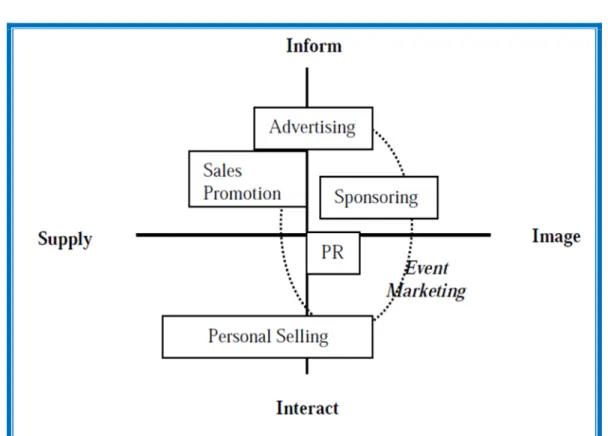
Through event marketing, there are two ways in which image can be affected. One is through the experience and the interaction that takes place during the event, the other is through the expressed and the exposed image. Both the message and the exposure during an event are usually strengthened with advertising.
2.2 – Event selection
When it comes to event marketing there is more than just one type of events to choose amongst. The event through what the marketing will be done has to match the strategic outcomes of the organizers and/or stakeholders
Authors Gwinner and Eaton (1999) state that consumers often associate the meaning of the event with the brand being portrayed, and that Image based similarity has been described as occurring when the image of the event is related to the image of the brand.
Just because an event is being arranged, it doesn‟t necessarily mean that the marketing will result in success, it is enormously important to conduct a thorough research before the planning of that event.
2.2.1 – Objectives of event marketing
The first and crucial issue a company must consider is what it wants to achieve by using event marketing. It needs to clearly state its objectives. Objectives that companies hope to achieve from event marketing can be broadly classified into corporate-related, product-related, sales, media coverage, guest hospitality, and personal. (Meenaghan, 2001)
The following table gives an overview of the objectives a company can try to reach with event marketing:
Objectives of Event Marketing
Corporate related objectives
- Affect company‟s image
- Create awareness - Create goodwill - Reassure shareholders
- Strengthen the internal relations - Identify company with target group - Establish relations with customers - Receive feedback
- Test a new market - Launch a new product
- Engine running overall marketing
Product-related objectives
- Affect the brand or product image - Generate brand or product awareness - Identify product with target group
Sales objectives
- Increase short and long term sales - Create shopping impulses
Achieve media coverage
Table 2.1: Summary of Objectives with Event Management Source: Adapted from Eriksson and Hjalmson, 2000
The way an event transmits its image is represented in Appendix 6.
19 Kotler P.; Armstrong G., 1999; “Principles of Marketing”, p.427 20 Http://marketing.about.com
13 There are four different approaches to Event Marketing, they are classified differently depending if they are based on a new or existing event, and depending if they take place in the
company‟s own arena or someone else‟s arena22.
2.3 – Advantages and disadvantages of event marketing
Taking in consideration everything said up to this point regarding event marketing, one can point out a list of potential advantages and disadvantages of using this kind of marketing. The most important advantages from the point of view of the company engaging in event marketing are connected with communication. Specifically they deal with: Penetration of the media; Credibility; Attention and Awareness; Image; Reputation; and Internal Motivation. Events, namely, and specially, mega-events, very easily penetrate the media, which immediately creates the attention of a much larger target audience and makes them aware of the existence of that event. The event will therefore more easily build a reputation and pass an image of the company that is using that event as its marketing tool.
On the other hand the main disadvantages of organizing an event from the point of view of the company are related to its inflexibility and the difficulty in evaluate it23.
Customer‟s perceptions, as well as relationship developments or assessments of customer satisfaction are abstract values and can be very complex to measure, complicating therefore the evaluation of an event. An event is also inflexible, it‟s something planned highly in advance and that very difficultly can be cancelled or changed due to all the precedent preparations for it. Even if, it is clear that the event will be a failure or that the number of spectators will be much lower than the desired, the process is already ongoing, and it is difficult to stop.
2.4 – Evaluation of an event’s success
As it was said in the previous section, it is quite difficult to evaluate if an event was successful or not in terms of marketing a brand. However, event marketing, like any other promotional tool, needs somehow to be evaluated, so that its effect becomes properly measured. The main way to do it is to set clear objectives, since they will be the base for any evaluation.
2.4.1 – How to measure the effects of event marketing
As we know, the evaluation of an event can be very difficult to execute. So the question that
arises is “how will those events be measured?”
According to Behrer and Larsson (1998) the marketing objectives set with the creation of the event are the base for any evaluation. Communication and sales objectives, mainly, have to be very clear and quantified. The company that is using event marketing can also set detailed objectives that it wants to achieve with its participation in an event, so called event specific objectives.
Communication objectives can be measured through interviews and other forms of attitude investigations. Sales objectives can be measured through sales development statistics during a limited period of time, during or after the event. The specific objectives of the event can be
measured with statistics over the event‟s development as well as through interviews with
questions regarding the event.
The impacts of mega-events will be more thoroughly studied in section 3.4. 2.4.2 – When to evaluate event marketing
According to Behrer and Larsson (1998) there is no right answer regarding the time when the evaluation of the marketing of an event should be done. They state, nonetheless, that, since an event takes place during a limited period of time, the effects should be measured within a near future.
22 Appendix 7 – Approaches to event marketing
23
14 According to them, long-term effects should be measured continuously and be looked upon as
a result of the company‟s total integrated communication, and not only due to the effects of
event marketing.
Meenaghan (1983) however, says that the evaluation process of events is easier if done through several key stages. He suggests three stages of evaluation: before, during and after the event.
- Before the event: This will facilitate the determination of the company‟s
present position in terms of awareness and image with the target audience.
- During the event: This will help the evaluators to detect movement on the chosen dimensions of awareness, image and market attitude.
- After the event: When the event is finished it is time to compare the performance levels against the ones that were determined as objectives.
This thesis will be mainly focused on the evaluation done before the event, since it will be entirely done previously to the occurrence of the event in study.
3
–
Mega-events
–
definition and potential impact
3.1 – Mega-events phenomenon
Mega-events are, very generally, “short-term events of fixed duration with long term
consequences for the cities that stage them.”24
Studies of economic and social impacts usually are based on this definition.
Mega-events, namely sporting ones, though, are not a new phenomenon. They can be traced
back to the Ancient Greek‟s era, in the times of the first Olympics. Nonetheless, worldwide
interest in these kinds of events is a much more recent happening, due to the increasing interest and leisure time spent in these kinds of, in this case, sporting activities.
From an economic point of view it is often argued that hosting a mega event is, increasingly being viewed as a strategy (potentially highly risky one) used to stimulate local economic growth. It is explained due to the competition among cities, in terms of jobs and capital, at a global scale. Mega-events serve as a stimulus and, at the same time, as a justification for local development.
In this chapter the mega-events referred are mainly sporting ones, since this is the basis for the entire thesis.
3.2 – Distinctive traits of mega-events
A more complete definition can be the one given by Roche (2000). He considers mega-events to be “large scale cultural (including commercial and sporting) events which have a dramatic
character, mass popular appeal and international significance. They are typically organized by variable combinations of national governmental and international non-governmental
organizations.”25
Based on Roche‟s definition, Green J. Solomon later defined them also as “short-term events with long-term consequences for the cities that stage them. They are associated with the creation of infrastructure and event facilities often carrying long-term debts and always requiring long-term use programming.” He continued stating that “if successful, they project a new (or renewed) and perhaps persistent and positive image and identity for the host city through national and international media, particularly TV, coverage. This is usually assumed to have long-term positive consequences in terms of tourism, industrial relocation, and inward
investments.”26
24
Ritchie, J.R. (2000). „Turning 16 days into 16 years through Olympic legacies‟, p.155
15 Horne and Manzenreiter (2006), basing their selves in these definitions, stated two major characteristics that, according to them, mega events should possess:
Firstly, the host nation, region or city should experience, during the event, significant
alterations to the normal cycle of activities existing in that place when the event wasn‟t happening. Secondly, the event should attract media representatives and viewers from numerous countries across the world.
3.2.1 – Significant alterations in the locality’s cycle of activities
As stated previously, an event‟s host nation, region or city must indicate several
factors/characteristics, during that event‟s period of time, so that it can be considered a mega
event. The main factors which need to be taken in consideration for that purpose are the following:
Increased volume of tourists directly and indirectly relating to the event
Additional publicity for the host nation with the intent of leading to further knowledge
of the nation‟s culture by the visitors and creating a positive image.
Local trade boost due to the visitors expenditures
Infrastructure improvements in the event‟s localization ant its surroundings
Increased prosperity during and following the event
Some other authors, like Matheson (2006), however don‟t agree with this last point, arguing
that mega-sporting events often have neutral and in many cases negative repercussions for their host nations.
3.2.2 – Global media participation
Mega events, namely sporting ones, provide immediate and direct access to a global market of viewers, through the media. This easy access allows host nations, regions or cities to project its image and culture to a multi-million base of viewers of different nations.
According to Matheson and Baade (2004), mega events offer hosts the chance to put their nation, region or city on the map, providing significant international exposure. For them this kind of events can also be seen as political activities, that work as economic, political and cultural tools, or even as a sign that a country has arrived as a major international figure. As examples for the last statement, one might consider the 2002 World Cup in Japan and South Korea, the Beijing Olympic Games in 2008, and even some recent Formula 1 Grand Prix hosted by countries like Bahrain, Turkey or Singapore.
3.3 – Stages of a mega-event
According to Kammeier (2002), mega events are also an issue of urban management, and in
order to be properly planned and to correctly manage event‟s effects, hosts must take in
consideration the whole phases of mega event hosting: pre-even, event and post event period. According to the author a mega event is formed by four crucial phases of management:
• Phase 1: The time in which the host nation, region or city applies for being the host of a mega-event. In this period it‟s evaluated the commitment of the host to create the required facilities in time for the event. It must include a serious capacity analysis and pre-investment studies centered on the expected supply and demand.
• Phase 2: After acceptance of the project. It includes the preparations for the additional infrastructures and services needed to host the event (e.g.: stadiums, in the case of Euro 2012), and the remaining infrastructures that will be required to be in perfect conditions due to the increasing demand of the host place (e.g.: hotels, housing, transportation means, communications). This phase is considered to be the more important one, as it is the phase in which the planning, financing and implementing of measures is done.
16
• Phase 3: This face is concerned with the management of the event itself. The evaluation of this phase can be done by the hosts, by the viewers, by the sponsors, organizers, etc., since it is the phase when the event is viewable by everyone and everyone can create an
“opinion” about it.
• Phase 4: This phase is concerned with the long-term management done after the
“hand-over” of the event. It includes, for instance, post-event adjustments (e.g.: dismantling temporary buildings and means of transportation done especially for the event).
Taking all this in consideration one is able to properly manage the event correctly and more easily understand its impacts. Examples of how to properly study the impacts of mega events will be discussed in the following section.
3.4 – Impact of mega-events
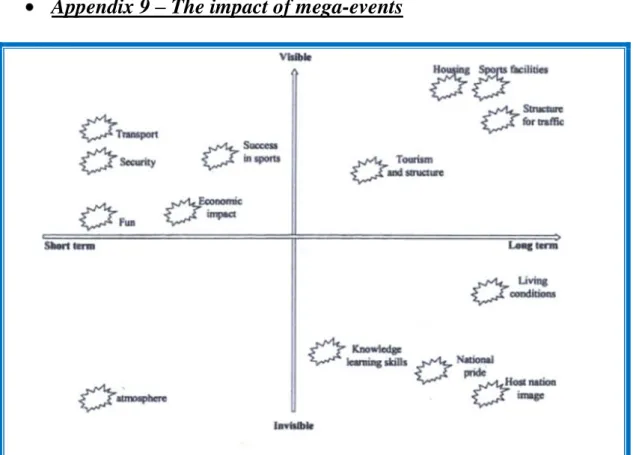
Every event, being a major one or not, impacts the society in which it is hosted. The effect of those impacts can be deeper or not, according to the magnitude of the event, its duration, its media coverage, its number of viewers/visitors, etc. There are the visible impacts of an event and the less visible ones, as there are the impacts that will be noticed at a short-term level and the ones that will be noticed at the long-term27.
Regarding the invisible short term impacts one can consider the atmosphere/environment surrounding the event. The nation, region or city in which the event is taking place is different than it uses to be. There are people from all over the world, streets are more crowded, there is
a higher mixture of cultures, etc. All of these things invisibly change the host‟s daily routines.
At the short term however, there are also several impacts very noticeable by everyone. Some of those impacts are: New/modified routes of public transports; Different measures of security; Creation of jobs directly related to the event; Economic impact; and Success in sports.
The increased number of new and modified routes for public transports and the measures of security are directly related to the increase of population that happens in a region or city during the occurrence of a mega event. The number of transports increases as do the measures of security.
These two aspects can also relate to the third impact on the above list, which is the creation of jobs related to the event. Jobs in the security area, tour guidance, stewardship in stadiums, streets, etc. all increase due to the high number of visitors that the host experiences during the mega event.
The creation of jobs, associated with the increase of local trade during the event, also creates an economic impact at the short-term level in the host‟s region and surroundings.
In the long term there are also several impacts that can be visible for the society, derived from the occurrence of mega-events. Here‟s a list of the most important ones: Sports facilities; Structure for traffic; Housing; and Tourism and Structure.
Sports facilities are, pretty much in every event, pre-requisites for the occurrence of that event, needed to be clearly defined and structured in the stages 1 and 2 of the preparation of that event. In the long term normally those facilities continue to be used by the host cities naturals.
New structures for traffic and housing can also be pre-requisites of the organization of an event, but a lot of the times are measures taken by the host nation, region or city for purposes of branding. The construction of these structures will facilitate the organization of the much higher number of people that a city will have during an event. In the long term the structures built continue active and may work as strategies of development for the host.
17 Well defined housing and traffic structures for a given event will work, in a long term perspective, as functional tourism structures, allowing a faster tourism development in the host city.
Furthermore, there are also several invisible impacts a mega event can have in the host countries, regions or cities, such as: Knowledge learning skills; Local pride; Host’s image; and Living conditions
The organization of a mega event allows a region to gain a very big amount of experience in terms of dealing with a huge and momentary increase of population (whether in case of future events or permanent number of inhabitants), of dealing with a huge variety of people, from different countries and cultures, and most importantly, deal with the problems derived from those situations.
When a mega event is globally considered successful it will very probably enhance the feeling of pride from the citizens of the city that hosted that event.
Furthermore, if the event is successful, it will create a positive image not only of the event but, most importantly of the nation, city or region that hosted it. The positive effect in the
host‟s image is only achieved with a good region branding, perceived by the viewers through
the media and the level of awareness that the event will obtain.
The enhancement of the image happens due to the transfer of the event‟s image to the image
of the host city. According to Brown (2004) the linking of a destination‟s brand to one or
more events is a co-operative branding activity. In order to increase brand awareness and/or to
enhance or change brand image the event‟s brand image is linked to that of a destination. For
an event to have an impact on a destination‟s image there must be some spillover from the event‟s image onto the destination‟s image. The strongest benefits for a city brand will accrue
from an event when consumers perceive a meaningful match between the image of the event and the destination (Gwinner and Eaton, 1999). When these two brands are paired, the image of city brand can be strengthened when its association set shares common elements with the association set of the event brand with which it is paired (Gwinner and Eaton, 1999).
These factors all assembled may lead to a better state of mind of the people living in the host cities, having the potential to, at a certain level, increase their living conditions.
Hosting a mega event is highly associated with positive impacts socially, economically and technologically wise. Nonetheless, it can also bring with it some negative legacies, generally not noticeable at first sight by the society, but that can be very damaging, especially in the long term.
These effects are normally related with the usage of the structures built specifically for the event in the post-event period. Several times those structures might remain idle in that period, becoming a financial burden for the municipalities and host countries‟ governments. Nevertheless, the level of this spatial problem depends on the city‟s demographic
characteristics such as city size, rate of population growth, demographic structure, etc.
Moreover, if unsuccessful, a mega-event can affect negatively the image of a host city or country, reducing future tourism revenues, for instance.
At the short-term some problems may also arise, especially related to potential lack of security and riots and disturbance in the host cities.
4
–
UEFA Euro championship
282012 as a mega-event example
In December 2006 a final decision was made by the Union of European Football Associations (UEFA) regarding the location of the Euro 2012. That decision was in favor of Poland and Ukraine.
18 Nonetheless, an extensive list of requirements was made by UEFA that the host countries and the cities in which the tournament would be developed had to respect. These requirements were the main drivers for most of the costs of the UEFA 2012 European Football Championship. The costs dictated a wide array of economic, legal, cultural and political prerequisite conditions for the host countries, Poland and Ukraine.
4.1 – Euro 2012 – organizing requirements
As stated above, every host country of a major event, such as the European Championship, has to deal with a certain number of requirements from the entities that organize the event, in this case, UEFA. Political requirements, for instance, include the existence of a stable political system and effective government agencies; and legal conditions include a complete legal system, capable of protecting the intellectual property rights associated with the tournament and the existence of a body of employment law that allows open labor markets with no constraints over foreign workers, laws which protect employees from exploitation and that guarantee them marginal benefits.2930
Regarding the amount of capital and labor to host Euro 2012, UEFA required the host nations
to prepare eight “state-of-the-art” stadiums with skyboxes and capacities of 30,000 to 50,000 spectators; parking in proximity to the stadiums; good hospitality facilities; multiple five-star hotels in each of the host cities for the use of UEFA officials and participating teams as well as sixteen modern training facilities for the participating teams; modern, well developed and high quality transportation infrastructures linking host cities in addition to public transportation networks within each host city and finally extensive security at major cities‟
locations. UEFA stated also that all infrastructure improvements were to be paid by the host countries.
UEFA‟s requirements regarding the stadiums included three stadiums seating at least 40,000
spectators and one seating at least 50,000 spectators. All of them should have luxury suites, reserved by UEFA during the entire period of the tournament. UEFA required between 5,000 and 8,000 car parking spaces as well as 400 to 800 bus parking spaces adjacent and near the stadiums. These should have also extensive facilities for media, teams and UEFA officials. Furthermore UEFA requires a large number of five-star hotels in the host cities that must be reserved exclusively for the use of UEFA officials, support staff and the participating teams, for the duration of the event. It requires moreover, 16 hotels, most of them five-star ones, to be provided for each of the 16 participating national teams. It also requires a five-star hotel near the stadiums for the referees and another five-star hotel with at least 20 rooms „in the countryside‟ for the exclusive use of the doping control doctors. Finally, UEFA requires
between 1,000 and 5,000 beds in four and five-star hotels in cities hosting matches for
UEFA‟s „commercial partners‟.
The requirements regarding facilities extend also for the spectators who will attend the matches. According to those requirements, the accommodations for spectators should range from five-star hotels to simple campgrounds.
The final requirements from UEFA are regarding the infrastructures of the host countries. These are not as specific as the ones for sporting facilities and accommodations.
The transportation infrastructures, for instance, are both vague and potentially expensive to meet. Each host country must have a modern, well developed and high quality transportation infrastructure that links each host city. The travelling inside the host cities should be convenient and travel times should be reasonable with efficient and modern routes linking the
29Humphreys B.R. and Prokopowicz S., 2005; “Assessing the impact of sports mega-events in transition economies: EURO
2012 in Poland and Ukraine”
30“UEFA European Football Championship Final Tournament 2012 Phase I Bid Requirements” – Available at
19 Official Site to the city center, the airport, railway stations and other transportation links. Host cities must have also international airports close to them and have at least a comprehensive hospital located near each stadium with 24 hours emergency availability.31
4.2 – Costs directly related with the organization of the event
To fulfill the requirements established by UEFA both Poland and Ukraine had to make huge public investments. The value of those construction investments, in sports, hotels and transportation infrastructures (including roads, railways and airports) related to the organization of the Euro 2012 was nearly €38 billion.
The costs associated with the construction or modernization of the EURO 2012 Stadiums, as well as its capacity and the numbers of planned matches are represented in Appendix 10. The total cost of the eight stadiums is about 2.5 billion Euros, making the venues for UEFA Euro 2012 three times more expensive than the stadiums built for UEFA Euro 2004 in Portugal and over two times more expensive that the ones built for UEFA Euro 2008 in Austria and Switzerland32.
In addition to the eight stadiums, four others were built in Poland and Ukraine as reserve stadiums for the event, costing around €400 million to construct.
In reality, however, for Poland and Ukraine, Euro 2012, much more than a prestigious football competition came as an opportunity to take a major step forward and make up for decades of underinvestment in the transport infrastructure. In fact, the costs related to the stadiums improvements or constructions accounted for less than 10% of the total costs. The vast majority of the investments (almost 80% of the funds) were allocated for projects related to roads and railways improvements.33 In the following section 4.2.1 I will describe the costs associated with the organization of the event, in Poland.
4.2.1 – Organizing costs in Poland
When it comes to the infrastructures, the completion of the majority of large-scale projects for Euro 2012 was scheduled for 2011. The most important infrastructure projects included: construction and modernization of stadiums, reconstruction and development of airports, modernization of railway and building facilities for motorway and railway communications between host cities and within those same cities. The projects concerned mainly the four host cities: Gdansk, Wroclaw, Warsaw and Poznan; but also Cracow and Upper Silesian agglomeration.
Regarding sporting infrastructures, Poland planned to build and/or modernize six stadiums. The first one finished, in Poznan, was opened in September 2010. The other three (Gdansk, Wroclaw and Warsaw) opened during 2011 and 2012, being the last one inaugurated in February 29th of 2012, in Warsaw. Their costs were approximately €1.2 billion, the most expensive being the national stadium in Warsaw, costing around €52034 million.
Moreover, Euro 2012 has brought considerable investments in road infrastructure. Since 2007 contracts for the construction of more than 1700 kilometers of road have been signed, including approximately 740 km of highways and over 1000km of railroads, bypasses and other major construction projects. All of these projects, up to 2010, accounted for
approximately €7 billion.35
As well as the reconstruction of roads, the preparation for Euro 2012 championship was also an opportunity to modernize the Polish main train stations and rail routes. Since 2007 have been signed contracts for the renovation of up to 1700 kilometers of railway lines, which the
31
“UEFA European Football Championship Final Tournament 2012 Phase II Bid Requirements” – Available at http://www.uefa.com/MultimediaFiles/Download/ITT/competitions/EURO/01/65/85/41/1658541_DOWNLOAD.pdf
32 http://www.playthegame.org/fileadmin/documents/World_Stadium_Index_10_The_future.pdf / - 31/05/2012 33 http://www.euinfrastructure.com/article/Poland-and-Ukraine-to-spend-big-on-Euro-2012/- 26/05/2012 34 Study was done in Polish currency (PLN) which I adapted to Euro (€).