online | memorias.ioc.fiocruz.br
Is there an efficient trap or collection method for sampling
Anopheles darlingi
and other malaria vectors that can describe
the essential parameters affecting transmission dynamics
as effectively as human landing catches? - A Review
José Bento Pereira Lima1,2,3/+, Maria Goreti Rosa-Freitas4,
Cynara Melo Rodovalho1,2, Fátima Santos5, Ricardo Lourenço-de-Oliveira4
1Laboratório de Fisiologia e Controle de Artrópodes Vetores 4Laboratório de Transmissores de Hematozoários, Instituto Oswaldo Cruz-Fiocruz, Rio de Janeiro, RJ, Brasil 2Laboratório de Entomologia, Instituto de Biologia do Exército,
Rio de Janeiro, RJ, Brasil 3Fundação de Medicina Tropical Doutor Heitor Vieira Dourado, Manaus, AM, Brasil 5Odebrecht Angola - Projectos e Serviços Ltda, Luanda, Angola
Distribution, abundance, feeding behaviour, host preference, parity status and human-biting and infection rates are among the medical entomological parameters evaluated when determining the vector capacity of mosquito spe-cies. To evaluate these parameters, mosquitoes must be collected using an appropriate method. Malaria is primarily transmitted by anthropophilic and synanthropic anophelines. Thus, collection methods must result in the identifica-tion of the anthropophilic species and efficiently evaluate the parameters involved in malaria transmission dynam-ics. Consequently, human landing catches would be the most appropriate method if not for their inherent risk. The choice of alternative anopheline collection methods, such as traps, must consider their effectiveness in reproducing the efficiency of human attraction. Collection methods lure mosquitoes by using a mixture of olfactory, visual and thermal cues. Here, we reviewed, classified and compared the efficiency of anopheline collection methods,with an emphasis on Neotropical anthropophilic species, especially Anopheles darlingi, in distinct malaria epidemiological conditions in Brazil.
Key words: Anophelesdarling - malaria - collection methods - traps
History and basics of collecting mosquitoes - The collection of live insects has occupied humans since before historical times. Whether for their beauty or for scientific interest, morphological and natural observa-tions of insects’ life cycles have always attracted human curiosity. A small percentage of insects are haematopha-gous. The recognition of the importance of bloodsuck-ing insects as vectors of parasites occurred only recently in human history. Among the bloodsucking insects, mosquitoes are of major importance for parasite trans-mission. Mosquitoes are holometabolic insects with four life stages: eggs, larvae, pupae and adults. The majority of mosquito species require blood for egg maturation. Adult females are the bloodsucking stage related to the transmission of parasites and are most easily trapped as they search for blood. Therefore, adult females of mos-quito species are the main focus of entomological stud-ies in transmission areas.
Although entomology as a discipline dates to at least 300 BC (as documented in Aristotle’s times), it was not
doi: 10.1590/0074-0276140134 Financial support: FIOCRUZ/SVS
+ Corresponding author: [email protected] Received 17 April 2014
Accepted 9 July 2014
until the end of the 1800s that mosquitoes were revealed as vectors of parasites, including Culex for bancroftiasis (Manson 1877), Aedes for yellow fever (Finlay 1881) and
Anopheles for malaria (Ross 1898, Grassi 1898) (Sanjad 2003). Accompanying these discoveries, the quest for the appropriate collection method for a given mosquito spe-cies has been an important pursuit for both academics and control personnel (WHO 1975a, b, 2002, Service 1977, 1993, Beaty & Marquardt 1996). Academics and techni-cians have known from the beginning that to understand transmission dynamics, appropriate qualitative and quan-titative collection methods had to be developed.
With regard to other vector-borne human parasites, anopheline mosquitoes that transmit malaria prefer human blood, a trait known as anthropophily. Anthropophilic anophelines live near and benefit from, the human host in a behaviour known as synanthropy. Human malaria is, thus far, associated only with humans and is therefore con-sidered an anthroponosis. In a mosquito population with dozens of anopheline species, the more anthropophilic an anopheline species is, the higher its efficiency in trans-mitting malaria and, therefore, its importance as a vector. Collection methods take advantage of this anthropophilic preference to lure anopheline females by using humans or human characteristics as attractants.
Egg traps and collection methods for immature anophelines are available (WHO 1975a, Harris et al. 2011). However, the present review is concerned only with collection methods for adult female anophelines that exhibit anthropophilic behaviour.
The various methods of collecting anthropophilic anophelines - As with any other anthropophilic mos-quito species, the process of anthropophilic anophelines searching for a blood meal is likely to involve a complex, interconnected cascade of behaviours involving olfac-tory, visual and thermal cues (de Jong & Knols 1995, Cork 1996, Clements 1999, Takken & Knols 1999, Cardé & Willis 2008, Cardé & Gibson 2010). Human odours generally act as attractants to anthropophilic anoph-elines (Knols 1996, Costantini 1996, Costantini et al.
1996, 1998a, Mboera 1999, Murphy et al. 2001). None-theless, human breath odour has been shown to be repel-lent to anophelines (Mboera et al. 1997, Mukabana et al. 2004a). Human skin bacteria are also involved in the composition of human odours (Verhulst et al. 2011).
Environmental, seasonal and circadian variables may also affect the activity and attraction of anthropophilic anophelines and it is likely that all collection methods lure anthropophilic anophelines using a combination of visual, thermal and olfactory cues.
There are many types of traps and collection meth-ods for adult female anophelines. In this review, the terms “anopheline collection methods” and “traps” will be used interchangeably. Anopheline collection methods for anthropophilic species have mainly used humans as the bait or attractant or imitate human-related character-istics in their design. In fact, the human landing catch has been, from the beginning, the most effective collec-tion method for anthropophilic anophelines.
Here, we list and discuss the most recent and most widely used collection methods for anthropophilic anoph-elines in Latin America. A comprehensive list of mos-quito collection methods can be found elsewhere (Service 1993). We also compare the efficiency of a few anthropo-philic anopheline methods in the field in Brazil.
Anopheline collection methods - We tentatively clas-sify anopheline collection methods based on their main attractant into four classes: biological, chemical, physi-cal and physiphysi-cal/chemiphysi-cal (Fig. 1).
Biological methods for collecting anthropophilic anophelines use whole organisms, such as humans and other animals, as attractants. Chemical collection meth-ods for anthropophilic anophelines utilise chemical at-tractants. These chemical attractants range from simple molecules [such as carbon dioxide (CO2), which re-sembles human exhalation] to more complex molecules (such as semiochemicals or hormones) or a mixture of simple and complex molecules mimicking scents and products released by the human body (Takken & Knols 1999). Among the physical attractants, anthropophilic anopheline collection methods can use colour (mimick-ing hid(mimick-ing or rest(mimick-ing places), light (mimick(mimick-ing human domiciles) and heat (mimicking the human body tem-perature). Physical/chemical anthropophilic anopheline collection methods use characteristics from both meth-ods to enhance the results. Common types of chemical, physical and physical/chemical anthropophilic anoph-eline collection methods include a suction fan used to aspirate adult specimens, after which they desiccate in bags, adhere to sticky surfaces or are electrocuted when contacting a charged grid.
Biological - Humans - For anthropophilic anoph-elines, there has been no better or more productive means of collection than the use of a human individual as an attractant (Service 1977, Hii et al. 2000, Santos et al. 2000, WHO 2002, Kweka & Mahande 2009, Dusfour et al. 2010, Duo-quan et al. 2012). For ethical reasons, the human landing catch method has been strictly limited. Notwithstanding, it remains the most accurate method to determine key entomological parameters and to evaluate control measures that are of paramount importance for vectors of human diseases (Pates & Curtis 2005, For-nadel et al. 2010). In the human landing catch, a human individual typically sits, exposes his/her legs, waits for anthropophilic anophelines to land and captures them with a manual aspirator, ideally before being bitten.
One of the main disadvantages of the human landing catch is that it is labour intensive and produces variable results due to the individual variation in human attrac-tiveness and skill in mosquito capture (Muirhead-Thom-son 1951, Smith 1956, Smart & Brown 1957, Brouwer 1960, Gilbert et al. 1966, Spencer 1967, Mayer & James 1969, Carnevale et al. 1978, Port et al. 1980, Curtis et al. 1987, Schreck et al. 1990, Knols et al. 1995, Lindsay et al. 1993, Brady et al. 1997, Mukabana 2002, Muka-bana et al. 2002, 2004b, Qiu et al. 2006).In addition, pregnancy can make humans more attractive to anthro-pophilic anophelines (Lindsay et al. 2000, Ansell et al. 2002, Himeidan et al. 2004). Yields from human landing catches translate directly into human-biting rates, which serve as a basic parameter for the estimation of both the entomologic inoculation rate and the vectorial capacity (MacDonald 1957, Davis et al. 1995, Githeko et al. 1996, Beier et al. 1999, Hay et al. 2000, Robert et al. 2003, Kelly-Hope & McKenzie 2009, Dusfour et al. 2012, Es-covar et al. 2013, Wong et al. 2013).
The human landing catch was previously referred to as “human bait”. The change in nomenclature, from hu-man bait to huhu-man landing catch, arose from the search for alternative methods. Anopheline collection using
hu-mans as attractants has been debated by ethical commit-tees worldwide in the last two decades, mainly because of the potential threat of malaria infection to the mos-quito collector. This danger is of particular concern in malaria holoendemic areas or in drug-resistant Plasmo-dium areas, such as malaria-endemic areas in Africa. To-gether, these disadvantages have led to ethical dilemmas (Rubio-Palis & Curtis 1992, Kilama 2010) discussed in institutional review boards and ethical committees that resulted in the restriction and even the banning of the hu-man landing catch as an anopheline collection method, with some such committees going so far as to deem this method an occupational hazard (Mirabello et al. 2008).
Some researchers have attempted to increase the protection for themselves and the personnel engaged in collecting anthropophilic mosquitoes by ameliorating the human landing catch method and placing the person serving as an attractant in a protective tent.
In the quest for an efficient, sensitive and safe col-lection method for anthropophilic anophelines, there has been a long list of evaluations of methods, including traps, with the aim of finding a method able to evaluate entomological parameters as accurately as the human landing catch that is also cost effective, exposure free and widely deployable (Mirabello et al. 2008), especially in areas of low densities of anthropophilic anophelines (Mathenge et al. 2004, 2005, Mboera 2005, Govella et al. 2009, JBP Lima et al., unpublished observations).
Shannon tents - One of the most efficient collec-tion methods for anophelines is the use of baited traps. Among baited traps, Shannon-type tent traps are widely used and can use a human individual, an animal or light as attractant (Shannon 1939, Service 1977, Dutra et al. 1996, Alencar et al. 2012). Shannon-type tent traps mak-ing use of light as the only attractant may show a dis-crepancy in anthropophilic anopheline yields. Shannon-type tent traps making use of light sometimes collect large numbers of anthropophilic anophelines, whereas, in some cases, the yield is low. In our opinion, the large anthropophilic anopheline yields observed for Shannon traps making use of light are likely to be due to the pres-ence of the human collector rather than to the prespres-ence of light only. When the human collector leaves the Shannon trap with the light unattended and comes back to collect from time to time, anthropophilic anopheline yields are low. Shannon-type tent traps also show discrepant re-sults for different anopheline species. The rere-sults from Shannon-type tent traps may correlate well quantitative-ly with human landing catch collections when the total number of anopheline species is considered independent of vector density. Qualitatively, however, our experience indicates that Shannon-type traps using animals and/or light attract a great number of non-vector species, such as
Anthropophilic anopheline collection methods using Shannon-type tent traps include the traditional Shannon tent (Shannon 1939), the Ifakara trap (Anderson et al. 2000, Govella et al. 2009, 2010, 2011, Sikulu et al. 2009, Okumu et al. 2010b), the Mbita trap (Mathenge et al. 2002, 2004, 2005, Laganier et al. 2003), the Malaise trap (Smith et al. 1965, Malaise 1936, Wallace et al. 1977), the Malayan trap (Colless 1959) and the Furvela trap (Odiere et al. 2007, Govella et al. 2009, Kweka et al. 2009, Stoops et al. 2010). The high survival of anthropophilic anoph-eline specimens in Shannon tent traps allows for the use of specimens caught for other entomological indices, such as those for the determination of parity, malaria in-fection rates and insecticide resistance.
Bed net traps - Some Shannon-type tent traps have been adapted for use as bed net traps (Mathenge et al. 2002) and a variety of these bed net traps have been tested in Africa, where malaria vectors are strongly endophilic. Bed net traps are not as efficient as human landing catches (Service 1993, Le Goff et al. 1997), but have been shown to capture anthropophilic anopheline females with comparable parity rates and with sporozo-ite indices comparable to those obtained in human land-ing catches (Le Goff et al. 1997). To our knowledge, bed net traps have not been evaluated in Brazil.
Entry and exit traps - Traps placed in the entry or exit apertures of human domiciles are called entry and exit traps, respectively. Windows are typically used as entry and exit traps (WHO 1975a) and were success-fully used in monitoring vector density in southern Af-rica (Mouatcho et al. 2007, Odiere et al. 2007, Govella et al. 2010, 2011), El Salvador (Rachou et al. 1965) and Equatorial Guinea (Sharp et al. 2007). Entry traps are designed to catch anthropophilic anophelines entering domiciles. In Africa, entry traps exploit the tendency of endophilic African malaria vectors to rest and possibly mate in intradomicile areas after blood feeding (Dao et al. 2008). The so-called Lehmann’s funnel entry trap is placed at house windows to capture and hold anthropo-philic anopheline females entering domiciles (Diabaté et al. 2013). In contrast, exit traps take advantage of the behaviour of anthropophilic female anophelines leav-ing the domicile at sunrise for egg layleav-ing. The main disadvantage of entry/exit traps is that when sampling anophelines escaping from domiciles (Service 1977), the results are positively affected by the presence of insec-ticides on bed nets or walls, which promote exit (Chare-onviriyaphap et al. 1997, Diuk-Wasser et al. 2005, WHO 2005, Muenworn et al. 2006, Mouatcho et al. 2007, Pothikasikorn et al. 2007, Sharp et al. 2007), and are negatively affected by behavioural changes in anthropo-philic anopheline populations, such as outdoor resting (Muirhead-Thomson 1960, Smith 1961, Bogh et al. 1998, Quinones et al. 1998, Sumodan et al. 2004, Richards et al. 2006, Chaves et al. 2010), due to the selection pres-sures of indoor insecticide spraying (Taylor 1975, Chare-onviriyaphap et al. 1997, Hemingway et al. 2002, Pates & Curtis 2005). Moreover, domiciles present entry and exit points in variable quantity and quality; sometimes it is difficult to find a spot that can be used as an entrance
or escape route for endophilic mosquitoes (Govella et al. 2011). In fact, the presence of many entry and exit points, sometimes represented by the lack of a door and win-dows, is a characteristic of the Amazonian domiciles of human populations throughout South America.
Chemical - Several hundred volatile molecules are produced by a human individual (Stoddart 1990, Bernier et al. 2000, Curran et al. 2005, Gallagher et al. 2008). These volatile molecules comprise simple and complex structures and are known as kairomones. Kairomones (Greek καιρός opportune moment + hormone) are sub-stances opportunistically used as odour cues by preda-tors to locate their prey and by parasites to locate their host. It has been hypothesised that parasitised hosts can emit odour signals to vectors (Braks et al. 1999).
Among kairomones there are simple molecules, such as CO2 (Gillies 1980, Costantini et al. 1996, Mboera et al. 2000b) and ammonia (Meijerink et al. 2001, Njiru et al. 2006), as well as more complex molecules, such as carboxylic fatty acids (Knols et al. 1997, Costantini et al. 2001), oxo-carboxylic acids (Healy & Copland 2000), ketones (Takken et al. 1997), phenols (Takken et al. 1997, Hallem et al. 2004) and L-lactic acid (Braks et al. 2001). All of these kairomone molecules can be po-tentially used as attractants in anthropophilic anopheline collection methods (Cork 1996, Healy & Copland 2000, Meijerink et al. 2001, Jawara et al. 2009).
Simple molecules - From the hundreds of molecules composing the odours produced by humans, only a few human odour molecules have been singly tested as attrac-tants for anthropophilic anophelines and other mosquito species, such as Aedes aegypti (Davis 1984, Healy & Cop-land 1995, Geier et al. 1999, Bernier et al. 2000, Braks et al. 2001, 2002, Healy et al. 2002, Smallegange et al. 2005).
compounds that are also found in human emanations and may play a role in anthropophilic anopheline attraction in addition to CO2 (Qiu 2005, Smallegange et al. 2005, 2009, Verhulst et al. 2009).
Examples of commercial traps that use the simple chemical molecule CO2 as an attractant and that were tested for collecting anthropophilic anophelines include the CDC trap (Center for Disease Control and Prevention, USA), the BG-Sentinel® trap (BioGents HmGb,
Ger-many) and the Mosquito Magnet®™ trap (Woodstream
Corporation, Pennsylvania) (Njiru et al. 2006, Qiu et al. 2007, Schmied et al. 2008). The Mosquito Magnet® trap
and its variations is a propane-powered CO2 trap (Kline 2002). In the Mosquito Magnet®, propane is catalytically
converted to produce CO2, heat and water vapour (Kline 1999, Johansen et al. 2003). The Mosquito Magnet®
pro-duces a down-flow plume of CO2 through a central pipe and a small fan blows the adult anophelines approach-ing the trap down into a net cage (Kline 1999). The BG-Malaria trap and its variations (Gama et al. 2013) are still in the non-commercial stage. The CDC, BG-Sentinel®
and Mosquito Magnet® also use a fan to produce suction
to capture anthropophilic anophelines and other mosqui-toes in receptacles, where they can be further analysed. It has long been known that using the CDC trap without its original light, but with alternative attractants, such as CO2, may increase yield (Carestia & Savage 1967, Tak-ken & Kline 1989). However, CDC traps using only CO2 as the attractant performed poorly when sampling the anthropophilic Anopheles aquasalis in Suriname (Hiwat et al. 2011a). In contrast, Anopheles darlingi from Suri-name was more attracted by CO2 in BG-Sentinel® traps
than by a protected human individual sleeping in a ham-mock nearby (Hiwat et al. 2011b).
Octenol - The molecule 1-octen-3-ol, or octenol, is a common volatile originally found as a derivative of gas-ses produced in the rumen of cows (Hall et al. 1984), as well as in mushrooms and truffles; octenol gives the odour of Camembert cheese a mushroom note. Octenol has also been found in blue cheeses and in some fruit sources, such as raspberries and orange juice oil, in el-der flowers and in Australian prawns and sand-lobsters (Cotton 2014). Octenol is an effective attractant for an-thropophilic anophelines and other mosquito species (Kline et al. 1990b, Eiras 2001, Lozovei 2001, Silva 2003). Octenol strips are convenient and can last for up to three-four months depending on storage and weather conditions (Xue et al. 2008). The use of octenol as the only attractant for Neotropical anthropophilic anoph-elines has not been found in the literature.
Combined simple molecules - Anopheline collec-tion methods using CO2 and other attractants have been largely assessed with results varying from mediocre to successful (Rubio-Palis 1996, Mboera et al. 2000a, Kline 2002, Hiwat et al. 2011b). A mixture of CO2 plus odour in traps enhances anopheline collection results (Costan-tini et al. 1996, Cooper et al. 2004, Qiu et al. 2007, Hi-wat et al. 2011b). The combination of attractants such as CO2 and octenol in CDC light traps greatly enhances the yield of mosquitoes, including anopheline malaria
vectors (Rubio-Palis 1996, Xue et al. 2008). Octenol has been used as a single attractant or in combination with other attractants (CO2, butanone, L-lactic acid, acetone, butyric acid) for anthropophilic anophelines in many different types of traps (Takken & Kline 1989, Kline et al. 1990a, Vythilingam et al. 1992, Cork & Park 1996, Mboera et al. 2000a); it has also been tried for Neotro-pical anthropophilic anopheline species (Rubio-Palis 1996). CO2 sachets and octenol strips are easy to carry and store and are safe to handle (Xue et al. 2008). In one study, human-specific 7-octenoic acid combined with CO2 attracted a greater number of Anopheles gambiae s.l. (Costantini et al. 2001). The Shannon-Ifakara-type tent trap also uses odours (such as aqueous ammonia, L-lactic acid and several other carboxylic acids + CO2) to attract anthropophilic anophelines (Okumu et al. 2010b). In one study using Mosquito Magnet® traps, the addition
of CO2 to a blend of ammonia + L-lactic acid + 3-meth-ylbutanoic acid used as synthetic odours considerably increased anthropophilic anopheline yields as well as the yields of other mosquito species (Qiu et al. 2007). The BG-Sentinel® trap is compact and easy to transport
and uses colour and chemicals as attractants (Geier et al. 2004, Schmied et al. 2008, Bhalala et al. 2010). The BG-Sentinel® trap can use attractants containing
am-monia, lactic acid and fatty acids developed to mimic human skin odour to attract anthropophilic anophelines. The effectiveness of the trap can be enhanced when used in combination with CO2 (Maciel-de-Freitas et al. 2006, Bhalala & Arias 2009) and a worn sock emanating foot odour (Hiwat et al. 2011b). The BG-Sentinel® trap works
well for the collection of African anophelines under seminatural conditions (Schmied et al. 2008). However, the BG-Sentinel® trap is not as efficient for collecting
the anthropophilic Neotropical anopheline An. darlingi
and enhancements have been tested in a collection meth-od known as BG-Malaria to increase yields (Gama et al. 2013). Another widely used trap with combined simple molecules is the Mosquito Magnet®. Some contemporary
models of Mosquito Magnet® use CO
2 + octenol as a
syn-ergic attractant (Takken & Kline 1989, Kline et al. 1991). The advantage of the Mosquito Magnet® over the CDC
light trap and the BG-Sentinel® is its functional
longev-ity because it can function for weeks without batteries or propane replacement (Davis et al. 1995, Schmied et al. 2008, Kitau et al. 2009).
acid (commercially available as Lurex®) were highly
ef-ficient attractants for An. gambiae s.s. when delivered together in laboratory experiments using the Mosquito Magnet®-X counterflow trap (Schmied et al. 2008). Trap
tests for single molecules present in human sweat have not been found in the literature for Neotropical anthro-pophilic anophelines.
Complex molecules - Complex molecules, usually derived from human odours, can act as attractants for anthropophilic anophelines and other mosquitoes. These complex molecules remain largely unidentified and are used as a mix of undefined molecules. Odour attrac-tants for mosquitoes have been investigated with the main objective of substituting for the live animals used as attractants in traps (Kline 1998, Ritchie et al. 2003, Dennett et al. 2004, Siphiprasasna et al. 2004, Bell et al. 2005, Njiru et al. 2006, Kitau et al. 2010). Nylon socks worn for at least 12 h by a human individual can attract significantly high numbers of anophelines (de Jong & Knols 1995, Njiru et al. 2006, Qiu et al. 2007, Schmied et al. 2008, Smallegange et al. 2010). Interestingly, emana-tions from worn socks lasted for days, corroborating ear-lier findings that vacant domiciles previously occupied by humans or worn clothing are attractive to anthropo-philic anophelines for a number of days (Haddow 1942). Limburger cheese has a characteristic smell resembling foot odour. Limburger cheese and moisture, limburger cheese and heat and limburger cheese moisture and heat have been found to be effective attractants to African malaria vectors (Knols & de Jong 1996, Owino 2011). The chemical nature of the complex molecules present in both worn socks and smelly cheeses may be linked to the class of carboxylic acids. There are no references for the testing of human sweat in traps for Neotropical anthropophilic anophelines.
Resting boxes - Resting boxes use fresh or decayed cattle urine. Interestingly, most of the literature on rest-ing boxes is from different parts of Africa and no stud-ies have been conducted in the Neotropics (Odiere et al. 2007, Kweka et al. 2009, 2010, Mahande et al. 2010). Nonetheless, we list resting boxes in our review due to their extensive and recent use in Africa. Resting boxes use complex, undefined chemical attractants and colour and are classified as a chemical collection method. Rest-ing boxes (Edman et al. 1997, Kweka et al. 2009, Sikulu et al. 2009, Govella et al. 2011) and clay pots (Odiere et al. 2007) have been assessed, mainly in Africa, for their efficacy at collecting different vectors and under distinct malaria epidemiological conditions. Resting boxes are simple tools and rely on the fact that mosquitoes gather together in dark and cool resting places during the day (Service 1977, Wayne 1989, Mboera 2005, Sikulu et al. 2009). However, resting boxes placed either in the in-tradomicile or in the exin-tradomicile provide smaller sur-faces than natural resting sites and, in most cases, yields are poor, with specimens becoming unidentifiable (Kay 1982, Burkett et al. 2008, Seyoum et al. 2012).
Knockdown - Indoor and resting anophelines can also be collected using a technique known as knock-down with the use of indoor pyrethrum spray onto
white sheets from which dead female specimens are readily collected by suction mechanisms (Kulkarni et al. 2006, Odiere et al. 2007). Tests involving the knock-down technique have not been recorded for Neotropical anthropophilic anophelines.
Physical - Light - A light attractant involves the chemical interaction of photons that are perceived by receptor molecules in the eyes of the mosquito. Nonethe-less, we classified light as a physical attractant due to the physical nature of the lamps used as light sources in traps. Insect light receptors are sensitive to wavelengths between 350-600 nm (Brioscoe & Chittka 2001, Alen-car et al. 2012) and light traps use lights with specific wavelengths to attract insects, including mosquitoes (Silveira-Neto et al. 1976, Forattini 2002). Light traps were first used in the United States of America (USA) in 1928 (Headlee 1928). Since then, light sources in traps have undergone many developments to increase mos-quito collection efficiency (Service 1970, Chandler et al. 1975, Joshi et al. 1975), have been used as one of the most common attractants and are largely used in CDC light traps (Sudia & Chamberlain 1962, Odetoyinbo 1969). Light traps are relatively reliable (Odetoyinbo 1969, Chandler et al. 1975, Zaim et al. 1986, Lines et al. 1991, Le Goff et al. 1993, Mbogo et al. 1993, Mathenge et al. 2004, 2005) and largely unaffected by the pres-ence of insecticidal interventions (Magbity et al. 2002, Killeen et al. 2007). The CDC miniature light trap is widely used, even though yields are unspecific, because it catches a variety of mosquito species. To increase specificity, especially for African malaria vectors, CDC light traps have usually been placed beside occupied bed nets (Sudia & Chamberlain 1962, Lines et al. 1991, Mbogo et al. 1993, Mboera et al. 1998). The attraction of mosquitoes to the human host inside the bed net in-creases the efficiency of the light trap (Garrett-Jones & Magayuka 1975, Shiff et al. 1995, Mboera et al. 1998, Mathenge et al. 2002). Interestingly, the attraction of dif-ferent anopheline population cohorts with distinct parity rates according to the trap position relative to the hu-man occupying the bed has been reported (Mboera et al. 1998, Magbity & Lines 2002, Killeen et al. 2007). The sampling efficiency of light traps for catching Neotropi-cal anthropophilic anophelines was found to be density dependent, with its efficiency decreasing at high vector densities in Venezuela and in the USA (Rubio-Palis et al. 1999, Kaufman et al. 2008). In fact, trap tests in Su-riname showed that the use of light in CDC traps gave non-specific results because it lured a variety of other mosquito species rather than anthropophilic anophelines (Hiwat et al. 2011b). In our experience, the use of the CDC trap is preferred without light for the collection of Neotropical anthropophilic anophelines.
et al. 2011) in traps have been reported as better attrac-tants for mosquitoes in general, white was the preferred colour of the Neotropical anthropophilic anopheline spe-cies An. darlingi (Gama et al. 2013).
The BG-Sentinel® trap is herein classified as a
physi-cal/chemical trap using colour as the main attractant even though BG-Sentinel® traps use heat and can be used
with simple and complex molecule chemicals. The BG-Sentinel® and its variations may use contrasting black
and white patterns and light-emitting diodes (LEDs) with green, blue, orange and purple colours and incan-descent and ultraviolet (UV) lights (Burkett et al. 1998, Gama et al. 2013). As its heat source, the BG-Sentinel®
trap employs an infrared, black plastic-encased heat-ing element. Chemical attractants include CO2 (250 mL/ min), Lurex3® (American Biophysics, USA) and octenol,
among others (Kaufman et al. 2008). The BG-Sentinel®
trap has been modified, re-named the BG-Malaria trap (under further development) and tested in the field in the Brazilian Amazon (Gama et al. 2013). The efficiency of the Mosquito Sentinel trap remains to be tested for Neotropical anthropophilic anophelines. In one study, a BG-Malaria trap that used CO2 as attractant and showed higher yields for An. darlingi when the colour of the test-ed trap was entirely white (Gama et al. 2013).
Heat -Heating elements from infrared light are used in the Mosquito Magnet® type of traps. Heating
convec-tion waves are likely to be used as cues from mosquitoes to locate a blood source (Kline & Lemire 1995). The Mosquito Magnet® trap also has a plume chamber into
which octenol strips are placed. The use of a trap such as the Mosquito Magnet®, which uses heat in combination
with CO2 and octenol, attracts high numbers of the Neo-tropical anophelines species Anopheles nuneztovari and
An. darlingi that are significantly correlated with human landing catch results (Rubio-Palis et al. 2012). The Mos-quito Magnet® trap produces higher yields for Anopheles oswaldoi than human landing catches, but is not as ef-ficient in collecting Anopheles marajoara (Rubio-Palis et al. 2012). The low yield for An. marajoara may be due to low population numbers for this species (Rubio-Palis et al. 2012). CO2-baited traps (Mosquito Magnet®, CDC,
BG-Sentinel®) were shown to be inefficient in the
collec-tion of the Neotropical anthropophilic anophelines An. aquasalis and An. darlingi (Hiwat et al. 2011a, b).
Physical/chemical - Currently, most commercially available mosquito traps use a combination of chemical and physical attractants. These different combinations of the above-mentioned biological, chemical and physical collection methods and attractants (Kline 2007, Silver & Service 2008) have been tested to enhance efficiency (Smallegange et al. 2005).
The CDC, BG-Sentinel® and Mosquito Magnet®
types of traps, for example, can use chemical attrac-tants, such as octenol, carboxylic acids and worn socks, in combination with light and colour, together with the use of suction, to collect and store mosquitoes attracted, including anophelines.
Advantages and disadvantages of the different anopheline collection methods - The choice of
anoph-eline collection method should be based on the actual human-biting mosquito population, thus increasing the reliability of the estimation of the real entomological in-oculation rate (Mboera 2005). All anopheline collection methods have their advantages and disadvantages. For the anopheline collection methods classified as biologi-cal, the main advantage of the use of humans and ani-mals is that it offers the most accurate representation of the relevant entomological parameters. The human land-ing catch, Shannon-type traps, bed net traps and exit and entry traps are classified here as biological anopheline collection methods. The main disadvantage of biological anopheline collection methods is the fact that human in-dividuals are prone to becoming infected when serving as attractants. The human landing catch method also has the disadvantages of requiring training and having a high cost in terms of the human-hours of work involved.
Physical, chemical and physical/chemical anoph-eline collection methods have the advantages of being relatively low cost and of low ethical impact, requiring simple installation and maintenance; these methods are useful for improving the understanding of the spatiotem-poral distribution of malaria vectors when human land-ing catches are not feasible.
Nonetheless, among the disadvantages of the physi-cal, chemical and physical/chemical anopheline collec-tion methods is the maintenance needed to ensure their continued effectiveness; for example, these methods require the regular recharging or changing of batter-ies, the replacement of chemical and physical sticks and propane tanks, the emptying of capture nets and the re-placement and cleaning of adhesive boards and electric grids. Shannon-type tent traps are bulky, which makes setting them up and moving them difficult. However, a main disadvantage of the physical, chemical and physi-cal/chemical anopheline collection methods is their inef-ficiency in providing results that are useful in assessing entomological parameters of anthropophilic anophelines when compared to the results and efficiency obtained from the human landing catch method (Hiwat et al. 2011b, Overgaard et al. 2012).
The choice of an alternative method to the human landing catch for capturing anthropophilic malaria vec-tors must take into account the power of the anopheline collection method to essentially reproduce the results of the human attraction. Generally, all tested traps and attractants have displayed variable performances com-pared to human landing catches for anopheline sampling, especially in the case of Neotropical anopheline vectors of malaria. In fact, several efforts have been made in the search for more appropriate methods to collect an-thropophilic anopheline vectors from the New World, such as An. darlingi, An. aquasalis, An. nuneztovari and
it has also been concluded that the yields of anthropo-philic anophelines can be enhanced by the use of human odour as an attractant in physical/chemical-type traps, such as the CDC without light (Hiwat et al. 2011a, b), the Mosquito Magnet® (Hiwat et al. 2011a, b, Rubio-Palis et
al. 2012), the BG-Sentinel® (Hiwat et al. 2011a, b) or the
BG-Malaria (Gama et al. 2013) traps and by the use of the biological-type traps, such as protected human collec-tors in Shannon-type traps (Hiwat et al. 2011b, Missawa et al. 2011, JBP Lima et al., unpublished observations). Based on these findings and conclusions, we formulated questions and carried out experiments years ago that we will describe and discuss in the following section.
Which collection method is most appropriate? Is there a trap to collect anthropophilic anophelines as a replacement for the human landing catch that is able to provide parameters essential to evaluating and un-derstanding malaria transmission dynamics in a given area? Are there yield differences in distinct areas? - To answer these questions and in an attempt to provide an improved an effective methodology for capturing an-thropophilic anophelines, several collection methods have been conducted. In our decades-long experience collecting mosquitoes for taxonomical, biological and parasitological studies, we have established our own preferences regarding anopheline collection methods. Like most authors, we have noticed that human landing catches are simple and efficient, but that Shannon-type traps may also present high performances with respect to anopheline yields. We wondered whether we could as-sess these collection methods and use our long-standing experience to modify them to increase the collection ef-ficiency for anthropophilic anophelines in distinct epi-demiological scenarios.
We then carried out comparative collections of anthro-pophilic anophelines and compared the collection methods with the traditional method of the human landing catch. Special attention was given to the quality and quantity of anopheline species collected in three comparisons in dis-tinct malaria epidemiological conditions in Brazil.
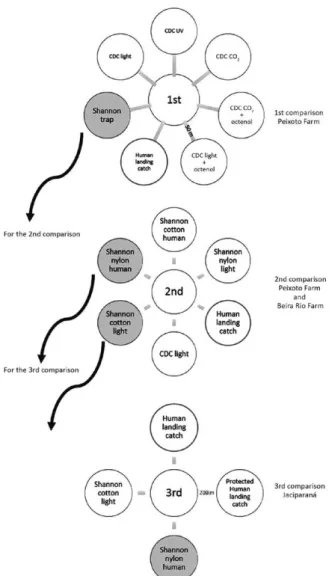
Three comparisons - Several collection methods were evaluated in three comparisons in the Brazilian Amazon. We conducted the comparisons at the end of the 1990s (Fig. 2). The first comparison consisted of seven collec-tion methods carried out in a medium-high anopheline population density and highly malaria-endemic area. The second comparison consisted of the two collection meth-ods with the highest anopheline yields of the first com-parison plus four other collection methods evaluated in the same high anopheline population density and highly malaria-endemic area. The third comparison consisted of the two collection methods with the highest anopheline yields in the second comparison plus two other collection methods. The third comparison was carried out in a ma-laria-endemic area subject to heavy insecticide spraying. Because of this heavy insecticide spraying at the time of comparison, the area presented a low number of malaria cases and low anopheline population density.
First comparison - The first comparison was con-ducted during 1996 on Peixoto Farm in the
municipal-ity of Peixoto de Azevedo, state of Mato Grosso, Brazil (10º13’12”S 54º58’12”W). Peixoto de Azevedo is a non-urban, highly malaria-endemic area with moderate use of insecticide spraying and a medium to high anopheline population density. Anopheline collections were carried out on Peixoto Farm, a cattle breeding farm in the rural area ~3 km from Peixoto de Azevedo. The seven collec-tion methods compared in the first stage comprised the human landing catch, a traditional Shannon trap and five CDC-type traps (CDC white LED light, CDC UV light, CDC CO2, CDC CO2 + octenol-1, CDC light + octenol-1) that were established 50 m from each other during sev-en consecutive nights (Fig. 2). The initial distribution of the collection method sites was random and was rotated clockwise in the subsequent captures to avoid sampling bias (Beaty & Marquardt 1996). Collections started at sunset, at approximately 06:00 pm and lasted for 4 h. Each collection lasted for 40 min with 20 min intervals between collections. Mosquitoes were identified (Faran & Linthicum 1981) and parity status evaluation checked for at least 10% of the females. A total of 1,507
eline specimens belonging to 11 species were collected. The most frequent species found were Anopheles strodei
(27%), An. triannulatus (18.7%), An. darlingi (16.7%), An. marajoara (13.5%) and An. nuneztovari (11.6%) (Table I).
When the total number of anophelines collected by each type of collection method was verified, the results showed that a Shannon trap built with nylon and using a human individual as the attractant was as efficient as the human landing catch (p > 0.05). For the anophelines in the studied areas, all of the CDC-type traps performed poor-ly. Low anopheline collection efficiency was observed even when attractants previously seen as powerful were used, such as CO2 + octenol + UV (Table I). Although An. darlingi was also caught in slightly higher numbers in the nylon-built Shannon trap using a human as attractant, when compared to the human landing catch, this finding was not statistically significant for the species alone (p > 0.05) (Table I). Because the Shannon trap was the anoph-eline collection method with the highest yield in the first comparison, including for An. darlingi, it was selected to be assessed in the second comparison.
Second comparison - The second comparison was also held in 1996 in two farms - the Peixoto Farm and the Beira Rio Farm - both in Peixoto de Azevedo. The Beira Rio Farm (10º09’34”S 55º00’22”W) was located ~7 km from the Peixoto Farm and ~8 km from Peixoto de Azevedo in what is considered a mining area. The anopheline collec-tion methods used were the human landing catch (2 hu-man individuals), a CDC light trap and four versions of the Shannon trap that was the anopheline collection meth-od with the highest yield from the first comparison, for a total of six collection methods for the second comparison.
The Shannon trap was made out of cotton and nylon and used light and a human as attractants (Fig. 2).
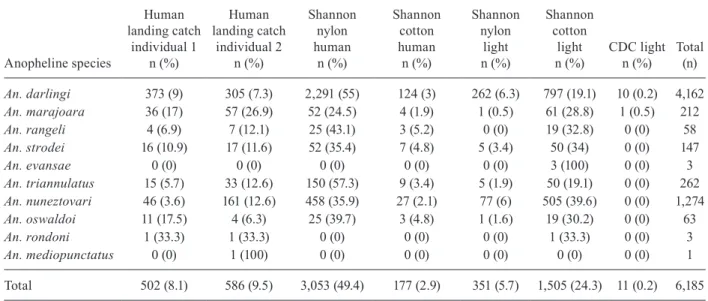
At Beira Rio Farm, 6,185 specimens of anophelines were collected belonging to 10 species. The most fre-quent anopheline species was An. darlingi, representing 67.3% of the total specimens captured, followed by An. nuneztovari, An. triannulatus and An. marajoara, which accounted for 20.6%, 4.2% and 3.4% of the specimens, respectively (Table II).
At Beira Rio Farm, the Shannon-type traps collected the highest number of anophelines (Fig. 3). The Shannon trap made of nylon with a protected human collector in-side had the highest yield for An. darlingi (Fig. 3).
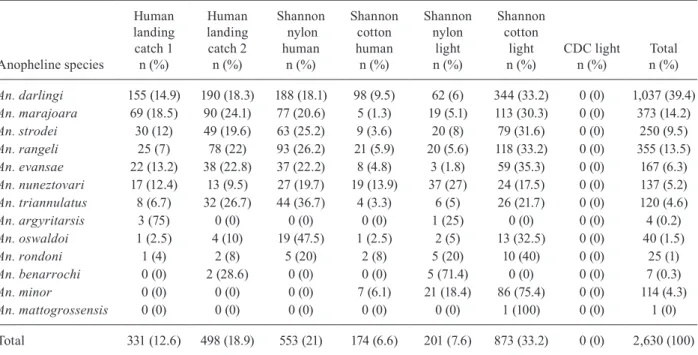
At Peixoto Farm, the second comparison resulted in 2,630 specimens of Anopheles. These anophelines be-longed to 13 species, of which the most frequent were
An. darlingi, accounting for 39.4% of the total and An. marajoara and An. rangeli contributing 14% and 13.5% of the specimens, respectively (Table III).
During the second comparison on Peixoto Farm, a Shannon trap built with cotton using light as an attrac-tant was the collection method with the highest yield when the total number of anophelines was considered (Fig. 3). For An. darlingi during the second comparison on Peixoto Farm, the Shannon trap built with cotton us-ing light as the attractant was also the collection method with the highest yield (Fig. 3).
Therefore, for both Beira Rio Farm and Peixoto Farm, the two collection methods with the highest yield of total anophelines were Shannon traps (Fig. 3). The nylon-built Shannon trap using a human as attractant (50% on Beira Rio Farm and 20% on Peixoto Farm) and the cotton-built
TABLE I
Number of anophelines caught using seven collection methods during the first comparison
during seven consecutive nights at sunset for 4 h (40 min + 20 min interval) in a total of 18.7 h of collection in 1996, Peixoto Farm, municipality of Peixoto de Azevedo, state of Mato Grosso, Brazil
Anopheline species
Human landing
catch n (%)
Shannon nylon human n (%)
CDC CO2 + octenol
n (%)
CDC UV n (%)
CDC light + CO2 n (%)
CDC light n (%)
CDC light + octenol
n (%)
Total (n)
An. strodei 220 (54.1) 125 (30.7) 58 (14.3) 2 (0.5) 2 (0.5) 0 (0) 0 (0) 407
An. marajoara 116 (57.1) 54 (26.6) 23 (11.3) 4 (2) 5 (2.5) 0 (0) 1 (0.5) 203
An. darlingi 111 (44) 136 (54) 1 (0.4) 4 (1.6) 0 (0) 0 (0) 0 (0) 252
An. triannulatus 100 (35.6) 179 (63.7) 0 (0) 0 (0) 2 (0.7) 0 (0) 0 (0) 281
An. nuneztovari 92 (52.6) 71 (40.6) 3 (1.7) 7 (4) 0 (0) 2 (1.1) 0 (0) 175
An. rangeli 57 (45.2) 68 (54) 0 (0) 0 (0) 1 (0.8) 0 (0) 0 (0) 126
An. oswaldoi 9 (23.7) 29 (76.3) 0 (0) 0 (0) 0 (0) 0 (0) 0 (0) 38
An. argyritarsis 7 (100) 0 (0) 0 (0) 0 (0) 0 (0) 0 (0) 0 (0) 7
An. benarrochi 4 (80) 1 (20) 0 (0) 0 (0) 0 (0) 0 (0) 0 (0) 5
An. rondoni 2 (22.2) 7 (77.8) 0 (0) 0 (0) 0 (0) 0 (0) 0 (0) 9
An. evansae 0 (0) 4 (100) 0 (0) 0 (0) 0 (0) 0 (0) 0 (0) 4
Total 718 (47.6) 674 (44.7) 85 (5.6) 17 (1.1) 10 (0.7) 2 (0.1) 1 (0.1) 1,507
TABLE II
Number of anophelines caught using six collection methods during the second comparison
during six consecutive nights at sunset for 4 h (40 min + 20 min interval) in a total of 16 h of collection in 1996, in Beira Rio Farm, municipality of Peixoto de Azevedo, state of Mato Grosso, Brazil
Anopheline species
Human landing catch
individual 1 n (%)
Human landing catch
individual 2 n (%)
Shannon nylon human n (%)
Shannon cotton human n (%)
Shannon nylon
light n (%)
Shannon cotton
light n (%)
CDC light n (%)
Total (n)
An. darlingi 373 (9) 305 (7.3) 2,291 (55) 124 (3) 262 (6.3) 797 (19.1) 10 (0.2) 4,162
An. marajoara 36 (17) 57 (26.9) 52 (24.5) 4 (1.9) 1 (0.5) 61 (28.8) 1 (0.5) 212
An. rangeli 4 (6.9) 7 (12.1) 25 (43.1) 3 (5.2) 0 (0) 19 (32.8) 0 (0) 58
An. strodei 16 (10.9) 17 (11.6) 52 (35.4) 7 (4.8) 5 (3.4) 50 (34) 0 (0) 147
An. evansae 0 (0) 0 (0) 0 (0) 0 (0) 0 (0) 3 (100) 0 (0) 3
An. triannulatus 15 (5.7) 33 (12.6) 150 (57.3) 9 (3.4) 5 (1.9) 50 (19.1) 0 (0) 262
An. nuneztovari 46 (3.6) 161 (12.6) 458 (35.9) 27 (2.1) 77 (6) 505 (39.6) 0 (0) 1,274
An. oswaldoi 11 (17.5) 4 (6.3) 25 (39.7) 3 (4.8) 1 (1.6) 19 (30.2) 0 (0) 63
An. rondoni 1 (33.3) 1 (33.3) 0 (0) 0 (0) 0 (0) 1 (33.3) 0 (0) 3
An. mediopunctatus 0 (0) 1 (100) 0 (0) 0 (0) 0 (0) 0 (0) 0 (0) 1
Total 502 (8.1) 586 (9.5) 3,053 (49.4) 177 (2.9) 351 (5.7) 1,505 (24.3) 11 (0.2) 6,185
Shannon trap using light as the attractant (24% on Beira Rio Farm and 33% on Peixoto Farm) showed the highest yields when compared to the human landing catch. For
An. darlingi, when compared to the human landing catch method,thehighest yields were observed for the Shan-non nylon trap with human attractant and the ShanShan-non cotton trap with light as the attractant, irrespective of the area and epidemiological malaria conditions (Fig. 3).
From our perspective, these results indicate that when anopheline density is high and reaches a thresh-old, the human landing catch is not particularly efficient. We believe that this is due to the decreased collection capacity of the collector when facing a high number of mosquitoes. In these situations, Shannon-type traps can be more efficient.
Whereas in the human landing catch, the average per-centage of An. darlingi collected for two human collectors was 8.2%, the Shannon nylon trap with human attractant collected 55% and the Shannon cotton trap with light as an attractant collected 19%, higher efficiencies than the human landing catch. Would the results for the different anopheline collection methods represent a distinct malaria epidemiological situation? The Shannon trap made out of cotton using light and the Shannon trap made out of nylon with a human as bait were the highest yielding anopheline collection methods in the second comparison (Fig. 2) and were selected to be assessed in the third comparison.
Third comparison - To evaluate whether the efficien-cy of anophelines yields could be compared for a distinct malaria epidemiological condition, a third comparison was conducted years later, in 1999, taking into account
the results found in Peixoto de Azevedo, in the municipal-ity of Jaciparaná, state of Rondônia, Brazil (09º15’13”S 64º24’28”W). Jaciparaná was then characterised as an urban area with high malaria endemicity and constant/ intensive insecticide spraying (JBP Lima, unpublished observation). Due to the continuous insecticide spray-ing for malaria vector control, Jaciparaná presented a low anopheline population density. Four collection methods were evaluated in the third comparison: a Shannon trap made out of cotton using light as the attractant, a Shan-non trap made out of nylon with a human as attractant, a protected human landing catch and human landing catch. In the protected human landing catch, the human collector wore a thick black sock on both legs and proceeded as in the human landing catch method. This procedure enabled the collector to capture the anophelines before biting took place. Anopheline collections were carried out in an ur-ban area inside Jaciparaná. The sites of the four collection methods were placed 200 m apart from each other in the peridomicile of four domiciles and were carried out in four different months of the year (February, April, August and November 1999) (Fig. 2) in a four-night collection period during these four months. A total of 4,334 anophelines were collected. Out of these, 4,313, or 99.52%, were An. darlingi. Monthly percentages varied (Table IV).
From the total collected anophelines, 52.8% (2,265) were collected in the human landing catches, 25.9% (1,110) in the protected human landing catches and 17.4% in the Shannon nylon traps with a human as the attrac-tant and only 4% in the Shannon cotton traps with light as the attractant. Similar percentages were observed in the different months (Table IV).
TABLE III
Number of anophelines caught using six collection methods during the second comparison
during six consecutive nights at sunset for 4 h (40 min + 20 min interval) in a total of 16 h of collection in 1996, Peixoto Farm, municipality of Peixoto de Azevedo, state of Mato Grosso, Brazil
Anopheline species
Human landing catch 1
n (%)
Human landing catch 2
n (%)
Shannon nylon human n (%)
Shannon cotton human n (%)
Shannon nylon
light n (%)
Shannon cotton
light n (%)
CDC light n (%)
Total n (%)
An. darlingi 155 (14.9) 190 (18.3) 188 (18.1) 98 (9.5) 62 (6) 344 (33.2) 0 (0) 1,037 (39.4)
An. marajoara 69 (18.5) 90 (24.1) 77 (20.6) 5 (1.3) 19 (5.1) 113 (30.3) 0 (0) 373 (14.2)
An. strodei 30 (12) 49 (19.6) 63 (25.2) 9 (3.6) 20 (8) 79 (31.6) 0 (0) 250 (9.5)
An. rangeli 25 (7) 78 (22) 93 (26.2) 21 (5.9) 20 (5.6) 118 (33.2) 0 (0) 355 (13.5)
An. evansae 22 (13.2) 38 (22.8) 37 (22.2) 8 (4.8) 3 (1.8) 59 (35.3) 0 (0) 167 (6.3)
An. nuneztovari 17 (12.4) 13 (9.5) 27 (19.7) 19 (13.9) 37 (27) 24 (17.5) 0 (0) 137 (5.2)
An. triannulatus 8 (6.7) 32 (26.7) 44 (36.7) 4 (3.3) 6 (5) 26 (21.7) 0 (0) 120 (4.6)
An. argyritarsis 3 (75) 0 (0) 0 (0) 0 (0) 1 (25) 0 (0) 0 (0) 4 (0.2)
An. oswaldoi 1 (2.5) 4 (10) 19 (47.5) 1 (2.5) 2 (5) 13 (32.5) 0 (0) 40 (1.5)
An. rondoni 1 (4) 2 (8) 5 (20) 2 (8) 5 (20) 10 (40) 0 (0) 25 (1)
An. benarrochi 0 (0) 2 (28.6) 0 (0) 0 (0) 5 (71.4) 0 (0) 0 (0) 7 (0.3)
An. minor 0 (0) 0 (0) 0 (0) 7 (6.1) 21 (18.4) 86 (75.4) 0 (0) 114 (4.3)
An. mattogrossensis 0 (0) 0 (0) 0 (0) 0 (0) 0 (0) 1 (100) 0 (0) 1 (0)
In Jaciparaná, the nylon-built Shannon trap using a human as bait and the cotton-built Shannon trap using light as the attractant followed the human landing catch and maintained the human landing catch yields both for total anophelines collected as well as for An. darlingi
(Fig. 3, Table IV).
The parity of An. darlingi from the three different localities showed a significantly higher percentage of parous females in Jaciparaná (p < 0.05). Differences in parity by type of collection method were not significant (p > 0.05) (Fig. 4, Table V).
In summary, when evaluating variations of the Shan-non trap and the CDC trap against the human landing catch with respect to the qualitative and quantitative yields for anthropophilic anopheline species, the Shannon-type traps using humans and colour as attractants were the col-lection methods with the highest yields (Fig. 5A).
The Shannon-type traps were shown to be a valuable tool for collecting An. darlingi in high densities when a human collector cannot capture swarms of females ac-tively seeking a blood meal, a common occurrence in the Brazilian Amazon (Fig. 5A, B). In one of our collec-tions, for example, a Shannon trap collected thousands of anopheline specimens in only 1 h of capture (JBP Lima, unpublished observation). It would not be possible for a single collector using the human landing catch method to collect this number of anopheline specimens. The Shannon trap was efficient in collecting a large num-ber of mosquitoes, but, interestingly, the Shannon trap was also able to attract and collect An. darlingi in low-density situations.
The different results might be tentatively explained by the spatially and temporally distinct epidemiological conditions in Brazil. Peixoto de Azevedo, for example,
a non-urban malaria-endemic area with high mosquito population densities, a high diversity of anopheline spe-cies and moderate use of insecticide spraying, showed different anopheline yields for the various collection methods for the first and second comparisons. Jaci-paraná, in contrast, an urban non-malaria-endemic area with low mosquito density, low anopheline species diver-sity and intensive insecticide spraying, showed different results for the same collection methods used in Peixoto de Azevedo. In Peixoto de Azevedo, the Shannon trap built with nylon and using a human as the attractant produced the highest number of anophelines when com-pared to the human landing catch in the first
compari-TABLE IV
Number of anophelines caught using four collection methods, four-night collection during four months, at sunset for 4 h (40 min + 20 min interval) in a total of 10.7 h of collection per month and 428 h for the four months
per type of collection method in a third comparison in 1999, Jaciparaná, state of Rondônia, Brazil
Anopheline species
Month (4 nights/month)
Human landing catch
(n)
Protected human landing catch
(n)
Shannon nylon human
(n)
Shannon cotton light
(n)
Total (n)
An. darlingi February 678 304 208 111 1,301
An. nuneztovari 0 0 1 3 4
An. evansae 0 0 0 7 7
An. darlingi April 1,241 723 428 74 2,466
An. nuneztovari 0 1 1 0 2
An. evansae 0 0 2 5 7
An. darlingi August 154 60 36 2 252
An. nuneztovari 0 0 0 0 0
An. evansae 0 0 0 1 1
An. darlingi November 192 23 74 5 294
An. nuneztovari 0 0 0 0 0
An. evansae 0 0 0 0 0
Total 2,265 1,111 750 208 4,334
son. Nonetheless, a few months later, during the second comparison, the Shannon trap built with cotton and us-ing light as the attractant showed the highest yield at the same collection point in Peixoto de Azevedo. In contrast, in Jaciparaná, the nylon Shannon trap using a human as the attractant was the trap with the highest yields after the protected human landing catch. These results show that different anopheline collection strategies might have to be adopted for different epidemiological situations pre-vailing in highly malaria-endemic areas that are distinct in both in space and time. For instance, we know that highly anthropophilic and endophilic behaviour, such as that presented by An. gambiae s.s. in Africa, is unlikely for any of the Neotropical vectors, including An. darlingi
in Brazil. Thus, for Neotropical anophelines, is there a most suitable collection method that should be employed for a given entomological parameter, another suitable for following transmission dynamics and another suitable for assessing control methods, taking into the account epidemiological characteristics of the area? To be reli-able, any anopheline collection method should be able to estimate the vector’s biting rates in a sufficiently sen-sitive manner. Sensitivity, therefore, is a factor of sam-pling efficiency that for the time being is calculated by comparison with results produced by the human landing catch. The efficiency of collection methods is influenced by the epidemiological characteristics of the area related to the landscape, the resident anophelines and humans, human culture and human behaviour (Gillies & de Meil-lon 1968, Ijumba et al. 2002, Mahande et al. 2007, Kweka et al. 2009). These local characteristics may influence reliable, representative, consistent and epidemiologically meaningful entomological parameters of the anopheline vector populations. In the Neotropics, the collection ef-ficiency for the different methods seems to be dependent on anopheline density. When anopheline density is very high, a nylon-built Shannon trap using a human as the attractant followed by a cotton-built Shannon trap using light as the attractant were more efficient than the human landing catch (Table II). Nonetheless, in moderate den-sity, collection efficiency was not as high as that of the human landing catch (Table III). When anopheline
den-TABLE V
Percentage of parous Anopheles darlingi females caught during 1996-1999 using three different collection methods in three localities in Brazil
Locality Peixoto Farm Beira Rio Farm Jaciparaná Total
Collection method
Dissected (n)
Parous n (%)
Dissected (n)
Parous n (%)
Dissected (n)
Parous n (%)
Total dissected
(n)
Total parous n (%)
Human landing catch 174 34 (19.5) 86 7 (8.1) 609 297 (48.8) 869 338 (38.9)
Shannon nylon human 95 28 (29.5) 243 44 (18.1) 265 113 (42.6) 603 185 (30.68)
Shannon cotton light 166 45 (27.1) 89 14 (15.73) 72 34 (47.2) 327 93 (28.44)
Total 435 107 (76.1) 418 65 (41.93) 946 444 (138.6) 1,799 616 (34.24)
sity is low, however, collection efficiency is better for the human landing catch. Therefore, thus far, out of the many collection methods that have been used in the Neotropics, none of them have qualitatively and quantitatively sur-passed the human landing catch in its efficacy in captur-ing anthropophilic anophelines, mainly represented by
An. darlingi when in low to moderate density (Fig. 5B).
Different collection methods may lead to different re-sults - Different anopheline collection methods may lead to heterogeneous and incomparable results for distinct prevailing malaria transmission conditions in a given area. The need for regular anopheline sampling across wider geographical areas to include a more diverse range of environmental settings has been previously em-phasised (Brown et al. 2008, Kelly-Hope & McKenzie 2009). We believe that distinct epidemiological situa-tions require different, yet comparable, approaches, such as the use of an anopheline collection method of choice for every particular situation.
Collection methods should be species-specific - Pre-vious knowledge regarding the biology of anophelines is important when choosing the collection method. A great portion of anopheline species that are malaria vectors are highly anthropophilic. Some malaria vector species, however, exhibit an eclectic behaviour of suck-ing blood from both animals and humans. This is true, for instance, for the exophilic and zoophilic Anopheles sinensis (Lee et al. 2009). In another example, collec-tion methods based on light attraccollec-tion in combinacollec-tion with odour attractants have been found to lure particular species from a greater area than CO2 alone (Gillies & Wilkes 1970) and distinct CO2 concentrations and non-CO2 attractants combinations have been found to attract different members of the An. gambiae complex (Dekker & Takken 1998). Additionally, the use of an incandes-cent light in CDC traps may enhance the attraction of
Anopheles aconitus (Das et al. 1993). Therefore, know-ing the particularities of the study area, includknow-ing the species targeted, is of key importance in the choice of appropriate collection methods and in the understanding of the results of the captures.
Interestingly, in most highly malaria-endemic areas in Brazil, anthropophilic anophelines do not present high population density. Is this due to the immediate ac-tion of insecticide applicaac-tion conducted by the control services in Brazil? We believe so. Thus far, insecticide sprayings are readily deployable in Brazil, mainly in ur-ban and periurur-ban areas, where access and logistics are greatly facilitated.
The human landing catch is the most accurate anoph-eline collection method - Alternative methods to the hu-man landing catch, for more productive traps in relation to mosquito yield and less exposure for the human collec-tor, have long been sought. Specifically for Latin America and the Caribbean, attempts to find a suitable trap for an-thropophilic anophelines with these characteristics date to the early 1940s (Pritchard & Pratt 1944, Bustamante & Pires 1949) and continue to the present (Wilton 1975, Lourenço-de-Oliveira 1984, Sexton et al. 1986,
Rubio-Palis & Curtis 1992, Rubio-Rubio-Palis 1996, Rubio-Rubio-Palis et al. 1999, JBP Lima et al., unpublished observations).
Currently, no collection method is as precise, accu-rate or representative of the humbiting accu-rates of an-thropophilic anophelines as the human landing catch.
The human landing catch remains the standard an-thropophilic anopheline collection method - In Brazil, as in the rest of the world, of the many collection meth-ods used to attract and capture anophelines, the human landing catch remains the method with the highest yield for anthropophilic vector species, such as An. darlingi, mainly in low to moderate anopheline population den-sities. The human landing catch is a collection method that primarily targets active host-seeking anthropophilic anopheline females and is the method of choice for quan-tifying entomological parameters essential for evaluat-ing and understandevaluat-ing malaria transmission dynamics, such as biting rates, the degree of anthropophily, human exposure and transmission rates. However, the collection of intradomiciliary resting females using knockdown and entry/exit collection methods can be used to answer questions related to resting and endophilic behaviours and to determine the blood source of engorged females (Service 1993, Service & Townson 2002, Harbison et al. 2006). In Brazil and other malaria-endemic territories in the American continents, studies of alternative anoph-eline collection methods to human landing catches are still scarce and restricted to a few research groups (Eiras & Jepson 1991, Rubio-Palis & Curtis 1992, Rubio-Palis 1996, Rubio-Palis et al. 1999, 2012, Gama et al. 2007, 2013, Missawa et al. 2011, JBP Lima et al., unpublished observations). Our results show that the development of Shannon-type traps with biological/chemical attractants using either whole organisms or molecules derived from the host should be investigated. The most effective at-tractant is most likely to be a combination of many odour molecules. Human individuals emit many locating sig-nals, the most powerful being odours. Thus, an appropri-ate blend of human odour molecules in specific ratios is more likely to act as an effective chemical attractant for anthropophilic anophelines (Eiras & Jepson 1991).
Knowledge obtained from technology and the results of anopheline collection methods may contribute to ef-forts to control malaria in the tropical and subtropical areas of the planet, where malaria continues to be an im-portant public health challenge.
ACKNOWLEDGEMENTS
To Ima Aparecida Braga, for logistical support in the col-lection areas, and to Rafael Maciel-de-Freitas, for valuable comments on the anopheline collection methods classification.
REFERENCES
Alencar J, de Mello VS, Serra-Freire NM, Silva JS, Morone F, Guimarães AE 2012. Evaluation of mosquito (Diptera: Culicidae) species rich-ness using two sampling methods in the hydroelectric reservoir of Simplício, Minas Gerais, Brazil. Zoolog Sci 29: 218-222.