Application of the Portuguese version of the Obstructive Sleep
Apnea-18 survey to children
Abstract
Fausto Manuel Vigario Santos Fernandes1, Rafaela da Cruz Vieira Veloso Teles2
1 Head of the ENT Service (Head of the Hospital ENT Service). 2 Bachelor’s Degree in Medicine (ENT Intern, Alto Ave Hospital Center, Guimarães).
Otorhinolaryngology Service of the Alto Ave. Hospital Center.
Send correspondence to: Fausto Fernandes. Rua dos Cuileiros, Creixomil, 4835-044, Guimarães. Portugal. Telefone: 00351 253 540 330. E-mail: [email protected]
Paper submited to the BJORL-SGP (Publishing Management System - Brazilian Journal of Otorhinolaryngology) on July 26, 2013; and accepted on August 27, 2013. cod. 11030.
D
espite the significant prevalence of obstructive sleep apnea syndrome (OSAS) in children, the diagnosis and treatment of this condition is still challenging due to the difficulties inherent to objectively assessing the disease’s severity.Objective: To verify whether the Portuguese version of the Obstructive Sleep Apnea-18 (OSA-18) survey is as valid as its original version in English.
Method: Prospective study. The OSA-18 was translated into Portuguese, culturally adapted, and tested in the Portuguese population. The caregivers of 51 children (aged from 2 to 12 years) diagnosed with OSAS answered the OSA-18-pv survey. Statistical analysis was used to assess the psychometric properties of the survey.
Results: Reliability analysis yielded a Cronbach’s alpha of 0.821, confirming the survey’s consistency. Converging validity was assessed using Pearson’s correlation coefficient, which revealed a statistically significant correlation between individual data and total results. The survey can be easily and quickly answered (7.26 min). The outcomes of the OSA-18-pv showed that quality of life was poor in 14 children with OSAS (28%), moderate in 22 (43%), and high in 15 (29%).
Conclusion: the OSA-18-pv is a valid tool and can be used to assess the impact on the quality of life of Portuguese children with OSAS.
ORIGINAL ARTICLE Braz J Otorhinolaryngol.
2013;79(6):720-6.
BJORL
Keywords: child development; health care surveys; sleep apnea, obstructive.
.org
INTRODUCTION
Obstructive sleep apnea syndrome (OSAS) is a respiratory disorder characterized by prolonged partial obstruction and/or intermittent complete obstruction of the upper airways and interruption of normal ventilation during sleep1.
Pediatric OSAS became an important topic not only because of its high prevalence, but also due to its associations with different comorbidities, some of which bearing possible implications to the affected subject’s adult life. Moreover, it has been established that the pathophysiology of pediatric OSAS is different from that of OSAS in adult subjects. Although its prevalence is yet unknown, pediatric OSAS has been estimated to affect 1%-2 % of children, with cases peaking between the ages of two and eight years, at a time in which the Waldeyer’s ring is enlarged2.
OSAS is the main indication for tonsillectomy and adenoidectomy in children. In the last two decades, a progressive decrease was observed in the number of adenotonsillectomy procedures for recurrent infections and an increase in the number of such procedures for OSAS3. Surgery has been proven effective in controlling
neurocognitive sequelae of OSAS, such as poor school performance and attention deficit and hyperactivity disorder, in improving left and right ventricular ejection fraction, and in decreasing the levels of biomarkers of inflammation4.
However, pediatric OSAS remains underdiagnosed5
and, therefore, undertreated. Polysomnography (PSG) is currently the gold standard test for the diagnosis of OSAS in children. However, PSG is expensive, time consuming, and not all sleep labs run this test in children. The correct diagnosis and the decision of when to surgically intervene is made difficult due to the limited availability of objective measures to determine the severity of OSAS.
Recently, Franco et al.6 developed a survey to assess
the impact of OSAS in children and their caregivers based on 18 questions. This instrument, called the OSA-18 survey, inquires caregivers in five domains: sleep disturbance, physical symptoms, emotional symptoms, daytime function, and caregiver concerns; each item is given a score from one to seven, in which one means ‘never’ and seven means ‘always’.
The OSA-18 survey proved to be simple and quick to complete, and can be used in clinical or research settings. Its va-lidity for the English-speaking population has been established. This study aimed to translate, culturally adapt, and validate the Portuguese version of the OSA-18 (OSA-18-pv).
METHOD
Adaptation and translation into Portuguese
The original version of the OSA-18 survey (Annex 1) was translated by two bilingual physicians into Portuguese,
translated back into English, so that then the final version in Portuguese were produced.
Sample and procedures
This study was carried out between March 2011 and March 2012, with patients seen at the Alto Ave Hospital Center in Guimarães, Portugal, for obstructive sleep apnea syndrome. The protocol was approved by the Ethics Committee of the institution. The following enrollment criteria were applied: (1) patients had to be aged between two and 12 years; (2) subjects had to have a history of sleep-disordered breathing suggestive of OSAS for a period exceeding three months. The exclusion criteria were as follows: (1) presence of craniofacial dysmorphic features; (2) patients with psychiatric disorders (except for attention deficit and hyperactivity disorder); or (3) neuromuscular diseases. The questionnaires were completed by the caregivers of children with a physician present in the room as they visited the hospital. A pretest with 10 questionnaires was conducted to assess the difficulties that the survey could present and whether the respondents had properly understood the questions. Some corrections were made considering the Portuguese socioeconomic and cultural context. The final version of the OSA-18 (Annex 2) was therefore applied to the first 51 caregivers of children meeting the enrollment criteria and diagnosed with OSAS.
Statistical analysis
Data was entered into a computer database developed specifically by the IT Department of the hospital. The data sets were processed with statistical analysis software SPSS (Statistical Package for the Social Sciences) version 19 (SPSS, Inc, USA).
Demographic and clinical data sets (age, gender, socioeconomic status according to Graffar7, level of
education of caregivers, history of recurrent tonsillitis, Friedman8 classification to evaluate the position of the
tongue and the degree of tonsillar hypertrophy, adenoid hypertrophy assessment) were reviewed in the statistical analysis.
The survey’s degree of internal consistency (Cronbach’s alpha) was validated based on the level of homogeneity seen between the different items of the questionnaire (adequate when > 0.70).
For quantitative variables, a correlation between each individual item and the total score of the OSA-pv-18 was assessed using the Pearson correlation coefficient. Convergent validity is verified when the Pearson correlation coefficient is greater than 0.20.
RESULTS
of 5 ± 2 years (2-11 years) with upper and lower quartiles at 4 and 6 years.
According to the Graffar socioeconomic classifi-cation, one child belonged to class I (2%), two to Class II (4%), 35 to Class III (69%), 13 to Class IV (25%), and none to Class V.
Two caregivers (4%) graduated from university, three (6%) graduated from high school or two-year degree programs, 11 (22%) did not complete high school or two-year degree programs, and 35 (69%) completed elementary school.
When history of recurrent tonsillitis was considered, 26 children (51%) met the Paradise9 criteria. On physical
examination, 31 children (61%) had Friedman grades 3 or 4 tonsillar hypertrophy, while the remaining 20 (39%) had grade 2 tonsillar hypertrophy. The position of the tongue, according to Friedman’s classification, was grade I in 18 children (35%) and grade II in the remaining 33 children (65%). Cephalometric evaluation was used to assess the degree of adenoid hypertrophy, which was determined by the ratio between the width of the adenoid tissue and the anteroposterior diameter of the nasopharynx after drawing a line tangential to the spheno-occipital synchondrosis intersecting the soft palate. Fifteen percent of the children had grade 2 adenoid hypertrophy (adenoid-nasopharynx ratios of 26% to 50%), 26% had grade 3 adenoid
hypertrophy (ratios of 51% to 75%) and 59% had grade 4 adenoid hypertrophy (ratio > 75%).
Caregivers answered the surveys while at the hospital in the presence of a physician. The mean time to complete the survey was 7 minutes (4-13 minutes). Five participants (10%) found the questionnaire difficult to understand. On item ‘sleep disturbance’, the percentages of children who had a score of five or higher (meaning the symptom was present at least ‘a good bit of the time’) were: 76% for loud snoring; 41% for breath holding spells or pauses in breathing at night; 33% for choking or making gasping sounds while asleep; and 53% for restless sleep or frequent awakenings from sleep. On item ‘physical symptoms’, mouth breathing because of nasal obstruction was present at least ‘a good bit of the time’ in 37 children (73%); frequent colds or upper respiratory infections in 18 (35%); nasal discharge or a runny nose in 27 (53%); and difficulty in swallowing foods in 11 (22%). Emotional symptoms (items 9-11) and daytime function (items 12-14) were the two areas with the lowest mean scores. Approximately 59% of the caregivers felt concerned about the health of their children; 59% also felt concern that their children were not breathing enough air; 33% felt that these problems interfered with performance in daily activities; and 33% felt frustrated with the children’s condition most of the time (Table 1).
Table 1. OSA-18-pv - Answers given to individual item answers for 51 children with OSAS (scale from one to seven, in which, 1)
none of the time, 2) rarely any of the time, 3) a little of the time, 4) some of the time, 5) a good bit of the time, 6) most of the time, 7) all of the time).
Item Subgroup Content Answers scored ≥ 5 (%) Mean scores per
group
1 Sleep disturbance Loud snoring 39 (76)
4.64
2 Sleep disturbance Breath pauses 21 (41)
3 Sleep disturbance Choking/gasping 17 (33)
4 Sleep disturbance Restless sleep 27 (53)
5 Physical symptoms Mouth breathing 37 (73)
4.25
6 Physical symptoms Colds / URTI 18 (35)
7 Physical symptoms Rhinorrhea 27 (53)
8 Physical symptoms Dysphagia 11 (22)
9 Emotional problems Mood swings 11 (22)
2.80 10 Emotional problems Aggressive/hyperactive behavior 15 (29)
11 Emotional problems Discipline problems 9 (18)
12 Daytime function Hypersomnia 8 (16)
2.88
13 Daytime function Attention deicit 12 (23)
14 Daytime function Dificulty waking up 10 (20)
15 Caregiver concern Worry about the child’s health 30 (59)
4.18 16 Caregiver concern Child is not getting
enough air 30 (59)
17 Caregiver concern Missing daily living activities 17 (33)
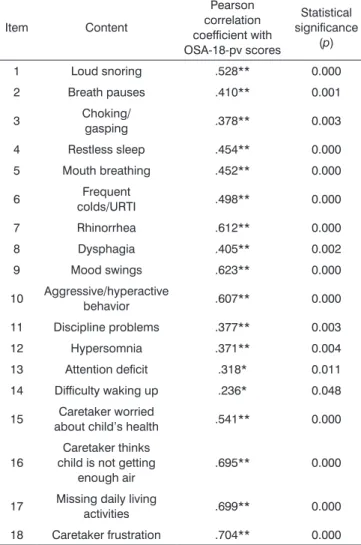
Reliability analysis was carried out on SPSS based on internal consistency, yielding a Cronbach’s alpha of 0.821 considering all items in the study. Converging validity was verified through the Pearson correlation coefficient, and each item was seen to have a statistically significant correlation with the OSA-18 total score and a Pearson coefficient correlation above 0.20 (Table 2).
Table 2. Pearson correlation coeficient between each item and
total scores in the OSA-18-pv, and signiicance levels (n = 51).
Item Content Pearson correlation coeficient with OSA-18-pv scores Statistical signiicance
(p)
1 Loud snoring .528** 0.000
2 Breath pauses .410** 0.001
3 Choking/
gasping .378** 0.003
4 Restless sleep .454** 0.000
5 Mouth breathing .452** 0.000
6 Frequent
colds/URTI .498** 0.000
7 Rhinorrhea .612** 0.000
8 Dysphagia .405** 0.002
9 Mood swings .623** 0.000
10 Aggressive/hyperactive
behavior .607** 0.000
11 Discipline problems .377** 0.003
12 Hypersomnia .371** 0.004
13 Attention deicit .318* 0.011
14 Dificulty waking up .236* 0.048
15 Caretaker worried
about child’s health .541** 0.000
16
Caretaker thinks child is not getting
enough air
.695** 0.000
17 Missing daily living
activities .699** 0.000
18 Caretaker frustration .704** 0.000
** Correlation is signiicant at a level of 0.01 (1-tailed). * Correlation is signiicant at a level of 0.05 (1-tailed).
Based on the OSA-18-pv total score, the impact of OSAS on quality of life was mild in 14 cases (28%), moderate in 22 (43%), and severe in 15 (29%) (Table 3).
DISCUSSION
The OSA-18 is a quick, easy-to-use, highly reliable and consistent test used to evaluate the subjective aspects of quality of life in children with OSAS6. This study
showed that the OSA-18-pv is an adequate translation
Table 3. The impact of OSAS on the quality of life of 51 children.
OSA-18-pv Total score
Impact on quality of life
Frequency (n)
Percent
(%)
< 60 Mild 14 27.5
[60-80] Moderate 22 43.1
≥ 80 Severe 15 29.4
of its original version in English, as demonstrated by the high reliability manifested through a Cronbach’s alpha of 0.821 and significant consistency illustrated by the correlation between individual test items and total scores, which yielded a Pearson correlation coefficient > 0.20 and p < 0.05. Generally, the caregivers of the children with OSAS found the survey easy to understand; the five caregivers (9.8%) with medium-to-low income levels and low levels of education found the questions difficult to understand.
This survey allows physicians to better assess the impact of OSAS on affected children and their families, in addition to improving the selection from different treatment classes when combined with other clinical parameters and objectives. The survey is a quick test that can be used by physicians of various specialties.
The consistency and reliability of this study can be attributed to the fact that a guiding protocol was used and that the data sets were collected by the same author. Our protocol for Obstructive Sleep Apnea Syndrome10 includes
systematic interviews in which caregivers are asked about the nocturnal signs and symptoms related to obstructive disease, including parasomnias, daytime symptoms, signs of adenotonsillar hypertrophy, and cognitive and behavioral problems. The second part of the protocol revolves around the application of the OSA-18-pv to caregivers in order to assess the impact of the disease on their lives. The children also undergo complete physical examination, which includes ENT evaluation, an analysis of their development in terms of height and body weight, and cardiovascular examination.
The most frequently reported symptoms in the OSA-18-pv survey were sleep disturbances (items 1-4), followed by physical symptoms (items 5-9), and caregiver concerns (items 16-18), as similarly reported by other authors6. Emotional problems and daytime
function (items 10-15) were the areas with the lowest mean scores, although symptoms were often related to OSAS, according to the literature11, and interfered
CONCLUSION
The OSA-18-pv is a quick, easy-to-use instrument used to determine the quality of life of subjects with OSAS. The survey can be used in future research studies. More scientific research is needed in the area of pediatric OSAS to determine diagnostic criteria,
correlate survey data with quality of life, clinical parameters with polysomnography results, to thus determine when it is necessary to carry out polygraphic sleep recordings/polysomnography to allow the timely referral of patients to ENT care and the identification of good candidates for surgery.
Annex 1. OSA-18 for children with OSAS - English version [4].
OSAS Quality of Life Survey (OSA-18) Date:___/_____/____
Name:______________________
For each question below, please circle the number that best describes how often each symptom or problem has occurred during the past 4 weeks. Please circle only one number per question. Thank you.
None of the time
Rarely any of the time
A little of the time
Some of the time
A good bit of the time
Most of the time
All of the time
Sleep Disturbance
During the past 4 weeks, how often has your child had…
… loud snoring? 1 2 3 4 5 6 7
… breath holding spells or pauses in breathing at night? 1 2 3 4 5 6 7
… choking or made gasping sound while asleep? 1 2 3 4 5 6 7
… restless sleep or frequent awakenings from sleep? 1 2 3 4 5 6 7
Physical Symptoms
During the past 4 weeks, how often has your child had…
… mouth breathing because of nasal obstruction? 1 2 3 4 5 6 7
… frequent colds or upper respiratory infections? 1 2 3 4 5 6 7
... nasal discharge or a runny nose? 1 2 3 4 5 6 7
… dificulty in swallowing foods? 1 2 3 4 5 6 7
Emotional Symptoms
During the past 4 weeks, how often has your child had…
… mood swings or temper tantrums? 1 2 3 4 5 6 7
… aggressive or hyperactive behavior? 1 2 3 4 5 6 7
… discipline problems? 1 2 3 4 5 6 7
Daytime Function
During the past 4 weeks, how often has your child had…
… excessive daytime sleepiness? 1 2 3 4 5 6 7
… aggressive or hyperactive behavior? 1 2 3 4 5 6 7
… discipline problems? 1 2 3 4 5 6 7
Caregiver Concerns
During the past 4 weeks, how often have the problems described above…
… caused you to worry about your child’s general health? 1 2 3 4 5 6 7
… created concern that your child is not getting enough air? 1 2 3 4 5 6 7
… interfered with your ability to perform daily activities? 1 2 3 4 5 6 7
OSA-18 Versão Portuguesa (OSA-18-pv) Data:___/_____/____
Nome:______________________
Em cada uma das questões seguintes, faça por favor um círculo à volta do número que melhor descreve a frequência de cada sintoma ou problema nas últimas 4 semanas. Assinala apenas um número por questão. Obrigado.
Nunca Quase Nunca
Poucas Vezes
Algumas Vezes
Bastantes vezes
Quase
Sempre Sempre
Distúrbio do Sono
Nas últimas 4 semanas, com que frequência o seu ilho teve…
… ressonar alto? 1 2 3 4 5 6 7
… paragens na respiração durante a noite? 1 2 3 4 5 6 7
… engasgos ou respiração ofegante enquanto dormia? 1 2 3 4 5 6 7
… sono agitado ou despertares frequentes do sono? 1 2 3 4 5 6 7
Sintomas Físicos
Nas últimas 4 semanas, com que frequência o seu ilho teve…
… respiração bucal por obstrução nasal? 1 2 3 4 5 6 7
… resfriados ou infecções das vias aéreas superiores? 1 2 3 4 5 6 7
… secreção e congestão nasal? 1 2 3 4 5 6 7
... diiculdade em engolir alimentos? 1 2 3 4 5 6 7
Problemas emocionais
Nas últimas 4 semanas, com que frequência o seu ilho teve…
… alterações do humor ou acessos de raiva? 1 2 3 4 5 6 7
… comportamento agressivo ou hiperactivo? 1 2 3 4 5 6 7
… problemas disciplinares? 1 2 3 4 5 6 7
Problemas do quotidiano
Nas últimas 4 semanas, com que frequência o seu ilho teve…
… sonolência diurna excessiva? 1 2 3 4 5 6 7
… episódios de falta de atenção ou concentração? 1 2 3 4 5 6 7
… diiculdade ao levantar da cama de manhã? 1 2 3 4 5 6 7
Opinião do Informante
Nas últimas 4 semanas, com que frequência os problemas acima descritos…
… causaram preocupação com a sua saúde? 1 2 3 4 5 6 7
… preocuparam-no pelo seu ilho não poder respirar ar suiciente? 1 2 3 4 5 6 7
… interferiram com as suas actividades diárias? 1 2 3 4 5 6 7
… deixaram-no frustrado? 1 2 3 4 5 6 7
Annex 2. Portuguese version of the OSA-18 (OSA-18-pv).
REFERENCES
1. Standards and indications for cardiopulmonary sleep studies in children. American Thoracic Society. Am J Respir Crit Care Med. 1996;153(2):866-78.
2. Uema SF, Vidal MV, Fujita R, Moreira G, Pignatari SS. Behavioral evaluation in children with obstructive sleep disorders. Braz J Otorhi-nolaryngol. 2006;72(1):120-2. PMID: 16917563
3. Rosenfeld RM, Green RP. Tonsillectomy and adenoidectomy: changing trends. Ann Otol Rhinol Laryngol. 1990;99(3 Pt 1):187-91.
4. Church GD. The role of polysomnography in diagnosing and treating obstructive sleep apnea in pediatric patients. Curr Probl Pediatr Ado-lesc Health Care. 2012;42(1):2-25. DOI: http://dx.doi.org/10.1016/j. cppeds.2011.10.001
5. Meltzer LJ, Johnson C, Crosette J, Ramos M, Mindell JA. Prevalence of diagnosed sleep disorders in pediatric primary care practices Pediatrics. 2010;125(6):e1410-8.
7. Graffar M. Une methode de classification sociale d’echantillons de population. Courrier. 1956;6(8):455-9.
8. Friedman M. Sleep Apnea and Snoring: surgical and non-surgical therapy. Philadelphia: Saunders-Elsevier; 2008.
9. Paradise JL, Bluestone CD, Bachman RZ, Colborn DK, Bernard BS, Taylor FH, et al. Efficacy of tonsillectomy for recurrent throat infec-tion in severely affected children. Results of parallel randomized and nonrandomized clinical trials. N Engl J Med. 1984;310(11):674-83. DOI: http://dx.doi.org/10.1056/NEJM198403153101102
10. Veloso-Teles R, Estevão R, Caselhos S, Moreira-Silva F, Fernandes F. Elaboração de um Protocolo Orientador da Consulta de SAOS da Criança. Rev Portuguesa Otorrinolaringol. 2011 (artigo submetido). 11. O’Brien LM, Mervis CB, Holbrook CR, Bruner JL, Klaus CJ, Rutherford