Prosthodontics
Michele Andrea Lopes Iglesias(a) Gabriela Campos Mesquita(a) Analice Giovani Pereira(b)
Lucas Costa de Medeiros Dantas(a) Luís Henrique Araújo Raposo(b) Carlos José Soares(b)
Adérito Soares da Mota(a)
(a) Department of Occlusion, Fixed Prosthodontics and Dental Materials, School of Dentistry, Federal University of Uberlândia - UFU, Uberlândia, MG, Brazil. (b) Department of Operative Dentistry and
Dental Materials, School of Dentistry, Federal University of Uberlândia - UFU, Uberlândia, MG, Brazil.
Corresponding Author:
Adérito Soares da Mota
E-mail: [email protected]
Received for publication on Mar 05, 2012 Accepted for publication on May 16, 2012
Influence of core-finishing intervals on
tensile strength of cast posts-and-cores
luted with zinc phosphate cement
Abstract: The core inishing of cast posts-and-cores after luting is rou-tine in dental practice. However, the effects of the vibrations produced by the rotary cutting instruments over the luting cements are not well-documented. This study evaluated the inluence of the time intervals that elapsed between the cementation and the core-inishing procedures on the tensile strength of cast posts-and-cores luted with zinc phosphate cement. Forty-eight bovine incisor roots were selected, endodontical-ly treated, and divided into four groups (n = 12): GA, control (without inishing); GB, GC, and GD, subjected to inishing at 20 minutes, 60 minutes, and 24 hours after cementation, respectively. Root canals were molded, and the resin patterns were cast in copper-aluminum alloy. Cast posts-and-cores were luted with zinc phosphate cement, and the core-inishing procedures were applied according to the groups. The tensile tests were performed at a crosshead speed of 0.5 mm/min for all groups, 24 hours after the core-inishing procedures. The data were subjected to one-way analysis of variance (ANOVA) and Tukey’s test (α = 0.05). No signiicant differences were observed in the tensile strengths between the control and experimental groups, regardless of the time interval that elapsed between the luting and inishing steps. Within the limitations of the present study, it was demonstrated that the core-inishing procedures and time intervals that elapsed after luting did not appear to affect the retention of cast posts-and-cores when zinc phosphate cement was used.
Descriptors: Dental Polishing; Post and Core Technique; Tensile Strength; Zinc Phosphate Cement.
Introduction
Severely damaged teeth with large structural loss often require posts-and-cores to retain the inal restoration.1-3 The restorative modalities for root-illed teeth have been the subject of important research over the years, aimed at making the root/post complex more resistant to masti-catory loads.4 Cast posts-and-cores have been used routinely to restore root-illed teeth with moderate to severe destruction, especially single-rooted teeth.2,5 This is mainly because cast posts-and-cores can be adapt-ed to different forms of canals, and, due to their proven clinical success, they are still widely used in dentistry.6
The longevity of restored teeth depends on both the remaining tooth structure and the eficiency of the restorative procedure.7 Prosthesis
tention is essential for clinical success. Several stud-ies have demonstrated that variables related to the retention of cast posts-and-cores—such as length,8 surface characteristics,9 diameter,10 wall inclina-tion,11 luting cement type,12 and luting technique13— are directly related to the longevity of the inal pros-thesis. While the inishing of the coronal portion of cast posts-and-cores after luting is routine in dental practice, this procedure can directly inluence the strength of the zinc phosphate cement, which is the common choice for luting metallic retainers.14
Ultrasonic vibration is known to weaken brittle zinc-phosphate-based cements, simplifying the re-moval of cast posts-and-cores and crowns when necessary.15,16 Reports evaluating the ability of ul-trasound instruments to remove luted posts from teeth have shown a direct correlation between the vibrations generated and post loosening.17,18 Because of the characteristics of the handpiece mechanism, the cutting instruments, and the speed of rotation, rotary instrumentation produces vibrations equiva-lent to those produced by ultrasound instruments.19 Additionally, the vibrations produced by rotary dia-mond instruments in high-speed handpieces may af-fect the post/tooth cement layer, consequently jeop-ardizing post stability and retention.20
Few evaluations have been conducted about the effects of inishing procedures on the strengths of different luting cements.21,22 This is signiicant, since the vibrations produced by inishing with rotary cutting instruments mounted on dental handpieces may be responsible for the reduced properties of these materials.20 Therefore, it is important to assess the inluence of coinishing procedures on the re-tention and stability of posts-and-cores to avoid in-terruptions in the longevity of restorations.
Thus, the aim of the present study was to assess the effects of core-inishing procedures, after dif-ferent time intervals, on the tensile strength of cast posts-and-cores luted with zinc phosphate cement. The null hypothesis was that the time elapsed be-tween the luting of the cast post-and-core with zinc phosphate cement and the core-inishing procedures would not inluence the tensile strength of these re-tainers to endodontically treated roots.
Methodology
Forty-eight freshly extracted bovine incisors of similar sizes and shapes were selected according to crown dimensions after measurement of the buc-colingual and mesiodistal widths in millimeters, al-lowing for a maximum deviation of 10% from the average.23 Debris was removed by means of hand-scalers, and teeth were stored in 0.1% thymol solu-tion prior to being tested. The crowns of all the teeth were sectioned perpendicularly to the long axis, 15 mm from the apex, with a water-cooled diamond disk (No. 7020; KG Sorensen, Barueri, Brazil).
Root canals were instrumented by the step-down technique, with 1.0% sodium hypochlorite (Cloro Rio 1.0%; São José do Rio Preto, Brazil), illed with gutta-percha and zinc oxide-eugenol sealer (Endoill; Dentsply, Petrópolis, Brazil). Ini-tially, the post space was created with heated in-struments, and the residual gutta-percha was then removed with Gattes-Gliden burs (2, 3, 4, Dentsply Maillefer, Ballaigues, Switzerland), standardizing the post space to 11 mm and preserving 4 mm of root illing at the apex. Root canal walls were then enlarged with a 1.5-mm-diameter bur (Largo Peeso Reamer, No. 5, Dentsply Maillefer). The roots were perpendicularly embedded in autopolymerizing acrylic resin cylinders (Dencrilon; Dencril, Piras-sununga, Brazil), and pre-fabricated polycarbonate patterns were used for cast post-and-core fabrica-tion (Nucleojet; Ângelus, Londrina, Brazil).23 Re-line of patterns was carried out with the autopoly-merizing acrylic resin in the individual root canal of each specimen (Duralay; Reliance Dental Mfg. Co., Worth, USA) until passive retention was achieved. The individual patterns were adjusted in the respec-tive specimens, and the coronal portion was deined as a cylindrical core.
Co-wax technique, and sandblasted with aluminum ox-ide particles (50 µm) under 2 bar for 10 s. The cor-rect adaptation of the cast posts-and-cores to their respective specimens was conirmed by radiography prior to the luting procedures.
The root canals were cleaned with distilled wa-ter and dried with absorbent paper points prior to cementation. The cast posts-and-cores were luted with zinc phosphate cement prepared according to the manufacturer’s instructions (Zinc Cement; SS White, Rio de Janeiro, Brazil). The cement was ap-plied over the cast post-and-core surfaces and in-serted into the root canal by means of lentulo drills (Dentsply Malleifer). The retainers were then po-sitioned in the root canals, and a constant load of 50 N was applied for 10 min in a static loading de-vice with a 4-mm cylindrical point, to standardize the cement layer thickness. The specimens were ran-domly distributed among four groups (n = 12 each): GA, control (without core inishing); GB, GC, and GD, subjected to core inishing at 20 min, 60 min, and 24 h after cementation, respectively.
Finishing of the cores was achieved with the use of a high-speed handpiece (EXTRAtorque 605C, KaVo do Brasil, Joinville, Brazil) and coarse, ta-pered diamond burs (No. 3146; KG Sorensen) un-der copious water irrigation. A new diamond bur
was used for the core inishing of each specimen and was then discarded. One experienced opera-tor was pre-calibrated by performing the inishing steps in pilot specimens made for this purpose, to standardize the position of the handpiece and the diamond bur in relation to the core long-axis, the manual pressure applied to the metallic cores, and the time required for completing this procedure, so that the technique could be regarded as reasonably consistent.21 This operator performed all inishing steps within 5 min (3 min on the axial surface and 2 min on the occlusal surface), as another way of standardizing the inishing procedure (Figures 1A– 1E). The resulting specimens in each experimental group were stored in distilled water at 37°C for 24h prior to being tested.
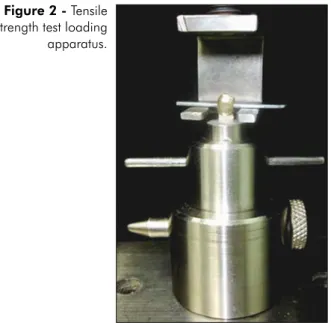
Next, the specimens were attached to a self-aligning tensile device in a mechanical testing ma-chine (DL 2000; EMIC, São José dos Pinhais, Brazil) and subjected to a tensile strength test at a crosshead speed of 0.5 mm/min (Figure 2). Each specimen was tested to failure. At any sudden dis-lodging of the retainer, the test was interrupted, and the tensile strength (N) required for dislodging the posts was recorded by the software (TESQ, EMIC). One-way analysis of variance (ANOVA) was then applied at the α = 0.05 conidence level.
Figure 1 - Core-finishing procedures: (A) diamond rotary cutting instrument in position; (B, C) buccal and proximal aspects of the specimens before cast post-and-core finishing; (D, E) buccal and proximal aspects of the specimens after cast post-and-core finishing steps.
C
E B
Results
Shapiro-Wilk and Kolmogorov-Smirnov tests re-vealed normality and homoscedasticity of the data. One-way ANOVA showed no signiicant differences among the groups tested (Table 1). Table 2 shows the mean tensile strength values (N) and standard deviations for each experimental group. Despite the lack of veriiably signiicant differences among the groups for tensile strength according to core-inish-ing time intervals (P = 0.440), the GA group
(con-trol) showed slightly higher tensile strength numeric values, followed by the GD (inishing after 24 h), GC (inishing after 60 min), and GB (inishing after 20 min) groups.
Discussion
The null hypothesis was fully accepted; results showed no signiicant differences in mean tensile strengths for the experimental groups tested. The core-inishing procedures performed at different time intervals after cast posts-and-cores were luted
tensile strength of these retainers to endodontically treated roots (Tables 1 and 2).
These indings are in agreement with the results reported by Lund and Wilcox, who found no dif-ferences in retention between posts whose cores had been prepared 1 h after cementation and those that had been left unprepared.24 The indings are also in accordance with those from a recent study that also found no differences in tensile strength for posts-and-cores left unprepared and for those prepared 15 min or 7 d after cementation.25 In contrast, Al-Ali et al.21 found that the retention of posts-and-cores prepared 15 min after cementation was lower than that of those prepared 1 and 24 h after cemen-tation. The different time intervals that elapsed be-tween the luting of the cast posts-and-cores and the core-inishing procedures may have produced vari-ous effects on microleakage at the cement-tooth in-terface.24 However, these intervals were not enough to affect the retention of cast posts-and-cores in the present study, since other factors involved in post re-tention—such as length, diameter, wall inclination, surface characteristics, and luting cement—did not appear to be compromised.
The core-inishing procedures involving high-speed handpieces and diamond burs produce vibra-tions that can be compared with those produced by Figure 2 - Tensile
strength test loading apparatus.
Variation source squaresSum of Degree of liberty Medium square Statistical F Significance(P)
Between groups 9822.835 3 3274.278 918.0 0.440 Within the groups 153432.067 43 3568.188
Total 163254.902 46
Table 2 - Mean tensile strengths (N) and standard devia-tions (SD) for tested groups.
Groups Tensile strength (N) ± SD GA 251.55 ± 55.64A
GB 213.39 ± 73.66A
GC 224.13 ± 53.94A
GD 239.62 ± 54.87A
*Same capital letters indicate non-significant difference between groups in rows (α = 0.05).
intense mechanical waves to the cementing layer between the metallic post and the root canal walls, dislodging the post as a result.26 The inishing time used for cast posts-and-cores, then, constitutes an important factor to be analyzed, becoming a vari-able that can produce differences between and among studies. A core-inishing procedure applied for time intervals longer than 5 min could result in retention values different from those observed in this study, since the utilization of variable times up to 12 min of ultrasound application on metallic/met-al-ceramic crowns signiicantly reduces the strength needed for crown removal.27 Thus, the longer the ultrasound application time, the higher the prob-ability of damage to the cement layer.15 This is true mainly for zinc phosphate cements, which require less time for post removal by ultrasonic vibration compared with other luting cements.26 Despite the indings of Lund and Wilcox, who reported that the preparation did not affect the tensile strength of cast posts-and-cores luted with zinc phosphate cement, they observed that post retention was reduced with increased severity of preparation, showing that the time expended on preparation is indeed relevant.24
The zinc phosphate cement setting period has been deined as between 2 and 8 min. However, studies have shown that this cement achieves 70% of its inal strength during the irst setting hour, and its maximum strength is attained only in the next 24 h.28 In this study, the cast posts-and-cores were subjected to tensile strength tests 24 h after the core-inishing procedures were carried out. Perhaps if the tests had been carried out immediately after the inishing procedures, the tensile strength results would have been lower, similar to already-reported values.29 The pre-testing waiting time could be ex-plained by attempts to follow clinical recommenda-tions that the core-inishing process should not be rushed for at least several minutes after the initial hardening of the zinc phosphate cement, to reduce the risk of water/saliva contact, because the material is very soluble in the non-matured state.30
In spite of the care taken for standardization of the specimens and methodology, some variabil-ity was observed in the tensile strength values for
intra-group comparisons. This was probably caused by differences inherent in the root anatomy, in the molding and cast procedures, and in the character-istics of the luting material itself. This variability is common in studies testing the tensile strength of cast posts-and-cores luted with zinc phosphate ce-ment.21 Additionally, the length, diameter, geomet-ric design, surface coniguration of the retainer, and the cement type are also directly related to the reten-tion and stability of cast posts-and-cores in the root canal.8 Thus, conditions different from those used in this study can result in different tensile strength values for cast posts-and-cores.
Increased time intervals between core-inishing procedures after cast post-and-core luting with zinc phosphate cements can result in higher rates of re-tention.21 However, the results of the present study conirm that the initial adjustments and inishing of these retainers can be made in the same session as luting, if the correct cement setting time is ensured prior to preparations with high-speed handpieces and diamond burs. Since this study was conducted in laboratory conditions, it presented some intrin-sic limitations, such as the absence of mechanical/ thermal cycling of the specimens and the use of a single luting cement type and dental alloy for cast-ing posts-and-cores. Clinical assessments would be of beneit.
Conclusions
Within the limitations of this in vitro study, the
following conclusions could be drawn:
1. The tensile strength of the cast posts-and-cores luted with zinc phosphate cement was not inlu-enced by the core-inishing procedures.
2. The time intervals for core inishing of cast posts-and-cores after luting with zinc phosphate cement did not seem to be a signiicant factor in retention when the inishing procedures took up to 5 min.
References
1. Joshi S, Mukherjee A, Kheur M, Mehta A. Mechanical per-formance of endodontically treated teeth. Finite Elem Anal Des. 2001;37(8):587-601.
2. Morgano SM, Brackett SE. Foundation restorations in fixed prosthodontics: current knowledge and future needs. J Pros-thet Dent. 1999 Dec;82(6):643-57.
3. Papa J, Wilson PR, Tyas MJ. Pins for direct restorations. J Dent. 1993 Oct;21(5):259-64.
4. Boschian Pest L, Cavalli G, Bertani P, Gagliani M. Adhesive post-endodontic restorations with fiber posts: push-out tests and SEM observations. Dent Mater. 2002 Dec;18(8):596-602. 5. Ross RS, Nicholls JI, Harrington GW. A comparison of strains
generated during placement of five endodontic posts. J Endod. 1991 Sep;17(9):450-6.
6. Schwartz RS, Robbins JW. Post placement and restoration of endodontically treated teeth: a literature review. J Endod. 2004 May;30(5):289-301.
7. da Silva NR, Raposo LH, Versluis A, Fernandes-Neto AJ, So-ares CJ. The effect of post, core, crown type, and ferrule pres-ence on the biomechanical behavior of endodontically treated bovine anterior teeth. J Prosthet Dent. 2010 Nov;104(5):306-17.
8. Fernandes AS, Dessai GS. Factors affecting the fracture resis-tance of post-core reconstructed teeth: a review. Int J Prostho-dont. 2001 Jul-Aug;14(4):355-63.
9. Williamson RT. Cast core precementation preparation. J Pros-thet Dent. 1995 Mar;73(3):320-1.
10. de Souza Filho CB, Paulino SM, Alfredo E, de Sousa Neto MD, Vansan LP. Effect of the diameter on Cu-Al post reten-tion. Braz Oral Res. 2004 Jul-Sep;18(3):238-41.
11. Tjan AH, Miller GD. Comparison of retentive properties of dowel forms after application of intermittent torsional forces. J Prosthet Dent. 1984 Aug;52(2):238-42.
12. Ertugrul HZ, Ismail YH. An in vitro comparison of cast metal dowel retention using various luting agents and tensile loading. J Prosthet Dent. 2005 May;93(5):446-52.
13. Stockton LW. Factors affecting retention of post systems: a literature review. J Prosthet Dent. 1999 Apr;81(4):380-5. 14. Mezzomo E, Massa F, Libera SD. Fracture resistance of teeth
restored with two different post-and-core designs cemented with two different cements: an in vitro study. Part I. Quintes-sence Int. 2003 Apr;34(4):301-6.
15. Olin PS. Effect of prolonged ultrasonic instrumentation on the retention of cemented cast crowns. J Prosthet Dent. 1990 Nov;64(5):563-5.
16. Queiroz EC, Menezes MS, Biffi JC, Soares CJ. Influence of the shape core on custom cast dowel and core removal by ultrasonic energy. J Oral Rehabil. 2007 Jun;34(6):463-7.
17. Johnson WT, Leary JM, Boyer DB. Effect of ultrasonic vibra-tion on post removal in extracted human premolar teeth. J Endod. 1996 Sep;22(9):487-8.
18. Yoshida T, Gomyo S, Itoh T, Shibata T, Sekine I. An experi-mental study of the removal of cemented dowel-retained cast cores by ultrasonic vibration. J Endod. 1997 Apr;23(4):239-41.
19. Morrison AH, Grinnell HW. The theoretical and functional evaluation of higher speed rotary instrumentation. J Prosthet Dent. 1958;8(2):297-314.
20. Abou-Rass M, Donovan TE. The restoration of endodontically treated teeth. J Calif Dent Assoc. 1993 Dec;21(12):61-7. 21. Al-Ali K, Talic Y, Abduljabbar T, Omar R. Influence of timing
of coronal preparation on retention of cemented cast posts and cores. Int J Prosthodont. 2003 May-Jun;16(3):290-4. 22. Saygili G, Sahmali S, Demirel F. Influence of timing of coronal
preparation on retention of two types of post cores. Am J Dent. 2008 Apr;21(2):105-7.
23. Raposo LH, Silva GR, Santos-Filho PC, Soares PV, Soares PB, Simamoto-Junior PC, et al. Effect of anti-rotation devices on biomechanical behaviour of teeth restored with cast post-and-cores. Int Endod J. 2010 Aug;43(8):681-91.
24. Lund PS, Wilcox LR. The effect of tooth preparation on reten-tion and microleakage of cemented cast posts. J Prosthodont. 1994 Mar;3(1):2-9.
25. Oliveira IK, Arsati YB, Basting RT, Franca FM. Waiting time for coronal preparation and the influence of differ-ent cemdiffer-ents on tensile strength of metal posts. Int J Ddiffer-ent. 2012 Jan;2012:785427.
26. Brito Jr M, Soares JA, Santos SM, Camilo CC, Moreira Jr G. Comparison of the time required for removal of intraradicular cast posts using two Brazilian ultrasound devices. Braz Oral Res. 2009 Jan-Mar;23(1):17-22.
27. Melo Filho AB, Mori M, Jardini MA, Landim KT, Solis AC. Effect of ultrasonic instrumentation on the bond strength of crowns cemented with zinc phosphate cement to natural teeth. An in vitro study. Braz Oral Res. 2008 Jul-Sep;22(3):270-4. 28. Williams PD, Smith DC. Measurement of the tensile strength
of dental restorative materials by use of a diametral compres-sion test. J Dent Res. 1971 Mar-Apr;50(2):436-42.
29. Yamamoto A, Shibayama B, Saito T. Retention of full casted crowns in relation to the diameter of the preparation and the setting time of cementation. Rev Paul Odontol. 1988 Jan-Feb;10(1):18-26.