ABSTRACT: The purpose of this study was to determine some ultrasonographic standards of temporomandibular joints with normally positioned discs. Nineteen patients from 18 to 45 years old (average age: 27.4 years; 16 fe-males and 3 fe-males), with history of orofacial pain, but without clinical or radiological signs of disc displacement, underwent ultrasonography (US) and magnetic resonance imaging (MRI) for the examination of their joints. In 30 joints, the distance between the most lateral point of the articular capsule and the most lateral point of the man-dibular condyle (lateral capsule-condyle distance) was measured, as well as the distance between the most anterior point of the articular capsule and the most anterior point of the mandibular condyle (anterior capsule-condyle distance). In the closed-mouth position, the average values found for the lateral capsule-condyle distance were 1.4 mm and 1.6 mm, respectively in the longitudinal (coronal) and transverse (axial) scans. In the open-mouth position, the average distance was 1.2 mm, in both longitudinal (coronal) and transverse (axial) scans. The average values found for the anterior capsule-condyle distance were 2.3 mm in the closed-mouth position and 1.1 mm in the open-mouth position, both in transverse (axial) scans. Intra-examiner agreement, measured in terms of the in-traclass correlation coeficient, varied from 0.83 to 0.93. We believe that this study can contribute to the validation of US as a diagnostic method for temporomandibular joint disorders, provided that the obtained measurements be used in future studies as normal reference values.
DESCRIPTORS: Temporomandibular joint disorders; Temporomandibular joint; Ultrasonography; Temporoman-dibular joint disk.
RESUMO: Este estudo teve o objetivo de determinar alguns padrões ultra-sonográicos de articulações temporo -mandibulares com discos normalmente posicionados. Dezenove pacientes com 18 a 45 anos de idade (média de 27,4 anos, sendo 16 do sexo feminino e 3 do masculino), com queixa de dor orofacial, mas sem sinais clínicos ou radiológicos de deslocamento do disco, foram submetidos à ultra-sonograia (US) e à ressonância magnética (RM) para avaliação de suas articulações temporomandibulares (ATMs). Em 30 ATMs, mediu-se a distância entre o ponto mais lateral da cápsula articular e o ponto mais lateral do côndilo mandibular (distância cápsula lateral-côndilo),bem como a distância entre o ponto mais anterior da cápsula articular e o ponto mais anterior do côndilo mandibular (distância cápsula anterior-côndilo). Na posição de boca fechada, as médias das medidas da distância cápsula lateral-côndilo foram 1,4 mm e 1,6 mm, respectivamente nos cortes longitudinal (coronal) e transversal (axial). Na posição de boca aberta, a média foi 1,2 mm, em ambos os cortes. As médias das medidas da distância cápsula anterior-côndilo foram 2,3 mm na posição de boca fechada e 1,1 mm na posição de boca aberta, ambas nos corte transversais (axiais). A concordância intra-examinador, medida pelo coeiciente de correlação intraclas -se, variou entre 0,83 e 0,93. Nós acreditamos que este estudo pode contribuir para a validação da US como uma técnica diagnóstica das disfunções temporomandibulares, à medida que as medidas obtidas sejam utilizadas em estudos futuros como valores normais de referência.
DESCRITORES: Transtornos da articulação temporomandibular; Articulação temporomandibular; Ultrasonograia; Disco da articulação temporomandibular.
INTRODUCTION
Temporomandibular joint (TMJ) disorders are recognized as one of the most common causes of orofacial pain. As revealed by imaging techniques,
disc displacement is frequently associated with these disorders, predominantly in the presence of joint pain and noises. Magnetic resonance
* PhD, Oral Surgeon, Division of Dentistry, University Hospital; **PhD, Head Professor, Department of Stomatology, School of Den-tistry; ***MD, Assistant, Service of Radiology, University Hospital; ****PhD, Professor, Discipline of Radiology, School of Medicine; *****PhD, Associate Professor, Department of Stomatology, School of Dentistry – University of São Paulo.
Ultrasonographic findings in normal temporomandibular joints
Achados ultra-sonográficos em articulações
temporomandibulares normais
Fernando Melhem Elias* Esther Goldenberg Birman** Cleide Kioco Matsuda***
ing (MRI) has been considered the most accurate method for visualizing the disc-condyle relation-ship and to confirm the clinical suspicion of disc displacement11. Its accuracy is about 95% when
sagittal and coronal scans are evaluated14. The
main disadvantages of MRI are non-availability in some centers, high cost and restricted use in patients with claustrophobia, cardiac pacemakers and metallic prostheses11. In the last decade,
ultra-sonography (US) has been used as a new method for diagnosing TMJ disc displacement, with the advantages of being noninvasive and less expen-sive than any other imaging technique used with this goal2,8.Most studies on this subject have
as-sessed the disc position depending on its superior relationship to the mandibular condyle, usually defining a normally positioned disc as the one with its posterior boundary located at or distal to the posterosuperior aspect of the condyle1,3-7,9,10,16,17.
However, some authors have questioned if the disc can always be observed during the sonograms2,18.
The difficulty found by some in observing the disc in all the exams performed in their studies has in-spired them to use indirect ultrasonographic signs in order to determine the disc position8,12,13.
Motoy-oshi et al.13 (1998) suggested that some irregularity
of the soft tissues surrounding the TMJ should indicate disc displacement. Landes et al.12(2000)
considered the width of the articular space, more visible in the open-mouth position, as a determi-nant of disc position. For Hayashi et al.8 (2001),
disc displacement should be suspected if the US reveals a distance between the articular capsule and the lateral surface of the mandibular condyle of 4 mm or more.
In the present study, joints free of disc dis-placement underwent ultrasonographic evaluation in order to identify some standards of normality, which could be used in future studies as indirect signs to assess the disc position.
MATERIAL AND METHODS
Nineteen patients (16 females, 3 males; aged between 18 and 45 years, average age: 27.4 years) with clinical diagnosis of orofacial pain underwent US and MRI, resulting in the scanning of 30 joints. Ultrasonographic investigation was carried out by an experienced general radiologist, supported by an oral surgeon, with a Toshiba Power Vision 6000 device and a 6-12 MHz transducer (Toshiba Inc., New York, USA). The optimal images were obtained with the transducer set to 9 MHz.
Magnetic resonance scans were accomplished with a General Electric Signa device of 1.5 T (Gen-eral Electric, Milwaukee, USA) and a dedicated, circular-polarized TMJ coil, obtaining oblique sagittal and oblique coronal T1 and T2 weighted fast spin echo images (repetition time, 2,300 ms; echo time, 30–80 ms), with 3 mm slice thickness, 256 x 160 matrix, 15 cm field of view, in both closed and maximum opening mouth positions. MRI findings were considered as the gold standard, according to normality criteria as the location of the posterior band of the disc at the superior or 12 o’clock position relative to the condyle, in the sagittal scans, and the location of the entire disc at the superior position relative to the condyle, in the coronal scans14,15.
Ultrasonographic investigation was accom-plished with longitudinal and transverse scans in the closed- and open-mouth positions, with the transducer overlying the TMJ and the zygomatic arch. Tilting the transducer over its long axis was necessary to obtain optimal visualization of the articular structures. The scanning was performed by the same radiologist and repeated 3 times for each closed- and open-mouth position, while all the images were being recorded.
In each scan, the operator measured the dis-tance between the most lateral point of the ar-ticular capsule and the most lateral point of the mandibular condyle (lateral capsule-condyle dis-tance). Afterwards, the distance between the most anterior point of the articular capsule and the most anterior point of the mandibular condyle (anterior capsule-condyle distance) was measured.
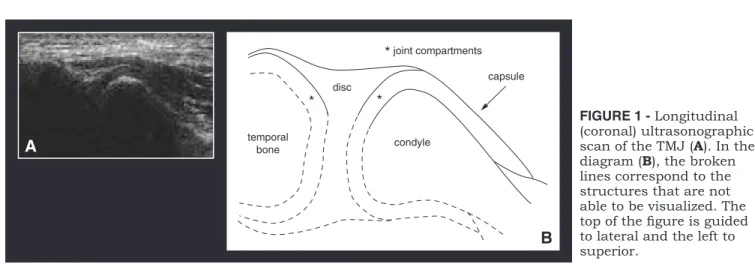
When visible, a normally positioned disc could be identified as an echogenic structure surrounded by a hyperechogenic line, corresponding to the articular capsule (Figure 1), as shown by Elias et al.2 (2002).
Because of inconstant visualization of the disc in all sonograms, lateral and anterior cap-sule-condyle distances were used as indirect ul-trasonographic signs to determine disc position, since these distances could be measured in all the exams (Figures 2 to 5).
RESULTS
for the lateral capsule-condyle distance in the closed-mouth position were 1.4 mm in longitudi-nal scans and 1.6 mm in transverse scans. In the open-mouth position, for both longitudinal and transverse scans, the average value was 1.2 mm. The average values for the anterior capsule-con-dyle distance in the closed- and open-mouth posi-tions were respectively 2.3 mm and 1.1 mm, both in transverse scans. No longitudinal scans could be accomplished to measure the anterior capsule-condyle distance, due to difficulty in observing the anterior portion of the TMJ capsule with this positioning of the transducer.
Differences between the values for the lateral capsule-condyle distance in the closed-mouth po-sition, measured in longitudinal and transverse scans, were statistically significant according to Student’s t-test (p < 0.005). On the other hand, differences between the values for the lateral cap-sule-condyle distance in the open-mouth position, measured in longitudinal and transverse scans, had no statistical significance, according to the same test (p > 0.05).
Intra-examiner agreement, measured in terms of the intraclass correlation coefficient, was 0.83 for lateral capsule-condyle distance in longitudinal scans and closed-mouth position, 0.89 for lateral capsule-condyle distance in longitudinal scans and open-mouth position, 0.83 for lateral capsule-condyle distance in transverse scans and closed-mouth position, 0.91 for lateral capsule-condyle distance in transverse scans and open-mouth po-sition, 0.92 for anterior capsule-condyle distance in transverse scans and closed-mouth position, and 0.93 for anterior capsule-condyle distance in transverse scans and open-mouth position. These values of intraclass correlation coefficient
demon-strated good (> 0.80 and < 0.90) and high (> 0.90) intra-examiner agreement.
DISCUSSION
In the last decade, some studies have been car-ried out with the purpose of establishing ultrasono-graphic criteria that could be used for diagnosing disc displacement. Most studies were based on the identification of the disc and its position relative to the condyle1,4-7,9,10,16,17. However, some authors have
found difficulty in observing the disc itself in all the exams accomplished by them, suggesting that the position of that structure should be evaluated by other anatomical landmarks, independently of its direct visualization8,12,13. These landmarks, as
seen in the sonograms, have been considered as indirect ultrasonographic signs of the disc posi-tion. Similarly to Landes et al.12 (2000), Hayashi et al.8 (2001) proposed an indirect sign to
evalu-ate the anterolevalu-ateral position of the disc, which was the distance between the articular capsule and the lateral surface of the mandibular condyle. We called this landmark lateral capsule-condyle distance, agreeing with Hayashi et al.8 (2001) in
that it is probably enlarged in the cases of lateral disc displacement. In our measurements, the aver-age values for this distance varied from 1.2 mm to 1.6 mm, depending on the scanning direction and the mouth position. These values were situated inferiorly to the cut off value of 4 mm, proposed by Hayashi et al.8 (2001) to separate joints with and
without anterolateral disc displacement.
In our cases, statistical analysis by means of Student’s t-test showed significant difference between longitudinal and transverse scanning, ac-complished in order to measure the lateral
cap-FIGURE 1 - Longitudinal (coronal) ultrasonographic scan of the TMJ (A). In the
diagram (B), the broken
lines correspond to the structures that are not able to be visualized. The top of the igure is guided to lateral and the left to superior.
temporal
bone condyle
capsule
* joint compartments
* *
disc
A
FIGURE 3 -A) Lateral
capsule-condyle distance, as seen in a longitudinal (coronal) ultrasonographic scan, in the closed-mouth position (1 = 2.7 mm) and open-mouth position (2 = 1.9 mm). The top of the igure is guided to lateral and the left side to superior.
B) Same image shown
in (A), with the contour of the capsule and condyle.
2.7 mm 1.9 mm
closed-mouth position open-mouth position
1
2 +
+ ××
A
1
2
× ×
closed-mouth position open-mouth position
2.7 mm 1.9 mm
+ +
B
temporal
bone D condyle
capsule
FIGURE 4 - Diagram of a transverse (axial)
ultrasonographic scan of the TMJ, showing the anterior capsule-condyle distance (double-ended arrow). The top of the igure is guided to lateral and the left side to anterior.
condyle mandible
joint capsule
FIGURE 5 -A) Anterior
capsule-condyle distance in a transverse (axial) ultrasonographic scan, in the closed- (1 = 1.6 mm) and open-mouth (2 = 0.0 mm) positions. The top of the igure is guided to lateral and the left side to anterior.
B) Same image shown in
(A), with the contour of the capsule and condyle. closed-mouth position open-mouth position
1
2
+ + ×
1.6 mm 0.0 mm
1.6 mm 0.0 mm
closed-mouth position open-mouth position
1
2
+ + ×
A
sule-condyle distance in the closed-mouth posi-tion. During the production of the sonograms, we observed that variations in the measurements of this distance are more likely to occur with trans-verse scanning, being much more dependent on the transducer tilting than in longitudinal scan-ning. For this reason, we propose longitudinal
scanning whenever the aim is measuring the lat-eral capsule-condyle distance.
In addition to the assessment of disc posi-tion using the lateral capsule-condyle distance, we assumed that in cases of pure anterior dis-placement no enlargement of this distance is sup-posed to occur. Thus, another indirect sign should TABLE 1 - Averages of 3 consecutive measurements for lateral and anterior capsule-condyle distances in the closed- and open-mouth positions, accomplished in longitudinal (coronal) and transverse (axial) ultrasonographic scans.
J
o
in
t
G
en
d
er
A
ge
S
id
e
Lateral capsule-condyle distance (mm)
Anterior capsule-condyle distance (mm)
longitudinal closed
longitudinal open
transverse closed
transverse open
transverse closed
transverse open
1 F 30 R 2.0 1.4 2.6 2.0 2.1 1.6
2 F 23 R 1.4 1.3 1.3 1.0 2.4 2.4
3 F 24 R 1.0 0.5 1.2 0.6 1.8 1.8
4 F 27 L 0.7 1.1 1.2 1.0 1.2 0.0
5 F 41 L 0.7 0.8 1.2 1.0 1.5 0.0
6 F 45 L 1.4 0.8 1.2 0.9 1.8 1.2
7 F 41 L 1.2 0.4 1.0 0.6 2.1 1.0
8 M 36 R 1.8 1.5 1.9 1.6 3.2 1.1
9 F 28 R 1.4 1.9 1.4 1.9 2.4 1.8
10 F 28 L 1.6 1.9 1.5 1.3 2.0 1.5
11 M 28 R 1.4 1.3 1.4 0.9 1.9 0.0
12 M 28 L 1.3 1.0 1.3 0.7 1.7 0.0
13 F 23 R 2.2 1.2 2.2 1.2 3.3 1.9
14 F 23 L 1.6 1.9 1.6 2.0 2.6 1.8
15 F 34 R 0.7 0.5 1.5 1.1 3.0 1.5
16 F 34 L 0.7 0.7 1.2 0.7 1.4 0.8
17 F 22 R 1.2 0.8 1.5 0.8 1.9 1.5
18 F 22 L 1.4 0.9 1.8 1.1 1.7 1.4
19 F 22 R 1.0 0.8 0.9 0.8 1.4 0.0
20 F 22 L 1.2 0.8 1.1 0.9 1.8 0.0
21 F 26 R 1.1 0.6 1.4 1.1 1.6 0.0
22 F 26 L 1.3 0.6 1.6 0.8 1.5 0.0
23 F 23 R 2.3 1.4 2.1 1.3 2.4 0.0
24 F 23 L 1.8 1.0 1.8 0.9 2.7 2.1
25 F 18 R 1.7 1.1 2.4 0.9 2.5 1.1
26 F 18 L 1.8 2.4 2.0 2.3 2.6 2.1
27 F 18 R 1.8 2.4 2.0 2.3 2.6 2.1
28 F 18 L 2.1 2.5 2.4 2.9 3.9 2.9
29 M 36 R 1.2 1.1 1.3 1.1 3.4 0.0
30 M 36 L 1.3 0.9 1.4 0.8 3.8 0.0
be considered to evaluate anterior disc displace-ment without a lateral vector. Theorizing that the distance between the most anterior point of the articular capsule and the most anterior point of the mandibular condyle (anterior capsule-condyle distance)should be enlarged in cases of anterior displacement, we proposed to make use of this distance to assess the anteroposterior disc po-sition. In our experience, it’s easier to visualize the anterior portions of the articular capsule and mandibular condyle with transverse scanning. To the best of our knowledge, this is the first time in the literature that a standardized ultrasonographic method of measuring the so called anterior cap-sule-condyle distance is presented.
In this study, the operator measured lateral and anterior capsule-condyle distances in joints free of disc displacement, in order to create refer-ence values that could be used to facilitate fu-ture comparisons between normal and diseased joints. The measurements were accomplished in both closed- and open-mouth positions, as well as in longitudinal and transverse scans, since we assumed that in joints with disc displacement the values for these measurements could vary depend-ing on the mouth position and the type of dis-placement (with or without reduction). Considering the very good intra-examiner agreement, it seems that the technique that was proposed is a reliable method to identify anatomical landmarks whose measurements could indicate the disc position.
Because US is an imaging method that is usually accomplished by general radiologists, all the measurements were obtained by consensus between a radiologist and an oral surgeon with
large experience in the anatomy of the TMJ. In our opinion, that’s the way it should be until medical and dental professionals are able to operate the ultrasound device and make the correct diagnosis autonomously.
Finally, we believe that this study can con-tribute to the validation of US as a diagnostic tool in TMJ disorders, since it has established normal values for the lateral and anterior capsule-condyle distances. Certainly, other studies should be car-ried out with a large number of subjects to test the inter-examiner agreement and the reproducibility of the proposed method.
CONCLUSIONS
During TMJ ultrasonographic examination, we concluded that the measurement of the distance between the most lateral point of the articular cap-sule and the most lateral point of the mandibu-lar condyle(lateral capsule-condyle distance) can be used to assess the lateral position of the disc, whereas the measurement of the distance between the most anterior point of the TMJ capsule and the most anterior point of the mandibular condyle (anterior capsule-condyle distance)can be used to assess the anterior position of the disc. The normal values for these distances obtained in the present study can be used in future studies as normal reference values.
ACKNOWLEDGEMENTS
The authors wish to thank Professor Julio da Motta Singer for the statistical analysis.
REFERENCES
1. Brandlmaier I, Rudisch A, Bodner G, Bertram S, Emshoff R. Temporomandibular joint internal derangement: de-tection with 12.5 MHz ultrasonography. J Oral Rehabil 2003;30(8):796-801.
2. Elias FM, Birman EG, Jorge WA, Homsi C. Ultrasonography of the temporomandibular joint. Where is the disc? [letter]. J Oral Maxillofac Surg 2002;60(11):1381.
3. Emshoff R, Bertram S, Rudisch A, Gabner R. The diagnostic value of ultrasonography to determine the temporoman-dibular joint disk position. Oral Surg Oral Med Oral Pathol Oral Radiol Endod 1997;84(6):688-96.
4. Emshoff R, Brandlmaier I, Bodner G, Rudisch A. Con-dylar erosion and disc displacement: detection with high-resolution ultrasonography. J Oral Maxillofac Surg 2003;61(8):877-81.
5. Emshoff R, Jank S, Bertram S, Rudisch A, Bodner G. Disk displacement of the temporomandibular joint:
so-nography versus MR imaging. AJR Am J Roentgenol 2002;178(6):1557-62.
6. Emshoff R, Jank S, Rudisch A, Bodner G. Are high-resolu-tion ultrasonographic signs of disc displacement valid? J Oral Maxillofac Surg 2002;60(6):623-8.
7. Emshoff R, Jank S, Rudisch A, Walch C, Bodner G. Error patterns and observer variations in the high-resolution ultrasonography imaging evaluation of the disk position of the temporomandibular joint. Oral Surg Oral Med Oral Pathol Oral Radiol Endod 2002;93(3):369-75.
8. Hayashi T, Ito J, Koyama J, Yamada K. The accuracy of sonography for evaluation of internal derangement of the temporomandibular joint in asymptomatic elementary school children: comparison with MR and CT. AJNR Am J Neuroradiol 2001;22(4):728-34.
ul-lofac Surg 2005;34(2):132-7.
10. Jank S, Rudisch A, Bodner G, Brandlmaier I, Gerhard S, Emshoff R. High-resolution ultrasonography of the TMJ: helpful diagnostic approach for patients with TMJ disor-ders? J Craniomaxillofac Surg 2001;29(6):366-71. 11. Katzberg RW, Westesson PL. Diagnosis of the
temporo-mandibular joint. Philadelphia: W. B. Saunders; 1994. 12. Landes C, Walendzik H, Klein C. Sonography of the
temporomandibular joint from 60 examinations and com-parison with MRI and axiography. J Craniomaxillofac Surg 2000;28(6):352-61.
13. Motoyoshi M, Kamijo K, Numata K, Namura S. Ul-trasonic imaging of the temporomandibular joint: a clini-cal trial for diagnosis of internal derangement. J Oral Sci 1998;40(2):89-94.
14. Tasaki MM, Westesson PL. Temporomandibular joint: diagnostic accuracy with sagittal and coronal MR imaging. Radiology 1993;186(3):723-9.
RH. Classification and prevalence of temporomandibular joint disc displacement in patients and asymptomatic vol-unteers. Am J Orthod Dentofacial Orthop 1996;109(3):249-62.
16. Tognini F, Manfredini D, Melchiorre D, Bosco M. Comparison of ultrasonography and magnetic resonance imaging in the evaluation of temporomandibular joint disc displacement. J Oral Rehabil 2005;32(4):248-53.
17. Uysal S, Kansu H, Akhan O, Kansu O. Comparison of ultrasonography with magnetic resonance imaging in the diagnosis of temporomandibular joint internal derange-ments: a preliminary investigation. Oral Surg Oral Med Oral Pathol Oral Radiol Endod 2002;94(1):115-21. 18. Westesson PL. Are high-resolution ultrasonographic
signs of disc displacement valid? [discussion]. J Oral Maxil-lofac Surg 2002;60(6):628-9.