w ww . e l s e v i e r . c o m / l o c a t e / b j p
Original
Article
Optimization
of
a
multi-residue
method
for
101
pesticides
in
green
tea
leaves
using
gas
chromatography–tandem
mass
spectrometry
Xue
Hou
a,b,∗,
ShaoRong
Lei
a,b,
LingAn
Guo
a,b,
ShiTing
Qiu
a,b aCenterofAnalysisandTesting,SichuanAcademyofAgriculturalSciences,Chengdu,ChinabLaboratoryofQualityandSafetyRiskAssessmentforAgro-products(Chengdu),MinistryofAgriculture,Chengdu,China
a
r
t
i
c
l
e
i
n
f
o
Articlehistory:
Received13January2016
Accepted2March2016
Availableonline13April2016
Keywords: Tealeaves Pesticideresidues SPE
GC–MS/MS PSA/GCB
a
b
s
t
r
a
c
t
Amethodforanalysisof101pesticideresiduesintealeaveswasdevelopedandvalidatedforthefirsttime. Pureacetonitrilewasusedasextractionsolventratherthanacetonitrileaftermatrixhydrationbasedon theamountofco-extractsandrecoveriesperformance.Duringclean-upprocedure,primary-secondary amine/graphitizedcarbonblack(500mg)wasselected,whichexhibitedoutstandingpropertiesin clean-upcapabilitiesandrecoveriesofpesticidescomparingtoprimary-secondaryamine/graphitizedcarbon black(250mg),NH2-CarbonandTPTabsorbents.Themethodwasvalidatedemployinggas
chromatogra-phycoupledtotandemmassspectrometryatthespikedconcentrationlevelsof0.050and0.100mgkg−1.
Formostofthetargetedpesticides,thepercentrecoveriesrangefrom70to120%,withrelativestandard deviations<20%.Thelinearcorrelationcoefficients(r2)werehigherthan0.99atconcentrationlevels
of0.025–0.250mgkg−1.Limitsofquantificationrangedfrom1.1to25.3
gkg−1forallpesticides.The
developedmethodwassuccessfullyappliedtothedeterminationofpesticidesintealeafsamples. ©2016SociedadeBrasileiradeFarmacognosia.PublishedbyElsevierEditoraLtda.Thisisanopen accessarticleundertheCCBY-NC-NDlicense(http://creativecommons.org/licenses/by-nc-nd/4.0/).
Introduction
Tea,thedriedleavesoftheplantofCamelliasinensis(L.)Kuntze, Theaceae(YangandLandau,2000),isanaromaticbeveragethat consumedworldwide.Duetoitspropertiesofantioxidant, antimi-crobial,anticarcinogenicandanti-inflammatory(deMejiaetal., 2009), tea has attracted great attention. However, tea farming is sensitivetomany kindsof diseases, pestsand weeds,which causesthewidely useof pesticides. Untilnow, more than 300 kindsofpesticideresiduesinteahavebeenreported(Pangetal., 2011).Pesticidesmaycausepotentialhealthrisktoconsumersand imposegreatpressureontheenvironment(Jaggietal.,2001),thus manycountrieshaveestablishedmaximumresiduelimits(MRL) formanypesticides,suchasEuropeanCommunity(EC)no.42/2000 and(EC)no.1881/2006(Lietal.,2013).
Meanwhile,tremendouseffortshavebeenperformedinorder todevelopanalyticalmethodsforpesticidesdeterminationintea. Generally,the preparationmethod ofmulti-residues analysisis carried outin a sequence of severalsteps,including extraction withsolvent,purificationanddetection.Forthesampleclean-up procedure, there areseveral efficientways, suchasgel perme-ationchromatography(GPC)(Pangetal.,2006;Huangetal.,2007)
∗ Correspondingauthor.
E-mail:[email protected](X.Hou).
andsolid-phaseextraction(SPE)(Huangetal.,2009).Apartfrom thesemorecommonapproaches,duringtheanalysisofsome pes-ticideresidues,head-spacesolid-phasemicro-extraction(SPME) (Schureketal.,2008)and stirbarsorptiveextraction(SBSE)(Li etal.,2012)werealsosuccessfullyapplied.Anotherfamousway forthedetectionofmulti-residuesisknownasQuEChERS(quick, easy, cheap, effective, rugged and safe), which involves MeCN extractionandpurificationwithdispersedsolid-phaseextraction (d-SPE)(Anastassiadesetal.,2003a,b;Zhangetal.,2010).Themain conceptofQuEChERSforsampleprocessingstrategyistouse dif-ferenttypeofabsorbentsonthebasisofthecomponentofmatrix, for instance: primary-secondaryamine (PSA),C18 silica,Florisil
and graphitizedcarbonblack (GCB).Haywardetal.have devel-opedamulti-residuesdeterminationmethodinbotanicaldietary supplements usingPSA/GCB asclean-up materials.Whereas,in this study,several SPEmaterialswerecompared depending on clean-upcapabilitiesandrecoveriesofpesticides(Haywardetal., 2013).
Forthedetectiontechniques,atthebeginning,gas chromatog-raphy(GC)andhighperformanceliquidchromatography(HPLC) withvariety ofdetectors were widelyemployedto detect pes-ticide residues. The most commonly used detectors including electroncapturedetector(ECD)(Xiaetal.,2008),flamephotometric detector(FPD)(Moinfarand Hosseini,2009), nitrogen phospho-rusdetector(NPD) (Oh, 2007)for GCand fluorescencedetector (FLD)(Wuetal.,2009),diodearraydetection(DAD)(Sharmaetal.,
http://dx.doi.org/10.1016/j.bjp.2016.03.007
0102-695X/©2016SociedadeBrasileiradeFarmacognosia.PublishedbyElsevierEditoraLtda.ThisisanopenaccessarticleundertheCCBY-NC-NDlicense(http://
2008)forHPLC.Owingtobetterselection,sensitivityandhigher throughputin thedetection of multi-residues, chromatography coupledto MS (Chen et al., 2012; Zhao et al., 2012) and tan-dem MS (MS/MS) (Zhao et al., 2012; Cajkaaet al., 2012) have beenwidelyusednowadays.Thesetechniquesenablethe analy-sisofmulti-residuessimultaneouslywithlowerLODsandhigher accuracy.
Unfortunately,althoughcontrolofpesticidesintealeavesmay increase the safety of tea from the source, for such detection method,littleresearchhasbeendoneuntilnow.Inthisstudy,we describeforthefirsttimethemethodof101residuesintealeaves basedontheapplicationofGC–MS/MScombinedwithoptimized extractionandSPEclean-upprocedures.Moreover,theproposed methodhasbeensuccessfullyappliedtothedeterminationofthese pesticidesinrealsamples.
Experimental
Materialandchemicals
HPLC-gradeMeCN,acetone,tolueneandhexanewereprovided byTedia(Fairfield,OH,USA).PrepackedQuEChERSextractionbags with4gMgSO4,1gsodiumchloride(NaCl),1gtri-sodiumcitrate
dehydrate (tri-Na) and disodium hydrogencitratesesquihydrate (di-Na)werepurchasedfromAgilent(PaloAlto,CA,USA).Standard pesticides(Table1)withpuritiesranging from95 to99%were suppliedbySigma–Aldrich(Madrid,Spain)andDr.Ehrenstorfer (Augsburg,Germany).Stocksolutionsofmixturepesticideswere preparedinacetoneandstoredinfreezer(−18◦C).Theworking
solutionswereprepareddaily.
ForSPE,PSA/GCB(500mg)cartridges,PSA/GCB(250mg) car-tridges,andNH2-CarboncartridgesweresuppliedbyAgilent(Palo
Alto,CA,USA).TPTcartridgeswereobtainedfromAgela Technolo-gies(Tianjin,China).
Equipment
AVortex(IKA,Germany),avacuumdistillationapparatus(IKA, Germany)andacentrifuge(Xingke,China)wereusedforpreparing thesamples.GC–MS/MSsystem(Varian,Inc.,USA)wasemployed, equippedwithaVarian450gaschromatograph(equippedwithaCP 8400autosampleranda1079injector)anda320triplequadrupole MS.A VF-5MSfused silicacapillary column of30m×0.25mm
I.D.and 0.25m wasused (Agilent, Inc., USA). Helium (purity
≥99.999%)wasusedasacarriergasataflowrateof1.2mlmin−1.
Programmedtemperaturevaporation(PTV)wasemployedasthe injectionmode.The injector temperatureprogram wasthe fol-lowing:initialtemperaturewasheldat60◦Cfor1min,increased to250◦C at the rateof 200◦Cmin−1 and was held for 10min.
Aliquotsofsampleextract(5l)wereinjected.TheGCovenwas operatedwiththefollowingtemperatureprogram:initial temper-aturewasheldat50◦Cfor3min,increasedto150◦Cattherate of25◦Cmin−1,andto220◦Cattherateof5◦Cmin−1,thenheld for5min,finallyto280◦Cattherateof8◦Cmin−1,andheldfor 6.5min.
Themassspectrometrywasoperatedwithanelectronimpact (EI)source.Theelectronenergywas70eV,andtheionandtransfer linetemperaturesweresetat230◦Cand300◦Crespectively.The solventdelaywassetto6min.Massspectrometricconfirmation wascarriedoutinthemultiplereactionmonitoring(MRM)mode usingonequantitativeiontransitionandonequalitativeion tran-sitionforeachpesticide.AlltheparametersforMRMtransitions andcollisionenergieswereoptimizedinordertoobtainhighest sensitivityandresolution(Table1).
Samplepreparationandclean-up
Samplepreparation
Tealeaveswerecollectedfromorganicteaplantationlocatedin SichuanprovinceinChinaduringMarch2014,whichwasidentified asCamelliasinensis(L.)Kuntzecv.Mengshan9byProf.YunWang (TeaResearchInstitute,SichuanAcademyofAgriculturalSciences). Thetealeafsampleswerecomminutedwithdryiceand homoge-nized,andthen50gsubsampleswerekeptfrozenuntilspikingor analysis.
Tealeafsubsamples(5g)wereweighedinpolypropylene cen-trifugetubes(50ml)and20mlMeCNwereadded.Thesolutionwas thenvortexedfor1min.QuEChERSextractionbagwith4g anhy-drousMgSO4,1gNaCl,1gtri-sodiumcitratedehydrate(tri-Na)
anddisodiumhydrogencitratesesquihydrate(di-Na)wasadded, andthetubewasvortexedimmediatelytopreventcoagulationof MgSO4for1min.Aftercentrifugation(1210g,10min,−10◦C),5ml
oftheupperacetonitrilelayerwastransferredandpurifiedwith SPE.
SPEprocedure
SPEcartridgeswerepreconditionedwith5mlMeCN–toluene (3:1,v/v).Thenconcentratedextractwasintroducedintothe car-tridge.Forallexperiments,MeCN–toluene(3:1,v/v)wasusedas elutingsolvent.Theeluentswerecollectedandthenconcentrated todrynessusingvacuumconcentration.Finally,theresiduewas redissolvedin2.5mlmixtureofn-hexaneandacetone(9+1;v/v) forGC–MS/MSanalysis.
Gravimetricdeterminationofco-extracts
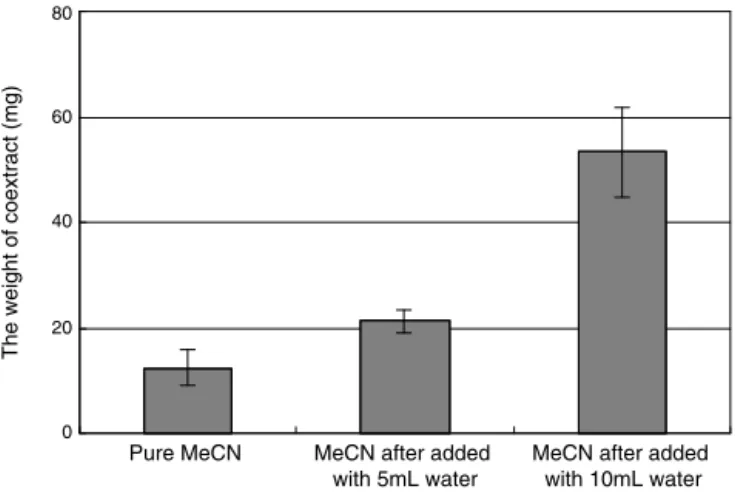
Forsampleextractionprocedure,threetypesof5mlofcrude MeCNextractsobtainedbypureMeCN,MeCNaftermatrix hydra-tionusing5mland10mlwaterwereevaporatedseparatelyuntil drynesswithaweaknitrogenstream,andtheresidueswere gravi-metricallydeterminedbyanalyticalbalance.Averageamountsof fivereplicateswereevaluated(Fig.1),theerrorbars(standard devi-ations)oftheweightsforeachgroupwerealsoshowed.
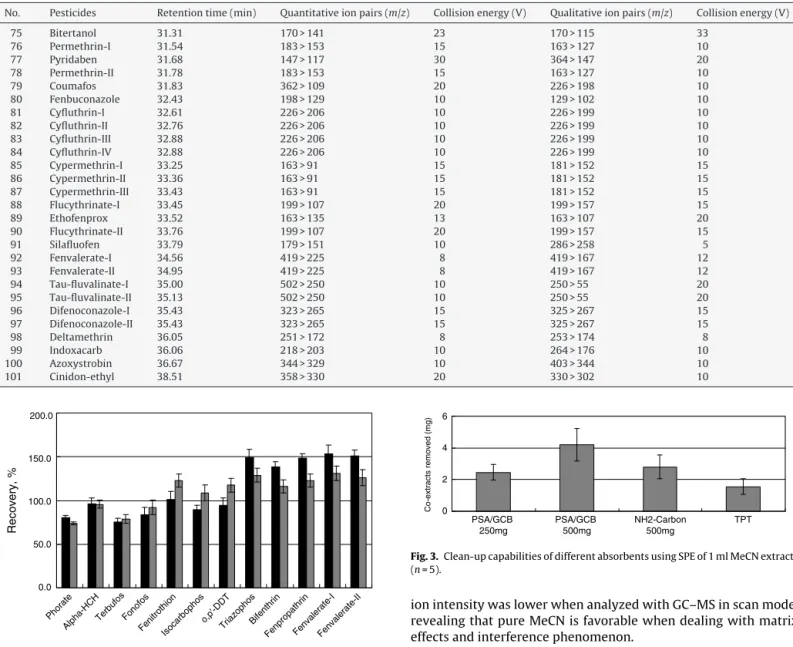
Forclean-upprocedure,5mlofcrudeMeCNextractsand5mlof MeCNextractspurifiedthroughfourtypesofSPEwereevaluated accordingtogravimetricmethoddescribedabove(Fig.3).
Methodperformance
The precision and accuracy of the methodwas tested with spiked tea leaves. Recoveries were determined for five repli-cates at two spiking concentrations (0.050 and 0.100mgkg−1).
0 20 40 60 80
MeCN after added with 5mL water
Pure MeCN MeCN after added
with 10mL water
The weight of coextract (mg)
Fig.1.Amountofco-extractsper1mlMeCNextractsdeterminedgravimetrically
Table1
Parametersfor101pesticideresidueanalysisbyGC/MS–MS.
No. Pesticides Retentiontime(min) Quantitativeionpairs(m/z) Collisionenergy(V) Qualitativeionpairs(m/z) Collisionenergy(V)
1 Isoprocarb 10.74 136>121 10 121>77 20
2 Omethoate 11.52 156>110 10 156>79 20
3 Fenobucarb 11.72 121>77 20 150>121 7
4 Profluralin 11.77 152>110 10 109>81 10
5 Dipheylamine 11.90 167>139 30 141>115 17
6 Diallate-I 13.01 234>150 20 234>192 20
7 Phorate 13.01 260>75 10 260>231 10
8 Alpha-HCH 13.14 181>145 15 217>181 12
9 Diallate-II 13.26 234>150 20 234>192 20
10 Dazomet 13.45 162>89 5 89>44 10
11 Diemthoate 13.57 125>79 10 229>87 10
12 Carbofuran 13.79 164>149 10 221>164 10
13 Chlorbufam 13.83 171>127 10 223>171 10
14 Beta-HCH 14.00 181>145 15 217>181 12
15 Gamma-HCH 14.15 181>145 15 217>181 12
16 Quintozene 14.31 295>237 20 293>235 20
17 Terbufos 14.35 231>175 13 231>129 25
18 Propetamphos 14.40 236>194 10 222>138 10
19 Fonofos 14.44 246>137 10 246>109 20
20 Pyrimethanil 14.61 198>183 10 198>118 30
21 Diazinon 14.78 304>179 10 304>162 10
22 Delta-HCH 14.92 217>181 10 181>145 15
23 Isazofos 15.19 257>162 10 257>119 20
24 Tefluthrin 15.20 177>127 15 197>141 10
25 Fenclorim 15.54 176>120 10 120>93 20
26 Formothion 15.61 224>125 10 170>93 10
27 Vinclozolin 16.34 285>212 10 285>198 20
28 Alachlor 16.59 188>160 10 160>132 10
29 Fenchlorphos 16.79 285>270 25 287>272 15
30 Fenitrothion 17.26 277>260 10 260>125 10
31 Methylparathion 17.26 263>109 10 125>79 10
32 Malathion 17.68 173>99 15 173>127 10
33 Fenthion 17.92 278>109 20 278>125 20
34 Chlorpyrifos 17.99 314>258 10 314>286 10
35 Parathion 18.02 291>109 15 291>137 10
36 Triadimefon 18.11 208>181 10 208>111 10
37 Isocarbophos 18.27 289>136 10 230>212 10
38 Chlorthion 18.33 125>79 10 297>109 10
39 Fosthiazate-I 18.56 195>103 10 195>139 7
40 Fosthiazate-II 18.65 195>103 10 195>139 7
41 Isofenphos-methyl 18.93 199>121 12 241>199 10
42 Quinalphos 19.56 298>156 10 298>190 10
43 Fipronil 19.66 367>213 30 367>255 15
44 Chlorbenside 19.72 125>89 20 268>125 10
45 Methidathion 19.99 145>85 10 302>14 10
46 Chlorfenson 20.70 175>111 10 302>175 10
47 Profenofos 21.12 337>267 15 339>269 15
48 Barban 21.23 222>69 10 257>222 10
49 p,p′-DDE 21.23 246>176 20 316>246 10
50 Buprofezin 21.66 305>175 10 305>190 5
51 p,p′-DDD 22.91 235>165 10 235>200 15
52 o,p′-DDT 23.03 235>165 10 235>200 15
53 Ethion 23.25 231>129 25 231>203 10
54 Triazophos 23.88 257>161 10 161>134 10
55 Quinoxyfen 24.39 272>237 15 237>208 20
56 Carfentrazone-ethyl 24.59 376>330 10 411>312 20
57 p,p′-DDT 24.75 235>165 10 235>200 15
58 Pyraflufen-ethyl 25.46 349>307 15 349>279 20
59 Propargite 26.11 350>201 10 350>173 15
60 Bioresmethrin 26.61 123>81 10 171>128 10
61 Phosmet 27.40 160>133 10 317>160 10
62 Picolinafen 27.91 376>239 15 238>145 25
63 Bifenazate 28.02 300>196 20 196>141 20
64 Bifenthrin 28.07 181>166 10 181>165 20
65 Fenpropathrin 28.28 181>152 20 265>210 10
66 Fenamidone 28.34 268>180 20 311>283 7
67 Phosalone 29.21 182>138 10 367>182 10
68 Pyriproxyfen 29.54 136>96 13 136>78 23
69 Cyhalofop-butyl 29.81 256>120 10 357>256 10
70 Amitraz 29.96 293>162 7 293>132 17
71 Lambda-Cyhalothrin 30.32 197>141 10 208>181 10
72 Pyrazophos 30.65 221>193 10 232>204 10
73 Pyraclofos 30.82 360>194 10 360>139 10
Table1(Continued)
No. Pesticides Retentiontime(min) Quantitativeionpairs(m/z) Collisionenergy(V) Qualitativeionpairs(m/z) Collisionenergy(V)
75 Bitertanol 31.31 170>141 23 170>115 33
76 Permethrin-I 31.54 183>153 15 163>127 10
77 Pyridaben 31.68 147>117 30 364>147 20
78 Permethrin-II 31.78 183>153 15 163>127 10
79 Coumafos 31.83 362>109 20 226>198 10
80 Fenbuconazole 32.43 198>129 10 129>102 10
81 Cyfluthrin-I 32.61 226>206 10 226>199 10
82 Cyfluthrin-II 32.76 226>206 10 226>199 10
83 Cyfluthrin-III 32.88 226>206 10 226>199 10
84 Cyfluthrin-IV 32.88 226>206 10 226>199 10
85 Cypermethrin-I 33.25 163>91 15 181>152 15
86 Cypermethrin-II 33.36 163>91 15 181>152 15
87 Cypermethrin-III 33.43 163>91 15 181>152 15
88 Flucythrinate-I 33.45 199>107 20 199>157 15
89 Ethofenprox 33.52 163>135 13 163>107 20
90 Flucythrinate-II 33.76 199>107 20 199>157 15
91 Silafluofen 33.79 179>151 10 286>258 5
92 Fenvalerate-I 34.56 419>225 8 419>167 12
93 Fenvalerate-II 34.95 419>225 8 419>167 12
94 Tau-fluvalinate-I 35.00 502>250 10 250>55 20
95 Tau-fluvalinate-II 35.13 502>250 10 250>55 20
96 Difenoconazole-I 35.43 323>265 15 325>267 15
97 Difenoconazole-II 35.43 323>265 15 325>267 15
98 Deltamethrin 36.05 251>172 8 253>174 8
99 Indoxacarb 36.06 218>203 10 264>176 10
100 Azoxystrobin 36.67 344>329 10 403>344 10
101 Cinidon-ethyl 38.51 358>330 20 330>302 10
0.0 50.0 100.0 150.0 200.0
Phorate Terbufos
Alpha-HCH FonofosFenitrothionIsocarbophoso,p'-DDTTriazophosBifenthrin
FenpropathrinFenvalerate-IFenvalerate-II
Recovery, %
Pure MeCN MeCN after matrix hydration
Fig.2.Comparisonofrecoveriesobtainedbyanalysisofpesticideresiduesusing
differentextractionprocedures(solventcalibration).
Matrix-matched standards at 0.025, 0.050, 0.100, 0.150,
0.250mgkg−1wereforcalibration.
Resultsanddiscussion
Extractionefficiency
Generally,whendealingwiththeextractionofpesticidesfrom tea,eitherpureMeCN(Pangetal.,2006;Xuetal.,2011)orMeCN (Pangetal.,2011)aftermatrixhydrationcouldbeused.Thetwo methodshaveitsownadvantages,usingMeCNasextractsolvent isrecommendedfortheanalysisofhigh-moisturematrices,and lesspolarmatrixcomponentsremains(Sanco,2010);whereas,for somepesticides,therecoverywouldbebetter,ifsomewatercould beaddedtothematrixbeforeextractedwithMeCN(Poulsenetal., 2009).Inourstudy,theamountofco-extractsusingpureMeCNand MeCNaftermatrixhydrationwascompared.AsshowninFig.1,the additionofextrawaterintotealeavesresultedintheincreaseofthe weightofco-extracts.Meanwhile,forextractsusingpureMeCN,the
0 2 4 6
NH2-Carbon 500mg PSA/GCB
500mg PSA/GCB
250mg
TPT
Co-extracts removed (mg)
Fig.3.Clean-upcapabilitiesofdifferentabsorbentsusingSPEof1mlMeCNextracts (n=5).
ionintensitywaslowerwhenanalyzedwithGC–MSinscanmode, revealingthatpureMeCNisfavorablewhendealingwithmatrix effectsandinterferencephenomenon.
Moreover,therecoveriesof severalpesticidesbelong to dif-ferent types were studied (Fig. 2). For organophosphorus and organochlorine pesticides(Phorate, Alpha-HCH, Terbufos, Fono-fos,Fenitrothion,Isocarbophosando,p′-DDT),therecoverieswere distributedaround100%,andtherewaslittledifferenceexhibited betweenusingpureMeCNandMeCNaftermatrixhydration.For pyrethroidpesticides,matrixeffectwasmuchmoresevere,leading tohighrecoveries.However,matrixeffectcouldbecompensated byusingmatrix-matchedcalibration(Table2).Thus,consideringall theaspectsdiscussedabove,pureMeCNwasusedastheextraction solvent.
ComparisonofdifferentSPEcartridges
Tealeavesrepresentaverycomplexmatrix,whichcontaina greatamountofcaffeine,pigments,polyphenolsetc.Duetothe co-extractsinterferencesandmatrixeffects,thosecomponentscould causeagreattroubleontheanalysisofmultipleresidues(Steiniger etal.,2010).Consideringtheclean-upcapabilitiesaswellasthe pesticiderecoveries,themostcommonlyusedabsorbentsfortea includingPSA/GCB(250mg),PSA/GCB(500mg),NH2-Carbon,and
Table2
Resultsofthevalidationstudy[meanrecoveries(%),relativestandarddeviations(RSDs,%),limitsofquantity(gkg−1)].
Pesticides Spiked0.050(mgkg−1) Spiked0.100(mgkg−1) LOQs(gkg−1) Linearity(r2)
Recovery(%) RSD(%) Recovery(%) RSD(%)
Isoprocarb 110.3 11.0 106.6 8.1 1.6 0.9946
Omethoate 97.7 10.6 79.6 7.3 3.2 0.9910
Fenobucarb 121.7 7.2 113.4 5.1 4.6 0.9973
Profluralin 112.0 6.9 109.2 6.2 11.5 0.9912
Dipheylamine 106.7 30.8 99.8 13.5 8.3 0.9985
Diallate-I 72.0 12.9 79.6 11.0 12.5 0.9961
Phorate 72.3 25.5 77.6 18.4 12.5 0.9942
a-666 113.3 20.6 86.0 11.4 15.6 0.9987
Diallate-II 73.6 14.4 76.4 13.9 12.5 0.9948
Dazomet 99.7 8.6 65.4 5.4 6.6 0.9933
Diemthoate 130.7 12.1 132.6 5.1 6.3 0.9970
Carbofuran 127.0 7.4 111.4 4.9 7.8 0.9936
Chlorbufam 129.3 7.6 99.6 4.6 12.5 0.9952
b-666 120.7 5.0 98.2 4.8 6.3 0.9960
r-666 128.0 18.7 114.4 3.8 15.6 0.9910
Quintozene 68.7 17.4 69.6 14.8 12.5 0.9919
Terbufos 120.0 14.3 98.4 7.5 8.3 0.9902
Propetamphos 116.0 4.8 105.2 3.7 12.5 0.9949
Fonofos 125.0 13.8 96.4 8.2 15.6 0.9951
Pyrimethanil 91.3 4.3 65.2 6.8 20.8 0.9947
Diazinon 119.3 9.1 116.4 5.1 25.3 0.9974
d-666 126.0 4.4 97.0 5.5 17.9 0.9959
Isazofos 119.3 5.7 109.2 4.3 6.0 0.9904
Tefluthrin 126.0 7.5 103.4 5.2 11.9 0.9924
Fenclorim 113.3 5.1 111.4 3.8 5.0 0.9974
Formothion 68.7 15.7 72.2 14.5 3.6 0.9938
Vinclozolin 131.3 3.6 108.2 4.2 2.5 0.9916
Alachlor 131.0 5.2 103.8 3.6 1.7 0.9960
Fenchlorphos 155.0 6.6 124.6 5.2 2.8 0.9976
Fenitrothion 139.7 3.2 113.2 1.3 5.7 0.9903
Methylparathion 136.7 3.3 112.2 1.5 5.0 0.9929
Malathion 122.3 3.6 99.0 4 1.8 0.9953
Fenthion 135.3 4.9 108.4 2.1 2.3 0.9915
Chlorpyrifos 143.7 4.9 117.6 2.7 16.7 0.9943
Parathion 142.3 3.5 121.4 1.9 6.3 0.9926
Triadimefon 96.0 4.8 84.6 6.1 4.6 0.9964
Isocarbophos 102.0 12.0 123.2 4.3 7.7 0.9968
Chlorthion 124.0 3.1 100.6 1.1 11.9 0.9909
Fosthiazate 100.7 5.8 85.2 2.1 2.5 0.9983
Fosthiazate 98.0 7.2 85.6 3.0 1.8 0.9934
Isofenphos-methyl 114.0 4.3 95.0 3.6 1.6 0.9973
Quinalphos 141.3 8.6 120.8 5.7 1.1 0.9965
Fipronil 101.0 4.5 93.6 10.2 2.5 0.9989
Chlorbenside 127.0 4.1 107.8 2.6 1.5 0.9913
Methidathion 118.3 4.2 99.4 2.3 1.5 0.9978
Chlorfenson 109.3 4.6 93.0 3.8 1.5 0.9976
Profenofos 104.3 3.9 93.4 3.6 1.4 0.9964
Barban 90.0 6.3 76.8 15.6 1.5 0.9971
p,p′-DDE 113.3 4.8 95.4 4.9 1.5 0.9980
Buprofezin 102.0 4.1 92.0 5.4 2.5 0.9981
p,p′-DDD 100.3 5.3 85.4 6.2 1.5 0.9973
o,p′-DDT 113.0 4.2 94.2 4.9 1.6 0.9985
Ethion 99.3 4.7 85.4 6.1 1.2 0.9990
Triazophos 92.3 5.0 83.4 5.3 1.8 0.9980
Quinoxyfen 85.3 5.3 80.6 4.2 1.8 0.9975
Carfentrazone-ethyl 90.3 3.3 87.0 3.7 4.0 0.9943
p,p′-DDT 108.0 5 90.4 5.3 1.5 0.9987
Pyraflufen-ethyl 84.3 4.6 82.8 4.4 9.5 0.9962
Propargite 97.3 8.5 88.0 12 13.2 0.9980
Bioresmethrin 85.0 5.7 55.6 6.8 1.6 0.9966
Phosmet 86.7 9.6 81.0 5.0 2.3 0.9975
Picolinafen 95.7 4.1 90.6 3.6 2.3 0.9963
Bifenazate 77.3 18.5 74.0 7.6 3.1 0.9988
Bifenthrin 99.0 6.9 83.2 6.7 1.5 0.9960
Fenpropathrin 92.7 5.0 81.4 5.4 1.8 0.9984
Fenamidone 82.3 6.4 77.6 5.1 1.2 0.9981
Phosalone 93.0 7.7 78.4 9.6 1.4 0.9979
Pyriproxyfen 84.7 6.6 78.6 5.4 1.5 0.9990
Cyhalofop-butyl 87.3 7.6 77.2 6.0 1.5 0.9981
Amitraz 76.0 10.0 76.4 14.7 4.2 0.9970
Lambda-Cyhalothrin 95.0 9.1 80.8 5.6 1.3 0.9962
Pyrazophos 88.7 8.4 74.8 8.5 1.5 0.9964
Pyraclofos 101 4.5 89.2 8.0 1.3 0.9961
Table2(Continued)
Pesticides Spiked0.050(mgkg−1) Spiked0.100(mgkg−1) LOQs(gkg−1) Linearity(r2)
Recovery(%) RSD(%) Recovery(%) RSD(%)
Bitertanol 91.7 5.8 86.6 5.7 1.6 0.9933
Permethrin 98.0 7.6 80.4 8.9 1.6 0.9934
Pyridaben 93.3 7.4 75.6 7.9 2.1 0.9954
Permethrin 96.0 7.0 78.0 7.5 2.9 0.9931
Coumafos 95.7 4.8 86.4 6.5 2.6 0.9983
Fenbuconazole 82.7 9.5 84.6 11.2 3.1 0.9913
Cyfluthrin 89.7 11.9 71.4 13.0 8.9 0.9920
Cyfluthrin 94.3 8.5 74.4 9.1 8.1 0.9928
Cyfluthrin 95.7 12.6 73.8 6.7 13.2 0.9978
Cyfluthrin 124.0 34.3 115.4 7.6 15.6 0.9912
Cypermethrin 95.3 7.7 74.4 11.3 15.6 0.9944
Cypermethrin 109.7 30.3 64.0 10 16.7 0.9938
Cypermethrin 106.3 5.2 88.6 15.3 11.9 0.9976
Flucythrinate 96.7 7.6 75.2 11.1 7.8 0.9932
Ethofenprox 93.3 10.3 71.8 10.4 1.8 0.9995
Flucythrinate 98.7 7.5 75.6 11.7 6.4 0.9929
Silafluofen 98.7 10.8 76.8 7.6 1.4 0.9950
Fenvalerate 94.7 6.4 82.0 9.0 1.7 0.9984
Fenvalerate 102.7 4.7 86.0 8.7 3.3 0.9974
Tau-fluvalinate 80.7 10.6 63.6 14.6 5.8 0.9972
Tau-fluvalinate 92.7 6.4 81.2 11.1 7.5 0.9977
Difenoconazole 76.0 8.8 63.6 14.0 5.0 0.9972
Difenoconazole 78.3 10.3 73.3 12.8 3.9 0.9968
Deltamethrin 76.7 14.8 75.0 18.9 3.1 0.9960
Indoxacarb 78.3 15.8 73.4 17.5 5.8 0.9932
Azoxystrobin 67.3 13.4 64.8 18.2 2.6 0.9988
Cinidon-ethyl 77.3 13.4 72.6 17.7 3.2 0.9987
comparingtoTPT.However,astheamountofPSA/GCBdoubled,
clean-upcapabilitywasincreasedsignificantly.
ItiswidelyrecognizedthattheabsorbentsusedduringSPE pro-cedurecouldabsorbnotonlyco-extractsinterferencesbutalsothe targetedpesticides.Thus,inordertodeterminewhetherthe dif-ferentabsorbentscouldinfluencetheresidueanalysisefficiency obviously,allthetargetedpesticideswereaddedbeforeSPE proce-dure,andthedistributionofrecoverieswereevaluated.Asshownin
Fig.4,therecoveriesofmostpesticideswerelocatedintherange of70–120%foralltheevaluatedabsorbents,whereas,the recov-eriesintherange of<70%exhibitedthegreatestnumber when TPTwasused. Thisindicated that the pesticide-absorbing phe-nomenonofTPTwassevere.Moreover,forPSA/GCB(500mg),the numberofpesticidesintherangeof>120%wasfewerthanPSA/GCB (250mg)andNH2-Carbon,revealingthat PSA/GCB(500mg)has
greatercapabilityininterference-absorbing.
Moreover,caffeine was evaluated by MS in full-scan mode, whichisthemaininterferenceinfreshtealeaves.Theresultshowed thatthecaffeine-removingcapabilitywereoflittledifferencefor NH2-Carbon,TPTandPSA/GCB(500mg)absorbents.Althoughthe
0 20 40 60 80
NH2-Carbon 500mg PSA/GCB
500mg PSA/GCB
250mg
TPT
Number of pesticides
<70 70-120 >120
Fig.4. Distributionoftherecoveries(n=3)obtainedbyusingdifferentabsorbents duringSPEprocessfor101targetedpesticidesintealeaves.
caffeine-removingcapabilityforPSA/GCB(250mg)waspoor,this couldbeattributedtotheabsorbentamount.Thus,accordingto thegravimetric experiment and recovery distribution,PSA/GCB (500mg)wasselectedintheprocedureofSPEclean-up.
Methodvalidation
Method validation of the newly proposed residue-analyzing methodintealeaveswasconducted.Severalvalidationparameters includingrecovery,precision,linearrange,andlimitof quantifica-tion(LOQ)weredeterminedandsummarizedinTable2.
Thelinearity foreach pesticidewasevaluatedusing matrix-matched calibration standards at five concentration levels, i.e. 0.025,0.050,0.100,0.150,0.250mgl−1.Goodlinearityresultswith
theregressioncoefficientsmorethan0.99forallthepesticideswere obtained.TheLOQcalculatedbyconsideringavaluetentimesofthe backgroundnoiserespectively.Forallpesticides,theLOQranged from1.1to25.3gkg−1.
Therecoveryandprecisionofthemethodforthe101targeted pesticideswereevaluatedbycarryingoutsixconsecutive extrac-tions(n=6)ofspikedteaatthetwoconcentrationlevels(0.050and 0.100mgkg−1).Theresultswerecalculatedusingmatrix-matched
calibrationstandardsbyexternalcalibrationmethod.Whenspiked levelswere0.050and0.100mgkg−1,theaveragerecoveriesforall
thetargetedpesticidesrangedfrom67.3to130.7and63.6to132.6 respectively.Therelativestandarddeviations(RSDs)forthetwo spikedlevelswerelowerthan20%.
Realsample
Conclusion
Inthiswork,theextractionmethodsbasedonpureMeCNand MeCNaftermatrixhydrationwereevaluatedthroughgravimetric experimentandcomparisontherecoveriesofrepresentative pes-ticides.Then,theclean-upcapabilitiesofdifferentabsorbents,i.e. PSA/GCB(250mg),PSA/GCB(500mg),NH2-Carbon,andTPTwere
compared.Finally,themethodformulti-pesticidesanalysisintea leaveswasdevelopedusingpureMeCNastheextractionsolvent andPSA/GCB(500mg)inSPEprocedure.DuringGC–MS/MS anal-ysis,MRMmodewasused,andquantitativeanalysiswasachieved byexternalcalibrationmethod.Thecalibrationparametersofthe methodincludingrecovery,precision,linearrange,andLOQwere examined,whichshowedthisnewlyproposedmethodwassuitable formulti-pesticidesanalysisintealeaves.
Authors’contributions
XH,STQperformedthelaboratorywork,dataandGC–MS/MS analysis. XH drafted the paper. SRL, LAG helped perform the analysiswithconstructivediscussions,participatedintheresults discussionandthemanuscriptfinalwriting.
Ethicaldisclosures
Protectionofhumanandanimalsubjects. Theauthorsdeclare thattheproceduresfollowedwereinaccordancewiththe regula-tionsoftherelevantclinicalresearchethicscommitteeandwith thoseoftheCodeofEthicsoftheWorldMedicalAssociation (Dec-larationofHelsinki).
Confidentialityofdata. Theauthorsdeclarethattheyhave fol-lowed theprotocolsof theirworkcenter onthe publicationof patientdata.
Right to privacy and informed consent. The authors have obtainedthewritteninformedconsentofthepatientsorsubjects mentionedinthearticle.Thecorrespondingauthorisinpossession ofthisdocument.
Conflictsofinterest
Theauthorsdeclarenoconflictsofinterest.
Acknowledgment
Thisworkwasfinanciallysupportedby“Riskassessmentoftea qualityandsafety”project,No.GJFP2015005.
References
Anastassiades,M.,Maˇstovská,K.,Lehotay,S.J.,2003a.Evaluationofanalyte protec-tantstoimprovegaschromatographicanalysisofpesticides.J.Chromatogr.A 1015,163–184.
Anastassiades,M.,Lehotay,S.J.,Stajnbaher,D.,Schenck,F.J.,2003b.Fastandeasy multiresiduemethodemployingacetonitrileextraction/partitioningand dis-persivesolid-phaseextractionforthedeterminationofpesticideresiduesin produce.J.AOACInt.86,412–431.
Chen,L., Shang, G.L., Wu,Y., Xu,L., Fu, F.,2012. Study on the residueand
degradation of fluorine-containing pesticides in Oolongtea by usinggas chromatography–massspectrometry.FoodControl25,433–440.
Cajkaa,T.,Sandy,C.,Bachanova,V.,Drabova,L.,Kalachova,K.,Pulkrabova,J.,Hajslova,
J.,2012.Streamliningsamplepreparationandgaschromatography–tandem
massspectrometryanalysisofmultiplepesticideresiduesintea.Anal.Chim. Acta743,51–60.
deMejia,E.G.,Ramirez-Mares,M.V.,Puangpraphant,S.,2009.Bioactivecomponents oftea:cancer,inflammationandbehavior.BrainBehav.Immun.23,721–731. Hayward,D.G.,Wong,J.W.,Shi,F.,Zhang,K.,Lee,N.S.,DiBenedetto,A.L.,Hengel,
M.L.,2013.Multi-residuepesticideanalysisofbotanicaldietarysupplements usingsalt-outacetonitrileextraction,solid-phaseextractioncleanupcolumn andgaschromatography–triplequadrupolemassspectrometry.Anal.Chem.85, 4686–4693.
Huang,Z.Q.,Li,Y.J.,Chen,B.,Yao,S.Z.,2007.Simultaneousdeterminationof102 pesticideresiduesinChineseteasbygaschromatography–massspectrometry. J.Chromatogr.B853,154–162.
Huang,Z.,Zhang,Y.,Wang,L.,Ding,L.,Wang,M.,Yan,H.,2009.Simultaneous deter-minationof103pesticideresiduesinteasamplesbyLC–MS/MS.J.Sep.Sci.32, 1294–1301.
Jaggi,S.,Sood,C.,Kumar,V.,Ravindranath,S.D.,Shanker,A.,2001.Leachingof pes-ticidesinteabrew.J.Agric.FoodChem.49,5479–5483.
Li,X.,Zhang,Z.W.,Li,P.W.,Zhang,Q.,Zhang,W.,Ding,X.X.,2013.Determinationfor majorchemicalcontaminantsintea(Camelliasinensis)matrices.Areview.Food Res.Int.53,649–658.
Li,B.,Zeng,F.G.,Dong,Q.C.,Cao,Y.,Fan,H.T.,Deng,C.F.,2012.Rapiddetermination methodfor12pyrethroidpesticideresiduesinteabystirbarsorptive extraction-thermaldesorption-gaschromatography.Phys.Proc.25,1776–1780.
Moinfar, S., Hosseini, M.R.M., 2009. Development of dispersive liquid–liquid
microextractionmethodfortheanalysisoforganophosphoruspesticidesintea. J.Hazard.Mater.169,907–911.
Oh,C.H.,2007.Purificationmethodformulti-residualpesticidesingreentea.Nat. Prod.Commun.2,1025–1030.
Pang,G.F.,Fan,C.L.,Zhang,F.,Li,Y.,Chang,Q.Y.,Cao,Y.Z.,2011.High-throughput GC–MSandHPLC–MS–MStechniquesforthemulticlassmultiresidue deter-minationof653pesticidesandchemicalpollutantsintea.J.AOACInt.94, 1253–1296.
Pang,Y.F.,Cao,Y.Z.,Zhang,J.J.,Fan,C.L.,Liu,Y.M.,Li,X.M.,Jia,G.Q.,Li,Z.Y.,Shi,Y.Q., Wu,Y.P.,Guo,T.T.,2006.Validationstudyon660pesticideresiduesinanimal tissuesbygelpermeationchromatographycleanup/gaschromatography–mass spectrometryandliquidchromatography–tandemmassspectrometry.J. Chro-matogr.A1125,1–30.
Poulsen,M.E.,Christensen,H.B.,Herrmann,S.S.,2009.Proficiencytestonincurred andspikedpesticideresiduesincereals.Accredit.Qual.Assur.14,477–485. Schurek,J.,Portolés,T.,Hajslova,J.,Riddellova,K.,Hernández,F.,2008.
Appli-cationofhead-spacesolid-phasemicroextractioncoupledtocomprehensive two-dimensionalgaschromatography–time-of-flightmassspectrometryfor thedeterminationofmultiplepesticideresiduesinteasamples.Anal.Chim. Acta611,163–172.
Sharma,A.,Gupta,M.,Shanker,A.,2008.Fenvalerateresiduelevelanddissipation inteaandinitsinfusion.FoodAddit.Contam.25,97–104.
Steiniger,D.,Lu,G.,Butler,J.,Phillips,E.,Fintschenko,T.,2010.Determinationof mul-tiresiduepesticidesingreenteabyusingamodifiedQuEChERSextractionand ion-trapgaschromatography/massspectrometry.J.AOACInt.93,1169–1179.
SANCO/10684/2009,2010.MethodValidationandQualityControlProceduresfor
PesticideResiduesAnalysisinFoodandFeed.CommissionoftheEuropean Communities,8.,pp.18.
Wu,C.C., Chu, C.,Wang, Y.S., Lur, H.S.,2009. Multiresiduemethodfor
high-performanceliquidchromatographydeterminationofcarbamatepesticides residuesinteasamples.J.Environ.Sci.Heal.B44,58–68.
Xia,H.,Ma,X.,Tu,Y.,2008.Comparisonoftherelativedissipationratesofendosulfan pesticideresiduesbetweenoolongandgreentea.FoodAddit.Contam.25,70–75. Xu,X.M.,Yu,C.,Han,J.L.,Li,J.P.,El-Sepai,F.,Zhu,Y.,Huang,B.F.,Cai,Z.X.,Wu,H.W., Ren,Y.P.,2011.Multi-residueanalysisofpesticidesinteabyonlineSEC–GC/MS. J.Sep.Sci.34,210–216.
Yang,C.S.,Landau,J.M.,2000.Effectsofteaconsumptiononnutritionandhealth.J. Nutr.13,2409–2412.
Zhang,X.,Mobley,N.,Zhang,J.G.,Zheng,X.M.,Lu,L.,Ragin,O.,Smith,C.J.,2010. Analysisofagriculturalresiduesonteausingd-SPEsamplepreparationwith GC–NCI-MSandUHPLC–MS/MS.J.Agric.FoodChem.58,11553–11560. Zhao,P.,Wang,L.,Jiang,Y.,Zhang,F.,Pan,C.,2012.Dispersivecleanupof