w w w . s b f g n o s i a . o r g . b r / r e v i s t a
Original
Article
Antischistosomal
activity
from
Brazilian
marine
algae
Erika
M.
Stein
a,
Levi
P.
Machado
b,
Henrique
K.
Roffato
c,
Patricia
A.
Miyasato
c,
Eliana
Nakano
c,
Pio
Colepicolo
d,
Daniel
X.
Andreguetti
a,∗aDepartamentodeAnálisesClínicaseToxicológicas,FaculdadedeCiênciasFarmacêuticas,UniversidadedeSãoPaulo,SãoPaulo,SP,Brazil bNúcleodePesquisaemFicologia,InstitutodeBotânica,SecretariadoMeioAmbientedoEstadodeSãoPaulo,SãoPaulo,SP,Brazil cLaboratóriodeParasitologia,InstitutoButantan,SecretariadeEstadodaSaúde,SãoPaulo,SP,Brazil
dDepartamentodeBioquímica,InstitutodeQuímica,UniversidadedeSãoPaulo,SãoPaulo,SP,Brazil
a
r
t
i
c
l
e
i
n
f
o
Articlehistory: Received22April2015 Accepted7September2015 Availableonline23October2015
Keywords: Antischistosomal Seaweeds
Secondarymetabolites Schistosomamansoni Terpenes
a
b
s
t
r
a
c
t
SchistosomiasismaybecausedbysixdifferentspeciesofthegenusSchistosoma.Currenttreatmentis basedonlyontwodrugs:oxamniquine,whichisonlyeffectiveagainsttheSchistosomamansonispecies, andpraziquantel,whichisineffectiveagainstyoungparasites.Therefore,researchonnewdrugsand theirtargetsforthetreatmentofthisdiseaseisurgentlyneeded.Inthepresentwork,theefficaciesof severalseaweedsextractsagainstS.mansoniweretested.Wormcoupleswereincubatedwithdifferent concentrationofseaweedextractsfor120handmonitoredafterthefirst2handthenevery24hto evaluatedeath,mobilityreductionandcoupledetachment.Theextractsof13differentseaweedspecies weretestedinafirsttrialandtheactiveextractswerefurtherevaluatedinlowerconcentrations.The extractsofGracilariaornataandspeciesbelongingtothegeneraDictyotaandLaurenciashowedactivity atrelativelylowconcentrations.TheactiveextractswereanalyzedbyLC–MS,andpossiblecandidates areproposed.
©2015SociedadeBrasileiradeFarmacognosia.PublishedbyElsevierEditoraLtda.Allrightsreserved.
Introduction
Schistosomiasisisthemostseriousformofparasitismby mul-ticellularorganismsandstillremainsonthelistoftheneglected diseases prioritized by the World Health Organization (WHO, 2015).Thedisease,alsoknownasbilharziaorsnailfever,iscaused byaninfectionwithbloodflukesofthegenusSchistosoma.It pre-dominantlyaffectsthepoorpopulation, representingoneofthe mainpublichealthproblemsinmorethan70developingcountries. AmongtheSchistosomaspecies,Schistosomamansoniisthemost widelyspreadin Africaand LatinAmerica.Theinfectionoccurs whenthehost’sskinispenetratedbythecercaria,theinfectious formoftheparasitelifecycle.Onceinsidethehosttheytransform intoschistosomula,matureandformcouplesinthevenoussystem. Theeggisresponsibleforparasitetransmissionandisalsothemain causeofthediseasesymptoms(Grysselsetal.,2006).
Thediseaseaffectsapproximately240millionpeoplearound theworld,resultinginanannualmortalityrateof280000people. Diseasetreatmentisbasedontwotherapeuticdrugs: praziquan-tel and oxamniquine (WHO, 2015). Praziquantel is ineffective
∗ Correspondingauthor.
E-mail:[email protected](D.X.Andreguetti).
against young parasites and larval-stage schistosomula, but is effective against one-month-old worms; while oxamniquine is onlyactiveagainsttheS.mansonispecies,butnotagainstother members of the Schistosoma genus. Moreover,both drugs face theproblemofresistancedevelopmentintheparasitesandside effects.Therefore,furtherstudiesonthetargetsandnewdrugsare desired.
Duetotheabilitytoproduceawiderangeofchemicalswith sophisticatedstructures, marineorganismsareconsideredgood candidatestoprovidenewdrugswithpharmaceuticalactivities, includingchemicalstoparasiticdiseases(Torresetal.,2014).Itis wellestablishedthatmarineandfreshwatersynthetizeimportant metaboliteswitheconomicimpact(Cardozoetal.,2006;Gressler etal.,2011a,b;Steinetal.,2011;Andreguettietal.,2013;Machado et al., 2014; Simas-Rodrigues et al., 2015), suchas low-weight hydrocarbons,tannins,fattyacids,acetogenins,saponins,phenolic compounds,lignans,alkaloidsandterpenoids(Crewsetal.,1978; Gonzálezetal.,1982;Laus,2001;Lietal.,2011).Specifically,the lastfiveclassescitedhavebeendescribedfortheiranthelmintic properties.
Inthispaper,weshowtheefficaciesof13macroalgaeextracts againstS.mansoni.TheactiveextractsfromtheGracilaria, Dicty-otaandLaurenciagenerawereanalyzedbyLC–MS,andpossible candidatesareproposed.
http://dx.doi.org/10.1016/j.bjp.2015.09.005
Materialsandmethods
Seaweedmaterial
Thespecies Chondrialittoralis Harvey– SP428.154, Dictyota dichotoma(Hudson)J.V.LamourouxSP469.031,Dictyota menstru-alis (Hoyt) Schnetter, Hörnig & Weber-Peukert – SP 469.032, Plocamiumbrasiliense(Greville)M.Howe&W.R.Taylor–SP428.163 and Spyridia hypnoides (Bory de Saint-Vincent) Papenfuss – SP 428.171were collectedat Ububeach, Anchieta– ESwhile the species of Laurencia catarinensis Cordeiro-Marino & Fujii – SP 400.209,LaurenciadendroideaJ.Agardh–SP400.198(designated as (a)) were collectedat Castelhanos beach,Guarapari – ES in October2011.Theaboveseaweedidentificationwasperformed byDr.MutueT.FujiifromInstitutodeBotânicaandMSc.ErikaM. Stein.ThevouchersofeachspecieswereplacedinHerbárioMaria EneidaP.KauffmanFidalgoatInstitutodeBotânica,SãoPaulo(SP). Padinagymnospora(Kützing)Sonder – 18.849,Gracilaria ornata Areschoug–37.629,L.dendroideaJ.Agardh–18.852(designatedas (b)),Ochtodessecundiramea(Montagne)M.A.Howe–18.851, Dic-tyotamertensii(Martius)Kützing–SP469.156andPterocladiella capillacea(S.G.Gmelin)Santelices&Hommersand–18.853were collectedatBaleiabeach,Vitória–ESinJuly2013,andthe identifi-cationwasperformedbyDr.LeviP.Machadoandavoucherofeach speciewasdepositedintheherbariumVIESattheUniversidade FederaldoEspíritoSanto.
Extractionprocedure
Extractswere preparedby usingdifferentprocedures. C. lit-toralis,D.dichotoma,D.menstrualis,P.brasilienseandS.hypnoides werefreeze-dried,powderedandextractedwithsupercriticalCO2,
withtheadditionof4%ethylalcoholasamodifiersolvent.The extractions were performed for 3hat 45◦C and a pressure of 280barwithaCO2flowof12ml/min.ThespeciesL.catarinensis
andL.dendroidea(b)werealsofreeze-driedand powdered,and differentextractswereobtainedbythecrescentorderofsolvent polarity:firsthexane,followedbychloroformandthenmethanol, threetimeseach for 24h. Thespecies P.gymnospora,G. ornata, L.dendroidea(a),O. secundiramea, D. mertensii and P.capillacea werefreshlyextractedwitha2:1mixtureofmethylenechloride: methanol,ataproportionof10ml/gofseaweedwithstirringfor oneweekatatemperatureof20◦C.
Schistosomicidalscreening
The life cycle of S. mansoni (Samboon, 1907) (Trematoda: Schistosomatidae)(BH strain–Belo Horizonte,MG, Brazil)was maintained in Biomphalaria glabrata (Say, 1818) (Gastropoda: Planorbidae)snailsandMesocricetusauratus(Waterhouse,1839) (Mammalia:Cricetidae)hamsters.Femalehamsterswereinfected bysubcutaneousinjectionof 300cercariae,and sixweekslater, S. mansoni adult worms were recovered by perfusion of the rodent’sportalandmesentericsystem.Thewormswerewashed inRPMI1640medium (Invitrogen),pH7.5, supplementedwith sodiumbicarbonate(2000g/ml),penicillin(100UI/ml), strepto-mycin (100g/ml), amphotericin B (0.25g/ml) and 10% fetal bovineserum(Gibco BRL).Adultwormpairs(maleandfemale) weretransferredtoeachwellofa24-wellcultureplate contain-ing1mlofthemedium.Theseaweedsextractsweredissolvedin DMSO(dimethylsulfoxide,at1.5%),dilutedin1mlofRPMImedium andaddedtotheculturedwormstoachieveafinalconcentration of500g/ml. Theparasites werekeptfor120handmonitored afterthefirst2handthenevery24hunderalightmicroscopeto evaluatemotoractivityandthemortalityrate.Thewormswere consideredtobedeadwhen nomovementwasobserved.RPMI
1640with1.5%DMSOwasusedinthenegativecontrolgroup,and 4.8M(1.5g/ml)praziquantel(PZQ)wasusedinthepositive con-trolgroup.Theexperimentswerecarriedoutinfivereplicatesand repeatedatleasttwotimes.Theactiveextractsintheassaywere re-testedatalowerconcentrationof100g/ml.
UFLC–MSanalysis
TheanalysiswerecarriedoutusinganUFLCsystem(Shimadzu, USA)consistingofasolventdeliverypump(ModelLC-20AD)and autosampler(SIL-20Aht)witha100-lloop,degasser(DGU20A3r) andcolumnoven(CTO-20A)followedbyaBrukerESI-microTOFII massspectrometer.Systemoperationwasperformedusing otof-ControlandHyStarV.3.2,whiledatacollectionandanalysiswere performed using Compass DataAnalysis V.4.1. Gradient elution wasperformedonaPhenomenex®Luna3
C18(2)100Acolumn (150mm×2.0mm)at30◦C.MobilephaseAconsistedofaaqueous solutionof20mMNH4Acand0.1%formicacidadjustedtopH6.4,
andsolutionBconsistedofacetonitrilewith0.1%formicacid. Sep-arationswereeffectedbyagradientelutionprogramasfollows: solutionBwasmaintainedat0%from0to2min,followedbya linearchangefrom0%to100%from2to75min,Bwaskeep iso-craticat100%from75to80min.SolutionBwaschangedto0% at80.1minandwasheldconstantuntil90min.Themobilephase flowratewas0.2ml/min,andtheinjectionvolumewas10l.Mass detectionwasperformedscanningthem/zbetween50and1100 inpositivemodewiththefollowingparameters:capillary4500V; endplateoffset−500V;nebulizer2.0Bar;dryheater180◦C;and drygasataflowof8l/min.
Results
TheactiveextractsfromtheGracilaria,DictyotaandLaurencia generadisplayedhighactivityagainstS.mansoniincomparison withtheotherextracts.Table1summarizestheextractionmethods andinvitroeffectsofallofpositivetestedseaweedextracts,which havebeenclassifiedintotwomaingroups,redalgae(Rhodophyta) and brownalgae (Heterokontophyta).Aspreviously mentioned, theextractsdisplayingactivityat500g/mlexposure,were con-sideredtobeactiveand subjectedtofurthertestingata lower concentration (100g/ml). The killing time (24, 72 and 120h) wasrecorded and Table 1 shows the 100% mortality rate.The supercritical extracts of the red algae P. brasiliense, C. littoralis and S. hypnoides were active only at the higher concentration (500g/ml)tested.ThemacroalgaeP.capillacea,O.secundiramae andL.dendroideaextractedwithdichloromethane/methanol(2:1), L.dendroideaextractedwithmethanol,andL.catarinensisextracted withchloroformdidnot presentanthelminticactivity(datanot shown).
TheredmacroalgaeP.brasiliense,S.hypnoidesandC.littoralis submittedtosupercriticalextractionwereactiveonlyatthehigher concentrations (Table 1).Interestingly that L.dendroideaand L. catarinensissubmittedtohexaneextractiondisplaydistinctresults againstschistosomaworms.L.catarinensishexanicextractskillthe wormsin24handL.dendroidea,killedthewormsinfemalesin 24handmalesin72h.Inaddition,chloroformicextractofL. den-droideawasalsoeffectiveagainstmaleafter120hincubation.G. ornatasubmittedtothedichlorometane/methanolextraction dis-playsanthelminticactivity(100g/ml)onlyagainstmaleworms inafter120h.
Table1
Listofseaweedsutilizedforscreening,extractionmethodsandantischistosomalactivityoftheextractsat500and100g/ml.
Seaweed Extractionmethod Antischistosomal activityat500g/ml
Antischistosomal activityat100g/ml
Heterokontophyta
Dictyotadichotoma SupercriticalCO2(4%ethanol) Active 72h
Dictyotamenstrualis SupercriticalCO2(4%ethanol) Active 24h
Dictyotamertensii Dichloromethane/methanol2:1 Active 72h♂120h♀
Rhodophyta
Plocamiumbrasiliense SupercriticalCO2(4%ethanol) Active –
Spyridiahypnoides SupercriticalCO2(4%ethanol) Active –
Gracilariaornata Dichloromethane/methanol2:1 Active 120h♂
Chondrialittoralis SupercriticalCO2(4%ethanol) Active –
Laurenciadendroidea(b) Hexane Active 72h♂24h♀
Chloroform Active 120h♂
Laurenciacatarinensis Hexane Active 24h
Note:Thetimeshowninthetableisrelatedwiththecouplewormdeathtime,unlessthesymbols♂formaleand♀forfemaleparasitesareindicated.
D. dichotoma (supercritical CO2)
D. mertensii (dichlorometane/methanol)
G. ornata (dichlorometane/methanol)
L. catarinensis (hexane)
L. dendroidea (hexane)
L. dendroidea (chloroform) D. menstrualis (supercritical CO2)
0 10 20 30 40 50 60 70 80 Time [min]
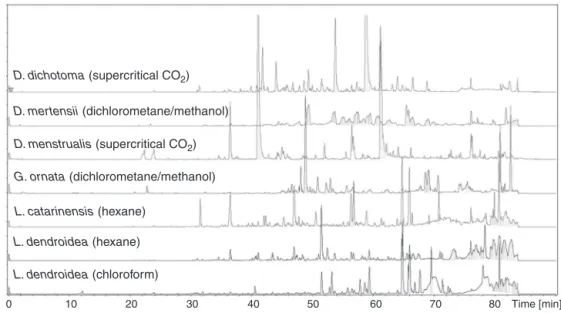
Fig.1. ChromatogramsobtainedfortheactiveseaweedextractsagainstS.mansoni.TheX-axisrepresentstheretentiontimeforeachpeak.
the schistosoma worms after 72h. Surprisingly, D. mertensii
extracted with dichloromethane/methanolkills male after 72h
andfemaleafter120hincubation.P.gymnosporaextractedwith
dichloromethane/methanol did not show anthelmintic activity
(datanotshown).
In orderto comparethechemical composition of theactive
extracts, samples were submitted to chromatographic analysis
applyingaUFLC–MSsystem.Fig.1showsextractchromatograms
generatedfromthetotalionchromatogram(TIC)mode,wherethe signalpeakscorrespondtothesumofeachmassdetected.
Thechromatogramsweremanuallyanalyzedtoidentifysimilar compoundspresentindifferentsamples.Thechromatogramswere stackedtostandardizetheretentiontimes,andthemassspectra
ofsimilarpeakswereanalyzedindividually.Itwasassumedthat thesamechemicalstructurewaspresentinsampleswhena sim-ilarmassspectrumwasdetectedata similarretentiontimefor bothextracts.Table2summarizescommonm/zvaluesobtainedin differentextractwithsimilarretentiontimes.
Amongthem/zvaluesdetectedinmorethanoneextract,we foundan[M+H]+ionatm/z391.283infiveextracts,witha
reten-tiontimeof76.1min,indicatingasimilarsecondarymetabolitein theextractsofD.mentrualis,D.dichotoma,L.catarinensisandL. den-droidea(hexanicandchloroformic).Asexpected,similarm/zvalues werederivedfromspeciesbelongingtothesamegenus,Laurencia, evenamongdifferentspeciesorwithdifferentextractionmethods. However,thispatterndidnotholdfortheDictyotagenus,where
Table2
Common[M+H]+ionatm/zvaluesrelatedtoeachseaweedspeciesanalyzedbyUFLC–MSindifferentretentiontimes.
Seaweedextract Retentiontime
36.1 51.5 64.8 66.1 67.7 72.6 76.1 80.9 81.1
D.dichotoma 391.283 494.564
D.mertensii
D.menstrualis 181.123 284.294 391.283
G.ornata 609.268 494.564
L.catarinensisEH 181.123 386.328 386.328 284.294 391.283 687.521
L.dendroideaEH 181.123 335.060 386.328 391.283 494.564
L.dendroideaEC 335.060 386.328 386.328 609.268 284.294 391.283 687.521
onlyone metabolite([M+H]+ ion atm/z391.283)wascommon
betweenthespeciesD. dichotomaandD. mentrualis.Comparing thethreegenera–Dictyota,LaurenciaandGracilaria–onecommon metabolite[M+H]+ionatm/z494.564wasdetectedat80.9min.
Thedichlorometane/methanolextractofD.mertensiiwastheonly samplethatsharednosimilarmetaboliteswiththeotherspecies.A comparisonoftheextractsfromD.mentrualisandhexanicextracts frombothL.catarinensisandL.dendroidea–thebestthree candi-datesfromtheantischistosomalscreening–identifiedonecommon metabolitewitha[M+H]+ionatm/z181.123at36.1min.
Discussion
Over thepast few decades, researchonnatural sources has
identified chemical compounds with important
pharmacologi-cal roles in medicinal fields. With regard to marine sources,
some compounds have shown unique biological properties, in
partdue to theirsingular chemical identity, and are currently employedasnewtherapeuticagents,eitherunmodifiedoras
pro-totypes for the design and synthesis of new drugs (Eustáquio
et al.,2011; Cherigo et al., 2015).Seaweeds from thephyla of RhodophytaandHeterokontophytahaveledtothediscoveryofa widevarietyofsecondarymetabolitesbelongingtodifferent chem-icalclasses, suchas terpenoids (monoterpenes,sesquiterpenes, diterpenes,triterpenes,etc.)andtheirvariants(cyclic,acyclic, halo-genated)(Pauletal.,1988;LaBarreetal.,2010),alkaloids(Güven et al.,2010), steroids(Francavilla et al.,2013), saponins(Jeeva et al., 2012), lignans, and phenolic compounds (Keyrouz et al., 2011).
In recent years, considerableefforts have been dedicatedto developalternativeapproachestotreatschistosomiasis.Inarecent publication, Barbosa de Castro et al. (2013) compiled several therapeuticcandidatesfromnaturalsources,includingalkaloids, flavonoids,saponins,phenoliccompoundsandterpenoids. There-fore,thepresenceofthosechemicalclassesinseaweedsjustifies theimportanceofthisstudy.
Inantischistosomalassays, themostsignificantresultswere obtainedwhentheparasites wereexposedtoextractsobtained fromseaweedthatbelongedmainlytothethreegenera,Dictyota, GracilariaandLaurencia.Acommonalityamongthesethreegenera istheterpenoidcompounds(Peresetal.,2012),whichmayplay animportantroleagainstS.mansoni.Nevertheless,thereremains apossibilitythattheantischistosomalactivitycanbemediatedby anothermolecule.
The active extracts were analyzed chromatographically in searchofacommonmetaboliteamongalloftheseaweeds.Fromthe threemostactiveextracts,definedforthetotalmortalityreached inashortperiodoftime(24h)–D.menstrualis,L.dendroideaand L.catarinensis–acommon[M+H]+ionwasfoundatm/z181.123,
whichmaycoincidewiththemolarweightofasesquiterpeneor evenaconjugatedmonoterpene(Al-Massarani,2014).Amongall oftheactiveextracts,themostcommonpeakseparatedat76.1min andshowed a[M+H]+ ion at m/z391.283,which is compatible
withthemolarweightofasesterterpeneoraconjugatedditerpene (Hiranoetal.,2001).
Overall,themostactiveextractswereobtainedbynon-polar extractionsolvents,suchashexane,chloroform,dichloromethane orsupercriticalCO2,andthepatternofthemassspectra(datanot
showed)obtainedfortheextractsrevealedanabundanceoflow weightmolecules(i.e.,95%ofallm/zareunder500DaforD. men-strualis)inalloftheactiveextracts.Thisleadstoourhypothesisthat terpenesand/ortheirvariants,suchasmono-,di-,tri-,sesqui-or sesterterpenes,maybeapromisingsourceofnewmoleculeswith activityagainstS.mansoniandrepresenttherapeuticalternatives totreatthedisease.
Authors’contribution
DXAcontributedtoallaspectsofthisstudy.EMSandLPM con-tributedtotheseaweedcollection,identification,preparationand analysisof the extractsand assays results. HKR and PAM con-tributedtothebiologicalstudiesunderthesupervisionofEN,who alsocontributedtothedesignofthebiologicalstudies.PC super-visedallaspectsofthestudyandcontributedtodesignofthestudy andthecriticalreadingofthemanuscript.Alloftheauthorshave readthefinalmanuscriptandapprovedthesubmission.
Conflictsofinterest
Theauthorsdeclarenoconflictsofinterest.
Acknowledgements
TheauthorsthankFAPESP(2011/18564-2and2011/10155-6), CAPESandCNPqfortheirfinancialsupport.
References
Al-Massarani,A.M.,2014.Phytochemicalandbiologicalpropertiesofsesquiterpene constituentsfromthemarineredseaweedLaurencia:areview.Nat.Prod.Chem. Res.2,147,http://dx.doi.org/10.4172/2329-6836.1000147.
Andreguetti,D.,Stein,E.M.,Pereira,C.M.P.,Pinto,E.,Colepicolo,P.,2013.Antioxidant propertiesandUVabsorbancepatternofmycosporine-likeaminoacidsanalogs synthesizedinanenvironmentallyfriendlymanner.J.Biochem.Mol.Toxicol. 27,305–312.
BarbosadeCastro,C.C.,Dias,M.M.,PessoadeRezende,T.,Magalhães,L.G.,DaSilva Filho,A.A.,2013.Chapter8-NaturalProductswithActivityAgainstSchistosoma Species.In:Mahendra,R.,Kateryna,K.(Eds.),FightingMultidrugResistancewith HerbalExtracts,EssentialOilsandtheirComponents.AcademicPress,SanDiego, pp.109–134.
Cardozo,K.H.M.,Carvalho,V.M.,Pinto,E.,Colepicolo,P.,2006.Fragmentationof mycosporine-likeaminoacidsbyhydrogen/deuteriumexchangeand electro-sprayionisationtandemmassspectrometry.RapidCommun.MassSpectrom. 20,253–258.
Cherigo,L.,Lopez,D.,Martinez-Luis,S.,2015.Marinenaturalproductsasbreast cancerresistanceproteininhibitors.Mar.Drugs13,2010–2029.
Crews,P.,Kho-Wiseman,E.,Montana,P.,1978.Halogenatedalicyclicmonoterpenes fromtheredalgaePlocamium.J.Org.Chem.43,116–120.
Eustáquio,A.S.,Nam,S.-J.,Penn,K.,Lechner,A.,Wilson,M.C.,Fenical,W.,Jensen, P.R.,Moore,B.S.,2011.ThediscoveryofsalinosporamideKfromthemarine bacteriumSalinisporapacificabygenomemininggivesinsightintopathway evolution.ChemBioChem12,61–64.
Francavilla, M., Franchi, M., Monteleone, M., Caroppo, C., 2013. The red seaweed Gracilaria gracilis as a multi products source. Mar. Drugs 11, 3754–3776.
González,A.G.,Darias,V.,Estévez,E.,1982.Chemotherapeuticactivityof polyhalo-genatedterpenesfromSpanishalgae.PlantaMed.44,44–46.
Gressler,V.,Fujii,M.T.,Martins,A.P.,Colepicolo,P.,Mancini-Filho,J.,Pinto,E.,2011a. BiochemicalcompositionoftworedseaweedspeciesgrownontheBrazilian coast.J.Sci.FoodAgric.91,1687–1692.
Gressler,V.,Stein,É.M.,Dörr,F.,Fujii,M.T.,Colepicolo,P.,Pinto,E.,2011b. Sesquiter-penesfromtheessentialoilofLaurenciadendroidea(Ceramiales,Rhodophyta): isolation,biologicalactivitiesanddistributionamongseaweeds.Rev.Bras. Far-macogn.21,248–254.
Gryssels,B.,Polman,K.,Clerinx,J.,Kestens,L.,2006.Humanschistosomiasis.Lancet 368,1106–1118.
Güven,K.C.,Percot,A.,Sezik,E.,2010.Alkaloidsinmarinealgae.Mar.Drugs8, 269–284.
Hirano,A.,Sugiyama,E.,Kondo,H.,Suda,H.,Ogawa,H.,Kojiri,K.,2001.Sesterterpene derivativesexhibitingantifungalactivities.GooglePatents.
Jeeva,S.,Antonisamy,J.M.,Domettila,C.,Anantham,B.,Mahesh,M.,2012. Prelim-inaryphytochemicalstudiesonsomeselectedseaweedsfromGulfofMannar India.AsianPac.J.Trop.Biomed.2,S30–S33.
Keyrouz,R.,Abasq,M.L.,Bourvellec,C.L.,Blanc,N.,Audibert,L.,ArGall,E.,Hauchard, D.,2011.Totalphenoliccontents,radicalscavengingandcyclicvoltammetryof seaweedsfromBrittany.FoodChem.126,831–836.
LaBarre,S.,Potin,P.,Leblanc,C.,Delage,L.,2010.Thehalogenatedmetabolism ofbrownalgae(Phaeophyta)itsbiologicalimportanceanditsenvironmental significance.MarineDrugs8,988–1010.
Laus,G.,2001.Biologicalactivitiesofnaturalhalogencompounds.In:Atta-ur,R. (Ed.),StudiesinNaturalProductsChemistry.Elsevier,pp.757–809.
Li,Y.-X.,Wijesekara,I.,Li,Y.,Kim,S.-K.,2011.Phlorotanninsasbioactiveagentsfrom brownalgae.ProcessBiochem.46,2219–2224.
and antifungal activity of Ochtodes secundiramea (Rhodophyta) extracts obtained usingdifferentbiomassprocessing methods.J. Appl.Phycol.26, 2029–2035.
Paul,V.J.,Hay,M.E.,Duffy,J.E.,Fenical,W.,Gustafson,K.,1988.Chemicaldefensein theseaweedOchtodessecundiramea(Montagne)Howe(Rhodophyta):effectsof itsmonoterpenoidcomponentsupondiversecoral-reefherbivores.J.Exp.Mar. Biol.Ecol.114,249–260.
Peres,J.C.,Carvalho,L.R.,Gonc¸alez,E.,Berian,L.O.S.,Felicio,J.D.,2012.Evaluationof antifungalactivityofseaweedextracts.Ciên.Agrotec.36,294–299.
Samboon,L.L.,1907.Descriptionsofsomenewspeciesofanimalparasites.Proc.Zoo. Soc.Lon.77(1),282–283.
Simas-Rodrigues,C.,Villela,H.D.M.,Martins,A.P.,Marques,L.G.,Colepicolo,P., Tonon,A.P.,2015.Microalgaeforeconomicapplications:advantagesand per-spectivesforbioethanol.J.Exp.Bot.,4097–4108.
Stein,E.M.,Colepicolo,P.,Afonso,F.A.K.,Fujii,M.T.,2011.Screeningfor antifun-galactivitiesofextractsoftheBrazilianseaweedgenusLaurencia(Ceramiales, Rhodophyta).Rev.Bras.Farmacogn.21,290–295.
Torres,F.A.E.,Passalacqua,T.G.,Velásquez,A.M.A.,deSouza,R.A.,Colepicolo,P., Graminha,M.A.S.,2014.Newdrugswithantiprotozoalactivityfrommarine algae:areview.Rev.Bras.Farmacogn.24,265–276.