J. Serb. Chem. Soc. 76 (6) 933–946 (2011) UDC 551.463+504.4.054:543.000.57+
JSCS–4172 639.42(497.16)
Original scientific paper
Mussels as a bio-indicator of the environmental quality of the
coastal water of the Boka Kotorska Bay (Montenegro)
MIHAJLO JOVIĆ1*, ANA STANKOVIĆ1, LATINKA SLAVKOVIĆ-BESKOSKI2, ILIJA TOMIĆ3, SANDRO DEGETTO4 and SLAVKA STANKOVIĆ1
1Faculty of Technology and Metallurgy, University of Belgrade, Belgrade, 2Institute of
Nuclear Science Vinča, University of Belgrade, Belgrade, 3Institute of Chemistry,
Technology and Metallurgy, University of Belgrade, Belgrade, Serbia an
4ICIS-CNR, Environmental Laboratory, Padua, Italy
(Received 7, revised 27 October 2010)
Abstract: The Mediterranean blue mussel Mytilus galloprovincialis was used as a pollution level indicator in the Boka Kotorska Bay of the southeastern Ad-riatic on the Montenegrin coast. The ever-increasing urbanization and indus-trialization, combined with a poor sewage system, an increase in both marine and inland traffic, as well as insufficient water circulation in the Bay itself have resulted in some level of pollution. Since heavy metals are extremely toxic and do not easily undergo biodecomposition, the results of this study supply va-luable information concerning the metal pollution of the marine environment in Boka Kotorska Bay. The concentrations of the investigated metals and non-metals accumulated in the mussels were determined during the fall of 2007 using Atomic Absorption Spectroscopy (AAS) for Cr, Mn, Co, Ni, Cu, Cd, Hg, Pb, Sn and V, and Energy Dispersive X-ray Fluorescence (ED–XRF) to de-termine the concentrations of Fe, Zn, Si, P, S, Cl, K and Ca. ED–XRF was also used to determine the levels of non-metals and elements present in high con-centrations. Comparing the data from this study in relation to data from other regions for Mytilus galloprovincialis, the mussel sampled from the Boka Ko-torska Bay showed a moderate level of pollution.
Keywords: pollution; metals; non-metals; Mytilus galloprovincialis; bio-indi-cator.
INTRODUCTION
The Boka Kotorska Bay is located in the southeastern part of the Adriatic Sea and is deemed to be one of the most beautiful bays of the world. The Boka Kotorska Bay is naturally divided into four smaller bays: the Herceg Novi, Tivat,
Risan and Kotor Bays. It is hypothesized that the Boka Kotorska Bay, having a coastline 105.7 km long, covering an area of 87.3 km2, containing a volume of
2.4×10⁶ km3 of water and with a maximum depth of 60 m, was formed by fluvial erosion.
Each and every one of the four smaller bays comprising the Boka Kotorska Bay has specific hydrographic and relief characteristics, and is significantly dif-ferent in its aquatic life from sea waters stretching away from Montenegro.1
The increased urbanization and industrialization of the Montenegrin Coast over the last two decades could lead to an increase of marine pollution of the Boka Kotorska Bay. Waste stemming from various inland human activities is directly delivered into the sea without any prior treatment, the greatest threat being old and poorly maintained sewage systems. Within the Boka Bay itself, 62 underwater untreated sewage disposal systems have been identified, all of which deliver sewage waste at a close distance to the shore. Sewage disposal systems in the Kotor, Tivat and Risan Bays are neither long nor deep enough, disposing waste immediately at the coastal line of the Bays. Moreover, many privately owned estates have sewage disposal systems which are not part of the municipal sewage system, thereby adding even more to the pollution of the Bay.1
Pollution and contamination of the Boka Kotorska Bay ecosystem arise from both anthropogenic sources of pollution and natural weathering. Industrial waste from the steel, soap and pharmaceutical industries, as well as waste produced by shipyards, hotels and hospitals located within the Boka Kotorska Bay itself, is allowed to freely flow into the sea, polluting it with heavy and other metals, causing significant environmental damage. The total quantity of wastewater de-livered into the sea from the three towns together (Herceg Novi, Tivat and Kotor) is 7700 and 4900 m3 per day from industries and households, respectively.1
Moreover, the Boka Kotorska Bay is known as one of the regions in Europe with the highest amount of precipitation, and the quantity of pollutants reaching the sea from this source cannot be neglected. Adding to this are the ever in-creasing volume of marine and inland traffic, as well as a growing number of tourists over the last decade.
All of the above-mentioned factors significantly contribute to the accumu-lating pollution of the Boka Kotorska Bay, the highest danger stemming from heavy metal pollution, such as mercury (Hg), lead (Pb), cadmium (Cd) and other metals.
me-tals in water are often below the instrument detection limit, making aquatic orga-nisms an even more attractive method for their determination.3
As marine organisms absorb and accumulate matter from their habitat, they serve as excellent heavy metal water pollution bio-indicators.4,5 In addition to
heavy metals, marine organisms serve as bio-indicators for metals and com-pounds otherwise difficult to identify and quantify.6
Not all marine organisms are suitable as water pollution bio-indicators. The criteria required for an acceptable bio-indicator are that it must be able to tolerate large concentrations of pollutants and accumulate them in addition to being able to withstand changes in temperature and salinity. It should be representative of a location, i.e., static and easy to identify, sample and handle. It should have a long enough life cycle to ensure sampling over specified and extended time frames, in addition to having a sufficient amount of tissue required for chemical analysis.5,6 Of marine organisms generally, mussels and benthic fish are selected as suitable indicator species of coastal pollution, as they give complementary information on the bio-availability of chemicals in the water column and sediments, respectively. Bioaccumulation patterns of the different pollutants vary substantially among species. Habitat, season and food chain play key roles in the bioaccumulation process. Filter feeder organisms accumulate most of the pollutants at levels higher than those found in the water column; hence, they permit the quality of coastal environments to be assessed. Being sedentary and easy to sample, the blue mussel Mytilus galloprovincialis fulfills most of the above-mentioned cri-teria,7 thus it was chosen to serve as the bio-indicator of heavy metal water pol-lution in the Boka Kotorska Bay.
The goal of this work was to determine levels of heavy metals and other elements in the marine environment of the Boka Kotorska Bay using the mussel
M. galloprovincialis as a bio-indicator and to compare the obtained data with other regional data. The aim was to establish the environmental quality of the coastal waters in the Boka Kotorska Bay.
EXPERIMENTAL
Sampling, storage and sample preparation
Mytilus galloprovincialis was sampled from seven different locations in the fall of 2007: Krašići, Kukuljina, Tivat, Opatovo, Sv. Stasija, Perast and Herceg Novi as indicated in Fig. 1. The seven sampling sites are spread throughout the entire Boka Kotorska Bay and are in close proximity to large towns, ports and industries of the Bay.
from each station were pulverized and homogenized using a mill. The application of different methods to analyze the metal concentrations in the mussels required the preparation of both liquid and solid samples.
Fig. 1. Sampling sites of Mytilus galloprovincialis in the Boka Kotorska Bay, Montenegro, southeastern Adriatic Sea.
Solid samples for Energy dispersive X-ray tluorescence (ED-XRF) analyses were pre-pared as follows: the dried material (post-lyophilization) was pulverized in a vibration mill in the presence of paraffin wax. The added wax allowed for homogenization of the sample and served as a binding material for making pellets (whilst not interfering with the analysis itself). The pellets (d = 40 mm) were made by pressing 5 g of material from the mill in a mold of the desired shape under high pressure.
Liquid samples for Atomic absorption spectrometry (AAS) analyses were prepared as follows: about 0.5 g of dried mussel tissue was digested under high pressure with a mixture containing 7 ml HNO3 (65 % Merck, Suprapur) and 2 ml H2O2 (30 % Merck, Suprapur) in a high microwave digestion system (CEM Corporation, MDS-2100) for 30 min, diluted to 25 ml with ultrapure water and stored in polyethylene bottles until analysis. A blank digest was performed in the same manner.
Chemical analysis
were used for the analyses of mercury (Hg) and tin (Sn) (PerkinElmer, AAnalyst 200). The Iron (Fe), zinc (Zn), silicon (Si), phosphorus (P), sulfur (S), chlorides (Cl), potassium (K) and calcium (Ca) concentrations were determined using the energy dispersive X-ray fluorescence method (Oxford, ED 2000).
RESULTS AND DISCUSSION
For the first time, the concentrations of the investigated elements were mea-sured in the mussel Mytilus galloprovincialis at the coastal area of the south-eastern Adriatic Sea, Montenegro, using the mussel as a bio-indicator.
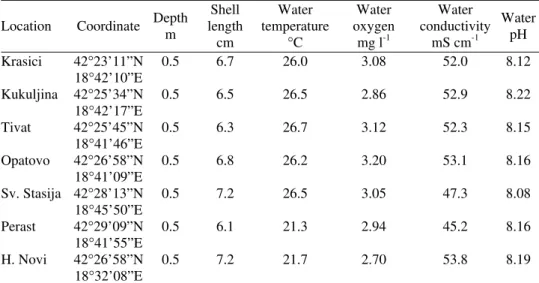
The information related to the collected samples and the physical parameters of the sea water at the seven investigated sites are given in Table I. The Perast site had the lowest water temperature (21.3 °C) and salinity (30.28 ‰), but the pH value was in the range of the all the other measured pH values, 8.16.
TABLE I. Information related to the collected sample
Location Coordinate Depth m Shell length cm Water temperature °C Water oxygen
mg l-1
Water conductivity
mS cm-1
Water pH
Krasici 42°23’11”N 18°42’10”E
0.5 6.7 26.0 3.08 52.0 8.12
Kukuljina 42°25’34”N 18°42’17”E
0.5 6.5 26.5 2.86 52.9 8.22
Tivat 42°25’45”N 18°41’46”E
0.5 6.3 26.7 3.12 52.3 8.15
Opatovo 42°26’58”N 18°41’09”E
0.5 6.8 26.2 3.20 53.1 8.16
Sv. Stasija 42°28’13”N 18°45’50”E
0.5 7.2 26.5 3.05 47.3 8.08
Perast 42°29’09”N 18°41’55”E
0.5 6.1 21.3 2.94 45.2 8.16
H. Novi 42°26’58”N 18°32’08”E
0.5 7.2 21.7 2.70 53.8 8.19
Determined mean concentrations (mg kg–1 dry weight) of Cr, Mn, Fe, Co,
Ni, Cu, Zn, Cd, Hg, Pb, Sn, V, Si, P, S, Cl, K and Ca using M. galloprovincialis
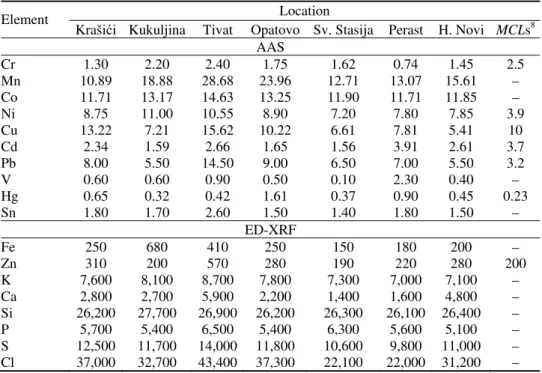
as a bio-indicator of the pollution of the Boka Kotorska Bay are given in Table II. The values of the MCLs8 (metal contamination levels) for Cr, Ni, Cu, Cd, Pb, Hg and Zn are shown in Table II. These MCLs could denote contamination. Recom-mended values of MCLs for the remaining elements do not exist in the literature.
TABLE II. Concentration of the elements found in the soft tissues of M. galloprovincialis (mg kg-1 dry weight)
Element Location
Krašići Kukuljina Tivat Opatovo Sv. Stasija Perast H. Novi MCLs8 AAS
Cr 1.30 2.20 2.40 1.75 1.62 0.74 1.45 2.5
Mn 10.89 18.88 28.68 23.96 12.71 13.07 15.61 –
Co 11.71 13.17 14.63 13.25 11.90 11.71 11.85 –
Ni 8.75 11.00 10.55 8.90 7.20 7.80 7.85 3.9
Cu 13.22 7.21 15.62 10.22 6.61 7.81 5.41 10
Cd 2.34 1.59 2.66 1.65 1.56 3.91 2.61 3.7
Pb 8.00 5.50 14.50 9.00 6.50 7.00 5.50 3.2
V 0.60 0.60 0.90 0.50 0.10 2.30 0.40 –
Hg 0.65 0.32 0.42 1.61 0.37 0.90 0.45 0.23
Sn 1.80 1.70 2.60 1.50 1.40 1.80 1.50 –
ED-XRF
Fe 250 680 410 250 150 180 200 –
Zn 310 200 570 280 190 220 280 200
K 7,600 8,100 8,700 7,800 7,300 7,000 7,100 –
Ca 2,800 2,700 5,900 2,200 1,400 1,600 4,800 –
Si 26,200 27,700 26,900 26,200 26,300 26,100 26,400 –
P 5,700 5,400 6,500 5,400 6,300 5,600 5,100 –
S 12,500 11,700 14,000 11,800 10,600 9,800 11,000 –
Cl 37,000 32,700 43,400 37,300 22,100 22,000 31,200 –
In relation to the values of MCLs for the mean concentrations of Ni, Cu, Cr, Cd, Pb, Hg and Zn (Table II), only the measured Cr levels in investigated mus-sels from the Boka Kotorska Bay were lower than MCL for this element. The higher levels of the other measured elements than the respective MCL value in the investigated mussel can also be caused by the bay mineralogy.
The highest concentrations of Cr, Mn, Co, Cu, Zn, Pb, K, Ca, P, S, Cl and Sn were detected in mussels at the Tivat location, as expected. This is the site with most anthropogenic activities, known as an agricultural area with military port, shipyard and airport nearby. Mussels sampled from the Kukuljina site contained the highest levels of Fe, Ni and Si; but the highest Hg level was found at the Opa-tovo site, while the highest levels of Cd and V were found at the Perast site.
Nickel (Ni) levels determined in M. galloprovincialis varied between 7.20– –11.00 mg kg–1 for all sampling sites; the maximum level was in mussels from the Kukuljina site (11.00 mg kg–1) and the minimum value was measured at Sv.
Stasija (7.20 mg kg–1). In comparison to other literature reports on the Ni content in mussels,9–11 its content in mussels from the Boka Kotorska Bay may be
The concentration levels of Mn and Cr in the mussels at the seven sites ranged between 10.89–28.68 and 0.74–2.40 mg kg–1, respectively. The
maxi-mum concentrations of manganese and chromium were recorded at the Tivat site. An analysis of the metal content of the Boka Bay sediments prior to its Indus-trialization period indicated that the sea bed of the Bay is rich in Mn and Cr,12 and that their presence in the mussel soft tissue cannot be entirely anthropogenic. The Cu concentrations ranged from 5.41 to 15.62 mg kg–1. The maximum Cu level was found in the Tivat and the minimum in the Herceg Novi mussels. Copper is an essential trace element required by all forms of life. In comparison to other literature reports on the Cu content in mussels, Table III, the Cu levels found in the present study were lower than the literature data.
TABLE III. A comparison of the metal and non-metal concentrations in M. galloprovincialis found for this study with literature data from other sea world regions (mg kg-1 dry weight)
Ele-ment Croatia 27
Italy10 Slovenia28 Turkey9 Morocco29 Spain30 Spain31 This study
Cu 3.7–11.1 17.9–156 6.5–49 90–260 4.1–43.1 4.42– 9.65
6.8–29.9 5.41–15.62
Si – – – – – – – 26,100–
27,700 Cd 0.6–1.0 0.44–1.09 2–4 2.12–34.71 0.36–
2.84
0.2–0.77 1.56–3.91
Cr 1–2.9 – 2.7–10.3 1–3 1.9–28.9 – 2.2–45.7 0.74–2.40
P – – – – – – – 5,100–6,500
Fe 53.4–719 45.1–754 1,150–4,030 – – 174–715 150–680
Ni 0.8–5 1.3–7.6 2.8–8.0 1–6 11.7–31.7 – 0.85–19 7.20–11.00
S – – – – – – – 9,800–
14,000
Co – – 0.31–2.09 –– – – 0.45–
2.69
11.71–14.63
Pb 2–7 2.0–9.0 0.79–11.5 5–21 0.1–26.45 0.52– 8.22
0.3–6.1 5.50–14.50
Sn – 0.6–3.9 – – – – 6.7–21 1.40–2.60
V – – – – – – – 0.10–2.30
K – – – 4,230–7,960 – – – 7,000–8,700
Ca – – – 6,960– 20,400
– – – 1,400–5,900
Cl – – – – – – – 22,000–
43,400 Zn 59.1–273 60.9–189 73–249 180–630 107.4–
365.7
134–462 85–447 190–570
Hg – <0.5 – – 0.01–2.31 0.08–
0.88
0.1–0.63 0.32–1.61
Cobalt is a relatively rare element, present at 0.0025% w/v in the Earth’s crust and 4×10⁻⁸ % (w/v) in seawater. It is usually found in Ni, Ag, Pb, Cu and
Fe ores.13 The cobalt levels found in the mussel soft tissue were in the range 11.71–14.63 mg kg–1; the maximum found level was at the Tivat (14.63 mg kg–1)
and the minimum at the Perast and Krasici sampling sites (11.71 mg kg–1). The relatively high levels of Co in the Boka Bay samples may be explained by its use as an alloying ingredient together with nickel, chromium, molybdenum and other elements. It is an important constituent of magnets and batteries, and is also used as a pigment for glass, ceramics and paints. Additionally, it can be used as a paint drier and as a catalyst in the petroleum and chemical industries. Many fertilizers are enriched with cobalt in order to amend agricultural soils that are cobalt-deficient. It can be claimed that the Co pollution of the Boka Bay is of anthro-pogenic nature, especially in the Tivat area, known as an agricultural area.
The non-essential metals Cd, Pb and Hg are toxic at relatively low concen-trations.14 Human activities and industrial processes lead to an increase of these metals in the environment and changes in their levels are good indicators of in-creased anthropogenic impact.14,15
Mussels can accumulate cadmium in their tissues at levels up to 100,000 times higher than the levels observed in the water in which they live.14 Cd con-centrations in M. galloprovincialis from this coastal area were in the range of 1.56–3.91 mg kg–1. Cd occurs naturally in ores together with Zn, Cu and Pb. Cd compounds are used as stabilizers in PVC products, pigments and in nickel–cad-mium batteries. The cadnickel–cad-mium sources in the investigated mussel samples most likely originate from pigments in paints for ships and phosphate fertilizers, since the highest Cd concentrations were found at locations with a port (Perast, Tivat and H. Novi) and at the Tivat location, known for its high usage of phosphate fer-tilizers.
Elevated levels of lead were detected in port towns with a high volume of marine and inland traffic. Pb levels ranged from 5.50 to 14.50 mg kg–1, the ma-ximum level having been found in Tivat. Lead is known to accumulate in the en-vironment and is dispersed due to anthropogenic activities. Hence, it comes as no surprise that highest Pb concentrations were found in mussels sampled from the Tivat location, the site with most anthropogenic activities.
0.32–1.61 mg kg–1 range. The maximum Hg level was found at the Opatovo and the minimum value at the Kukuljina site. Such high levels of mercury can indeed be somewhat ascribed to anthropogenic factors, but is important to emphasize that the Mediterranean is extremely rich in Hg; its basin containing about 65 % of the total world Hg mineral resources.17,18 Hence, naturally occurring mercury levels are significant and might in the case of the Boka Bay outweigh anthropo-genic factors.
The maximum concentration of tin was found at the Tivat site (2.60 mg kg–1),
while the minimum value was found at the Sv. Stasija site (1.40 mg kg–1). Tin may be released into the environment from natural (component of many soils) and anthropogenic (agricultural activities, gases, dusts and fumes containing tin may be released from smelting and refining processes, industrial uses of tin, waste incineration, and burning of fossil fuels) sources. There is no evidence that tin is essential for organisms and, in general, tin-containing compounds are main-ly released into the environment from anthropogenic sources. Most of the tin found in a marine environment comes from boat paints containing tributyltin – TBT,19 which could explain the high Sn content in the mussels sampled at the Tivat location.
Vanadium concentrations were in the 0.10–2.30 mg kg–1 range. The maxi-mum value of V was found in Perast (2.30 mg kg–1), while the minimum value
was measured at the Sv. Stasija site (0.10 mg kg–1). As there is no naturally occurring free vanadium, this metal occurs in seawater either by its absorption from the atmosphere or by dissolution of sediment as it is found to be a com-ponent of some minerals. Industrially, vanadium is mostly used as an additive in the steel industry and in petrochemical products. It is an essential element for marine organisms and its concentration found in mussels was a thousand times higher than in seawater.20
Elements such as Fe, Zn, K, Ca, Si, P, S and Cl were determined using the ED–XRF technique for two reasons: all of the elements analyzed were present in very high concentrations, and P, S and Cl are non-metals which cannot be deter-mined by AAS.
The iron concentrations were in the 150–680 mg kg–1 range. The maximum
concentration of Fe was found at Kukuljina (680 mg kg–1) while the minimum value was found at Sv. Stasija (150 mg kg–1). Iron is an essential trace element
required by all forms of life. In comparison with literature data, it is clear that the measured Fe concentrations were lower than in other examined areas, Table III, indicating that there is no major pollution caused by this element in Boka Ko-torska Bay.
The concentrations of zinc ranged from 190–570 mg kg–1. The maximum value of Zn was found at Tivat (570 mg kg–1), while the minimum value was
levels are regulated by most organisms.21 Zinc is not biomagnified. The absorp-tion of zinc by aquatic organisms tends to be from water rather than food.22 Only
dissolved zinc tends to be bioavailable and the bioavailability depends on the physical and chemical characteristics of the marine environment, such as: pH, dissolved organics, water hardness, competing ions, soluble ligands and biolo-gical processes.23 The increased concentrations of Zn in the investigated samples
compared to other regions, Table III, could be explained by fact that Zn is used as a dietary supplement, as well as in the chemical industry and all industries located along the coastal area of the Bay.23
The concentrations of Si, K, P and S do not vary much amongst the investi-gated locations, which may indicate common local inputs and similar dispersion processes in the study area, with the exception of Ca and Cl. The concentrations of these two elements are also main factors of seawater salinity, which is ob-viously related to Perast and St. Stasija, Tables I and II. Simultaneously it can be noticed that the concentrations of all the investigated elements in mussels were generally lower from the sites Sv. Stasija and Perast, except some elements such as Cr (Sv. Stasija) and V (Perast). It could be concluded that salinity has high impact on metal accumulation in mussels. Some elements (Cu, Cd, Pb, V and Hg) were present at lower levels in the mussel from H. Novi (salinity at H. Novi was higher compared to Perast) than in mussel from Perast, but it could be ex-plained by the mixing of bay water with open-sea water at the mouth of the Bay.
The silicon concentrations were in the range 26,100–27,700 mg kg–1. Silicon
constitutes 25.7 % of the Earth’s crust by weight and is the second most abundant element. It is found largely in the form of silicon oxides such as sand (silica), quartz, rock crystal, amethyst, jasper and opal. Si is the main constituent of clay,20 and clay is being the main constituent of the Bay bottom. As in the case
of Mn and Cr, it can be concluded that Si is naturally present in the seawater and mussels of the Bay, explaining its similar and increased level.
The maximum value of P was found at Tivat (6,500 mg kg–1), while the mi-nimum value was found in H. Novi (5,100 mg kg–1). Phosphorus is a natural and
anthropogenic component of an aquatic environment.24 The most important an-thropogenic inputs of this element in the Boka Kotorska Bay ecosystem are through the use of fertilizers and detergents.
Chlorides are the most common component of sea water, together with Na, Mg and SO4, it makes up almost 97 % of the concentrations of all ions.25 After
them, K and Ca are the most common and it is not surprising that the largest concentrations of these three elements, Cl, K and Ca, were found in the samples: Cl (22,000–43,400 mg kg–1), K (7,000–8,700 mg kg–1) and Ca (1,400–5,900 mg
me-dicines, insecticides, solvents, paints and plastics; K is used in the preparation of potassium phosphates for liquid detergents and fertilizers; while Ca is commonly used in cement factories.20
The concentrations of sulfur (S) ranged from 9,800–14,000 mg kg–1. Sulfur
is a natural and anthropogenic component of an aquatic environment. Natural sul-fur is primarily derived from the dissolution of dead marine organisms, plants and animals. The formation of sulfur intermediates in marine sediments princi-pally occurs through the oxidation of sulfide produced during bacterial sulfate reduction.26 The most important anthropogenic input of this element to a marine ecosystem is through the use of fuel oil and its presence in fungicides.20 This was
confirmed by the highest concentration of S obtained for mussels sampled at Ti-vat (14,000 mg kg–1), already mentioned as location with the greatest number of
possible pollution sources.
Literature data and data from this study are given in Table III to compare element concentration levels in the M. galloprovincialis.
The sampled mussels are compared with the available literature data of other areas of the Adriatic Sea, (Italy, Croatia and Slovenia),10,27,28 and of other Medi-terranean areas.9,29–31 From Table III, it can be concluded that the heavy metal
concentrations of Cd, Pb, Ni, Hg, Co and Zn are generally higher in the Boka Kotorska Bay than in mussels from other parts of the Adriatic (Italy, Croatia and Slovenia). However, this is not case when the levels of these metal are compared with most industrialized and developed areas in the Mediterranean area (Spain, Turkey and Morocco)9,29–31 In this case, the concentrations of Cd, Pb, Hg and Ni in the mussels from the bay are generally lower, Table III.
Of all seven investigated locations, the mussel sampled at the Tivat site had the highest levels of heavy and other metals, suggesting that the highest seawater pollution is at this site in Boka Kotorska Bay. The total quantity of wastewater delivered into the sea at the Tivat location is second, compared to Herceg Novi, indicating that other pollution sources play a role in the case of Tivat: the pro-ximity of the airport, a military harbor, shipyards, oil tankers and a high usage of agricultural fertilizers in the hinterland of Tivat. Nevertheless, the hydrological positions of Tivat and Herceg Novi in the Bay cannot be disregarded: Herceg Novi is located nearer to the entrance of the bay, experiencing higher seawater flux and water exchange with the open sea in comparison to Tivat.
CONCLUSIONS
ecosystem as the determined concentrations of Ni, Cu, Cd, Pb, Hg and Zn were higher than the corresponding MCL value.
It was found that of all of the investigated locations in the Boka Kotorska Bay, the mussels sampled at the Tivat location contained the highest levels of toxic metals, primarily due to anthropogenic activities.
The results of this investigation, i.e., the determination of the concentrations of metal and non-metal elements in mussels, indicate that the degree of pollution of the Boka Kotorska Bay, which is influenced by anthropogenic activities, is comparable to other marine environments. A comparison of the concentrations of the investigated elements found in mussels from the Boka Kotorska Bay to the other areas of the Adriatic Sea show that the levels Zn and Co, and also of the heavy metals Ni, Pb, Cd and Hg in the Boka Kotorska Bay are generally higher. Additionally, it was found that the concentrations of a few very toxic elements, Cd, Pb, Hg and Ni, were generally lower compared to those determined in mus-sels sampled from other Mediterranean regions.
Mytilus galloprovincialis as a bio-indicator of metal pollution has and can continue to provide information about water quality not only in the Boka Ko-torska Bay, but also along the whole coast of Montenegro on the southeastern Adriatic Sea.
Acknowledgement. This research was financed by the Ministry of Education and Science of the Republic of Serbia, Contract No. III 43009 and EAR, Contract No. 04SER02/05/007.
( )
1
, 1, - 2, 3,
SANDRO DEGETTO4 1
1Tehnolo{ko
–metalur{ki fakultet, Univerzitet u Beogradu, Beograd, 2Institut za nuklearne nauke
Vin~a, Univerzitet u Beogradu, Beograd, 3Institut za hemiju, tehnologiju i metalurgiju, Univerzitet u
Beogradu, Beograd i 4ICIS-CNR, Envinronmental lab, Padova, Italy
Mytilus galloprovincialis ( )
ђ , –
-. , ,
, ,
ђ .
, ђ
.
2007 ђ
( S) Cr, Mn, Co, Ni, Cu, Cd, Hg, Pb, Sn i V,
(ED-XRF) ђ Fe, Zn, Si, P, S, Cl,
K i Ca. D-XRF
, ђ .
( 7., 27. 2010)
REFERENCES
1. Government of Montenegro, Spatial Plan of Montenegro Until 2020, http://www.gov.me/ /files/1216637502.pdf (last accessed: September, 2010)
2. A. Ikem, N. O. Egiebor, J. Food Compos. Anal.18 (2005) 771 3. J. Morillo, J. Usero, I. Gracia, Chemosphere58 (2005) 1421 4. F. Regoli, Arch. Environ. Contam. Toxicol. 34 (1998) 48
5. R. T. Angelo, M. S. Cringan, D. L. Chamberlain, A. J. Stahl, S. G. Haslouer, C. A. Goodrich, Sci. Total Environ.384 (2007) 467
6. M. Roméo, C. Frasila, M. G. Barelli, G. Damiens, D. Micu, G. Mustata, Water Res.39 (2005) 596
7. U. Sunlu, Environ. Monit. Assess. 114 (2006) 273 8. A.Y. Cantillo, Mar. Pollut. Bull.36 (1998) 712
9. U. Çevik, N. Damla, A. I. Kobya, V. N. Bulut, C. Duran, G. Dalgic, R. Bozaci, J. Hazard. Mater. 160 (2008) 396
10. D. Desideri, M. A. Meli, C. Roselli, L. Feduzi, J. Radioanal. Nucl. Chem.279 (2009) 591 11. P. Szefer, B. S. Kim, C. K. Kim, E. H. Kim, C. B. Lee, Environ. Pollut.129 (2004) 209 12. S. Degetto, C. Cantaluppi, D. Desideri, M. Schinitu, S. Stankovic, Z. Kljajic, in
Proceeding of 7th Int. Conf. Methods and Applications of Radioanalytical Chemistry – MARC VII, 2006, Kailua-Kona, Hawaii, USA, 2006, p. 83
13. J. Nechev, K. Stefanov, D. Nedelcheva, S. Popov, Comp. Biochem. Physiol. B146 (2007) 568
14. S. T. Culha, M. Y. Celik, M. Culha, I. Karayucel, A. Gundogdu, J. Anim. Vet. Adv.7 (2008) 1618
15. F. X. Han, A. Banin, Y. Su, D. L. Monts, M. J. Plodinec, W. L. Kingery, G. E. Triplett, Naturwissenschaften89 (2002) 497
16. N. Odzak, T. Zvonaric, Z. Kljakovic Gaspic, M. Horvat, A. Baric, Sci. Total Environ.261 (2000) 61
17. S. R. Aston, S. W. Fowler, Sci. Total Environ.43 (1985) 13
18. R. Bargagli, R. Ferrara, B. E. Maserti, Sci. Total Environ. 72 (1988) 123
19. International Programme on Chemical Safety INCHEM, Tin and inorganic tin compounds, http://www.inchem.org/documents/cicads/cicads/cicad65.htm (last accessed: September, 2010)
20. Web Elements: the periodic table on the web, http://www.webelements.com (last ac-cessed: September, 2010)
21. D. G. Heijerick, C. R. Janssen, C. Karlen, I. O. Wallinder, C. Leygraf, Chemosphere47 (2002) 1073
22. L. T. Sun, S. S. Jeng, Zool. Stud. 37 (1998) 184
23. B. Simon-Hertich, A. Wibbertmann, D. Wagner, L. Tomaska, H. Malcolm, Environ. Health Criteria221 (2000) 1
24. Y. Liu, G. Villalba, R. U. Ayres, H. Schroder, J. Ind. Ecol.12 (2008) 229
26. B. B. Jørgensen, Mar. Biol.41 (1977) 7
27. V. Orescanin, I. Lovrencic, L. Mikelic, D. Barisic, Z. Matasin, S. Lulic, D. Pezelj, Nucl. Instrum. Methods B245 (2006) 495
28. J. Scancar, T. Zuliani, T. Turk, R. Milacic, Environ. Monit. Assess. 127 (2007) 271 29. M. Maanan, Environ. Toxicol. 22 (2007) 525
30. V. Besada, J. Fumega, A. Vaamonde, Sci. Total Environ.288 (2002) 239