ISSN 1517-7076 artigo e-11838, 2017
Corresponding Author: Tulio Hallak Panzera Received on: 12/07/2016 Accepted on: 27/10/2016
10.1590/S1517-707620170002.0171
Hybrid composites reinforced with short
sisal fibres and micro ceramic particles
Francisco Margotti dos Santos 1, Fabiano Bianchini Batista 1, Tulio Hallak Panzera 1, André Luis Christoforo 2,
Juan Carlos Campos Rubio 3
1
Centre for Innovation and Technology in Composite Materials - CITeC, UFSJ, São João Del-Rei, MG e-mail: [email protected]; [email protected]; [email protected]
2
Centre for Innovation and Technology in Composite Materials - CITeC, UFSCar, São Carlos, SP e-mail: [email protected]
3
Departament of Production Engineering, UFMG, Belo Horizonte, MG e-mail: [email protected]
ABSTRACT
Biocomposites reinforced with natural fibres have been extensively investigated as a promising replacing material for synthetic ones, such as the glass fibre reinforced composites. The length of natural fibres depends not only on the plant species, but also on the extraction processing. The heterogeneity of natural fibres, in terms of length, can be considered a problem for some industrial applications. A little amount of work has been conducted towards the use of short natural fibres in composite materials. In order to balance the reduction of strength due to the use of short length fibres, ceramic particles can be incorporated. This paper describes the experimental characterization of hybrid biocomposites consisted of epoxy polymer, short random sisal fibres and Portland cement particles. A full factorial design was performed to investigate the effect of the factors and levels, such as fibre length (4 mm and 8 mm) and Portland cement inclusion (0wt%, 5wt% and 10wt%) on the following properties, flexural modulus and strength (via three-point bending test), damping ratio, apparent porosity and water absorption. The fibre volume fraction was kept constant at 25%.
The Design of Experiment (DoE) analysis revealed the “Fibre length” factor does not affect the responses.
The interaction “Fibre length and Cement inclusion” affected only the stiffness. Portland cement particles statistically revealed a noticeable contribution to the apparent porosity and water absorption. The presence of cement particles at 5wt% provided not only the increase in the damping ratio response, but also the reduction in the flexural strength and stiffness.
Keywords: Hybrid composites, biocomposites, sisal fibres, Portland cement.
1. INTRODUCTION
Polymeric composite materials reinforced with natural fibres have been widely investigated to obtain new materials with sustainable characteristics [1-6]. Natural fibres have low cost when compared to glass and carbon fibres, besides lead to important renewable characteristics [1]. Sisal fibres present hallmark characteristics such as lightweight, non-toxic, high specific modulus and strength, a cost ten times less than the glass fibre, besides being less abrasive to equipment and moulds [2]. ANGRIZANI, et al. [2] have emphasized the aggregated value of sisal fibres is amplified when used as reinforcement in polymeric composites. These factors make sisal the most studied natural fibres worldwide. However, the discontinuous fibre length and diameter make them infeasible for industrial applications. MARTIN, et al. [3] have reported a fibre diameter variation greater than 65% from the basal (0 - 30 cm) to apexes (90 - 120 cm) parts of the sisal sheet plant. The toughest part of sisal fibre is located about 30 cm to 60 cm from its base and the lowest performance is found for the apical region. In this context, a possible alternative for the use of sisal fibres in industrial applications can be related to the use of short sisal fibres.
studied low-density polyethylene composites reinforced with short sisal fibres (6 mm) testing a set of treatments on the electrical properties of the composites. A variety of surface treatments such as alkali, stearic acid, peroxide, permanganate and acetylation have been evaluated to improve the interfacial bonding of sisal fibres. PAIVA, et al. [6] have analysed the thermal stability of unmodified and modified short sisal fibres (3 mm) of phenolic and lignophenolic based composites.
Significant improvements on the mechanical performance of polymeric composites have been reported when ceramic particle inclusions were combined with the matrix phase [7-12]. CAO and CAMERON [7] have investigated the effect of silica particle inclusions on the impact resistance of glass fibre composites made with epoxy resin. Stiff particles are able to increase the mechanical strength of the composites minimizing the onset and rate of crack propagation. This effect depends not only on the amount, but also on the sizes and densities of the particles, i.e. microparticles has been investigated up to 33wt% [7 -9], while nano-sized particles has been considered up to 5wt% [12-13].
When a crack propagation reaches a ceramic particle along the fibre-matrix interface, the crack front cannot break it, as a consequence, additional effort is required to spread across the interface fibre/particle or the interface between particle/matrix. As a result, a lower rate of crack propagation has been observed, increasing the strength of the composites [1, 7]. SILVA, et al. [8] have investigated the effect of silica micro particles and maleic anhydride inclusions into polymeric matrix (epoxy resin) of composites with unidirectional sisal fibres. The factors investigated were the fibre volume fraction (30% and 50%), the mass fraction of silica micro particles (0wt%, 20wt% and 33wt%) and the mass fraction of maleic anhydride (0wt% to 2wt%). The results have revealed the micro silica inclusions did not significantly affect the flexural strength, while the interaction between “fraction of fibres, silica particles and maleic anhydride” has played a major role not only on the flexural strength, but also on the flexural modulus [8].
This work investigates the effect of Portland cement inclusions and sisal fibre lengths on the physical, dynamic and mechanical behaviour of short sisal fibre reinforced composites. A full factorial design was conducted to identify the effects of individual factors or interactions on the responses.
2. MATERIALS AND METHODS
The composite specimens were fabricated manually. The epoxy resin and hardener were CMR 028 and HY951, respectively. A resin/hardener ratio of 10:1 was considered. The sisal fibres were supplied by Sisalsul Company (São Paulo - Brazil). The matrix phase was modified by the incorporation of Portland cement particles (Holcim Company, ASTM III type). Firstly, the resin and the hardener were combined, then the Portland cement particles were added and hand-mixed for 5 minutes at room temperature (≈23°C). A wood mould covered by Armalon (a demoulding tissue) was used to laminate the composites. The sisal fibres were cut in lengths of 4 mm and 8 mm and spread out manually in the mould. Subsequently, the epoxy matrix (modified and non-modified) was spread upon the fibres and cold-pressed at 2.5 tonnes for 12 hours.
The experimental factors such as sisal fibre length (4 mm and 8 mm) and weight fraction of cement particles (0wt%, 5wt% and 10wt%) were investigated, providing a full factorial design of 2131, resulting in 6 experimental conditions (see Table 1). The fibre volume fraction was kept constant at 25% based on prelimi-nary analysis results. Twenty grams (20g) of short sisal fibres were used to fabricate each lamina; this is the equivalent mass of five layers of unidirectional sisal fibre laminate.
Table 1: Experimental conditions, full factorial design (2131).
CONDITIONS FIBRE LENGTH (mm) CEMENT INCLUSION (wt%)
C1 4 0
C2 4 5
C3 4 10
C4 8 0
C5 8 5
C6 8 10
experimental conditions were performed running a total of 120 specimens. The replicate consists on the repe-tition of the experimental conditions, which offers the estimative of the experimental error of the individual response. The extension of this error is important to decide the existence or not of significant effects attribut-ed to factor action [15]. The responses investigated in the experiment were: flexural modulus and strength [14], damping ratio, apparent porosity and water absorption [17]. A Shimadzu AG-X Plus testing machine of 100KN capacity was used to perform the flexural tests (via three-point bending tests with a span to depth ratio of 16). The testing speed was set at 2 mm/min [14].
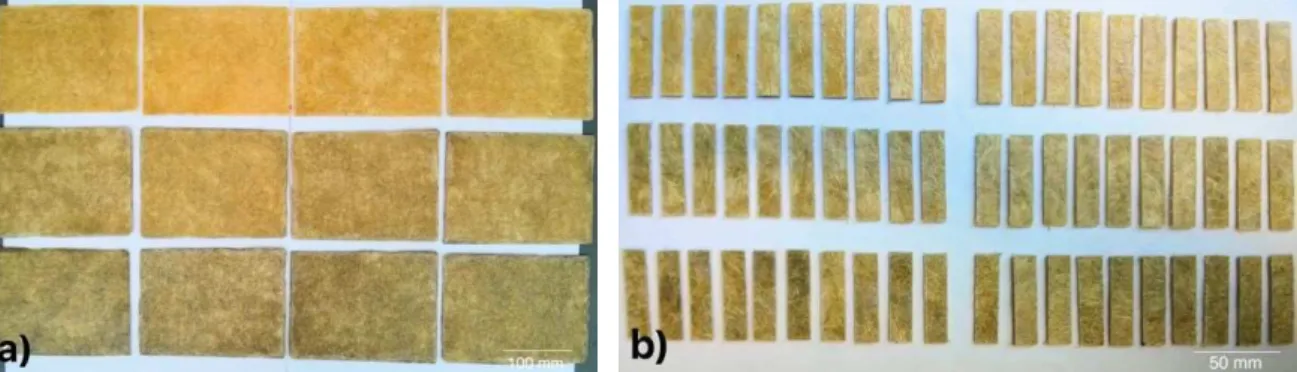
Figure 1: Composite laminas (a) and flexural specimens (b).
The damping represents the capability of the system to dissipate energy; the damping ratio (ζ) is a d i-mensionless number that provides an amount of damping that acts on the real system [16]. A high damping
ratio value (ζ) is indicative of a material having high, non-elastic strain component while a low value indi-cates high elasticity. The increase in the fibre/matrix interface bonding has led to the reduction in damping ratio, since the mobility of the molecular chains at the fibre/matrix interface decreases [17]. The equipment used to perform the damping tests was a Polytec OFV-503 Sensor Head.
The apparent porosity and water absorption analysis were carried out according to recommendations of British Standard BS EN ISO 10545-3 [18]. Apparent porosity is a measure of the void spaces in a material, and it is measured as a fraction, between 0 and 1, or as a percentage; and water absorption of a material is the percentage of water absorbed after immersion in water under constant negative pressure. The statistical soft-ware Minitab 17 was used to manipulate the data using the Design of Experiment (DoE) and Analysis of Var-iance (ANOVA) tools.
3. RESULTS
Table 2 shows the mean results of the properties for each experimental condition. Table 3 shows the ANOVA results for the responses. If the P-values are less than or equal to 0.05, it is concluded that the relevant effect
is significant. A α-level of 0.05 is the level of significance that implies a 95% of reliability of the effect being significant [19]. The underlined P-values shown in Table 3 indicate the significant factors identified in this study. The adjusted R2 value indicates whether the model behaved appropriately. This means that the variance of the properties is explained by the variance of experimental factors such as the fibre length and Portland cement inclusion factors. When one or more interaction effects are significant, the factors that interact can be considered together [20]. R2 values close to 1 (or 100%) indicate a very significant predictive ability of the model [19, 20]. The R2 values given in Table 3 varied between 68.68% and 83.52%. A normality test via Anderson-Darling technique was used to validate the ANOVA. In this case, P-values must be equal or superior to 0.05 to follow a normal distribution configuration. All data followed a normal distribution showing P-values higher than 0.05 as shown in Table 3.
Table 2: Mean of the experimental results for the responses.
CONDITIONS FLEXURAL STRENGTH (MPa)
FLEXURAL MODULUS (GPa)
DAMPING RA-TIO
APPARENT PO-ROSITY (%)
WATER AB-SORPTION (%)
C1 36.49 1.55 0.0274 15.12 14.00
C2 29.38 1.27 0.0336 20.92 20.83
C4 35.30 1.49 0.0267 15.61 14.64
C5 34.15 1.38 0.0337 21.26 21.35
C6 34.47 1.26 0.0315 22.95 22.77
3.1 Flexural modulus and strength
The flexural modulus of the composites ranged from 1.26 GPa to 1.75 GPa (see Table 2). The interaction between the factors “Fibre length and Cement inclusion” exhibited significant effect, with a P-value of 0.019 (Table 3). Figure 2a shows the interaction effect plot for the mean flexural modulus. The cement inclusions provided superior stiffness (13%) to the pristine condition, only when 10wt% of particles were incorporated in composites made with 4 mm fibre length. The level of 5wt% of cement was not able to increase the elastic moduli of the composites. A possible hydration of the cement grains by the epoxy resin can possibly contrib-ute to increase the stiffness of polymeric composites [21].
Table 3: Analysis of variance (P-value ≤ 0.05).
EFECTS
EXPERIMENTAL FACTORS
FLEXURAL STRENGTH
FLEXURAL MODULUS
DAMPING RATIO
APPARENT POROSITY
WATER AB-SORPTION
(P-values ≤ 0.05)
MAIN
FIBRE LENGTH 0.746 0.059 0.611 0.192 0.168
CEMENT INCLUSION 0.050 0.071 0.037 0.044 0.046
IN
TE
R
A
C
TI
ON
FIBRE LENGTH AND
CEMENT INCLUSION 0.102 0.019 0.649 0.313 0.291
R2-ADJUSTED (%) 73.88 83.52 68.68 72.65 73.10
Anderson-Darling
(P-values ≥ 0.05) 0.897 0.761 0.494 0.898 0.816
Figure 2: Interaction effect plot for the mean flexural modulus (a) and main effect plot for the mean flexural strength (b).
3.2 Damping ratio
The damping ratio of the composites varied from 0.0267 to 0.0337 (Table 2). The main factor “Cement
inclu-sion” significantly affected the damping ratio response, with a P-value of 0.037 (Table 3). The main effect plot for the mean damping ratio (Figure 3) reveals the cement inclusion was able to increase the damping ratio of the composites, mainly when 5wt% of particles were incorporated, exhibiting a percent increase of 25%. It is noted the composites with lower stiffness/strength are those with higher damping ratio.
Figure 3: Main effect plot for the mean damping ratio.
3.3 Apparent porosity and water absorption
The apparent porosity of the composites ranged from 15.12% to 22.95% (Table 2). The P-value of 0.044
un-derlined in Table 3 indicates the main factor “Cement inclusion” significantly affected the apparent porosity results. Figure 4a shows the main effect plot for the mean apparent porosity data. The apparent porosity re-sults raised when cement particles were incorporated. This behaviour can be attributed due to the increase of surface area while cement particles are incorporated. In addition, a wettability of the natural fibres is prone to reduce when cement particles are mixed with the epoxy resin, contributing to the presence of micro pores at the fibre/matrix interface.
The water absorption of the composites varied between 14.00% and 22.77% (see Table 2). The main
Figure 4: Main effect plots for the mean apparent porosity (a), and the mean water absorption (b).
4. CONCLUSIONS
This paper investigated the effect of Portland cement inclusions and sisal fibre lengths on the physical, dy-namic and mechanical behaviour of short sisal fibre reinforced composites. A full factorial design was con-ducted to identify the effects of individual factors or interactions on the responses. The main factor Cement inclusion revealed significant effects on the flexural strength, damping ratio, apparent porosity and water absorption. Higher stiffness was achieved only when 10wt% of cement particles were incorporated in com-posites made with sisal fibre length of 4 mm. No significant effect was evidenced on strength when 10wt% of cement was added, however a large reduction was reached when 5wt% of cement was considered. The pres-ence of cement particles increased the damping ratio, the apparent porosity and water absorption of the com-posites. The main factor Fibre length did not affect the responses. The interaction “Fibre length and Cement
inclusion” exhibited significant effect only on the modulus of elasticity. The level of 10wt% of cement parti-cles did not contribute to the flexural strength of short fibre composites, however it can be considered a promising reinforcing phase, since it can enhance the durability of the matrix phase, especially when a possi-ble cement hydration is considered. Finally, the presence of hydrated cement products and the particle loca-tion will be the scope of future investigaloca-tions.
5. ACKNOWLEDGMENTS
The authors would like to thank CAPES, CNPq and FAPEMIG for the financial support provided.
6. BIBLIOGRAPHY
[1] SILVA, L.J., Estudo experimental e numérico das propriedades mecânicas de compósitos poliméricos laminados com fibras vegetais, Dissertação de M.Sc., Universidade Federal de São João Del-Rei, São João Del-Rei, MG, Brasil, 2011.
[2] ANGRIZANI, C.A., VIEIRA, C.A.B., ZATTERA, A.J., et al., "Influência do comprimento da fibra de sisal e do seu tratamento químico nas propriedades de compósitos com poliéster", 17º CBECIMat - Congres-so Brasileiro de Engenharia e Ciência dos Materiais, Foz do Iguaçu, PR, Brasil, Novembro 2006.
[3] MARTIN, A.R., MARTINS, M.A., MATTOSO, L.H.C., et al., "Caracterização química e estrutural de fibra de sisal da variedade agave sisalana", Polímeros: Ciência e Tecnologia, v. 19, n. 1, pp. 40-46, 2009. [4] GIBSON, R.F. Principles of composite material mechanics, 2 ed, Ohio, McGraw-Hill, 1994.
[5] PAUL, A., JOSEPH, K., THOMAS, S. “Effect of surface treatments on the electrical properties of low-density polyethylene composites reinforced with short sisal fibers”, Composites Science and Technology, v. 51, pp. 67-79, 1997.
[6] PAIVA, J.M.F., FROLLINI, E., “Unmodified and modified surface sisal fibers as reinforcement of phe-nolic and lignophephe-nolic matrices composites: thermal analyses of fibers and composites”, Materials Engi-neering, v. 291, pp. 405-417, April 2006.
[7] CAO, Y., CAMERON, J., “Impact properties of silica particle modified glass fiber reinforced epoxy composite”, Journal of Reinforced Plastics and Composites, v. 25, n. 7, pp. 761-769, May 2006.
[9] SILVA, L.J., PANZERA, T.H., VELLOSO, V.R., et al., “Statistical design of polymeric composites rein-forced with banana fibres and silica microparticles”, Journal of Composite Materials, v. 47, n. 10, pp. 1199-1210, May 2012.
[10] MAHRHOLZ, T., STÄNGLE, J., SINAPIUS, M., “Quantitation of the reinforcement effect of silica nanoparticles in epoxy resins used in liquid composite moulding processes”, Composites: Part A, v. 40, n. 3, pp. 235–243, March 2009.
[11] ROSSO, P., YE, L., FRIEDRICH, K., et al., “A toughened epoxy resin by silica nanoparticle reinforce-ment”, Journal of Applied Polymer Science, v. 100, n. 3, pp. 1849-1855, May 2006.
[12] TSAI, J.L., CHENG, Y.L., “Investigating silica nanoparticle effect on dynamic and quasi-static com-pressive strengths of glass fiber/epoxy nanocomposites”, Journal of Composite Materials, v. 43, n. 25, Sep-tember 2009.
[13] ALAMRI, H., LOW, I. M., “Characterization of epoxy hybrid composites filled with cellulose fibers and nano-SiC”, Journal of Applied Polymer Science, v. 126, pp. 221-231, April 2012.
[14] ASTM D 790-07, “Standard Test Methods for Flexural Properties of Unreinforced and Reinforced Plas-tics and Electrical Insulating Materials”, 2007.
[15] WERKEMA, M.C.C., AGUIAR, S., Planejamento e análise de experimentos: como identificar e avaliar as principais variáveis influentes em um processo, 1 ed, Werkema editora, Belo Horizonte, MG, 1996. [16] COSSOLINO, L.C., PEREIRA, A.H.A., Amortecimento: classificação e métodos de determinação, In-formativo Técnico-Científico, ITC04, São Carlos, 2010.
[17] SABA, N., JAWAID, M., ALOTHMAN, O.Y., et al., “A review on dynamic mechanical properties of natural fibre reinforced polymer composites”, Construction and Building Materials, v. 106, pp.149-159, March 2016.
[18] BRITISH STANDARD BS EN ISO 10545-3, Ceramic Tiles - Part 3: Determination of water absorption, apparent porosity, apparent relative density and bulk density. 1997.
[19] MONTGOMERY, D.C., Introduction to statistical quality control, 6 ed, New York, John Wiley & Sons, 2009.
[20] DRUMOND, F.B., Metodologia de otimização de processos, Departamento de Estatística da UFMG, Departamento de Tecnologia Mineral do CDTN/CNEN, Belo Horizonte, Minas Gerais, 1993.
[21] PANZERA, T.H., SABARIZ, A.L.R., STRECKER, K., et al, “Propriedades mecânicas de materiais compósitos à base de cimento Portland e resina epóxi”, Cerâmica, v. 56, pp.77-82, Março 2010.