Preparation of Ferroelectric Bi-Layered Thin Films Using the
Modified Polymeric Precursor Method
S.M. Zanettia*, E.R. Leitea, E. Longoa, J.A. Varelab
aCMDMC/LIEC, Departamento de Química, Universidade Federal de São Carlos,
C.P. 676, 13660-905 São Carlos - SP, Brazil
bInstituto de Química, Universidade Estadual de São Paulo, C.P. 355,
14801-970 Araraquara - SP, Brazil
Received: November 13, 2000; Revised: June 28, 2001
The modified polymeric precursor method was used to synthesize ferroelectric bismuth-layered compounds such as, SrBi2Ta2O9(SBT) and SrBi2Nb2O9(SBN). This method allows for the use of precursor reagents such as oxide, carbonate or nitrate as cation sources, with the additional advantage of not requiring special equipment for the synthesis. The films were deposited by spin coating on Pt/Ti/SiO2/Si(100) and SrTiO3(100) (STO) substrates and crystallized at temperatures between 700 and 800 °C in the case of SBT films and 650 °C to 750 °C in that of SBN films. The crystallographic and microstructural characterizations were carried out by X-ray diffraction (XRD), scanning electron microscopy (SEM) and atomic force microscopy (AFM). The ferroelectric and dielectric properties of the films indicate their applicability in ferroelectric memories and optical devices.
Keywords:bismuth layer, ferroelectric , thin films, electrical properties
1. Introduction
Ferroelectric bismuth-layered compounds were first studied by Aurivillius and Fang1. These structures consist of alternate bismuth oxide and perovskite type layers. Bi-layer structured compounds are generally represented by the following formula:
(Bi2O2)2+(Am-1BmO3m+1)2- (1)
whereAis Bi3+, Ba2+, Sr2+, Ca2+, Pb2+, K+or Na+andBis Ti4+, Nb5+, Ta5+, Mo6+, W6+ or Fe3+, and mis a whole number from 1 to 8 or a fraction such as 2(1/2) or 3(1/2). A is the cation of coordination 12 in the perovskite sublattice and B is the octahedral site. Bi forms the oxide interlayer (Bi2O2)2+between the perovskite blocks (Am-1BmO3m+1)2-,
where m is the number of octahedral layers inside the perovskite sublattice of the structure. For the stoichiometric composition SrBi2Ta2O9 (SBT), m = 2; thus, there is a
complete perovskite sublattice created by the Ta-O octahedra in which a cation A of coordination 12 (i.e., Sr) can reside2.
These compositions have recently been studied mainly in the form of thin films as an alternative material for application in ferroelectric memories, replacing PbxZr 1-xTiO3, which presents serious problems of polarization
fatigue (loss of the ferroelectric property after several po-larization/depolarization cycles) when used on platinum electrodes. The literature mentions a great variation in the synthesis of these compounds,e.g., pulsed laser deposition (PLD)3-6, organometallic decomposition (MOD)7,8, chemi-cal vapor deposition (CVD)9,10, sol-gel11-16, etc.
Among the chemical solution methods, the most widely investigated has been the sol-gel method, mostly using alkoxides normally dissolved in organic solvents as precur-sors. Alkoxides are extremely sensitive to ambient humid-ity and require a special water-free atmosphere. Moreover, certain alkoxides require special solvents to form a trans-parent solution, which is a basic requirement for their use in film deposition.
A variation of the sol-gel process is the polymeric precursor method developed by Pechini17in the 1960s. The Pechini method consists of the chelation of metal cations by a carboxylic acid, such as citric acid, and further polym-erization which is promoted by the addition of ethylene glycol and the consequent polyesterification reaction. The polymeric precursor method has been successfully used to synthesize several mixed oxide compounds, among them SrTiO318,19and LiNbO320.
In this study, the compounds were synthesized by the modified polymeric precursor method based on the Pechini
e-mail: [email protected]
process. However, the resin was obtained by the reaction between a carboxilic acid (citric acid) and an amine (ethyle-nediamine), forming a polyamide as a polymer21-23. Re-agents such as oxides, carbonates or nitrates can be used as the cation source, the reactions occurring in an aqueous medium with no need for any special atmosphere. The films were deposited on metallic electrodes (Pt) to determine their ferroelectric properties, and onto a transparent mono-crystalline substrate to evaluate the orientation of the films with possible optical applications.
2. Experimental
2.1. Preparation of the SBN resin
Strontium carbonate, SrCO3(Merck), niobium
ammo-nium oxalate, NH4H2[NbO-(C2O4)3].3H2O (CBMM,
Araxá, Brazil) and bismuth oxide, Bi2O3 (Aldrich) were
used as reagents to synthesize SrBi2Nb2O9. Niobium
hy-droxide was formed by dissolving niobium ammonium oxalate in water and precipitating it as Nb(OH)5by adding
NH4OH. After filtration, the niobium hydroxide was
dis-solved in an aqueous solution of citric acid to form niobium citrate. The Nb content was gravimetrically determined as Nb2O5. Stoichiometric amounts of SrCO3as salt and Bi2O3
dissolved in water with HNO3 were then added to this
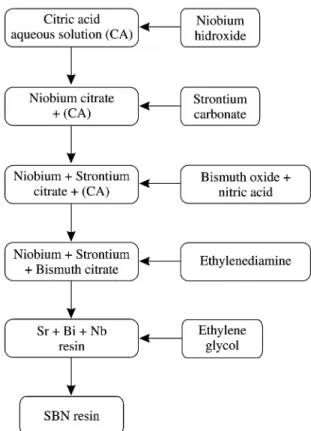
niobium citrate solution. Ethylenediamine was added drop by drop to the solution, which was stirred constantly until the pH reached 7-8. After the solution became homoge-nized, ethylene glycol was added as a secondary solvent. The molar ratio between strontium, bismuth and niobium was 1:2:2, the citric acid/metal molar ratio was fixed at 3.95 and the citric acid/ethylene glycol ratio was set at 60/40 (mass ratio). The viscosity of the deposition solution was adjusted by water evaporation until it reached 25 mPa.s. Figure 1 contains the flow chart for the preparation of SBN resin.
2.2. Preparation of the SBT resin
The Ta source for SBT was tantalum ethoxide (Ta(OC2H5)5- Alfa AESAR). Because this compound is an
alkoxide, the synthesis route had to be altered as follows: tantalum ethoxide was dissolved in ethylene glycol without the addition of water. Citric acid was then added to this solution to form tantalum citrate. The addition of ethyle-nediamine caused the pH to reach 7-8. Stoichiometric amounts of SrCO3(as salt) and Bi2O3(dissolved in nitric
acid) were added to this tantalum citrate solution. The citric acid/metal citric and acid/ethylene glycol ratios were the same as for SBN. Figure 2 shows the flow chart for the preparation of SBT resin.
2.3. Film deposition and characterization
The SBT and SBN films were deposited by spin coating using a rotation speed of 5000 rpm for 20 s on
Pt/Ti/SiO2/Si(100) and SrTiO3(100) (STO) substrates.
Af-ter deposition, the films were treated on a hot plate at approximately 150-200 °C to eliminate the solvent, fol-lowed by thermal treatment at 400 °C for 2 h to eliminate the excess organic material. This procedure resulted in an amorphous layer. The procedure was repeated several times until a thickness of about 300 nm was reached. Finally, the films were treated at temperatures ranging from 500 °C to 800 °C, according to the compound, to crystallize the perovskite phase. In the case of the films deposited on STO(100) substrate, after elimination of the organic mate-rial, each layer was crystallized in an oxygen atmosphere before the subsequent layer was deposited.
The films were characterized by grazing incidence X-ray diffraction (GIXRD) (Siemens, D5000), using an inci-dent angle of 2°(α) and a LiF100 monochromator. In addition to the usualθ-2θscans, the rocking curves (i.e.
ω-scans) around the (0010) SBT and SBT peak were re-corded for films grown onto STO substrates to determine the quality of their orientation. The full width at half maxi-mum (FWHM) values of the rocking curves were deter-mined by fitting the experimental curve to a Gaussian function.
ping mode. Film thickness was determined by Scanning Electron Microscopy (SEM) (Zeiss, DSM940A).
For the electrical measurements, gold electrodes, each with a nominal area of 7.07x10⁻⁴cm2, were sputter-depos-ited on the top surface in a metal-ferroelectric-metal (MFM) configuration. Capacitance and dissipation factor (tanδ) values, in the 100 Hz-10 MHz frequency range, and capacitance-voltage (C-V) were measured with a HP 4194A impedance analyzer. Ferroelectricity was investigated us-ing a Radiant RT6000HVS in the virtual ground mode. Before taking the measurements, the electrodes were an-nealed at 300 °C in an N2 atmosphere to improve the
contact.
3. Results and Discussion
Figure 3 presents the diffraction patterns for the SBT films deposited on Pt and treated at temperatures ranging from 500 °C to 800 °C. It can be observed that the film treated at 500 °C is amorphous, while the formation of an intermediate phase can be seen (a fluorite type phase, previously observed in the literature11) at 550 °C. This intermediate phase transforms into the perovskite phase at 600 °C and crystallizes perfectly at 700 °C. Increased treatment temperature led to films with higher crystallinity.
The same analysis can be extended to the SBN films, which crystallize at a temperature approximately 100 °C lower than the SBT films. The films deposited on Pt are polycrys-talline, with no preferential orientation. These results are favorable for the ferroelectric properties because the great-est polarization takes place in the (a-b) plane.
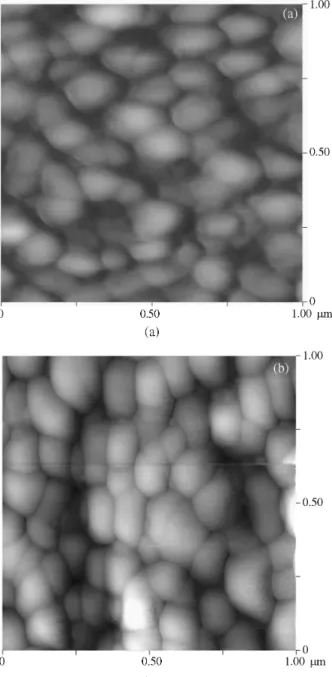
Figure 4 presents the AFM images of the SBT and SBN films treated, respectively, at 800 °C and 700 °C for 2 h.
As can be seen, the films have a granular structure of spherical grains with a homogeneous mean grain size in the order of 80-100 nm for both materials. These values are in agreement with the XRD data that presented a lower crys-tallization temperature for SBN. It should be noted that, although the SBN films were treated at 700 °C (100 °C lower than the thermal treatment temperature for SBT), they nevertheless presented similar sized grains.
The superficial roughness of the SBT films was around 5 nm, while the SBN films showed a greater superficial roughness varying from 13 nm to 16 nm. The greater superficial roughness of the SBN films may stem from the synthesis route. Ethylene glycol, which was used as the solvent for SBT, resulted in a resin containing a larger Figure 2.Flowchart for preparation of SBT resin.
amount of organic material. After the elimination of this organic material, a thinner amorphous layer was produced, which resulted in a reduction of the superficial roughness. Film thickness was determined by cross section analy-ses of the substrate using SEM. Figure 5 presents a mi-crograph of the SBN film treated at 700 °C.
The dielectric properties were determined by measuring the capacitance as a function of the frequency. The values of the dielectric constant () and the dissipation factor (tan δ), measured at a 100 kHz frequency, were 92 and 0.033 for the SBN films treated at 700 °C and 248 and 0.040 for the SBT films treated at 800 °C, respectively. Figure 6
presents the capacitance as a function of the voltage curves (C-V), measured at a 100 kHz frequency. The variation of capacitance with applied voltage, and curve displacement upon inversion of the direction of the sweep is clearly visible. This displacement is characteristic of a ferroelectric material and confirms the ferroelectric properties of the films. The SBT capacitance values are much higher than the SBN values, in agreement with the values determined for the dielectric constant.
The polarization-electric field (P-E) curves of the SBN and SBT films were measured; the results are shown in Fig. 7. TheP-Ecurves presented in Fig. 7 attest the ferroelec-tricity of the films, since the two compounds presented hysteresis loops. The SBN film showed a remnant polari-Figure 4.AFM images of (a) SBT film treated at 800 °C for 2 h; (b) SBN
film treated at 700 °C for 2 h.
zation (Pr) of 6.72 µC/cm2
and a coercive field (Ec) of 139 kV/cm. The Pr value of the SBT film was 9.2µC/cm2
and the Ec was 56 kV/cm. It should be pointed out that the shape of the curves and the Pr and Ec values are in conform-ity with those reported in the literature4,24,25.
These results are very interesting inasmuch as they reflect the ferroelectric properties of films obtained by an alternative chemical method with an extremely simple syn-thesis compared to the chemical methods reported in the
literature. This synthesis allows for the use of easily avail-able reagents whose cost is low compared to alkoxides and requires no controlled atmosphere. These films possess the properties required for ferroelectric memory applications.
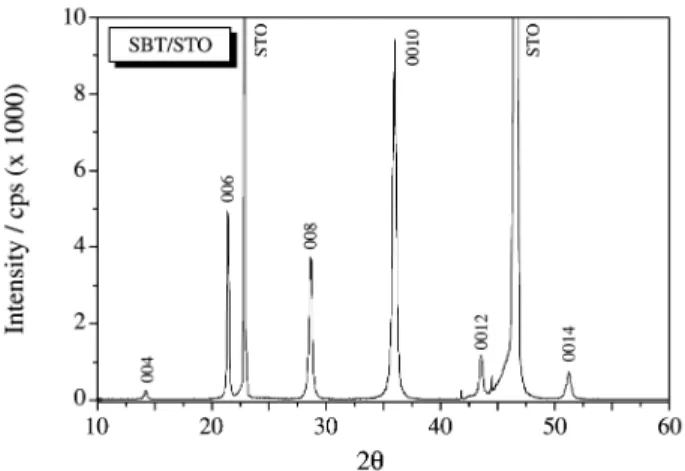
Several recent articles have presented preliminary find-ings for possible optical and electro-optical applications for SBT films26,27. Films for optical applications must be de-posited on a single crystal substrate and, in this case, they should preferentially be grown epitaxially. In other words, the films must be highly oriented in the c direction as well as in the a-b plane. However, this type of orientation is obtained more easily when deposition is carried out by physical methods. SBN and SBT films were deposited on STO(100) substrate to evaluate the possibility of obtaining highly oriented films using the proposed method. Figure 8 presents the diffraction pattern obtained for the SBT/STO film treated at 800 °C in an oxygen atmosphere.
As can be observed in Fig. 8, the SBT film is highly oriented in thecdirection since the only peaks to be indexed were the (00l) and those of the substrate. Rocking curve tests around the (0010) peak were carried out to check the degree of orientation of these films (Fig. 9). The presence of two peaks can be observed in the SBT films, with FWHM values of 0.12° and 0.60°. These results suggest that there are two regions having different degrees of orientation, with the narrow peak representing a highly oriented inter-facial region close to the substrate and the wide peak indicating a more distorted region far from the substrate. The rocking curve of the SBN film showed the same profile with FWHM values of 0.13° and 0.98°. Similar results were found for LiNbO3films grown onto sapphire20.
The rocking curve results enable us to affirm that it is possible to obtain highly oriented SBN and SBT films that are potentially applicable in optical devices.
Figure 6.C-Vcurves of SBN and SBT films.
Figure 7.Hysteresis loops (P-E) of the SBN and SBT films.
4. Conclusions
SrBi2Ta2O9 and SrBi2Nb2O9 were synthesized by the
modified polymeric precursor method. The films were de-posited on Pt/Ti/SiO2/Si(100) and SrTiO3(001) substrates.
The films deposited on Pt were polycrystalline, with no preferential orientation and with the ferroelectric properties necessary for application in FERAM (Pr of 6.7µC/cm2
and 9.2µC/cm2
for SBN and SBT, respectively). When depos-ited on STO(100), the films presented a high orientation in thecdirection, with FWHM values, obtained by the rocking curves, close to the peak (0010) of 0.12° and 0.60° for SBT, and of 0.13° and 0.98° for SBN.
The modified polymeric precursor method is an alter-native chemical method that allows for the synthesis of SBN and SBT using reagents such as oxides, carbonates or nitrates, except for Ta source. The synthesis is fast, low cost and can be accomplished in a laboratory atmosphere, re-quiring no special equipment or atmosphere.
Acknowledgements
The authors thank the Brazilian research financing agencies FAPESP and CNPq/PRONEX for their support of this work. Special thanks are due to MSc. M. Inês B. Bernardi for the rocking curve measurements.
References
1. Aurivillius, B.; Fang, P.H..Phys. Rev., v. 126, n. 3, p. 893, 1962.
2. Rodriguez, M.A.; Boyle, T.J.; Hernandez,B.A.; Buch-heit, C.D.; Eatough;M.O.J. Mater. Res., v. 11, n. 9, p. 2282, 1996.
3. Yang, H-M.; Luo, J-S; Lin, W-T.J. Mater. Res., v. 12, n. 4, p. 1145, 1997.
4. Battacharyya, S.; Bharadwaja, S.S.N.; Krupanidhi, S.B.Appl. Phys. Lett., v. 75, n. 17, p. 2656, 1999.
5. Gruverman, A.; Pignolet, A.; Satyalakshmi, K.M.; Alexe,M.; Zakharov, N.D.; Hesse, D. Appl. Phys. Lett., v. 76, n. 1, p.106, 2000.
6. Bhattacharyya, S.; Bharadwaja, S.S.N.; Krupanidhi, S.B.Sol. Stat. Com., v. 114, p. 585, 2000.
7. Yeon, D.J.; Park, J.D.; Oh, T.S.J. Korean Physical Society, v. 32, p. S1445, 1998.
8. Tanaka, M.; Watanabe, K.; Katori, K.; Yamoto H.; Yagim H.Mater. Res. Bull., v. 33, n. 5, p.789, 1998. 9. Seong, N-J.; Yoon, S-G.Integrated Ferroelectrics, v.
21, p. 207, 1998.
10. Shin, D.S.; Choi, H.S.; Kim, Y.T.; Choi, I-H.J. Crys-tal Gowth, v. 209, p.1009, 2000.
11. Boyle, T.J.; Buchheit, C.D.; Rodriguez, M.A.; Al-Shareef, H.N.; Hernandez, B.A.; Scott, B.; Ziller, J.W.
J. Mater. Res., v. 11, n. 9, p. 2274, 1996.
12. Atsuki, T.; Soyama, N.; Yonezawa, T.; Ogi, K.Jpn. J. Appl. Phys., v. 34, n. 9B, p. 5096, 1995.
13. Ito, Y.; Ushikubo, M.; Yokoyama, S.; Matsunaga, H.; Atsuki, T.; Yonezawa, T.; Ogi, K.Jpn. J. Appl. Phys., v. 35, n. 9B, p. 4925, 1996.
14. Ching-Prado, E.; Perez, W.; Reynés-Figueroa, A.; Katiyar, R.S.; Ravichandran, D.; Bhalla, A.S. Mat. Res. Soc. Symp., v. 459, p. 213, 1997.
15. Kato, K.; Zheng, C.; Finder, J.M.; Dey, S.K.; Torii, Y.
J. Am. Ceram. Soc., v. 81, p. 7, p. 1869, 1998. 16. Aizawa, K.; Tokumitsu, E.; Okamoto, K.; Ishiwara,
H.Appl. Phys. Lett., v. 76, n. 18, p. 2609, 2000. 17. Pechini, M.P.U.S. Patentn. 3,330,697, 1967. 18. Zanetti, S.M.; Longo, E.; Varela, J.A.; Leite, E.R.Mat.
Lett., 31, p. 173, 1997.
19. Zanetti, S.M.; Leite, E.R; Longo, E.; Varela, J.A.
Appl. Organomet. Chem., v. 13, p. 373, 1999. 20. Bouquet, V.; Leite, E.R.; Longo, E.; Varela, J.A.J.
Eur. Ceram. Soc., 19, p. 1447, 1999.
21. Zanetti, S.M.; Leite, E.R.; Longo, E.; Varela, J.A.Mat. Lett.,v. 40, p. 33, 1999.
22. Zanetti, S.M.; Araújo, E.B.; Leite, E.R.; Longo, E.; Varela, J.A.Appl. Organomet. Chem., v. 13, p. 373, 1999.
23. Zanetti, S.M.; Leite, E.R., Longo, E.; Araújo, E.B.; Chiquito, A.J.; Eiras, J.A.; Varela, J.A.J. Mater. Res., v. 15, n. 10, p. 2091, 2000.
24. Yi, J.H.; Thomas, P.; Manier, M.; Mercurio, J.P.; Jauberteau, I.; Guinebretière,R.J. Sol-gel Sci. Tech., v. 13, p. 885, 1998.
25. Watanabe, H.; Mihara, T.; Yoshimori, H.; Paz de Araujo, C.A.Jpn. J. Appl. Phys., v. 34, n. 9B, p. 5240, 1995.
26. Zhang, W.F.; Zhang, M.S.; Yin, Z.; Gu, Y.Z.; Du, Z.L.; Yu, B.L.Appl. Phys. Lett., v. 75, n. 7, p. 902, 1999.
27. Huang, Z.; Yang, P;. Cahng, Y.; Chu, J.J.Appl. Phys., v. 86, n. 3, p. 1771, 1999.
FAPESP helped in meeting the publication costs of this article Figure 9.Rocking curves around the (0010) peak of the SBT film