ABSTRACT
BACKGROUND AND OBJECTIVES:Pain is a major symp-tom responsible for the search for urgency care. his study aimed at checking the presence of pain in patients attending the risk classiication.
METHODS:his is a cross-sectional and descriptive study car-ried out at an urgency care unit, using a form with socio-demo-graphic and clinical data, risk classiication, analgesia and pain record on medical charts. Pain Management Index proposed by the World Health Organization was calculated.
RESULTS: From 102 patients included in the study, 82 (80.2%) reported pain, 45 (54.9%) were females, 48 (58.5%) were mar-ried, most (62 – 75.6%) lived in Greater Aracaju, 28 (34.1%) were classiied as yellow. Acute, severe to moderate pain was the most frequent. In 71 (86.6%) cases, continuous pain has moti-vated the search for urgency care. Pain recording was present in almost all medical charts, being 80.5% performed by physicians. Simple analgesics and non-steroid anti-inlammatory drugs were the most frequently prescribed analgesics (59 – 72%). Pain man-agement was inadequate in 86.6% of cases and there has been wide variation between admission and administration of irst an-algesia (mean: 94.5 min; min-max: 8-360 min).
CONCLUSION: he lack of analgesic protocols at risk classii-cation may impair adequate pain management.
Keywords: Nursing at emergency, Pain, Pain Measurement, Screening.
RESUMO
JUSTIFICATIVA E OBJETIVOS: A dor é um dos principais sintomas responsáveis pela procura de serviços de urgência. O objetivo deste estudo foi veriicar a presença de dor em pacientes atendidos na classiicação de risco.
Pain in patients attended at risk classification of an emergency service
Dor em pacientes atendidos na classificação de risco de um serviço de urgência
Jamille Santos da Silva1, Taynara Apolonia Fagundes da Cruz1, Caíque Jordan Nunes Ribeiro1, Victor Santana Santos2, José Antonio
Barreto Alves3, Maria do Carmo de Oliveira Ribeiro3
1. Universidade Federal de Sergipe, Departamento de Enfermagem, Aracaju, SE, Brasil. 2. Universidade Federal de Sergipe, Programa de Pós-Graduação em Ciências da Saúde, Aracaju, SE, Brasil.
3. Universidade Federal de Sergipe, Aracaju, SE, Brasil.
Submitted in October 26, 2015.
Accepted for publication in January 21, 2016. Conlict of interests: none – Sponsoring sources: none.
Correspondence to:
Maria do Carmo de Oliveira Ribeiro Av. Cláudio Batista, S/N - Bairro Sanatório 49060-108 Aracaju, SE, Brasil. E-mail: [email protected]
© Sociedade Brasileira para o Estudo da Dor
MÉTODOS: Estudo transversal e descritivo, realizado em um serviço de urgência. Foi utilizado formulário que continha os dados sócio-demográicos e clínicos, classiicação de risco, anal-gesia e registro da dor em prontuário. Foi calculado o Índice de Manuseio da Dor proposto pela Organização Mundial de Saúde.
RESULTADOS: Dos 102 pacientes incluídos no estudo, 82 (80,2%) relataram dor, 45 (54,9%) eram do gênero feminino, 48 (58,5%) eram casados, a maioria (62 – 75,6%) residentes da grande Aracaju, 28 (34,1%) foram classiicados como amarelo. A dor aguda, intensa à moderada foi a mais frequente. Em 71 (86,6%) casos, a dor do tipo continua motivou a procura pelo serviço de urgência. O registro de dor esteve presente na quase totalidade dos prontuários, sendo 80,5% realizados pelos médi-cos. Os analgésicos simples e anti-inlamatórios não esteroides foram os mais prescritos (59 – 72%). O manuseio da dor foi inadequado em 86,6% dos casos e existiu grande variação entre o tempo de admissão e administração da primeira analgesia (mé-dia: 94,5min; mín-máx: 8-360min).
CONCLUSÃO: A ausência de protocolos de analgesia na clas-siicação de risco pode diicultar o adequado manuseio do fenô-meno doloroso.
Descritores: Dor, Enfermagem em emergência, Mensuração da dor, Triagem.
INTRODUCTION
he search for urgency assistance has increased and most pa-tients report pain at screening. As from this complaint, re-sources are used to classify and organize patients’ priorities. Pain is a major reason for human sufering, brings incapacities which relect on quality of life (QL) and generate major psy-chosocial and economic repercussions1.
Deined as unpleasant sensory and emotional experience, pain is associated to real or potential tissue injury, or is de-scribed in terms of such injury2. So, it is visible the need to
measure pain from patients’ arrival to the urgency unit until their hospital discharge.
Pain is common in patients looking for urgency services. A study evaluating pain in trauma victims has identiied it in 90% of cases3. So, there is a real need for adequate pain
man-agement in this group of patients, aiming at ofering better assistance, thus assuring that recommendations of the Inter-national Association for the Study of Pain (IASP) and of the Single Health System (SUS) are followed.
In Brazil, the National Humanization Policy (NHP), created by the Department of Health in 20034, establishes assistance
with risk classiication to provide SUS users a holistic,
ly and humanized assistance.
Health services have adopted the Manchester Protocol to or-ganize queues in urgency services. his protocol is built with categories of signs and symptoms and not with pre-estab-lished urgency scales. As from clinical data (signs and symp-toms), individuals are classiied by colors (red, orange, yellow, green and blue) and service time is established according to severity5. Pain during screening associated to other signs and
symptoms, orients patients’ classiication according to the protocol of the service.
his study aimed at observing the presence of pain, its char-acteristics and management among patients seen by the risk classiication of the most important urgency service of Ser-gipe. his study was justiied by the need to understand the proile of the public seen by the risk classiication, especially with regard to pain as motivating symptom for the search for urgency services.
METHODS
This is a cross-sectional, descriptive and exploratory study with 102 patients seen by the risk classification from March to April 2015, in the most important public urgen-cy hospital of Sergipe-Brazil, located in the city of Aracaju, capital of the state. This hospital is reference for urgency and emergency services for the whole state of Sergipe and is responsible for approximately 250 weekly consultations. So, to estimate sample size, we considered an expected pro-portion that 30% of patients look for health services due to pain. With this parameter, and considering 95% confi-dence interval and power of 80, sample was estimated in 102 patients.
Inclusion criteria were age above 18 years and cognitive conditions to answer questions. Exclusion criteria were un-stable patients, hemodynamic instability and being victim of trauma. Initially a pilot test was carried out with seven patients to gage data collection tool and researchers. These seven patients were excluded from the final sample.
Data were collected after evaluation by risk classification and by the physician on duty. Patients meeting inclusion crite-ria were invited to participate in the research. After signing the Free and Informed Consent Term (FICT), patients were interviewed by trained research assistants and documental analysis of medical charts was carried out by researchers. A structured questionnaire was used for data collection with the following information: socio-demographic and clinical data, risk classification, previously used analgesia and anal-gesia during urgency assistance, pain presence, intensity and duration, its periodicity, location, improving and worsening factors, and pain record on medical charts.
Pain was measured with the numeric scales where zero corre-sponds to no pain and 10 to maximum pain2. Patients were
asked to verbally state the value corresponding to their pain. To evaluate pain management according to World Health Organization (WHO) recommendations6, Pain
Manage-ment Index (PMI) was calculated. This index takes into
ac-count the analgesic drug prescribed and pain intensity re-ferred by patients, and is established as follows: analgesic potency is subtracted from pain intensity referred by pa-tient. PMI varies from -3 to +3; negative scores point to the use of inadequate analgesics and zero or positive scores indicate adequate analgesia6. Analgesics were classified
ac-cording to their analgesic potency (AP), where zero means no analgesic drug; 1 – non-steroid anti-inflammatory drug (NSAID); 2 – weak opioid; 3 – strong opioid. Pain intensity (PI) was classified as zero – no pain, 1 – mild pain (1-4), 2 – moderate pain (5-7) and 3 – severe pain (8-10)7.
Statistical analysis
Information was coded and inserted in a database. Then data were submitted to exploratory analysis. Categorical variables were described with absolute and percentage fre-quencies. Kolmogorov-Smirnov test was used to check nor-mality (symmetry) of numerical variables distribution. Since distribution was asymmetric, non-parametric Mann-Whit-ney test was used. Chi-square test or Fisher Exact test were used to evaluate the association of patients’ profile and the presence of pain during evaluation. Statistical significance was 5% (p<0.05). Data were analyzed by the software Sta-tistical Package for the Social Sciences (SPSS) version 20.0 and are shown in tables.
Recommendations of Resolution 466/2010, of the National Health Council were followed in all research stages.
The study was approved by the Ethics Committee, Univer-sidade Federal de Sergipe, CAAE 40884415.0.0000.5546.
RESULTS
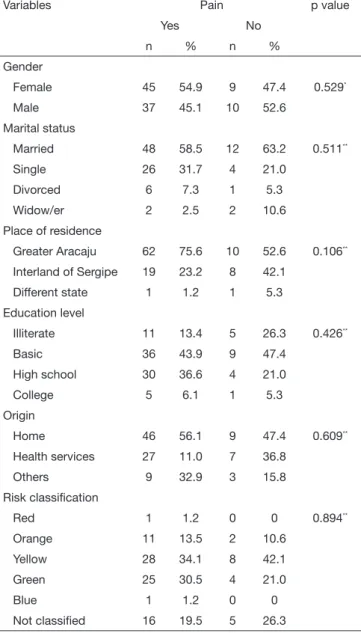
A total of 102 patients were eligible for the study. However, one participant was excluded for being less than 18 years old. Among respondents, 19 (18.8%) have not reported pain. Final sample was made up of 82 (80.2% patients with median age (interquartile interval, IIQ) of 36 years (27-49), of whom 54.9% were females, 58.5% were married, 75.6% lived in greater Aracaju, 43.9% had basic education and 34.1% were classified as yellow risk (Table 1).
Sample was considered homogeneous for socio-demograph-ic characteristsocio-demograph-ics since there were no statistsocio-demograph-ically signifsocio-demograph-icant differences among patients reporting or not pain at risk clas-sification (Table 1). However, patients referring pain were younger than those without pain (p=0.027, Mann-Whitney test).
Our study has identiied that 46.3% of patients used analge-sia without medical prescription before looking for the ur-gency service. From them, 4.9% did not know the drug used; 26.8% stated using simple analgesics and/or NSAIDS; and 14.6% stated using antispasmodic or muscle relaxants alone or associated to NSAIDS (Table 3).
In almost all cases, analgesics were prescribed by emergency physicians (97.6%), being simple analgesic and NSAIDS the most commonly prescribed drugs in 72% of cases, thus char-acterizing the practice of oligoanalgesia (Table 3).
Although pain being classiied as moderate to severe, admin-istered analgesia was not adequate to relieve pain in 86.6% of cases. Mean time between admission to the urgency service and administration of analgesia was 94.5 (50.7-172) minutes; minimum time was eight minutes and maximum time was 360 minutes (Table 4).
Table 1. Socio-demographic and clinical characterization of users seen by the risk classiication sector of an urgency service. Aracaju, SE, Brazil, 2015
Variables Pain p value
Yes No
n % n %
Gender
Female 45 54.9 9 47.4 0.529*
Male 37 45.1 10 52.6 Marital status
Married 48 58.5 12 63.2 0.511**
Single 26 31.7 4 21.0 Divorced 6 7.3 1 5.3 Widow/er 2 2.5 2 10.6 Place of residence
Greater Aracaju 62 75.6 10 52.6 0.106**
Interland of Sergipe 19 23.2 8 42.1 Different state 1 1.2 1 5.3 Education level
Illiterate 11 13.4 5 26.3 0.426**
Basic 36 43.9 9 47.4 High school 30 36.6 4 21.0 College 5 6.1 1 5.3 Origin
Home 46 56.1 9 47.4 0.609**
Health services 27 11.0 7 36.8 Others 9 32.9 3 15.8 Risk classiication
Red 1 1.2 0 0 0.894**
Orange 11 13.5 2 10.6 Yellow 28 34.1 8 42.1 Green 25 30.5 4 21.0
Blue 1 1.2 0 0
Not classiied 16 19.5 5 26.3
*Fisher Exact test; **Chi-square test.
Table 2. Pain evaluation of users seen by the risk classiication sector of an urgency service. Aracaju, SE, Brazil, 2015 – continuation
Variables n % p value†
Pain characteristic
Intermittent 34 44.5
Continuous 46 56.1 0.21
Fimproving factors
Rest 26 31.7 0.004
Change in position 9 11.0
Does not know 30 36.6
Others 17 20.7
Worsening factors
Change in position 30 36.6 0.79
Does not know 27 32.9
Others 25 30.5
Pain location
Head 11 13.4 <0.001
Chest 6 7.3
Abdomen 27 32.9
Extremities 7 8.6
Multiple 21 25.6
Others 10 12.2
Pain record
Yes 78 95.1 <0.001
No 4 4.9
Professional in charge of recording
Physicians 66 80.5 0.16
Nurses 56 68.3
†Adherence Chi-square value with Yates correction.
Table 2. Pain evaluation of users seen by the risk classiication sector of an urgency service. Aracaju, SE, Brazil, 2015
Variables n % p value†
Major reason related to pain
Yes 71 86.6 <0.001
No 11 13.4
Pain duration
Acute 78 95.1 <0.001
Chronic 4 4.9
Pain intensity
Mild (1 – 4) 44 53.7 <0.001 Moderate (5 – 7) 30 36.5
Severe (8 – 10) 8 9.8
DISCUSSION
Pain is a common symptom in urgency services, especially in risk classiication, which requires efective strategies for its relief. So, deleterious efects caused by untreated pain should be avoided, thus providing patients with assistance based on ethics and humanization.
Most patients of our study were females. Studies8,9 evaluating
pain in emergency services have found similar results. It is believed that females are more concerned with health, thus looking more often for medical assistance, as shown in our study.
here has been prevalence of patients with complete or in-complete basic education. A study emphasizes that people with lower education levels have less perspective to satisfacto-rily deal with pain10. Poor education level, associated to
un-favorable socioeconomic conditions, may impair the under-standing of health primary and tertiary attention functions. So, the lack of knowledge of the real function of the urgency service overloads the tertiary attention, increases waiting time and patients dissatisfaction, thus changing logistics of such services.
As to risk classiication, approximately one third of patients were classiied as yellow. A study aiming at checking the level of agreement between institutional and Manchester protocols has found diferent results5. hese researchers have identiied
patients classiied as red and orange. According to the Man-chester protocol11, patients are classiied according to severity
in red (imminent risk of death), orange (very urgent), yel-low (without imminence of death), green (moderate risk) and blue (low risk). he higher frequency of patients classiied as yellow is related to the fact that, in the studied service, pa-tients with imminent risk of death are directly referred to the red area of the irst aid unit.
Almost all patients have referred acute pain. A study12
iden-tifying pain in the postoperative period of craniotomy has shown data similar to ours. Acute pain may change blood pressure, temperature and heart rate, and may decrease oxy-gen tissue supply and impair daily life activities.
Severe to moderate continuous pain was the most frequent, as opposed to a study carried out in the USA evaluating pain management in the emergency service13. Severe pain leads to
physical and emotional distress not only to patients but also to relatives. In addition, continuous pain is characterized for being sudden and spontaneous or related to a certain activity. So, adequate pain management is critical to provide comfort to patients, to avoid negative efects of untreated pain, pain recurrence, as well as frequent returns to urgency services. Pain was associated to the major reason for looking for urgen-cy services in most cases, being abdominal the most frequent pain. his result difers from a study which has observed back pain as the predominant type14. Lumbar and abdominal pain
impairs production and productivity, in addition to afecting patients’ QL.
Factors improving and worsening pain were, respectively, rest and change in position. Health professionals have several methods to manage pain, among them, pharmacological and non-pharmacological therapies. So, they should use all avail-able resources aiming at promoting pain relief, thus improv-ing satisfaction of users lookimprov-ing for health services.
here has been inadequate analgesia in this study since in spite of severe pain in most cases, simple analgesics and NSAIDS were the most commonly prescribed drugs, which
Table 3. Analgesic consumption in an urgency public service. Aracaju, SE, Brazil, 2015
Variables n % p value‡
Previous use of analgesia
Yes 38 46.3 <0.001
No 44 53.7
Previously used analgesic
Simple analgesic or NSAIDS‡‡ 19 23.2 <0.001
Buscopan 7 8.5
Simple analgesic + NSAIDS‡‡ 6 7.3
Muscle relaxant 2 2.4 Does not know 4 4.9 Did not use 44 53.7 Received analgesia in the service
Yes 80 97.6 <0.001
No 2 2.4
Analgesic received in the service
Simple analgesic + NSAIDS‡‡ 59 72.0 <0.001
Weak opioid 16 19.5 Simple analgesic + weak opioid 4 4.9 Strong opioid 1 1.2 Has not received analgesia 2 2.4 Administration route
Intravenous 66 80.5 <0.001 Venous + muscular 11 13.4
Other route associations 3 3.7 Has not received analgesia 2 2.4
‡Adherence Chi-square value with Yates correction, ‡‡NSAIDS = non-steroid
anti-inlammatory drugs.
Table 4. Adequacy of analgesic treatment and time between admis-sion and irst analgesia in an urgency service. Aracaju, SE, Brazil, 2015
Variables n % value§
Adequate analgesic treatment
Yes 11 13.4 <0.001
No 71 86.6
Time between admission and 1st
anal-gesia (min)
1–10 2 2.4 <0.001
11–60 23 28.1
61–120 25 30.5
121–240 21 25.6
>240 11 13.4
characterizes the practice of oligoanalgesia. hese data con-irm a study carried out in a teaching hospital of the USA15.
It was also possible to observe the low cost of strong opioids, which are highly recommended for severe pain16. Although a
wide availability of opioids in the market, simple analgesics and NSAIDS prescription is still a common practice in ur-gency services.
With regard to time between admission and irst analgesia in the urgency service, there has been a delay, in some cases, for the administration of the irst analgesia. hese results con-irm a study where researchers have observed mean time of 90 minutes13, which shows that urgency services overload is a
common problem also in other countries.
Additionally, according to the Manchester protocol11,
pa-tients classiied as yellow should be assisted no longer than in 60 minutes. In our study, although almost one third of patients being classiied this way, 69.5% of patients were seen in a period above that recommended. Overcrowding of ur-gency services, added to the lack of analgesia protocols and organization of patients low, may contribute for the delay in starting treatment and receiving analgesia, in addition to increasing risks for negative outcomes.
Pain records were mostly illed by physicians, however there were no medical chart speciications about pain characteris-tics. On the other hand, the study12 has identiied that most
medical charts had no records about pain by the multipro-fessional team and, when existing, they were performed by physicians. In a study carried out in Turkey, just 35.1% of nurses reported keeping pain records in all medical charts17.
Adequate and complete pain record on medical charts is a major tool to guide therapeutic approach and evaluation of its eicacy, especially for nursing professionals, aiming at as-suring ethic-legal support.
CONCLUSION
he study about pain in patients seen by the risk classiication of an urgency service has enabled the following conclusions: females were predominant and most patients were young adults; major reason for looking for the urgency service was related to pain; rest and change in position were pain improv-ing and worsenimprov-ing factors, respectively. Some patients were classiied as yellow and pain was described as acute,
continu-ous, from severe to moderate, however there has been inade-quate management. Physicians were professionals more often recording pain on medical charts, however its characteristics were absent.
In light of the above, some questions are raised: why are there no analgesia protocols in risk classiication? Why is there a large number of patients choosing urgency services rather than looking for primary attention? Why is oligoanalgesia still a frequent practice? Answers to these questions are com-plex and need further studies trying to solve such issues.
REFERENCES
1. Sousa FA, Pereira LV, Cardoso R, Hortense P. Multidimensional pain evaluation scale. Rev Lat Am Enfermagem. 2010;18(1):3-10.
2. International Association for Study of Pain (IASP). Consensus development confer-ence statement: the integrated approach to the management of pain. Accid Emerg Med. 1994;6:491-2.
3. Calil AM, Pimenta CA, Birolini D. he “oligoanalgesia problem” in the emergency care. Clinics. 2007;62(5):591-8.
4. Ministério da Saúde (BR). Política Nacional de Humanização. Formação e interven-ção. [internet]. 1st ed. Brasília (BR): Ministério da Saúde; 2010. [acesso em: 15 maio 2015]. Disponível em: <http://bvsms.saude.gov.br/bvs/publicacoes/cadernos_human-izaSUS.pdf>.
5. Souza CC, Toledo AD, Tadeu LF, Chianca TC. Risk classiication in an emergency room: agreement level between a Brazilian institutional and the Manchester Protocol. Rev Lat Am Enfermagem. 2011;19(1):26-33.
6. World Health Organization. Cancer pain relief with a guide to opioid availability, 2nd
ed. Geneva: WHO; 1996.
7. Calil AM, Pimenta CA. [Pain intensity of pain and adequacy of analgesia]. Rev Lat Am Enfermagem. 2005;13(5):692-9. Portuguese.
8. Oliveira GN, Silva MF, Araujo IE, Carvalho-Filho MA. Proile of the population cared for in a referral emergency unit. Rev Latino Am Enfermagem. 2011;19(3):548-56. 9. Wheeler E, Hardie T, Klemm P, Akanji I, Schonewolf E, Scott J, et al. Level of pain
and waiting time in the emergency department. Pain Manag Nurs. 2010;11(2):108-14.
10. Joynt M, Train MK, Robbins BW, Halterman JS, Caiola E, Fortuna RJ. he im-pact of neighborhood socioeconomic status and race on the prescribing of opi-oids in emergency departments throughout the United States. J Gen Intern Med. 2015;28(12):1604-10.
11. van der Wulp I, Sturms LM, de Jong A, Schot-Balfoort M, Schrijvers AJ, van Stel HF. Pain assessments at triage with the Manchester triage system: a prospective observa-tional study. Emerg Med J. 2011;28(7):585-9.
12. de Oliveira Ribeiro Mdo C, Pereira CU, Sallum AM, Martins-Filho PR, Desantana JM, da Silva Nunes M, et al. Immediate post-craniotomy headache. Cephalalgia. 2013;33(11):897-905.
13. Tood KH, Ducharme J, Choiniere M, Crandall CS, Fosnocht DE, Homel P, et al. Pain in the emergency department: results of the pain and emergency medicine initia-tive (PEMI) multicenter study. J Pain. 2007;8(6):460-6.
14. Langley PC. he prevalence, correlates and treatment of pain in the European Union. Curr Med Res Opin. 2011;27(2):463-80.
15. Cordell WH, Keene KK, Giles BK, Jones JB, Jones JH, Brizendine EJ. he high preva-lence of pain in emergency medical care. Am J Emerg Med. 2002;20(3):165-9. 16. Calil AM, Pimenta CA. Importance of pain evaluation and standardization of
analge-sic medication in emergency services. Acta Paul Enferm. 2010;23(1):53-9. 17. Ucuzal M, Dogãn R. Emergency nurses’ knowledge, attitude and clinical decision