ORIGINAL
ARTICLE
ENGLISH
VERSION
Socioeconomic and maturational levels of
young samba dancers from Rio de Janeiro
Denise Martins Moreira
1, Maria Isabel Januário Fragoso
2and Astrogildo Vianna de Oliveira Júnior
3INTRODUCTION
During life, since birth, the individual experiences sev-eral changing periods, and the puberty – transition period between infancy and adulthood – is characterized by sev-eral metabolic processes that make the young individual biologically able to the adult life. The word maturation has many conceptions; in the biological field it means reach-ing the maturity, passreach-ing through the maximal development peak. The maturation, according to Le Boulch1, consists of
the functioning of all systems of the organism, so far exist-ing at potential level, grantexist-ing to each one its established genetic individuality.
The maturation process may occur regardless the exter-nal influences, although only a few cases of strictly pure maturation are reported, once each being genetically and chemically established, may act and react to any internal and external stimulus, being this way is the fastest way for the individual to adapt himself2. Actually, the
environmen-tal effects interact with the maturational process and al-though the maturation process establishes increases on the quality functional and structural complexity (adaptive ca-pacity), this interaction model adjusts the context regard-ing the own system. However, along his development, the individual loses this capacity.
Thus, although facing a quite large variety of definitions, maturation is a qualitative phenomenon, subjected to the heredity control, causing a complex integration of biolog-ical modifications and the acquired social interactions, this way establishing the development.
The daily physical activity has decreased worldwide. This reality resulted in alteration of the populations’ health stan-dards. In the United States3, the inactivity, in addition to
other risk factors, has exponentially increased fatness not only among adults, but also among children. The increase on the children fatness4 is already an endemic problem that
may be solved through the increase on the spare time of young children and their leisure spontaneous activities. It is within this context and based on the developed princi-ples that we find interesting studying the morphology of children who perform the samba dance in their spare times. Etymologically, growing up means the increase on the body size, the progressive increase of the organism and its
1. Universitary Center Moacyr Sreder Bastos – Rio de Janeiro-RJ, Brazil. 2. Technical University of Lisbon, Human Motility School – Lisbon,
Portu-gal.
3. State University of Rio de Janeiro, Sports and Physical Education Insti-tute – Rio de Janeiro-RJ, Brazil.
Received in 10/4/03
2nd version received in 11/11/03 Approved in 21/11/03
Correspondence to:
Astrogildo Vianna de Oliveira Júnior Rua Henrique Lopes de Mendonça, 3 – 1ºC 1495-692 – Cruz Quebrada – Dafundo Portugal E-mail: [email protected]
ABSTRACT
The aim of this study is the assessment of young samba dancers biological maturation process and its relationship with socioeconomic stratum, growth and body composi-tion, emphasizing both the development during adolescence comprising infancy and adulthood and the several inter-mediate stages through a collection of the ordinary used parameters. With this purpose, sexual maturation was as-sessed as well as its most important physical and social signs. The authors assessed 118 girls aged between 9 and 16 years attending the samba school of Nilópolis. The vari-ables used to determine some characteristics of the matu-rational development were: axillary hair, menarcheal age through retrospective method and status quo, pubic hair and genital development using Tanner protocol. Accord-ing to the results presented, it seems that: the mean age of menarche is similar to other samples, although lower; so-cioeconomic level and familiar income seem not to inter-fere neither in the number of the girls after menarche and the mean age of the occurrence of this phenomenon. The groups of lower familiar income are composed of girls af-ter menarche, and showing higher levels of fat. On the con-trary, when familiar income is higher the authors have found girls before menarche with higher levels of fat.
parts5. The human growth has been target of constant
stud-ies. The word growth is usually used indistinctly regarding development and maturation. Despite being related to the biological maturation process, it is not exactly the same thing.
The variables that affect the physical growth, according to Tanner6, are nine: the genetic conditioners, the nutrition
effects, the ethnical differences, the climatic and seasonal effects, the disease effects, the psychosocial pressure, the urbanization, the family size, the socioeconomic status and the secular tendency. The child is passible of suffering sev-eral external aggressions during growth, which generate body adaptations that may result in growth delay and small-er body size7. The socioeconomic factors may also
influ-ence the growth, and the family size, the country’s culture, the personal hygiene, the residence conditions and the per capita income are elements that possibly interact on the nutrition and health conditions of a given child.
The establishment of the biological maturity has been studied on several researches. According to Claessens8, four
biological systems have been and still are used to evaluate the biological maturity: sexual maturation, dental matura-tion, morphological maturation and osseous maturation.
According to Beunen9, the age in which the growth
max-imal velocity occurs – growth long stretch – is also a good morphological maturation indicative.
The evaluation principle of the dental maturation con-sists of the eruption or not of each tooth as maturation measuring, which may change regarding the sex10. The
dental maturation has been estimated using as parameter the age in which the eruption of the temporary and perma-nent teeth occurs or using the number of teeth present at a given age, although some external factors might influence the dental eruption. The maturation precocious appearance and the acceleration of the dental development are due to alimentary alterations, above all. Currently, the techniques used for the dental maturation assessment are based on the proposal of Demirjian11, where radiographic resources are
used in order to obtain information regarding teeth ossifi-cation levels before their eruption similarly to procedures employed on the skeletal maturation.
The osseous or skeletal maturation is the most usual bi-ological maturation indicative. According to Tanner6, it is
widely recognized as the best biological maturation isolat-ed indicative.
Probably, the information regarding the assessment of the skeletal maturation are the most indicated for the study of the biological maturation of children and teenagers, once it may be applied as an evaluative procedure since birth until 17-18 years of age. The osseous development always follows the same maturational order; its ossification
oc-curs at proximal-distal way and does not change for dis-eased children or poorly nourished, or even by ethnical reasons, therefore, being of universal validity12.
The wrist and hand radiographies are frequently used. The ossification quantity and level of the osseous centers are observed, as well as the number of epiphysary fusions. The skeletal and biological ages are coincident, on aver-age, but any child may be normal, advanced or delayed in terms of skeletal maturation if we consider the reference chronological age. However, this technique is considered expensive and exposes children to radiation, even in small quantity. A study performed by Beunen13 puts the cost
ques-tion. 14,259 boys from 12 to 17 years of age were evaluat-ed, all submitted to biological maturity evaluation through osseous maturity. It is clear that such reality is far away from ours, but it makes us think if actually the costs in-volved are reason enough for this methodology to be rare-ly employed.
On the morphological maturity evaluation, we used the age relative to a given tallness – the average age in which a given tallness is reached by a given population, according to Claessens8 is an inadequate indicative of biological
mat-uration. The morphological age may equally be calculated from the percentage of adult tallness reached in a given age. Some techniques have been developed using as pre-dictors the current tallness, the chronological age and in some techniques, the tallness of parents and/or the age of menarche for girls. Another proposal recently presented by Beunen14 suggests the use of the sitting tallness, the
chronological age and two cutaneous folds as predictors for boys between 12 and 15 years of age. According to Claessens8, this technique has accuracy similar to the
meth-od of Tanner-Whitehouse 2 (TW2)15.
The sexual maturation is indicated by physical and bio-logical changes during puberty. The word puberty regards the development period of the secondary sexual character-istics. Changes externally observable, such as the appear-ance of hair on pubic region and on breast for girls and the increase on the penis and testicles size for boys, are con-sidered as a mark of the beginning of puberty, once the internal changes, such as the increase on the hormonal rate and the progressive increase on the ovary size for girls and the increase on the testicular cells for boys are difficult to be evaluated16.
The development of the reproductive system is a visible mark of the several transformations experienced during adolescence. Such changes are related to the anatomical, endocrinal and psychosocial alterations one individual pass-es through, which are followed by the adolpass-escence long stretch17,18. Biologically, the growth outbreak begins
of puberty, being this period characterized by the complete formation of testicles, prostate, ovaries and uterus. Further-more, at this phase, there is an increase on the hormone production that causes remarkable external transformations, such as the girls’ breast development, the appearance of pubic hair, changes on body proportions among others.
According to Oliveira Júnior19, although poor on
cate-gories discrimination, the analysis of the presence or ab-sence as well as the characteristics of the axillary hair may be a good method for establishing the biological matura-tion, once the axillary hair generally appears for the first time about two years after the appearance of the pubic hair, although perfectly normal individual variations may occur on the sequence of physical and sexual transformations in adolescents, once each individual has a personal internal development rhythm. The items related below are typical from the sequence of events that lead to sexual and physi-cal maturity on girls:
“The growth long stretch starts; the pubic hair, as col-orless fuzz appears; the breast elevation starts (the so called bud phase) and hips rounding, the axillary fuzz appears; the uterus and the vagina as well as the lips and clitoris increase in size; the pubic hair quickly grows and become slightly pigmented; the breast are more de-veloped, the breast nipple pigmentation appears and the areola increases in size; the axillary hair become slight-ly pigmented; the growth long stretch rate reaches peak and declines afterwards; the menarche occurs (begin-ning of menstruation); the pubic hair development be-comes complete followed by breast mature development and the finish of the axillary hair development; the “ad-olescent sterility” period ends and the girl becomes ca-pable of becoming pregnant (until approximately one year after the menarche)”16.
The menarche appearance characterizes the uterus com-plete formation, however, the full reproductive function will only be reached approximately one year after this event, when the menstrual cycle and the ovules production show higher regularity20.
Most available protocols for the sexual maturation esti-mative are based on secondary sexual characteristics; how-ever, it is already known the existence of individual differ-ences on the appearance of secondary sexual characteristics in relation to maturated boys and girls, advanced or de-layed.
The evaluation of the secondary sexual characteristics is characterized by being exclusively limited to the adoles-cence period, becoming a poorly sensible resource regard-ing the maturational alterations durregard-ing infancy. This eval-uation is based on the following observations: voice change,
genital development, breast development, menarcheal age and axillary and pubic hair. The menarcheal age, defined as the age in which the first menstrual cycle occurs, is fre-quently used as indicative of female sexual maturation. Some maturational evaluation techniques tend to the inter-dependence of the biological maturation protocols; in oth-er words, some of them are related to each othoth-er, while others are not.
The researchers analyses indicate the fact that girls, in general, maturate earlier, with their growth velocity peak around the 12 years of age, while for boys, this peak is around the 14 years of age, on average, and there is possi-bly a difference of up to 6 years between the same matura-tion event of an advanced girl and a delayed boy with the same chronological age. In order to establish the sexual maturation of girls, the development of breast and pubic hair is observed, according to protocols established by Tan-ner6. The pubic hair classification changes from I
(preado-lescence stage) to V (adult-type stage), and five breast de-velopment classification stages are also used.
The hairiness test is a technique that analyses the axil-lary hair evolution and because of its facility and less inva-sive utilization, it constitutes a powerful approach on the sexual maturation evaluation, especially for boys21. The
menarche is also related to the period of maximal growth peak and to the mammary development stages. According to Marshall & Tanner, mentioned by França & Matsudo22,
from 30 to 40% of girls reach the maximal growth peak on stage II of breast development, 50 to 60% on stage III and only 10% on stage IV, and the menarche of a given girl rarely occurs before she has passed through her growth maximal peak.
On the other hand, Stukovsky et al.23 and Picanço24
em-phasize the strong influence of environmental and socioeco-nomic factors on the age of the menarche appearance and conclude that geographic and social factors act especially through the child’s nutritional level. The authors consider the number of brothers on the family as one of the socio-economic factors that contributes to the menarche delay.
Other authors such as Malina25, have also reported that
girls born and grown under better socioeconomic circum-stances show higher tallness along their ages and maturate earlier than girls educated under worse circumstances. San-tos26 has studied the differences in maturation percentage
on boys from region with different socioeconomic levels in Brazil and concluded that boys who belong to a lower socioeconomic level also show lower maturation percent-age and lower growth velocity at the same percent-age of those who belong to higher socioeconomic level.
Guedes & Guedes27 has analyzed the influence of
school boys and girls from Londrina, PR. The authors ver-ified the relevant influence of the higher socioeconomic level on the menarcheal age precocity.
Comparing ethnical aspects (yellow, white and black), they observed that black girls maturate latter than non-black girls.
França & Matsudo22 has investigated the fatness in girls
and their sexual maturation. The authors have verified in-crease on the skin fatness between pre-menarcheal and me-narcheal phases, of about 10.2%; and from meme-narcheal to post-menarcheal, of about 20.8%. Therefore, it seems that there is a direct relationship between sexual maturation and fatness increase on girls.
Thus, we have defined as objective of the present study, the assessment of young samba dancers biological matura-tion process and its relamatura-tionship with socioeconomic stra-tum, growth and body composition.
METHODOLOGY
The sample is composed of 118 female individuals at-tending the samba school of Beija-Flor of Nilópolis – Rio de Janeiro, from 9.0 to 16.0 years of age, who have been invited to participate on the research. A explanation and approval form has been filled by their parents, according to the resolution # 196/96 from the Health National Coun-cil regarding researches involving human beings. The fol-lowing inclusion factors were adopted: a) to have partici-pated since the beginning of rehearsals, with minimum frequency of three rehearsals per week; b) to have shown assiduity on rehearsals above 90%; c) to have as limiting age between 9 and 16 years at the observation date; d) if younger than 13 years of age, to be followed by a responsi-ble adult during measurements performance, with the pur-pose of aiding the interviewed to answer to the question-naire; and e) to have returned the explanation and approval form filled and signed by parents or responsible adult.
For the establishment of the maturational stage, three measurements were performed: axillary hairiness21,
menar-cheal age and secondary sexual characteristics develop-ment, according to method published by Tanner6.
On the evaluation of the axillary hairiness, the axillary region was observed free of clothing with arm raised, where the environment luminosity was observed. The axillary hair evaluation was performed as follows: level I – “Absence”, with no axillary hair at all; level II – “Partial presence”, when axillary hair is characterized by: a) low number, b) softer, c) opaque, d) thin and e) light; level III – “Total presence”, when axillary hair is characterized by: a) large number, b) curlier, c) shiny, d) thick and e) dark.
The establishment of the menarcheal age was obtained through retrospective method and status quo, applied through
questionnaire. With the purpose of increasing the accuracy of information about menarche date and occurrence, ques-tions with the purpose of delimitating temporarily the phe-nomenon occurrence were yet presented.
The self-evaluation of the secondary sexual characteris-tics was based on the development of breast and pubic hair. The pubic hair classification changes from I (preadoles-cent stage – P1) to V (adult-type stage – P5), and five breast development classification stages are also used (M1-M5). The information regarding maturation from the socio-economic point of view were obtained through an individ-ualized mixed questionnaire.
A pre-test applied with the questionnaire, described by Oliveira Júnior19, showed a return rate of only 39.29%,
considering the total number of questionnaires taken home to be filled with their parents. This return percentage would be harmful for the study, so we felt the necessity of re-questing the presence of parents of children younger than 13 years of age.
The objective of the questionnaire was, in its first part, to know the socioeconomic conditions of the studied pop-ulation, considering the familiar income, the comfort level and the children’s educational level28, described on study
performed by Oliveira Júnior19 (1996) and adapted to the
Brazilian Economical Classification protocols, according to studies from ABA and ANEP, in agreement with the ABIMEP
in 1997; the second part, to obtain information regarding the sexual maturation.
The following anthropometrical measurements were per-formed: total body mass, through a Filizola®
anthropomet-rical pair of scales, gauged each ten measurements, with the young girls barefooted, wearing bikini or shorts and top, and the measurements were observed with accuracy of 100 grams; the tallness measurement was obtained through movable anthropometer; and skin folds (axillar, subscapular, tricipital, supra-iliac and leg medial) were measured with the Lange® compass. All measurements were
performed through an experient researcher (ISAK 3), ac-cording to norms described by Norton et al.29. For the
es-tablishment of the body composition, the predictive equa-tion of Slaughter et al.30 was applied.
RESULTS
each other, what indeed corroborates the average represen-tativity.
Although the average age ranges from 12 to 19 years, until 9 years of age, no girls were with menarche yet and only about 30% of girls already were with menarche at 11 years of age. However, at 12-13 years of age, the percent-age increases to about 80%, reaching 100% at 14 years of age.
The data regarding the occurrence provided us two types of results. Through the retrospective method, the menar-cheal average age was obtained, considering the minimal and maximal ages of occurrence, respectively 8.90 and 16.00 years of age. The data regarding the menarche oc-currence or not, obtained through the status quo methodol-ogy, no girls under 10 years of age with menarche were found as well as no girls above 14 years of age without menarche were found.
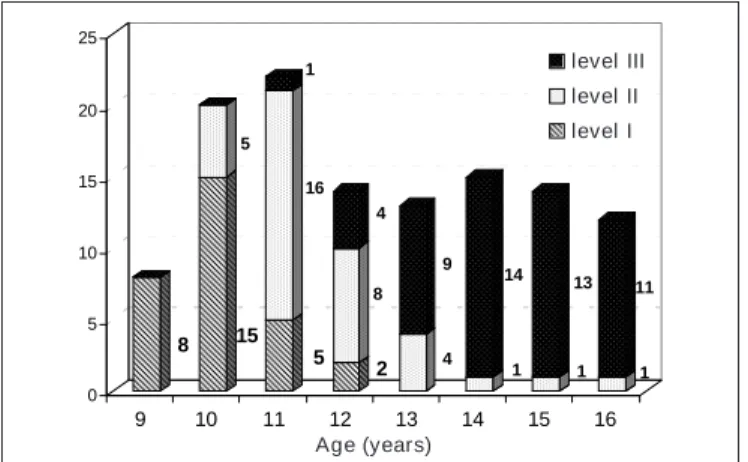
Analyzing the sexual maturation evaluated from the ex-istence and characteristics of the axillary hair, we have observed that about half of the girls (44%) were found at level III of axillary hairiness, 31% at level II and 25% at level I. From the age of 13 years, only 5 girls were found below level III.
The axillary hairiness distributed by age is shown on fig-ure 1, where it is noticed that at 9 years of age, 100% of young samba dancers belong to level I, and that, at ages ranging from 11.0 and 12.0 years, there were girls belong-ing to the three axillary hairiness levels. From the age of 13 years, the young samba dancers were found at levels II and III with progressive decrease on the number of cases of girls at level II.
The sexual maturation evaluation provides us a result similar to the result obtained through the maturity evalua-tion through the axillary hairiness observaevalua-tion. However, it is possible verifying an increase on the sample variabil-ity (figure 2), in such way that, between 10 and 14 years of
age, the studied young samba dancers are found at three different maturation levels. It is worthy mentioning that the stage II is no longer observed at 14 years of age and that 70% of sample is found at level IV of maturation from the age of 15 years.
When the influence of the socioeconomic condition is observed, in function of the minimum wage, on the me-narche (figures 3 and 4), we verify that the percentage of girls that reach the menarche, when grouped by number of minimum wages, changes between 60 and 70%, however, when this same variable is analyzed in function of the so-cial class, the percentage of young samba dancers already with menarche starts to change between 50 and 100%.
Although the percentage results obtained when the monthly income is used are different from those found when social classes are used, the fact is that when we distribute individuals from sample by social level, after and before menarche, the difference between the ages when menarche occurred among different socioeconomic level groups be-comes even clearer.
When data regarding the age when menarche occurred, according to income (table 1) are observed, we verify that between 2 and 6 minimum wages, no significant differenc-es between averagdifferenc-es of the agdifferenc-es when menarche occurred are found.
Following, we present the relation between the percent-age of fat mass and the mass free of fat on young samba dancers, after and before menarche as well as the familiar income level. The figure 5 shows us that on groups with lower incomes, the girls after menarche present higher fat levels. Otherwise, when the familiar income is higher, the girls before menarche are the ones showing higher fat lev-els.
The mass free of fat is similar among all studied groups, after menarche. Before menarche, it is verified that the
Fig. 1 – Distribution of the three axillary hairiness levels by age
8 15
5
5 16 1
2 8
4
4 9
1 14
1 13
1 11
0 5 10 15 20 25
9 10 11 12 13 14 15 16
Idade (anos)
nível III
nível II
nível I
level III level II level I
Age (years)
0% 10% 20% 30% 40% 50% 60% 70% 80% 90% 100%
9 10 11 12 13 14 15 16
estágio IV
estágio III
estágio II
estágio I
Fig. 2 – Distribution of the development stages of secondary sexual
char-acteristics by age – self-evaluation method
groups with higher familiar income show higher levels of mass free of fat.
DISCUSSION
The average age when menarche occurred of 12.19 (± 1.51) years is a value quite close to values found for European countries in general, even though we are consid-ering a group with special social characteristics. When the average age when menarcheal occurred (12.19 years) from the present study to others shown by literature, we verify that there are differences between young samba dancers and data presented by Petroski et al.31. We also conclude
that between samples taken for comparison purposes, this one is shown among samples with the lowest age when menarche occurred, what possibly may be related to the high total body mass and to the high fat mass/age those girls show.
When we relate the analyses of the growth and the sexu-al maturation to socioeconomic characteristics, we come to elucidating data regarding the studied population.
Data from literature show that girls from high socioeco-nomic standard families reach menarche before girls from low socioeconomic standard families31.
The average menarcheal age found in this study is not in agreement with reports from Guedes & Guedes27 and
Ma-lina et al.25, who affirm that girls educated in more favored
socioeconomic environments maturate earlier than girls ed-ucated in less favored socioeconomic environments. How-ever, when we evaluate the figure 5 and observe the distri-bution of young samba dancers with and without menarche regarding the number of minimum wages of the family they belong to, we verify that the percentage of girls with me-narche increase with the increase of the familiar income, however, since those results are dependent on age and we have verified that only above 16 years of age the familiar income is higher, we should be careful about the conclu-sions.
From results here presented, it seems that the socioeco-nomic level and familiar income do not interfere both the number of the girls with menarche and the average age of the occurrence of this phenomenon.
0% 10% 20% 30% 40% 50% 60% 70% 80% 90% 100%
B1 B2 C D E
SIM NÃO
Fig. 4 – Menarcheal distribution on young samba dancers by
socioeco-nomic class TABLE 1
M enarcheal age, according to familiar income
Income (M W) N Average (SD)
< 2 21 11.7 (1.39)
2-4 18 12.3 (1.58)
4-6 10 12.1 (1.29)
> 6 9 12.9 (1.80)
M W = m inim um w age
66,7% 66,7% 69,3% 60,0%
33,3% 40,0%
33,3% 30,8%
0% 10% 20% 30% 40% 50% 60% 70% 80%
até 2 s.m. 2 - 4 s.m. 4 - 6 s.m. > 6 s.m.
SIM
NÃO
Fig. 3 – Menarcheal distribution of young samba dancers by income s.m. = minimum wage
YES
NO
YES
NO
0 10 20 30 40 50
< 2 s.m. 2 - 4 s.m. 4 - 6 s.m. > 6 s.m.
Fig. 5 – Percentage of fat mass of young samba dancers after and before
menarche by number of minimum wages
CONCLUSION
Within limits imposed by the observed sample, we could conclude that the average age when menarche happens in young samba dancers is 12.19 (± 1.51) years. Among sam-ples taken for comparison purpose, this one is shown among samples with the lowest average menarche age, not com-paring to literature, what suggests that the sample assem-bles not identified specific characteristics, which influence the results observed.
The increase on the percentage of girls after menarche as the familiar income increased is dependent on age, and once we have verified that only above 16 years of age the familiar income is higher, we should be careful about the conclusions on these data.
It seems that the socioeconomic level and familiar in-come do not to interfere both the number of the girls after menarche and the average age of the occurrence of this phenomenon.
We have also concluded that on groups with lower fa-miliar incomes, the girls after menarche present higher fat levels than girls before menarche. Otherwise, when the fa-miliar income is higher, the girls before menarche are the ones showing higher fat levels.
The mass free of fat is similar among all studied groups, since the girls are after menarche, regardless the socioeco-nomic classification, what makes us believe that it did not influence the development of the mass free of fat of this sample.
Based on the information from this study, we understand to be of great importance further studies about what is the influence of the socioeconomic context on the biological maturity and body composition of teenage girls.
All the authors declared there is not any potential conflict of interests regarding this article.
REFERENCES
1. Le Boulch J. Educação psicomotora. Porto Alegre: Artes Médicas, 1987. 2. Kube FM. Respostas extremas: genótipo e ambiente. Rev Bras Ativ Fis
Saúde 1996;1:39-43.
3. Kuntzleman CT, Reiff GG. The decline in American children’s fitness level. Res Q Exerc Sport 1992;62:107-11.
4. Dollman J, Olds TS, Norton KI. The evolution of fitness and fatness in 10-11 year-old Australian schoolchildren. Pediatr Exerc Sci 1999;11: 108-21.
5. Perez LMR. Desarrollo motor y actividades físicas. Córdoba: Gimnos-Libreria Editorial Deportiva, 1989.
6. Tanner JM. Growth at adolescence, with a general consideration of the effects of hereditary and environmental factors upon growth and matu-ration from birth to maturity. 2nd ed. Oxford: Blackwell Scientific Publi-cations, 1962.
7. Tanner JM. Constituição e crescimento humano. In: Harrison GA, Wei-ner JS, TanWei-ner JM, Barnicot NA, editors. Biologia humana: introdução à
evolução, variação e crescimento humanos. São Paulo: Ed. Universida-de Universida-de São Paulo, 1971.
8. Claessens AL, Beunen G, Malina RM. Anthropometry, physique, body composition and maturity. In: Armstrong N, van Mechelen W, editors. Paediatric exercise science and medicine. Oxford: Oxford University Press, 2000;11-22.
9. Beunen G, Borms J. Cineantropometria: raízes, desenvolvimento e futu-ro. Rev Bras Ciên e Mov 1990;4:76-97.
10. Eckert H. Desenvolvimento motor. São Paulo: Manole, 1993. 11. Demirjian A, Goldstein H, Tanner JM. A new system of dental age
as-sessment. Hum Biol 1973;45:211-27.
12. Fragoso MI, Vieira F, editors. Antropometria aplicada. Actas do 1o Ciclo de Conferências. Lisboa: FMH edições, 1999.
13. Beunen G, Malina RM, Ostyn M, Renson R, Simons J, Van Gerven D. Fatness and skeletal maturity of Belgian boys 12 through 17 years of age. Am J Phys Anthropol 1982;59:387-92.
14. Beunen GP, Malina RM, Lefevre J, Claessens AL, Renson R, Simons J. Prediction of adult stature and noninvasive assessment of biological maturation. Med Sci Sports Exerc 1997;29:225-30.
15. Tanner JM, Whitehouse RH, Marshal WA. Assessment of skeletal matu-rity and prediction of adult height (TW2 method). London: Academic Press, 1975.
16. Mussen PH, Conger JJ, Kagan J, Huston AC. Desenvolvimento e perso-nalidade da criança. São Paulo: Harbra, 1995.
17. Tanner JM. The physique of the olympic athlete. London: George Allen and Unwin, 1964.
18. Colli A. Inter-relações entre característica de maturação sexual em ado-lescentes brasileiros. Pediatria 1984;18-24.
19. Oliveira Júnior AV. Estudo do comportamento do crescimento e da matu-ração sexual em suas relações com a estratificação social em indivíduos do Colégio Pedro II na Cidade do Rio de Janeiro [dissertação de mestra-do]. Rio de Janeiro: Universidade do Estado do Rio de Janeiro, 1996. 20. Bee H. A criança em desenvolvimento. Porto Alegre: Artes Médicas,
1996.
21. Matsudo VKR. Testes em ciências do esporte. São Caetano do Sul: Ce-lafiscs, 1987.
22. França NM, Matsudo VKR. Alterações da adiposidade em função da maturação sexual. In: Anais, editor. XVII Simpósio Internacional de Ciências do Esporte, 1990; São Paulo: Celafiscs, 1990.
23. Stukovsky RM, et al. Family size and menarcheal age in Constanza Rou-mania. Hum Biol 1976;3:227-83.
24. Picanço MRA. A idade da menarca da menina brasileira: os fatores so-cioeconômicos e as diferenças regionais [dissertação de mestrado]. Rio de Janeiro: Universidade Federal do Rio de Janeiro, 1995.
25. Malina RM, Bouchard C. Growth, maturation and physical activity. Champaign-Illinois: Human Kinetics Books, 1991.
26. Santos VCD, Figueira Júnior AJ, Matsudo VKR. Porcentagem de matura-ção e velocidade de crescimento de variáveis antropométricas e neuromo-toras de duas regiões distintas. Rev Bras Ciên e Mov 1991;5:52-60. 27. Guedes DP, Guedes JERP. Influência do nível socioeconômico e do
as-pecto racional em variáveis antropométricas e motoras de moças matu-radas e não matumatu-radas. Rev Bras Ciên e Mov 1991;5:41-51.
28. Srour RH. Classe, regimes, ideologias. São Paulo: Ática, 1987. 29. Norton K, Whittingham N, Carter L, Kerr D, Gore C, Marfell-Jones M.
Measurement techniques in anthropometry. In: Norton K, Olds T, edi-tors. Anthropometrica. Sydney: University of New South Wales Press, 1996;25-76.
30. Slaughter MH, Lohman TG, Boileau RA, Horswill CA, Stillman RJ, Loan MDV, et al. Skinfold equations for estimation of body fatness in children and youth. Hum Biol 1988;60:709-23.