Taxation of Insolvent Companies: Empirical Evidence in Portugal*
Ana Cristina dos Santos Arromba Dinis
Instituto Superior de Contabilidade e Administração de Coimbra, Coimbra, Portugal
Cidália Maria da Mota Lopes
Instituto Superior de Contabilidade e Administração de Coimbra, Departamento de Ciências Empresariais e Fiscalidade, Coimbra, Portugal
Alexandre Miguel Fernandes Gomes da Silva
Instituto Superior de Contabilidade e Administração de Coimbra, Departamento de Matemática e Estatística, Coimbra, Portugal
Pedro Miguel de Jesus Marcelino
Instituto Superior de Contabilidade e Administração de Coimbra, Departamento de Ciências Empresariais e Fiscalidade, Coimbra, Portugal
Received on 01.28.2014 – Desk acceptance on 03.18.2014 – 4th version approved on 04.16.2015
ABSTRACT
This article discusses the issue of taxation of insolvent companies in Portugal, particularly regarding the Portuguese tax on revenue of legal entities (IRC). For this purpose, first, some considerations on the legal framework of insolvent companies are woven and, second, their tax regime is analyzed. Then, a brief review of the main studies that, in the international context, analyze and debate major issues derived from the tax regime of insolvent companies is conducted, particularly in Brazil, Spain, United States, and Italy. Finally, there are the results of an empirical study conducted in Portugal, in 2013, which evaluates and compares the opinions of insolvency administrators (IA), the tax and customs authority (TA), and court magistrates (CM), in order to contribute to a better solution concerning business taxation under this regime. Respondents (IA, TA, CM) demonstrate objective thinking about the fact they believe it is very important that the Portuguese Code of Insolvency and Business Recovery (CIRE) and the Portuguese Code of Tax on Revenue of Legal Entities (CIRC) are modified, now to make clear whether the settlement of property ownership of an insolvent estate is liable to the IRC, then to assign a chapter specifically devoted to the subject of taxation on insolvency in Portugal.
Keywords: insolvency, taxation, Portuguese tax on revenue of legal entities.
DOI: 10.1590/1808-057x201500020
1 INTRODUCTION
plan turns out, in practice, to be just a way of delaying the settlement of a company that long ago should have been extinct.
In the accounting sphere, it is pertinent to analyze the-re is a widespthe-read failuthe-re with the-regard to the obligation to keep books organized in insolvent companies, a situation that worsens by delaying the insolvency proceedings.
In the iscal sphere, it is observed that the iscal science has given more attention to the goals of equity and ei-ciency than to simplicity and feasibility issues or opera-tion of the iscal system, a situaopera-tion that becomes more complex concerning the issue of taxation of insolvent companies (Lopes, 2008).
hus, it is a signiicant issue that deserves to be discus-sed with the academic and professional community.
So, our research shows up as signiicant for the reasons listed below. First, to the best of our knowledge, there are not in Portugal many studies that have addressed taxation of insolvent companies and its implications. And, second, the current economic conjuncture, i.e. crisis and conse-quent increased number of bankruptcies and insolven-cies, makes the theme pertinent, up-to-date, and relevant. So, this article seeks to introduce a critical view of the tax regime for insolvent irms also analyzing in the inter-national context the iscal issue of taxation of insolvent companies, resorting to an empirical study based on a reference sample, which focuses on the proile and work developed by IA, the TA, and court magistrates (CM) in Portugal.
In order to achieve the proposed objectives, this article was structured into three sections. Subsequently there are some preliminary considerations on the legal regime of insolvent companies, a brief analysis of the iscal regime of the insolvency proceedings in Portugal and the various studies conducted at the international level. hen, we de-vote our study to research methodology and data analysis, and develop the methodological aspects of our research, by performing statistical tests, in order to conirm the hy-potheses, and discussing the results obtained. And, then, we make our inal remarks.
his study addresses the iscal framework of insolvent companies regarding the Portuguese tax on revenue of legal entities (IRC), in a reality encircled by companies established or efectively managed in the Portuguese terri-tory. It is intended to know, as already discussed by Dinis, Lopes, and Marcelino (2014), whether the insolvent estate is subject to tax liability and whether the outcome of an insolvent company’s settlement of assets must be subject to taxation regarding the IRC.
he authors highlight there is no consensus among the various stakeholders in the insolvency proceedings con-cerning the tax liability of these companies. Because, if on the one hand “the tax and customs authority (TA) has regarded the insolvent estate as liable to taxation and, as a consequence, an insolvent company’s settlement of assets is subject to taxation regarding the IRC,” turn “the insol-vency administrators (IA)1 argue that an insolvent com-pany does not pursue, primarily, a commercial, industrial, or agricultural activity, and, therefore, from the moment when all goods are seized for the insolvent estate, the ou-tcome of their liquidation is not liable to the IRC, and this viewpoint is corroborated by a part of the Portuguese ju-risprudence.”
Legally speaking, Law 16/2012, enacted on April 20, 2012, provided the 6th amendment to the Portuguese Code of Insolvency and Business Recovery (CIRE) and it aimed to clarify the regime applicable to compliance with tax liabilities by insolvent companies in Portugal, particularly ater decision-making with regard to business closure, a case where all tax liabilities and revenue debts should be extinguished. However, still, this theme has not been fully made clear, thus, doubts remain in the phase of settlement of property ownership of an insolvent estate.
In the economic sphere, regarding the application of the CIRE over time it can be seen that the recovery of in-solvent companies failed to come true by itself, in prac-tice, as an efective alternative to company settlement (Portugal, 2010, 2 de dezembro). In most cases, compa-nies declared as insolvent are indeed in this situation for quite some time, and the maintenance of an insolvency
1 Whenever referring to the IAs, we are considering the position of the Portuguese Association of Legal Administrators (APAJ).
2 LEGAL REGIME OF INSOLVENT COMPANIES: SOME PRELIMINARY
CONSIDERATIONS
he legal framework of insolvent companies in Portugal is regulated by the CIRE.
he concept of insolvent estate is deined by article 46 in the CIRE. he insolvent estate is generally designed to meet the insolvency creditors’ needs and it covers all assets of the insolvent company at the time insolvency is
decla-red, as well as the assets and rights it acquires during the proceedings.
If the insolvent estate is not enough or when creditors are paid, the insolvency proceedings are terminated and the insolvent company can keep pursuing its activity as usual.
decide on the termination or maintenance of the company activity, or other businesses comprised in the insolvent es-tate, as deined by article 156 in the CIRE.
If the meeting of creditors decides to keep pursuing
the company activity, adopting an insolvency plan, the business activity can also go on as usual. If the meeting of creditors decides to terminate business, the company enters liquidation.
3 THE FISCAL REGIME OF INSOLVENT COMPANIES
3.1 Taxation of Insolvent Companies in Portugal
he TA (Portugal, 2010, 16 de dezembro) argues that compliance with tax liability standards, even at the phase of an insolvent company’s settlement of assets, will have nothing extraordinary in the light of the principles un-derlying taxation liable to the IRC, in accordance with the CIRC. his is so because, according to the TA, once in-solvency is declared, even if a a business is terminated, it does not mean this company ceases to have revenues sub-ject to the IRC. Hence, according to the TA, revenues are not derived only from an efective economic activity, but also from positive equity changes not relected on the net income within the period. So, the TA advocates that af-ter declaring insolvency, the conditions to be liable to the IRC are still checked, because what is relevant is the fact that, although it is regarded that insolvent companies do not engage in an activity, they would never become, due to insolvency, classiied as entities that do not primarily pursue a commercial, industrial, or agricultural activity, in accordance with the CIRC.
Tiago (2012) advocates for the position taken by the TA and believes that in companies declared as insolvent it is not the fact that this is an insolvency proceeding that pre-vents revenues due to the sale of goods at prices that may, in addition to paying all debts to creditors, increase equity. As such, no reason remains to evade taxation regarding the IRC. However, the taxable proit of an insolvent company is determined in relation to the entire settlement period of the company’s equity.
Nevertheless, the IA (Portugal, 2010, 16 de dezembro) interpret article 3, paragraph 4, in the CIRC on the con-trary, insofar as they think an insolvent company does not primarily pursue a commercial, industrial, or agricultural activity, when the meeting of creditors decides on the li-quidation of the insolvent estate and shares the value ob-tained by the creditors. According to the IA, the aim is not proit, but only paying the creditors, thus there is no business operation and they claim that, since no revenues are obtained, the insolvent estate should not be subject to taxation.
In this way, according to Portugal (2007), a part of the Portuguese jurisprudence is also guided by the fact that the company settlement standards should not be confu-sed with those concerning settlement of insolvent assets, because while the irst are intended to regulate the sharing of corporate assets of a dissolved company, and settlement
is made in the interest of shareholders, the latter regulate the sale of goods listed for the insolvent estate, as if consis-ting of executive proceedings, made in the interest of cre-ditors. Also, in view of the concept of additional revenue, for the purposes of the IRC, and considering that taxation of revenue gain regarding the IRC is related to the econo-mic reality made up of proit, Portugal (2003) shows that the sale of goods included in the property of a company declared as bankrupt, made in the proceedings of the set-tlement of a certain asset, does not refer to the concept of capital gains and capital losses provided for the CIRC and, ater declaration of bankruptcy, there is no property, as such, before all goods are seized, they become a new property, a collection of assets and rights taken away from the company and it serves exclusively, ater liquidated, to pay, irst, the legal fees and administrative expenses, then, the credits recognized. Furthermore, it explains that only through a legal iction someone could regard as taxable proit the outcome of property alienation related to the payment of debts that can no longer be fully paid.
As made apparent above, we may conclude that this theme constitutes a very controversial subject and it is still open to discussions and conclusions, in Portugal.
Is this a problem observed in all of the other countries in the global market?
It is the answer to this question that the subsequent section looks for.
3.2 Taxation of Insolvent Companies:
International Comparisons and Results of
Studies in Brazil, Spain, the U.S., and Italy
In the international literature, within the theme of ta-xation regarding companies’ bankruptcy, the iscal issue is not peaceful, too. Our focus lies on Brazil, Spain, the U.S., and Italy, as these are the countries with references to au-thors that we have found in our literature search, concer-ning the theme under study.
3.2.1 Taxation of insolvent companies in Brazil.
contri-bution and highlight that, ater bankruptcy, the bankrupt is dispossessed of its assets and the bankrupt estate emerges, as an “accounting entity for the purposes of analyses and con-trols,” but it has no legal personality in the Brazilian positive law and it is also not equal to a “person for tax purposes.” In addition, the authors state that there were several Pareceres Normativos da Secretaria da Receita Federal [Normative Opi-nions from the Secretariat of Federal Revenue] recognizing that the bankrupt estate was not liable to the tax standards, since it has only the nominal property of collected goods, ad-ministration is a responsibility of the court trustee. Although the Brazilian legislation has regarded many amendments to current standards, regarding taxation of a bankrupt estate, this is a very controversial subject, above all due to the fact that according to Fernandes and Mario (2010) “taxation or the lack of it for a bankrupt estate is directly related to the assumption of the economic essence of an accounting enti-ty as opposed to the legal form personiied or not, bringing up to the current context conlicting points and their possi-ble efects.” Total settlement of assets to pay creditors, as it is not possible to address the joint sale of assets as revenue, because this is only the “best value obtained” of those assets in “forced proceedings.” Taxation on the resources seized for a bankrupt estate to pay of its debts has no economic su-pport, not even legal. What is taxed is property instead of revenue and “moreover, the guarantees let over to creditors.” Also, and similarly to what occurs in Portugal, according to Marques (2005), “tax” is the main link between the iscal re-gime and the bankruptcy rere-gime, but when it comes to iscal credits, the author shows there is an order to be followed, and the credits to the court trustee and assistants, as well as the credits to service provided to the bankrupt estate, expen-ses, and court costs related to the bankruptcy proceedings should be paid irst. Because only ater complying with all of the obligations mentioned above, inally, it is possible to think of paying the “tax credit owed by the bankrupt esta-te.” Restructuring the legal regime of insolvency was a need, with the main purpose of getting the two regimes closer. On the other hand, Spadotto (2005) claims that “tax debts” constitute a major obstacle to the economic recovery of a company and that according to the “old system, the acqui-rer of a company whose break was decreed subrogates the tax liabilities of the company to which alienation had fallen on,” but ater this “new system adopted by the lawmaker, tax debts that fall on the sale of the company’s assets must not be required from the acquirer.”
3.2.2 Taxation of insolvent companies in Spain.
In Spain, the Ley Concursal [Bankruptcy Law] establi-shes a single court procedure to address the proceedings triggered by the insolvency of a debtor, the so-called “ con-curso de acreedores” (meetings of creditors). According to Moreno-Ternero and Villar (2002) the issue of bankruptcy is aimed at the fact that there must be assigned a certain amount of a divisible good when a company has not enou-gh to meet the requirements of all creditors. As for the tax issues raised in insolvency proceedings, concerning iscal implications in the reform of the Ley Concursal, namely the
fact that the reform was accompanied by a number of other legislative changes, such as, for instance, that derived from the Ley General Tributaria [General Tax Law], Medina (2012) shows that this change had an impact that might not generate any beneit to the “concurso de acreedores”, since, by favoring the credit position of public creditors in case of bankruptcy, it ceased safeguarding the position of cre-ditors, which is the main interest of insolvency proceedin-gs, in order to prioritize the public interest, which comes out favored at the expense of the economic operators. he author also points out the British insolvency practice that, ater the abolition of privileges to the public credits, provi-ded a greater satisfaction of creditors, which enabled incre-asing their “rentas disponibles” [disposable revenue gain] and, as a consequence, their investment and consumption possibilities, thus stimulating the economy and, naturally, government’s tax revenue. Escolà (2004) argues that, al-though the Ministry of Justice insists on highlighting that the purpose of the new regulation on bankruptcy is sup-porting and ensuring the continuity of viable companies that are temporarily involved in an insolvency situation, the regulation will be far from making it easier to achieve this goal, because, according to this author, payment of de-bts is the main objective of the new regulation.
3.2.3 Taxation of insolvent companies in the U.S..
he U.S. insolvency proceedings are regulated by fe-deral law, through the Código de Falências [Bankruptcy Code]. Regarding the theme of insolvency taxation, even appealing to iscal awareness as a last resort, Newton (2000) demonstrates the efect of tax on certain transac-tions, which may impose great diiculties to entities that are undergoing insolvency, as per se in a weak inancial position. It is not uncommon in bankruptcy realizing ta-xable proits within the administration period, by selling all or a part of assets or taxable recoveries, however, net business transaction losses and other iscal deductions are oten unable to compensate in order to minimize the efect of tax. Krause and Kapilof (1966) claim that when the bankrupt estate is created, there is a tax directly im-posed against property and indirectly against creditors, by reducing their dividend in bankruptcy, so the efect of bankruptcy is transferring the tax burden from debtors to creditors. he government receives a tax due to the bankruptcy proceedings, which is obtained at the expen-se of creditors, hence the issue of taxable revenue, during property administration in bankruptcy, is full of conside-rations having a social and economic nature.
3.2.4 Taxation of insolvent companies in Italy.
Italy generates some controversy. Addressing the reform of the Italian insolvency law, Tosi (2005) highlights the usefulness of taking stock of the situation, trying to identify the lawmaker’s guidelines according to innovation prospects in the tax sys-tem – the implications with a iscal nature. And it is neces-sary because many of the problems that arise for identifying the treatment applicable to iscal proceedings occur due to an overlap between tax legislation and the bankruptcy law, hence it is advantageous in this context to address issues raised in the past about iscal discipline in insolvency proceedings that the lawmaker inally sets the regulatory framework. his is a major taxation issue of settlement of assets and the consequent satisfaction of creditors’ needs, since it is the lawmaker’s intent to tax only the positive outcome of the insolvency procedure, creating a deinitive continuity solution for the common taxa-tion system (Busa, 2005 as cited in Tosi, 2005). his
require-ment, however, does not agree with the settlement purpose, particularly the rule in force in bankruptcy proceedings. his is so because the ultimate solution for the activity of a com-pany undergoing insolvency is its settlement, thus there is no reason to worry about taxation; business activity ater insol-vency should not be liable to taxation, because this imposition is regarded as unjustiiable.
3.3 Concluding Notes
he literature review conducted seems to lead us to con-clude there are actually many doubts regarding the iscal framework of an insolvent company, particularly when the decision is estate settlement. It is a controversial debate that goes beyond the case of Portugal, as we can see.
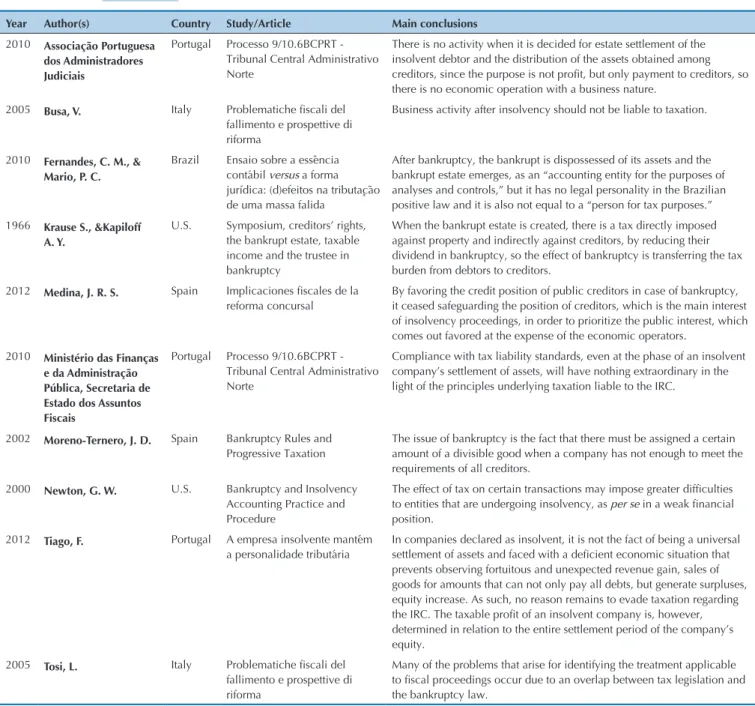
Table 1 summarizes the indings of the several authors addressed in this study.
Table 1 Comparative analysis of the main approaches to taxation of insolvent companies
Source: Prepared by the authors.
Year Author(s) Country Study/Article Main conclusions
2010 Associação Portuguesa dos Administradores Judiciais
Portugal Processo 9/10.6BCPRT - Tribunal Central Administrativo Norte
There is no activity when it is decided for estate settlement of the insolvent debtor and the distribution of the assets obtained among creditors, since the purpose is not proit, but only payment to creditors, so there is no economic operation with a business nature.
2005 Busa, V. Italy Problematiche iscali del fallimento e prospettive di riforma
Business activity after insolvency should not be liable to taxation.
2010 Fernandes, C. M., & Mario, P. C.
Brazil Ensaio sobre a essência contábil versus a forma jurídica: (d)efeitos na tributação de uma massa falida
After bankruptcy, the bankrupt is dispossessed of its assets and the bankrupt estate emerges, as an “accounting entity for the purposes of analyses and controls,” but it has no legal personality in the Brazilian positive law and it is also not equal to a “person for tax purposes.”
1966 Krause S., &Kapiloff A. Y.
U.S. Symposium, creditors’ rights, the bankrupt estate, taxable income and the trustee in bankruptcy
When the bankrupt estate is created, there is a tax directly imposed against property and indirectly against creditors, by reducing their dividend in bankruptcy, so the effect of bankruptcy is transferring the tax burden from debtors to creditors.
2012 Medina, J. R. S. Spain Implicaciones iscales de la reforma concursal
By favoring the credit position of public creditors in case of bankruptcy, it ceased safeguarding the position of creditors, which is the main interest of insolvency proceedings, in order to prioritize the public interest, which comes out favored at the expense of the economic operators.
2010 Ministério das Finanças e da Administração Pública, Secretaria de Estado dos Assuntos Fiscais
Portugal Processo 9/10.6BCPRT - Tribunal Central Administrativo Norte
Compliance with tax liability standards, even at the phase of an insolvent company’s settlement of assets, will have nothing extraordinary in the light of the principles underlying taxation liable to the IRC.
2002 Moreno-Ternero, J. D. Spain Bankruptcy Rules and Progressive Taxation
The issue of bankruptcy is the fact that there must be assigned a certain amount of a divisible good when a company has not enough to meet the requirements of all creditors.
2000 Newton, G. W. U.S. Bankruptcy and Insolvency Accounting Practice and Procedure
The effect of tax on certain transactions may impose greater dificulties to entities that are undergoing insolvency, as per se in a weak inancial position.
2012 Tiago, F. Portugal A empresa insolvente mantém a personalidade tributária
In companies declared as insolvent, it is not the fact of being a universal settlement of assets and faced with a deicient economic situation that prevents observing fortuitous and unexpected revenue gain, sales of goods for amounts that can not only pay all debts, but generate surpluses, equity increase. As such, no reason remains to evade taxation regarding the IRC. The taxable proit of an insolvent company is, however, determined in relation to the entire settlement period of the company’s equity.
2005 Tosi, L. Italy Problematiche iscali del fallimento e prospettive di riforma
hus, subsequently, we evaluate the perception of IA, the TA, and CM about the taxation of insolvent compa-nies regarding the IRC, in Portugal. We intend to
quali-tatively assess the various opinions and identify the va-riables that enable us to conclude whether the insolvent estate is liable to the IRC.
4 EMPIRICAL STUDY
Ater establishing the theoretical framework and re-viewing the literature, this part consists in introducing the research methodology and showing data analysis. he choice of a qualitative approach (interpretive perspective) for this study has to do with the fact that it aims to unders-tand the meanings assigned by subjects to their actions in a given context, something which enables interpretation instead of measurement, it is opposed to a quantitative approach (positivist perspective), seeking information through quantitative data.
4.1 Study Objectives and Research Hypotheses
At this stage, we seek answers to the following questions:
Will insolvent companies be liable to taxation in Portugal? Should the CIRE be amended in order to clearly state whe-ther the settlement of assets of an insolvent estate is liable to the IRC? Should the CIRC be amended and include a chapter specially devote to the subject of taxation in insolvency?
Consequently, the aim of our study is obtaining empi-rical evidence of the Portuguese reality that enable con-cluding whether there is a foundation for taxation regar-ding the IRC of insolvent companies and need to change the legislation applicable to insolvent companies.
To achieve the goals set, we have formalized the rese-arch hypotheses to be tested, which largely stem from the literature review previously conducted. We deine our re-search hypotheses in view of the objectives and problems identiied by our study. hus, we have:
Hypothesis 1: he insolvent estate pursues a business activity.
In many situations, it is possible to observe that the IA think there is no business activity when a decision is made to seek settlement of insolvent assets, since the pur-pose of sharing the outcome obtained among creditors is not proit, but only payment to creditors, thus operations having an economic nature are not realized. So, our ob-jective is evaluating whether the bankrupt estate pursues a business activity.
Hypothesis 2: he outcome of settlement of the insol-vent estate is revenue gain.
Given the concept of revenue gain for the purposes of the IRC, and since wealth increase is the very object of ta-xation, according to the TA, on the grounds that the insol-vent estate obtains revenue gain, it will not be exempted from payment of any tax, we intend to know whether the outcome of settlement of insolvent assets will be regarded as revenue gain.
Hypothesis 3:he insolvent estate isliable to the IRC and it has contributory/economic capacity.
If we take into account that the IRC is not a capitation tax2 and that taxes cannot be required just for the simple fact a society exists and there is a need to consider its economic capacity, we intend to ascertain to what extent the bankrupt estate is able to pay taxes and whether it is liable to the IRC.
Hypothesis 4: he bankruptcy law lacks harmonization with the iscal legislation.
Taking as a starting point the regulatory framework and the literature review of this study, addressed in the irst part, it is possible to see that the controversy associated with the taxation issue of insolvent companies is essentially related to lack of harmonization between the bankruptcy law and tax legislation. hen, we aim to evaluate whether liability to the IRC of insolvent companies may have various interpre-tations in the standards under study.
4.2 Methodology and Sample Characterization
he hypotheses we deined above have as their as-sumptions and population IA, the TA, and CM. Our analysis was based on the population of IA in Portugal, the chiefs, service directors, and inance directors of the TA, and Portuguese CM. As a starting point for data col-lection, the database of IA was used, obtained from the
Comissão de Apreciação e Controlo da Atividade dos Ad-ministradores da Insolvência (CACAAI) [Commission for Assessment and Control of the Activity of Insolvency Administrators], the database of electronic addresses of the tax services of the TA, and the database of contacts of the Portuguese courts, provided by the Direção Geral da Administração da Justiça (DGAJ) [General Direction of Justice Administration].
he information collection technique was applied by using electronic questionnaires, created and sent through
the sotware LimeSurvey. According to Kawk and Radler
(2002), the choice of this methodology is based on relative eicacy – cost, since the use of questionnaires allows ob-taining good results with low cost, enabling the treatment of a large amount of information.
he questionnaire sent to respondents was divided into two sections common to the three groups and a section only for the group of IA. he irst section addressed biographical data and characterization of the academic and professional proile. he second section addressed speciic aspects of professional performance, regarding the bankruptcy pro-ceedings. he section only for the group of IA addressed
appointments in insolvency proceedings. he irst group of questions intended to gather information on respondents’ biographical data, such as gender, educational level and aca-demic degree, supplementary professional training, work experience, certiications or oicial accreditations achieved, as well as the district serving as workplace. his analysis allo-wed us to analyze the various opinions of respondents accor-ding to their biographical data. Regaraccor-ding the second group, it comprised a set of questions with a broader scope and, as a consequence, one part of the questionnaire was crucial for further analysis of results, aimed at framing the opinion of these professional groups on the theme of taxation of insol-vent companies. his part of the questionnaire was aimed at gathering an opinion of professionals under study, which might subsequently enable comparing the opinion between
the three groups of respondents, based on speciic aspects of profession performance. Finally, the third group of questions intended to obtain information on the actual experience of the professional class of IA within their professional perfor-mance, and the questions are aimed, like the earlier parts of the questionnaire, at the goal we have set.
Questionnaires were individually mailed to the entire po-pulation of respondents, a total of 1,150 individuals. We exclu-ded 132 questionnaires because 70 of them were incomplete and the other 62 were not fully illed in. Ater this procedure, we obtained 126 questionnaires fully illed in, corresponding to a response rate of 10.96%, which we regard as reasonable3. hus, our sample consisted of 126 observations.
Briely, in Table 2, it is possible to visualize our sample and the respective response rate.
3 We think there was no impact of the response rate on the results analyzed, since we intended to evaluate empirical evidence in Portugal, particularly in terms of the taxation of insolvent companies regarding the IRC. For an in-depth study, see, for instance, Moss and Hendry (2002).
Our research is classiied as an exploratory study. he sample obtained does not consist in a representative sam-ple nor in a random samsam-ple derived from an experimental design, therefore, it does not allow generalizations. hus, even if hypothesis testing is used to test population para-meters through sampling statistics, their use in our study might not make much sense, using simple statistics would be enough, such as, e.g. frequency distribution tables, in order to reach the same conclusions. However, we think that, in an integrated manner, either for analyzing how the study groups behave with each other or for seeing in an absolutely clear way the position of each group in rela-tion to our research hypotheses, the “chi-square” test (χ2) for independence, and the binomial test better exposes this information.
4.3 Analysis and Discussion of Results
Ater completing data collection, the information un-dergoes analysis, by using the version 20 of the sotware
Statistical Package for the Social Sciences (SPSS). All tests were made with a 5% signiicance level. he statistical methodology to process data was the most accurate, re-sorting to the use of rather appropriate statistical tests to
approach the information collected (Miles & Huberman, 1994).
4.3.1 Bivariate analysis: “chi-square” test for inde-pendence.
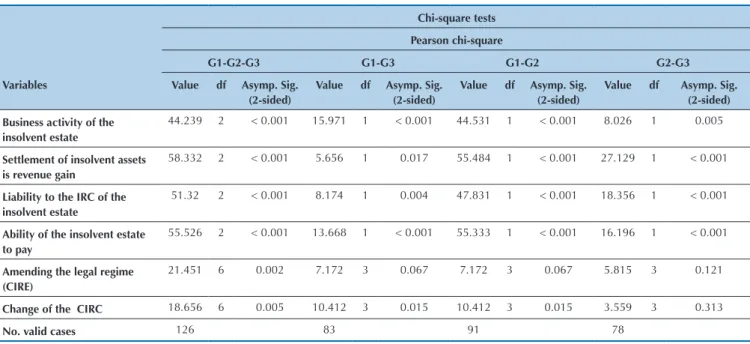
In this study, and for this analysis, we took three groups into account, which are related to the profession pursued by respondents, where G1 corresponds to IA, G2 to the TA, and G3 to CM; χ2 is used to evaluate the association between two qualitative variables X and Y. he hypotheses of this test are: H0 (null hypothesis): there is no diference in behavior between the groups with regard to a certain speciied variable (the groups behave similarly or depen-dently); H1 (alternative hypothesis): there is diference in behavior between the groups with regard to a determi-ned variable (groups behave independently in relation to the determined variable). It may be said that two groups behave similarly if diferences between the observed and expected frequencies in each category are very small. If P
< 0.05 (α = signiicance) rejects the null hypothesis (H0) that there is no diference in behavior between the groups with regard to a particular variable. We display the results of χ2 for independence in Table 3.
Actors in insolvency proceedings Population Sample Response rate
Insolvency administrators 310 48 15.48%
Tax and customs authority 415 43 10.36%
Court magistrates 425 35 8.24%
Total 1,150 126 10.96%
Source: Prepared by the authors.
By analyzing Table 3, we observe that when compa-ring two groups, G1 and G3, there were no diferences in the variable “change to the legal regime” and all the other diferences between the remaining variables were signii-cant. Speciically, it is concluded that only in the variable “change to the legal regime” the groups G1 and G3 have a similar behavior.
Between G2 and G3, only in the variables “amending the legal regime” and “change to the CIRC” there is no variation, where groups have no behavioral diferences.
Between G1 and G2 all diferences are signiicant, ex-cept for the variable “change to the legal regime”, where groups behave similarly.
We test below the hypotheses of our research.
4.3.2 Testing the general study hypothesis: bino-mial test.
At this phase, our analysis is conducted to meet the research objectives and to compare and contrast data and evidence, in order to reject or not our research hypothe-ses. Taking into account the research methodology adop-ted, conirmation or denial of the hypotheses prepared consists in evaluating whether the results obtained in the study of each professional classes under analysis (through a survey) are in line with the regulatory framework and the literature review that we deine and approach theo-retically.
Hence, our focus, in this part of the study, lies on iden-tifying the factors that may be associated with the analysis of taxation of insolvent companies. For this analysis, we used the binomial test, because we intend to analyze varia-bles having a nominal nature with two categories only. It is useful to check whether the success rate observed in the
sample may belong to a population with a given p value. he proportion to be tested is 50%4. hus, we may interpret
p value as the smallest value of the signiicance level for which we reject H0 (null hypothesis). In this way, if p value was greater than the signiicance level (α) proposed for the test, we do not reject H0. All tests were prepared with a 5% signiicance level. So, we intend to test, among the 3 study groups, the perception of the various respondents about the theme under study. Using the binomial test will serve us to conirm the absolutely clear position of each group in relation to our research hypotheses5. hus, the hypothesis tested is whether there is a clear attitude among individuals in each group, i.e. if they act the same way.
Let us consider the variable: Business activity of the insolvent estate. here was a question for the three sets of individuals, namely: IA, referred to as G1 in Table 4; TA, named as G2; and CM, named as G3. Each of these sets was divided into two groups: Group 1 – Yes, named as Group 1 in Table 4; Group 2 – No, named as Group 2. Group 1 (Yes) thinks that the insolvent estate pursues a business activity. Group 2 (No) thinks that the insolvent estate does not pursue a business activity.
he variable is: the insolvent estate pursues a business activity.
he hypotheses are:
H0: here is no signiicant diference in the propor-tions between Group 1 (Yes) and Group 2 (No), within each group, namely: IA (or G1), TA (or G2), and CM (or G3) (null hypothesis).
HA: here is a signiicant diference in the proportions between Group 1 (Yes) and Group 2 (No), within each group, namely: IA (or G1), TA (or G2), and CM (or G3) (alternative hypothesis).
4 We intend to ind out whether the proportion is signiicantly different among respondents in each group. 5 The hypotheses under study relect the alternative hypothesis.
Chi-square tests Pearson chi-square
G1-G2-G3 G1-G3 G1-G2 G2-G3
Variables Value df Asymp. Sig. (2-sided)
Value df Asymp. Sig. (2-sided)
Value df Asymp. Sig. (2-sided)
Value df Asymp. Sig. (2-sided) Business activity of the
insolvent estate
44.239 2 < 0.001 15.971 1 < 0.001 44.531 1 < 0.001 8.026 1 0.005
Settlement of insolvent assets is revenue gain
58.332 2 < 0.001 5.656 1 0.017 55.484 1 < 0.001 27.129 1 < 0.001
Liability to the IRC of the insolvent estate
51.32 2 < 0.001 8.174 1 0.004 47.831 1 < 0.001 18.356 1 < 0.001
Ability of the insolvent estate to pay
55.526 2 < 0.001 13.668 1 < 0.001 55.333 1 < 0.001 16.196 1 < 0.001
Amending the legal regime (CIRE)
21.451 6 0.002 7.172 3 0.067 7.172 3 0.067 5.815 3 0.121
Change of the CIRC 18.656 6 0.005 10.412 3 0.015 10.412 3 0.015 3.559 3 0.313
No. valid cases 126 83 91 78
Source: Prepared by the authors.
he result of binomial test in the case of G3 indicates that p = 50%, so we do not reject H0. his means there are no signiicant statistical evidence that lead us to believe that the proportion of CM respondents that think the insolvent estate does not pursue a business activity is signiicantly di-ferent from that of respondents who think it pursues.
In turn, for G1 and G2, and because p < 1%, we re-ject H0, and we observed that IA respondents have a clear position regarding the fact they think the insolvent esta-te does not pursue a business activity, unlike TA respon-dents, who have a clear position about the fact they think the insolvent estate pursues a business activity.
Since there are diferences of opinion among the three groups, we are unable to validate our research hypothe-sis: Hypothesis 1: he insolvent estate pursues a business activity.
Let us consider the variable: Settlement of insolvent assets is revenue gain. here was a question for the three
sets of individuals, namely: IA, named as G1 in Table 5; TA, named as G2; and CM, named as G3. Each of the sets of respondents was divided into two groups: Group 1 (Yes), named in Table 5 Group 1; Group 2 (No), named as Group 2. Group 1 (Yes) thinks the settlement of insolvent assets is revenue gain. Group 2 (No) does not think the settlement of insolvent assets is revenue gain.
he variable is: settlement of insolvent assets is reve-nue gain.
he hypotheses are:
H0: here is no signiicant diference in the propor-tions between Group 1 (Yes) and Group 2 (No), within each group, namely: IA (or G1), TA (or G2), and CM (or G3) (null hypothesis).
HA: here is a signiicant diference in the proportions between Group 1 (Yes) and Group 2 (No), within each group, namely: IA (or G1), TA (or G2), and CM (or G3) (alternative hypothesis).
For G1 and G2, and because p < 1%, we reject H0. his means there is signiicant statistical evidence that lead us to believe that the proportion of IA and TA respondents who think the outcome of settlement of the insolvent es-tate is revenue gain is signiicantly diferent from that of respondents who think it is not revenue gain. Speciically, IA respondents have a clear position concerning the fact the outcome of settlement of the insolvent estate is not re-venue gain, unlike TA respondents, who have a clear po-sition about the fact they think the outcome of settlement of the insolvent estate is revenue gain.
he result of binomial test in the case of G3 indicates that p = 9%, so we do not reject H0. his means there is no reason to doubt that the proportion of CM respondents who have the opinion that the outcome of settlement of the insolvent estate is revenue gain is signiicantly diferent from that of respondents who think it is not revenue gain.
As there are diferences between the groups, we are una-ble to validate our research hypothesis: Hypothesis 2: he outcome of settlement of the insolvent estate is revenue gain.
Let us consider the variables: Liability to the IRC of the insolvent estate and Contributory capacity of the insolvent Source: Prepared by the authors.
Table 4 Variable binomial test: a business activity pursued by the bankrupt estate
Binomial test G1 G2 G3
Variable Cat. N Obs. Prop.
Test Prop.
Exact Sig. (2-tailed)
Cat. N Obs. Prop.
Test Prop.
Exact Sig. (2-tailed)
Cat. N Obs. Prop.
Test Prop.
Exact Sig. (2-tailed) Business
activity of the insolvent estate
Group 1 Yes (1) 3 0.06 0.50 < 0.001 Yes (1) 32 0.74 0.50 0.002 Yes (1) 15 0.43 0.50 0.500
Group 2 No (2) 45 0.94 No (2) 11 0.26 No (2) 20 0.57
Total 48 1.00 43 1.00 35 1.00
Table 5 Variables binomial test: settlement of insolvent assets is revenue gain
Binomial test
G1 G2 G3
Variable Cat. N Obs. Prop.
Test Prop.
Exact Sig.
(2-tailed) Cat. N Obs. Prop.
Test Prop.
Exact Sig.
(2-tailed) Cat. N Obs. Prop.
Test Prop.
Exact Sig. (2-tailed) Settlement
of insolvent assets is revenue gain
Group 1 Yes (1) 6 0.13 0.50 < 0,001 Yes (1) 39 0.91 0.50 < 0.001 Yes (1) 12 0.34 0.50 0.090
Group 2 No (2) 42 0.88 No (2) 4 0.09 No (2) 23 0.66
Total 48 1.00 43 1.00 35 1.00
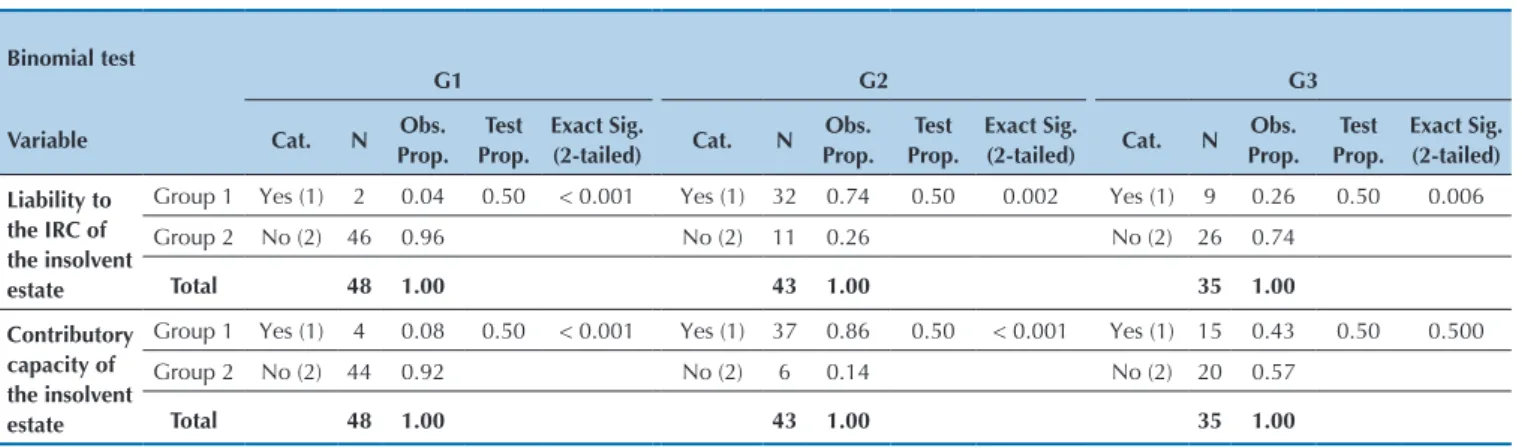
estate. here was a question for the three sets of individuals, namely: IA, named as G1 in Table 6; TA, named as G2; and CM, named as G3. Each of these sets was divided into two groups: Group 1 (Yes) named in Table 6 Group 1; Group 2 (No), named Group 2. Group 1 (Yes) thinks the insolvent estate is passively liable to the IRC and the insolvent estate has contributory capacity. Group 2 (No) does not think the insolvent estate is passively liable to the IRC and the insol-vent estate has not contributory capacity.
he variables are: the insolvent estate is passively liable
to the IRC and the estate has contributory capacity. he hypotheses are:
H0: here is no signiicant diference in the propor-tions between Group 1 (Yes) and Group 2 (No), within each group, namely: IA (or G1), TA (or G2), and CM (or G3) (null hypothesis).
HA: here is a signiicant diference in the proportions between Group 1 (Yes) and Group 2 (No), within each group, namely: IA (or G1), TA (or G2), and CM (or G3) (alternative hypothesis).
For the variable liability to the IRC of the insolvent estate, the result of the binomial test indicates that the test value associated with the test is < 1% in G1, G2, and G3, so we reject H0. Speciically, this means that the IA and CM respondents have a clear position that the insolvent estate should not be liable to the IRC and TA respondents that the insolvent estate should be liable to the IRC.
For the variable contributory capacity of the insolvent estate, the result of binomial test in the case of G3 indi-cates that p = 50%, so we do not reject H0. his means that there is no reason to doubt that the proportion of CM respondents who have the opinion that the insolvent estate has contributory capacity is signiicantly diferent from that of respondents who think it has no contributory capacity. For G1 and G2, the probative value associated with the test is < 1%. hus, for the 5% signiicance level
(α), we reject H0. his means we may conclude that IA
and TA respondents have a clear position by considering, respectively, that the insolvent estate has no contributory capacity or it has contributory capacity.
Since there are diferences between the groups, we are unable to validate our research hypothesis: Hypothesis 3:
he insolvent estate is liable to the IRC and it has contri-butory/economic capacity.
Consider the variables: change in the CIRE and chan-ge in the CIRC. here was a question for the three sets of individuals, namely: IA, named as G1 in Table 7; TA, named as G2; and CM, named as G3. Each of these sets was divided into two groups: Group 1 (Yes), named in Ta-ble 7 Group 1; Group 2 (No), named as Group 2. Group 1 (Yes) thinks that the CIRE and the CIRC should be chan-ged. Group 2 (No) does not think the CIRE and the CIRC should be changed.
he variables are: changing the CIRE and changing the CIRC.
he hypotheses are:
H0: here is no signiicant diference in the propor-tions between Group 1 (Yes) and Group 2 (No), within each group, namely: IA (or G1), TA (or G2), and CM (or G3) (null hypothesis).
HA: here is a signiicant diference in the proportions between Group 1 (Yes) and Group 2 (No), within each group, namely: IA (or G1), TA (or G2), and CM (or G3) (alternative hypothesis).
Source: Prepared by the authors.
Table 6 Variables binomial test: liability to the IRC and contributory capacity of the insolvent estate
Binomial test
G1 G2 G3
Variable Cat. N Obs. Prop.
Test Prop.
Exact Sig.
(2-tailed) Cat. N Obs. Prop.
Test Prop.
Exact Sig.
(2-tailed) Cat. N Obs. Prop.
Test Prop.
Exact Sig. (2-tailed) Liability to
the IRC of the insolvent estate
Group 1 Yes (1) 2 0.04 0.50 < 0.001 Yes (1) 32 0.74 0.50 0.002 Yes (1) 9 0.26 0.50 0.006
Group 2 No (2) 46 0.96 No (2) 11 0.26 No (2) 26 0.74
Total 48 1.00 43 1.00 35 1.00
Contributory capacity of the insolvent estate
Group 1 Yes (1) 4 0.08 0.50 < 0.001 Yes (1) 37 0.86 0.50 < 0.001 Yes (1) 15 0.43 0.50 0.500
Group 2 No (2) 44 0.92 No (2) 6 0.14 No (2) 20 0.57
In both variables, changing the CIRE and changing the CIRC, the result of the binomial test for G1, G2, and G3 indicates that p < α, so we reject H0. his means we may conclude that there are reasons to doubt that the opinion of respondents (IA, TA, CM) who think the CIRE and the CIRC should not be changed is in the same proportion of respondents who think the CIRE and the CIRC should be changed. Speciically, IA, TA, and CM have a clear po-sition on the fact they think it is very important that the CIRE and the CIRC are changed, either to explain clearly whether settlement of the insolvent estate assets is liable
to the IRC or to assign a chapter especially devoted to the theme of taxation in insolvency.
Due to the position agreement between the three groups, it is possible to validate our research hypothesis: Hypothesis 4: he bankruptcy law lacks harmonization with the iscal legislation.
At this phase we are able to summarize the results of our research and make it clear whether the objectives have been met and our hypotheses have been conirmed or rejected, in order to provide answers to our research questions.
5 CONCLUDING REMARKS
We began this study convinced that we could provi-de answers to our research questions. he methodology adopted in gathering information was the use of
questio-nnaires, created through the sotware LimeSurvey, and
emailed to the professional classes covered by this study (IA, TA, CM). he response rate was 10.96%, something which is partly justiied by the fact the questionnaires were sent within a period coinciding with the respondents’ va-cation. However, even though they were sent only twice, they had the validity of a month and many respondents did not regard the link as safe, whence they did not com-plete their answers. In order to extend this study in the future, to ensure a good level of response rate, the ques-tionnaires should be sent more frequently and they need a longer validity period, as well as a prior contact to the entities must be made.
Still, we obtained a total of 126 responses, where 38.1% of the answers are from IA (48 responses), 34.1% are from the TA (43 responses), and 27.8% are from CM (35 res-ponses), something which has provided a response rate regarded as reasonable. We think there was no impact of
the response rate on the results analyzed, as we intended to evaluate empirical evidence in Portugal, particularly in terms of taxation of insolvent companies regarding the IRC.
Given the results obtained, by means of the various tests of our variables, we think that, although the metho-dology used requires caution in the conclusions, just as in terms of generalizing the results obtained to the popula-tion, above all due to the fact we have received only about 11% of responses, when we aimed to gather information from the universe concerned, it is clear that there is no empirical evidence that allow us to reject the hypotheses prepared. Similarly, we also cannot conirm them. Howe-ver, it is possible to suggest the answers to our research questions, taking into account the results obtained and analyzed.
Regarding the study hypotheses, the results are shown below.
he IA and CM respondents clearly believe that the insolvent estate should not be liable to the IRC (respecti-vely, 96% and 74%) and TA respondents pointed out that
Table 7 Variables binomial test: change in the CIRE and the CIRC
Binomial test
G1 G2 G3
Variable Cat. N Obs. Prop.
Test Prop.
Exact Sig.
(2-tailed) Cat. N Obs. Prop.
Test Prop.
Exact Sig.
(2-tailed) Cat. N Obs. Prop.
Test Prop.
Exact Sig. (2-tailed) Amending
the legal regime (CIRE)
Group 1 Yes (1) 38 0.79 0.50 < 0,001 Yes (1) 41 0.95 0.50 < 0.001 Yes (1) 28 0.80 0.50 0.001
Group 2 No (2) 10 0.21 No (2) 2 0.05 No (2) 7 0.20
Total 48 1.00 43 1.00 35 1.00
Changing the CIRC
Group 1 Yes (1) 36 0.75 0.50 0.001 Yes (1) 37 0.86 0.50 < 0.001 Yes (1) 24 0.69 0.50 0.041
Group 2 No (2) 12 0.25 No (2) 6 0.14 No (2) 11 0.31
Total 48 1.00 43 1.00 35 1.00
the insolvent estate should be liable to the IRC (74%). he IA respondents (94%) objectively think the insolvent es-tate does not pursue a business activity, unlike TA res-pondents (74%), who have a clear position about the fact that they think the insolvent estate pursues an economic activity. In turn, CM respondents do not have an objec-tive opinion in this regard. IA respondents (88%) clearly think the outcome of the settlement of the insolvent estate should not be revenue gain, unlike TA respondents (91%), who think it is revenue gain. CM respondents do not have an objective position in this regard. IA and TA respon-dents (respectively, 92% and 86%) have a clear opinion as they think, respectively, the insolvent estate has not contributory capacity or it has contributory capacity. CM respondents do not have a clear idea in this regard. Res-pondents (IA, TA, CM) have an objective thinking about the fact they regard as very important that the CIRE and the CIRC are amended, now to explain clearly whether settlement of assets of an insolvent estate is liable to the IRC (respectively, 79%, 95%, and 80%), then to then to assign a chapter speciically devoted to the subject of
ta-xation on insolvency (respectively, 75%, 86%, and 69%). Taking into account the results obtained, even if we cannot answer the question about taxation regarding the IRC of insolvent companies, and considering the results analyzed, we think the iscal system is not simpliied in this subject of taxation of insolvent companies, thus we conclude it is very interesting and useful amending the CIRE and the CIRC for a rather speciic approach to tax in insolvency proceedings, in order to settle all disputes that still coexist.
Our paper is an analysis of taxation of insolvent com-panies regarding the IRC.
Insolvency proceedings also encompasses, as it is known, other taxes, as well as various kinds of costs to the State.
hrough this paper and the analysis of the tax regime of insolvent companies, we hope to have contributed to make such a controversial theme clearer, which involves the various agents in the insolvency proceedings in Por-tugal (IA, TA, CM).
hus, we hope this is just a irst paper within a set of further research studies.
Dinis, A. C. S. A., Lopes, C. M. M., Marcelino, P. M. J. (2014). As sociedades insolventes e a tributação em sede de imposto sobre o rendimento das pessoas colectivas (IRC) em Portugal. Revista de Finanças Públicas e Direito Fiscal, 7(2), 113-142.
Escolà, M. E. (2004). New Bankruptcy Act in Spain. Recuperado de http://www.imakenews.com/iln/new_bankruptcy_act_spain.pdf Fernandes, C. M., & Mario, P. C. (2010). Ensaio sobre a essência
contabil versus a forma jurídica: (d)efeitos na tributação de uma massa falida. Recuperado de http://www.congressousp.ipecai.org/ artigos102010/453.pdf
Kawk, N., & Radler, B. (2002). A comparison between mail and web surveys: response pattern, respondent proile, and data quality. Recuperado de http://www.jos.nu/Articles/article.asp
Krause, S., & Kapilof, A. Y. (1966). Symposium, creditors’ rights, the bankrupt estate, taxable income and the trustee in bankruptcy. Recuperado de http://ir.lawnet.fordham.edu/cgi/viewcontent. cgi?article=1859&context=lr
Lopes, C. M. M. (2008). Quanto custa pagar impostos em Portugal?
Coimbra: Almedina.
Marques, L. A. (2005). O tributo e o seu tratamento no novo regime jurídico de insolvência empresarial. Recuperado de www.miggo. com.br/imgarq/176/248700_533.doc
Medina, J. R. S. (2012). Implicaciones iscales de la reforma concursal. Recuperado de http://www.diariojuridico.com/implicaciones-iscales-de-la-reforma-concursal/
Miles, B. M., & Huberman, A. M. (1994). A expanded sourcebook qualitative data analysis (2. ed.). housand Oaks, CA: Sage. Moreno-Ternero, J. D. & Villar, A. (2002). Bankruptcy rules and
progressive taxation. Recuperado de http://www.researchgate. net/publication/5134429_BANKRUPTCY_RULES_AND_ PROGRESSIVE_TAXATION
Moss, J., & Hendry, G. (2002). Use of electronic surveys in course evaluation. British Journal of Educational Technology, 33(5), 583-592. Newton, G.w. (2000). Bankruptcy and insolvency accounting practice and
procedure (Vol. 1, 6. ed.). Hoboken, NJ: John Wiley & Sons. Portugal. (2010, 16 de dezembro). Processo 9/10.6BCPRT. Porto:
Tribunal Central Administrativo Norte. Recuperado de http://www. apaj.pt/icheiros/oposicao_da_accao_principal.pdf
Portugal. (2007, 18 de abril). Processo 236/03.2TYVNG. Vila Nova de Gaia, Portugal.
Portugal. (2003, 29 de outubro). Processo 01079/03. Lisboa, Portugal. Recuperado de http://www.dgsi.pt/jsta.nsf/35bbbf22e1bb1e680256f 8e003ea931/32e17fdc3a9cbdfc80256dea003ec11b?OpenDocument& ExpandSection=1
Santos, J. A. (2003). Teoria iscal. Lisboa: Universidade Técnica de Lisboa.
Spadotto, R. D. C. (2005). A venda de bens da massa falida e sua respetiva tributação sob a ótica da nova lei de falências. Recuperado de
http://www.ibrademp.org.br/arquivos/nova_lei_de_falencias2.pdf Tiago, F. (2012). A empresa insolvente mantém a personalidade
tributária. Recuperado de http://www.vidaeconomica.pt/gen. pl?p=stories&op=view&fokey=ve.stories/79852
Tosi, L. (2005). Problematiche iscali del fallimento e prospettive di riforma
(collana diretta da Francesco Moschetti e Loris Tosi). Torino: CEDAM/AEST.
References
Correspondence Address: Ana Cristina dos Santos Arromba Dinis
Instituto Superior de Contabilidade e Administração de Coimbra Quinta Agrícola, Bencanta – 3040-316
Coimbra – Portugal
E-mail: [email protected]
Dinis, A. C. S. A., Lopes, C. M. M., Marcelino, P. M. J. (2014). As sociedades insolventes e a tributação em sede de imposto sobre o rendimento das pessoas colectivas (IRC) em Portugal. Revista de Finanças Públicas e Direito Fiscal, 7(2), 113-142.
Escolà, M. E. (2004). New Bankruptcy Act in Spain. Recuperado de http://www.imakenews.com/iln/new_bankruptcy_act_spain.pdf Fernandes, C. M., & Mario, P. C. (2010). Ensaio sobre a essência
contabil versus a forma jurídica: (d)efeitos na tributação de uma massa falida. Recuperado de http://www.congressousp.ipecai.org/ artigos102010/453.pdf
Kawk, N., & Radler, B. (2002). A comparison between mail and web surveys: response pattern, respondent proile, and data quality. Recuperado de http://www.jos.nu/Articles/article.asp
Krause, S., & Kapilof, A. Y. (1966). Symposium, creditors’ rights, the bankrupt estate, taxable income and the trustee in bankruptcy. Recuperado de http://ir.lawnet.fordham.edu/cgi/viewcontent. cgi?article=1859&context=lr
Lopes, C. M. M. (2008). Quanto custa pagar impostos em Portugal?
Coimbra: Almedina.
Marques, L. A. (2005). O tributo e o seu tratamento no novo regime jurídico de insolvência empresarial. Recuperado de www.miggo. com.br/imgarq/176/248700_533.doc
Medina, J. R. S. (2012). Implicaciones iscales de la reforma concursal. Recuperado de http://www.diariojuridico.com/implicaciones-iscales-de-la-reforma-concursal/
Miles, B. M., & Huberman, A. M. (1994). A expanded sourcebook qualitative data analysis (2. ed.). housand Oaks, CA: Sage. Moreno-Ternero, J. D. & Villar, A. (2002). Bankruptcy rules and
progressive taxation. Recuperado de http://www.researchgate. net/publication/5134429_BANKRUPTCY_RULES_AND_ PROGRESSIVE_TAXATION
Moss, J., & Hendry, G. (2002). Use of electronic surveys in course evaluation. British Journal of Educational Technology, 33(5), 583-592. Newton, G.w. (2000). Bankruptcy and insolvency accounting practice and
procedure (Vol. 1, 6. ed.). Hoboken, NJ: John Wiley & Sons. Portugal. (2003, 29 de outubro). Processo 01079/03. Lisboa, Portugal.
Recuperado de http://www.dgsi.pt/jsta.nsf/35bbbf22e1bb1e680256f 8e003ea931/32e17fdc3a9cbdfc80256dea003ec11b?OpenDocument& ExpandSection=1
Portugal. (2007, 18 de abril). Processo 236/03.2TYVNG. Vila Nova de Gaia, Portugal.
Portugal. (2010, 2 de dezembro). Regime jurídico da insolvência e recuperação de empresas: estudo de avaliação sucessiva. Lisboa: Direção-Geral da Política de Justiça. Recuperado de http://www. dgpj.mj.pt/sections/politica-legislativa/anexos-pendencias/sections/ politica-legislativa/anexos-pendencias/anexo-iv-estudo-dezembro/ downloadFile/ile/AnexoIV_Relatorio_Insolvencias.pdf
Portugal. (2010, 16 de dezembro). Processo 9/10.6BCPRT. Porto: Tribunal Central Administrativo Norte. Recuperado de http://www. apaj.pt/icheiros/oposicao_da_accao_principal.pdf
Santos, J. A. (2003). Teoria iscal. Lisboa: Universidade Técnica de Lisboa.
Spadotto, R. D. C. (2005). A venda de bens da massa falida e sua respetiva tributação sob a ótica da nova lei de falências. Recuperado de http://www.ibrademp.org.br/arquivos/nova_lei_de_falencias2.pdf Tiago, F. (2012). A empresa insolvente mantém a personalidade
tributária. Recuperado de http://www.vidaeconomica.pt/gen. pl?p=stories&op=view&fokey=ve.stories/79852
Tosi, L. (2005). Problematiche iscali del fallimento e prospettive di riforma
(collana diretta da Francesco Moschetti e Loris Tosi). Torino: CEDAM/AEST.