Interference of Enalaprilat on Glomerular Permeability to
Macromolecules (IgG) in Acute Unilateral Ureteral Obstruction
in Rats
Rene M. Oliveira, Antonio A. Oliveira Neto, Luiz C. Miranda
Section of Urology, Clementino Fraga Filho University Hospital, UFRJ, Rio de Janeiro, RJ, Brazil
ABSTRACT
Introduction: Unilateral ureteral obstruction breaks out events that cause the transitory increase of glomerular permeability to macromolecules, both in the obstructed kidney and in the contralateral kidney, suggesting the presence of some factor, with a systemic action, liberated as a response to the obstruction. We know that the rennin-angiotensin system is activated by acute ureteral obstruction. We have developed an experiment to assess the role of angiotensin II on the glomerular permeability to IgG due to acute ureteral obstruction, using enalaprilat, an angiotensin enzyme conversion inhibitor, to block the effects of the activation of the rennin-angiotensin system.
Materials and Methods: We have used 45 adult Wistar female rats, distributed into 3 main groups: a control group with 5 animals and 2 experiment groups each one with 10 animals submitted to unilateral ureteral obstruction and nephrectomy at 60 and 120 minutes. Each experiment group had its simulation correspondent (sham). We have studied both kidneys through the direct immunofluorescence method.
Results: We have found positive permeation in animals without enalaprilat in both kidneys and negative permeation in those in which the drug was used.
Conclusion: We have concluded that enalaprilat interferes in this alteration of permeability, suggesting that angiotensin II is involved in the loss of selectivity of the glomerular membrane.
Key words: ureteral obstruction; immunoglobulin G; angiotensin II; enalaprilat; immunofluorescence Int Braz J Urol. 2006; 32: 216-21
INTRODUCTION
Acute ureteral obstructions a common situa-tion in urological practice. The obstructed kidney suf-fers both rough morphologic alterations and micro-scopic ones, which were demonstrated in experimen-tal studies and through the study of surgical speci-mens (1-4).
In a line of research on the alterations of glom-erular permeability to macromolecules in an
experi-mental situation of acute unilateral ureteral obstruc-tion, Henriques (5) demonstrated the permeation of rat endogenous IgG through the glomerular mesangium of the obstructed kidney. Interestingly enough, he also observed a similar phenomenon in contralateral kid-ney, without blockage to the urinary flow, in more in-tensity between 60 and 120 minutes after the obstruc-tion.
us suppose the action of some factor that has been liberated by the acute ureteral obstruction and that has a systemic action.
Acute ureteral obstruction is a potent activa-tor of the rennin-angiotensin system that once acti-vated is capable of promoting systemic actions (6-10). Based on this information, we have developed an experiment using acute unilateral obstruction as a factor to activate the rennin-angiotensin system, both to observe the selectivity alteration of the permeabil-ity of the glomerular filtration blockage after this ac-tivation and to verify the responsibility of angiotensin II in the phenomenon of the alteration of the selec-tive permeability of the glomerular filtration mem-brane.
To test our hypothesis we have used an an-giotensin I enzyme conversion inhibitor for angio-tensin II as a blocker to the events broken out by the activation of the rennin-angiotensin system. We have proceeded to the histopathological analysis, through the direct immunofluorescence technique, both of the obstructed kidney and of the kidney without obstruc-tion.
MATERIALS AND METHODS
We used forty-five Wistar albino female rats with weights varying from 240 to 300g (255.55 ± 9.35 g.) and aged 8 months. Animals were kept in the ani-mal room of the Experimental Lab, in individual cages, were fed with industrialized food used by the animal room and water ad libitum. At the day of the surgery, they were on a fast of solid foods. The weight of each animal was checked before surgery. The ex-perimental protocol was approved by the animal re-search ethics commission.
Animals were divided into 3 groups: Group 1 - control (5 animals), Group 2 – ureteral ligature (10 animals) and Group 3 – enalaprilat previous to the ureteral ligature (10 animals). All animals were submitted to bilateral nephrectomy. On groups 2 and 3, nephrectomy was accomplished in half of the ani-mals at 60 minutes and on the other half at 120 min-utes. Groups 2 and 3 have simulation correspondents (sham).
The enalaprilat was the drug used in the ex-periment, in the form of injectable solution. The dos-age used was 1mg/kg, adequate for the obtainment of the angiotensin enzyme conversion inhibitor effect in animals (11). In those animals in which enalaprilat was used its administration was made by injection in the inferior vena cava 15 minutes before the ureteral ligature, time enough for the distribution of the drug and the obtainment of the angiotensin enzyme con-version inhibitor effect (11). For sham groups we have administered distilled water.
We have used sevoflurane as inhaling anes-thetic agent, administered by means of a vaporizing device for small animals anesthesia developed by the experimental lab.
The animals were submitted to median lap-arotomy, we have identified the left ureter using an optic magnification with a 2.5X surgical magnifier, and we performed the complete ureteral occlusion in its upper 1/3 with cotton 3-0 suture.
Once the ureteral occlusion time set forth in this work’s protocol was finished, we performed the bilateral nephrectomy and the animals, still under an-esthesia were transposed to a glass shade saturated with sulphuric ether for the euthanasia to be performed.
All surgical specimens at the moment of their extraction were longitudinally cleavage, involved in aluminum paper, identified by group, animal number and side (left or right) and stored in a liquid nitrogen container.
For direct immunofluorescence reaction, we use antiserum for rat IgG (sheep anti rat IgG:FITC – AAR10F).
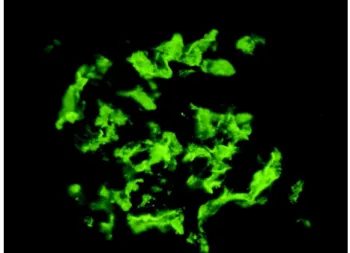
In histopathological analysis, we considered positive mesangial staining when we observed a green brilliant coloration highlighting the glomeruli under the microscope ultraviolet light, and negative when this staining was continuous with background col-oration or inexistent.
The most representative fields were selected for illustration with image registration by Nikon-Coolpix de 3.44 megapixels adapted to the micro-scope with automatic saturation, brightness and con-trast adjustment and exposure time of 1/2 second.
Statistical analysis was performed by Fisher exact test to compare positivity among studied groups. The criterion of significance is 5%. Statistical analy-sis was processed by the statistical software SAS®
System.
RESULTS
In the control group the mesangial staining was negative.
All 10 animals of group 2 presented positive mesangial staining, and one animal of the sham group also presented positive staining. We have observed that the proportion of positive results in group 2 was significantly larger than in the sham group (p < 0.0001).
All animals of group 3 presented negative mesangial staining but one animal of the sham group presented positive mesangial staining. Statistical analysis demonstrated that there was no significant difference between the 2 groups (p = 0.50).
Comparison between group 2 and 3 showed a significant difference with p < 0.0001.
On Figure-1 we present the photomicrogra-phy of a glomerulus with positive mesangial stain-ing.
COMMENTS
It is a consensus among investigators that, in physiologic conditions, macromolecules the size of IgG (molecular radius of approximately 55 Å, mo-lecular weight of 150.000 Daltons) are not found in significant quantities in the glomerular filter but can
be detected in the mesangium. There is, however, a physiological transit of macromolecules through the vascular endothelium fenestrations of the glomerular tuft, but are retained by the basal membrane and by the filtration diaphragm and come back to the intra-vascular space, via the lymphatics, or they are me-tabolized by mesangial cells without immunological reaction involved in this process (12-16).
Acute ureteral unilateral obstruction causes alterations in glomerular perfusion and in the glom-erular filtration rate. Those alterations act as activa-tors of the rennangiotensin system, with the in-crease in the secretion of rennin through the obstructed kidney, be it by a reduction in the concentration of sodium in the distal tubules, be it by baroreceptors distension localized in the afferent arteriole. (1,3,4). The hypothesis is that the phenomenon of IgG endogenous permeability by glomerular filtration barrier of the animals submitted to acute unilateral ureteral obstruction, observed both in the obstructed kidney and in the contralateral kidney is related to the effects promoted by endogenous angiotensin II. Liberated from the activation of the rennin-angio-tensin system broke out by the acute ureteral obstruc-tion.
Alterations of glomerular filtration during unilateral ureteral obstruction were already described from the 5 to 8 minutes occlusion, in the affected kid-ney (3). In experimental work of unilateral ureteral
Figure 1 – Histological study showing positive glomerular
obstruction, Henriques (5) demonstrated the passage of macromolecules (IgG) for the mesangium, a pre-cocious and transitory phenomenon that is most in-tensively manifested between 60 and 120 minutes after the installation of the unilateral ureteral obstruc-tion, and is reduced after 120 minutes of obstrucobstruc-tion, but was observed in both kidneys. However, it seemed to be valid to focus our study in this period of time. This is a model that makes more intense the mesangial transit of macromolecules, a phenomenon that can be easily demonstrated by the technique of direct immunofluorescence but does not involve immuno-logic processes.
We have observed that pertinent literature is poor in relation to this experiment, for, in general, only the obstructed kidney is analyzed. In this work we have considered only the qualitative aspect of the event for we supposed that angiotensin II participates in the alteration of the glomerular filtration barrier selectivity. We did not try to determine the intensity of this action, or if other substances liberated in re-sponse to the ureteral obstruction can alter this selec-tivity. We have made a ureteral obstruction and kid-ney extraction in subgroups of 60 and 120 minutes after the ureteral obstruction, for we do not have data on the time interval necessary to occur the probable action of the angiotensin II over the glomerular se-lectivity.
To test our hypothesis that the alteration of the glomerular permeability is related to the action of the angiotensin II, we use the pharmacologic obstruc-tion of the angiotensin conversion enzyme, through the injection of enalaprilat before we performed a ureteral obstruction.
The study of the control group demonstrates that in a normal situation the mesangial transit of en-dogenous IgG is not detectable through the direct immunofluorescence technique since there was no positive staining in the kidney of those animals.
The study of the animals of group 2 evidences the intense permeability of IgG through the glomeru-lar mesangium, demonstrated by the positive stain-ing of both kidneys.
This mesangial transit can be influenced by the capilar hydrostatic pressure, by the molecular weight and protein electrical charge and by factors
related to the mesangial matrix selectivity properties that can be altered as demonstrated in experimental situations, with the infusion of angiotensin II (1,13,14,17).
When we observe the animals of group 2 (sham), we observe that one of the animals sacrificed at 60 minutes presented a positive mesangial stain-ing. This data was not statistically significant, how-ever, we can consider that factors activated by surgi-cal procedure, unchained by the neuroendocrine re-action of the organic trauma, or other humoral me-diators involved in the response to the acute unilat-eral uretunilat-eral obstruction, such as aracdonic acid me-tabolites (eicosanoids), the atrial natriuretic peptide, nitric oxide, endotelin, plaquetary activation factor, clusterin and the growth and transformation factor β can also interfere in the glomerular filtration barrier permselectivity (3). We have made this registration as a possibility to develop other experiments in the same line of research.
The analysis of group 3 demonstrated that the use of an angiotensin enzyme conversion inhibitor interfered in the IgG mesangial transit, for we did not observe positive staining in one of the animals of group 3 (sham), sacrificed at 60 minutes of obstruc-tion, that reinforces considerations over other factors involved in the alteration of the glomerular perme-ability even though this data does not have any statis-tical significance to this study.
The alteration of selectivity of the glomeru-lar filtration membrane in the obstructed kidney was previously described (13,17,18), however, the obser-vation of the change in the glomerular filtration permselectivity in the contralateral kidney, observed in this work and previously reported (5,19), makes us suppose the action of some factor that has a sys-temic action affecting such selectivity at distance, relating the loss of the glomerular filtration barrier selectivity with the increase of the mesangial transit of macromolecules in situation of activation of the rennin-angiotensin system.
ani-mals of group 2, and the interference caused by the obstruction of the angiotensin conversion enzyme with negative staining in the kidneys of the animals of group 3.
Our interpretation thus, is that there are sta-tistical evidences of the interference of enalaprilat over the permeability of IgG in the acute unilateral ureteral obstruction.
CONCLUSIONS
We concluded that the acute unilateral ure-teral obstruction in the rat, causes alteration of the glomerular selective filtration in the kidney free of obstruction, allowing the permeability of endogenous IgG.
There are evidences that the use of enalaprilat presents interference in the endogenous IgG perme-ability by the glomerular filtration membrane of the kidney free of obstruction in the rat.
Angiotensin II, one of the humoral factors liberated by the acute ureteral obstruction is related to the glomerular filtration membrane permselectivity of the kidney free of obstruction in the rat, observed between 60 and 120 minutes of ureteral obstruction.
CONFLICT OF INTEREST
None declared.
REFERENCES
1. D’Amico G, Bazzi C: Pathophysiology of proteinuria. Kidney Int. 2003; 63: 809-25.
2. Nangaku M: Final common pathways of progression of renal diseases. Clin Exp Nephrol. 2002; 6: 182-9. 3. Gulmi FA, Felse D, Vaugham ED Jr: Pathophysiology
of Urinary Tract Obstruction. In: Walsh PC (ed.), Campbell’s Urology. Philadelphia, Saunders. 2002; pp. 411-62.
4. Wen JG, Frokiaer J, Jorgensen TM, Djurhuus JC: Ob-structive nephropathy: an update of the experimental research. Urol Res. 1999; 27: 29-39.
5. Henriques FP: Immunoglobulin Absorption by the Glomerular Mesangium in Rats with Ureteral Obstruc-tion. Thesis (Doctoral Degree in Surgery). Federal University of Rio de Janeiro, UFRJ, Brazil, 1998. [in Portuguese]
6. Frokiaer J, Pedersen EB, Knudsen L, Djurhuus JC: The impact of total unilateral ureteral obstruction on intrarenal angiotensin II production in the polycalyceal pig kidney. Scand J Urol Nephrol. 1992; 26: 289-95.
7. Frokiaer J, Knudsen L, Nielsen AS, Pedersen EB, Djurhuus JC: Enhanced intrarenal angiotensin II gen-eration in response to obstruction of the pig ureter. Am J Physiol. 1992; 263: F527-33.
8. Klahr S, Ishidoya S, Morrissey J: Role of angiotensin II in the tubulointerstitial fibrosis of obstructive neph-ropathy. Am J Kidney Dis. 1995; 26: 141-6.
9. Oliw E: Acute unilateral ureteral occlusion increases plasma renin activity and contralateral urinary pros-taglandin excretion in rabbits. Eur J Pharmacol. 1978; 53: 95-102.
10. Pimentel JL Jr, Martinez-Maldonado M, Wilcox JN, Wang S, Luo C: Regulation of renin-angiotensin sys-tem in unilateral ureteral obstruction. Kidney Int. 1993; 44: 390-400.
11. Tocco DJ, deLuna FA, Duncan AE, Vassil TC, Ulm EH: The physiological disposition and metabolism of enalapril maleate in laboratory animals. Drug Metab Dispos. 1982; 10: 15-9.
12. Deen WM, Lazzara MJ, Myers BD: Structural deter-minants of glomerular permeability. Am J Physiol Re-nal Physiol. 2001; 281: F579-96.
13. Keane WF, Raij L: Relationship among altered glom-erular barrier permselectivity, angiotensin II, and mesangial uptake of macromolecules. Lab Invest. 1985; 52: 599-604.
14. Michael AF, Keane WF, Raij L, Vernier RL, Mauer SM: The glomerular mesangium. Kidney Int. 1980; 17: 141-54.
15. Olivetti G, Kithier K, Giacomelli F, Wiener J: Glom-erular permeability to endogenous proteins in the rat: effects of acute hypertension. Lab Invest. 1981; 44: 127-37.
16. Raij L, Keane WF: Glomerular mesangium: its func-tion and relafunc-tionship to angiotensin II. Am J Med. 1985; 79: 24-30.
18. Mayer G, Lafayette RA, Oliver J, Deen WM, Myers BD, Meyer TW: Effects of angiotensin II receptor blockade on remnant glomerular permselectivity. Kid-ney Int. 1993; 43: 346-53.
19. Miranda LC: Behavior of Immunoglobulin G and M in the Renal Ischemia Reperfusion in Rats. Immunof-luorescence Study. Thesis (Doctoral Degree in Sur-gery). Federal University of Rio de Janeiro, UFRJ, Brazil, 1992; p. 91. [in Portuguese]
Accepted after Revision: January 5, 2006
Correspondence address:
Dr. René Murilo de Oliveira