Does PSA reduction after antibiotic therapy permits
postpone prostate biopsy in asymptomatic men with PSA
levels between 4 and 10ng/mL?
_______________________________________________
W. F. S. Busato
1, G. L. Almeida
1, Jamylle Geraldo
1, F. S. Busato
11 Urology Service, Department of Surgery, University of Itajaí’s Valley (UNIVALI) and Catarinense Institute
of Urology, Itajaí, Brazil
ABSTRACT
ARTICLE
INFO
______________________________________________________________ ______________________
Purpose: We investigated the effect of antibiotics on PSA in asymptomatic patients with mild PSA elevation.
Materials and Methods: We prospectively evaluated, in a non-randomized design, 106 asymptomatic patients with PSA of 4-10ng/mL, with a negative digital rectal exami-nation and with no urinary tract infection evidence for 2 years. Patients were divided into two groups: those treated with antibiotics for 3 weeks (G1) and those who were not treated (G2). PSA was taken six weeks after and prostate biopsy was performed in all patients.
Results: PCa was diagnosed in 25 of 106 patients (23.6%): 16 (25.0%) in G1 and 9 (21.4%) in G2 (p>0.05). PSA normalization was experienced in 24.5%. In G1, PSA returned to <4ng/mL in 15 (23.4%) patients compared to 11 (26%) patients in G2. In the patients with a positive biopsy, no significant variation was noted in PSA, fPSA, %fPSA and DPSA after antibiotic treatment. A significantly lower cancer detection rate was noted with decreased PSA, fPSA, and DPSA after antibiotic use. A PSA reduction rate of ≥10% occurred in 58.5%, and this was similar in both G1 and G2 groups. The sensibility, specificity and accuracy of PSA reduction of ≥10% were 31%, 23% and 25%, respectively.
Conclusion: Empirical antibiotic therapy in asymptomatic male patients is not related to PSA reduction. The greater than 10% PSA reduction after antibiotic in this popula-tion cannot postpone prostate biopsy.
Key words:
prostatic-specific antigen, prostate cancer, antibiotics, screening, biopsy
Int Braz J Urol. 2015; 41: 329-36
_____________________
Submitted for publication: September 29, 2013
_____________________
Accepted after revision: July 28, 2014
INTRODUCTION
Prostate cancer (PCa) is a frequent cancer that can be cured if early diagnosed (1). However, diagnosis and treatment of localized disease re-mains a challenge for urologists. Prostate Specific Antigen (PSA) has become an important tool in PCa screening (2, 3) and men with serum PSA gre-ater than 4ng/mL are at higher risk of PCa. These patients are usually referred for a prostate
biop-sy (BxP). However, increased PSA levels are also associated with conditions other than cancer (3), such as benign prostatic hyperplasia (BPH) and prostatitis (4, 5).
prostate could elevate serum PSA in asymptoma-tic patients, confounding the use of PSA values to indicate BxP (10). In the majority of cases, prosta-titis is an incidental pathological finding that has no clinical relevance. There has been investigation into ways to decrease the misleading diagnosis resulting from inflammation. Repeat PSA measu-rements after a period of observation in asymp-tomatic men can help to avoid unnecessary BxP (10-12).
It has been suggested that antibiotic thera-py (AT) can also avoid BxP in many patients with prostate inflammation, in the PSA grey zone (4.0 to 10.0ng/mL) (6, 13, 14). Currently, the indications of re-BxP in patients with a negative initial biopsy are few; therefore, the first BxP must be precise. In an effort to improve the reliability of PSA reduction as an indicator, and consequently avoid unneces-sary prostate biopsy, we conducted a prospective, controlled, non-randomized study to evaluate the effect of AT on PSA levels in patients who have an initially mild PSA elevation (4.0-10ng/mL).
MATERIAL AND METHODS
A prospective, controlled, non-randomi-zed trial was carried out, with 106 asymptomatic men with total PSA (tPSA) levels between 4.0 and 10.0ng/mL, who underwent routine evaluation from April 2007 to October 2011. The criteria for inclusion in the trial were digital rectal examina-tion (DRE) with no suspicion of malignancy and no history of urologic instrumentation, use of an-tibiotics, and urinary infection or sexually trans-mitted disease in the previous 12 months. Patients with diseases like diabetes or alcoholism, those describing the use of illegal drugs, those under-going treatment for bladder outlet obstruction and patients with previous BxP (positive and negative) were excluded, as were those participants who did not use the AT correctly or who did not carry out the follow-up correctly. After institutional review board (ethical committee) approval, all study par-ticipants provided informed written consent befo-re enrolment.
After the initial consultation, the serum le-vels of total PSA (tPSA) and free PSA (fPSA) were determined. The body mass index (BMI), free PSA
fraction (%fPSA), and PSA density (DPSA) were calculated for all patients.
The participants were divided into two groups (Figu1) according to their decision re-garding the use of antibiotics. This decision was made after the authors explained about the lack of evidence for this treatment. Group I patients received antibiotics, while Group II patients chose not to use AT. In Group I, 64 men used ciproflo-xacin 500mg twice a day for a period of three weeks. Then, three weeks after the end of AT, the serum PSA, DPSA, and fPSA were again determi-ned (Figure-1). The results of these patients were compared with those of 42 participants with PSA between 4.0 and 10.0ng/mL whose exams were repeated after 6 weeks, without antibiotics, at the participant’s discretion. PSA was considered to be normalized after treatment when the values returned to lower than 4ng/dL. All of the partici-pants underwent BxP 2-4 weeks after the second PSA determination. Based on the pre- (PSApre) and post-treatment (PSApost) PSA values, the variation (PSAvar) was calculated: PSAvar = PSApost - PSApre. Thus, the variation rate (PSAvar) can be calculated with ∆PSA = (PSAvar/PSApre).100%. The BxP was ultrasound-guided and a minimum of 12 cores were sampled with determination of prostate vo-lume in cubic centimetres (cc). For those partici-pants whose biopsy did not show PCa, PSA was determined after 6 months as in routine practice.
Statistical analysis
The data obtained were analysed by tes-ting the difference between two proportions for incidence of PCa in each group, and evaluation of the decrease in PSA levels. The other data were evaluated using the Student t test, citing the criti-cal t for a significance level of 0.05.
RESULTS
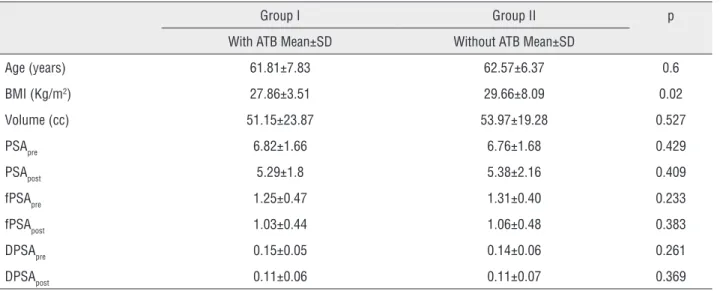
sho-wn in Table-1. The diagnosis of PCa was confir-med in 25 of the 106 participants (23.6%); in 9 out of 42 participants in G2 (21.4%) and in 16 out of 64 in G1 (25%) (z=0.42; p>0.05).
There was a more than 10% PSA decrease in 72 out of 106 patients (67.9%); this rate was 65.6% and 71% in Groups 1 and 2, respectively (z=-0.63; p>0.05). Of the 42 participants from G1 in which the PSA decreased after AT, 6 (14.3%) had a positive and 36 (85.7%) a negative biopsy. In G2, 30 participants had a PSA reduction, with 4 (13.3%) with a positive and 26 (86.7%) a negative biopsy. After the use of AT, the PSA level decreased to <4ng/mL in 26 par-ticipants (24.5%); in 15 (23.4%) of those who used
AT, and in 11 (26%) from G2 (z=-0.032; p>0.05). The percentage of participants who had a value below 2.5ng/mL in the second PSA was 9.4% for G1, and 7.1% for G2 (z=0.40; p>0.05). The initial and final values for PSA, fPSA, %fPSA and DPSA decreased significantly in both groups (Table-2).
The mean total PSA in G1 was 6.82±1.66 and 5.29±1.8ng/mL before and after treatment, respectively (p<0.001); this represents a PSAvar of -1.53±1.93ng/mL. In G2, the mean PSA before and after antibiotics was 6.76±1.68 and 5.38±2.16ng/ mL, respectively, with a PSAvar of -1.38±1.87 (p<0.001). The ∆PSA in G1 was 25.56, and in G2 was 28.7 (p=0.429). The differences between G1
Table 1 - Comparison of initial values of the variables between groups.
Group I Group II p
With ATB Mean±SD Without ATB Mean±SD
Age (years) 61.81±7.83 62.57±6.37 0.6
BMI (Kg/m2) 27.86±3.51 29.66±8.09 0.02
Volume (cc) 51.15±23.87 53.97±19.28 0.527
PSApre 6.82±1.66 6.76±1.68 0.429
PSApost 5.29±1.8 5.38±2.16 0.409
fPSApre 1.25±0.47 1.31±0.40 0.233
fPSApost 1.03±0.44 1.06±0.48 0.383
DPSApre 0.15±0.05 0.14±0.06 0.261
DPSApost 0.11±0.06 0.11±0.07 0.369
Values expressed in mean ± standard variation. Student t test
Table 2 - Comparison of initial and final PSA values between groups.
Group I Group II
Pre-ATB Post-ATB p PSA initial PSA final p
tPSA 6.82±1.66 5.29±1.8 <0.001 6.76±1.68 5.38±2.16 <0.0001
fPSA 1.25±0.47 1.03±0.44 0.0002 1.31±0.4 1.06±0.48 0.0003
%fPSA 18.26±5.08 20.13±6.35 0.0017 19.91±5.56 21.08±6.95 0.072
DPSA 0.15±0.05 0.11±0.06 <0.0001 0.14±0.04 0.11±0.07 0.0003
Values expressed in mean±standard variation. Student t test
and G2 are shown in Table-2, according to the initial and final fPSA and DPSA. There was no statistical difference between these values.
In relation to DPSA, for G1, the initial mean was 0.15±0.05ng/mL/gr of prostate, which decrea-sed to 0.11±0.06ng/mL/gr (p<0.0001). In G2, these figures were 0.14±0.04ng/mL/gr and 0.11±0.07ng/ mL/gr, respectively (p=0.0003). Therefore, there was no statistical difference. These same compa-risons, analysing the cases with and without PCa, are shown in Table-3. In the participants diagnosed with PCa, there was no statistical difference in re-lation to variation in PSA, fPSA, %fPSA or DPSA. However, in the participants with negative BxP, there was a significant reduction in PSA, fPSA and DPSA, but not in %fPSA.
The sensitivity to a decrease greater than 10% in PSA after the use of AT to a diagnosis of prostate cancer was 31%, with a specificity of 23%; the positive predictive value (PPV) was 12% and the negative predictive value (NPV) was 23%. The accuracy of the method was 25%. Regarding to the possibility of reducing unnecessary BxP af-ter AT, it should be emphasized that none of the 25 participants with PCa had a final PSA below 4ng/mL.
DISCUSSION
by AT could be related to a decreased cancer de-tection rate at biopsy. PSA is tumour-associated but not tumour-specific. Physiological conditions other than cancer can cause an increase in serum PSA levels that lead to potentially unnecessary bi-opsy procedures, increasing inconvenience for the patient, and causing over-diagnosis, over-treat-ment and elevated medical costs (15).
Prostate cancer is determined in only 34% of biopsies performed on the basis of PSA eleva-tion (1), and in 20-30% in patients with normal DRE and PSA values of between 4 and 10ng/mL. Therefore, there is a high level of unnecessary bi-opsies, particularly in this group (16, 17). The lit-erature demonstrates a relationship between acute and chronic inflammation with elevated PSA, but there have been recent studies that suggest the ef-fects and benefits of chronic prostatitis treatment on PSA (18-21). In our study, PCa was diagnosed more frequently in patients treated with AT (25% versus 21.4%, p>0.05), but without statistical rel-evance. Antibiotics certainly did not cause chang-es in PSA in thchang-ese men with PCa. Scardino (22) suggested that the changes in PSA with AT were similar to the random variations found in healthy men. Also, Potts (23) demonstrated no significant differences in bacterial cultures before or after AT between PSA responders and non-responders.
Okada (24) and Schatteman (25) concluded that subclinical inflammation could cause PSA el-evation, and emphasized the fact that nearly half of all clinically asymptomatic men with elevated PSA levels have laboratory signs of prostatitis. They suggest that the use of antibiotics would re-sult in a decrease in PSA levels in almost 50% of patients, thereby avoiding BxP. This approach,
however, requires careful follow-up, especially for patients whose PSA levels fail to decrease to within the normal range (26, 27). Kaygisiz (1) and Del Rosso (19) suggested that AT should be ad-ministered for 3 weeks, regardless of the presence of inflammation when PSA levels are in the grey zone, before making a decision regarding whether or not to carry out a biopsy.
On the other hand, Serretta et al. (28) found no cancer present if PSA levels decreased to below 4ng/mL, or more than 70%, and postulated that biopsy can be postponed, with only a small risk of failing to detect cancer. In multivariate analy-sis with other clinical variables, the PSA reduction rate was a significant independent predictor of bi-opsy results. Although this was not a randomized trial, it was prospective, assessing asymptomatic males without a clinical indication of prostatitis; the study demonstrated that a large reduction in PSA following antibiotics may help to avoid biop-sy in selected patients in whom the PSA elevation is probably due to inflammation/infection.
Our data show that those patients who re-ceived AT and those who did not had the same rate of normalization of PSA (<4ng/mL). Prostatic Specific Antigen normalization occurred in 24.5% of individuals. In the AT group, PSA returned to normal levels in 23.4% of patients, compared with 26% patients in the non-treatment group. The reason for this is still unclear, although PSA nor-malization does not rule out PCa diagnosis, and biopsy must still be considered. Magri et al. (29), showed that the presence of BPH may prevent the reduction of PSA induced by combination phar-macological therapy, and suggest that care must be taken in the adoption of PSA as a marker of
Table 3 - Comparison of PSA values between patients with and without prostate cancer.
Benign Prostate Cancer
PSA initial PSA final p PSA initial PSA final p
tPSA 6.85±1.72 4.96±1.98 0.001 6.63±1.49 6.52±1.19 0.2
fPSA 1.35±0.44 1.06±0.47 0.001 1.02±0.37 0.97±0.40 0.077
%fPSA 19.96±5.05 22.20±5.89 0.124 15.52±4.75 15.01±5.69 0.641
PSAD 0.14±0.06 0.10±0.06 <0.00001 0.15±0.02 0.15±0.07 0.61
therapeutic efficacy in the presence of confound-ing factors like BPH. Accordconfound-ing to these authors, PSA should be used as a significant component of a strategy that integrates multiple diagnostic approaches.
Our results are different from those reported by other authors. Hochreiter et al. (11) showed a PSA reduction in 63% of patients following AT, with PSA returning to normal values in 9% of cas-es, thus avoiding prostate biopsy. After AT, Potts et al. (23) documented PSA normalization in 42% of patients, and Brett et al. (30) found the same in 41% of patients. These studies did not perform BxP in all patients to exclude the diagnosis of PCa after treatment. Our study demonstrated a PSA normali-zation after antibiotics in only 23.4% of patients. However, our study performed biopsy in all patients (treated and not-treated), comparing the PCa inci-dence between groups. It is therefore more signifi-cant in terms of prostate biopsy decision. However, the entry of participants was not random, but based on the decision made by each participant; this may represent a selection bias. Moreover, the shared de-cision with the patient is one of the commonalities in international guidelines.
Approximately 10-15% of men will have a PSA level >4ng/mL in any given round of screen-ing. However, the level will return to normal in the subsequent test in 26-37%, and will become normal with the next testing in 40-55%. Heldwein et al. (31) showed that PSA levels tend to fall when repeated after 45 days, regardless of AT. Once nor-malized, 65-83% of men have normal PSA levels for several years without therapy (32). If PSA lev-els do not fall, the probability of finding cancer is higher than if levels decrease. This occurs because PCa is more likely to occur in men with sustained PSA elevation than in those with a randomly vari-able PSA that is temporarily elevated (24).
Our study shows a lower, but not sig-nificant, cancer detection rate in patients with decreased PSA, fPSA and DPSA after antibiotic therapy, demonstrating a correlation between PSA normalization and prostatitis or negative biopsy. A PSA reduction rate of 10% occurred in 58.5% of patients; however, it was lower in patients who received antibiotics than in those who received no treatment (65.6% versus 71%), but there was
not significant difference (p>0.05). The sensitivity, specificity and accuracy of a PSA reduction rate of 10% were 31%, 23% and 25%, respectively. This level is therefore not recommended as a cut-off point for clinical decision-making. Serreta et al. (28) showed a significantly lower cancer detection rate in patients with decreased PSA after antibi-otic therapy, demonstrating a correlation between PSA reduction and negative biopsy, with an odds ratio varying from 1.2 to 3.9 for reduction per-centages of between 10 and 90%. They suggested that a PSA reduction rate of 50% can be adopted and 11% of biopsies avoided until a further PSA increase occurs. Dirim et al. (33) reported that the f/t PSA ratio appears to be more suggestive of PCa than PSA in these cases. It should be emphasized, however, that a long follow-up time is needed to determine whether any of these men will have prostate cancer in the near future, and wider stud-ies are required to identify the optimal PSA reduc-tion level at which biopsy can be postponed.
asymp-tomatic male patients once the PSA will spontane-ously reduce in a quarter of cases; and that antibi-otic use has no role in this clinic scenario (36).
There are several implications in the use of empiric AT for patients with elevated PSA lev-els. Scardino (22) emphasized some disadvantages of this approach, such as cost, toxicity, and the fact that it can cause complications of infection. Moreover, a decrease in PSA after AT does not absolutely exclude the presence of PCa, even if the PSA decreases to very low levels. In addition, there is concern that the indiscriminate use of em-piric antibiotics could lead to the development of resistant bacterial species and thereby expose the patient to more resistant and aggressive sepsis, should a biopsy eventually be performed (38-40).
CONCLUSIONS
Empirical antibiotic therapy in asymptom-atic male patients is not related to PSA reduction and that PSA reduction after antibiotic cannot post-pone prostate biopsy. Based in our findings, only PSA normalization can postpone prostate biopsy. Additionally, it is not possible to define a safe rate reduction and further studies stratifying the relative values of reduction and cancer risk are needed.
CONFLICT OF INTEREST
None declared.
REFERENCES
1. Kaygisiz O, Uğurlu O, Koşan M, Inal G, Oztürk B, Cetinkaya M. Effects of antibacterial therapy on PSA change in the presence and absence of prostatic inflammation in patients with PSA levels between 4 and 10 ng/mL. Prostate Cancer Prostatic Dis. 2006;9:235-8.
2. Catalona WJ, Smith DS, Ratliff TL, Basler JW. Detection of organ-confined prostate cancer is increased through prostate-specific antigen-based screening. JAMA. 1993 25;270:948-54.
3. Schaeffer AJ, Wu SC, Tennenberg AM, Kahn JB. Treatment of chronic bacterial prostatitis with levofloxacin and ciprofloxacin lowers serum prostate specific antigen. J Urol. 2005;174:161-4.
4. Lloyd GL, Schaeffer AJ. The New Age of Prostatitis. Curr Infect Dis Rep. 2001;3:534-9.
5. Schaeffer AJ, Landis JR, Knauss JS, Propert KJ, Alexander RB, Litwin MS, et al. Demographic and clinical characteristics of men with chronic prostatitis: the national institutes of health chronic prostatitis cohort study. J Urol. 2002;168:593-8. 6. Bozeman CB, Carver BS, Eastham JA, Venable DD. Treatment
of chronic prostatitis lowers serum prostate specific antigen. J Urol. 2002;167:1723-6.
7. Lorente Garín JA, Arango Toro O, Bielsa Gali O, Cortadellas Angel R, Gelabert-Mas A. Effect of antibiotic treatment on PSA and percentage of free PSA in patients with biochemical criteria of prostatic biopsy. Actas Urol Esp. 2001;25:637-44. 8. Nadler RB, Humphrey PA, Smith DS, Catalona WJ, Ratliff
TL. Effect of inflammation and benign prostatic hyperplasia on elevated serum prostate specific antigen levels. J Urol. 1995;154:407-13.
9. Carver BS, Bozeman CB, Williams BJ, Venable DD. The prevalence of men with National Institutes of Health category IV prostatitis and association with serum prostate specific antigen. J Urol. 2003;169:589-91.
10. Loeb S, Gashti SN, Catalona WJ. Exclusion of inflammation in the differential diagnosis of an elevated prostate-specific antigen (PSA). Urol Oncol. 2009;27:64-6.
11. Hochreiter W, Wolfensberger P, Danuser H, Studer UE. Antibiotic treatment of asymptomatic inflammatory prostatitis in patients with elevated PSA: can biopsies be avoided? Eur Urol 2004;3(Suppl 2):204. Abstract 806. 12. Singh R, Cahill D, Popert R, O’Brien TS. Repeating the
measurement of prostate-specific antigen in symptomatic men can avoid unnecessary prostatic biopsy. BJU Int. 2003;92:932-5.
13. Karazanashvili G, Managadze L. Prostate-specific antigen (PSA) value change after antibacterial therapy of prostate inflammation, as a diagnostic method for prostate cancer screening in cases of PSA value within 4-10 ng/mL and nonsuspicious results of digital rectal examination. Eur Urol. 2001;39:538-43.
14. Kobayashi M, Nukui A, Morita T. Serum PSA and percent free PSA value changes after antibiotic treatment. A diagnostic method in prostate cancer suspects with asymptomatic prostatitis. Urol Int. 2008;80:186-92.
15. Tchetgen MB, Oesterling JE. The effect of prostatitis, urinary retention, ejaculation, and ambulation on the serum prostate-specific antigen concentration. Urol Clin North Am. 1997;24:283-91.
16. Keetch DW, Catalona WJ, Smith DS. Serial prostatic biopsies in men with persistently elevated serum prostate specific antigen values. J Urol. 1994;151:1571-4.
18. Toktas G, Demiray M, Erkan E, Kocaaslan R, Yucetas U, Unluer SE. The effect of antibiotherapy on prostate-specific antigen levels and prostate biopsy results in patients with levels 2.5 to 10 ng/mL. J Endourol. 2013;27:1061-7. 19. Del Rosso A, Saldutto P, Di Pierro ED, Masciovecchio S,
Galatioto GP, Vicentini C. Impacts of antibiotic and anti-inflammatory therapy on serum prostate specific antigen in asymptomatic men: our experience. Urologia. 2012;79(Suppl 19):37-40.
20. Faydaci G, Eryildirim B, Tarhan F, Goktas C, Tosun C, Kuyumcuoglu U. Does antibiotherapy prevent unnecessary prostate biopsies in patients with high PSA values?. Actas Urol Esp. 2012;36:234-8.
21. Kim YJ, Kim SO, Ryu KH, Hwang IS, Hwang EC, Oh KJ, et al. Prostate Cancer Can Be Detected Even in Patients with Decreased PSA Less than 2.5 ng/ml after Treatment of Chronic Prostatitis. Korean J Urol. 2011;52:457-60.
22. Scardino PT. The responsible use of antibiotics for an elevated PSA level. Nat Clin Pract Urol. 2007;4:1.
23. Potts JM. Prospective identification of National Institutes of Health category IV prostatitis in men with elevated prostate specific antigen. J Urol. 2000;164:1550-3.
24. Okada K, Kojima M, Naya Y, Kamoi K, Yokoyama K, Takamatsu T, et al. Correlation of histological inflammation in needle biopsy specimens with serum prostate- specific antigen levels in men with negative biopsy for prostate cancer. Urology. 2000;55:892-8.
25. Schatteman PH, Hoekx L, Wyndaele JJ, Jeuris W, Van Marck E. Inflammation in prostate biopsies of men without prostatic malignancy or clinical prostatitis: correlation with total serum PSA and PSA density. Eur Urol. 2000;37:404-12. 26. Bulbul MA, Wazzan W, Hijaz A, Shaar A. The effect of
antibiotics on elevated serum prostate specific antigen in patients with urinary symptoms and negative digital rectal examination: a pilot study. J Med Liban. 2002;50:23-5. 27. Shtricker A, Shefi S, Ringel A, Gillon G. PSA levels of 4.0 -
10 ng/mL and negative digital rectal examination. Antibiotic therapy versus immediate prostate biopsy. Int Braz J Urol. 2009;35:551-5; discussion 555-8.
28. Serretta V, Catanese A, Daricello G, Liotta R, Allegro R, Martorana A, et al. PSA reduction (after antibiotics) permits to avoid or postpone prostate biopsy in selected patients. Prostate Cancer Prostatic Dis. 2008;11:148-52.
29. Magri V, Trinchieri A, Montanari E, Del Nero A, Mangiarotti B, , et al. Reduction of PSA values by combination pharmacological therapy in patients with chronic prostatitis: implications for prostate cancer detection. Arch Ital Urol Androl. 2007;79:84-92.
30. Carver BS, Bozeman CB, Williams BJ, Venable DD. The prevalence of men with National Institutes of Health category IV prostatitis and association with serum prostate specific antigen. J Urol. 2003;169:589-91.
31. Heldwein FL, Teloken PE, Hartmann AA, Rhoden EL, Teloken C. Antibiotics and observation have a similar impact on asymptomatic patients with a raised PSA. BJU Int. 2011;107:1576-81.
32. Eastham JA, Riedel E, Scardino PT, Shike M, Fleisher M, Schatzkin A, et al. Variation of serum prostate-specific antigen levels: an evaluation of year-to-year fluctuations. JAMA. 2003;289:2695-700.
33. Dirim A, Tekin MI, Koyluoglu E, Oguzulgen AI, Peskircioglu L, Ozkardes H. Do changes in a high serum prostate-specific antigen level and the free/total prostate-specific antigen ratio after antibiotic treatment rule out biopsy and the suspicion of cancer? Urol Int. 2009;82:266-9.
34. Lorente JA, Arango O, Bielsa O, Cortadellas R, Gelabert-Mas A. Effect of antibiotic treatment on serum PSA and percent free PSA levels in patients with biochemical criteria for prostate biopsy and previous lower urinary tract infections. Int J Biol Markers. 2002;17:84-9.
35. Ozen H, Aygün C, Ergen A, Sözen S, Aki FT, Uygur MC. Combined use of prostate-specific antigen derivatives decreases the number of unnecessary biopsies to detect prostate cancer. Am J Clin Oncol. 2001;24:610-3.
36. Stopiglia RM, Ferreira U, Silva MM Jr, Matheus WE, Denardi F, Reis LO. Prostate specific antigen decrease and prostate cancer diagnosis: antibiotic versus placebo prospective randomized clinical trial. J Urol. 2010;183:940-4.
37. Faydaci G, Eryildirim B, Tarhan F, Goktas C, Tosun C, Kuyumcuoglu U. Does antibiotherapy prevent unnecessary prostate biopsies in patients with high PSA values?. Actas Urol Esp. 2012;36:234-8.
38. Loeb S, Roehl KA, Nadler RB, Yu X, Catalona WJ. Prostate specific antigen velocity in men with total prostate specific antigen less than 4 ng/ml. J Urol. 2007;178:2348-52; discussion 2352-3.
39. Sindhwani P, Wilson CM. Prostatitis and serum prostate-specific antigen. Curr Urol Rep. 2005;6:307-12.
40. Lange D, Zappavigna C, Hamidizadeh R, Goldenberg SL, Paterson RF, Chew BH. Bacterial sepsis after prostate biopsy--a new perspective. Urology. 2009;74:1200-5.
_______________________ Correspondence address: