Research Paper
Causal Pathways from Enteropathogens to Environmental Enteropathy:
Findings from the MAL-ED Birth Cohort Study
Margaret N. Kosek
⁎
, The MAL-ED Network Investigators:
Writing group Tahmeed Ahmed, Zul
fi
quar Bhutta, Laura Caul
fi
eld, Richard Guerrant, Eric Houpt,
Gagandeep Kang, Margaret Kosek, Gwenyth Lee, Aldo Lima, Benjamin J.J. McCormick, James Platts-Mills,
Jessica Seidman
Data analysis group , Laura Caul
fi
eld, Margaret Kosek, Gwenyth Lee, Benjamin J.J. McCormick, Jessica Seidman
The MAL-ED Network Investigators Rebecca R. Blank
gMichael Gottlieb
gStacey L. Knobler
fDennis R. Lang
f,gMark A. Miller
fKaren H. Tountas
gProject technical subcommittee leadership, Zul
fi
qar A. Bhutta
bLaura Caul
fi
eld
kWilliam Checkley
k,fRichard L. Guerrant
rEric Houpt
rMargaret N. Kosek
kDennis R. Lang
f,gCarl J. Mason
cMark A. Miller
fLaura E. Murray-Kolb
lWilliam A. Petri Jr.
rJessica C. Seidman
fStudy site lead investigators, Tahmeed Ahmed
iPascal Bessong
qZul
fi
qar A. Bhutta
bRashidul Haque
iSushil John
dGagandeep Kang
dMargaret N. Kosek
kAldo A.M. Lima
nEstomih R. Mduma
hReinaldo B. Oriá
nPrakash Sunder Shrestha
jSanjaya Kumar Shrestha
sErling Svensen
t,hAnita K.M. Zaidi
bData and sample collection and management, Cláudia B. Abreu
nAngel Mendez Acosta
aImran Ahmed
bA.M. Shamsir Ahmed
iAsad Ali
bRamya Ambikapathi
fLeah Barrett
rAubrey Bauck
kEliwaza Bayyo
h–
⁎ Corresponding author at: Department of International Health, Johns Hopkins Bloomberg School of Public Health, 615 N. Wolfe St E5608, Baltimore, MD 21205, USA.
E-mail addresses:[email protected](M.N. Kosek),[email protected](R.R. Blank),[email protected](M. Gottlieb),[email protected](S.L. Knobler),[email protected] (D.R. Lang),[email protected](M.A. Miller),[email protected](K.H. Tountas),zulfi[email protected](Z.A. Bhutta),lcaulfi[email protected](L. Caulfield),[email protected] (W. Checkley),[email protected](R.L. Guerrant),[email protected](E. Houpt),[email protected](M.N. Kosek),[email protected](D.R. Lang),[email protected](C.J. Mason), [email protected](M.A. Miller),[email protected](L.E. Murray-Kolb),[email protected](W.A. Petri),[email protected](J.C. Seidman),[email protected](T. Ahmed), [email protected](P. Bessong),zulfi[email protected](Z.A. Bhutta),[email protected](R. Haque),[email protected](S. John),[email protected](G. Kang), [email protected](M.N. Kosek),[email protected](A.A.M. Lima),[email protected](E.R. Mduma),[email protected](R.B. Oriá),[email protected] (P.S. Shrestha),[email protected](S.K. Shrestha),[email protected](E. Svensen),[email protected](A.K.M. Zaidi),[email protected](C.B. Abreu), [email protected](A.M. Acosta),[email protected](I. Ahmed),[email protected](A.M. Shamsir Ahmed),[email protected](A. Ali),[email protected] (R. Ambikapathi),[email protected](L. Barrett),[email protected](A. Bauck),[email protected](E. Bayyo),[email protected](L. Bodhidatta),[email protected] (A. Bose),[email protected](J. Daniel Carreon),[email protected](R.K. Chandyo),[email protected](V. Charu),[email protected](H. Costa),[email protected] (R. Dillingham),[email protected](A. Di Moura),[email protected](V. Doan),[email protected](J.Q. Filho),[email protected](J. Graham),[email protected] (C. Hoest),[email protected](I. Hossain),[email protected](M. Islam),[email protected](M. SteffiJennifer),[email protected](S. Kaki),beenakoshy1@rediffmail.com (B. Koshy),[email protected](G. Lee),[email protected](Á.M. Leite),[email protected](N.L. Lima),[email protected](B.L.L. Maciel), [email protected](M. Mahfuz),[email protected](C. Mahopo),[email protected](A. Maphula),[email protected](B.J.J. McCormick),
[email protected](M. McGrath),[email protected](A. Mohale),[email protected](M. Moraes),[email protected](F.S. Mota),[email protected] (J. Muliyil),[email protected](R. Mvungi),[email protected](G. Nayyar),[email protected](E. Nyathi),[email protected](M.P. Olortegui),
[email protected](R. Oria),[email protected](A.O. Vasquez),[email protected](W.K. Pan),[email protected](J. Pascal),[email protected] (C.L. Patil),[email protected](L. Pendergast),[email protected](S.R. Pinedo),[email protected](J. Platts-Mills),[email protected](S. Psaki), [email protected](M.V. Raghava),[email protected](K. Ramanujam),[email protected](M. Rasheed),[email protected](Z.A. Rasmussen), [email protected](S.A. Richard),[email protected](A. Rose),[email protected](R. Roshan),[email protected](B. Schaefer),[email protected] (R. Scharf),[email protected](J.C. Seidman),[email protected](S.L. Sharma),[email protected](B. Shrestha),[email protected](R. Shrestha),[email protected] (S. Simons),[email protected](A.M. Soares),[email protected](R.M.S. Mota),sajid.soofi@aku.edu(S. Soofi),[email protected](T. Strand),[email protected](F. Tofail),
[email protected](R.J. Thomas),[email protected](A. Turab),[email protected](M. Ulak),[email protected](V. Wang),[email protected](L. Yarrot), [email protected](P.P. Yori),[email protected](D. Alam),[email protected](R. Ambikapathi),[email protected](C. Amour),[email protected](C.B. Chavez), [email protected](S. Babji),[email protected](R.R. de Burga),[email protected](V. Doan),jfl[email protected](J.T. Flores),[email protected](J. Gratz), [email protected](A.T. George),[email protected](D. Hariraju),[email protected](A. Havt),[email protected](E. Houpt),[email protected] (P. Karunakaran),[email protected](R.P. Lazarus),[email protected](I.F. Lima),[email protected](M. McGrath),[email protected](D. Mondal),
[email protected](P.H.Q.S. Medeiros),[email protected](R. Nshama),[email protected](J. Quetz),[email protected](S. Qureshi),[email protected] (S. Raju),[email protected](A. Ramachandran),[email protected](R. Ramadas),[email protected](A. Catharine Ross),[email protected](M.S. Salas),
[email protected](A. Samie),[email protected](K. Schulze),[email protected](J.C. Seidman),[email protected](E. Shanmuga Sundaram), [email protected](B.M. Swema),[email protected](D.R. Trigoso).
http://dx.doi.org/10.1016/j.ebiom.2017.02.024
2352-3964/© 2017 The Authors. Published by Elsevier B.V. This is an open access article under the CC BY license (http://creativecommons.org/licenses/by/4.0/). Contents lists available atScienceDirect
EBioMedicine
Ladaporn Bodhidatta
cAnuradha Bose
dJ. Daniel Carreon
fRam Krishna Chandyo
jVivek Charu
fHilda Costa
nRebecca Dillingham
rAlessandra Di Moura
nViyada Doan
fJose Quirino Filho
n,fJhanelle Graham
fChristel Hoest
fIqbal Hossain
iMunirul Islam
iM. Stef
fi
Jennifer
dShiny Kaki
dBeena Koshy
dGwenyth Lee
kÁlvaro M. Leite
nNoélia L. Lima
nBruna L.L. Maciel
nMustafa Mahfuz
iCloupas Mahopo
qAngelina Maphula
qBenjamin J.J. McCormick
fMonica McGrath
fArchana Mohale
fMilena Moraes
nFrancisco S. Mota
nJayaprakash Muliyil
dRegisiana Mvungi
hGaurvika Nayyar
fEmanuel Nyathi
qMaribel Paredes Olortegui
aReinaldo Oria
nAngel Orbe Vasquez
aWilliam K. Pan
e,fJohn Pascal
hCrystal L. Patil
pLaura Pendergast
mSilvia Rengifo Pinedo
aJames Platts-Mills
rStephanie Psaki
fMohan Venkata Raghava
dKarthikeyan Ramanujam
dMuneera Rasheed
bZeba A. Rasmussen
fStephanie A. Richard
fAnuradha Rose
dReeba Roshan
dBarbara Schaefer
l,fRebecca Scharf
rJessica C. Seidman
fSrujan L. Sharma
dBinob Shrestha
sRita Shrestha
jSuzanne Simons
lAlberto M. Soares
nRosa M.S. Mota
nSajid Soo
fi
bTor Strand
s,oFahmida Tofail
iRahul J. Thomas
dAli Turab
bManjeswori Ulak
jVivian Wang
fLadislaus Yarrot
hPablo Peñataro Yori
kSample processing and management, Didar Alam
bRamya Ambikapathi
fCaroline Amour
hCesar Banda Chavez
aSudhir Babji
dRosa Rios de Burga
aViyada Doan
fJulian Torres Flores
aJean Gratz
rAjila T. George
dDinesh Hariraju
dAlexandre Havt
nEric Houpt
rPriyadarshani Karunakaran
dRobin P. Lazarus
dIla F. Lima
nMonica McGrath
fDinesh Mondal
iPedro H.Q.S. Medeiros
nRosemary Nshama
hJosiane Quetz
nShahida Qureshi
bSophy Raju
dAnup Ramachandran
dRakhi Ramadas
dA. Catharine Ross
lMery Siguas Salas
aAmidou Samie
qKerry Schulze
kJessica C. Seidman
fShanmuga Sundaram E.
dBuliga Mujaga Swema
hDixner Rengifo Trigoso
aaA.B. PRISMA, Iquitos, Peru
bAga Khan University, Karachi, Pakistan
cArmed Forces Research Institute of Medical Sciences, Bangkok, Thailand dChristian Medical College, Vellore, India
eDuke University, Durham, NC, USA
fFogarty International Center/National Institutes of Health, Bethesda, MD, USA gFoundation for the NIH, Bethesda, MD, USA
hHaydom Lutheran Hospital, Haydom, Tanzania iicddr, b, Dhaka, Bangladesh
jInstitute of Medicine, Tribhuvan University, Kathmandu, Nepal kJohns Hopkins University, Baltimore, MD, USA
lThe Pennsylvania State University, University Park, PA, USA mTemple University, Philadelphia, PA, USA
nUniversidade Federal do Ceara, Fortaleza, Brazil oUniversity of Bergen, Norway
pUniversity of Illinois at Chicago, IL, USA qUniversity of Venda, Thohoyandou, South Africa rUniversity of Virginia, Charlottesville, VA, USA sWalter Reed/AFRIMS Research Unit, Kathmandu, Nepal tHaukeland University Hospital, Bergen, Norway
a b s t r a c t
a r t i c l e
i n f o
Article history:
Received 25 September 2016
Received in revised form 9 February 2017 Accepted 23 February 2017
Available online 8 March 2017
Background:Environmental enteropathy (EE), the adverse impact of frequent and numerous enteric infections on the gut resulting in a state of persistent immune activation and altered permeability, has been proposed as a key determinant of growth failure in children in low- and middle-income populations. A theory-driven systems model to critically evaluate pathways through which enteropathogens, gut permeability, and intestinal and sys-temic inflammation affect child growth was conducted within the framework of the Etiology, Risk Factors and Interactions of Enteric Infections and Malnutrition and the Consequences for Child Health and Development (MAL-ED) birth cohort study that included children from eight countries.
Methods:Non-diarrheal stool samples (N= 22,846) from 1253 children from multiple sites were evaluated for a panel of 40 enteropathogens and fecal concentrations of myeloperoxidase, alpha-1-antitrypsin, and neopterin. Among these same children, urinary lactulose:mannitol (L:M) (N= 6363) and plasma alpha-1-acid glycoprotein (AGP) (N= 2797) were also measured. The temporal sampling design was used to create a directed acyclic graph of proposed mechanistic pathways between enteropathogen detection in non-diarrheal stools, biomarkers of in-testinal permeability and inflammation, systemic inflammation and change in length- and weight- for age in chil-dren 0–2 years of age.
Findings:Children in these populations had frequent enteric infections and high levels of both intestinal and sys-temic inflammation. Higher burdens of enteropathogens, especially those categorized as being enteroinvasive or causing mucosal disruption, were associated with elevated biomarker concentrations of gut and systemic infl am-mation and, via these associations, indirectly associated with both reduced linear and ponderal growth. Evidence for the association with reduced linear growth was stronger for systemic inflammation than for gut infl amma-tion; the opposite was true of reduced ponderal growth. AlthoughGiardiawas associated with reduced growth, the association was not mediated by any of the biomarkers evaluated.
Interpretation:The large quantity of empirical evidence contributing to this analysis supports the conceptual model of EE. The effects of EE on growth faltering in young children were small, but multiple mechanistic
Keywords:
Enteropathy Undernutrition Stunting Enteropathogen Child growth Child health
pathways underlying the attribution of growth failure to asymptomatic enteric infections had statistical support in the analysis. The strongest evidence for EE was the association between enteropathogens and linear growth mediated through systemic inflammation.
Funding:Bill & Melinda Gates Foundation.
© 2017 The Authors. Published by Elsevier B.V. This is an open access article under the CC BY license (http://creativecommons.org/licenses/by/4.0/).
1. Introduction
Traditionally, the evaluation of pathogenicity from enteric in-fections in the host has focused on the evaluation of defined diar-rheal or acute gastrointestinal illnesses and the health outcomes associated with such illness perceived as binary, that is, either death or survival. It has been posited that the host response to fre-quent enteric infections alters the gut in a way that adversely af-fects the health status of the host even in the absence of diarrhea or acute gastrointestinal illness. The consequences of this altered host phenotype may have long term effects on child health and de-velopment potential. This condition is known as environmental enteropathy (EE). A proposed consequence of EE is reduced linear growth in children (Lunn, 2000; Keusch et al., 2013; Keusch et al., 2014), and EE may explain the less than expected effectiveness of nutritional interventions to improve growth in developing popula-tions (Lunn et al., 1991; Humphrey, 2009; Korpe & Petri, 2012; Kosek et al., 2014). Several mechanisms have been proposed to ex-plain how EE results in poorer nutritional status by reducing func-tional capacities of the gut. These include reduced absorptive capacity (Kelly et al., 2004; Menzies et al., 1999), increased perme-ability (Lunn et al., 1991), and chronic intestinal and systemic in-flammation with resulting metabolic changes that affect nutrient and micronutrient availability and utilization (Campbell et al., 2003; Kosek et al., 2013).
Multiple physiological mechanisms by which enteropathogens can disrupt gut functioning have been identified (Guerrant et al., 1999; Berkes et al., 2003; Beltinger et al., 2008; Viswanathan et al., 2009; Kamada et al., 2013; Brown et al., 2015) although the long term conse-quences in settings where exposure to enteropathogens is intense and continuous (Platts-Mills et al., 2015) are poorly understood. Populations in low- and middle-income countries are also subject to other causes of growth failure, including inadequate dietary intake and frequent overt illness, any of which may influence both EE biomarkers and observed growth outcomes.
The collection of non-invasive biomarkers of EE is expanding, with different markers characterizing different aspects of gut physiology and integrity. The most widely used EE biomarker is the lactulose:mannitol (L:M) dual sugar test for intestinal permeability (Menzies et al., 1999; Denno et al., 2014), which has been used to dem-onstrate that altered gut permeability is related to the risk of stunting and is prevalent in environments with poor sanitation (Lunn et al., 1991; Lin et al., 2013; Weisz et al., 2012). Other EE bioassays available include fecal markers of gut inflammation (Campbell et al., 2004), intes-tinal growth factors (Peterson et al., 2013), and plasma markers of bac-terial translocation (Naylor et al., 2015). Additionally, an increasing set of markers are becoming available that encompass systemic infl amma-tion and amino acid and lipid metabolism (Campbell et al., 2003; Mondal et al., 2012; Hashimoto et al., 2012; Mayneris-Perxachs et al., 2016; Semba et al., 2016). Aligning the pathways indicted by this expanding collection of biomarkers with enteric infections and growth in early infancy and childhood across different populations is the subject of considerable current effort (Kosek et al., 2013; Peterson et al., 2013; Prendergast & Kelly, 2012).
The Etiology, Risk Factors and Interactions of Enteric Infections and Malnutrition and the Consequences for Child Health and Devel-opment (MAL-ED) study was designed to assess the role of enteropathogens and other factors in growth faltering from birth to
two years across eight sites (MAL-ED Network Investigators, 2014a). A central hypothesis of MAL-ED is that gut injury resulting in disrup-tion of normal physiology is the key route by which enteropathogens contribute to malnutrition. Here, we use a causal systems model (a directed acyclic graph [DAG]) to test key theoretical pathways of the EE conceptual model and examine how enteropathogen infection results in impaired physical growth in infancy and early childhood (Fig. 1).
2. Methods
2.1. Study Design and Population
The MAL-ED study, conducted in eight diverse sites on three conti-nents: Bangladesh (Dhaka: BGD), India (Vellore: INV), Nepal (Bhaktapur: NEB), and Pakistan (Naushero Feroze: PKN) in Southern Asia; Brazil (For-taleza: BRF) and Peru (Loreto: PEL) in Latin America; and South Africa (Venda: SAV) and Tanzania (Haydom: TZH) in Sub-Saharan Africa. The study design is described in detail elsewhere (MAL-ED Network Investigators, 2014b). In brief, children were enrolled within 17 days of birth, but excluded if they had a birth weightb1500 g, were very ill, or were non-singleton; or if their mother wasb16 years of age. Approxi-mately 10 children were enrolled per month per site, with the goal of retaining≥200 per site at 24 months of age (after loss to follow up).
Data collection methods are described elsewhere for illness and treat-ment (Richard et al., 2014), infant feeding (Caulfield et al., 2014), and stool microbiology (Houpt et al., 2014). Each site obtained ethical approv-al from their respective institutions and written consent was obtained from participants.
Non-diarrheal stool samples collected monthly in thefirst year and quarterly in the second year were evaluated forN40 pathogens using a standardized approach (Houpt et al., 2014). In addition to analyzing total number of pathogens detected per stool, we also categorized path-ogens intofive groups based on pathophysiology. Group I included
Fig. 1.Conceptual model of the associations between pathogens, markers of gut function and inflammation, systemic inflammation and growth.
viruses that cause limited mucosal disturbances (rotavirus, adenovirus and astrovirus). Group II included bacteria that are enteroinvasive or cause extensive mucosal disruption (Campylobacter,Shigella, Salmonel-la,Plesiomonas,Yersinia, enteroaggregativeE. coli(EAEC), enteropatho-genicE. coli(EPEC), enteroinvasive E. coli(EIEC) andAeromonas). Group III was enterotoxigenicE. coli(ETEC), which is a cause of secreto-ry diarrhea with only limited mucosal changes.Cryptosporidium(Group IV) andGiardia(Group V) were considered independently as organisms have both been shown to be associated with linear growth failure and prolonged and persistent carriage.
Three fecal biomarkers relating to aspects of gut inflammation and immunity (“local inflammation”inFig. 1) were evaluated using the same non-diarrheal stool samples assayed for enteropathogens:(Kosek et al., 2014; Kosek et al., 2013) (1) myeloperoxidase (MPO, ng/mL) as a marker of neutrophil activity in the intestinal mucosa (Alpco, Salem, NH, USA); (Keusch et al., 2013) neopterin (NEO, nmol/L) to indicate T-helper cell 1 activity (GenWay Biotech, San Diego, CA, USA); and (Keusch et al., 2014) alpha-1-antitrypsin (AAT, mg/g) to indicate pro-tein loss and intestinal permeability (Biovendor, Candler, NC, USA). Be-cause diarrhea leads to stool dilution, fecal biomarker values were excluded if proximate to diarrheal symptoms (within seven days prior). Similarly, stools collected the day of or the day following the L:M test were excluded as this test is an osmotic laxative.
In addition to fecal biomarkers, urinary L:M testing (“gut permeabil-ity”inFig. 1) was performed at three, six, nine, and 15 months, as de-scribed elsewhere (Kosek et al., 2014). Urine samples were processed using high-performance liquid chromatography and pulsed ampero-metric detection or ion chromatography (depending on study site). The results were converted into a sample-basedZ-score (LMZ) to mimize age and sex trends. Data from the BRF cohort were used as the in-ternal reference standard.
Finally, systemic inflammation was evaluated at seven, 15, and 24 months using alpha-1-acid glycoprotein (AGP) concentration in plasma. Incidence of acute lower respiratory infection (ALRI), diarrhea, fever (associated with neither ALRI nor diarrhea), and a composite for any of the three categorized illness episodes in the seven or 14 days pceding the blood collection were drawn from bi-weekly maternal re-ports. These were used to examine the influence of recent, non-diarrheal, overt illness on AGP concentration.
Monthly length (cm) and weight (kg) measures (Lohmann et al., 1988) were converted toZ-scores (LAZ, WAZ respectively) based on WHO 2006 standards (World Health Organization, 2006). The change (Δ) in LAZ and WAZ for each child (final minus initial value for each pe-riod) served as the outcome in all analyses, controlling for the initial value. Intense quality assurance review procedures identified bias with-in the PKN length measures; therefore, these data were excluded from
the system analysis. PKN biomarker data were however, included in the evaluation of associations between pathogens and biomarkers.
2.2. Statistical Analysis
First, to maximally leverage the large size of the MAL-ED dataset and to place our results in the context of previous studies, we analyzed rela-tionships between pathogens and fecal biomarker concentrations, be-tween pathogens and LMZ scores, bebe-tween LMZ scores and changes in anthropometry, and among potential sources of systemic inflammation not associated with gut enteropathy.
Linear mixed effects models were constructed to examine cross-sec-tional associations between individual pathogens and concentrations of each fecal biomarker. Specifically, the log concentrations of MPO, NEO, and AAT were modeled as functions of stool consistency (a categorical description of stool liquidity), linear and quadratic terms for child age (to capture age-related trends), the presence of individual pathogens (adjusting for the presence of other pathogens), and a random intercept for child nested in site (McCormick et al., 2016).
The same model structure was extended to evaluate associations be-tween pathogen presence and LMZ scores, limiting the analyses to non-diarrheal stools collected at the same age as the L:M test. Additionally, changes in anthropometry (ΔLAZ andΔWAZ) over three, six, and nine month windows starting at each L:M assay were evaluated as a function of the LMZ scores. Individual children nested within their respective site were treated as a random intercept to account for clustering at both the individual child and site levels.
To determine whether the concentration of AGP was related to overt illness in the seven or 14 days preceding blood collection, another linear mixed effects model was constructed with log-transformed AGP con-centration as a function of age and illness (i.e., the presence of diarrhea, Fig. 2.Timeline for collection of stool, urine, and blood samples and their respective biomarker assays that relate to changes in growthZ-scores.
Table 1
The number of samples collected and with complete data to yield observations in individ-ual children included in the system model. The analysis of individindivid-ual biomarkers includes all available observations.
Age 1 (4≤m≤11) Age 2 (12≤m≤21)
Collected Complete Collected Complete
Samples Blood 1503 1476 1536 1503
Urine 1767 1601 1706 1535
Non-diarrheal stools 4481 4285 2821 2676 Anthropometry 15,272 15,257 16,232 16,215
Children Total 2001 1873
Excluding PKN 1734 1617
Complete data 1059 1070
fever, and ALRI). A random intercept for child nested in site was included.
In addition to these linear regressions and given that disease systems composed of different interacting pathways lend themselves to causal graphical modeling (e.g.,Fig. 1) (Pearl, 1995; Greenland et al., 1999) we constructed a DAG model to test hypothetical pathways between the presence of enteropathogens, biomarker concentrations, and chang-es in LAZ and WAZ. Combining all factors into a single system allowed for the explicit partition of associations into direct and indirect pathways.
Variables within this system were represented as conditionally inde-pendent, multivariate, generalized linear mixed models such that the probability of observing a given value for each variable was a function of other variables connected within the system (indicated by arrows inFig. 1). To account for heterogeneity between sites, random effects for both site and child were added at every node. The DAG analysis fo-cused on two time periods, 4≤months≤11 (Age 1) and 12≤months ≤21 (Age 2), using the data collection schedule shown inFig. 2to
cap-ture temporal associations between events marked by the biomarkers. Specifically, pathogen data was coincident with collection of the fecal biomarkers (MPO, NEO, and AAT). Their collection preceded collection of L:M as alterations in gut permeability are a hypothesized result of in-flammation. Measures of systemic inflammation then followed. The temporal window then extended beyond biomarker collection to assess associations with subsequent growth.
The net effects of both direct and indirect pathways were simulated from thefitted DAG. Sensitivities ofΔLAZ andΔWAZ to changes in each biomarker were examined byfixing each biomarker to its observed mean concentration as well as one standard deviation higher or lower. TheΔLAZ andΔWAZ were then simulated and the difference between their mean values when biomarkers were raised or lowered relative to when they were held at mean concentration were estimated.
The model was run in JAGS (version 3.4.0) to perform Markov Chain Monte Carlo simulations (Plummer, 2003). Further details are given in the Appendix.
2.3. Role of the Funding Source
The Bill & Melinda Gates Foundation did not play any role in the writing of the manuscript nor did the funders have of the study had any role in the study design, data collection, analysis, or interpretation of study results. The corresponding author had full access to all the data in the study and hadfinal responsibility for the decision to submit for publication.
3. Results
Data from the entire cohort were included in the linear analyses for associations between pathogens and fecal biomarkers and LMZ, the changes in anthropometry following the L:M test, and between illness
and AGP (Table 1 and Table 2). Among the over 20,000 non-diarrheal stools tested for concentrations of MPO, NEO, and AAT, there was a trend for the concentration of each biomarker to decrease with increas-ing age. Within individual children; however, biomarker concentrations were highly variable across time, with intra-class correlations (ICC) of 0·07, 0·03, and 0·06 for MPO, NEO, and AAT respectively. Pearson cor-relation coefficients between the biomarkers were low (≤0·2)
suggest-ing they measured different physiological insults.
A comparison of associations between enteropathogens and the fecal biomarkers revealed that pathophysiological groups tended to show similar trends, with some prevalent pathogens being associated with either higher or lower biomarker concentrations (e.g., Campylo-bacterand EAEC were associated with higher concentrations of MPO and AAT, whileGiardiawas associated with lower concentrations of all three fecal biomarkers). The associations were more pronounced in some of the rarer pathogens (e.g.,Yersinia enterocoliticawas strongly as-sociated with increased MPO and decreased NEO concentrations the few times it was detected) (Fig. 3). These exploratory models assumed additive effects of pathogens, though in many instances more than one pathogen was detected.
LMZ tended to be higher, indicating increased permeability, in chil-dren with pathogens detected, especially those with positive tests for Cryptosporidium(0·34 ± 0·08 for mean ± standard deviation, N = 134) andGiardia(0·20 ± 0·05, N = 457) (Fig. 3). However, there was no statistical support for LMZ relating to changes in either LAZ or WAZ (Table 3).
With respect to systemic inflammation, approximately half the mea-sures of AGP were elevated (N100 mg/dL), indicating common subclin-ical inflammation. Across the two time points when AGP was measured, Table 2
Observed characteristics of the subset of the MAL-ED population with complete data that were included in the system model. The mean and standard deviation (SD) of the continuous variables (anthropometry and the biomarkers) are shown along with the percentage of the discrete variables that were positive for at least one pathogen in each of the groups or the pres-ence of maternally reported symptoms of ALRI and fever preceding the AGP assay and the percentage of stools that were coincident with different food intakes.
Continuous variables Age 1 Age 2 Discrete variables Age 1 Age 2
Mean ±SD Mean ±SD % Positive % Positive
LAZ start −0.97 1.13 −1.05 1.05 Pathogens Group 1 6.85 9.11
ΔLAZ −0.06 0.63 −0.20 0.47 Group 2 56.76 65.86
WAZ start −0.53 1.15 −0.61 1.21 Group 3 6.85 10.21
ΔWAZ −0.04 0.50 −0.13 0.41 Group 4 3.43 5.10
log(MPO) 8.90 1.26 8.33 1.27 Group 5 3.36 18.35
log(NEO) 7.69 1.08 7.30 1.30 ALRI 1.71 1.94
log(AAT) −0.89 0.93 −1.17 1.13 Fever 28.26 24.18
log(AGP) 4.61 0.40 4.63 0.36
LMZ 0.35 0.87 0.40 1.12
Fig. 3.Effect of pathogens on the three fecal biomarkers (N non-diarrheal stools = 27,931) and the L:M test (N urine samples = 4476). The color represents the coefficient from a linear mixed effects model with pathogens found in the same stool as the fecal biomarkers or during the same month as the L:M test. Cells with crosses are not significant (p≥0.05). Pathogens, within their groups (I˗V), are sorted by prevalence (high to low, left to right). In addition to the presence of individual pathogens, age was included using both linear and quadratic terms, stool consistency was included in the biomarker models, and child nested in site was included as a random intercept.
high concentrations were dispersed between children rather than fo-cused in an identifiable subset (ICC 0·16). Across 4257 AGP assays, nei-ther symptoms of ALRI (which was uncommon at the time of the two blood draws) nor diarrhea were associated with concentrations of AGP (Table 4). Maternally-reported fever in the 14 days prior to the blood draw was associated with increased AGP concentration. Only the subset of MAL-ED children with complete data (i.e. with no missing observations across all variables) was included in the DAG (Table 1).
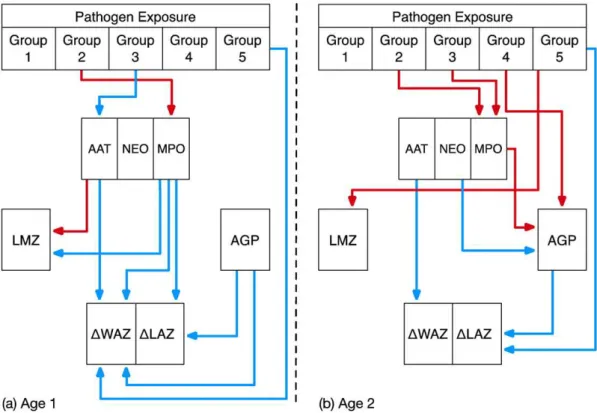
Within the systems model, which included the pathogen groups, all biomarkers, and both growth outcomes, the invasive bacteria (Group II) showed positive associations with MPO for both ages (Fig. 4). Addition-ally, ETEC (Group III) infection was associated with lower concentra-tions of AAT at Age 1 and higher concentraconcentra-tions of MPO in older Age 2 children. At Age 1, AAT concentration was positively associated with LMZ, while MPO was negatively associated with LMZ (Fig. 4). In the older age period, MPO concentration was positively associated with AGP, while NEO was negatively associated with AGP.
Regarding associations between biomarkers and the two growth outcomes,ΔLAZ andΔWAZ, the systems model revealed direct negative relationships between MPO and bothΔLAZ andΔWAZ during Age 1 and
negative associations between AAT andΔWAZ in both age groups (Fig. 4) (i.e., the higher the concentration of MPO or AAT, the more restricted the growth over the respective period). There was no statistical support for an association between LMZ and eitherΔLAZ orΔWAZ in the system model (or for lactulose excretion, data not shown). Higher AGP concen-trations were associated with decreasedΔLAZ at both ages and with ΔWAZ during Age 1 (Fig. 4). Because enteropathogens, particularly those associated with enteroinvasion or mucosal disruption (Group II), were directly related to increased MPO, they were thereby indirectly related to reduced growth.Giardiawas associated directly with reduced growth, but not with the fecal biomarkers.
The effects of higher or lower biomarker concentrations relative to their observed means onΔLAZ andΔWAZ over each age period are shown inFig. 5. None of the biomarkers had large mean effects on the averageΔLAZ orΔWAZ. Of the effects onΔLAZ, changing the log(AGP) concentration by ±1SD produced the greatest difference (±0·05 meanΔLAZ), but little effect on the meanΔWAZ (±0·02ΔWAZ) rela-tive to the observed concentration of log(AGP). Changing the MPO con-centration by ±1SD had the second largest impact onΔLAZ (+0·04 or
−0·03 for a decrease or increase in log(MPO) concentration
respective-ly). The effect of increasing MPO concentration onΔWAZ was marginal-ly larger (−0·05 ± 0·03), after which AAT had the second biggest
impact onΔWAZ (+0·04 when decreased and−0·06 when log(AAT)
was increased by 1SD).
4. Discussion
The systems model presented here is thefirst effort to explicitly combine enteropathogen exposure and different EE biomarkers (i.e., for gut permeability, gut inflammation, and systemic inflammation) into a single system and examine prospectively the pathways through which they relate to growth, thus providing an important proof of prin-cipal for a poorly defined condition. The temporal nature of the data al-lows for the exploration of causality and for the natural history of the biologic processes being measured to be interpreted with rigor. Our model is informed by a substantial quantity of structured longitudinal data on enteropathogens in non-diarrheal stools, illness history, intesti-nal inflammation and permeability, systemic inflammation, and growth across seven populations. The number of repeated measures over time and measures within the same individual is a particular strength of these data. Enteropathogen presence changes the concentration of con-temporary biomarkers of gut immunity (NEO), inflammation (MPO), Table 4
The impact of recent overt symptoms on the log concentration of AGP based on samples at seven, 15, and 24 months. A linear mixed model of log(AGP) as a func-tion of the presence or absence of overt symptoms in the 14 days preceding the blood draw. Child nested in site was treated as a random intercept.
Variable Mean (±standard error)
Constant 4.58 (0.07)⁎⁎⁎,⁎⁎,⁎
Diarrhea 0.04 (0.05)
Fever 0.21 (0.04)⁎⁎⁎
ALRI −0.14 (0.07)
Age (months) −0.00 (0.00)
Diarrhea∗age 0.00 (0.00)
Fever∗age 0.00 (0.00)
ALRI∗age 0.02 (0.00)⁎⁎⁎
N 4257
N children 1801
N sites 8
Variance (child) 0.01
Variance (site) 0.03
Variance (residual) 0.15
⁎⁎⁎ pb0·001.
⁎⁎ pb0·01.
⁎ pb0·05.
Table 3
The relationship between the LMZ and changes in LAZ and WAZ over a three, six, or nine month period from the age of the L:M test. L:M tests were performed at three, six, nine, and 15 months. Child nested in study site was considered a random intercept to account for repeated measures and site heterogeneity.
Mean effect (±standard error)
ΔLAZ (months post L:M test) ΔWAZ (months post L:M test)
3 m 6 m 9 m 3 m 6 m 9 m
Constant (3 m L:M) −0.21 (0.08)⁎,⁎⁎ −0.71 (0.20)⁎⁎⁎ −1.08 (0.25)⁎⁎⁎ −0.21 (0.08)⁎ −0.71 (0.20)⁎⁎⁎ −1.08 (0.25)⁎⁎⁎ Constant (6 m L:M) −0.12 (0.02)⁎⁎⁎ −0.21 (0.02)⁎⁎⁎ −0.19 (0.02)⁎⁎⁎ −0.12 (0.02)⁎⁎⁎ −0.21 (0.02)⁎⁎⁎ −0.19 (0.02)⁎⁎⁎ Constant (9 m L:M) −0.24 (0.02)⁎⁎⁎ −0.33 (0.02)⁎⁎⁎ −0.27 (0.02)⁎⁎⁎ −0.24 (0.02)⁎⁎⁎ −0.33 (0.02)⁎⁎⁎ −0.27 (0.02)⁎⁎⁎ Constant (15 m L:M) −0.25 (0.02)⁎⁎⁎ −0.40 (0.02)⁎⁎⁎ −0.33 (0.02)⁎⁎⁎ −0.25 (0.02)⁎⁎⁎ −0.40 (0.02)⁎⁎⁎ −0.33 (0.02)⁎⁎⁎ LAZ/WAZ at start −0.24 (0.01)⁎⁎⁎ −0.65 (0.01)⁎⁎⁎ −0.82 (0.01)⁎⁎⁎ −0.24 (0.01)⁎⁎⁎ −0.65 (0.01)⁎⁎⁎ −0.82 (0.01)⁎⁎⁎ L:MZ-score (3 m) 0.00 (0.02) −0.01 (0.01) 0.00 (0.01) 0.00 (0.02) −0.01 (0.01) 0.00 (0.01) L:MZ-score (6 m) −0.03 (0.02) 0.03 (0.02) −0.01 (0.02) −0.03 (0.02) 0.03 (0.02) −0.01 (0.02) L:MZ-score (9 m) −0.01 (0.02) −0.00 (0.02) −0.02 (0.02) −0.01 (0.02) −0.00 (0.02) −0.02 (0.02) L:MZ-score (15 m) −0.02 (0.02) 0.00 (0.02) 0.00 (0.02) −0.02 (0.02) 0.00 (0.02) 0.00 (0.02)
N 5343 5213 5117 5343 5213 5117
N children 1650 1591 1563 1650 1591 1563
N sites 7 7 7 7 7 7
Variance (child) 0.03 0.37 0.61 0.03 0.37 0.61
Variance (site) 0.05 0.27 0.44 0.05 0.27 0.44
Variance (Residual) 0.29 0.18 0.13 0.29 0.18 0.13
⁎⁎⁎ pb0·001.
⁎⁎ pb0·01.
⁎ pb0·05.
and permeability (AAT and LMZ). Wefind additional evidence that both enteropathogens and gut inflammation relate to systemic inflammation.
Our results yield several importantfindings. First, children living in these eight countries with differing epidemiologic settings have consis-tently and strikingly high concentrations of MPO (nearly 5–10 times the those seen in the USA) (Saiki, 1998) and nearly twice the concentration of AAT (Meyers et al., 1985). They also have notable elevations in AGP and intestinal permeability (L:M) that are two to three times higher than values in healthy populations (Kremer et al., 1988). Additionally, there was a high burden of enteropathogens detected even in the ab-sence of overt diarrhea episodes (Platts-Mills et al., 2015). But most im-portantly, related MAL-ED analyses have demonstrated that, in the
diverse epidemiologic settings of the study, growth velocities were low (MAL-ED Network Investigators, n.d.-a) leading to an increased prevalence of stunting by two years (MAL-ED Network Investigators, n.d.-b). The evidence we present here suggests that EE as measured by these markers contributes to, but does not appear to be the predomi-nant driver of growth faltering.
As hypothesized, pathogen presence in non-diarrheal stool samples was associated with higher fecal MPO; thisfinding was also noted for AAT, although the AATfindings were evident only in younger children (aged 4˗11 months). When fecal biomarkers were evaluated for associ-ations with individual pathogens, stronger signals of inflammation were noted in response to the rarely detectedShigellaandYersiniaand the ubiquitousCampylobacter. The differential importance of pathogens in
Fig. 5.Sensitivity analysis of the DAG model (Fig. 4) to explore the effect of increasing (triangles) or decreasing (squares) the concentration of different biomarkers on meanΔLAZ and ΔWAZ at the two age periods (Age 1, black; Age 2, gray). Symbols indicate the mean difference (lines, ±1 standard deviation) in the mean simulatedΔLAZ andΔWAZ when biomarkers are changed ±1 standard deviation compared to a simulation using the mean observed biomarker value (i.e., the dotted horizontal line shows a difference of zero). Fig. 4.The model results for (a) Age 1 (4≤months≤11) and (b) Age 2 (12≤months≤21) using functional pathogen groupings and the specific pathways indicated by the individual fecal biomarkers as well as LMZ and AGP. Arrows show those relationships that had statistical support based on the 95% credibility interval. Red arrows indicate positive associations and blue arrows show negative associations. The pathogen groups reflect 1) viruses; 2) invasive bacteria; 3) non-invasive bacteria; 4)Cryptosporidium; and 5)Giardia.
inducing EE is an area that requires additional attention, especially given the availability of newer technologies that allow for broad cover-age and quantification of enteropathogens (Platts-Mills et al., 2015), and other strategies for determining which microbial taxa are inducing mucosal response in the gut (MAL-ED Network Investigators, n.d.-b). Such studies will enhance our understanding of the possible impact of etiology-specific interventions on EE.
Each of the three fecal biomarkers in this analysis have previously been associated with an elevated risk of stunting in thefirst year of life (George et al., 2015). Similar results have been found in other stud-ies (Lin et al., 2013; Naylor et al., 2015). Here, we alsofind support for direct effects of gut inflammation (i.e., as measured by the three fecal biomarkers) onΔLAZ orΔWAZ. The evidence for an effect of systemic inflammation (i.e., as measured by AGP) is more compelling than that of the EE biomarkers. We found no evidence for an association between augmented intestinal permeability (i.e., as measured by LMZ) and fu-ture growth. Despite the popular use of L:M as a test of EE in cross sec-tional studies, its predictive power for future growth is less clear. While many studies have shown the L:M ratio to be associated with the con-temporaneous LAZ (Lunn et al., 1991; Goto et al., 2009; Campbell et al., 2002), others have found (as we did) that it was not predictive of change in LAZ of children (Lin et al., 2013; Weisz et al., 2012). Given that AAT was associated with both gut permeability and subsequently to changes in growth (especially WAZ, both Age 1 and 2), it is possible that AAT more reliably reflects changes (or more severe changes) in permeability than the L:M test. The polar surface area of AAT greatly ex-ceeds that of lactulose, and the size of the permeability defect may be important to delineate in greater detail using alternate probes. It is worth noting that other MAL-ED data (i.e., non-growth data) indicate the L:M test is predictive of impaired efficacy of oral polio vaccine (MAL-ED Network Investigators, n.d.-c). As such, the L:M test may cap-ture other domains of EE not examined in these analyses.
Our results suggest that reductions in the exposure to pathogens, in particular to invasive bacteria that increase MPO, could reduce systemic inflammation (AGP). Recent evidence from another cohort study simi-larly highlighted the importance of systemic inflammation (Naylor et al., 2015). AGP interacts with bacterial lipopolysaccharide (LPS) (Moore et al., 1997), which is an indicator of bacterial translocation, and LPS bound to AGP is more rapidly cleared from the body than un-bound LPS. Consequently, it was surprising to see that neither LMZ nor AAT were associated with AGP, as permeability leading to bacterial translocation has been a principal hypothesized component of EE (Lunn et al., 1991). Other markers of bacterial translocation are needed to con-firm thesefindings.
Although our model indicates that specific enteropathogens alter gut inflammation and permeability, the effect sizes of the pathways from biomarkers to growth were smaller than anticipated (Humphrey, 2009; Brown et al., 2015). Based on available evidence, the contribution of EE to growth deficits as captured in these biomarkers is small relative to the accrued growth deficits in these populations (Lunn et al., 1991; Humphrey, 2009; MAL-ED Network Investigators, n.d.-a; MAL-ED Network Investigators, n.d.-b). The use of additional biomarkers or com-binations of biomarkers and growth phenotypes (Naylor et al., 2015) or inclusion of metabolic markers may help to identify stronger support for links between the interactions of enteropathogen pressure and undernutrition on growth failure. Additionally, on-going work in this study population to understand links between the microbiome (Subramanian et al., 2014), host metabolism (Mayneris-Perxachs et al., 2016), and growth will expand our understanding of how microbial populations affect the nutritional status in these populations (Lunn, 2000; Brown et al., 2015; Kau et al., 2015; Blanton et al., 2016; Kosek et al., 2016).
The analytical framework described here is thefirst attempt to plicitly examine causal pathways of EE. Our results demonstrate that ex-posure to enteropathogens results in abnormal gut permeability, inflammation, systemic immune activation, and growth failure, but
suggest that additional work incorporating other critical features of host metabolic status and the microbiome are needed to explain the gap between the insults attributable to EE and the observed cumulative acquired deficits of growth in children in these populations.
Contributors
Margaret N. Kosek and Benjamin J.J. McCormick devised the model in discussion with Richard L. Guerrant, Laura E. Caulfield, Tahmeed Ahmed, Zulfiquar Bhutta, Gagandeep Kang, Aldo Lima, Eric Houpt, and James Platts-Mills. Benjamin J.J. McCormick ran the analyses. Margaret N. Kosek, Benjamin J.J. McCormick, Gwenyth Lee, and Jessica C. Seidman participated in the interpretation of the results and drafted the manu-script. The MAL-ED Investigators participated in the design, conduct, and analysis of the MAL-ED study and its results.
Declaration of Interests
We declare that we have no conflicts of interest.
Acknowledgements
The Etiology, Risk Factors and Interactions of Enteric Infections and Malnutrition and the Consequences for Child Health and Development Project (MAL-ED) is carried out as a collaborative project supported by the Bill & Melinda Gates Foundation (47075), the Foundation for the Na-tional Institutes of Health, and the NaNa-tional Institutes of Health, Fogarty International Center. We particularly want to thank the children and caregivers who participated in the study for their invaluable contribu-tions. Tom Brewer and Gretchen Meller are also thanked for their early support of the project. We are truly indebted to the following individ-uals for their advisory role in the MAL-ED study: Henry Binder, Maureen Black, Kathleen Braden, Robert Breiman, Susan Bull, Katherine Dewey, Christopher Duggan, Christine Grady, Gerry Keusch, Nancy Krebs, Claudio Lanata, James Nataro, Jerome Singh, Peter Smith, Phillip Tarr, Katherine Tucker and Theodore Wachs. Fraser Lewis is recognized and appreciated for his critical review of and guidance on the analytical methods and statistical approaches applied in the MAL-ED study. We thank Leslie Pray and Alicia Livinski for their editorial assistance. Special thanks go to Roger Glass and George Griffin for their continued support and guidance.
Appendix A. Supplementary data
Supplementary data to this article can be found online athttp://dx. doi.org/10.1016/j.ebiom.2017.02.024.
References
Beltinger, J., Del Buono, J., Skelly, M.M., et al., 2008.Disruption of colonic barrier function and induction of mediator release by strains of Campylobacter jejuni that invade ep-ithelial cells. World J. Gastroenterol. 14, 7345–7352.
Berkes, J., Viswanathan, V.K., Savkovic, S.D., Hecht, G., 2003.Intestinal epithelial responses to enteric pathogens: effects on the tight junction barrier, ion transport, and infl am-mation. Gut 52, 439–451.
Blanton, L.V., Charbonneau, M.R., Salih, T., et al., 2016. Gut bacteria that prevent growth impairments transmitted by microbiota from malnourished children. Science 351 (aad3311).10.1126/science.aad3311.
Brown, E.M., Wlodarska, M., Willing, B.P., et al., 2015.Diet and specific microbial exposure trigger features of environmental enteropathy in a novel murine model. Nat. Commun. 6, 7806.
Campbell, D.I., Lunn, P.G., Elia, M., 2002.Age-related association of small intestinal muco-sal enteropathy with nutritional status in rural Gambian children. Br. J. Nutr. 88, 499–505.
Campbell, D.I., Murch, S.H., Elia, M., et al., 2003.Chronic T cell-mediated enteropathy in rural west African children: relationship with nutritional status and small bowel function. Pediatr. Res. 54, 306–311.
Campbell, D.I., McPhail, G., Lunn, P.G., Elia, M., Jeffries, D.J., 2004.Intestinal inflammation measured by fecal neopterin in Gambian children with enteropathy: association with growth failure,Giardia lamblia, and intestinal permeability. J. Pediatr. Gastroenterol. Nutr. 39, 153–157.
Caulfield, L.E., Bose, A., Chandyo, R.K., et al., 2014.Infant feeding practices, dietary adequa-cy, and micronutrient status measures in the MAL-ED study. Clin. Infect. Dis. 59, S248–S254.
Denno, D.M., VanBuskirk, K., Nelson, Z.C., Musser, C.A., Hay Burgess, D.C., Tarr, P.I., 2014. Use of the lactulose to mannitol ratio to evaluate childhood environmental enteric dysfunction: a systematic review. Clin. Infect. Dis. 59, S213–S219.
George, C.M., Oldja, L., Biswas, S., et al., 2015.Geophagy is associated with environmental enteropathy and stunting in children in Rural Bangladesh. Am. J. Trop. Med. Hyg. 92, 1117–1124.
Goto, R., Mascie-Taylor, C.G.N., Lunn, P.G., 2009.Impact of intestinal permeability, infl am-mation status and parasitic infections on infant growth faltering in rural Bangladesh. Br. J. Nutr. 101, 1509–1516.
Greenland, S., Pearl, J., Robins, J.M., 1999.Causal diagrams for epidemiologic research. Ep-idemiology 10, 37–48.
Guerrant, R.L., Steiner, T.S., Lima, A.A.M., Bobak, D.A., 1999.How intestinal bacteria cause disease. J. Infect. Dis. 179, S331–S337.
Hashimoto, T., Perlot, T., Rehman, A., et al., 2012.ACE2 links amino acid malnutrition to microbial ecology and intestinal inflammation. Nature 487, 477–481.
Houpt, E., Gratz, J., Kosek, M., et al., 2014.Microbiologic methods utilized in the MAL-ED cohort study. Clin. Infect. Dis. 59, S225–S232.
Humphrey, J.H., 2009. Child undernutrition, tropical enteropathy, toilets, and handwashing. Lancet 374, 1032–1035.
Kamada, N., Chen, G.Y., Inohara, N., Núñez, G., 2013.Control of pathogens and pathobionts by the gut microbiota. Nat. Immunol. 14, 685–690.
Kau, A.L., Planer, J.D., Liu, J., et al., 2015. Functional characterization of IgA-targeted bacte-rial taxa from undernourished Malawian children that produce diet-dependent en-teropathy. Sci. Transl. Med. 7 (276ra24).10.1126/scitranslmed.aaa4877.
Kelly, P., Menzies, I., Crane, R., et al., 2004.Responses of small intestinal architecture and function over time to environmental factors in a tropical population. Am.J.Trop. Med. Hyg. 70, 412–419.
Keusch, G.T., Rosenberg, I.H., Denno, D.M., et al., 2013.Implications of acquired environ-mental enteric dysfunction for growth and stunting in infants and children living in low- and middle-income countries. Food Nutr. Bull. 34, 357–364.
Keusch, G.T., Denno, D.M., Black, R.E., et al., 2014.Environmental enteric dysfunction: pathogenesis, diagnosis, and clinical consequences. Clin. Infect. Dis. 59, S207–S212. Korpe, P.S., Petri Jr., W.A., 2012.Environmental enteropathy: critical implications of a
poorly understood condition. Trends Mol. Med. 18, 328–336.
Kosek, M., Haque, R., Lima, A., et al., 2013.Fecal markers of intestinal inflammation and permeability associated with the subsequent acquisition of linear growth deficits in infants. Am.J.Trop. Med. Hyg. 88, 390–396.
Kosek, M., Guerrant, R.L., Kang, G., et al., 2014.Assessment of environmental enteropathy in the MAL-ED cohort study: theoretical and analytic framework. Clin. Infect. Dis. 59, S239–S247.
Kosek, M.N., Mduma, E., Kosek, P.S., et al., 2016. Plasma Tryptophan and the Kynurenine-Tryptophan Ratio are Associated with the Acquisition of Statural Growth Deficits and Oral Vaccine Underperformance in Populations with Environmental Enteropathy. Am. J. Trop. Med. Hyg. (published online Aug 8).10.4269/ajtmh.16-0037. Kremer, J.M., Wilting, J., Janssen, L.H., 1988.Drug binding to human alpha-1-acid
glyco-protein in health and disease. Pharmacol. Rev. 40, 1–47.
Lin, A., Arnold, B.F., Afreen, S., et al., 2013.Household environmental conditions are asso-ciated with enteropathy and impaired growth in rural Bangladesh. Am.J.Trop. Med. Hyg. 89, 130–137.
Lohmann, T.G., Roche, A.F., Martorell, R., 1988.Anthropometric Standardization Reference Manual. Human Kinetics Books, Champaign, IL.
Lunn, P.G., 2000.The impact of infection and nutrition on gut function and growth in childhood. Proc. Nutr. Soc. 59, 147–154.
Lunn, P.G., Northrop-Clewes, C.A., Downes, R.M., 1991.Intestinal permeability, mucosal injury, and growth faltering in Gambian infants. Lancet 338, 907–910.
MAL-ED Network Investigators, 2014a.The MAL-ED study: a multinational and multidis-ciplinary approach to understand the relationship between enteric pathogens, mal-nutrition, gut physiology, physical growth, cognitive development, and immune responses in infants and children up to 2 years of age in resource-poor environments. Clin. Infect. Dis. 59, S193–S206.
MAL-ED Network Investigators, 2014b.The Malnutrition and Enteric Disease Study (MAL-ED): understanding the consequences for child health and development. Clin. Infect. Dis. 59, S193–S330.
MAL-ED Network Investigators. Growth velocity and attained size at 24 months are af-fected by enteropathogens and dietary intakes, but not diarrhoea:findings from the MAL-ED birth cohort study. Lancet (submitted).
MAL-ED Network Investigators. Prevalence of stunting at 24 months is linked to enteropathogens, diet, socioeconomic status, maternal height, and child weight at en-rolment:findings from the MAL-ED birth cohort study. Lancet (submitted). MAL-ED Network Investigators. Oral polio vaccine failure is associated with
socio-envi-ronmental conditions, enteropathogens, and timing and frequency of vaccination: findings from the MAL-ED birth cohort study.Personal Communication.
Mayneris-Perxachs, J., Lima, A.A.M., Guerrant, R.L., et al., 2016. Urinary N-methylnicotinamide andβ-aminoisobutyric acid predict catch-up growth in under-nourished Brazilian children. Sci. Rep. 6:19780.http://dx.doi.org/10.1038/srep19780. McCormick, B.J.J., Lee, G.O., Seidman, J.C., et al., 2016.Dynamics and trends in fecal bio-markers of gut function in children from 1–24 months in the MAL-ED study. Am.J.Trop. Med. Hyg. (16–0496).
Menzies, I.S., Zuckerman, M.J., Nukajam, W.S., et al., 1999.Geography of intestinal perme-ability and absorption. Gut 44, 483–489.
Meyers, S., Wolke, A., Field, S.P., Feuer, E.J., Johnson, J.W., Janowitz, H.D., 1985.Fecal alpha 1-antitrypsin measurement: an indicator of Crohn's disease activity. Gastroenterolo-gy 89, 13–18.
Mondal, D., Minak, J., Alam, M., et al., 2012.Contribution of enteric infection, altered intes-tinal barrier function, and maternal malnutrition to infant malnutrition in Bangla-desh. Clin. Infect. Dis. 54, 185–192.
Moore, D.F., Rosenfeld, M.R., Gribbon, P.M., Winlove, C.P., Tsai, C.M., 1997.Alpha-1-acid (AAG, orosomucoid) glycoprotein: interaction with bacterial lipopolysaccharide and protection from sepsis. Inflammation 21, 69–82.
Naylor, C., Lu, M., Haque, R., et al., 2015.Environmental enteropathy, oral vaccine failure and growth faltering in infants in Bangladesh. EBioMedicine 2, 1759–1766. Pearl, J., 1995.Causal diagrams for empirical research. Biometrika 82, 669–688. Peterson, K.M., Buss, J., Easley, R., et al., 2013.REG1B as a predictor of childhood stunting
in Bangladesh and Peru. Am. J. Clin. Nutr. 97, 1129–1133.
Platts-Mills, J.A., Babji, S., Bodhidatta, L., et al., 2015. Pathogen-specific burdens of commu-nity diarrhoea in developing countries: a multisite birth cohort study (MAL-ED). Lan-cet Glob. Health (published online July 17).10.1016/S2214-109X(15)00151-5. Plummer, M., March 2003.JAGS: A program for analysis of Bayesian graphical models
using Gibbs sampling. Proceedings of the 3rd International Workshop on Distributed Statistical Computing (DSC 2003), pp. 20–22.
Prendergast, A., Kelly, P., 2012.Enteropathies in the developing world: neglected effects on global health. Am.J.Trop. Med. Hyg. 86, 756–763.
Richard, S.A., Barrett, L.J., Guerrant, R.L., Checkley, W., Miller, M.A., 2014.Disease surveil-lance methods used in the 8-site MAL-ED cohort study. Clin. Infect. Dis. 59, S220–S224.
Saiki, T., 1998.Myeloperoxidase concentrations in the stool as a new parameter of infl am-matory bowel disease. Kurume Med. J. 45, 69–73.
Semba, R.D., Shardell, M., Sakr Ashour, F.A., et al., 2016.Child stunting is associated with low circulating essential amino acids. EBioMedicine 6, 246–252.
Subramanian, S., Huq, S., Yatsunenko, T., et al., 2014.Persistent gut microbiota immaturity in malnourished Bangladeshi children. Nature 510, 417–421.
Viswanathan, V.K., Hodges, K., Hecht, G., 2009.Enteric infection meets intestinal function: how bacterial pathogens cause diarrhoea. Nat. Rev. Microbiol. 7, 110–119. Weisz, A.J., Manary, M.J., Stephenson, K., et al., 2012.Abnormal gut integrity is associated
with reduced linear growth in rural Malawian children. J. Pediatr. Gastroenterol. Nutr. 55, 747–750.
World Health Organization, 2006. WHO Child Growth Standards: Methods and develop-ment: Length/height-for-age, Weight-for-age, Weight-for-length, Weight-for-height and Body Mass Index-for-age. World Health Organization, Geneva, Switzerland (http://www.who.int/childgrowth/publications/technical_report_pub/en/accessed July 23, 2013).