Printed in Brazil - ©2006 Sociedade Brasileira de Química 0103 - 5053 $6.00+0.00
Article
* e-mail: [email protected]
AFM Studies and Electrochemical Characterization of Boron-Doped Diamond
Surfaces Modified with Metal Oxides by the Sol-Gel Method
Hugo B. Suffredini, Giancarlo R. Salazar-Banda, Sônia T. Tanimoto, Marcelo L. Calegaro,
Sergio A. S. Machado and Luis A. Avaca
*
Instituto de Química de São Carlos, Universidade de São Paulo, CP 780, 13566-500 São Carlos - SP, Brazil
Com o objetivo de aprofundar investigações anteriores, foram realizadas modificações superficiais diretas em eletrodos de diamante dopados com boro (DDB), com óxidos metálicos (PtOx, RuO2, IrO2 e PbO2) e com alguns compósitos mistos, utilizando a técnica Sol-Gel. Estes materiais foram
estudados por microscopia de força atômica (MFA) e os resultados indicaram a formação de sítios de deposição heterogênea. Técnicas eletroquímicas foram utilizadas para estabelecer a atividade catalítica para a reação de desprendimento de oxigênio (RDO) e para reação de oxidação de etanol em meio ácido utilizando os compósitos de PtOx e PtOx-RuO2. Testou-se ainda a estabilidade de um depósito de PtOx, recoberto por um filme de Nafion
®, por meio de operação contínua de longa
duração. Estudos de voltametria cíclica comparativa mostraram que a área superficial ativa dos novos materiais mudou consideravelmente com o método de modificação proposto. O eletrodo de IrO2/BDD mostrou o melhor desempenho para a RDO, iniciando o processo de oxidação em ~ 1.4 V
vs. HESS, valor este 200 mV menor do que o observado sobre um eletrodo de PtOx/BDD. Foi observada uma pequena perda da atividade do eletrodo de PtOx/BDD (6%) depois de realizada
eletrólise de 4 horas, enquanto que 1000 ciclos voltamétricos deixaram a superfície praticamente inalterada. Os estudos realizados mostram que as atividades satisfatórias dos eletrodos preparados pelo método Sol-Gel podem constituir ferramentas interessantes de pesquisa, visando principalmente a utilização destes materiais em aplicações práticas.
Continuing previous investigations, direct surface modifications of boron-doped diamond (BDD) electrodes with metal oxides (PtOx, RuO2, IrO2 and PbO2) and with some mixed composites were carried out by the Sol-Gel technique. The materials were studied by atomic force microscopy (AFM) to determine their surface topologies and by electrochemical techniques to establish the catalytic activity towards the oxygen evolution reaction (OER) and also, for the PtOx and PtOx
-RuO2 composites, the ethanol oxidation reactions in acid media. The stability of PtOx coating covered by a Nafion® film was also tested by long-term operation. The AFM results indicated
sites of heterogeneous deposition and the electrochemical studies demonstrated that the active surface area changed considerably with the proposed method of modification. The IrO2/BDD
electrode showed the best performance to the OER with the onset of the oxidation current at ~1.4 V, a value 200 mV lower than for the PtOx/BDD electrode. The enhanced stability of PtOx/BDD electrodes achieved by the application of a Nafion® film and already reported in acid media was
further proved using the ethanol oxidation reaction. Only a small loss of activity (6%) was observed after 4-hours electrolysis while one-thousand voltammetric cycles left the surface practically unchanged. In addition, preliminary studies for the same reaction on PtOx/BDD and PtOx-RuO2/
BDD electrodes demonstrated the excellent activity of these mixed Sol-Gel coatings on the BDD surface and the possibility of further investigations for practical applications.
Keywords: modified diamond electrodes, Sol-Gel technique, metal oxides
Introduction
Boron-doped diamond (BDD) films have been largely
used as electrode material in electroanalytical studies1-7
since they posses an extraordinary chemical stability, low capacitive currents in an extended range of potentials and good reproducibility of the results if adequately
pre-treated.8,9 Taking advantage of these qualities, several
compounds, particularly for the wastewater treatment.10-13
In addition, modifications of the BDD surface have been
employed for a number of specific applications.14-30
Thus, Duo et al.14 have studied the deposition of small
quantities of IrO2 clusters on the BDD surface by a thermal
decomposition technique and observed that the oxygen evolution reaction (OER) was dramatically enhanced with the surface modification. De Battisti et al.15 have reported
Sol-Gel modifications of the BDD surface with RuO2 and
IrO2 and used chlorine evolution as a model reaction to
evaluated the effect of RuO2 modification on BDD films.
They showed that the catalytic activity of the RuO2/BDD
electrode was much higher in comparison to the unmodified BDD and also observed that the chlorine
evolution reaction at the RuO2/BDD electrode proceeds
with a higher rate than on a RuO2/Ti electrode. Terashima
et al.16 have demonstrated that a regular dispersion of
iridium oxide nanoparticles or a continuous oxide films could be obtained on BDD surfaces using a electrodeposition method, with excellent control of the amount deposited and high reproducibility of the electrochemical performance for the amperometric
detection of hydrogen peroxide. Salimi et al.17 studied
the behavior of BDD surfaces modified with IrO2 by an
electrodeposition method for the detection of arsenic (III) in real samples and found that the modified electrodes showed an excellent analytical performance with detection
limit of 2 mmol L-1 of arsenic (III). More recently, BDD
surface modifications were proposed using chemical,18
electrochemical19 and ion implantation techniques.20
Methanol oxidation was studied by Montilla et al.21
on a Pt-modified diamond electrode. Platinum particles were deposited on the BDD surface by conventional chemical or electrochemical methods. The stability of the deposited Pt was very low, but the activity for methanol oxidation was satisfactory. Meanwhile, in a very recent
Communication to this Journal, Salazar-Banda et al.22 have
shown great improvements in the stability of PtOx particles
deposited on the BBD surface by the Sol-Gel method. The authors used a thermal pre-treatment of the surface before applying the Sol-Gel coating and then the electrode
surface was covered by a Nafion® film. This procedure
yielded electrodes that retained over 90% of the coated material after one-thousand voltammetric cycles carried out between the water decomposition reactions. Thus, the use of the Sol-Gel method together with the application
of a Nafion® film on top of the coating preserved almost
integrally the deposited platinum oxide.
The electrocatalytic activities for oxygen reduction and methanol oxidation at a boron-doped nanoporous honeycomb diamond films, modified with Pt nanoparticles
by immersion of electrodes in a H2PtCl6 aqueous solution
and subsequent Pt reduction by a 3 hours exposure to
flowing H2 gas at 580 °C, was examined with cyclic
voltammetry and electrochemical impedance spectroscopy
in acid solution by Honda et al.23 These boron-doped
nanoporous honeycomb diamond electrodes were also electrochemically characterized in non-aqueous electrolytes
by Yoshimura et al.24 In other work, nanometer-size metal
particles of Ag, Au, Pd and others with preferred crystalline textures were spontaneously deposited on a diamond thin
film by Gao et al.25 The deposition was achieved after
immersion in an acidic solution containing metal ions or complex metal ions and a significant enhancement of hydrogen evolution activity was observed on a diamond electrode modified by 9% coverage of Pd nanoparticles.
On the other hand, is well established in the literature that Sol-Gel is a feasible coating method and have been
used for different purposes. Thus, Mattos-Costa et al.26
have constructed Ti/RuxIr1-xO2 electrodes to be used as
anodes under extreme conditions and Suffredini et al.27
have prepared NiCo2O4 coatings on Ni using the Sol-Gel
method to produce an efficient material for oxygen evolution in alkaline media. Several other authors have
prepared Sol-Gel films of Ga–Zn oxide28 as well as
tetraethoxysilane (TEOS) and methyltriethoxysilane
(MTEOS)-based films29 were prepared to be used as
oxygen sensors while, for the first time, modified carbon powder electrodes were recently produced by the Sol-Gel
method to be used as anodes in direct methanol fuel cells.30
The aim of this work is to extend our previous findings
on the Sol-Gel modification of the BDD surface22 to
different catalytic coatings such as metal oxides (MO2, M
= Pb, Ru, and Ir) and analyze their surface topologies by atomic force microscopy (AFM) and electrochemical active area by comparative studies with a polycrystalline Pt electrode. These new materials will be tested as anodes for the oxygen evolution reaction (OER) in acid media. In addition, the ethanol oxidation reaction will be used to confirm the stability of the Pt oxide deposit made by the
Sol-Gel technique and covered by a Nafion® film as well
as the catalytic activity of the MO2 coatings towards this
last and very important electrode reaction.
Experimental
Reagents and apparatus
The electrochemical experiments were performed at
room temperature in a Pyrex® glass cell provided with
three electrodes and degassing facilities for bubbling N2.
same solution (HESS) and all potentials are referred to
this system while the auxiliary one was a 2 cm2 Pt foil.
The reagents used in this work were all of Merck P.A. quality and the water was purified by the Milli-Q system from Millipore. The Sol-Gel solutions were prepared with Ru (III), Ir (III), Pb (II) and Pt (II) acetylacetonates in a mixture of ethanol + acetic acid (3:2, v/v). The final
concentration of these solutions was 0.01 mol L-1. A 5%
Nafion® solution in a mixture of lower aliphatic alcohols
and water (Sigma-Aldrich) was used for coating the deposits. The comparative cyclic voltammetries, aiming to determine the electrochemical active areas, were performed in a 1.0 x 10⁻² mol L-1 K
4Fe(CN)6 + 0.5 mol L
-1 H 2SO4
solution while the OER studies were carried out in 0.5 mol L-1 H
2SO4 solution. The ethanol oxidation reaction was
studied in a 0.5 mol L-1 CH
3CH2OH + 0.5 mol L
-1 H 2SO4
solution by cyclic and linear voltammetry and control potential electrolysis. All electrochemical measurements were carried out in a Mod. 283 EG&G PARC instrument and the surface topology studies were performed using an
atomic force microscope TopoMetrix®AFM Explorer.
Working electrodes preparation
Boron-doped diamond (BDD) electrodes were prepared by the Centre Suisse de Electronique et de Microtechnique SA (CSEM), Switzerland, using the hot filament chemical vapor deposition (HF-CVD) technique
with a filament temperature in the range 2440-2560 oC
and a gaseous mixture containing methane, H2 and
trimethylboron. The final boron content was of the order of 4500-5000 ppm. The BDD plates were used as working electrode and as substrate for the surface modifications carried out by the Sol-Gel method. A thermal pre-treatment
at 400 oC was applied for 30 min to the BDD prior to the
coatings deposition. The Pt (II), Pb (II), Ru (III) or Ir (III) acetylacetonate solutions, described in the previous section, were transferred to the diamond surface by the painting technique. Then, the solution was evaporated for
5 minutes at a temperature of 80 oC in a stove. This
procedure was repeated for five times for the IrO2/BDD,
RuO2/BDD and PbO2/BDD electrodes and ten times for
the PtOx/BDD and PtOx-RuO2/BDD electrodes. Finally,
the coated electrodes were submitted to a thermal
treatment at 400 oC for 1 hour in an Argon atmosphere.
The PtOx/BDD electrode used to perform the ethanol
oxidation and the durability studies received a Nafion®
film to improve the stability of the coating on the diamond surface.22 Thus, 40 μL of the Nafion® solution diluted to
0.5% was evaporated onto the electrode surface (geometric
area of 0.56 cm2) using a hot air stream. The Pt working
electrode used for comparative studies was a foil with
0.18 cm2 of geometric area and was cleaned using
conventional chemical and electrochemical techniques.
Results and Discussion
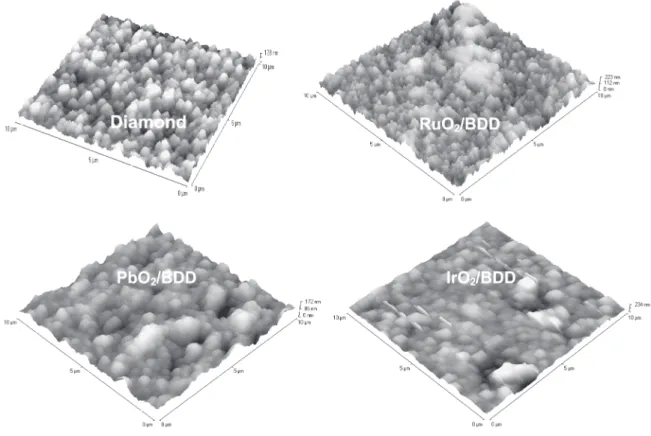
Figure 1 shows the AFM images (10 x 10 μm) for the
BDD surface and for the different modified electrodes. The BDD topology presents regular pyramidal structures and it is similar to those already reported in the
literature.31,32 For the modified structures, the same
regularity can be observed but with the presence of some metallic oxide “islands”. For all BDD-modified samples, some agglomerations of metallic oxides can be observed indicating sites of heterogeneous deposition.
To exclude the possibility that enhanced oxidation currents could be due to surface roughness and not to a real catalytic effect, a rough estimate of the electro-chemical active area of the modified electrodes was carried out. Thus, the voltammetric experiments shown in Figure
2 were recorded in 0.5 mol L-1 H
2SO4 + 10
-2 mol L-1
K4Fe(CN)6 solutions except for that in the insert of Figure
2A that was carried out in the pure H2SO4 solution. The
insert presents a typical steady-state response of a polycrystalline Pt electrode in acid media. It is well established in the literature33-36 that the Pt electrochemical
active area can be calculated by the H adsorption/ desorption charge density since for polycrystalline Pt surfaces, the occupation of all active sites of the surface with a complete monolayer of adsorbed hydrogen involves
a charge of 210 μC cm-2. This charge density corresponds
to the transfer of one electron to each one of the 1.3 x 10¹⁵
atoms of Pt in 1 cm2 of its surface.37,38 In the present case,
the calculated charge for desorbed H (dashed region in
the voltammogram) was 66.60 μC and the corresponding
active area was equal a 0.317 cm-2. As the geometric area
of the electrode was 0.181 cm2, the roughness factor for
Pt was equal to 1.75.
It is well recognized that for a typical outer-sphere and diffusion-controlled reaction, as it is the case for the
K4Fe(CN)6/K3Fe(CN)6 redox couple in solution, the
Randles-Sevick equation can be used:
(1)
where Ip is the peak current, n is the electrons number, A
is the active area of the electrode, Do is the diffusion
coefficient, v is the scan rate and C
o
* is the bulk
concentration of the specie. Then, a relation between Ip
and A can be established provided the reaction follows
Figure 2B shows the cyclic voltammograms for BDD,
PbO2/BDD, RuO2/BDD and IrO2/BDD in presence of a
10-2 mol L-1 K
4Fe(CN)6 + 0.5 mol L
-1 H
2SO4 aqueous
solution. Except for the case of IrO2/BDD, the other systems
show an acceptable reversibility for the intended comparison with the Pt response. Minor differences could be due to an internal resistance in the oxide layers while for DBB the reasons are mainly linked to the state of the surface prior to
the experiment.8 On the other hand, the quasi-reversible
response recorded for the IrO2/BBD electrode (Figure 2B)
has been previously reported by Gottesfeld39 who observed
that the K4Fe(CN)6/K3Fe(CN)6 redox couple in acid media showed a reversible behavior on an Ir rotating disk electrode that changed to irreversible when the electrode is covered by a Ir oxide layer, probably due to a blocking effect in the diffusion through the oxide film. Likewise, non-reversible
behavior was observed for hydroquinone using an IrOx
electrode while a reversible response was observed for gold in a borate buffer solution.40
Therefore, using equation 2 (below) together with the response of the Pt electrode in the same solution (Figure 2A) an estimate of the active surface areas of the modified electrodes can be obtained:
(2)
where A(Pt) is the Pt active area, Ip (Pt) is the platinum
peak current, A(Mod.) is the active area of the modified
electrode (or of the BDD surface) and Ip (Mod.) is the
peak current for the modified electrode. The active surface areas of the oxide-modified electrodes were then calculated and the values are presented in Table 1. These values will be used later for performance comparisons between the different materials.
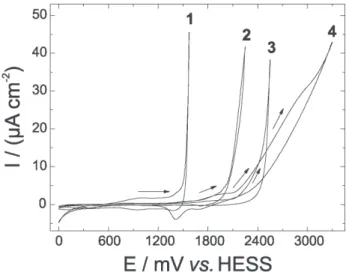
Figure 3 shows the electrochemical responses for the oxygen evolution reaction in acid media recorded on the different electrode materials. The reaction mechanism for
the OER on a BDD electrode has already been reported41
indicating that the Diamond surface is not favorable for adsorption. Consequently, electrode processes that involve
Table 1. Electrochemical active areas and roughness factors for the BDD and the oxide-modified electrodes obtained by comparative cyclic voltammetries using a Pt electrode and a 10-2 mol L-1 K
4Fe(CN)6 + 0.5 mol L-1 H
2SO4 solution
electrode geometric active area roughness material area (cm2) (cm2) factor
PLATINUM 0.18 0.32 1.75
BDD 0.62 1.43 2.32
PbO2/BDD 0.55 2.58 4.72
RuO2/BDD 0.43 1.68 3.93
IrO2/BDD 0.46 1.71 3.75
adsorbed intermediates as in the case of the oxygen evolution reaction (OER) as well as for the oxidation of alcohols are strongly hindered on diamond. This is concluded from the fact that the initial adsorption is the rate-determining step for both water reactions and explains the wide electrochemical potential window for BDD in
aqueous solutions.41,42 Due to the lack of activity of the
diamond electrode for adsorbed intermediate, its surface needs to be modified with catalysts for the activation of many interesting reactions.
The best performance for the OER was observed for
the IrO2/BDD sample (Figure 3) with an onset potential of
~1.4 V vs. HESS and these results are in good agreement
with previous work that describes similar studies on IrO2/
BDD electrodes deposited by thermal decomposition.14
They also agree with the results for IrO2/ITO electrodes
deposited by electrodeposition43 and for IrO
2 powders
prepared by a pyrolytic process.44 It is important to notice
that the onset potential for the OER (~1.4 V vs. HESS)
obtained on the IrO2/BDD electrode has a similar value to
that obtained using elaborated binary and ternary electrodes,
i.e., Ti/RuO2-Nb2O5 electrodes prepared by the polymeric
precursor method45 and for Ti/Ru
0.3Pb(0.7-x)TixO2 electrodes
prepared by thermal decomposition of ruthenium, titanium
and lead inorganic salts dissolved in isopropanol.46
In addition, the response of the RuO2/BDD electrode is
also somewhat better than that of the BDD sample while
the PbO2/BDD electrode is extremely inactive for the OER.
In fact, PbO2 electrodes have been largely used as anodes
under extreme conditions due to its extended anodic window
in aqueous media47,48 while RuO
2 anodes are commonly
reported as appropriate materials to promote the OER reaction.26,49 For comparison, it is important to mention that
under similar conditions a PtOx/BDD electrode shows the
Figure 4.Topological studies carried out by the AFM technique (10 x 10
μm) for BDD electrode modified with Platinum by the Sol-Gel technique. Figure 2. Comparative cyclic voltammograms (1st cycle) to determine
the active areas of the oxide-modified electrodes: (A) Pt electrode in a 1.0 x 10⁻² mol L-1 K
4Fe(CN)6 + 0.5 mol L -1 H
2SO4 solution; (B) responses for BDD (dotted line), PbO2/BDD (solid line), RuO2/BDD (dashed line) and IrO2/BDD (dash-dotted line) electrodes in the same solution. The Insert in (A) shows the Pt steady-state response in a pure 0.5 mol L-1 H2SO4 solution. v = 50 mV s-1.
onset of the oxidation current for the OER at ~1.6 V vs.
HESS as it was previously reported by our group.22
Studies of the ethanol oxidation reaction in acid
medium were initially carried out using a PtOx-modified
BDD electrode prepared by the Sol-Gel technique with a
greater loading than in previous studies.22 Figure 4 shows
the AFM image (10 x 10 μm) of that surface where it can
be observed the presence of Pt oxide “islands” with micrometric size and a rather irregular distribution. This fact indicates that the agglomeration of the Pt metal
clusters (having small amounts of PtOx, as revealed by
EDX measurements) on preferential sites of the surface renders a non-homogeneous coating.
To increase the stability of Pt oxide “islands” on de BDD
surface, 40 μL of a 0.5% Nafion® solution were evaporated
on the electrode surface using a hot air stream thus forming a Nafion® film on the electrode surface. The almost negligible
loss of Pt oxide particles after one-thousand voltammetric cycles between the water decomposition reactions for this
kind of electrode has been already shown.22 In the present
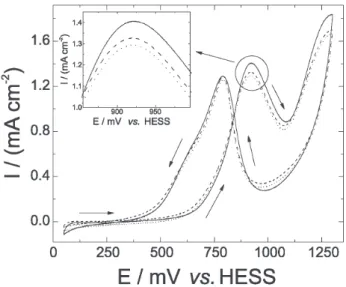
case, the modified surface was tested with the ethanol oxidation reaction and the results are presented in Figure 5.
These studies were carried out in a 0.5 mol L-1 CH
3CH3OH
+ 0.5 mol L-1 H
2SO4 solution and show the 1
st cycle
(solid-line), the response after 4 hours of continuous electrolysis at 650 mV vs. HESS (dashed-line) and, finally, the further effect
of 1000 cycles at 500 mV s-1 (dotted-line) on a PtO
x/BDD
electrode. A comparison of the oxidation current densities
at 920 mV vs. HESS reveals a very small decrease (6%)
after the electrolysis and a practically insignificant variation after the additional one-thousand voltammetric cycles in
the same solution. This confirms that the stability of the PtOx-Nafion® coating on BDD is extensive to other electrode
reactions. Thus, the stability of this deposit was somewhat higher than that observed on an amperometric biosensor sensitive to ethanol built on a carbon paste electrode modified with alcohol dehydrogenase (ADH), nicotinamide
adenine dinucleotide (NAD+) cofactor and Meldola’s blue
(MB) adsorbed on silica gel coated with niobium oxide.50
Using this biosensor 95% of the activity was maintained after 300 determinations. Meanwhile, the stability of the
Nafion® coated PtO
x/BDD was much higher than that
observed on a ethanol biosensor based on the enzymatic activity of immobilized (on a nylon mesh) alcohol dehydrogenase, coupled with the electrocatalytic oxidation
of NADH.51
It is important to point out that the responses for the ethanol oxidation reaction observed in Figure 5 present a
similar shape and a reaction onset potential (~ 600 mV vs.
HESS) than those previously reported for polycrystalline
platinum electrodes (between 550 and 600 mV vs.
RHE)52-54 and for Pt particles dispersed on carbon (~ 600
mV vs. HESS),55 demonstrating that these responses are only
due to the Pt catalyst activity on the BDD surfaces as well as the high purity of deposits. On the other hand, the ethanol oxidation reaction in acid media has a onset potential higher
than 1000 mV vs. HESS on the IrO2/BDD, RuO2/BDD and
PbO2/BDD electrodes (not shown) in a clear indication of
their low electrocatalytic activity for such reaction. To complete the investigation on the properties of the metal-oxide coatings deposited onto the diamond surface, a Pt oxide deposit was incorporated to one of the previously developed coating. The results are shown in Figure 6 were it can be observed that the incorporation of
Figure 5.Cyclic voltammograms for ethanol oxidation on a PtOx/BDD electrode in 0.5 mol L-1 CH
3CH2OH + 0.5 mol L -1 H
2SO4 corresponding to: 1st cycle (full line), after 4 hours of continuous electrolysis at 650 mV
vs. HESS (dashed line) and after additional 1000 cycles at 500 mV s-1 (dotted line). The insert shows an enlargement of the 1st peak region. ν = 20 mV s-1.
Figure 6.Linear-sweep voltammograms to ethanol oxidation on the PtOx/ BDD (full line) and PtOx-RuO2/BDD (dotted line) electrodes carried out in a 0.5 mol L-1 CH
3CH2OH + 0.5 mol L -1 H
PtOx to a RuO2/BDD deposit greatly increases the current density and shifts the onset potential by ~100 mV with
respect to the pure PtOx/BDD electrode for ethanol
oxidation in acid media. This earlier onset potential is probably due to the fact that the ruthenium atoms activate
water molecules and provides preferential sites for OHads
adsorption at lower potentials than Pt. Abundant –OHads
species are necessary to completely oxidize the poisoning
intermediates to CO2.56 The good performance of the PtO
x
-RuO2/BDD electrode and the increased stability of the
deposits when using a Nafion® film, suggests the
continuation of these studies.
Conclusions
The results of this investigation clearly show that the Sol-Gel method can be successfully employed to modify the BDD surface and that it constitutes a feasible and simple methodology for the preparation of electrocatalysts for the OER and the ethanol oxidation reactions in acid media.
Although the AFM images indicate that the modified electrode surfaces present sites of heterogeneous deposition, the electrocatalytic activity appears in all cases and the active surface areas increase considerably after application of the metal oxides.
As expected, the RuO2/BDD and IrO2/BDD electrodes
show good electrocatalytic activity for the oxygen evolution reaction (OER) if compared with diamond and/
or PbO2/BDD electrodes.
In addition, the use of a Nafion® film greatly improves
the stability of the deposits on the BDD surfaces and this property can make possible the use of these systems in practical applications, such as sensors manufacturing or electrochemical combustion of unwanted organic residues.
Moreover, the combination of PtOx with other metal oxides
deposited on a BDD surface could lead to the development of anodes tailored for ethanol oxidation or other important electrochemical reactions
Acknowledgments
The authors wish to thank the Brazilian Institutions FAPESP (Proc. 01/14320-0), CNPq and CAPES for the scholarships and financial support to this work.
References
1. Manivannan, A.; Seehra, M.S.; Fujishima, A.; Fuel Process.
Technol.2004, 85, 513.
2. Codognoto, L.; Machado, S.A.S.; Avaca, L.A.; Diam. Relat. Mat.2002, 11, 1670.
3. Muna, G.W.; Tasheva, N.; Swain, G.; Environ. Sci. Technol.
2004, 38, 3674.
4. Banks, C.E.; Hyde, M.E.; Tomcik, P.; Jacobs, R.; Comptom, R.G.; Talanta2004, 62, 279.
5. Pedrosa, V.A.; Codognoto, L.; Avaca, L.A.; J. Braz. Chem. Soc.
2003, 14, 530.
6. Pedrosa, V.A.; Codognoto, L.; Machado, S.A.S.; Avaca, L.A.;
J. Electroanal. Chem.2004, 573, 11.
7. Pedrosa, V.A.; Suffredini, H.B.; Codognoto, L.; Tanimoto, S.T.; Machado, S.A.S.; Avaca, L.A.; Anal. Lett.2005, 38, 1115. 8. Suffredini, H.B.; Pedrosa, V.; Codognoto, L.; Machado, S.A.S.;
Rocha-Filho, R.C.; Avaca, L.A.; Electrochim. Acta2004, 49, 4021.
9. Salazar-Banda, G.R.; Andrade, L.S.; Nascente, P.A.P.; Pizanni, P.S.; Rocha-Filho, R.C.; Avaca, L.A.; Electrochim. Acta,
submitted.
10. Bellagamba, R.; Michaud, P.A.; Comninellis, C.; Vatistas, N.;
Electrochem. Comm.2002, 4, 171.
11 Codognoto, L.; Machado, S.A.S.; Avaca, L.A.; J. Appl.
Electrochem. 2003, 33, 951.
12. Zhi, J.F.; Wang, H.B.; Nakashima, T.; Rao, T.N.; Fujishima,
A.; J. Phys. Chem. B2004, 107, 13389.
13. Brillas, E.; Boye, B.; Sires, I.; Garrido, J.A.; Rodriguez, R.M.; Arias, C.; Cabot, P.L.; Comninellis, C.; Electrochim. Acta2004,
49, 4487.
14. Duo, I.; Michaud, P.A.; Haenni, W.; Perret, A.; Comninellis,
C.; Electrochem. Solid-State Lett. 2000, 3, 325.
15. De Battisti, A., Ferro, S.; Dal Colle, M.; J. Phys. Chem. B2001,
105, 1679.
16. Terashima, C.; Rao, T.N.; Sarada, B.V.; Spataru, N.; Fujishima
A.; J. Electroanal. Chem.2003, 544, 65.
17. Salimi, A.; Hyde, M.E.; Banks, C.E.; Compton, R.G.; Analyst
2004, 129, 9.
18. Tsubota, T.; Tanii, S.; Ida, S.; Nagata, M.; Matsumoto, Y.; Phys.
Chem. Chem. Phys.2003, 5, 474.
19. Kruusma, J.; Banks, C.E.; Compton, R.G.; Anal. Bioanal. Chem.
2004, 379, 700.
20. Ivandini, T.A.; Sato, R.; Makide, Y.; Fujishima, A.; Einaga, Y.;
Diamond Relat. Mater.2004, 13, 2003.
21. Montilla, F.; Morallon, E.; Duo, I.; Comninellis, C.; Vazquez, J.L.; Electrochim. Acta 2003, 48, 3891.
22. Salazar-Banda, G.R.; Suffredini, H.B.; Avaca, L.A.; J. Braz
Chem. Soc. 2005, 16, 903.
23. Honda, K.; Yoshimura, M.; Rao, T.N.; Tryk, D.A.; Fujishima, A.; Yasui, K.; Sakamoto, Y.; Nishio, K.; Masuda, H.; J.
Electroanal. Chem.2001, 514, 35.
24. Yoshimura, M.; Honda, K.; Uchikado, R.; Kondo, T.; Rao, T. N.; Tryk, D. A.; Fujishima, A.; Sakamoto, Y., Yasui, K.; Masuda,
H.; Diamond Relat. Mater.2001, 10, 620.
26. Mattos-Costa, F.I.; de Lima-Neto, P.; Machado, S.A.S.; Avaca, L.A.; Electrochim. Acta1998, 44, 1515.
27. Suffredini, H.B.; Cerne, J.L.; Crnkovic, F.C.; Machado, S.A.S.; Avaca, L.A.; Int. J. Hydrogen Energ.2000, 25, 415. 28. Trinchi, A.; Li, Y.X.; Wlodarski, W.; Kaciulis, S.; Pandolfi, L.;
Russo, S.P.; Duplessis, J.; Viticoli, S.; Sensors Acts. A: Phys.
2003, 108, 263.
29. McDonagh, C.; Bowe, P.; Mongey, K.; MacCraith, B.D.; J.
Non-Cryst. Solids2002, 306, 138.
30. Suffredini, H.B.; Tricoli, V.; Avaca, L.A.; Vatistas, N.;
Electrochem. Comm. 2004, 6, 1025.
31. Ferreira, N.G.; Silva, L.L.G.; Corat, E.J.; Trava-Airoldi, V.J.;
Diamond Relat. Mater. 2002, 11, 1523.
32. Goeting, C.H.; Jones, F.; Foord, J.S.; Eklund, J.C.; Marken, F.; Compton, R.G.; Chalker, P.R.; Johnston, C.; J. Electroanal.
Chem.1998, 442, 207.
33. Breiter, M.W.; Kammermaier, H.; Knorr, C.A.; Z. Elektrochem.
1956, 60, 37.
34. Gilman, S. In Electroanalytical Chemistry; Bard, A.J., ed., Marcel Dekker: New York, 1967, vol. 2.
35. Woods, R. In Electroanalytical Chemistry; Bard, A.J., ed., Marcel Dekker: New York, 1976, vol. 9.
36. Aschauer, E.; Fasching, R.; Varahram, M.; Jobst, G.; Urban, G.; Nicolussi, G.; Husinsky, W.; Friedbacher, G.; Grasserbrauer,
G.; J. Electroanal. Chem. 1997, 426, 157.
37. Brummer, S.B.; J. Phys. Chem.1965, 69, 562.
38. Biegler, T.; Rand, D.A.J.; Woods, R.; J. Electroanal. Chem.
1971, 29, 269.
39. Gottesfeld, S.; J. Electrochem. Soc.1980, 127, 1922. 40. Wilson, M.S.; Rauh, R.D.; Biosens. Bioelectron.2004, 20, 276. 41. Suffredini, H.B.; Machado, S.A.S.; Avaca, L.A.; J. Braz. Chem.
Soc.2004, 15, 16.
42. Swain, G.M.; Anderson, A.B.; Angust, J.C.; MRS Bulletin1998,
23, 56.
43. Yagi, M.; Tomita, E.; Kuwabara, T.; J. Electroanal. Chem. 2005,
579, 83.
44. Rasten, E.; Hagen, G.; Tunold, R.; Electrochim. Acta 2003, 48, 3945.
45. Terezo, A.J.; Pereira, E.C.; Electrochim. Acta 1999, 44, 4507. 46. Cestarolli, D.T.; De Andrade A.R.; Electrochim. Acta 2003,
48, 4137
47. Ho, J.C.K; Tremiliosi-Filho, G.; Simpraga, R.; Conway, B.E.;
J. Electroanal. Chem.1994, 366, 147.
48. Zhang, M; Wilde, C.P.; J. Electroanal. Chem. 1995, 390, 59. 49. Terezo, A.J.; Pereira, E.C.; Mater. Lett.2002, 53, 339. 50. Santos, A.S.; Freire, R.S.; Kubota, L.T.; J. Electroanal. Chem.
2003, 547, 135.
51. Wu, Q.; Maskus, M.; Pariente, F.; Tobalina, F.; Fernández, V.M.; Lorenzo, E.; Abruña, H.D.; Anal. Chem. 1996, 68, 3688. 52. Li, N.H.; Sun, S.G.; Chen, S.P.; J. Electroanal. Chem. 1997,
430, 57.
53. Chen, S.; Schell, M.; J. Electroanal. Chem. 1999, 478, 108. 54. Camara, G.A.; Iwasita, T.; J. Electroanal. Chem. 2005, 578,
315.
55. Calegaro, M.L.; Suffredini, H.B.; Machado, S.A.S.; Avaca, L.A.; J. Power Sources2005, in press.
56. Gurau, B.R.; Viswanathan, R.; Liu, R.X.; Lafrenz, T.J.; Ley, K.L.; Smotkin, E.S.; Reddington, E.; Sapienza, A.; Chan, B.C.; Mallouk, T.E.; Sarangapani, S.; J. Phys. Chem. B1998, 102, 9997.
Received: September 8, 2005 Published on the web: February 6, 2006