Short Report
0103 - 5053 $6.00+0.00*e-mail: [email protected]
New Optically Active and Thermally Stable Poly(amide-imide)s Containing
N,N
’-(Bicyclo[2,2,2]oct-7-ene-2,3,5,6-tetracarboxylic)-bis-L-Alanine
and Aromatic Diamines: Synthesis and Characterization
Khalil Faghihi,* Morteza Absalar and Mohsen Hajibeygi
Organic Polymer Chemistry Research Laboratory, Department of Chemistry, Faculty of Science, Arak University, 38158 Arak, Iran
Cinco novas poliamidas-iminas (PAIs) oticamente ativas 6a-e foram preparadas pela reação de policondensação direta da N,N´-(biciclo[2,2,2]octa-7-eno-2,3,5,6-tetracarboxila)-bis-L-alanina
4 com várias diaminas aromáticas 5a-e usando solventes polares apróticos como a N -metil-2-pirrolidona (NMP). Neste procedimento, trifenil fosito (TPP) e piridina foram usados como agentes de condensação para formar poliamidas-imidas através dos sais de N-fosfônio-piridina. Todos os polímeros foram obtidos com rendimentos quantitativos com uma viscosidade intrínseca entre 0,29-0,46 dL g−1, sendo altamente solúveis em solventes polares apróticos como N,N-dimetil acetamida (DMAc), N,N-dimetilformamida (DMF), dimetil sulfóxido (DMSO), N -metil-2-pirrolidona (NMP) e ainda em solventes como o ácido sulfúrico. Os compostos foram caracterizados por espectroscopia de RMN 1H, espectroscopia no infravermelho, análise elementar, viscosidade intrínseca, testes de solubilidade, rotação especíica e as propriedades térmicas desses polímeros foram investigadas usando técnicas termogravimétricas de análise (TGA e DTG).
Five new optically active poly(amide-imide)s (PAIs) 6a-e were prepared by direct polycondensation reaction of the newly synthesized N,N´-(bicyclo[2,2,2]oct-7-ene-2,3,5,6-tetra carboxylic)-bis-L-alanine 4 with various aromatic diamines 5a-e using polar aprotic solvents such as N-methyl-2-pyrrolidone (NMP). In this technique triphenyl phosphite (TPP) and pyridine were used as condensing agents to form poly(amide-imide)s through the N-phosphonium salts of pyridine. All of the polymers were obtained in quantitative yields with inherent viscosities between 0.29-0.46 dL g−1 and were highly soluble in polar aprotic solvents such as N,N-dimethyl acetamide (DMAc), N,N-dimethyl formamide (DMF), dimethyl sulfoxide (DMSO), N -methyl-2-pyrrolidone (NMP) and solvents such as sulfuric acid. They were fully characterized by means of 1H NMR, FTIR spectroscopy, elemental analyses, inherent viscosity, solubility test, speciic rotation and thermal properties of these polymers were investigated using thermogravimetric analysis techniques (TGA and DTG).
Keywords: Poly(amide-imide)s; optically active polymers; L-alanine
Introduction
Aromatic polyimides are widely employed in the aerospace, microelectronics, optoelectronics and composites for their excellent balance of thermal and mechanical properties.1-2 However their applications have been limited in some ields because the aromatic polyimides are normally insoluble in common organic solvents and have extremely high glass transition or melting temperatures. It is well known that the chemical composition and chain structure of aromatic polyimides were responsible for their prominent
copolyimides such as poly(amide-imide)s (PAIs) may be useful to tackle the intractability of polyimides12-13 and among them poly(amide-imide)s (PAIs) can improve the solubility. Recently we have synthesized thermally stable PAIs by different methods.14-18
Also polymers with optically active properties have been found interesting applications such as chiral stationary phase for enantiomeric separation in chromatography methods or chiral media for asymmetric synthesis.19-24 In the polycondensation reactions we use amino acids as chiral inducting agents. These materials are naturally occurring compounds and synthetic polymers based on amino acids are expected to be biodegradable and biocompatible. Recently optically active polymers by the reaction of an optically active monomer with several diamines via solution polymerization have been synthesized.25-29
In this article, we described synthesis and characterization of a series of novel poly(amide-imide) s 6a-e containing rigid segments such as bicyclo[2,2,2] oct-7-ene-2,3,5,6-tetracarboxylic diimide in the main chain. The resulting polymers were prepared by the direct polycondensation reaction of N,N´-(bicyclo[2,2,2] oct-7-ene-2,3,5,6-tetracarboxylic)-bis-L-alanine 4 with 4,4´-diamino diphenyl ether 5a, 4,4´-diamino diphenyl sulfone 5b, 3,3´-diamino diphenyl sulfone 5c, 1,4-diamino benzene 5d, 1,5-diamino naphthalene 5e in a medium consisting of N-methyl-2-pyrrolidone (NMP), triphenyl phosphite (TPP), calcium chloride (CaCl2) and pyridine.
Experimental
Reagents
Bicyclo[2,2,2]oct-7-ene-2,3,5,6-tetracarboxylic dianhydride 1, L-alanine 2, 4,4’-diaminodiphenylether 5 a, 4 , 4 ’ - d i a m i n o d i p h e n y l s u l l f o n e 5 b , 3,3’-diaminodiphenylsulfone 5c, 1,4-phenylenediamine 5d, 1,5-diamino naphthalene 5e,N-methyl-2-pyrrolidone (NMP), pyridine and triphenyl phosphite (TPP) were purchased from Merck Chemical Company and used without previous purification. Commercially available calcium chloride (CaCl2) was purchased from Merck Chemical Company and dried under vacuum at 150 °C for 6 h.
Techniques
1H NMR and 13C NMR spectra were recorded on a
Bruker 300 MHz instrument, (Germany). Fourier transform infrared (FTIR) spectra were recorded on Galaxy series FTIR 5000 spectrophotometer (England) as solid by using KBr pellets. Vibration transition frequencies were
reported in wave number (cm−1) and band intensities were assigned as weak (w), medium (m), shoulder (sh), strong (s) and broad (br). Inherent viscosities were measured by a standard procedure using a Technico Regd Trad Mark Viscometer. Speciic rotations were measured by an A-Kruss polarimeter. Thermal Gravimetric Analysis (TGA and DTG) data for polymers were taken on a Mettler TA4000 System under N2atmosphere at rateof10°C min−1. Elemental analyses were measured by Vario EL equipment by Arak University.
Monomer synthesis
N,N´-(bicyclo[2,2,2]oct-7-ene-2,3,5,6-tetra carboxylic) bis-L-alanine 4
Into a 100 mL round-bottomed lask with a stirring bar were placed (1.24 g, 5.0 mmol) of bicyclo[2,2,2] oct-7-ene-2,3,5,6-tetracarboxylic dianhydride 1, (0.89 g, 10.0 mmol) of L-alanine 2 and 30 mL of concentrated acetic acid. The mixture was stirred at room temperature for 8 h and then reluxed for 5 h. The solvent was removed under reduced pressure and then 5 mL cold concentrated HCl was added to the residue until a white precipitate formed. The precipitate was washed with cold water and dried under reduced pressure to give 1.79 g (92%) of compound 4, m.p. 248-251 °C; [α]D25= −58.35° (0.05g in 10 mL DMF); IR (KBr, νmax/ cm−1): 2400-3400 (m, br), 1770 (w), 1705 (s), 1628 (w), 1396 (m), 1309 (w), 1207 (m), 1126 (m), 976 (w), 819 (w), 675 (w), 611 (w), 353 (w); 1H NMR (300 MHz, DMSO-d6, TMS ): d 13.01(s, br, 2H), 5.95-5.98 (t, 2H), 4.50-4.57 (q, 2H), 3.37 (s, 2H), 3.22 (s, 4H), 1.23-1.25 (d, 6H); 13C NMR (300 MHz, DMSO-d
6):d 176.82, 170.61, 130.64, 47.55, 42.47, 33.89, 14.49. Elemental Anal. Calc. for C18H18N2O8: C, 55.39; H, 4.65; N, 7.18; Found: C, 55.04; H, 4.46; N, 7.14.
Polymer synthesis
Results and Discussion
Monomer synthesis
The asymmetric diimide-diacid 4 was synthesized by the condensation reaction of one equimolar of
bicyclo[2,2,2]oct-7-ene-2,3,5,6-tetracarboxylic dianhydride 1 with two equimolars of L- alanine 2 in an acetic acid solution (Scheme 1).
The chemical structure and purity of diimide-diacid 4 were proved by using elemental analysis, 1H NMR, 13C NMR and FTIR spectroscopy. The measured results
in elemental analyses were closely corresponded to the calculated ones, demonstrating that the expected compound was obtained. Figure 1 displays FTIR spectrum of diimide-diacid 4. Peaks appearing at 2400-3400 cm−1 (acid O-H stretching), 1770 cm−1 (C=O asymmetric imide stretching), 1705 cm−1 (C=O acid and symmetric imide stretching), 1396 and 675 cm−1 (imide characteristic ring vibration) conirmed the presence of imide rings and carboxylic groups in this compound.
The 1H NMR spectrum of diimide-diacid 4 showed in Figure 2. H(a) protons relevant to O-H carboxylic groups, H(b) protons relevant to olein hydrogens that appeared in region of 5.95-5.98 ppm. Peaks in the region 4.50-4.57 ppm as a quartet were assigned to the CH(c) proton which is a chiral center.
The 13C NMR spectrum of diimide-diacid 4 showed 7 signals including C(b) in carboxylic group that appeared in region of 176.82 ppm, C(d) was relevant to chiral carbon atom that appeared in region of 47.55 ppm (Figure 3). 13C NMR and 1H NMR spectra along with elemental analyses
data conirmed the proposal structure of compound 4.
Polymer synthesis
PAIs 6a-e were synthesized by direct polycondensation reaction of an equimolar mixture of monomer 4 with ive
different derivatives of aromatic diamine 5a-e as shown in Scheme 2.
Synthesis and some physical properties of PAIs 6a-e are summarized in Table 1. These polymers have inherent viscosities in range of 0.29-0.46 dL g−1. All of the resulting polymers show optical rotations and have optical activities. Results show that PAIs 6b and 6c have higher inherent viscosities in comparing to other PAIs because they have
Figure 2.1H NMR spectrum of diimide-diacid 4.
Figure 3. 13C NMR spectrum of diimide-diacid 4.
a rigid and polar moiety in the diamine structure such as sulfone moiety (Table 1).
Polymer characterization
Table 1. Synthesis and some physical properties of PAIs 6a-e
Aromatic
Diamine Polymer Yield (%)
ηinh
(dL g−1) a [α]D
25 Color
5a 6a 90 0.35 -14.6 White
5b 6b 96 0.41 -36.7 Cream
5c 6c 91 0.46 -32.4 White
5d 6d 85 0.29 -28.5 White
5e 6e 87 0.37 -18.3 Cream
a Measured at a concentration of 0.5 g dL−1 in DMF at 25 °C.
Scheme 2.
Figure 4. FTIR spectrum of PAI 6e.
The representative FTIR spectrum of PAI 6e was shown in Figure 4. The polymer exhibited characteristic absorption bands at 1707-1774 cm−1 to the imide ring (asymmetric and symmetric C=O stretching vibration) and 1384 cm−1 (C-N stretching vibration). The absorption bands of amide groups appeared at 3286 cm−1 (N-H stretching).
Figure 5 displays 1H NMR spectrum of PAI 6d. Peak at 9.60 ppm related to NH of amide groups in the polymer chain, aromatic protons related to 1,4-phenylene appeared in the region of 7.41 ppm and the peak in the region of 6.06 ppm related to olein protons.
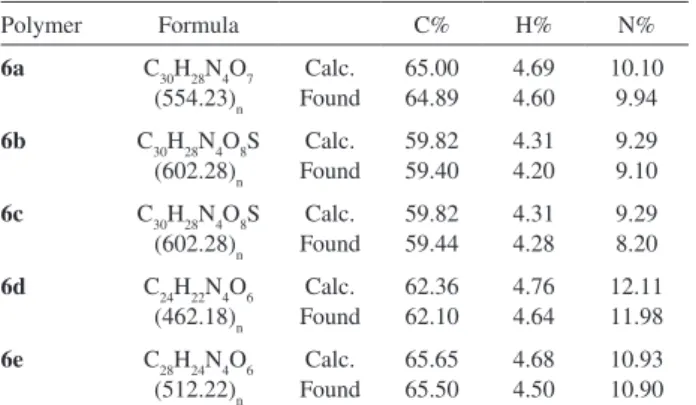
The elemental analyses of the resulting PAIs 6a-e were in good agreement with the calculated values for the proposed structure (Table 3).
The solubility of PAIs 6a-e was investigated by 0.01g of polymeric sample in 2.0 mL solvent. All of the polymers are soluble in organic solvents such as N,N-dimethyl acetamide (DMAc), N,N-dimethyl formamide (DMF), dimethyl sulfoxide (DMSO), NMP (N -methyl-2-pyrrolidone), sulfuric acid and are insoluble in solvents such as chloroform, methylene chloride, methanol, ethanol and water (Table 4).
Thermal properties
Table 2. FTIR Characterization of PAIs 6a-e
Polymer Spectra data
6a IR peaks (cm−1): 3202 (w), 2957 (m), 1776 (w), 1710 (s, br), 1604 (w), 1500 (s, sh), 1386 (m), 1305 (m), 1222 (m, sh), 1068 (m),
833 (w), 787 (w), 516 (w).
6b IR peaks (cm−1): 3254 (w), 2962 (w), 1774 (w), 1710 (s), 1664 (m, sh), 1591 (m), 1531 (m), 1479 (m), 1386 (m), 1305 (m), 1255 (w),
1188 (w), 1151 (m), 1107 (m), 839 (w), 790 (w), 721 (w), 690 (w).
6c IR peaks (cm−1): 3294 (w), 2876 (w), 1776 (w), 1709 (s, br), 1595 (m), 1535 (m), 1479 (m), 1384 (m), 1302 (m), 1244 (m), 1159 (m),
1149 (m), 995 (w), 784 (w), 746 (w).
6d IR peaks (cm−1):3344 (w), 2960 (m), 2872 (w), 1774 (w), 1707 (s, br), 1610 (w), 1516 (s), 1386 (m), 1307 (w), 1236 (w), 1192 (m), 853
(w), 790 (w).
6e IR peaks (cm−1): 3286 (w, br), 2982 (w, sh), 1774 (w), 1707 (s, br), 1601 (w), 1535 (m), 1496 (m), 1384 (m, sh), 1305 (w), 1197 (m),
1122 (w), 974 (w), 788 (m).
Figure 5. 1H NMR spectrum PAI 6d.
Table 3. Elemental analyses of PAIs 6a-e
Polymer Formula C% H% N%
6a C30H28N4O7
(554.23)n Calc. Found 65.00 64.89 4.69 4.60 10.10 9.94
6b C30H28N4O8S (602.28)n Calc. Found 59.82 59.40 4.31 4.20 9.29 9.10
6c C30H28N4O8S (602.28)n Calc. Found 59.82 59.44 4.31 4.28 9.29 8.20
6d C24H22N4O6
(462.18)n Calc. Found 62.36 62.10 4.76 4.64 12.11 11.98
6e C28H24N4O6
(512.22)n Calc. Found 65.65 65.50 4.68 4.50 10.93 10.90
Table 4. Solubility of PAIs 6a-e
Solvent 6a 6b 6c 6d 6e
H2SO4 + + + + +
DMAc + + + + +
DMSO + + + + +
DMF + + + + +
NMP + + + + +
MeOH − − − − −
EtOH − − − − −
CHCl3 − − − − −
CH2Cl2 − − − − −
H2O − − − − −
Soluble (+) and insoluble (−) at room temperature.
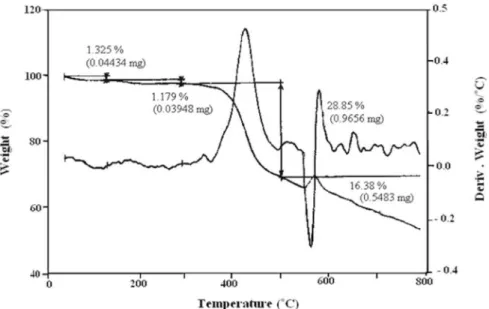
weight losses (T5 and T10) and the char yield at 600 °C are summarized in Table 5. These polymers exhibited good resistance to thermal decomposition up to 320 to 340 °C in nitrogen and began to decompose gradually above
that PAI 6c containing sulfone moiety has higher thermal stability in comparing to PAI 6a because this polymer has a rigid and polar moiety in the diamine structure such as sulfone moiety (Table 5).
Conclusions
A new series of PAIs 6a-e containing bicyclo[2,2,2] oct-7-ene-2,3,5,6-tetracarboxylic diimide were synthesized by direct polycondensation reaction of N,N´-(bicyclo[2,2,2] oct-7-ene-2,3,5,6-tetracarboxylic)bis-L-alanine 4 with various aromatic diamins 5a-e using triphenyl phosphite, NMP, calcium chloride and pyridine as condensing agents. The high char yields of these polymers showed that the introduction of bicyclo and aromatic rings into the polymer backbone increased the thermal stability and solubility in polar amidic solvents. Since these optically active polymers have amino acid in the polymer architecture and they are expected to be biodegradable. Optically active and thermal stability properties can make these polymers attractive for practical applications such as processable high-performance engineering plastics used as chiral stationary phase and chiral media for asymmetric synthesis.
Figure 6. TGA and DTG thermograme of PAI 6a.
Table 5. Thermal behavior of PAIs 6a and 6c
Polymer T5 (°C) a T 10 (°C)
b Char Yield c (%)
6a 320-330 345-355 58
6c 340-345 355-360 38
a,b Temperature at which 5% and 10% weight loss was recorded by TGA
at heating rate of 10 °C min−1 in N
2 respectively.
. c Percentage weight of
material left undecomposed after TGA analysis in 600°C.
References
1. Ghosh, M. K.; Mittal, K. L.; Polyimide: Fundamental and Applications, Dekker: New York, 1996.
2. Wilson, D.; Stenzenberger, H. D.; Hergenrother, P. M.; Polyimides, Chapman and Hall: New York, 1990.
3. Kripotou, S.; Pissis, P.; Sysel, P.; Sindelar, V.; Bershtein, V. A.; Polymer2006, 47, 357.
4. Liaw, D. J.; Chang, F. C.; Liu, J. H.; Wang, K. L.; Faghihi, K.; Huang, S. H.; Lee, K. R.; Lai, J. Y.; Polym. Degrad. Stab. 2007, 92, 323.
5. Williams, M. K.; Holland, D. B.; Melendez, O.; Weiser, E. S.; Brenner, J. R.; Nelson, G. L.; Polym. Degrad. Stab. 2005, 88, 20.
6. Maya, E. M.; Lozano, A. E.; Campa, J. G.; Abajo, J.; Macromol. Rapid Commun. 2004, 25, 592.
7. Yang, C. P.; Hsiao, S. H.; Wu, K. L.; Polymer2003, 44, 7067. 8. Hariharan, R.; Bhuvana, S.; Anitha, M. M.; Sarojadevi, M.;
J. Appl. Polym. Sci. 2004, 93, 1846.
9. Liaw, D. J.; Hsu, P. N.; Chen, W. H.; Lin, S. L.; Macromolecules
2002, 35, 4669.
10. Patil, P. S.; Pal, R. R.; Salunkhe, M. M.; Maldar, N. N.; Wadgaonkar, P. P.; Eur. Polym. J.2007, 43, 5047.
11. Liaw, D. J.; Huang, C. C.; Chen, W. H.; Polymer2006, 47, 2337. 12. Chang, Y. T.; Shu, C. F.; Macromolecules2003, 36, 661. 13. Liaw, D. J.; Chen, W. H.; Polym. Degrad. Stab. 2006, 91, 1731. 14. Faghihi, K.; Naghavi, H.; J. Appl. Polym. Sci. 2005, 96, 1776. 15. Faghihi, K.; Hajibeygi, M.; J. Appl. Polym. Sci. 2004, 92, 3447. 16. Faghihi, K.; Zamani, K.; Mirsamie, A.; Mallakpour, S.; J. Appl.
Polym. Sci. 2004, 91, 516.
17. Faghihi, K.; J. Appl. Polym. Sci. 2008, 109, 74.
19. Akekah, A.; Sherrington, D. S.; Chem. Rev. 1981, 81, 557. 20. Aglietto, M.; Chiellini, E.; Antone, S. D.; Ruggeri, G.; Solaro,
R.; Pure Appl. Chem. 1988, 60, 415.
21. Yuki, H.; Okamoto, Y.; Okamoto, I.; J. Am. Chem. Soc. 1980, 102, 6358.
22. Okamoto, Y. E.; Yashima, E.; Angew.Chem., Int. Ed. 1999, 37, 1020.
23. Soai, K.; Niwa, S.; Chem. Rev. 1992, 92, 833.
24. Subramanian, G.; Chiral Separation Techniques, Wiley: New York, USA, 2001.
25. Mallakpour, S. E.; Hajipour, A. R.; Zamanlou, M. R.; Eur. Polym. J. 2002, 38, 475.
26. Mallakpour, S. E.; Hajipour, A. R.; Zamanlou, M. R.; Polym. Sci., Ser. A2002, 44, 243.
27. Faghihi, K.; Macromol. Res. 2004, 12, 258.
28. Faghihi, K.; Zamani, K.; Mirsamie, A.; Mallakpour, S. E.; Polym. Int. 2004, 53, 1226.
29. Mallakpour, S.; Kowsari, E.; Polym. Bull. 2005, 53, 169.
Received: December 22, 2008