Article
0103 - 5053 $6.00+0.00*e-mail: [email protected]
Determination of L-aspartic Acid by using the Cu(II)-Catalyzed
Oscillating Reaction
Jinzhang Gao,*,a Dongyu Lv,a,b Houtan Sunc andWu Yanga
aChemistry & Chemical Engineering College, Northwest Normal University, Lanzhou 730070, P. R. China
bChemistry & Chemical Engineering College, Lanzhou University, Lanzhou 730000, P. R. China
cLanzhou General Hospital for PLA, Lanzhou 730070, P. R. China
Foi proposto um procedimento conveniente por meio de um sistema químico oscilante como uma ferramenta analítica para a determinação de ácido L-aspártico (L-Asp). O sistema envolve a reação entre peróxido de hidrogênio e tiocianato de sódio, catalizada por íons Cu(II) em meio alcalino. O método baseia-se na relação linear entre as mudanças no período de oscilação e o logarítmo da concentração de ácido L-aspártico. Condições otimizadas foram posteriormente validadas para garantir a coniabilidade do método. Sob condições otimizadas, o gráico de calibração é linear e proporcional à concentração do ácido L-aspártico no intervalo de 1,17 × 10⁻⁵ mol L−1 a 7,10 × 10⁻⁸ mol L−1 com um coeiciente de regressão linear de 0,9990 e
RSD de 2,75%. O limite de determinação (LOD) foi de 5,58 x 10⁻⁸ mol L-1. O método proposto
foi empregado na determinação do ácido L-aspártico em amostras de medicamentos. Além disto, a técnica HPLC foi empregada para conirmar os resultados.
A convenient procedure by means of oscillating chemical system as an analytical tool to determine the L-aspartic acid (L-Asp) is proposed. The system involves the Cu(II)-catalyzed reaction between hydrogen peroxide and sodium thiocyanate in an alkaline medium. The method relies on the linear relationship between the changes in the oscillation period and the logarithm of concentration of L-aspartic acid. Optimized conditions were further validated to ensure the reliability of the method. Under optimum conditions, the calibration plot is linearly proportional to the concentration of L-aspartic acid over the range from 1.17 × 10⁻⁵ mol L−1 to
7.10 × 10⁻⁸ mol L−1 with a corresponding regression coeficient of 0.9990 (RSD 2.75%). A lower
limit of determination (LOD) was 5.58 × 10⁻⁸ mol L−1. The proposed method has been used to
determine L-aspartic acid in drug sample. Additionally, the HPLC technique was also used to conirm the determination results.
Keywords: oscillating chemical reaction, analyte pulse perturbation technique, L-aspartic acid, drug sample
Introduction
In the biochemical process the well-known Krebs cycle illustrated the conversion of various compounds and the transformation of energy, for example, L-aspartic acid (L-Asp) can be converted into α-ketoglutaric acid to enter this cycle. In clinic, L-Asp is necessary for the treatment of heart disease, hepatopathy, and hypertension; it can also help people providing and recovering from fatigue. Thereby, a rapid and convenient determination method is required in many ields. At present, some methods have been reported
for the determination of L-Asp such as ion exchange chromatography,1 high-performance liquid chromatography
(HPLC)2 and capillary electrophoresis (CE) coupled with
low injection (FI).3 Although these methods have higher
sensitivity and good selectivity, generally, the pre-treatment of column is not easy to be done.
Compared to these methods, the application of oscillating chemical reaction for the determination of trace amounts of substances has gained interest from many analysts4-5 because of its simplicity, largely linear
range (ca. 10−7 - 10−3 mol L−1), and lower detection limit
(ca. 10−8 - 10−6 mol L−1). The use of oscillating chemical
two oscillators. One is the most widely studied and used B-Z oscillating reaction, particularly, the Ce(IV)-catalyzed reaction between malonic acid and potassium bromate in acidic medium. The early FKN mechanism6 and a recently
theoretical analysis by Taylor7 impel the study to the deep
progress. Another is the Cu(II)-catalyzed reaction between hydrogen peroxide and sodium thiocyanate in the alkaline medium, which has developed by Orban et al.8-9 A lot of
papers concerning the determination of organic10-14 and
inorganic substances15-22 have also been published.
In general, the response of a regular oscillating system (such as its induction period, oscillating amplitude or oscillating period) to the perturbation from the surroundings relies on the interaction between the sample and the oscillating-system substrates. The stronger the response is, the higher sensitivity. For the purpose of analytical determination, the response of the system without analyte (i.e., a stable regular oscillating proile) is deined as a baseline just like common instrumental analysis; and then, the sample was added into the stable regular oscillating system to perturb it. The response-change relative to baseline (i.e., the stable regular oscillating proile) was recorded to calculate the quantity of analyte. This is the basic principle of analytical determination in oscillating reaction.
In this work, adding a few of L-Asp into the Cu(II)-catalyzed oscillating reaction between hydrogen peroxide and sodium thiocyanate in alkaline medium which was implemented in a closed system, causes a change in oscillation period. Such a response implied that the L-Asp has reacted with some of components in this system. The change of oscillation period is correlated with the amount of adding L-Asp. The purpose of this work is to broaden the scope of application in the Cu(II)-catalyzed oscillating chemical reaction. The most salient advantage of this proposed method is very rapid and convenient for determination. Moreover, its good reproducibility, sensitivity and precision have also been accepted.
Experimental
Reagents
All chemicals used were of analytical-reagent grade and doubly distilled-deionized water was used throughout. Stock solution of 1.40 mol L−1 H
2O2 was made freshly
just prior to use, and was standardized with the standard KMnO4 solution. The stock solution was kept in a black polyethylene bottles and stored in refrigerator at 5 °C to avoid decomposition. Solution of 0.0750 mol L−1 sodium
thiocyanate was prepared by dissolving the appropriate
amount of NaSCN in 0.310 mol L−1 sodium hydroxide
solution. The 0.310 mol L−1 NaOH solution was checked by
the acid-base titration method. Copper sulfate stock solution (1.80 × 10⁻³ mol L−1) in 1.20 mol L−1 NaCl solution was
also made. Solution of 0.01 mol L−1 L-aspartic acid was
prepared using biochemical reagent dissolved in doubly distilled-deionized water and stored in refrigerator.
Apparatus
The oscillating assembly consists of a 50 mL glass reaction vessel itted with a thermostated jacket connected to a Model CS 501 thermostat (Shanghai Experimental Instrumental Factory, China), with an accuracy ± 0.1 K. A Model ML-902 magnetic stirrer was used for homogenization (Shanghai Pujiang Analytical Instrumental Factory, China). The oscillation was monitored by means of two platinum electrodes (Rex, 213, China), and an Hg | Hg2SO4 | K2SO4 reference (Rex, 217, China), which were directly connected to an electrochemical instrument (Shanghai Chenhua CHI 832, China) with a potential measurement error ± 0.1 mV. Signals were recorded as a function of time at intervals of 0.1 s. A micro-injector was used for adding different amounts of sample solution.
Chromatograms were recorded on a SHIMADZU LC-16A high-performance liquid chromatographic instrument (Shimadzu, Japan) equipped with a SPD-16A UV spectrophotometric detector and a CR-3A data processor.
Procedure
The following procedure was used in all experiments for determination of L-Asp: A 23.5 mL of Cu(II) catalyzed reaction mixture solution was consisted of 2.50 mL of 1.80 × 10⁻³ mol L−1 CuSO
4 (prepared by using 1.20 mol L
−1
NaCl), 7.00 mL of 7.50 × 10⁻² mol L−1 NaSCN (prepared by
using 0.310 mol L−1 NaOH), and 3.00 mL of 1.40 mol L−1
Results and Discussion
The copper sulfate-catalyzed oscillating reaction of hydrogen peroxide with sodium thiocyanate is the most representative example of an oscillating system involving no halogen compounds. This oscillating system has a high potential for analytical determination, owing to the different responses to sample perturbation exhibited by this oscillation.4 In this work, adding a trace amount of L-Asp
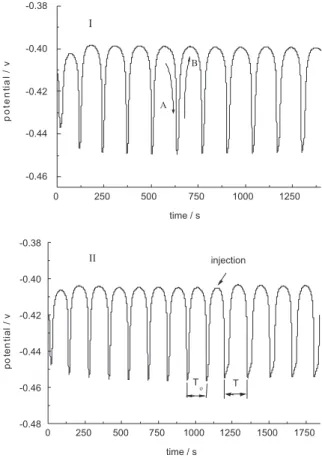
can perturb the oscillating proile, implying that the L-Asp has reacted with some of components in oscillating system. Figure 1 shows typical oscillation proiles for the proposed system in the absence (I) and presence (II) of L-aspartic acid. As mentioned above, the position of adding sample was chosen at the highest point of oscillating proile, and repeated again to ensure the reproducibility. The result perturbed is that the period is increased and its change is relative to the amount of L-Asp injected.
Firstly, we deined To and T as the periods before and after perturbing, respectively. Then, the values of ∆T can be expressed as follow:
∆T = T − To
Inluence of experimental variables
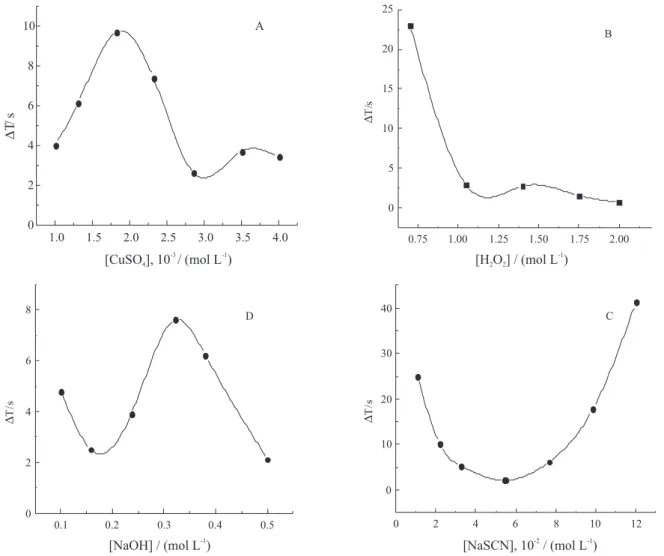
To obtain a stable regular oscillating system for determining L-Asp with higher sensitivity and accurate, the effects of various variables on the behavior of the oscillating system were tested thoroughly. The effect of hydrogen peroxide concentration was studied in the range of 0.75-3.0 mol L−1. With increasing the concentration, the
period would be decreased, the induction time become shorter and eventually disappeared. When the concentration of hydrogen peroxide increased from 2.0 mol L−1 to 3.0 mol L−1,
the oscillation profile was drifted up obviously. If the sodium thiocyanate concentrations were changed from 0.01 to 0.12 mol L−1, the period would be lengthened. The
NaOH concentration and pH have strong effects on the oscillating reaction, which were studied over the range of 0.1 - 0.5 mol L−1, in which the oscillation amplitude and
period increased with the increase of NaOH concentration. The inluence of the Cu(II) concentration was also examined, it can be seen that an increase of Cu(II) in the range of 1.0 × 10⁻³ mol L-1 - 4.0 × 10⁻³ mol L−1 would cause a decrease
in the oscillation period while the amplitude has not changed. Adding L-Asp to the regular oscillating system to ensure that the highest sensitivity and precision were obtained. For ease of representation, we use the change of oscillation period (∆T) as a reference standard to analyze the variables on the determination of L-Asp. Results are given in Figure 2 and Table 1.
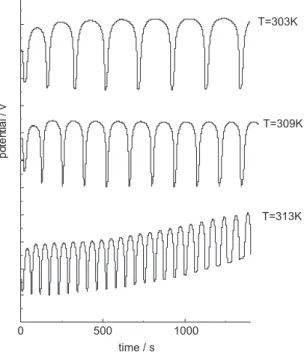
The inluence of temperature was also investigated over the range of 303-313 K. It is clear that with increasing the temperature the frequency becomes quicker and eventually the proile drifts up (see Figure 3). For the purpose of determination, the optimal temperature of 309 K was chosen.
Sodium chloride was used to keep a moderate ionic strength of oscillating system and to avoid passivation of the Pt electrode23. Thus, 1.20 mol L−1 of NaCl was
adopted in this work.
Determination of L-aspartic acid
Under the optimum conditions, a stable regular oscillating proile was obtained and could be lasting for 2000 s. That is to say, the determination of L-Asp would begin. All data were recorded by personal computer. A plot of ∆T against the amounts of L-Asp in the range of 7.10 × 10⁻⁸ - 1.17 × 10⁻⁵ mol L−1 was made (in Figure 4) that was
itted to the following linear regression equation very well:
∆T (s) = (2.94 ± 0.04) logCL-Asp + (27.6 ± 0.2) (r = 0.9995; n = 14; RSD = 2.75% )
Figure 1. Typical oscillation proiles obtained in the absence (I) and presence (II) of 8.50 × 10⁻⁷ mol L−1 of L-aspartic acid under the optimum
It is known that oscillating chemical reactions are very sensitive to the foreign species both ion and molecule. We therefore investigated effects of some common inorganic ions and organic compounds on the determination of L-Asp. Tolerance levels (deined as the maximum amount of foreign species causing an error lower than ± 5% (RSD) in the determination of 8.50 × 10⁻⁷ mol L−1 L-Asp) are
shown in Table 2. Generally, inorganic ions and some organic compounds with small molecular weight have little inluence on the determination.
Table 1. Optimum conditions of the L-aspartic acid determination
Variables CuSO4 / mol L−1
H2O2 / mol L−1
NaSCN / mol L−1
NaOH / mol L−1
T/K
Selected value
1.80 × 10⁻³ 1.40 0.0750 0.310 309
Table 2. Inluence of foreign species on the determination of L-aspartic acid
Foreign species Tolerated ratio
(foreign/ L-aspartic acid) Zn2+, Mn2+, Ca2+, Ni2+
NO3−, Cl−, Br −, I−
Threonine Lysine, Cysteine L-Glutemic acid, Glycin
2000 800 100 20 10
Figure 2. Inluence of the concentrations of CuSO4 (A), H2O2 (B), NaSCN (C) and NaOH (D) on the L-aspartic acid pertubed oscillating period change. Experimental conditions: T = 309K, [L-Asp] = 5.60 × 10⁻⁶ mol L−1; (A) 1.40mol L−1 H
2O2, 7.65 × 10
−2 mol L−1 NaSCN, 1.20 mol L−1 NaCl, 0.310 mol L−1
NaOH; (B) 1.80 × 10⁻³ mol L−1 CuSO
4, 7.65 × 10
−2 mol L−1 NaSCN, 1.20 mol L−1 NaCl, 0.310 mol L−1 NaOH; (C) 1.80 × 10⁻³ mol L−1 CuSO
4, 1.40mol L
−1
H2O2, 1.20 mol L−1 NaCl, 0.310 mol L−1 NaOH; (D) 1.80 × 10⁻³ mol L−1 CuSO
4, 1.40 mol L
−1 H
2O2, 7.65 × 10
−2 mol L−1 NaSCN, 1.20 mol L−1 NaCl.
Perturbation of L-aspartic to the oscillating system
The copper(II)-catalyzed oscillating reaction between hydrogen peroxide and sodium thiocyanate has been widely studied by Orban8 in 1986 and Luo24 in 1988 proposing that the
mechanism for this oscillating reaction consists of 30 kinetic steps involving 26 independent variables.4 The centerpiece of
Figure 3. Inluence of temperature on the oscillating proile. Other Experimental conditions are as same as the Figure 2 used.
Figure 4. Calibration curve of the ∆T in period versus the logarithm of L-Asp concentration.
Intermediate OS(O)CN−is produced very slowly in the following reaction:
2OOS(O)CN− + OH− OS(O)CN− + SO
4
2−+ HOCN
and it initially has a very low concentration. It is generated auto-catalytically through the formation and reduction of the radical OS(O)CN•, when the concentration of OS(O)CN−and Cu+[SCN−]
n become high enough to make this pathway
signii-cant. The Cu+ is simultaneously oxidized to Cu2+, and the
yel-low superoxy complex is produced almost immediately. The sharp increase in color stops when most of the Cu+ has been
consumed. The amino in the L-aspartic acid molecule may be oxidized by peroxohypothiocyanate ion (OS(O)CN−), which may delay both the positive and negative feedback loop, this may prolong the survival of the yellow superoxide-complex and increase the oscillating period as observed in practice.
Determination of L-aspartic acid in pharmaceutical
We assessed the potential of the proposed method for determining L-Asp in three samples that produced by different pharmaceutical company. 100 µL of sample solution was diluted to 100 mL with distilled-deionized water. To test the accuracy of the proposed procedure, we employed HPLC method to determine the content of L-Asp in the same pharmaceutical samples. Each real sample was analyzed for 8 times in parallel and the results are listed in Table 3.
Conclusions
A simple and convenient method for the determination of L-Asp without pretreatment was developed. Compared with other analytical instruments, the set-up used in Table 3. Determination of L-aspartic acid by using different methods for pharmaceutical samples
Method Sample Average found/
mg cm−3
% RSD
labelled amount /mg cm−3
Present method 1 79∼91 81.9 2.52
2 85.0 83.9 2.41
3 45.1 46.1 2.59
HPLC 1 79∼91 82.0 1.49
2 85.0 84.5 1.51
3 45.1 45.7 1.55
Notes:1-Potassium aspartate and magnesium aspartate injection (Shandong Chenxin Pharmaceutical Co. Ltd, China). 2-Potassium aspartate and magnesium aspartate injection, (Chengdu Tiantaishan Pharmaceutical Co. Ltd, China). 3-Potassium magnesium aspartate oral solution, (Suzhou Changzheng-Xinkai Pharmaceutical Co. Ltd, China). on which the autocatalytic process relies. Thus, the positive
feedback loop produces the yellow superoxide-copper(I) complex [HO2-Cu(I)] that governs the rate of the process:
OS(O)CN− + OOS(O)CN− + H
2O 2OS(O)CN• + 2OH
−
OS(O)CN• + Cu+[SCN]
n OS(O)CN
− + Cu2++ nSCN−
H2O2 + Cu2+ + OH− HO
2-Cu(I) + H2O
which disappears in the negative feedback loop:
HO2-Cu(I) + nSCN− Cu+[SCN−]
n + HO2•
OS(O)CN− + HO
2• SO3•
− + HOCN
SO3•− + Cu+[SCN−]
n SO3
2−+ Cu2+ + nSCN−
the proposed method is rather cheap in price. However, the sensitivity and reproducibility are very well. It can offer a linear range of 7.10 × 10⁻⁸ - 1.17 × 10⁻⁵ mol L−1
(RSD 2.75%), with a lower limit of detection (LOD) of 5.58 × 10⁻⁸ mol L−1. Simple set-up, convenient operation
would be easy received by clinic analysis.
Acknowledgements
This work was supported in part by the Project of International Cooperation between China and Ukraine (043-05), the National Natural Science Foundation (20873101) and the Invention Project of Science & Technology of NWNU (KJCXGC-01).
References
1. Ding,Y. S.; Yu, H.; Mou, S.; J. Chromatogr., A2002, 982, 237. 2. Naval, M. V.; Gómez-Serranillos, M. P.; Carretero, M. E.;
De Arce, C.; J. Chromatogr., A 2006, 1121, 242.
3. Cheng,Y. Q.; Fan, L.Y.; Chen, H. L.; Chen, X. G.; Hu, Z. D.;
J. Chromatogr., A 2005, 1072, 259.
4. Jimenez-Prieto, R.; Silva, M.; Perez-Bendito, D.; Analyst 1998,
123, 1R.
5. Gao, J.Z.; Pak. J. Biol. Sci.2005, 8, 512.
6. Field, R. J.; Schneider, F. W.; J. Chem. Educ.1989, 66, 195. 7. Taylor, A. F.; Prog. React. Kinet. Mech. 2002, 27, 247. 8. Orban, M.; J. Am. Chem. Soc. 1986, 108, 6893.
9. Luo, Y.; Orban, M.; Kustin, K.; J. Am. Chem. Soc.1989, 111, 4541.
10. Jimenez-Prieto, R.; Silva, M.; Perez-Bendito, D.; Analyst 1997,
122, 287.
11. Toledo, R.; Silva, M.; Khavrus, V. O.; Strizhak, P. E.; Analyst
2000, 125, 2118.
12. Gao, J. Z.; Yang, H.; Liu, X. H.; Ren, J.; Li, Q. Z.; Kang, J. W.;
Talanta2002, 57, 105.
13. Gao, J. Z.; Sun, K. J.; Yang, W.; Yang, F. W.; Zhao, G. H.;
Pak. J. Biol. Sci.2004, 7, 1721.
14. Raoof, J. B.; Ojani, R.; Kiani, A.; Khosravi, M.; Adnani, A.;
Bull. Chem. Soc. Jpn.2005, 78, 258.
15. Strizhak, P. E.; Khavrus, V. O.; Talanta2000, 51, 935. 16. Liu, X. H.; Yang, H.; Gao, J. Z.; Ma, Y. J.; Lu, X. Q.; J. Anal.
Chem.2001, 29, 1318.
17. Strizhak, P. E.; Didenko, O. Z.; Ivashchenko, T. S.; Anal. Chim. Acta2001, 428, 15.
18. Yang, B.; An, C. J.; Zheng, D.; Ding, Z. Z.; J. Inorg. Chem.
2002, 18, 874.
19. Ojani, R.; Raoof, J.; Mahdavi, F.; Bull. Chem. Soc. 2003, 76, 2117.
20. Raoof, J.; Ojani, R.; Kiani, A.; Anal. Sci.2004, 20, 883. 21. Gao, J. Z.; Wang, L.; Yang, W.; Yang, F. W.; J. Braz. Chem.
Soc. 2006, 17, 458.
22. Gao, J.Z.; Chen, H.; Dai, H. X.; Lv, D.Y.; Ren, J.; Wang, L.; Yang, W.; Anal. Chim. Acta 2006, 571, 150.
23. Jimenez-Prieto, R.; Silva, M.; Perez-Bendito, D. Anal. Chem.
1995, 67, 729.
24. Luo, Y.; Kustin, K.; Epstein, I. R.; Inorg. Chem. 1988, 27, 2489.
Received: August 5, 2008