From the Children’s Institute, Hospital das Clínicas, Faculty of Medicine, University of São Paulo – São Paulo/SP, Brazil. E-mail: [email protected]
Received for publication on November 14, 2003.
ORIGINAL RESEARCH
INFLUENCE OF NEPHROTIC STATE ON THE
INFECTIOUS PROFILE IN CHILDHOOD IDIOPATHIC
NEPHROTIC SYNDROME
Emilia Maria Dantas Soeiro, Vera Hermina Koch, Maria Danisi Fujimura and Yassuhiko Okay
SOEIRO EMD et al. Influence of nephrotic state on the infectious profile in childhood idiopathic nephrotic syndrome. Rev. Hosp. Clín. Fac. Med. S. Paulo 59(5):273-278, 2004.
Patients with idiopathic nephrotic syndrome present alterations in their cellular and humoral immune reactions that predispose them to the development of infectious processes.
PURPOSE: To characterize the infectious processes in patients with idiopathic nephrotic syndrome.
PATIENTS AND METHODS: Ninety-two children and adolescents with idiopathic nephrotic syndrome were assessed retrospectively. The types of infection were grouped as follows: upper respiratory tract infections; pneumonia; skin infections; peritonitis; diarrhea; urinary tract infection ; herpes virus; and others. The patients were divided into 2 groups: Group I (steroid-responsive) n = 75, with 4 subgroups–IA (single episode) n = 10, IB (infrequent relapsers) n = 5, IC (frequent relapsers) n = 14, and ID (steroid-dependent) n = 46; and Group II (steroid-resistant) n = 17. The incidence-density of infection among the patients was assessed throughout the follow-up period. Comparisons for each group and subgroup were done during the periods of negative and nephrotic proteinuria.
RESULTS: The analysis revealed a greater incidence-density of infections during the period of nephrotic proteinuria in all the groups and subgroups, with the exception of subgroup IA. During the period of nephrotic proteinuria, subgroups IC, ID, and Group II presented a greater incidence-density of infections as compared to subgroup IA. For the period of negative proteinuria, there was no difference in the incidence-density of infections between the groups and subgroups. Upper respiratory tract infections were the most frequent infectious processes.
CONCLUSION: The nephrotic condition, whether as part of a course of frequent relapses, steroid dependence, or steroid resistance, conferred greater susceptibility to infection among the patients with idiopathic nephrotic syndrome. The results of this study suggest that the best preventive action against infection in this disease is to control the nephrotic state.
KEY WORDS: Nephrotic syndrome. Infection. Children. Adolescent.
It has long been recognized that an immunogenic stimulus can trigger idi-opathic nephrotic syndrome or cause recurrence of the disease.1,2
Abnormali-ties in the functions of the T lymphocytes and in particular the sup-pressor T lymphocytes and the genera-tion of circulating factors capable of altering the glomerular permeability to proteins seem to be involved in the pathogenesis of the disease.3 The
in-fectious episodes result from a group
of alterations that synergically in-crease the patients’ susceptibility to infections. These alterations are low serum levels of immunoglobulins, par-ticularly IgG, due fundamentally to low production and to a lesser extent
to catabolism and renal losses; defect in the opsonization of bacteria; and immunosuppressive therapy.4,5
Infectious episodes in nephrotic patients are responsible for high mor-bidity and can also cause an inad-equate response to corticosteroid therapy and recurrences among pa-tients in remission.6 Determining the
Consequently, the objective of this work was to clarify whether the neph-rotic state does in fact increase suscep-tibility of the patients to infections and, if so, to characterize the types of infections that occur in these patients.
PATIENTS AND METHODS
A retrospective analysis was done on the hospital records of 92 patients with idiopathic nephrotic syndrome who attended from January 1985 to December 1998. Each patient was evaluated throughout the follow-up in terms of period (in months) of remis-sion with negative proteinuria and of nephrotic decompensation. For char-acterization of nephrotic proteinuria, the qualitative test with 10% trichlo-roacetic acid was used. Negative pro-teinuria was considered to be when there was no alteration in the color of the urine. Proteinuria +++ and ++++ were considered to be a nephrotic level for comparison with the quantitative tests.8 Eighty-eight patients used
pred-nisone, at an initial dose of 2 mg/kg/ day, for 4 to 6 weeks, then on alternate days, at the same dose, for a further 8 weeks. After that period, the dose was reduced by 0.5 mg/kg, every 15 days, until suspension of the drug. The re-maining 4 patients were steroid-resist-ant cases referred from other services for whom other immunosuppressive agents were used at the initiation of follow-up.
Fifty-two patients, including those who were steroid-resistant, steroid-de-pendent, or frequent relapsers, were administered cyclophosphamide at a dose of 75 mg/m²/day for 8 weeks in association with prednisone. Eight pa-tients that did not respond to cyclo-phosphamide received chlorambucil at a dose of 0.1 mg/kg/day for 10 weeks. Nine steroid-resistant patients received cyclosporine A at a dose of 4 mg/kg/ day every 12 hours, initially
associ-ated with prednisone. Five steroid-re-sistant patients were treated with cy-clophosphamide pulse therapy and methylprednisolone, associated with prednisone, according to the protocol of Tune and Mendonza.9 The patients
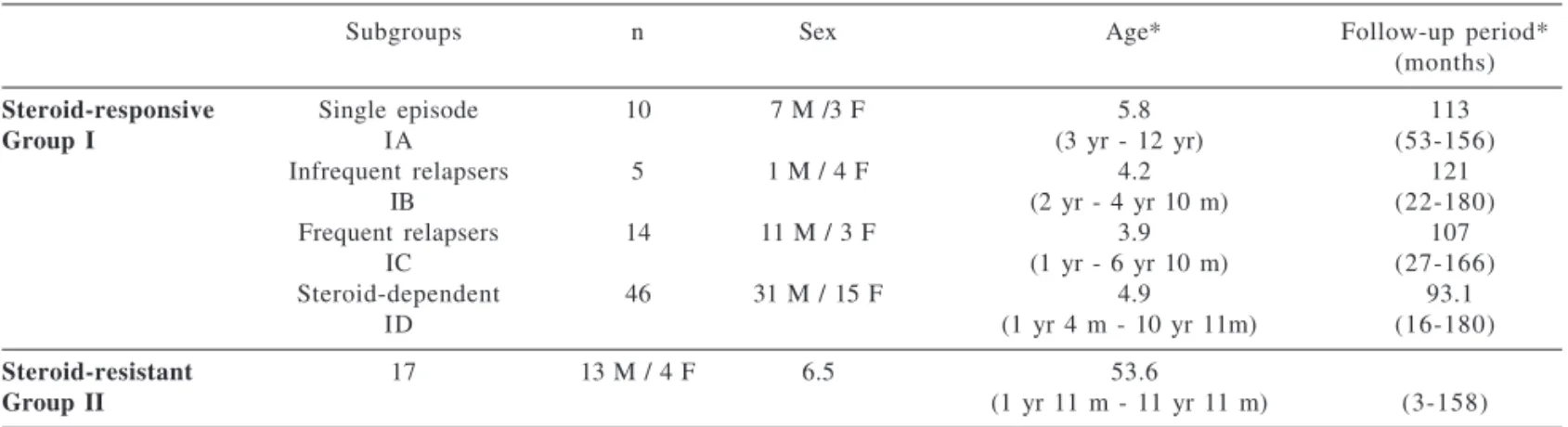
were divided into 2 groups according to their initial response to the steroid therapy: Group I (steroid-responsive– resolution of the proteinuria during the first 4 weeks of continuous daily treat-ment with prednisone) and Group II (steroid-resistant–no response to the continuous daily treatment with pred-nisone for 6 weeks). Group I was fur-ther divided into 4 subgroups: IA (sin-gle episode–without recurrences), IB (infrequent relapsers–less than 2 recur-rences in the 6 months after the initial response), IC (frequent relapsers–2 or more recurrences in the 6 months after the initial response), and ID (steroid-dependent–recurrence during the gradual withdrawal of prednisone or 15 days after its suspension). The in-cidence-density of infections was compared (number of infections/100 patients/month) in the total sample and for each of the groups and sub-groups10 in the both the period with
negative proteinuria and the period with nephrotic proteinuria.The infec-tions were identified and classified into: URTI (upper respiratory tract in-fections–cold, sinusitis, otitis, tonsil-litis, laryngitis); pneumonia; cutane-ous infections (impetigo, cellulitis, and skin abscess); peritonitis; diarrhea; UTI (urinary tract infections); herpes virus (gingival stomatitis, labial herpes, herpes zoster, and chickenpox); and others (mumps, conjunctivitis, hepatitis, onychomycosis, septicemia, and osteomyelitis). The diagnoses of the infections were made according to clinical criteria and in some patients through laboratory exams. Blood cul-tures were performed in cases of peri-tonitis and septicemia. The diagnosis of UTI was defined with quantitative urine culture. The z score was used to
analyze the differences between the means of groups and sub-groups.11,12
The null hypothesis was rejected at the 5% confidence limit.
RESULTS
negative proteinuria is shown in Table 2. Only Subgroup IA failed to show a significant reduction in the number of infections. The comparison of the in-cidence-density of infections between groups and subgroups in the period with nephrotic proteinuria is shown in Table 3. Subgroups IC, ID, and Group
II, presented the highest incidence-density of infections when compared to Subgroup IA. The other compari-sons did not show a statistically sig-nificant difference. The comparison of the incidence-density of infections be-tween the groups and subgroups dur-ing the period with negative
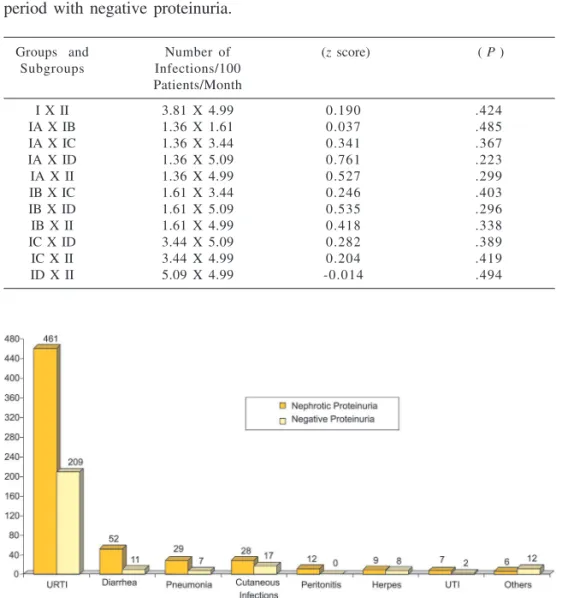
proteinu-ria is shown in Table 4. There was no statistically significant difference in the comparison of the incidence-den-sity of infections between the groups and subgroups throughout this period.
DISCUSSION
Infections in patients with neph-rotic syndrome have been described as hallmarks of idiopathic nephrotic syn-drome (INS).4 In the past, many
chil-dren with nephrotic syndrome died from bacterial infections and particu-larly from peritonitis due to pneumo-cocci.13 With the advent of antibiotic
therapy and corticotherapy in the last 50 years, much progress has been achieved, with a dramatic reduction in the mortality.14 Despite the
improve-ment in the morbidity rates and mor-tality in INS following the introduc-tion of corticotherapy and other immunosuppressants, it is still neces-sary to keep in mind that these agents can also predispose patients to infec-tious processes.14,15 Even so, the use of
these drugs serves to maintain the pa-tients free from recurrences and to con-trol proteinuria for prolonged peri-ods.15 This study showed a greater
den-sity of infections during the period with nephrotic proteinuria. The com-parative analysis between the 2 groups and subgroups during this period
re-Table 1 - Characteristics of the 92 patients in relation to type of response to steroid therapy, sex, age, and period of follow-up.
Subgroups n Sex Age* Follow-up period*
(months)
Steroid-responsive Single episode 10 7 M /3 F 5.8 113
Group I IA (3 yr - 12 yr) (53-156)
Infrequent relapsers 5 1 M / 4 F 4.2 121
IB (2 yr - 4 yr 10 m) (22-180)
Frequent relapsers 14 11 M / 3 F 3.9 107
IC (1 yr - 6 yr 10 m) (27-166)
Steroid-dependent 46 31 M / 15 F 4.9 93.1
ID (1 yr 4 m - 10 yr 11m) (16-180)
Steroid-resistant 17 13 M / 4 F 6.5 53.6
Group II (1 yr 11 m - 11 yr 11 m) (3-158)
n = number of patients; * = data given as mean and range
Table 2 - Comparison of the incidence-density of infections (number of infections/ 100 patients/month) during the periods with nephrotic proteinuria and with negative proteinuria.
Groups and Nephrotic Negative (z score) (P)
Subgroups Proteinuria Proteinuria
I 55.26 3.81 -8.365 <.001*
IA 15.79 1.36 -1.192 .117
IB 42.86 1.61 -1.806 .035*
IC 53.40 3.44 -3.520 <.001*
ID 57.48 5.09 -6.569 <.001*
II 45.49 4.99 -3.021 .001*
* Statistic significance
Table 3 - Comparison of the number of infections/100 patients/month, during the period with nephrotic proteinuria.
Groups and Number of (z score) ( P )
Subgroups Infections/100 Patients/Month
I X II 55.26 X 45.49 -0.731 .232
IA X IB 15.79 X 42.86 1.085 .139
IA X IC 15.79 X 53.40 2.134 .016*
IA X ID 15.79 X 57.48 3.056 .001*
IA X II 15.79 X 45.49 1.779 .038*
IB X IC 42.86 X 53.40 0.408 .342
IB X ID 42.86 X 57.48 0.628 .265
IB X II 42.86 X 45.49 0.104 .458
IC X ID 53.40 X 57.48 0.269 .394
IC X II 53.40 X 45.49 -0.440 .330
vealed higher densities of infections in the subgroups comprising frequent relapsers (IC), corticodependent (ID), and corticoresistant patients (Group II), relative to Subgroup IA (patients presenting a single nephrotic episode), a finding that is similar to the findings of Gulati et al.7 The International
Study of Kidney Disease in Children has suggested that the greater vulner-ability to infections and resistance to corticosteroids could have a common biological origin.15 A recent study by
Moorani et al.16 points to URTI,
cellulites, diarrhea, UTI, and peritoni-tis as the most frequent infections and
that the majority are associated with decompensation of the disease. In the various published results, the type of infection is variable. The comparison of our results with other studies is somewhat difficult, since our sample is predominantly comprised of outpa-tients.
Upper respiratory tract infections were the most frequent infectious proc-esses in all of the groups and sub-groups during both periods. There is evidence that multiple factors have favored a higher occurrence of respi-ratory infections in the last 30 years.17
In the city of São Paulo, a rate of 11.8
episodes of respiratory infections can be expected per child/year among chil-dren of up to 5 years of age.18
The onset of nephrotic syndrome or recurrence of the disease can be as-sociated with a nonspecific infection that affects the child. Studies have re-ported that the decompensation of the nephrotic syndrome is related to viral infections of the upper airways and that there is a causal relationship, in that the altered response to infection could be the triggering factor for the disease.6
We found 12 peritonitis episodes in 7 patients, all with nephrotic pro-teinuria. The predominant pathogen was Streptococcus pneumoniae.
Pneumococcal infections in chil-dren with nephrotic syndrome are the most common invasive bacterial infec-tions. Since 1985, the use of pneumo-coccal polysaccharide vaccine has been recommended for those children at greater risk of developing strepto-coccal infections. However, the effec-tiveness of this preventive measure is limited.19,20 Recently, the response to
conjugated pneumococcal vaccine in patients with nephrotic syndrome has been studied, but the results are still under evaluation.20
This is the first study in Brazil that evaluates the profile of infections in children and adolescents with neph-rotic syndrome. It is possible that knowledge of the etiological profile of the infections in patients with INS could lead to the introduction of new vaccines for the routine care of these patients, seeking to minimize avoid-able infectious processes. Nevertheless the chief conclusion of this study is that the best preventive measure for control of the infectious processes in INS continues to be resolution of the proteinuria.
Table 4 - Comparison of the number of infections/100 patients/month, during the period with negative proteinuria.
Groups and Number of (z score) ( P )
Subgroups Infections/100 Patients/Month
I X II 3.81 X 4.99 0.190 .424
IA X IB 1.36 X 1.61 0.037 .485
IA X IC 1.36 X 3.44 0.341 .367
IA X ID 1.36 X 5.09 0.761 .223
IA X II 1.36 X 4.99 0.527 .299
IB X IC 1.61 X 3.44 0.246 .403
IB X ID 1.61 X 5.09 0.535 .296
IB X II 1.61 X 4.99 0.418 .338
IC X ID 3.44 X 5.09 0.282 .389
IC X II 3.44 X 4.99 0.204 .419
ID X II 5.09 X 4.99 -0.014 .494
RESUMO
SOEIRO EMD e col. Pacientes com síndrome nefrótica idiopática apresentam alterações na imuni-dade celular e humoral que predis-põem a processos infecciosos. Rev. Hosp. Clín. Fac. Med. S. Paulo 59(5):273-278, 2004.
OBJETIVO: Caracterizar as
infec-ções, em pacientes com Síndrome Nefrótica Idiopática .
PACIENTES E MÉTODOS:
Fo-ram analisados, os prontuários de 92 crianças e adolescentes com Síndrome Nefrótica Idiopática . Os tipos de infec-ções foram agrupados em: Infecinfec-ções de Vias Aéreas Superiores , Pnemonia, In-fecções Cutâneas, Peritonite, Diarréia, Infecção do Trato Urinário, Herpes Ví-rus e Outros. Os pacientes foram divi-didos, em dois grupos: Grupo I
(córtico-sensíveis)-n=75, com quatro subgrupos; IA (episódio único)-n=10; IB (recidivantes infreqüentes)-n=5; IC (recidivantes freqüentes)-n=14 e ID (córtico-dependentes) n=46; e Grupo II (córtico-resistentes)-n=17. Comparou-se a densidade de incidência de infecções nos períodos com proteinúria negativa e nefrótica. No período com proteinúria nefrótica, comparou-se a densidade de incidência de infecções dos grupos e subgrupos entre si. Da mesma forma, no período com proteinúria negativa.
RESULTADO: A análise revelou
maior densidade de incidência de in-fecções, no período com proteinúria nefrótica, em todos os grupos e sub-grupos, com exceção do subgrupo IA. No período com proteinúria nefrótica, os subgrupos IC, ID e o grupo II, apre-sentaram maior densidade de
incidên-cia de infecções, quando comparados ao subgrupo IA. No período com proteinúria negativa, não houve dife-rença na densidade de incidência de infecções entre os grupos e subgrupos. As Infecções de Vias Aéreas Superiores foram os processos infecciosos mais freqüentes.
CONCLUSÃO: O estado nefrótico,
manifesto através de recidivas freqüen-tes, dependência ou resistência aos corticosteróides, conferiu ao pacientes com Síndrome Nefrótica Idiopática , maior susceptibilidade à infecções. O resultado deste estudo reforça que a melhor prevenção anti-infecciosa nesta doença é o controle do estado nefrótico.
UNITERMOS: Síndrome Nefró-tica. Infecção. Criança. Adolescência.
REFERENCES
1 . Shalhoub RJ. Pathogenesis of lipoid nephrosis: a disorder of T-cell function. Lancet.1974;2:556-60.
2 . Michael AF, Mclean HR, Roy LP,Westberg NG,Hoyer JR, Fish AJ, et al. Immunologic aspects of the nephrotic syndrome. Kidney Int. 1973;3:105-15.
3 . Eduardo HG. Effect of lipoid nephrosis cytokine on glomerular sulfated compounds and albuminuria. Pediatr Nephrol 1995;9:587-93.
4 . Schnaper HW. Immunization practices in childhood nephrotic syndrome: a survey of North American pediatric nephrologists. Pediatr Nephrol 1994;8:4-6.
5 . Harris RC, Ismail N. Extrarenal complications of the nephrotic syndrome. Am J Kidney Dis 1994;23:477-97.
6 . McDonald NE, Wolfish N, Mclaine P, Phipps P, Rossier E. Role of respiratory viruses in exacerbation of primary nephrotic syndrome. J Pediatr 1986;108:378-82.
7 . Gulati S, Kher V, Gupta A, Arora P, Ray PK, Sharma RK. Spectrum of infections in Indian children with nephrotic syndrome. Pediatr Nephrol 1995;9:431-4.
8 . Kasiske Bl, Keane WF. Laboratory assessment of renal diseases: clearance, urinalysis and renal biopsy. In: BRENER BM. The Kidney. 5th ed. Philadelphia, Saunders, 1996, 1137-74.
9 . Tune BM, Lieberman E, Mendoza AS. Steroid-resistant nephrotic focal segmental glomerulosclerosis: a treatable disease. Pediatr Nephrol 1996;10:772-8.
10. Fletcher RH, Fletcher SW, Wagner EH. Epidemiologia Clínica: Elementos Essenciais. 3rd ed. Porto Alegre, Artmed, 1996,84-102.
11. Guedes MS, Guedes JS. Bioestatística para profissionais de saúde. Rio de Janeiro, Ao livro técnico, CNPq, 1988.
12. Horan TC. How to compare SSI rates using aggregated data from the NNIS system. Center For Disease Control And Prevention, 1993. Available at: www.CDC.gov
13. Orth SR, Ritz E. The nephrotic syndrome. N Eng J Med 1998;23:1202-11.
14. Melvin T, Bennett W. Management of nephrotic syndrome in childhood. Drugs 1991;42:30-51.
15. International Study Of Kidney Disease In Children. Pediatrics 1984;73:497-501.
16. Moorani KN, Khan KM, Ramzan A. Infection in children with nephrotic syndrome. J Coll Physicians Surg Pak 2003;13:337-9 .
18. Monteiro CA. Saúde e Nutrição das Crianças de São Paulo. São Paulo, Hucitec e Editora da Universidade de São Paulo; 1988. 19. Mcintry P, CRAIG JC. Prevention of serious bacterial infection in children with nephrotic syndrome. J Paediatr Child Health 1998;34:314-7.