Content validation of quality
indicators for nursing care evaluation
**Extracted from the thesis “Desenvolvimento e validação de um instrumento para avaliação da qualidade do cuidado de enfermagem”, Nursing Masters Program at Maringá State University, 2007. 1 Master in Nursing. Nurse in the Control and Quality Supervision for Nursing Service at Hospital Universitário Regional do Norte do Paraná. Londrina, PR, Brazil. [email protected] 2 Nurse. Doctor Professor of the Nursing Department at Maringá State University. Maringá,
O
RIGINAL
A
R
TICLE
VALIDAÇÃO DE CONTEÚDO DE INDICADORES DE QUALIDADE PARA AVALIAÇÃO DO CUIDADO DE ENFERMAGEM
VALIDACIÓN DE CONTENIDO DE INDICADORES DE CALIDAD PARA EVALUACIÓN DEL CUIDADO DE ENFERMERÍA
RESUMO
O objetivo do estudo é submeter dez Indi-cadores de Qualidade do Cuidado de Enfer-magem na Prevenção de Eventos Adversos à validação de conteúdo. Participaram nove experts, que responderam a três formulá-rios. Os resultados apontaram a validade dos indicadores, porém com reformula-ções. Resultaram do processo doze indica-dores: Identificação do leito do paciente; Identificação de risco para queda do leito; Identificação de acessos venosos periféri-cos; Verificação de lesões cutâneas pós-infiltrativas; Identificação de equipos para infusão venosa; Identificação de frascos de soro e controle da velocidade de infusão; Identificação de sondas gástricas; Fixação da sonda vesical de demora e posiciona-mento da bolsa coletora de diurese; Checa-gem dos procedimentos na prescrição de enfermagem; Controle de sinais vitais; Che-cagem dos procedimentos de enfermagem na prescrição médica e Elaboração da pres-crição diária e completa pelo enfermeiro. A partir dos resultados acredita-se no pro-cedimento de validação de conteúdo como imprescindível para o desenvolvimento de medidas avaliativas.
DESCRITORES Cuidados de enfermagem.
Garantia da qualidade dos cuidados de saúde.
Indicadores de qualidade em assistência à saúde.
Estudos de validação.
Dagmar Willamowius Vituri1, Laura Misue Matsuda2
ABSTRACT
The objective of this study is to perform the content validation of ten Nursing Care Qual-ity Indicators in Adverse Event Prevention. Nine experts took part in this study and answered three forms. The results ap-pointed the validity of the indicators, but with reformulations. The process yielded twelve indicators: identification of the patient’s bed; identification of the risk of falling out of bed; Identification of periph-eral venous accesses; Verification of skin lesions after infiltrations;Identification of venous infusionequipment; Identification of serum bottles and infusion speed control; Identification of peptic probes; Fixation of vesical delay probe and positioning of the urine collection bag; Checking of Proce-dures in Nursing Prescription; Control of Vital Signs; Checking of Nursing Procedures in Medical Prescription and Nursing elabo-ration of daily and complete prescription. The results confirm that the content vali-dation procedure is indispensable for the development of evaluative measures.
KEY WORDS Nursing care.
Quality assurance, health care. Quality indicators, health care. Validation studies.
RESUMEN
El objetivo del estudio es someter a valida-ción de contenido a diez Indicadores de Calidad del Cuidado de Enfermería en la Prevención de Eventos Adversos. Participa-ron nueve experts, que respondieron a tres formularios. Los resultados apuntaron la validad de los indicadores, sin embargo con reformulaciones. Resultaron del proceso doce indicadores: Identificación de la cama del paciente; Identificación de riesgo para caídas de la cama; Identificación de acce-sos venoacce-sos periféricos; Verificación de le-siones cutáneas después de infiltraciones; Identificación de equipos para infusión venosa; Identificación de frascos de suero y control de la velocidad de infusión; Iden-tificación de sondas gástricas; Fijación de la sonda vesical de demora y posición de la bolsa colectora de diuresis; Verificación de los procedimientos en la prescripción de enfermería; Control de señales vitales; Ve-rificación de los procedimientos de enfer-mería en la prescripción médica y Elabora-ción de la prescripElabora-ción diaria y completa por el enfermero. A partir de los resultados se piensa en el procedimiento de validación de contenido como imprescindible para el desarrollo de medidas de evaluación.
DESCRIPTORES Atención de enfermería.
Garantía de la calidad de atención de salud.
Indicadores de calidad de la atención de salud.
INTRODUCTION
In the context of our globalized world, where science, technology, and information are within everyone’s reach, occupations, and more specifically nursing, face the need to improve their knowledge in order to guarantee a satis-factory level of quality of care.
Health quality has become a compulsory feature and it is modernity’s trademark; however, the systematization of the whole set of practices and processes must take place so that quality is achieved(1).
The Ministry of Health defines quality as the degree of compliance with established standards of norms and pro-tocols that organize actions and practices, as well as all cur-rent scientific technical knowledge(2).
The path toward care quality improvement is part of the daily routine of healthcare professionals and it is a le-gal demand in several countries. Hence, care quality con-trol, grounded in indicators that according to literature can be used as health assessment tools(3), becomes a must.
When incorporated as managerial disposi-tives, and thus routinely applied as measure-ment instrumeasure-ments, quality indicators allow nurses to self-govern workers; this action rep-resents an empowerment in their administra-tive practices(4).
One of the examples of the employment of indicators in the search for quality improve-ment, and a subsequent humanization pro-cess, was described by a study on professional satisfaction in nursing. The application of the
professional satisfaction indicator allowed authors to
con-clude that, throughout the years, countless nurses have of-fered resistance to labor innovation and also do not act based in principles, indicators, and quality standards as a way of complying with personal and professional demands. Un-doubtedly, this behavior renders any planned and system-atized nursing action impossible, and can result in far-reach-ing damage to clients, their family members, other profes-sionals, the health institution, and so on and so forth(5).
An indicator can be defined as a measurement unit for an activity; however, it is not a direct measure of quality. Indicators signal discrepancies toward the determined de-sired standard, and act as an alert that identifies and draws attention to the necessary review of key care elements(6).
In accordance with, and reinforcing the above-men-tioned principles related to the determination of an indica-tor as a measurement, authors define it as a means to cer-tify, estimate, value, control, and self-regulate results of a given process(7).
The application of quality indicators indispensably demands that the employed measurements are secure,
because when changes are not effectively captured and monitored, the supposedly positive incentive can become
a wicked incentive, thus generating discouragement,
mal-function, and crisis(8).
As measurements, and consequently indicators, have the characteristic of describing phenomena so that they can be statistically analyzed, it is vital that this set of infor-mation to be validated (that is, the measurement variables) represent the phenomenon of interest(9).
The determination of the true validity of measurements is reached by means of the empirical research, grounded in a systematic exam of conceptual abstractions and per-formed through a process of observation and estimation of responses, aimed at identifying and explaining a phe-nomenon of interest(10).
Validity is deemed by scholars on the subject to be a cru-cial factor in the choice for and/or application of a measure-ment or measuremeasure-ment instrumeasure-ment. There is a mutual con-sensus among authors that validity is calculated by the ex-tension or degree in which the measurement, or the datum, is a representation of the concept the instrument is set to estimate; that is, the capacity it has of captur-ing or revealcaptur-ing any given phenomenon(11).
One of the measures of validity, content validity, which is the object of this study, is understood as being the determination of representativity and extension with which each measurement item appropriately con-firms the domain of interest and the dimen-sion of each item, within the scope of what was set to be measured in a determined in-vestigated phenomenon(12).
The content validation strategy will be applicable only when the universe of behaviors to be measured(13) is clearly
delimited.
In order to assign any content validity test, it must con-stitute a representative sample of a finite universe of be-haviors – the domain(13).
The content validation instrument proposed in this in-vestigation is comprised of quality indicators grounded in the conception of adverse events. The referred instrument is based on some assessment issues that were extracted from a study developed in 1999(14) in the same institution.
An adverse event is defined as a non-intentional lesion resulting in temporary or permanent incapacity, lengthen-ing of hospital stay, or even death resultlengthen-ing from the ren-dered care(15).
Bearing in mind the need to safeguard quality care pro-cesses and consequently to free patients of any eventual risk, the following question arises: does a given instrument made of nursing basic care quality indicators aimed at the preven-tion of adverse event have content and applicability validity
The path toward care quality improvement is part of the daily routine
of healthcare professionals and it is
in such a way that it becomes a rational and objective mana-gerial tool to assess the nursing quality care offered to adult patients admitted into a medical-surgical unit of a university hospital in the Northern region of the State of Paraná?
It is worth remembering that the present research is part of the Masters Degree thesis titled Development and
valida-tion of nursing care quality assessment instruments; the work
was developed in order to optimize nursing care quality as-sessment processes, as a way to contribute to the qualifica-tion of practices aimed at the prevenqualifica-tion of adverse events.
From the results achieved by the application of the pro-posed instrument and validated by the content validation strategy, it is definitely possible to perfect managerial pro-files to such an extent that a continuous nursing care qual-ity improvement is consolidated, since results obtained with the employment of a validated instrument can serve as quality drivers, which allow for elaboration and rearrange-ment of goals, aiming at the highest quality possible.
The objective of this investigation is to validate the con-tent of a nursing care assessment instrument comprised of Nursing Care Quality Indicators for the Prevention of Ad-verse Events.
METHODOLOGICAL REFERENCE
The content validation methodological procedures
be-gin with the development of a clinical performance
mea-surement and the construction of the instrument, which must be implemented in four steps(11):
1. Choose the care aspect to be submitted to assess-ment, based on three criteria: the importance of the care activity to be measured; the improvement potential it pre-sents; and the degree of control that professional care ex-ecutives have on the mechanisms that will perform the desired improvement. From this point on, the instrument’s items are built, and they must express the behavioral rep-resentation of what is being measured; that is, the tasks people will execute and that will undergo assessment.
2. Select performance indicators within each area based on the certification of the strength of the scientific evidence. This step foresees the determination of a name for the in-dicator, and this term must describe the major care activity or event to be analyzed(16).
3. Build a trustworthy and valid measurement grounded on the determination of the concept to be measured, the target population, the need of additional data collection to explain the indicator’s variations, the data source and the details on the collection process, and finally the determi-nation of the measurement scoring.
4. Test the scientific strength of the measure so that it is possible to confirm how clear and pertinent the instru-ment’s items are. In this sense, built items must be assessed in their relation to the opinion of judges or experts, who
are not representative samples of the population for which the instrument was built(13).
As soon as the above-mentioned steps are completed, two methods for the analysis of data originated from the validation strategy are recommended; in the present study they are listed in the 5th step and are described below(12).
5. Analysis of data achieved by the content validation strategy:
5.1. Reliability index or interrater agreement (IRA): it assesses the agreement of experts concerning the representativity and clearness of the studied content. A more conservative approach considers only the items in which judges reached 100% agreement. A less conservative approach considers the items that reached at least 80% agreement.
5.2. Content Validity Index (CVI): it assesses the agree-ment of experts concerning the representativity of the mea-sure in relation to the studied content. This method con-siders as valid all items and the instrument as a whole, whenever they achieve a CVI of 0.80 % (12).
METHOD
This is a methodological, applied, qualitative-based re-search, developed between November 2006 and June 2007 in a medical-surgical unit of a university hospital for adult males, containing 74 beds, and located in Northern Paraná.
The study’s first phase took place in November 2007 and was comprised of the selection of care aspects to be measured, focusing on the problems indicated by the meth-odology applied by the institution since 1999(14). The
de-termination of care aspects to be measured was founded on the recommendation of high frequency problems that affect a great number of patients, thus establishing a risk situation(6). Problems related to ethical and legal aspects of
care documentation were also taken into account, as well as those problems liable to being minimized or solved with permanent and continuous education measures(6,14).
In the next phase, the researcher developed 10 quality indicators comprised of 32 certification items, based on 15 investigative questions extracted from the methodology applied in the institution(14); the questions carefully made
to comply with all determined steps of the adopted refer-ence points(11,14,16).
After the development of indicators and certification items, and grounded in the need to build a trustworthy and valid measure(11), an Operation Manual for each one of the
proposed indicators was elaborated(17). One example can be
observed in Annex 1, which elucidates indicator number 3.
re-sult); the numerator and the denominator, including their calculation; the data source; the criteria for the assessment qualification; the sample to undergo conformity analysis; assessment periodicity; and the indicator’s assessment items recorded in the proposed instrument. In addition to this in-formation, the Manual also presents the Ideal Conformity Index (ICI); that is, the expected adjustment percentage re-garding the determined standard – or measure scoring(17).
As a way of allowing experts to evaluate both indica-tors and certification items, three other assessment instru-ments were developed, grounded in the study(9): the first
was aimed at assessing the Operational Manual content; the second at assessing each one of the 32 certification items; and the last, the set of certification items that con-stitute each one of the ten indicators. Experts applied as-sessment criteria adjusted from an indicator validation study performed to assess the practices related to infec-tion preveninfec-tion processes associated with vesical catheters (inserted into Annex 2).
The objective of the instrument assessment was to verify to what degree the representativity and the extension of each measure item corroborates the studied domain, as well as the dimension of each item, aiming at measuring the nurs-ing care quality for the prevention of adverse events.
Following the necessary methodological procedures for the content validation of the proposed instrument, the sci-entific strength of the measure, or the so-called item theo-retical analysis, was tested(13).
In this phase, the sample was composed of researching professors who developed work in administrative nursing, quality assurance and methodological research, selected from a search in the Lattes Platform on the National Coun-cil of Scientific and Technologic Development (CNPq) website, resulting in an intentional sample of 12 nursing doctors from several regions of Brazil. Of these, nine con-sented to participate in the study.
Following the experts’ confirmation and considering the Delphi technique recommendation, a group communica-tion framework method for the analysis of complex prob-lems(18), the material to be validated was individually
for-warded by mail (courier) to each judge. They were in-structed to forward the received papers containing their opinion the material by means of a sealed envelope. This process was carried out from January to April 2007.
Following the experts’ analysis and the return of the material, responses were manually tabbed and all comments and suggestions were organized in tables for analysis.
Assessment items, indicators, and consequently the in-strument were reformatted in accordance with the experts’ opinions. Following a pilot study of the reformulated instru-ment was carried out in order to certify its applicability.
Selection of subjects for the pilot study took place us-ing the systematic samplus-ing method, which delimited the drawing of five students taking the 6th period of the
gradu-ate nursing course at the local Stgradu-ate University, and who are trainees in the Advising Service of Nursing Assistance Quality Control of the researched hospital.
The pilot study was carried out by means of the appli-cation of the reformatted instrument in five nursing wards containing six beds each, in the same unit where the re-mainder of the investigation was developed, under the su-pervision of the researcher.
The research project was submitted for the approval to the Ethics Committee of the State University of Londrina and approved on 18 October 2006 under the Legal Opin-ion number 246/06.
Microsoft® Excel® 2002 program was used to tabulate
the data. Now, the results will be presented by a descrip-tive statistic oriented program in the format of tables com-prised of percentage numbers.
RESULTS
The experts’ opinion included, besides the analysis and judgment of the indicators proposed by the Operational Manual, the content of each assessment item and the at-tributes of the contents of nursing care quality indicator assessment items for the prevention of adverse events.
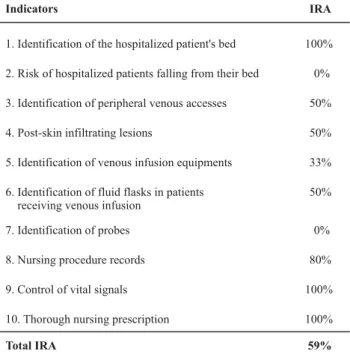
The content validation procedure allowed for the cap-ture of the experts’ opinions concerning the studied domain, and subsidized the reformulation of proposed items and in-dicators, as well as the application of statistical calculations to determine both the Content Validity Index (CVI) and the Reliability Test (IRA) shown in Tables 1 and 2 below.
Table 1 - Expert agreement percentage concerning the measure representativity (CVI) of the set of assessment items that comprise the quality indicators of basic nursing are towards the prevention of adverse events - Londrina, PR - 2007
Indicators CVI
1. Identification of the hospitalized patient's bed 100%
2. Risk of hospitalized patients falling from their bed
89%
3. Identification of peripheral venous accesses 100%
4. Post-skin infiltrating lesions 100%
5. Identification of venous infusion equipment 100%
6. Identification of fluid flasks in patients receiving venous infusion
100%
7. Identification of probes 100%
8. Nursing procedure records 100%
9. Control of vital signals 100%
Table 2 - Expert agreement percentage concerning representativity and clearness of certification items (IRA) of quality indicators in basic nursing care towards the prevention of adverse events - Londrina, PR - 2007
Indicators IRA
1. Identification of the hospitalized patient's bed 100%
2. Risk of hospitalized patients falling from their bed 0%
3. Identification of peripheral venous accesses 50%
4. Post-skin infiltrating lesions 50%
5. Identification of venous infusion equipments 33%
6. Identification of fluid flasks in patients receiving venous infusion
50%
7. Identification of probes 0%
8. Nursing procedure records 80%
9. Control of vital signals 100%
10. Thorough nursing prescription 100%
Total IRA 59%
The values shown in Table 1 indicate the percentage of experts who judged the set of items that composed each indicator as valid measure representatives concerning the studied content. All observed items scored higher than the CVI minimum standard of 80% determined by the adopted literature; therefore, it is possible to affirm that all items were considered as valid in relation to their content.
The achieved values displayed in Table 2 consider the Reliability Analysis, or Interrater Agreement.
When CVI values in Table 1 are compared with IRA per-centage in Table 2 it is possible to conclude that the pro-posed indicators, under assessment measure conditions, are representative of the Nursing Assistance Quality con-struction; however, seven indicators presented serious clearness and representativity problems regarding this same construction.
Data from Table 2 show that indicators numbered 1, 9, and 10 had 100% reliability percentages, that is, they are clear and representative of the studied content.
Indicator 8 achieved 80% reliability, which corroborates experts’ comments. They pointed out that for the items re-lated to nursing procedures and missed medications it was not clear if justifications for the non-performance should be reported in the space indicated by nursing notes on the corresponding prescriptions.
As for indicators 3, 4, and 6, the reliability percentage reached 50%. The problems displayed by indicator 3 are related to the presence of two variables in the item that
assessed the issue of absence of identification and improper identification of peripheral venous accesses, and also the unnecessary presence of the item in the assessment of venous access through intracath, phlebotomy, and Central Catheter of Peripheral Insertion (CCIP); this item did not present any relation to the indicator’s objective.
Indicator 4 showed a 50% reliability percentage and confirmed problems concerning the lack of the descriptor’s patient indicator determination, those who less than 24 hours prior to the assessment had had venous infusion, but who did not have venous access at the time of the active search. These patients presented risk of post-infiltration skin lesions, and in this case they were undergoing assessment. Hence, the descriptor should be reformulated.
Indicator 6 displayed a 50% reliability percentage, and indicated a similar problem to indicator 3 regarding the presence of two variables in only one assessment item, those being the lack of identification and the improper iden-tification of fluid flasks.
Indicator 5 received a 33% reliability percentage due to the same problems identified in indicators 3 and 6, that is, the assessment of two variables in the same certification item, lack of identification and improper identification of venous infusion equipment, and also due to the need to readjust the item description, which should replace the expression
dated but expired for adequate but expired identification.
Indicator 2 was not considered reliable concerning clear-ness and representativity of the studied content (0%) due to problems with the descriptor, which was not clear on how the risk of bed collapse would be determined, whether by examining the records or the patient’s physical status.
Regarding indicator 7 (0%), the problem rested on the fact that it suggested the assessment of two distinct vari-ables (gastric tubes and intravenous lines), to which pre-vention procedures for adverse events are distinct.
The opinion of one of the experts suggested that indi-cator 7 - Identification of tubes - should be subdivided. As a result, two other indicators were developed: identifica-tion of gastric tubes, which kept the descriptor’s character-istics and assessment criteria; and the indicator of delayed intravenous line fixation and positioning of the urine-col-lection bag, to which a subsidy from a study developed in 2005(9) to validate assessment indicators of practices related
to the prevention of catheter-associated urinary infection was applied. In this case, the assessment criteria had al-ready been validated.
of the amount of items that presented 100% experts’ a-greement by the total amount of items.
In case the less conservative approach (80%) was taken into account – and it is indicated when the number of judges exceeds five, such as in this study - results of the IRA calcu-lations would not confirm the problems indicated by the judges’ opinion. This is explained by the fact that the prob-lems pointed out by the experts when framing the indica-tors did not render them unfeasible assessment measures; however, there is still a need for further review in order to improve the selected variables toward the nursing quality assurance aimed at the prevention of adverse events.
All comments and suggestions received from the experts were taken into consideration, and the items and
indica-tors were reformatted in order to comply with the judges’ guidelines.
After the reformulation of the instrument, the pilot study was carried out. As there were no doubts left on the under-standing of items and application of the instrument, it was deemed as valid concerning content and applicability toward the assessment of basic nursing care quality for the prevention of adverse events. The validated instrument was named Active Search Report and was finally comprised of 12 quality indica-tors, listed in Chart 1, and composed of 49 certification items(17).
After the validation proceedings, the institution which served as a basis for the study adopted the Active Search Report through its Quality Control Advising Group, aimed at the prevention of adverse events.
Chart 1 - Nursing Basic Care Quality Indicators for the Prevention of Adverse Events – content validation post-procedure - Londrina, PR - 2007
1. Identification of the hospitalized patient's bed;
2. Bed collapse risk for hospitalized patients;
3. Identification of peripheral venous accesses;
4. Identification of post-skin infiltration lesions;
5. Identification of venous infusion equipment;
6. Identification of medication bags and control of infusion speed;
7. Identification of gastric tubes;
8. Fixation of intermittent infusion catheter and positioning of urine-collection bag;
9. Verification of nursing prescription procedures;
10. Assessment of vital signals;
11. Verification of nursing procedures in the physician's orders;
12. Verification of complete daily orders by nurse.
FINAL CONSIDERATIONS
The assessment of nursing care quality through indica-tors can be applied to reinforce the natural desires of healthcare professionals towards improving care processes; at the same time, it functions as a way to assess the quality of such care.
Assessment processes, however, must employ valid in-formation, since the application of validated measures is the only way to prevent the risk of promoting healthcare teams’ unsafe behavior and consequently the discourage-ment of nursing professionals.
Based on previous premises, this study was carried out inspired by the general objective of validating a nursing care assessment instrument comprised of quality indicators by means of the content validation strategy.
The proposed instrument was considered valid as per its content and applicability to a population of adult pa-tients hospitalized in a medical-surgical clinic of a public university hospital.
After analysis and opinion by experts, the content vali-dation strategy’s results showed that from ten initial indi-cators, comprised of 32 certification items, 12 indicators and 49 certification items were achieved.
Experts’ suggestions mostly tackled issues such as the adjustment of the name of some indicators by adding verbs that could infer action; readjustment of indicators’ calculation (numerator and denominator) by replacing the average of events observed by the total number; and the subdivision of indicators that measured more than one variable.
As per indicator 12 (verification of complete daily or-ders by nurse), several comments and suggestions were presented by experts in order to reinforce the importance of the daily basis on the indicator’s descriptor, and also the need of complying with the real care demands displayed by the patient.
they are directed at the more urgent needs for interven-tion, aimed at improving the quality assurance practices in the studied institution, whose reality certainly does not differ from many others all around the country.
The challenge of validating nursing care quality indica-tors by means of the content validation strategy was worth-while, since we believe that valid measurement instruments make possible the assessment of care quality patterns, thus directing all necessary changes toward the nursing team work process, aiming at achieving the best possible quality in the context of local realities.
It is worth highlighting, as a limitation of this study, the non-insertion of an indicator related to the interactive as-pect between nursing teams and patients. The decision not to include this aspect is justified by the more prominent
problems detected in the basic care process, which de-manded them to be top priority for interventions.
Another limitation concerns the preciseness of indica-tor 12 for the quality assessment of the orders carried out by the nurse. The structure of this indicator, along with the data collection methodology, does not allow for a detailed analysis subsidized by individual criteria for the assessment of care provided towards the real needs of patients. For this reason, whenever a detailed analysis is an imperative, it is recommended that the instrument developed in 1999(14)
be applied, since it is directed exactly to this end.
The relevance of other studies toward the determina-tion of the instrument’s reliability should be stressed, mak-ing way for the determination of the coherence degree with which the instrument measures the studied attribute.
REFERENCES
1. Almeida HMS. Programa de Qualidade do Governo Federal aplicado à Saúde. Rev Adm Saúde. 2001;3(12):5-10.
2. Brasil. Ministério da Saúde. Avaliação para melhoria da quali-dade da estratégia saúde da família: documento técnico. Brasília; 2006.
3. Campbell SM, Braspenning J, Hutchinson A, Marshall MN. Research methods used in developing and applying quality indicators in primary care. BMJ. 2003;326(7393):816-9.
4. Ermel RC, Fracolli LA. Processo de trabalho de gerência: uma revisão da literatura. Rev Esc Enferm USP. 2003;37(2):89-96.
5. Matsuda LM, Évora YDM. Gestão da equipe de enfermagem da uma UTI: a satisfação profissional em foco. Ciên Cuid Saú-de. 2003;2(1):11-8.
6. Idvall E, Rooke L, Hamrin E. Quality indicators in clinical nursing: a review of the literature. J Adv Nurs. 1997;25(1):6-17.
7. Ramírez A, Pérez M. Indicadores de calidad en enfermaría: eventos accidentals de los pacientes. Enfermería. 2003;38 (124):15-21.
8. Pringle M, Wilson T, Grol R. Measuring “goodness” in individuals and healthcare systems. BMJ. 2002;325(7366):704-7.
9. Fernandes MVL. Indicadores de avaliação de práticas de contro-le e prevenção de infecção do trato urinário associada a cateter: construção e validação [dissertação]. Ribeirão Preto: Escola de Enfermagem de Ribeirão Preto, Universidade de São Paulo; 2005.
10. Wynd CA, Schimidt B, Schaefer MA. Two quantitative approaches for estimating content validity. West J Nurs Res. 2003;25(5):508-18.
11. Mcglynn EA, Asch SM. Developing a clinical performance measure. Am J Prev Med. 1998;14(3):14-21.
12. Rubio DM, Berg-Weger M, Tebb SS, Lee ES, Rauch S. Objectify-ing content validity: conductObjectify-ing a content validity study in so-cial work research. Soc Work Res. 2003;27(2):94-111.
13. Pasquali L. Psicometria: teoria dos testes na psicologia e na educação. Petrópolis: Vozes; 2003.
14. Haddad MCL, Lima SM, Freitas IS, Vituri DW. Avaliação da qua-lidade da assistência de enfermagem prestada em um Hospital de Ensino. Rev Olho Mágico. 1999;5(19):27-8.
15. Torres RM, Castro CGSO. Gerenciamento de eventos adversos relacionados a medicamentos em hospitais. Rev Eletrônica Adm Hosp [periódico na Internet]. 2007 [citado 2007 ago. 8];3(1). Disponível em: http://www.saocamilo-rj.br/REAH/pdf/ gerenciamento_eventos.pdf
16. Bohomol E. Padrões para avaliação da qualidade da assistên-cia de enfermagem. In: D’Innocenzo M, coordenador. Indica-dores, auditorias, certificações: ferramentas de qualidade para gestão em saúde. São Paulo: Martinari; 2006. p. 73-85.
17. Vituri DW. Desenvolvimento e validação de um instrumento para avaliação da qualidade do cuidado de enfermagem, Maringá-PR [dissertação]. Maringá: Universidade Estadual de Maringá; 2007.
ANNEX 1
Operation manual of nursing care quality indicators
Indicator 3: identification of peripheral intravenous access (metal catheter - scalp; butterfly; plastic catheter - abocath; venocath)
1. Descriptor
Peripheral intravenous accesses must be identified by a small bandage or a similar material, with readable writing and containing the following information: date and time of venipuncture and signature of the responsible employee. Peripheral intrave-nous access by metal or plastic catheter aimed at infusions in adults should be re-placed at either every 72 hours or at the development of any signal of infection (phle-bitis). In case the access is used for the infusion of hemoderivatives or lipidic solu-tions, it must be replaced at every 24 hours. In case of infants, the catheter must be replaced only at the signal of phlebitis.
2. Scientific reference
Kreisher, E. D. et all. Utilização de indicadores de qualidade pela supervisão: uma inovação. In: CONGRESSO BRASILEIRO DE ENFERMAGEM, 57., 2005, Goiânia. Anais eletrônicos... Goiânia: ABEn, 2005. Disponível em HTTP://bvsms.saude.gov.br/ bvs/publicacoes/57cbe/resumos/1652.htm. Acesso em 12 ago 2007.
O’GRADY, N. P. Guidelines for the Prevention of Intravascular Catheter – Related Infections. MMWR: Morbidity and Mortality Weekly Report, Atlanta, V.51, n.RR10, p.1-26, 2002. Disponível em http://www.cdc.gov/mmwr/preview/mmwrhtml/ rr5110al.htm#top. Acesso em 4 jan 2006.
PHILLIPS, L. D. Controle de Infecção. In: ________. Manual de terapia intravenosa. 2. ed. Porto Alegre: Artmed, 2001. Cap.6, p.140-166.
POTTER, P. A.; PERRY, A. G. Equilíbrios hídricos, eletrolítico e ácido-básico. In: ________. Fundamentos de enfermagem. 5. ed. Rio de Janeiro: Guanabara Koogan, 2004 F. Cap. 40, p.1014-64.
SMELTZER, S. C.; BARE, B. G. Líquido e eletrólitos: equilíbrio e distúrbios. In: SMELTZER, S. C.; BARE, B. G. Brunner & Suddarthtratado de enfermagem médico-cirúrgica. 9. Ed. Rio de Janeiro: Guanabara Koogan, 2002. v.1 Cap. 13, p.192-232. WEINSTEIN, S. Principals and practice of intravenous therapy. New York: Lippincot, 2001.
3. Type of indicator: Process
4. Numerator
1: Number of peripheral intravenous accesses with adequate identifica-tion/day.
5. Denominator
1: Number of peripheral intravenous accesses in the period.
6. Calculation
1 of the indicator:
Number of peripheral intravenous accesses with adequate identification/day Number of peripheral intravenous accesses in the period
x 100
7. Numerator1: Number of peripheral intravenous accesses with adequate
identifica-tion, but past due (past due replacement, according to descriptor).
8. Denominator
1: Number of peripheral intravenous accesses in hospitalized patients that comply with/don’t comply with the indicator’s descriptor.
9. Calculation2 of the indicator:
Number of peripheral intravenous accesses with adequate identification, but past due/day Number of peripheral intravenous accesses with adequate
identification in the period
x 100
10. Sources of information: direct observation of hospitalized patients in the unit
making use of peripheral intravenous access through metal or plastic catheter.
11. Criteria for the assessment qualification: verify the number of intravenous
ac-cesses in hospitalized patients who comply with/don't comply with the indicator's de-scriptor.
12. Sample for conformity analysis: all patients admitted into the studied unit who
make use of peripheral intravenous access through metal or plastic catheter at the time of the research, observed for 14 days at random, pre-determined by selection, during the month of May 2007.
13. Assessment periodicity: Trimonthly, according to pre-determined calendar.
14. Indicator assessment items inserted into the active search sheet:
5. Number of peripheral intravenous accesses 6. Number of peripheral intravenous accesses 7. Number of peripheral intravenous accesses 8. Number of peripheral intravenous accesses
WITH adequate identification and not past due. WITH inadequate identification.
WITHOUT identification.
WITH adequate identification and past due.
IDEAL CONFORMITY INDEX: 100%
ANNEX 2
Operation manual's assessment criteria of each indicator, by experts
PRE-REQUISITES TO BE ASSESSED IN EACH OF THE INDICATORS
1. Descriptor Clear and objective towards what it is aimed at measuring.
2. Foundation Sufficient to highlight the indicator. 3. Type of indicator Adequate to what it intends to measure.
4. Numerator Described in a clear, objective way concerning what it is aimed at measuring. 5. Denominator Described in a clear, objective way concerning what it is aimed at measuring.
6. Source of information Adequate and sufficient to what it intends to measure.
7. Assessment criteria Clear and objective, do not generate doubts regarding what must be assessed. 8. Sample Adequate to depict reality of the studied unit.
Criteria for the assessment of each item of each indicator, by experts
PRE-REQUISITES TO BE ANALYZED IN EACH ONE OF THE ASSESSMENT ITEMS OF NURSING CARE QUALITY INDICATORS
1. Behavioral Allows for a clear and precise assessment action.
2. Objectivity Allows for on-time responses.
3. Simplicity Expresses a unique idea.
4. Clearness Clear, simple and indubitable demonstration.
5. Pertinence Does not imply discrepant attribute from what was defined.
6. Preciseness Each assessment item is different from the others, they do not mix.
Criteria for the assessment of each set of items of each indicator, by experts
ATTRIBUTES TO BE EVALUATED FOR THE WHOLE SET OF ASSESSMENT ITEMS OF EACH ONE OF THE NURSING CARE QUALITY INDICATORS
Reflects a quality aspect for nursing care.
Data are rapidly accessed with minimum effort and costs.
The relevance of the measure can be easily communicated and understood.
The measure can be achieved context-free, or context effects can be adjusted.
It measures what it is aimed at measuring.
The measure is applicable.
The measure allows for a clear and precise measurement action, with no subjective judgment. 1. Attributable
2. Accessible 3. Communicable
4. Contextualizable
5. Effective/Precise
6. Feasible 7. Objective
LIST OF POSSIBLE RESPONSES TO THE ATTRIBUTES OF THE SET OF ASSESSMENT ITEMS OF EACH ONE OF THE NURSING CARE
QUALITY INDICATORS
Does not meet the attribute.
Incapable of meeting the attribute without a reviewing process.
Meets the attribute, but needs minimum change.
Meets the attribute. 1
2
3