Rev Odontol UNESP. 2016 May-June; 45(3): 127-131 © 2016 - ISSN 1807-2577
ORIGINAL ARTICLE
Doi: http://dx.doi.org/10.1590/1807-2577.24115
Eicacy of a bioactive material and nanostructured
desensitizing on dentin hypersensitivity treatment
Eicácia de um material bioativo e dessensibilizante nanoestruturado no tratamento da
hipersensibilidade dentinária
Flávia Magnani BEVILACQUA
a, Anderson CATELAN
a*, Giovana Spagnolo Albamonte ARAÚJO
a,
Cintia Helena Coury SARACENI
b, José Eduardo Cézar SAMPAIO
caInstituto de Ciências da Saúde, UNIP – Universidade Paulista, Campinas, SP, Brasil bUNIP – Universidade Paulista, São Paulo, SP, Brasil
cFaculdade de Odontologia, UNESP – Universidade Estadual Paulista, Araraquara, SP, Brasil
Resumo
Introdução: A hipersensibilidade dentinária é uma ocorrência frequente na prática clínica; clinicamente caracterizada por dor aguda, curta e temporária, em resposta ao estímulo mecânico, químico, térmico ou osmótico causada pela exposição dentinária. Objetivo: Comparar in vivo o efeito de um material bioativo cristalino experimental e um dessensibilizante nanoestruturado na avaliação da dor de pacientes com hipersensibilidade dentinária cervical. Material e método: Trinta pacientes foram selecionados para este estudo, que foram randomicamente divididos em dois grupos (n=15) em um desenho experimental de boca dividida. Cada paciente recebeu dois tratamentos: grupo 1 (flúor gel e material bioativo) e grupo 2 (flúor gel e dessensibilizante nanoestruturado). As análises de dor foram realizadas usando uma escala visual analógica, variando de 0-10. A mensuração da dor inicial foi realizada previamente ao tratamento inicial (T0) e novas análises foram realizadas semanalmente durante 3 semanas (T1, T2 e T3) antes da reaplicação dos materiais. A análise final da dor foi realizada 3 meses após o início do tratamento (T4). O grau de redução de dor foi mensurado pela fórmula: T0 - Tperíodo após tratamento. Os dados das mensurações de dor foram analisados pela ANOVA para medidas repetidas 2 critérios e teste de Tukey (α=0,05). Resultado: Independente do período de avaliação, não houve diferença estatística entre todos os tratamentos na redução da dor (p>0,05). O grau de dor reduziu significativamente em cada período avaliado para todos os tratamentos testados (p<0,05), aproximadamente três graus após 3 meses. Conclusão: Os materiais dessensibilizantes testados foram efetivos na redução da hipersensibilidade dentinária.
Descritores: Dessensibilizantes dentinários; sensibilidade da dentina; dor.
Abstract
Introduction: Dentin hypersensitivity is a frequent occurrence in dental practice. It is clinically characterized by acute, short, and temporary pain in response to mechanical, chemical, thermal, or osmotic stimuli resulting from dentin exposure. Objective: To compare in vivo the effect of an experimental crystalline bioactive material and nanostructured desensitizing on the pain assessment among patients with cervical dentin hypersensitivity. Material and method: Thirty patients were selected for this study, who were randomly assigned to two groups (n=15) in a split-mouth design. Each patient received two treatments: group 1 (fluoride gel and bioactive material) and group 2 (fluoride gel and nanostructured desensitizing). Pain analyses were performed using a visual analogue scale, ranging 0-10. Baseline pain measurement was performed prior to initial treatment (T0) and new measurements were carried out weekly for 3 weeks (T1, T2, and T3) before materials were reapplied. Final pain analysis was performed 3 months after initial treatment (T4). Degree of pain reduction was calculated using the formula T0 - Tperiod after treatment. The data of the pain measurements were analyzed using 2-way repeated measure ANOVA and Tukey’s test (α=0.05). Result: Regardless of evaluation period, there was no statistical difference on pain reduction between the treatments (p>0.05). The degree of pain was reduced significantly in each evaluated period for all tested treatments (p<0.05), by approximately three degrees after 3 months. Conclusion: The tested desensitizing materials were effective on dentin hypersensitivity reduction.
Bevilacqua, Catelan, Araújo et al. Rev Odontol UNESP. 2016 May-June; 45(3): 127-131 128
INTRODUCTION
Dentin hypersensitivity (DH) is a very frequent occurrence in daily dental practice showing incidence as high as 74% but, in most populations, it appears to range between 10-30%1. It is clinically the result of dentin exposure and is characterized by acute, short and temporary pain in response to mechanical, chemical, thermal, or osmotic stimuli and cannot be attributed to any other dental pathology1-4. he most widely accepted theory to explain DH is Brännström’s hydrodynamic theory5 and one of its main causes is non-carious cervical lesions such as abrasion, erosion, and abfraction6. In addition, gingival recession also exposes the underlying dentin1,4.
The treatments indicated for dentin hypersensitivity are numerous2,7-10 and are based on either the obliteration of the dentinal tubules to prevent movement of intratubular luid, or neural blockage of pulp mechanoreceptors, or both11. he treatments that act on the pulp nerve mechanoreceptors use potassium salts, tin and strontium which, when present in oral environment, are released in ionic form thus decreasing pain transmission. However, the interruption of treatment leads to a decrease in the concentration of these ions surrounding the mechanoreceptors resulting in the re-establishment of painful stimulus6,12-14. Regarding treatment through dentinal tubule obliteration, several substances such as strontium chloride, luoride, potassium oxalate, inert ceramic particles like silica, alumina, and arginine, among others1,4,7,13,15-17 may be used. he luoride reacts with calcium forming calcium luoride (CaF2) crystals and decreasing dentin permeability. However, the crystals are small and dissolve quickly when exposed to acid solutions18.
A desensitization and remineralization, using nanostructured calcium phosphate organized in the crystalline form of hydroxyapatite (Nano P), has been recently introduced in the dental market. According to the manufacturer, the efectiveness of this material is based on its ability to provide ions of calcium, phosphate, and luoride to demineralized tooth surfaces, which can be reorganized in the form of hydroxyapatite, luorapatite, and calcium luoride, with acid resistance similar to that of the natural tooth. In addition to this characteristic of remineralization, based on the ability of the hydroxyapatite layer to occlude the dentinal tubules19, potassium nitrate depolarizes the nerve ibers thereby decreasing the pain6,12-14.
Another promising material for the treatment of dentin hypersensitivity is the bioactive glass-ceramic (biosilicate). his product is a fully crystalline glass-ceramic, produced by modifying the structure and concentration of the initial bioglass components through thermal treatment. hat results in the formation of polycrystalline microstructures having crystals with controlled size and volumetric fraction16. his change results in particles with lower cutting potential and proven biological properties20,21, reducing dentin hypersensitivity22. Previous studies have shown that, ater biosilicate application on the dentin, deposition of hydroxycarbonate apatite in open dentinal tubules was observed, forming a uniform layer over this surface23,24.
However, no hypersensitivity treatment was shown be fully efective for all patients. herefore, this study aimed to compare the efect of bioactive glass-ceramic and nanostructured desensitizing among patients with non-carious cervical lesions and dentin hypersensitivity, in a split-mouth design having luoride as the
control treatment. he hypothesis was that the materials evaluated would reduce or eliminate dentin hypersensitivity.
MATERIAL AND METHOD
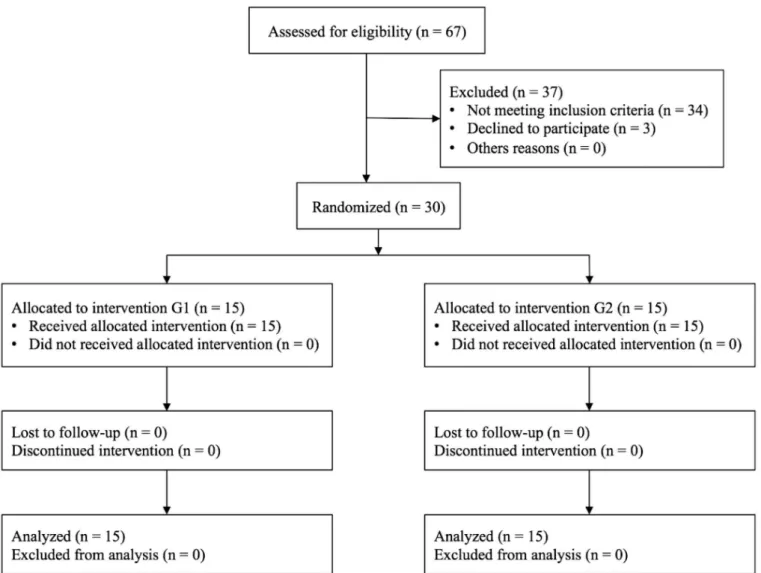
his study was approved by the Research Ethics Committee (protocol # 243.771) of Paulista University. he procedures followed were in accordance with the ethical standards of the committee on human experimentation and with the Helsinki Declaration of 1975, as revised in 1983. hirty patients were selected (Figure 1) in a single-center, meeting the following inclusion criteria: aged 18-60 years, presenting at least 2 teeth with DH (maxillary premolars, one in each dental arch), not subjected to periodontal treatment in the last 3 months, presenting periodontal health, non-smoker, presenting non-carious cervical lesions (abrasion, abfraction and/or erosion) or dentin exposed by gingival recession, not presenting occlusion interferences in the selected teeth, and not subjected to orthodontic treatment in the last 6 months. Patients using occlusal splint, mouthwashes, medications (such as analgesics, antidepressants, anxiolytics, and anti-inlammatory drugs), with amelogenesis or imperfect dentinogenesis, cervical restoration, patients who underwent dental bleaching within the last 6 months, pregnant women and nursing mothers, patients with digestive disorders and those in orthodontic treatment, were excluded from the study.
Ater signing an informed consent, the patients underwent anamnesis to determine oral history, dietary information, oral hygiene routine, and description of events that cause hypersensitivity. In addition, an extra-sot bristle toothbrush and 1,100 ppm luoridated toothpaste without desensitizing were provided for standardization of patients during the study. hey received instructions for brushing (45º at the dental surface, with slight pressure and light movements), prior to the beginning of treatment7.
he split-mouth design was selected for this trial and the study was double-blind. Initially, the area to be treated was relatively isolated. A prior mechanical cleaning was performed in the sensitive area using a cotton swab soaked in distilled water23. hen, a stream of compressed air (~ 10 ºC, 40-65 psi) was blown for 2 s, at 1 cm, perpendicular to the tooth surface while adjacent teeth were protected by the operator’s gloved ingers and cotton rolls. he patients’ hypersensitivity was quantiied using a visual analogue scale (VAS)7. his VAS ranges from 0 to 10, where 0 means complete absence of pain and 10 the maximum level of pain bearable by the patient.
was applied according to the manufacturer’s instructions using a micro-applicator (friction for 10 s with felt disc and let for 5 min).
Baseline pain measurement was performed prior to initial treatment (T0), then desensitizing materials were applied as previously described. New measurements were carried out weekly for 3 weeks (T1, T2, and T3), immediately before materials were reapplied. Final pain analysis was performed 3 months ater initial treatment (T4). Degree of pain reduction was calculated using the formula: T0 - Tperiod ater treatment. All patients completed all follow-up controls.
he degree of pain data were statistically analyzed using two-way repeated measures ANOVA (analysis of variance) followed by Tukey HSD (honest signiicant diference) post-hoc tests at a pre-set alpha of 5%. he factors considered were treatment (in 4 levels: luoride in G1 patients, bioactive material, luoride in G2 patients, and nanostructured desensitizing) and period of evaluation (in 4 levels: T0-T1, T0-T2, T0-T3, and T0-T4).
RESULT
All patients who participated in this study received treatment; the mean of the initial degree of pain was about 5 for both groups. he means and standard deviations of degree of pain reduction are presented in Table 1.
ANOVA showed no signiicant diference between treatments (p > 0.05). For all treatments, a statistically decrease on degree of pain was observed at the return of the patient for a new application, compared to the baseline (p < 0.05). he mean pain intensity decrease was about three degrees at the end of the three-month period.
Figure 1. Participant low diagram. G1 - luoride and biosilicate. G2 - luoride and Nano P.
Table 1. Degree of pain reduction means (standard deviation) according treatment and period of treatment
Treatment Period of treatment* Group Material T0-T1 T0-T2 T0-T3 T0-T4
1
Fluoride 0.9
(0.5)
1.2 (0.6)
2.5 (0.5)
3.1 (0.5)
Biosilicate (0.5)1.4 (0.5)2.2 (0.4)3.1 (0.4)3.8
2
Fluoride 1.3
(0.4)
2.2 (0.5)
2.8 (0.6)
3.2 (0.6)
Nano P (0.4)1.1 (0.5)2.0 (0.7)2.5 (0.7)3.2
Bevilacqua, Catelan, Araújo et al. Rev Odontol UNESP. 2016 May-June; 45(3): 127-131 130
DISCUSSION
DH etiology is due to dentin tubule exposure, manifesting as short, acute pain, and caused by thermal, chemical, and osmotic stimuli1-4. here are several proposed treatments, showing efectiveness in diferent degrees and times, but a permanent solution is not complete. here also may be relapses, mainly due to the fact that the substances used in the treatment do not remain for long on the tooth surface2. hus, the treatment for DH has been a challenge for both clinicians and researchers.
In this study, the acidulated phosphate luoride group was used as the control group. Sodium luoride can be easily difused by the enamel and precipitated as luorapatite and luor-hydroxyapatite7. he CaF2 crystals, formed when the luoride comes into contact with the calcium and phosphate ions, obliterate the entries of dentinal tubules, decreasing dentin permeability2,7. However, being unstable, the efect is of short duration; hence, the need for multiple treatment sessions. Another inconvenience of luoride is the size of the crystals formed, which are smaller and less efective than those formed by other compounds22,24.
he acidulated phosphate luoride is more reactive than the neutral, so this was chosen for the present investigation. he pain intensity decreased over time, ater topical application of luoride on the exposed dentin. he pain decrease was about three degrees at the end of the three-month period. A previous study7 observed a signiicant decrease in pain only ater 3 months of using acidulated phosphate luoride, justifying the claim that agents containing sodium luoride do not result in precipitates able to efectively block the dentinal tubules. However, in the present investigation, pain reduction was observed at the second visit of the patients.
Another product tested was a nanostructured (NanoP) desensitizing product, with the capacity to provide calcium, phosphate, and luoride ions to the demineralized tooth surface, which can be reorganized in the form of hydroxyapatite, luorapatite, or calcium luoride. he desensitizing efect is due to remineralization, which is based on the ability of the hydroxyapatite layer to occlude the dentinal tubules19, in addition to the efect of nerve iber depolarization by the potassium nitrate present in the material6,12-14. his product also resulted in pain decrease over time.
he experimental bioactive glass-ceramic material (biosilicate) is an innovation in the ceramic glass bioactive area, developed at the Laboratory of Vitreous Materials of São Carlos Federal University. Its chemical composition is P2O5-Na2O-CaO-SiO2 and is biocompatible20,21,23. The bioactive glass-ceramic, in contact with luids, starts the chemical reaction. hus, when this material was applied on the dentin surface, it showed deposition of hydroxycarbonate apatite, occluding the open dentinal tubules. It could be a promising desensitizing agent for the treatment of dentin hypersensitivity23,24. Similar to the results of the present investigation, a previous study also found greater absolute pain reduction ater biosilicate application22.
It was observed in the present study that, regardless of the material evaluated, ater 3 months of treatment all desensitizing agents were able to decrease dentin hypersensitivity and provide a signiicant reduction in pain when compared with initial pain (baseline). As in the present investigation, many studies have shown that treatment with desensitizing agents decreases hypersensitivity over time1-4,6,7,12,15,19,22. he acting speed of the materials used for DH treatment is an important factor to be considered. All materials tested showed pain reduction over time. he pain reduction was about three degrees ater 3 months, thus the hypothesis tested was accepted.
he clinical evaluation of pain among patients with DH is problematic, as several factors may modify the response of volunteers. One diiculty is the cooperation of volunteers and their commitment to return visits. here are also diiculties with the interpretation of dentin hypersensitivity in the results of clinical studies, since responses of the body itself may lead to a pain reduction. However, it was evident in the present study that the desensitizing agents were efective in reducing the sensitivity within an acceptable period of time, improving the patients’ comfort. In addition, the tested biomaterial proved to be very promising, and other in vivo and
in vitro studies should be conducted in order to verify its eicacy.
CONCLUSION
It can be concluded that there were no signiicant diferences between treatments evaluated and, at the end of three months, all tested desensitizing agents reduced dentin hypersensitivity.
REFERENCES
1. Kapferer I, Pflug C, Kisielewsky I, Giesinger J, Beier US, Dumfahrt H. Instant dentin hypersensitivity relief of a single topical application of an in-office desensitizing paste containing 8% arginine and calcium carbonate: a split-mouth, randomized-controlled study. Acta Odontol Scand. 2013 May-Jul;71(3-4):994-9. http://dx.doi.org/10.3109/00016357.2012.741701. PMid:23140517.
2. Lund RG, Silva AF, Piva E, Da Rosa WL, Heckmann SS, Demarco FF. Clinical evaluation of two desensitizing treatments in southern Brazil: a 3-month follow-up. Acta Odontol Scand. 2013 Nov;71(6):1469-74. http://dx.doi.org/10.3109/00016357.2013.770919. PMid:24180588. 3. Mehta D, Gowda VS, Santosh A, Finger WJ, Sasaki K. Randomized controlled clinical trial on the efficacy of dentin desensitizing agents.
Acta Odontol Scand. 2014 Nov;72(8):936-41. http://dx.doi.org/10.3109/00016357.2014.923112. PMid:24909155.
4. Torres CR, Silva TM, Fonseca BM, Sales AL, Holleben P, Di Nicolo R, et al. The effect of three desensitizing agents on dentin hypersensitivity: a randomized, split-mouth clinical trial. Oper Dent. 2014 Sep-Oct;39(5):E186-94. http://dx.doi.org/10.2341/13-057. PMid:24720265. 5. Braennstroem M, Astroem A. A study on the mechanism of pain elicited from the dentin. J Dent Res. 1964 Jul-Aug;43(4):619-25. http://
6. Freitas SS, Sousa LLA, Moita JM No, Mendes RF, Prado RR Jr. Dentin hypersensitivity treatment of non-carious cervical lesions - a single-blind, split-mouth study. Braz Oral Res. 2015;29(1):1-6. http://dx.doi.org/10.1590/1807-3107BOR-2015.vol29.0045.
7. Aranha AC, Pimenta LA, Marchi GM. Clinical evaluation of desensitizing treatments for cervical dentin hypersensitivity. Braz Oral Res. 2009 Jul-Sep;23(3):333-9. http://dx.doi.org/10.1590/S1806-83242009000300018. PMid:19893971.
8. Jacobsen PL, Bruce G. Clinical dentin hypersensitivity: understanding the causes and prescribing a treatment. J Contemp Dent Pract. 2001 Feb;2(1):1-12. PMid:12167939.
9. Orchardson R, Gangarosa LP Sr, Holland GR, Pashley DH, Trowbridge HO, Ashley FP, et al. Dentine hypersensitivity into the 21st century. Arch Oral Biol. 1994;39(Suppl):113S-9S. http://dx.doi.org/10.1016/0003-9969(94)90197-X. PMid:7702459.
10. Walters PA. Dentinal hypersensitivity: a review. J Contemp Dent Pract. 2005 May;6(2):107-17. PMid:15915210.
11. Canadian Advisory Board on Dentin Hypersensitivity. Consensus-based recommendations for the diagnosis and management of dentin hypersensitivity. J Can Dent Assoc. 2003 Apr;69(4):221-6. PMid:12662460.
12. Ayad F, Berta R, De Vizio W, McCool J, Petrone ME, Volpe AR. Comparative efficacy of two dentifrices containing 5% potassium nitrate on dentinal sensitivity: a twelve-week clinical study. J Clin Dent. 1994;5(Spec No):97-101. PMid:8534382.
13. Collins JF, Gingold J, Stanley H, Simring M. Reducing dentinal hypersensitivity with strontium chloride and potassium nitrate. Gen Dent. 1984 Jan-Feb;32(1):40-3. PMid:6586609.
14. Schiff T, Dotson M, Cohen S, De Vizio W, McColl J, Volpe A. Efficacy of a dentifrice containing potassium nitrate, soluble pyrophosphate, PVM/MA copolymer, and sodium fluoride on dentinal hypersensitivity: a twelve-week clinical study. J Clin Dent. 1994;5(Spec No):87-92. PMid:8534380.
15. França IL, Sallum EA, Do Vale HF, Casati MZ, Sallum AW, Stewart B. Efficacy of a combined in-office/home-use desensitizing system containing 8% arginine and calcium carbonate in reducing dentin hypersensitivity: an 8-week randomized clinical study. Am J Dent. 2015 Feb;28(1):45-50. PMid:25864242.
16. Peitl O Fo, LaTorre GP, Hench LL. Effect of crystallization on apatite-layer formation of bioactive glass 45S5. J Biomed Mater Res. 2015 Apr;30(4):509-14. http://dx.doi.org/10.1002/(SICI)1097-4636(199604)30:4<509:AID-JBM9>3.0.CO;2-T. PMid:8847359.
17. Pereira JC, Segala AD, Gillam DG. Effect of desensitizing agents on the hydraulic conductance of human dentin subjected to different surface pre-treatments - an in vitro study. Dent Mater. 2005 Feb;21(2):129-38. http://dx.doi.org/10.1016/j.dental.2004.02.007. PMid:15681011. 18. Ganss C, Klimek J, Schäffer U, Spall T. Effectiveness of two fluoridation measures on erosion progression in human enamel and dentine in
vitro. Caries Res. 2001 Sep-Oct;35(5):325-30. http://dx.doi.org/10.1159/000047470. PMid:11641567.
19. Vano M, Derchi G, Barone A, Covani U. Effectiveness of nano-hydroxyapatite toothpaste in reducing dentin hypersensitivity: a double-blind randomized controlled trial. Quintessence Int. 2014 Sep;45(8):703-11. http://dx.doi.org/10.3290/j.qi.a32240. PMid:25019114.
20. Massuda ET, Maldonato LL, Lima JT Jr, Peitl O, Hyppolito MA, Oliveira JA. Biosilicate ototoxicity and vestibulotoxicity evaluation in guinea-pigs. Braz J Otorhinolaryngol. 2009 Sep-Oct;75(5):665-8. http://dx.doi.org/10.1016/S1808-8694(15)30515-2. PMid:19893933.
21. Moura J, Teixeira LN, Ravagnani C, Peitl O, Zonotto ED, Beloti MM, et al. In vitro osteogenesis on a highly bioactive glass-ceramic (Biosilicate). J Biomed Mater Res A. 2007 Sep;82(3):545-57. http://dx.doi.org/10.1002/jbm.a.31165. PMid:17311315.
22. Tirapelli C, Panzeri H, Lara EH, Soares RG, Peitl O, Zanotto ED. The effect of a novel crystallised bioactive glass-ceramic powder on dentine hypersensitivity: a long-term clinical study. J Oral Rehabil. 2011 Apr;38(4):253-62. http://dx.doi.org/10.1111/j.1365-2842.2010.02157.x. PMid:20868428.
23. Pinheiro MC, Lopes BM, Cavassim R, Pinto SC, Sampaio JE. In vitro evaluation of Biosilicate® dissolution on dentin surface. A SEM analysis. Rev Odontol UNESP. 2013 Jul-Aug;42(4):251-8. http://dx.doi.org/10.1590/S1807-25772013000400004.
24. Tirapelli C, Panzeri H, Soares RG, Peitl O, Zanotto ED. A novel bioactive glass-ceramic for treating dentin hypersensitivity. Braz Oral Res. 2010 Oct-Dec;24(4):381-7. http://dx.doi.org/10.1590/S1806-83242010000400002. PMid:21180956.
CONFLICTS OF INTERESTS
he authors declare no conlicts of interest.
*CORRESPONDING AUTHOR
Anderson Catelan, Instituto de Ciências da Saúde, UNIP - Universidade Paulista, Campus Swit, Av. Enzo Ferrari, 280, Swit, 13043-900 Campinas - SP, Brasil, e-mail: [email protected]