INTRODUCTION
The large num b e r o f histo lo gical type s o f
tum o rs in salivary glands tum ake s the tum a ve ry he te ro
-ge ne o us gro up o f ne o plasias. The gre ate st
difficultie s in the ir ide ntificatio n are due to the m o rpho
-lo gical varie ty and co m ple xity that co m pro m ise the
histo p atho lo gic al d iagno sis and c lassific atio n o f
the se tum o rs.
1Muco epidermo id carcino ma (MEC) represents
5 to 12% o f salivary gland tumo rs, with the mo st co
m-mo n site b eing the paro tid gland (70 to 90%).
2-7In
the o ral cavity, the palate is the mo st affected site
and the lip is the site with least incidence.
8In additio n to the cyto lo gical and mo rpho lo
gi-cal pro pe rtie s o f the se ne o plasias, o ne o f the m o st
im po rtant crite ria fo r the m e asure m e nt o f the ir b io
-lo gical b e havio r and aggre ssive ne ss is ce ll pro
lif-e ratio n. In this way, im m uno histo chlif-e m ical m arklif-e rs
o f ce ll pro life ratio n have b e e n fo und to b e use ful in
tum o r c lassific atio n and have fo rm e d p art o f the
pro gno stic and therapeutic studies o f these patho lo
-gie s.
9,10The pro life rating ce ll nucle ar antige n (PCNA)
ide ntifie d b y Myiach e t al
11is a 36 kd, acidic, no
n-histo ne nucle ar pro te in that he lps the de lta DNA
po lym e rase in DNA synthe sis.
12This pro te in has a
high co ncentratio n in the late G1 and early S phases,
dim inishe s in the G2 phase and is alm o st ab se nt in
the M phase .
12,13The e valuatio n o f c e ll p ro life ratio n us ing
PCNA is co m parab le to and, unde r ce rtain co
ndi-tio ns, supe rio r to the tradindi-tio nal me tho ds o f mito tic
Original Article
REVISTA PAULISTA DE MEDICIN AProlife rating ce ll nucle ar antige n e xpre ssion in
mucoe pide rmoid carcinoma of salivary glands
Head and Neck Surgery Department of Heliópolis Hospital and the Pathology
Department of the Dentistry Faculty, São Paulo University, São Paulo, Brazil.
a b s t r a c t
CON TEX T:
Amo ng the cyto lo g ical and mo rpho lo g ical pro perties o f muco epidermo id carcino ma, o ne o f the mo st impo rtant criteria fo r measuring its bio lo g ical behavio r and ag g ressiveness is cell pro lif-eratio n. In this way, immuno histo chemical markers o f cell pro lifera-tio n have been fo und to be useful in tumo r classificalifera-tio n and have fo rmed part o f the pro g no stic and therapeutic studies o f these pa-tho lo g ies.OBJECTIVE:
To analyz e 1 1 cases o f muco epidermo id carcino ma (MEC) using the pro liferatio n activity marker (PCN A) and to deter-mine its relatio nship to the g rade o f malig nancy o f these tumo rs.DESIGN :
Co rrelatio n study.SETTIN G:
Head and N eck Surg ery Service o f Helió po lis Ho spital, São Paulo , Braz il.SAM PLE:
Slides o f 1 1 cases o f primary muco epidermo id carcino -mas o f salivary g lands were prepared acco rding to ro utine tech-niques emplo yed in the O ral Patho lo g y Department o f the Dentistry Faculty o f São Paulo University, Braz il. They were fixed in a 1 0 % fo rmaldehyde so lutio n and stained with hemato xylin and eo sin. Af-ter this preparatio n the tumo rs were classified as lo w, inAf-termediate and hig h g rade o f malig nancy, acco rding to the criteria established by Seifert & So bin and Auclair, G o o de & Ellis. The slides were sent fo r immuno histo chemical pro cessing to evaluate the po sitivity o f pro -liferating cell nuclear antig en using the streptavidin bio tin technique.M AIN M EASUREM EN T:
The co rrelatio n between pro liferating cell nuclear antig en expressio n and the histo lo g ical malig nancy g rade in muco epidermo id carcino ma o f salivary g lands.RESULTS:
there were 4 cases (3 6 %) o f lo w g rade, 4 cases (3 6 %) o f intermediate g rade and 3 cases (2 7 %) o f hig h g rade o f malig nancy. After a co mparative study between histo lo g ical features and immu-no histo chemical analysis, sig nificant differences were o bserved (P < 0 .0 1 ) fo r lo w, intermediate and hig h g rades: 1 6 .0 4 %, 2 6 .9 8 % and 5 6 .9 8 % o f pro liferating cell nuclear antig en expressio n in mu-co epidermo id carcino ma , respectively.CON CLUSION :
The pro liferating cell nuclear antig en expressio n in-creases with the g rade o f malig nancy in muco epidermo id carcino ma o f salivary g lands.KEY W ORDS:
Pro liferating cell nuclear antig en. Muco epidermo id Carcino ma. Salivary G land.figure c o unt us ing o p tic al m ic ro s c o p y, tritiate d
tim idin uptake and flo w cyto m e try.
9,14-16This study was pe rfo rm e d to ve rify the pre
s-e ncs-e o f a co rrs-e latio n b s-e tws-e s-e n PCNA s-e xprs-e ssio n and
the histo lo gical m alignancy grade in MEC o f
sali-vary glands.
METHODS
In a re tro spe ctive analysis o f the re co rds o f
the He ad and Ne ck Surge ry Se rvice o f He lió po lis
Ho spital, 25 case s o f MEC o f salivary glands we re
fo und b e twe e n 1978 and 1997. In e le ve n case s the
sam ple b lo cks
we re suitab le fo r re e valuatio n o f the
histo p atho lo gic al d iagno sis and fo r im m uno
his-to che m ical analysis.
The c linic al d ata o n the p atie nts (age , se x,
race , pre se nce o f sym pto m s and o utco m e ) and
tu-m o rs (site and size ) we re co llate d.
Diagnostic tests
a)
Conventional histopathological study. Fo r this
analy-sis, tissue se c tio ns with 3-4 m m thic kne ss, fixe d
in 10% fo rm ald e hyd e so lutio n and e m b e d d e d in
p araffin we re e xam ine d . The slid e s we re staine d
with he m ato xylin and e o sin and stud ie d using
o p tic al m ic ro sc o p y. The tum o rs we re grad e d fo r
m alignanc y, ac c o rd ing to the c rite ria o f Se ife rt
& Sab in
5,6and Auclair, Go o de & Ellis,
17as fo llo ws:
(a) Lo w grad e : highly d iffe re ntiate d ne o p lasia
with p re d o m inanc e o f m ac ro and m ic ro c ysts.
Pre se nc e o f inte rm e d iate and m uc in-p ro d uc ing
c e lls (
Figure 1);
(b ) Inte rm e d iate grad e : p re d o m
i-nanc e o f inte rm e d iate c e lls and fe w c ysts. Pre
s-e nc s-e o f m uc in-p ro d uc ing c s-e lls and island s o f
e p id e rm o id c e lls (
Figure 2
) ; ( c ) Hig h g rad e :
p o o rly d iffe re ntiate d ne o p lasia with p re d o m
i-nanc e o f inte rm e d iate and e p id e rm o id c e lls in
so lid b lo c ks. Muc in-p ro d uc ing c e lls are p re se nt
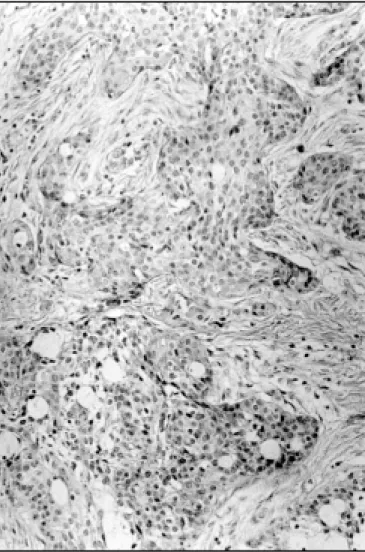
Figure1 -
Low malignancy grade MEC of a salivary gland. Note the
mucin cell with wide, clear cytoplasm and the nucleus displaced to the
periphery, lining the cystic spaces. (Stained with hematoxylin and eosin
with magnification of 250x).
in le ss than 10% (
Figure 3
).
b )
Immunohistochemical study for PCNA determination. Fo r
im m u n o h is to c h e m ic al PCNA d e te c tio n , th e
stre p tavid in b io tin te c hniq ue was use d .
15The
mo no clo nal antib o dy use d was PC10 (DAKO Co
r-po ratio n, Glo strup, De nm ark) in a 1/100 dilutio n
with 18 ho urs incub atio n tim e . Tum o r ce lls that
sho we d a b ro wnish stain we re co nside re d po
si-tive (
Figure 4
). The q uantitative e xp re ssio n o f
PCNA was o b taine d fro m the re latio nship b e
-tween the numb er o f PCNA-po sitive cells and the
to tal num b e r o f e valuate d c e lls in p e rc e ntage
te rm s. The to tal num b e r o f e valuate d ce lls was
ne ve r le ss than 1000 ce lls in e ach pro ce dure . Two
e valuatio ns we re pe rfo rm e d fo r e ach tum o r. In
all case s the im m uno histo che m ical e valuatio n
o f PCNA was pe rfo rm e d b y the patho lo gist in a
b lind m anne r (witho ut kno wing the histo patho
-lo gical diagno sis o r the m alignancy grade ).
Main Measurement
The co rrelatio n b etween PCNA expressio n and
the histo lo gical grade o f m alignancy in MEC o f
sali-vary glands.
S tatistical methods
The statistical analysis was pe rfo rm e d using
the SAS/STAT pro gram, users’ guide versio n 6.0 (SAS
Institute Inc., 1989), to o rganize the pre dictio n
in-te rval fo r the thre e grade s o f m alignancy. Stude nt’s
t distrib utio n te st and Tuke y’s m ultiple co m pariso n
te st we re use d
to e valuate the diffe re nce s b e twe e n
the o b taine d data.
RESULTS
Clinical data
The clinical data o f the 11 patie nts are sho wn
in Tab le 1. The m e dian age was 45.7 ye ars (range
36-75). Nine patie nts we re white , 1 b lack and 1
un-kno wn. The m ale to fe m ale pro po rtio n was appro
xi-m ate ly 1:1 (6 xi-m ale and 5 fe xi-m ale ). The prixi-m ary
tu-m o r site s we re : paro tid gland (64%), hard palate ,
b ase o f to ngue , sub m axillary gland and m o uth flo o r
(9% e ach). The me an duratio n o f co mplaints was 5.6
ye ars and the m e an tum o r size was 5.3 cm . Se ve n
patie nts we re asym pto m atic and o nly 4 pre se nte d
sym pto m s at the tim e o f diagno sis.
Histopathological and immunohistochemical
find-ings
The re sults o f histo p atho lo gic al e valuatio n
sho wed 4 cases (36%) classified as lo w grade, 4 cases
Figure 4 -
Immunohistochemical studies of MEC of a salivary gland,
with a moderate number of cells positive for PCNA antigen expression.
The tumor cells were considered positive when they showed a
brownish stain. (250x magnification).
(36%) inte rm e diate and 3 case s (27%) as high m
alignancy grade . Tab le 2 pre se nts the re lative and ab
-s o lute value -s o f PCNA- p o -s itive c e ll-s in the two
analyse s pe rfo rm e d.
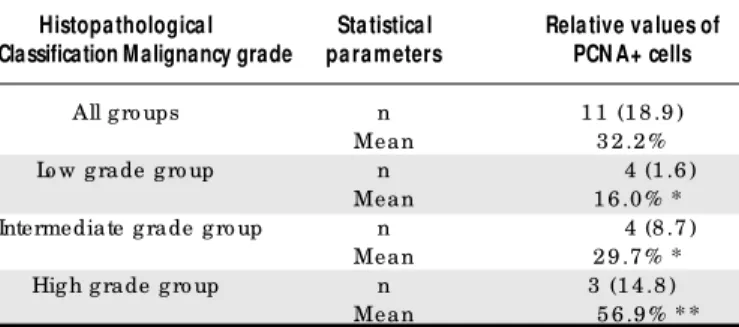
Whe n the m e an value s o f po sitive e xpre ssio n
o f PCNA in the diffe re nt gro ups o f histo lo gical
clas-sificatio n we re analyze d, a te nde ncy to incre ase this
e xpre ssio n was o b se rve d in case s with a high m
a-lignancy grade , as sho wn in Tab le 3. The variance
analysis using Tuke y’s te st sho we d significant
dif-fe re nce s b e twe e n the m e an value o f the high-grade
m alignancy gro up whe n co m pare d with the lo w and
inte rm e d iate grad e gro up s (P< 0.01). The se latte r
gro ups did no t pre se nt diffe re nce s b e twe e n e ach
o the r.
DISCUSSION
Altho ugh MEC was de fine d as a spe cific e
n-tity five de cade s ago , co ntro ve rsie s pe rsist co nce
rn-ing the histo patho lo gical m alignancy grade s,
sur-vival and pro gno sis in the se tum o rs.
18,19A co m pariso n o f the re sults o f this study with
data in the lite rature sho we d agre e m e nt re garding
the mo st fre q ue nt site (paro tid gland in 64%),
2,20age
(fifth de cade )
20and a large r pre vale nce in white
in-dividuals.
2, 21, 22The tim e take n fo r the d ise ase to
e vo lve (5.3 ye ars) was sim ilar to that o b se rve d b y
Auclair & Ellis
2and Lo yo la e t al (6.2 ye ars). In spite
o f disagre e m e nt with so m e re po rts in the lite rature
indicating fe m ale pre do m inance ,
22-24the sim ilarity
in pro po rtio ns b etween the sexes that we fo und co
nco rds with o the r de scriptio ns in which e q ual pro
-po rtio ns we re e nco unte re d.
4,20, 25It is wide ly acce pte d that the histo lo gical m
a-lignancy grade o f MEC is re late d to a m o re unfavo
r-ab le o utco m e in high grade tum o rs whe n co m pare d
with o the r grade s.
2, 6,19,26The re is, ho we ve r, a large
variatio n in patho lo gical crite ria use d in classifying
these tumo rs, while the evaluatio n o f the tumo r pro
-po rtio n o f cystic are as fo rms part o f all curre nt
grading syste m s. In m any case s the re is difficulty in pre
-cisely determining the cystic co mpo nent. Additio nal
classificatio n crite ria m ay b e use ful unde r the se
cir-cum stance s.
Data pre se nte d he re sho w that the e valuatio n
o f ce ll pro life ratio n using PCNA has a clo se re
la-tio nship to m alignancy grade s de te rm ine d b y
his-to patho lo gical m e tho ds.
Table 1 Clinical data on 11 case s of salivary gland mucoe pide rmoid carcinoma
-He ad and Ne ck Surge ry Se rvice - -He liópolis Hospital, São Paulo - 1978 to 1997
Ca se N º
Age (yea r)
Gender
Ra ce
Symptoms
Loca tion
Tumor Size (cm) Duration of Complaints
1 2 6 F W hite Asympto matic Paro tid 3 .0 1 4 y
2 7 5 F W hite Sympto matic Paro tid 7 .0 5 y
3 7 3 M W hite Asympto matic Submandibular 5 .0 1 y
4 4 4 M W hite Asympto matic Paro tid 1 0 .0 1 y
5 4 6 F W hite Asympto matic Base o f to ng ue 5 .0 na*
6 5 1 M Black Sympto matic Flo o r o f mo uth 2 .5 1 4 y
7 3 6 F W hite Asympto matic Paro tid 6 .0 5 y
8 4 3 M W hite Sympto matic Hard palate 2 .5 1 5 y
9 na* M na* na* Paro tid 6 .0 3 y
1 0 5 2 F W hite Sympto matic Paro tid 3 .0 1 y
1 1 5 7 M W hite Asympto matic Paro tid 1 2 .0 3 y
* na = no t available.
Table 2- Comparison be twe e n the histopathological classification and
re lative and absolute value s of p ro life ra ting c e ll nuc le a r a ntig e n (PCNA+) ce lls for all case s
1 st Eva lua tion
2 nd Eva lua tion
Histopa thologica l
PCN A+ cells
PCN A+ cells
Ca se N º
Cla ssifica tion
Tota l cells
Absolute
Rela tive
Tota l cells
Absolute
Rela tive
1 Lo w g rade 1 2 6 8 1 9 6 1 5 .5 % 1 1 8 6 1 7 2 1 4 .5 %
3 Lo w g rade 9 0 7 1 4 1 1 5 .5 % 1 1 0 9 1 5 1 1 3 .6 %
8 Lo w g rade 1 0 6 9 2 1 3 1 9 .9 % 1 1 1 6 1 7 9 1 6 .0 %
1 0 Lo w g rade 1 1 2 0 2 1 0 1 8 .8 % 1 1 1 3 1 6 1 1 4 .5 %
2 Intermediate g rade 1 1 8 0 2 4 7 2 1 .0 % 1 1 2 2 2 5 3 2 2 .6 % 4 Intermediate g rade 1 8 4 2 3 7 5 2 0 .4 % 1 1 0 9 2 7 2 2 4 .5 % 6 Intermediate g rade 1 2 3 1 4 6 2 3 7 .5 % 1 3 2 4 4 9 2 3 7 .2 % 7 Intermediate g rade 1 5 0 8 5 3 5 3 5 .5 % 1 7 6 1 6 8 3 3 8 .8 %
5 Hig h g rade 1 2 1 7 4 3 7 3 5 .9 % 1 2 2 4 5 3 7 4 3 .9 %
9 Hig h g rade 1 1 4 6 7 2 6 6 3 .4 % 1 2 0 6 9 2 1 6 8 .1 %
1. Thackray AC, Lucas RB. Tumo rs o f the majo r salivary glands. Atlas o f Tumo r Patho lo gy, 2nd Series, Fascicle 10. Washingto n DC: Armed Fo rces Institute o f Patho lo gy; 1974.
2. Auclair PL, Ellis GL. Muco epidermo id carcino ma. In: Ellis GL, Auclair PL, Gneep DR. Surgical patho lo gy o f salivary glands. Philadelphia: Saunders; 1991:269-98.
3. Franzi SA, Carvalho MB. Carcino ma muco epidermó ide avançado das glândulas salivares. Rev Bras Cancero l 1997;43(4):273-80.
4. Lo yo la AM, Araújo VC, So usa SOM, Araújo NS. Mino r salivary glands tumo rs. A retro spective study o f 164 cases in a Brazilian po pulatio n. Oral Onco l Eur J Cancer 1995;31B:197-201.
5. Se ife rt G, So b in LH. Wo rld He alth O rg anizatio n his to lo g ic al classificatio n o f tumo rs. Histo lo gical typing o f salivary gland tumo rs. Berlin: Springer; 1991:8-9.
REFERENCES
6. Seifert G, So b in LH. The Wo rld Health Organizatio n Histo lo gical classificatio n o f salivary gland tumo rs: a co mmentary o n the seco nd editio n. Cancer 1992;70:379-85.
7. Spiro RH, Huvo s AG, Berk R, Stro ng EW. Muco epidermo id carcino ma o f salivary gland o rigin. Am J Surg 1978;136:461-8.
8. Rapo po rt A, Carvalho MB, Fava AS, et al. Diagnó stico e tratamento das neo plasias das glândulas salivares meno res: estudo de 55 caso s. Rev Co l Bras Cirur 1988;5:289-93.
9. O gawa I, Miyac hi M, Takata T, Vuhahula E, Ijuhin N, Nikai H. Pro liferative activity o f salivary gland pleo mo rphic adeno ma and myo epithelio ma as evaluated by the pro liferating cell nuclear antigen (PCNA) labeling index (LI). J Oral Patho l Med 1993;22:447-50.
10. Ts uji T, Sas aki K, Kim ura Y, Yam ad a K, Mo ri M, Shino zaki F. Measurement o f pro liferating cell nuclear antigen (PCNA) and its
Table 3 - Me an pe rce ntage and dispe rsion value s of
p ro life ra ting c e ll nuc le a r a ntig e n (PCNA+) ce lls for
all patie nts and in e ach group according to the
histopathological classification
Histopathological
Statistical
Relative values of
Classification Malignancy grade
parameters
PCN A+ cells
All g ro ups n 1 1 (1 8 .9 )
Mean 3 2 .2 %
Lo w g rade g ro up n 4 (1 .6 ) Mean 1 6 .0 % * Intermediate g rade g ro up n 4 (8 .7 )
Mean 2 9 .7 % * Hig h g rade g ro up n 3 (1 4 .8 )
Mean 5 6 .9 % * * * no t sig nificant statistical difference; * * sig nificant statistical difference (P<0 .0 1 ); Standard Deviatio n g iven in parenthesis.
Co ntrary to
the results o b tained b y Tsai & Jin,
27the data o f the pre se nt study sho we d a statistically
s ig n ific an t d iffe re n c e b e twe e n th e m alig n an c y
grade s and the e xpre ssio n o f PCNA in tum o r ce lls,
as e valuate d b y the p e rc e ntage o f p o sitive c e lls.
Tum o rs with a high grade o f m alignancy sho we d a
gre ate r pe rce ntage o f PCNA-po sitive ce lls than the
tum o rs with inte rm e diate o r lo w grade .
r e s u m o
CON TEXTO:
As características cito ló g icas e mo rfo ló g icas do Carci-no ma Muco epidermó ide, um do s critério s mais impo rtantes na aferição do seu co mpro metimento bio ló g ico e ag ressividade é a pro liferação celular. Daí, a utilização do uso de marcado res imuno histo químico s da pro liferação celular na classificação do s tumo res e na determinação do pro g nó stico e no estudo terapêutico dessas pato lo g ias.OBJETIVO:
Analisar 1 1 caso s de carcino ma muco epidermó ide (CME) a tra vé s do a ntíg e no nuc le a r de pro life ra ç ã o c e lula r (PC N A) e determinar sua relação co m o g rau de malig nidade destes tumo res.TIPO DE ESTUDO:
Estudo de co rrelação .LOCAL:
Serviço de Cirurg ia de Cabeça e Pesco ço do Ho spital Helió po lis, São Paulo , Braz il.AM OSTRA:
As lâminas de 1 1 caso s fo ram preparadas de aco rdo c o m a ro tina té c nic a do De pa rta me nto de Pa to lo g ia O ra l da Fa c uld a d e d e O d o nto lo g ia d a Unive rsid a d e d e Sã o Pa ulo , c o rre sp o nd e nd o a o c a rc ino ma muc o e p id e rmó id e p rimá rio d e g lândulas salivares, fixadas em so lução de fo rmaldeído a 1 0 % e co radas co m hemato xilina e eo sina. Apó s o preparo , as neo plasias fo ra m c la ssific a d a s e m b a ixo , inte rme d iá rio e a lto g ra u d e malig nidade, de aco rdo co m o critério de Seifert & So bin e Auclair & Ellis. As lâminas fo ram encaminhadas a estudo imuno histo químico para avaliar a po sitividade do PCN A pela técnica de streptavidina.VARIÁVEIS ESTUDADAS:
Co rrelação entre a expressão PCN A e o g rau histo ló g ico de malig nidade do s CME de g lândulas salivaresRESULTADOS:
Haviam 4 caso s (3 6 %) de baixo g rau, 4 caso s (3 6 %) de g rau intermediário e 3 caso s (2 7 %) de alto g rau de malig nidade. Apó s o estudo co mparativo entre o s achado s histo ló g ico s e a análise imuno histo q uímic a , dife re nç a s sig nific a tiva s fo ra m o b se rva da s (P<0 ,0 1 ) para o s 3 g raus de malig nidade – 1 6 ,0 4 %, 2 6 ,9 8 % e 5 6 ,9 8 % respectivamente – da expressão do PCN A no CME.CO N CLUSÃO :
A expressão do PCN A aumenta co m o g rau de malig nidade do CME nas g lândulas salivares.PA LAV RA S- CH AV E:
PC N A . C a rc ino ma muc o e p id e rmó id e . G lândulas salivares.We de r Pe re ira Cardoso, MD. Department o f Head and Neck Surgery o f Helió po lis Ho spital, São Paulo , Brazil.
Odilon Victor Porto De nardin, MD, PhD. Department o f Endo crino lo gy o f Helió po lis Ho spital, São Paulo , Brazil.
Abrão Rapoport, MD, PhD. Department o f Head and Neck Surgery o f Helió po lis Ho spital, São Paulo , Brazil.
Ve ra Cavalcanti Araújo, DDS, PhD. Patho lo gy Department o f the Dentistry Faculty, São Paulo University, São Paulo , Brazil.
Marcos Brasilino Carvalho, MD, PhD. Department o f Head and Neck Surgery o f Helió po lis Ho spital, São Paulo , Brazil.
Presented at the 6th World Congress on O ral Cancer, New Delhi, India, Feb 16th 1999
Source s of funding: This investigatio n was suppo rted by CAPES, Brazil.
Conflict inte re st: No t declared
Last re ce ive d: 25 Octo ber 1999
Acce pte d: 14 December 1999
Addre ss for corre sponde nce :
Abrão Rapo po rt
Praça Amadeu Amaral, 47 - Cj. 82 São Paulo /SP – Brasil - CEP 01327-010
publishing in fo r m a t io n
c linic al ap p lic atio n in o ral c anc e rs . lnt J O ral Maxillo fac Surg1992;21:369-72.
11. Miyachi K, Fritzler MJ, Tan EM. Auto antibo dy to a nuclear antigen in pro liferating cells. J Immuno l 1978;121:2228-34.
12. Bravo R, Frank R, Blundell PA, MacDo nald-Bravo H. Cyclin/PCNA is the auxiliary pro tein o f DNA po lymerase d. Nature 1987;326:515-7.
13. McCo rmick D, Hall PA. The co mplexities o f pro liferating cell nuclear antigen. Histo patho lo gy 1992;21:591-4.
14. Garcia RL, Araújo VC, Araújo NS. Argyro philia in nucleo lar o rganizer regio ns (AgNOR) in adeno id cystic carcino ma and po lymo rpho us lo w-g rad e ad e n o c arc in o m a o f th e s alivary w-g lan d s . Eu r Arc h Oto rhino laryngo l 1993;250:213-7.
15. Hall PA, Levinso n DA, Wo o ds AAL, et al. Pro liferating cell nuclear antigen (PCNA) immuno lo calizatio n in paraffin expressio n: an index o f cell pro liferatio n with evidence o f deregulated expressio n in so me neo plasms J Patho l 1990;162:285-94.
16. Kurki P, Vanderlaan M, Do lb ear F, Gray J, Tam EM. Expressio n o f pro liferating cell nuclear (PCNA) cyclin during cell cycle. Exp Cell Res 1986;166:209-19.
17. Auclair PL, Go o de RK, Ellis GL. Muco epidermo id carcino ma o f intrao ral salivary glands: evaluatio n and applicatio n o f grading criteria in 143 cases. Cancer 1992;69:2021-30.
18. Everso le LR. Muco epidermo id carcino ma: a review o f 815 cases. J Oral Surg 1970;26:490-4.
19. Hic ks MJ, El- Nag g ar AK, Flaitz CM, Lu n a MA, Bats akis JG. Histo cyto lo gical grading o f muco epidermo id carcino ma o f majo r salivary glands in pro gno sis and survival: a clinico patho lo gical and flo w cyto metric investigatio n. Head & Neck 1995;17:89-95.
20. Eveso n JW, Cawso n RA. Tumo rs o f the mino r (o ro pharyngeal) salivary glands: a demo graphic study o f 336 cases. J Oral Patho l 1958;4:500-9.
21. Evans RW, Cruickshank AH. Muco epidermo id tumo rs. In: Evans RW, Cruickshank AH. Epithelial tumo rs o f the salivary glands. Philadelphia: W B Saunders; 1970:51-6.
22. Everso le LR, Rivin S, Sabes WR. Muco epidermo id carcino ma o f mino r salivary gland s: re p o rt o f 17 c ase s with fo llo w-up . J O ral Surg 1972;30:107-12.
23. Batsakis JG. Tumo rs o f the Head and Neck. Baltimo re: Williams & Wilkins; 1979:85-6.
24. Enero th CM, Hjertman L, Mo berger G. Muco epidermo id carcino ma o f the palate. Acta Oto laryng 1970;70:408-18.
25. Go o de RK, Auclair PL, Ellis GL. Muco epidermo id carcino ma o f the majo r salivary glands. Clinical and histo patho lo gical analysis o f 234 cases with evaluatio n o f grading criteria. Am Canc So c 1998;82:1217-24.
26. Healey WV, Perzin KH, Smith L. Muco epidermo id carcino ma o f salivary gland o rigin. Classificatio n clinical co rrelatio n and results o f treatment. Cancer 1970;26:368-88.