Arq Neuropsiquiatr 2009;67(3-A):657-660
657
Pregnancy and MultiPle ScleroSiS
The initial results from a Brazilian database
Yara Dadalti Fragoso
1, Alessandro Finkelsztejn
2, Elizabeth Regina Comini-Frota
3,
Paulo Diniz da Gama
4, Ansderson Kuntz Grzesiuk
5, Jussara Mathias Netto Khouri
6,
Soniza Vieira Alves-Leon
7, Rogério de Rizo Morales
8,
Marco Aurélio Lana-Peixoto
9, Cristiane Franklin da Rocha
9abstract – Purpose: Pregnancy management poses an extra challenge to physicians and their multiple sclerosis (MS) patients. There are few papers reporting databases on the subject. Method: Brazilian database from nine MS clinical and research units, with complete data on 47 pregnant women (49 pregnancies). Results: Despite relatively high exposure to MS medications, no birth defects were reported. Low birth weight and prematurity were similar to those for developing countries. Three complications may have been associated with these medications, while three others were considered to be of purely obstetric nature. Conclusion: Our results confirm previous findings on lower relapse rate during pregnancy and add to the present literature informing on data related to drug exposure.
Key wOrDS: multiple sclerosis, pregnancy, prematurity, low birth weight, obstetric complications, interferon beta, glatiramer acetate.
gravidez e esclerose múltipla: resultados preliminares de base de dados Brasileira
resumo – Propósito: O manejo da gravidez cria um desafio extra aos médicos e aos pacientes com esclerose múltipla (eM). existem poucos trabalhos relatando bases de dados neste tema. Método: Base de dados brasileira de nove centros clínicos e de pesquisa na eM, com dados completos de 47 mulheres grávidas (49 gestações). Resultados: Apesar da exposição a drogas para eM ter sido relativamente alta, não foram registradas malformações. Baixo peso e prematuridade foram semelhantes àqueles de países em desenvolvimento. Três complicações podem ter sido associadas a drogas, enquanto outras três foram consideradas como sendo de natureza puramente obstétrica. Conclusão: Nossos resultados confirmam os achados de menor taxa de surtos na gestação e adicionam dados relacionados a exposição a drogas, na literatura atual.
PALAvrAS-chAve: esclerose múltipla, gravidez, prematuridade, baixo peso, complicações obstétricas, interferon beta, acetato de glatirâmer.
1MS reference center, coastal region of São Paulo, SP, DrS Iv and Universidade Metropolitana de Santos, Santos SP, Brazil; 2MS reference center, hospital de clínicas de Porto Alegre, Porto Alegre rS, Brazil; 3hospital das clínicas, Universidade Federal de Minas Gerais, Belo horizonte MG, Brazil; 4Medical School, Pontifícia Universidade católica de São Paulo, campus Sorocaba, Sorocaba SP, Brazil; 5Instituto Neurologico e da coluna vertebral / hospital Santa rosa, cuiabá MT, Brazil; 6Medical School, Pontifícia Universidade católica do Paraná (PUcPr) and Universidade Positivo, curitiba Pr, Brazil; 7Universidade Federal do estado do rio de Janeiro, hospital Universitário clementino Fraga Filho, research Unit on Idiopatic Inlammatory De-myelinating Diseases of the cNS, rio de Janeiro rJ, Brazil; 8Universidade Federal de Uberlândia, Uberlândia MG, Brazil; 9cIeM, Investigation center for MS, Universidade Federal de Minas Gerais, Belo horizonte MG, Brazil.
received 10 April 2009. Accepted 15 June 2009.
Dra. Yara Dadalti Fragoso – Department of Neurology / Medical School / UNIMES - Rua da Constituição 374 - 11015-470 Santos SP - Brasil. E-mail: [email protected]
Multiple sclerosis (MS) is more prevalent in women of childbearing age, posing an extra challenge for manage-ment of this chronic neurological disease. Drugs used for treating MS patients include a variety of
low-Arq Neuropsiquiatr 2009;67(3-A)
658
Multiple sclerosis: pregnancy Fragoso et al.
er risk of relapses during pregnancy, all researchers seem to have agreed with this point. In fact, such relapse rate reduction is typical of the T-cell regulation favored by pregnancy-speciic glycoproteins2, alpha-fetoprotein3, es-trogens4 and estriol5 and expression of chemokine recep-tors6. During pregnancy, both the inherent reduction in re-lapses and the uncertainty about the safety of drugs used for MS, encourage physicians not to prescribe any med-ications. however, many women using MS drugs become pregnant while taking these medications, even if they stop any treatment as soon as they realize they are pregnant. Some physicians may, even when aware of the risks, con-sider it necessary to continue with some medications for their patients, and follow the recommendations of the Food and Drug Administration (FDA).
The FDA classiication for MS immunomodulatory and immunosuppressive drugs speciies that there are no safe class A drugs. class B drugs include immunoglobulin and glatiramer acetate. class c includes beta-interferons, mi-toxantrone and corticosteroids. Drugs with evidence of fetal risk, where the risk and beneit should be careful-ly assessed, include azathioprine and cyclophosphamide. Methotrexate is considered to be very high risk (class X) and should not be used for potentially fertile women.
The relative rarity of data on pregnancy and MS has encouraged our study7.
Method
Over a period of ten months in 2008, MS researchers in Bra-zil were invited to send data from the last ive years on their cas-es of pregnancy in MS patients. Those who showed intercas-est in this study received, by e-mail, a speciic excel ile. Two of the
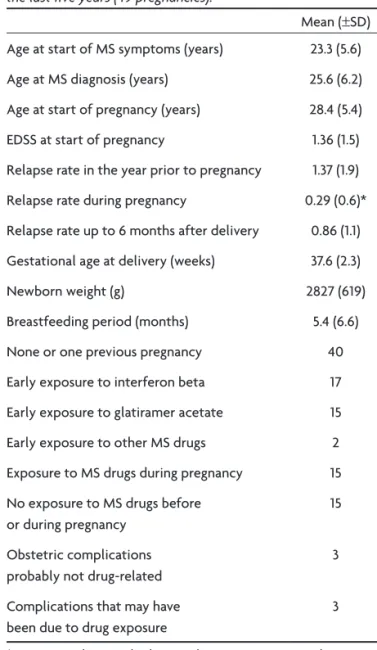
re-Table 1. Data on 47 women with MS who became pregnant over the last ive years (49 pregnancies).
Mean (±SD) Age at start of MS symptoms (years) 23.3 (5.6) Age at MS diagnosis (years) 25.6 (6.2) Age at start of pregnancy (years) 28.4 (5.4) eDSS at start of pregnancy 1.36 (1.5) relapse rate in the year prior to pregnancy 1.37 (1.9) relapse rate during pregnancy 0.29 (0.6)* relapse rate up to 6 months after delivery 0.86 (1.1) Gestational age at delivery (weeks) 37.6 (2.3) Newborn weight (g) 2827 (619) Breastfeeding period (months) 5.4 (6.6) None or one previous pregnancy 40 early exposure to interferon beta 17 early exposure to glatiramer acetate 15 early exposure to other MS drugs 2 exposure to MS drugs during pregnancy 15 No exposure to MS drugs before
or during pregnancy
15
Obstetric complications probably not drug-related
3
complications that may have been due to drug exposure
3
*p=0.002 in relation to both pre and post pregnancy periods
Table 2. Data on potential effects of different MS drugs used at any time during pregnancy.
Outcome
No drug exposure
(n=15)
Interferon beta (n=17)
Glatiramer acetate
(n=15)
cortico-steroids (n=8)
Immuno globulin
(n=3)
Methotrexate (n=1)
combination (n=11) Low birth weight 1 1 1 3 0 1 Prematurity 1 2 1 1 0 2 Birth defects 0 0 0 0 0 0 Neonatal death 0 0 0 0 0 1 [PNr] Abortion 0 0 1 [PNr] 0 1 0 Delayed intrauterine growth 0 1 0 0 0 0 Neonatal jaundice 1 0 0 0 0 0 Shoulder dystocia 0 0 1 [PNr] 0 0 0 Twin pregnancy 0 0 0 0 0 1 [PNr]
Arq Neuropsiquiatr 2009;67(3-A)
659
Multiple sclerosis: pregnancy Fragoso et al.
searchers (AF, yDF) received the returned iles and (AF) analyzed the data. The present paper was written by one of the researchers (yDF) and its contents were approved by all participants prior to submission. This work was not carried out at a single institution and it was undertaken on the authors’ own initiative, working without any inancial support. Authorization from ethics com-mittees and patients’ consent were individually obtained by the authors, in accordance with the regulations of their workplaces.
The excel ile included each patient’s demographic data, his-tory and characteristics of MS, data on clinical and neurological conditions, time of each pregnancy, medications in use at any gestational stage, number and timing of relapses, birth outcome and breastfeeding details.
The t-test was used to calculate continuous data and the chi-square test, for categorical data. correlations were assessed using the ANOvA, Pearson and Spearman tests. results were considered to be signiicant when p<0.05. SPSS version 11.5 was used for all the analyses.
reSultS
complete data from 47 women (49 pregnancies) were received and analyzed. A summary of the demographic and gestational data is presented in Table 1. regular treat-ment at the time of pregnancy diagnosis was: interferon-beta (17 cases), glatiramer acetate (15 cases), methotrexate (1 case) and corticosteroids (1 case), while 15 patients were not receiving any regular medication. Glatiramer acetate was continuously administered during pregnancy in 12 pa-tients, in accordance with their physicians’ decision and discretion. Although decreased, postpartum relapse rate in these cases were not signiicantly reduced in patients who used drugs throughout pregnancy (p=0.41).
There were no cases of fetal malformation. Obstetric complications consisted of one neonatal death (hospital infection), one abortion (polycystic ovaries and obesity) and one shoulder dystocia (baby >3,500 g).
The following complications might have been drug-re-lated. One case of abortion was temporally related to a relapse and the use of immunoglobulin. It cannot be ruled out that one case of hemorrhage and one case of delayed intrauterine growth might have been related to MS or its treatment (corticosteroids and interferon-beta 1a 22 mcg three times a week, at start of pregnancy, respectively).
One case of neonatal jaundice was reported in a pa-tient without drug exposure. There was one case of twins, born without complications, despite one sibling‘s low weight. Low birth weight or prematurity rates were simi-lar to those for developing countries (7 cases, 14.8%). Both low birth weight and prematurity were observed in three of these babies. These cases could not be correlated to any drugs, eDSS or MS duration. The only patient using methotrexate, who became pregnant despite counsel-ing and the use of birth control pills, did not present any
complication during or after pregnancy, and her normal child is now two years old.
A summary of data on the potential effect of drugs is presented in Table 2.
diScuSSion
This is the irst Brazilian collaborative study on preg-nancy and MS. The present work reports on one of the largest series of cases (49 pregnancies) recorded in proper databases in the world7-12. Only pregnancy cases from can-ada (n=16)7, Sweden8 (n=69), Spain9 (n=88), Finland10 (n=42), Italy11 (n=38) and Germany12 (n=88) have been previously reported in the literature with a similar methodology.
Our results showed no correlation among parameters in early pregnancy (different drugs, eDSS and time of dis-ease) and poor gestational outcome (low birth-weight, prematurity, birth defects and drug-related complica-tions). The lower relapse rate during pregnancy was in ac-cordance with expected results1. No signiicant increase in relapse rate was observed in the postpartum period. Our patients were of relatively young age, with low eDSS at the beginning of pregnancy, nearly half of them in their irst pregnancy, and only a small number of relapses in the year preceding pregnancy. These indings corroborate the idea, already noted by others13,14, that perhaps wom-en in better clinical condition have increased propwom-ensity to maternity, at the same time that those using more ag-gressive cytotoxic treatments may present impaired fer-tility15. The use of FDA class B drugs during pregnancy did not signiicantly alter the postpartum relapse rate. This inding further corroborates the concept that there is no indication for continuous use of medication during ges-tation, and that medical prescription should be used only in very particular cases. however, it must be considered that only the most aggressive forms of MS were treated during pregnancy in Brazil, and the similar relapse rate in those who used immunomodulators must be further as-sessed. Data collection in Brazil continues, assessing MS and pregnancy parameters, as well as drug exposure. Phy-sicians who are interested in joining the database should send an e-mail to [email protected] indicating their willingness to participate in the study.
referenceS
1. Confravreux C, Hutchinson M, Hours MM, Cortinovis-Tourniaire P, Moreau T. Rate of pregnancy-related relapse in multiple sclerosis. N Eng J Med 1998;339:283-291.
2. Bebo BF Jr, Dveskler GS. Evidence that pregnancy speciic glycoproteins regulate T-Cell function and inlammatory autoimmune disease during pregnancy. Curr Drug Targets Inlamm Allergy 2005;4:231-237.
3. Murgita RA, Andersson LC, Sherman MS, Bennich H, Wigzell H. Ef
-fects of human alpha-fetoprotein on human B and T lymphocyte pro-liferation in vitro. Clin Exp Immunol 1978;33:347-356.
Arq Neuropsiquiatr 2009;67(3-A)
660
Multiple sclerosis: pregnancy Fragoso et al.
5. Sicotte NL, Liva SM, Klutch R, et al. Treatment of multiple sclerosis with the pregnancy hormone estriol. Ann Neurol 2002;52:421-428.
6. Lopez C, Comabella M, Tintore M, Sastre-Garriga J, Montalban X. Vari
-ations in chemokine receptor and cytokine expression during pregnan-cy in multiple sclerosis patients. Mult Scler 2006;12:421-427.
7. Sandberg-Wollheim M, Frank D, Goodwin TM, et al. Pregnancy out
-comes during treatment with interferon beta-1a in patients with mul-tiple sclerosis. Neurology 2005;65:802-806.
8. Boskovic R, Wide R, Wolpin J, Bauer DJ, Koren G. The reproductive effects of beta interferon therapy in pregnancy: a longitudinal cohort. Neurology 2005;65:807-811.
9. De Las Heras V, De Andrés C, Téllez N, Tintoré M, EMPATIE Study Group. Pregnancy in multiple sclerosis patients treated with immu-nomodulators prior to or during part of the pregnancy: a descriptive study in the Spanish population.Mult Scler 2007;13:981-984.
10. Saraste M, Vaisanen S, alanen A, Airas L, Finnish Multiple Sclerosis and Pregnancy Study Group. Gen Med 2007;4:45-55.
11. Patti F, Cavallaro T, Lo Fermo S, et al. Is in utero early-exposure to in
-terferon beta a risk factor for pregnancy outcomes in multiple sclero-sis? J Neurol 2008;255:1250-1253.
12. Hellwig K, Brune N, Muller T, Schimrigk S, Schwodiauer V. Reproduc
-tive counselling, treatment and course of pregnancy in 73 German MS patients. Acta Neurol Scand 2008;118:24-28.
13. Argyriou AA, Makris N. Multiple sclerosis and reproductive risks in women. Reprod Sci 2008;15:755-764.
14. Lee M, O’Brien P. Pregnancy and multiple sclerosis. J Neurol Neuro
-surg Psychiatry 2008;79:1308-1311.
15. Cocco E, Sardu C, Gallo P, et al. Frequency and risk factors of mitox