
ACUTE DISSEMINATED ENCEPHALOMYELITIS
Clinical features, HLA DRB1*1501, HLA DRB1*1503, HLA DQA1*0102,
HLA DQB1*0602, and HLA DPA1*0301 allelic association study
Soniza Vieira Alves-Leon
1,2,3, Maria Lucia Veluttini-Pimentel
3,4,
Maria Emmerick Gouveia
5, Fabíola Rachid Malfetano
3,5, Emerson L. Gaspareto
6,
Marcos P. Alvarenga
2, Izabel Frugulhetti
6, Thereza Quirico-Santos
7Abstract – We evaluated the frequency, demographic, clinical, disability evolution and genetic association of HLA DRB1*1501, DRB1*1503, DQA1*0102, DQB1*0602 and DPA1*0301 alleles in patients diagnosed as acute disseminated encephalomyelitis (ADEM) among a population of CNS demyelinating diseases. Fifteen patients (8.4%) of our series were diagnosed as ADEM. The mean age onset was 35.23 years (range 12 to 77), 53.3% were male and follow-up range was 8.5 to 16 years. Two cases (13.3%) had a preceding infection before neurological symptoms, one presented a parainfectious demyelinating, and one case had been submitted to hepatitis B vaccination four weeks before the clinical onset. The EDSS range was 3.0 to 9.5. Eight patients (53.3%) presented MRI with multiple large lesions. CSF was normal in 73.3%. The severe disability observed at EDSS onset improved in 86.66% patients. The genetic susceptibility for ADEM was significantly associated with the HLA DQB1*0602, DRB1*1501 and DRB1*1503 alleles (<0.05) in monophasic ADEM.
KEy WoRDS: ADEM, HLA class II, demyelinating disease.
Encefalomielite aguda disseminada: características clínicas e estudo de associação com os alelos HLA DRB1*1501, HLA DRB1*1503, HLA DQA1*0102, HLA DQB1*0602 e DPA1*0301
Resumo – Avaliamos as frequencia, características demográficas, clínicas e de associação genética dos alelos HLA DRB1*1501, DRB1*1503, DQA1*0102, DQB1*0602 e DPA1*0301 em pacientes com diagnóstico de encefalomielite aguda disseminada (ADEM) em população com doença desmielinizante do SNC. Quinze (8,4%) pacientes de nossa série foram diagnosticados como ADEM. A média de idade foi 35,23 anos (variando entre 12 e 77), 53,3% eram homens e o tempo de acompanhamento variou entre 8,5 e 16 anos. Dois casos (13,3%) apresentaram infecção prévia, um apresentou processo desmielinizante para infeccioso e outro havia se submetido a vacinação para hepatite B quatro semanas antes. o EDSS variou entre 3,0 e 9,5. oito pacientes (53,3%) apresentaram grandes lesões na RM. o LCR foi normal em 73,3%. A incapacidade grave quantificada pelo EDSS foi seguida de melhora importante em 86,6% dos pacientes. A susceptibilidade genética na ADEM foi significativamente associada com os alelos HLA DQB1*0602, DRB1*1501 e DRB1*1503 (p<0,05) nos pacientes com quadro monofásico. PALAVRAS-CHAVE: ADEM, HLA classe II, doenças desmielinizantes.
1Neurologist Associate Professor, Universidade Federal do Estado do Rio de Janeiro (UNIRIo), Rio de Janeiro RJ, Brazil; 2NeurologyPostgraduation Program UNIRIo; 3Universidade Federal do Rio de Janeiro (UFRJ), Rio de Janeiro RJ, Brazil; 4Neurologist, Serviço de Neurologia da Santa Casa da Misericórdia do Rio de Janeiro, Rio de Janeiro RJ, Brazil; 5Laboratory of Molecular Biology, Universidade Federal Fluminense (UFF), Neurologist, Hospital Naval Marcílio Dias, Rio de Janeiro RJ, Brazil; 6Assistant Professor of Radiology Department, UFRJ; 7Full Professor, UFF.
Received 13 March 2009, received in inal form 4 May 2009. Accepted 11 May 2009.
Dra. Soniza Vieira Alves-Leon – Neurology Department / Hospital Universitário Clementino Fraga Filho/ UFRJ - Rua Professor Rodolpho Paulo Rocco 255 21941-913 Rio de Janeiro RJ - Brasil. E-mail: [email protected]
Acute disseminated encephalomyelitis (ADEM) is a de-myelinating disorder characterized by multifocal involve-ment of the central nervous system (CNS) white and gray matter and, in some cases, peripheral nervous system
it is named post-infectious encephalomyelitis (PIEM) or, when associated to immunization is considered post-vac-cination encephalomyelitis (PVEM)6-9. ADEM can progress with recurrent manifestation of multiple functional neu-rological systems, similar to multiple sclerosis (MS), and, in these cases, it is deined as multiphasic encephalomy-elitis (MDEM)5,9. When the same functional neurological systems are involved, characterizing a stereotypic recur-rent neurological deicit identical of the irst demyelinat-ing event, it is denominated recurrent encephalomyeli-tis (RDEM)5,9-12.Post-infectious forms of encephalomyeli-tis, also termed ADEM compose one of the several cat-egories of inlammatory demyelinating disorders (IDD) of the CNS13,14. Recently, new criteria for pediatric popu-lation were proposed10. Pediatric monophasic ADEM in-cludes obligatorily encephalopathy associated to multi-focal areas of CNS demyelinating or inlammatory origin, after exclusion of any other cause10-12 and neuroimaging showing focal or multifocal lesions predominantly involv-ing white matter, without evidence of previous lesions10. The pediatric RDEM is deined as a new event of ADEM, with recurrence of the same initial signs and symptoms, always associated to encephalopathy; magnetic resonance image (MRI) shows no new lesion and the original ones can have enlarged, during a interval time of three months, or more, of the remission, and at least one month after the last treatment with corticosteroids10-12. The pediatric MDEM diagnoses requires encephalopathy associated to new polysymptomatic neurological dysfunction, new MRI lesions, and an equal interval time of three months, or more, after the recovering of the irst attack and at least one month after corticosteroids treatment ending20; the MRI needs to show new areas of involvement and com-plete or partial resolution of the irst ADEM event11,12.
ADEM is thought to be an autoimmune disorder of the CNS targeting the myelin. Possibly, a T cell mediated au-toimmune response to myelin basic protein, triggered by an infection or vaccination, underlies its pathogenesis15-18. Studies on peripheral immunocytes and on cerebrospinal luid (CSF) revealed the presence of cytokine-mediated responses in ADEM19. As the cytokines proiles are mediat-ed by the human leukocyte antigen (HLA), it can be spec-ulated a possible association between ADEM and HLA al-leles. ADEM followed poliomyelitis vaccine virus was re-ported in a Japanese child associated with the HLA-Cw3 and HLA-DR2, which are related to multiple sclerosis (MS) in Japan8. A linkage genetic study in children showed that ADEM was associated with HLA DRB1*01 and DRB1*017(03) in the Russian population, and these alleles are associated with MS in Russian patients20. In Brazil, MS has been asso-ciated with HLA DR2 in Caucasian21 patients and with HLA DQB1*0602 independently of DRB1*1501, in African-de-scendent patients of Rio de Janeiro City (RJC)21-23.
The aim of this study was to analyze the clinical fea-tures and the genetic association of HLA DRB1*1501, HLA DRB1*1503, HLA DQA1*0102, DQB1*0602 and HLA DPA1*0301 alleles in a group of Brazilian ADEM patients.
METHOD
Adult patients were classiied as ADEM according to descrip-tions proposed by Brinar and Poser1, and pediatric patients were
classiied according to International Pediatric MS Study Group (IPMSSG)10. They were grouped as monophasic ADEM if no new
neurological functional deicit or MRI lesion occurred until at least 3 months of the irst event recovering, and at least one month after the treatment with corticosteroids. The patients included should be at least 8.5 years of follow up. The pediatric patients were classiied as ADEM, MDEM or RDEM according to IPMSSG10, and adult ADEM,MDEM or RDEM patients according
to Brinar and Poser studies1.
Clinical symptoms and disability were measured by the ex-panded disability scale score (EDSS)24 during the irst
demyeli-nating event and after recovered. The last evaluation in 2008 measured the interval time between the first and the actual EDSS. The brain MR imaging, cerebral spinal luid (CSF) indings and the response to a standardized treatment during the acute phase of the disease and the follow up were assessed.
The genetic association study of the HLA DQB1*0602, DQA1*0102, DRB1*1501, DRB1*1503 and DPA1*0301 alleles com-pared the 15 ADEM/MDEM/RDEM patients with 84 healthy matched controls. It was considered for the present study only the genetic association analysis of monophasic ADEM patients.
Analyses of alleles by PCR methods
Genomic DNA was isolated from proteinase-K treated pe-ripheral blood leukocytes by the salting-out method25. The
anal-ysed of sub regions of HLA DRB1, DQA1, DQB1 and DPA1 was performed by polymerase chain reaction (PCR) with sequence-speciic primers. The genomic DNA was isolated from peripher-al blood leukocytes by the speripher-alting-out method. Each 10 mL PCR reaction consisted of 100 ng genomic DNA, PCR buffer (50 mM-KCl, 1.5 mM MgCl2, 10 mM Tris-HCl), 200 mM each of dATP, dCTP, dGTP and dTTP, 0.40 mM of the group-speciic primers. PCR re-action mixture was obtained in total 25 uL of rere-action including l0pM of each PCR primer speciic HLA fragment ampliication and 45 PCR cycles (95oC 20 sec, 55–60oC 20sec and 72oC 30 sec)
were run. The whole PCR reactions were directly electrophore-sed in 2% ME agarose gels prestained with ethidium bromide (0.5 mg mL»1 gel). The gels were run at 10 V cm-1 for 15 min in 1X TBE
buffer (1X TBE=80 mMTris base, 80 mM boric acid, 2 mM EDTA, pH 8.0), visualized under ultraviolet (UV) illumination and doc-umented by photography.
RESULTS
Among 226 patients with idiopathic inlammatory de-myelinating disease (IIDD) of CNS follow-up in our Uni-versity Hospital from 1992 to 2008, 25 (11.06%) were di-agnosed as ADEM. Fifteen (8.4%) patients were included in this study. The follow up ranged from 8.9 years to 16 years. The mean age onset was 35.2 years (range 12 to 77 years-old), 55.3% were male. Eight patients (53.33%) were African-descendents.
Thirteen patients were adult and fulill the ADEM/
MDEM/REDEM characteristics1. Two patients
present-ed less than 19 years old and fulfill criteria for ppresent-ediat- pediat-ric ADEM10-12.
The two pediatric patients with ADEM presented en-cephalopathy and polysymptomatic neurological mani-festations. In adult group of patients, encephalopathy oc-curred in three cases, one of them during a neuromyeli-tis optica (NMo) syndrome, and in two others during the irst polysymptomatic demyelinating event.
ADEM was associated with previously infection in two patients (13.3%) and to hepatitis B vaccination in one (6.6%). ADEM occurred simultaneously to an infection in one (6.6%) but no microorganism was found in the vi-rology and fungus/bacteriology culture of CSF. The CSF analysis, investigated during the acute phase of the ini-tial event, was normal in 73.4% of the patients; three
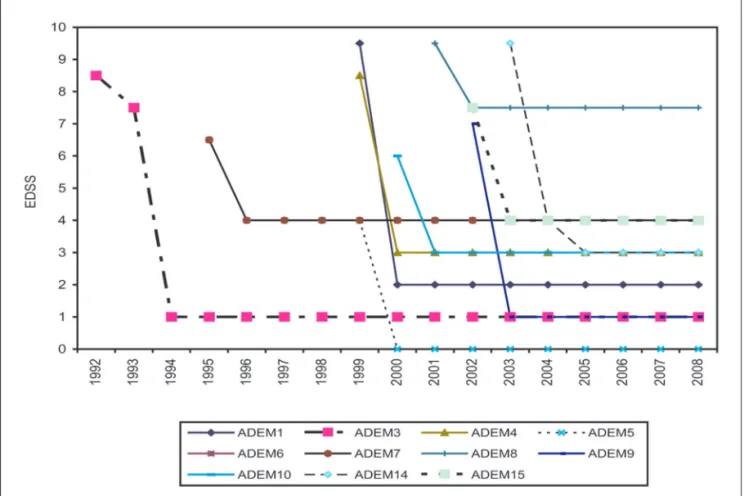
pa-Fig 1. Patient number 1 to 15 and the EDSS level during the irst and the last neurological exams: 86.66% of patients presented a signii-cant improvement of the onset disability.
Fig 3. Case 13. A 43-year-old female patient with ADEM/MDEM. Axial T2-weighted [A] and T1-weighted af-ter gadolinium administration [B] show two large lesions in the fronto-parietal regions, which demonstrate high signal on T2-weighted images and incomplete ring-enhancement post-gadolinium. Other foci of high sig-nal on weighted images are seen in the left frontal white matter. After treatment with corticosteroids, T2-weighted [C] and T1-T2-weighted after gadolinium [D] show almost complete regression of the lesion, with per-sistence of high signal foci in the frontal white matter bilaterally. The follow-up MR images eight years later demonstrate bilateral areas of high signal on T2-weighted [E] and FLAIR [F] images, mainly in the peri-atrial regions, as well as mild brain atrophy.
tients presented positive oligoclonal bands (20%) and one had an inlammatory CSF (6.6%) with severe pleocytosis and high protein level without a speciic antigen. Two of the three MDEM patients showed positive oligoclonal bands (oGC).
Four patients (26.67%) presented large intracranial masses and underwent biopsy, as well as a patient with cervical lesion that was initially asumed as a tumor. Three patients (20%) presented multiphasic evolution and one case had a recurrent form of ADEM.
During the acute event, the EDSS ranged from 3.0 to 9.5 and the follow-up was associated with almost completely recovered or signiicant improvement in all 15 cases (Fig 1).
When we assess the progression of the 11 patients with ADEM and of the four patients with MDEM/RDEM, we clearly see the EDSS decrease after a monophasic event (Fig 2), and MDEM/RDEM patients progression were sim-ilar to the relapsing-remitting course of MS.
The acute onset of the neurological symptoms was
Fig 5. Case 8. A 20-year-old male patient with ADEM. Axial T1-weighted [A], T2-weighted [B] and FLAIR MR images [C] demonstrate a single lesion hypointense on T1 and hyperintense on T2 and FLAIR images, which has minimal mass effect and is located in the left insula and lentiform nucleus region.
Fig 6. Case 4.A 43-year-old female patient with ADEM. Sagittal T2-weighted [A and B] and T1-weighted after gadolinium administration [C] MR images show a hyperintense lesion extending from the medulla oblongata to the level of C4, which demonstrate an area of contrast enhance-ment (white arrow-head). The patient underwent a biopsy, which was negative for tumor, and she was treated with corticosteroids with good clinical improvement. The follow-up MR image [D] Sagittal T2-weighted image shows regression of the lesion and the area of malacia (black arrow) secondary to the surgery.
seen in eight patients (53.4%) and sub-acute in seven cas-es (46.6%). The polysymptomatic neurological signs and symptoms occurred in all patients, and were associated to encephalopathy in three adults MDEM patients and in two ADEM pediatric patients. The most frequent neuro-logical syndrome was motor functional system involve-ment (86.6%), followed by the sensory symptoms (53.3%), consciousness and cognitive disturbance (33.3%), optical neuritis (26.6%), ataxia (20%), epileptic seizures (20%) and radiculopathy (6.6%).
In most of the cases (n=8, 53.3%), brain MRI showed large, conluent or tumefactive lesions, usually with perile-sional edema and mass effect (Figs 3, 4, 5), which were mul-tiple in ive and single in three cases. Three patients pre-sented multiple small lesions (smaller than 5 cm), mainly involving sub cortical and peri ventricular regions, associ-ated to gadolinium enhancement. one patient had a large longitudinal medullar lesion (Fig 6), which reached the bul-bar region, and the other two had multifocal spinal cord le-sions. In three cases, large lesions were seen in association to spinal cord lesions areas of signal abnormality (Fig 7).
Genetic association study result
The genetic association study of the HLA DRB1*1501,
DRB1*1503, DQA1*0102, DQB1*0602, and DPA1*0301 was compared with 84 matched healthy controls (Table 1).
The results of the allelic association can be compared among the 11 monophasic ADEM patients according with the disease duration and EDSS. The HLA DQB1*0602 (90.9%
versus 35.7%, p=0.0001) and HLA DRB1*1503 (45.4% versus
10.7%, p=0.01) were signiicantly associated with ADEM, as well as the DRB1*1501(36.3% versus 13.0% p=0.01) (Table 2).
DISCUSSION
The similar clinical characteristics of ADEM and MS constitute one of the major problems among the differen-tial diagnosis of MS and other primary inlammatory de-myelinating diseases of the CNS5-7,9,11,19,25,26. ADEM has been considered a disease with favorable long term diagnosis, which is not commonly seen in patients with MS9,11,13. Al-though ADEM is supposed to be a monophasic illness, the possibility of multiphasic or recurrent progression needs to be considered1,5,9-12. The differentiation between ADEM and a first attack of MS is difficult and has prognostic and therapeutic implications11,12,27. The search for biologi-cal markers to differential diagnosis between ADEM and MS has failed28. In pediatric patients, the diagnostic crite-ria for ADEM, MDEM and RDEM were recently proposed Table 1. The 11 monophasic ADEM patients listed with the onset EDSS, the last EDSS, evolution type, and association with the alleles HLA class II studied.
EDSS1 EDSS2 DQB1*0602 DQA1*0102 DPA1*0301 DRB1*1501 DRB1*1503
ADEM1 9.5 2.0 + + + + +
ADEM3 7.5 1.0 + + – – –
ADEM4 8.5 3.0 – – + + –
ADEM5 4.0 0.0 + – – – –
ADEM6 6.5 4.0 + – – – –
ADEM7 6.5 4.0 + – + + –
ADEM8 9.5 7.5 + + – – +
ADEM9 9.0 1.0 + – + – +
ADEM10 6.0 3.0 + + – + +
ADEM14 9.5 4.0 + – + – –
ADEM15 7.5 4.0 + – + – +
Table 2. The allelic association of DRB1*1501, DRB1*1503, DQA1*0201, DQB1*0602 and DPA1*0301 among 11 ADEM patients and 84 healthy matched controls.
Patients N=11 (%) Controls N=84 (%) p Pc oR
DQB1*0602 10 (90.9) 30 (35.7) 0.0004 0.0001 18.00
DQA1*0102 4 (36.3) 24 (28.5) 0.59 0.85 1.43
DRB1*1501 4 (36.3) 10 (13.0) 0.04 0.12 3.79
DRB1*1503 5 (45.4) 9 (10.7) 0.004 0.01 6.17
and have been applied10, but for adults it not clearly de-ined. The lack of ADEM diagnostic criteria in adults per-mitting a calculation of “conversion rate” for ADEM to MS is probably associated to a short observation period. our study is longest than the previously longest follow-up of patients with ADEM3,4,29
In the present study we have evaluated 15 ADEM pa-tients, eleven of them monophasic, three multiphasic (MDEM) and one with recurrent (RDEM) evolution. Two patients were pediatric. As previously reported in pediat-ric patients, ADEM patients from our series presented sub cortical white matter aggression, which progressed as iso-lated acute encephalitis, multifocal myelitis or both, and polysymptomatic neurologic symptoms10,11,13,30. The optic neuritis, transverse demyelinating myelitis, like Devic’s syndrome14, hemiparesia, ataxia and brainstem syndromes were the neurological syndromes seen in our ADEM es, resembling MS and NMo symptoms. one of our cas-es (patient 8) with encephalomyeloradiculoneuropathy il-lustrated the combination of ADEM with acute peripheral neuropathy, as has been showed by Poser1,9.
In addition, a twelve-years-old girl (patient 14) began the neurological manifestation with cognitive impair-ment and progression to bilateral optical neuritis, pro-gressive motor deicit and pseudobulbar symptoms, re-sembling initially a sub acute pan encephalitis. The MRI showed lesions suggestive of Schilder’s disease, and she recovered the tetraplegia and cognitive dysfunction al-most completely after intravenous methylprednisolone (IVMP) treatment. our indings are similar to the charac-teristic clinical features described by other authors who includes sudden onset of multifocal neurologic distur-bances sometimes associated with a depressed level of consciousness and signs of an acute meningoencephalop-athy, focal or generalized seizures and psychosis. Recently, encephalopathy, characterized by cognitive impairment, consciousness disturbance or psychiatric symptoms, is re-quest in the diagnostic criteria of ADEM, MDEM or RDEM among pediatric patients10,12.
our two pediatric patients presented all these symp-toms and fulill IPMSSG criteria10. one of them presented a consciousness impairment associated to transverse my-elitis. The spinal cord MRI showed longitudinal transverse medullar extension lesion (LETML) (Fig 7), normal cranium MRI and inlammatory CSF. Treated with IVMP, improved after days, and two months latter presented a recurrence of the myelitis and consciousness impairment; at this mo-ment, cranium MRI showed new large lesions (Fig 7). This patient illustrates step by step the new pediatric ADEM diagnoses10: he presented two polysymptomatic neurolog-ical manifestations, both of them associated to encephal-opathy; we classiied as monophasic ADEM because the “new manifestation” occurred before three months of the
initial event, and is considered part of it. He was treated with IVMP and presented completely recovered.
As described by Hartung et al.17, our patients also reached several deicits within few days, followed by sim-ilar rapid remission. No one of our patients died, and the low lethality of ADEM was also found by other authors who call attention to the actual contrast with the high mortality rate in the past.
The eleven monophasic ADEM patients followed in our analysis did not present new clinical attack during the long follow-up ranged from almost 9 to 16 years, and the last MRI didn’t show any new lesion. They can be consid-ered classic cases of monophasic ADEM. In this group two patients presented NMo syndrome. one of them pre-sented bilateral optical neuritis followed 48 hours later by acute transverse thoracic myelitis, with normal crani-um MRI, spinal cord MRI showing LTMEL involving more than three segments, and normal CSF. This patient could fulill Wingerchuket al.14 clinical criteria for NMo, but in this case the NMo syndrome was a parainfecctious de-myelinating event, with all CSF culture negative. This pa-tient presented lung tuberculosis, which was diagnosed and treated simultaneously with IVMP. He recovered com-pletely and has been followed for the last 10 years with no new relapsing. The other NMo ADEM syndrome occurred in a patient who opened the symptoms with headache, visual disturbance, tetraplegia and consciousness impair-ment (Fig 6). This patient was submitted to cervical biop-sy which showed an unspeciic inlammatory process. The treatment with IVMP was followed by partial improve-ment and no new relapsing. The presence of encephalop-athy is not seemed in diagnosis criteria of NMo.
present-ed polysymptomatic neurologic manifestation and multi-ple large lesions of white and gray matter involving crani-um and cervical region, after less than four weeks of hep-atitis B immunization. The evolution for relapsing-remit-ting neurological manifestations and new MRI lesions in the last years could move the ADEM diagnosis to MS, but accordingly to Brinar and Poser1, the temporal onset of a post-immunization event allow us to consider this case a post-infeccious ADEM, evaluating as MDEM.
The similarities in clinical, MRI and pathogenesis ind-ings of ADEM and other inlammatory demyelinating dis-eases of CNS, as MS, NMo and Schilder disease, made some authors considered ADEM as part of the spectrum of IDD. The relationship between ADEM and MS remains a matter of controversy1, and our three MDEM adult cas-es illustratcas-es thcas-ese dificulticas-es. We can’t distinct the clin-ical manifestations of our MDEM patients as exclusive of ADEM. Nevertheless, epileptic seizures were high frequent than in MS patients (20% in our ADEM/MDEM series ver-sus 5% reported by Poser in MS patients9). The presence of encephalopathy and temporal relationship with immuni-zation or infection process suggest a distinct condition.
Considering the MRI indings, large and multifocal le-sions in the brain and spinal cord can suggest the ADEM diagnosis, and those lesions were present in all patients of our series. In pediatric ADEM, the MRI large lesions are not included in diagnostic criteria10, and in adult pa-tients it is still undeined. The MRI abnormalities are most frequently seen on T2-weighted and luid-attenuated in-version recovery (FLAIR) sequences as patchy, ill-deined areas of high-signal intensity. The lesions are frequently large, multiple, and asymmetric, involving the sub cortical and central white matter and cortical gray-white junction of cerebral hemispheres, cerebellum, brainstem, and spi-nal cord. The gray matter of the thalami and basal ganglia are commonly involved, typically in a symmetric pattern. Four patterns of cerebral involvement have been pro-posed to describe the MRI indings in patient with ADEM: (1) ADEM with small lesions; (2) ADEM with large, conlu-ent, or tumefactive lesions, with extensive perilesional edema and mass effect; (3) ADEM with additional sym-metric bithalamic involvement; and (4) acute hemorrhag-ic encephalomyelitis. The prevalence of gadolinium en-hancement of the lesions is variable and depends on the stage of inlammation, being described in 30 to 100% of patients31,32. In our series, most of the cases presented the pattern associated with large, conluent or tumefactive lesions, which was seen in 53.3% of the patients. In addi-tion, four cases showed the pattern of multiple small le-sions. None of our patients presented the patterns with symmetric thalamic involvement or of the acute hemor-rhagic encephalomyelitis.
The CSF analysis in our series showed pleocytosis in
only one patient, different from literature that usually ind it, but the rarity of intrathecal band found here is in according with other studies33,34. Besides these indings, CSF results are not distinctive enough to allow discrimi-nation between ADEM and MS.
The interesting aspect of our series is the HLA allele association study. We found signiicantly association of HLA DQB1*0602, HLA DRB1*1501 and DRB1*1503 alleles with ADEM monophasic patients. The HLA DQB1*0602 allele confers genetic susceptibility to Brazilian MS pa-tients from Rio de Janeiro City (RJC), independently of the genetic background21-23. The presence of a common allele conferring genetic susceptibility for both MS and ADEM in the same population was found by Idrissovaet al.20 among Russian MS and ADEM patients. In the present study, we found the HLA DQB1*0602 and HLA DRB1*1501 alleles sharing genetic susceptibility to MS and ADEM in patients from RJC. HLA DRB1*1501 confers MS susceptibili-ty only to White RJC MS patients21, but the low number of ADEM patients didn’t allow us to distinct African-descen-dents and White patients allelic association.
Concerning to HLA DRB1*1501, this allele has been con-tinually pointed out as a protection factor to MS patients, associated to low morbidity when compared the MS out-come of patients who are DRB1*1501 negative22. The signif-icantly association of ADEM patients with HLA DRB1*1501 allele can speculate about a protector role of these allele among the monophasic course and rapid improvement of those patients. Accordingly to this point of view, Id-rissovaet al.20 also found association of HLA DRB1*01 al-lele with ADEM susceptibility in Russian patients. And like DRB1*1501, DRB1*01 has been described as an allele asso-ciated to low morbidity in MS patients.
We previously described that HLA DRB1*1503 is an al-lelic characteristic of African descent in both MS patients and controls, and this allele is not associated to the sus-ceptibility or either protection to MS in Brazilian patients from the Rio de Janeiro City22. Among our ADEM patients, HLA DRB1*1503 confers genetic susceptibility. The con-comitant presence of an allele attributed to MS low mor-bidity, as DRB1*1501, associated to HLA DRB1*1503, this last one associated to a genetic characteristic of African population (an original population who seems to be more resistant than others to MS) can suggest some kind of pro-tection contributing to a monophasic pattern of ADEM demyelinating event. The low number of patients is a lim-it factor, but the power of our results is supported by the careful clinical and MRI analysis and the long follow-up. These results need to be conirmed in largest series of ADEM patients, and differential diagnosis between ADEM and MS in adults still remains35.
Neuroimmu-nological Unit of our University Hospital. The frequen-cy of multiphasic and recurrent forms was smaller. The ADEM showed a similar prevalence in both genders, with age of presentation raging from 12 to 77 years, and simi-lar frequency in White and African descendent. The acute and the polysymptomatic neurological presentation, con-sciousness impairment and epileptic seizures were com-mon. The outcome was favorable, with EDSS showing sig-niicant decrease in most of the cases. The alleles HLA DQB1*0602, DRB1*1501 and DRB1*1503confers genetic susceptibility to ADEM in our series, and except to the DRB1*1503 association, these results are similar to our indings in MS patients from the Rio de Janeiro City.
REFERENCES
1 Brinar V, Poser CM. Disseminated encephalomyelitis in adults. Clin Neurol Neurosurg 2008;110:913-918.
2 Garg RK. Acute disseminated encephalomyelitis. Postgrad Med J 2003; 927:11-17.
3. Gupte G, Stonehouse M, Wassmer E, Coad NA, Whitehouse WP. Acute disseminated encephalomyelitis: a review of 18 cases in childhood. J Paediatr Child Health 2003;5:336-342.
4. Menge T, Hemmer B, Nessler S, et al. Acute disseminated encephalo-myelitis: an update. Arch Neurol 2005;62:1673-1680.
5. Poser CM. Multiple sclerosis and recurrent disseminated encephalo-myelitis are different diseases. Arch Neurol 2008;65:674-675. 6. Alves-Leon SV, Lavrado FP, Fonseca M, Sohler MP, Alvarenga RP.
Hep-atitis B vacination in a case of CNS demyelination: multiphasic demy-elination encephalomyelitis, postvaccinal demydemy-elination or a new syn-drome? Rev Neurol Argentina 2000;25:3.
7. Alves-Leon SV, Basto R, Dominguez R, et al. Neuromyelitisoptica (NMO) associated to tuberculosis infection: case report. Rev Neurológica 2002;12:1184.
8. Ozawa H, Noma S, Yoshida Y, Sekine H, Hashimoto T. Acute dissemi-nated encephalomyelitis associated with poliomyelitis. Pediatric Neu-rol 2001;4:325.
9. Poser CM. Multiple sclerosis: diagnosis and treatment. Med Principles Pract 1993;3:1-16.
10. Krupp LB, Banwell B, Tenembaum S. for the International Pediatric
MS Study Group. Consensus deinitions proposed for pediatric multi
-ple sclerosis and related disorders. Neurol 2007;68(Suppl2):S7-S12. 11. Tenembaum S, Chitnis T, Ness J, Hahn JS. International Pediatric MS
Study Group. Acute disseminated encephalomyelitis. Neurology 2007; 68(Suppl 2):S23-S36.
12. Tenenbaum S. Disseminated encephalomyelitis in children. Clin Neu-rol Neurosurg 2008;110:928-938.
13. Wingerchuk DM. The clinical course of acute disseminated encephalo-myelitis. Neurol Res 2006;28:341-347.
14. Wingerchuk DM, Lennon VA, Pittock SJ, et al. Revised diagnostic cri-teria for neuromyelitisoptica. Neurology 2006;66:1485-1489.
15. Dale RC, Morovat A. Interleukin-6 and oligoclonal IgG synthesis in children with acute disseminated encephalomyelitis. Neuropediatrics 2003;3:141-145.
16. Durán I, Martinez-Carcere EM, Brieva L, et al. Similar pro-and
anti-in-lammatory cytokine production in the different clinical forms of mul
-tiple sclerosis. Mult Scler 2001;7:151-156.
17. Hartung HP, Achelos JJ, Zielasek J, et al. Circulating adhesion
mole-cules and inlammatory mediators in demyelination: a review. Neu
-rology 1995;45:22-32.
18. Ichiyama T, Shoji H, Kato M, et al. Cerebrospinal luid levels of cytok
-ines and soluble tumour necrosis factor receptor in acute disseminat-ed encephalomyelitis. Eur J Pdisseminat-ediatr 2002;3:133-137.
19. Kadhim H, De Prez C, Gazagnes MD, Sebire G. In situ cytokine im-mune responses in acute disseminated encephalomyelitis: insights into pathophysiologic mechanisms. Hum Pathol 2003;3:293-297.
20. Idrissova ZhR, Boldyreva MN, Dekonenko EP, et al. Acute disseminat-ed encephalomyelitis in children: clinical features and HLA-DR link-age. Eur J Neurol 2003;5:537-546.
21. Papais-Alvarenga RM, Alves-Leon SV, Miranda Santos CM, et al. South Atlantic project: a Brazilian multiple sclerosis trial. In: Arriagada RC, Nogales-Gaete J (Eds). Esclerosis múltiple: una mirada Ibero Pan Amer-icana. Santiago Chile: ArrynogEdiciones, 2002:35-45.
22. Alves-Leon SV, Papais-Alvarenga R, Magalhães M, Alvarenga M, Thuler LC, Fernandez y Fernandez O. Ethnicity-dependent association of HLA DRB1-DQA1-DQB1 alleles in Brazilian. Acta Neurol Scand 2007; 115:306-311. 23. Caballero A, Alves-Leon S, Papais-Alvarenga R, Fernandez O, Navar-ro G, Alonso A. DQB1*0602 confers genetic susceptibility to multiples-clerosis in Afro-Brazilians. Tissue Antigens 1999;5:524-526.
24. Kurtzke JF. Rating neurological impairment in multiple sclerosis: an ex-panded disability status scale (EDSS). Neurology 1983;33:1444-1452. 25. Olerup O, Aldener A, Fogdell A. HLA- DQB1 and – DQA1 typing by
PCR ampliication with sequence-specifc primers (PCR-SSP) in 2 hours.
Tissue Antigens 1993;41:119-134.
26. Alves-Leon, SV, Malfetano FR, Pimentel MLV, et al. Multiple sclerosis
outcome and morbi-mortality of a Brazilian cohort patients. Arq Neu
-ropsiquiatr 2008;66:671-677.
27. Tintore M, Rovira A, Martínez MJ, et al. Isolated demyelinating syn-dromes: comparison of different MRI criteria to predict conversion to
clinically deinite multiple sclerosis. Am J Neuroradiol 2000;21:702-706.
28. Chopra B, Abraham R, Abraham A. CSF beta-1 globulin--a potential marker in differentiating multiple sclerosis and acute disseminated en-cephalomyelitis: a preliminary study. Neurol India 2002;1:41-44. 29. Jin S, Hahn JS, Pohl D, Rensel M, Rao S. Diferential diagnosis and
evalua-tion in pediatric multiple sclerosis. Neurology 2007;68(Suppl 2):S13-S22. 30. Lim KE, Hsu YY, Hsu WC, Chan CY. Multiple complete ring-shaped
enhanced MRI lesions in acute disseminated encephalomyelitis. Clin Imaging 2003;4:281-284.
31. Holtmannspotter M, Inglese M, Rovaris M, Rocca MA, Codella M, Fil-ippi M. A diffusion tensor MRI study of basal ganglia from patients with ADEM. J Neurol Sci 2003;1:27-30.
32. Hong PL, Ho HK, Cheng PW, Wong VC, Goh W, Chan FL. Childhood acute disseminated encephalomyelitis: the role of brain and spinal cord MRI. Pediatr Radiol 2002;1:59-66.
33. Hollinger P, Sturzenegger M, Mathis J, Schroth G, Hess CW. Acute dis-seminated encephalomyelitis in adults: a reappraisal of clinical, CSF,
EEG, and MRI indings.J Neurol 2002;3:320-329.
34. Schwarz S, Mohr A, Knauth M, Wildemann B, Storch-Hagenlocher B.Acute disseminated encephalomyelitis: a follow-up study of 40 adult patients. Neurology 2001;10:1313-1318.
35. Maranhão-Filho P. Multiple sclerosis or multiphasic disseminated
![Fig 4. Case 2. A 49-year-old male patient with ADEM/MDEM. Axial T2-weighted [A and B] and coronal T1- T1-weighted after gadolinium administration [C] show multiple hyperintense oval and round lesions bilaterally in the white matter, mainly in the peri-ven](https://thumb-eu.123doks.com/thumbv2/123dok_br/15432293.594906/4.955.158.757.682.1098/patient-weighted-weighted-gadolinium-administration-multiple-hyperintense-bilaterally.webp)
![Fig 6. Case 4.A 43-year-old female patient with ADEM. Sagittal T2-weighted [A and B] and T1-weighted after gadolinium administration [C] MR images show a hyperintense lesion extending from the medulla oblongata to the level of C4, which demonstrate an are](https://thumb-eu.123doks.com/thumbv2/123dok_br/15432293.594906/5.955.110.895.421.655/sagittal-weighted-gadolinium-administration-hyperintense-extending-oblongata-demonstrate.webp)

