Hospital Universitário Professor Edgard Santos - Universidade Federal da Bahia Mailing address: Antonio Carlos Beisl Noblat - Rua Quintino de Carvalho, 126/204 Cep 40155-280 - Salvador, BA, Brazil - E-mail: [email protected]
Received: 11/12/02 Accepted: 6/16/03
English version by Stela Maris C. e Gandour
Arq Bras Cardiol, volume 82 (nº 2), 116-20, 2004
Antonio Carlos Beisl N oblat, Marcelo Barreto Lopes, Antonio Alberto Lopes
Salvador, BA - Brazil
Race and Hypertensive Target-Organ Damage in Patients
from an University-Affiliated Outpatient Care Referral
Clinic in the City of Salvador
Studies carried out in the United States have shown that arterial hypertension is more frequent in black than in white individuals 1, and the racial differences are greater in the more
severe forms and in the complications related to the disease, mainly chronic renal failure, stroke, and left ventricular hyper-trophy 2-4. Similarly to that observed in the Unites States, in
Bra-zil, the prevalence of arterial hypertension is greater among black than among white individuals 5-11, the racial differences
being greater in the more severe forms of the disease 7.
According to data from the Brazilian Institute of Geo-graphy and Statistics, the city of Salvador, in the state of Ba-hia, has the largest population of black African descendants in Brazil. In 1990, the individuals classified as black or mixed (mulatto) represented approximately 80% of the 2.5 million inhabitants of the city 12. The ethnic/racial composition of
the population in Bahia, and especially in the city of Salva-dor and in the area of the Reconcavo Baiano, resulted from the intense mixture of white Portuguese men and black African women 13. However, individuals with very diverse
racial characteristics may be identified in the population, which ranges from white individuals, similar to Europeans, to blacks with marked traits of their African ancestors. We compared patients of different racial groups (white, mulatto, black) treated in the hypertension outpatient care clinic of a university-affiliated hospital in the city of Salvador, aiming at assessing whether an association exists between a pa-tient’s race and the presence of data indicating stroke, left ventricular hypertrophy, or renal failure.
Methods
This was a cross-sectional study with sampling resul-ting from demand for medical care, with data from 622 hyper-tensive individuals who were admitted to the outpatient care referral clinic for arterial hypertension at the Hospital Universitário Professor Edgard Santos of the Universidade Federal da Bahia, from August 1982 to July 1986. The pa-tients’ assessment comprised anamnesis and physical exa-mination according to a particular protocol. Laboratory
as-Objective - To assess whether a patient’s race is asso-ciated with the presence of left ventricular hypertrophy, stroke, and renal failure in hypertensive patients from an outpatient care referral clinic in the city of Salvador in the state of Bahia.
Methods - We assessed the data of 622 patients col-lected during their first visit to the hypertension outpatient care clinic between 1982 and 1986, identifying those with a previous history or sequela of stroke, left ventricular hy-pertrophy, or renal failure (serum creatinine ≥ 1.4 mg/dL). Logistic regression models were used to estimate the odds ratio (OR) of the association between race (mulattos or black vs white individuals) and hypertensive target-organ damage adjusted for sex and age.
Results - The mean age of the patients was 53.8±14.3 years, and 74.1% were women. In regard to race, 15.1% were white, 65.9% mulatto, and 19.0% black. Stroke was significantly more frequent in blacks or mulattos than in white individuals [adjusted odds ratio (aOR) = 3.44; 95% confidence interval (CI) = (1.23-9.67). In regard to the as-sociations involving race and the events of left ventricular hypertrophy and renal failure, the aORs were not statis-tically significant but were consistent with a greater pre-valence of left ventricular hypertrophy and renal failure in blacks and mulattos.
Conclusion - Hypertensive mulattos and blacks have a greater risk of target-organ damage than white individuals do, with a greater racial difference for nonfatal stroke. Whether racial differences in mortality related to hyperten-sive complications influence the associations observed bet-ween race and target-organ damage should be assessed.
sessment included the following examinations: urinalysis, serum measurements of urea, creatinine, uric acid, sodium, potassium, fasting glycemia, total cholesterol and fractions, triglycerides, and routine electrocardiography.
Blood pressure was measured in the right arm according to the auscultatory method with the patient in 3 positions (lying down, seated, and standing up) at 2-minute intervals, using a mercury-column sphygmomanometer and cuffs for adults, measuring 12 cm wide by 23 cm long. The cuff was in-flated up to 30 mmHg above the systolic blood pressure (SBP) previously measured according to the palpation me-thod, and deflation was slowly performed at a rate of 2 to 3 mm Hg per second. Systolic blood pressure was determined by the auscultation of the first continuous sound (phase I of the Korotkoff sounds) and diastolic blood pressure (DBP) by the disappearance of the sound (phase V), and the means of the 3 initial measurements of systolic and diastolic blood pressures were calculated. Arterial hypertension was defined as SBP ≥ 140 mmHg or DBP ≥ 90 mmHg, or both, or the use of antihypertensive medication. The patients were classified ac-cording to the etiology of the disease as primary or seconda-ry. In regard to severity, hypertension was categorized as mild, moderate, or severe, according to the classification at the time of data collection 14. The patient's who already had
target-organ damage were considered as having severe hy-pertension, independent of the blood pressure levels.
The complications of arterial hypertension were as-sessed through data collected at the initial clinical examina-tion and the complementary methods required in the first outpatient care clinic visit. Left ventricular hypertrophy was diagnosed through electrocardiographic criteria. Stroke was identified through the history of a previous event (in-cluding transient ischemic stroke) or its sequela identified on physical examination.
The patients with a history of arterial hypertension in one of the parents, grandparents, or siblings were considered as having a positive familial history. The duration of the di-sease diagnosed was stratified into 3 levels, < 1 year, ≥ 1 to < 10 years, and ≥ 10 years. The patients’ origins were classified as follows: from the state capital (the city of Salvador); from the inner area of the state; and from another state. Race was classified into 3 groups: white, mulatto, and black, according to the classification of Krieger et al 15 modified by Azevêdo 16.
Analysis of variance (ANOVA) was used to compare the means between the 3 racial groups and the chi-square test to compare proportions. When data were not compati-ble with the use of the chi-square test, the Fisher exact test was used. Multiple logistic regression was used for estima-ting the odds ratio of the association between race (white as a reference) and each type of target-organ damage. The odds ratio was adjusted for sex and age: < 35 years, 35-49 years, 50-59 years, ≥ 60 years. The Statistical Package for Social Science - SPSS software, version 10.0 for Windows,
was used for the parametric tests and multiple logistic re-gression 17, 18. The exact2k module of the Computer
Pro-grams for Epidemiologists software (PEPI), version 3, was used for Fisher exact test 19.
Results
The sample comprised 622 patients, 94 (15.1%) white, 410 (65.9%) mulatto, and 118 (19.0%) black. Four hundred sixty-one (74.1%) patients were women. Patients from the city of Salvador corresponded to approximately 85.4% of the sample, and no statistically significant difference regar-ding the patient's origin was found between the racial groups (tab. I). The mean age was 53.8±14.3 (median = 55.0) years in the whites, 47.3±13.3 (median = 47) years in the mulattos, and 48.3±14.1 (median = 48.5) years in the blacks (P<0.001).
Table I shows that approximately 27.1% of the patients knew they were hypertensive at least for 1 year, 50.4% for 1 to 10 years, and 22.5% for more than 10 years, and no significant difference existed between the racial groups (P = 0.809). Se-condary forms of arterial hypertension were diagnosed in ap-proximately 2.1% of the white individuals, 3.7% of the mulat-tos, and 1.7% of the blacks (P = 0.153). Familial history of arte-rial hypertension was reported by 56.4% of the white indivi-duals, 59.0% of the mulattos, and 50.8% of the blacks (P = 0.283) with a greater prevalence of severe or accelerated forms in the blacks (51.3%) and mulattos (49.9%) than in the white individuals (41.5%); the difference, however, was not statistically significant (P = 0.249). Treatment for arterial hy-pertension at the time of the first outpatient care clinic visit was reported by 81.9% of the white individuals, 79.3% of the mulattos, and 76.3% of the blacks (P = 0.598). In the patients who were not using antihypertensive drugs, the mean SBP varied significantly (P = 0.048) among the racial groups, being greater in the blacks (174.6 ± 33.5; median = 156) than in the mulattos (159.3 ± 25.3; median = 156) and whites (166.0 ± 28.3 mmHg; median = 163 mmHg). Diastolic blood pressure did not significantly vary among the racial groups.
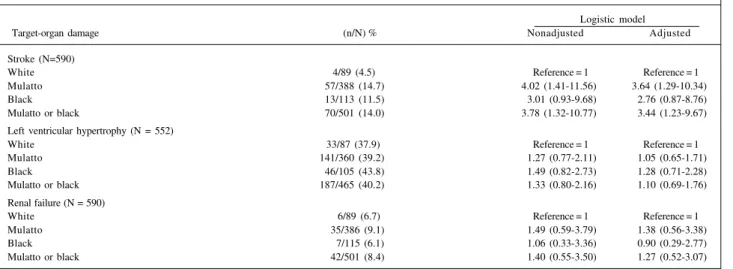
The results of the association between race and hyper-tensive target-organ damage adjusted and nonadjusted for sex and age with multiple logistic regression analysis are shown in table II. The frequency of stroke was significantly greater in patients classified as mulatto or black than in those classified as white [adjusted odds ratio (aOR) = 3.44; 95% confidence interval (CI) = 1.23-9.67; P = 0.013). The comparison between mulatto and white individuals showed the greatest difference in the prevalence of stroke (aOR = 3.64; 95% CI = 1.29-10.34; P = 0.01). The frequencies of left ventricular hypertrophy (aOR = 1.10; 95% CI = 0.69-1.76) and renal failure (aOR = 1.27; 95% CI = 0.52-3.07) were also greater in the patients classified as black or mulatto; the differences in regard to white individuals, however, were not statistically significant.
Discussion
study has a cross-sectional design, it is not clear to which extent the differences in survival among the patients of the different racial groups may have interfered with the asso-ciation between race and stroke. The lethality of the disease should be lower in black and mulatto patients as compared with that in white ones, so that survival could contribute to a greater prevalence of the event in those groups. No evi-dence supports this hypothesis. In fact, the data indicate that mortality due to stroke is greater in black than in white individuals. In the United States, mortality related to strokes of different etiologies, except for cerebral infarction due to the extracranial occlusion of the carotid artery, is greater among blacks 20. It has been known that mortality due to the
disease in the city of Salvador, where the population is pre-dominantly composed of blacks and mulattos, is one of the
greatest in Latin America. This was confirmed in a study comparing the mortality in the city of Salvador with that in 7 Latin American countries, the city of Salvador having the greatest mortality, 3 times greater than that observed in Me-xico, after correcting for age 21. In approximately 80% of the
cases of stroke in the city of Salvador, the patients are esti-mated to be hypertensive 22. However, in an international
comparative study 21, the influence of race on mortality due
to stroke in the city of Salvador could not be assessed. In the present study, the associations of race and the events of left ventricular hypertrophy and renal failure were not statistically significant. The adjusted odds ratio, howe-ver, was consistent with a greater prevalence of the event and renal failure in blacks and mulattos than in white indi-viduals. It is worth noting that the odds ratios were more
ex-Table I - Characteristics of the patients a
Race
Characteristics White Mullato Black P Value Total
N=94 N=410 N=118
Age (mean±SD) 53.8±14.3 47.3±13.3 48.3±14.1 <0.001 48.4±13.8
Median 55.0 47.0 48.5 48.0
Origin
Salvador 83 (88.3) 346 (84.4) 102 (86.4) 0.622b 531 (85.4)
Inner state of Bahia 9 (9.6) 61(14.9) 16(13.6) 86(13.8)
Other states 2 (2.1) 3 (0.7) - 5 (8.0)
Familial history 53(56.4) 242(59.0) 60(50.8) 0.283 355(57.1)
Secondary AH c 2 (2.1) 15 (3.7) 2 (1.7) 0.153 19 (3.1)
Duration of AH (years) d
< 1 24(26.1) 113(28.4) 26(23.4) 0.809 163(27.1)
1 a < 10 49(53.3) 197(49.5) 57(51.4) 303(50.4)
≥ 10 19(20.7) 88(20.7) 28(25.2) 135(22.5)
Classification of AH e
Mild 39(41.5) 129(32.0) 31(26.5) 0.249 199(32.4)
Moderate 16(17.0) 73(18.1) 26(22.2) 115(18.7)
Severe 37(39.4) 193(47.9) 55(47.0) 285(46.4)
Accelerated/malignant 2 (2.1) 8 (2.0) 5 (4.3) 15 (2.4)
Use of antihypertensive drugs 77(81.9) 325(79.3) 90(76.3) 0.598 492(79.1)
a Except for age, the other results are represented by absolute numbers (%); b Fisher exact test comparing Salvador versus other origins; c no data for 3 mulattos and 1
black; d no data for 2 white individuals, 12 mulattos, and 7 blacks; e no data for 7 mulattos and 1 black.
Table II - Odds ratio of the association between race and target-organ damage
Logistic model
Target-organ damage (n/N) % Nonadjusted Adjusted
Stroke (N=590)
White 4/89 (4.5) Reference = 1 Reference = 1
Mulatto 57/388 (14.7) 4.02 (1.41-11.56) 3.64 (1.29-10.34)
Black 13/113 (11.5) 3.01 (0.93-9.68) 2.76 (0.87-8.76)
Mulatto or black 70/501 (14.0) 3.78 (1.32-10.77) 3.44 (1.23-9.67)
Left ventricular hypertrophy (N = 552)
White 33/87 (37.9) Reference = 1 Reference = 1
Mulatto 141/360 (39.2) 1.27 (0.77-2.11) 1.05 (0.65-1.71)
Black 46/105 (43.8) 1.49 (0.82-2.73) 1.28 (0.71-2.28)
Mulatto or black 187/465 (40.2) 1.33 (0.80-2.16) 1.10 (0.69-1.76)
Renal failure (N = 590)
White 6/89 (6.7) Reference = 1 Reference = 1
Mulatto 35/386 (9.1) 1.49 (0.59-3.79) 1.38 (0.56-3.38)
Black 7/115 (6.1) 1.06 (0.33-3.36) 0.90 (0.29-2.77)
pressive when comparing mulatto with white individuals than black with white individuals. In fact, in the nonadjusted comparison between black and white individuals for renal failure, the odds ratio (OR = 1.06) was consistent with the lower prevalence in blacks (OR = 0.9) after adjusting for age and sex through logistic regression. However, in agreement with that which has been reported in other countries, our data suggest a greater prevalence of left ventricular hyper-tension and renal failure in the blacks and mulattos who sought medical care due to arterial hypertension in the city of Salvador. Previous studies have shown that ve blacks have a greater risk for the event than hypertensi-ve white individuals, ehypertensi-ven after adjusting for blood pressu-re levels 23. This greater predisposition of the blacks for the
disease has been observed even in normotensive indivi-duals 24,25. Several North American studies have shown that
the risk for the end-stage of renal disease, particularly for hypertensive nephropathy, is much greater among black than among white individuals 26-33. The racial difference in
the end-stage of renal disease due to hypertensive nephro-pathy is not eliminated after adjusting for the differences in arterial hypertension, suggesting the existence of more severe forms or differences in the quality of the antihyper-tensive treatment between black and white individuals 30. In
accordance with the North American data, Noblat & Lo-pes34 reported an incidence of the end-stage of renal
disea-se attributed to hypertension 45% greater among black than among white individuals. In addition, in black and mu-latto patients with primary glomerulonephritis, the presence of arterial hypertension observed at the time of the first ne-phrologic consultation was an important risk factor for the end-stage of renal disease 35,36. An interaction between
bio-logical and environmental factors, as well as racial differen-ces in the treatment of arterial hypertension, seem to contri-bute to more severe forms of arterial hypertension and a greater risk of target-organ complications in blacks and mu-lattos than those in white individuals 37,38.
The greater prevalence of strokes in blacks and mulat-tos cannot be explained by differences in the duration of hy-pertension nor in the proportion of patients using antihyper-tensive drugs at the time of the outpatient care clinic visit. As shown in table I, the duration of hypertension and the proportion of patients using antihypertensive drugs were similar in the racial groups. However, among the patients not using antihypertensive drugs, the mean SBP was signifi-cantly greater in blacks and mulattos, which is consistent with the more severe forms found in these patients than in the white ones. These data also suggest that arterial hyper-tension developed earlier in mulattos and blacks than in white individuals, considering the lower mean ages of the first 2 groups by the time they seek medical treatment in the hypertension outpatient care clinics. This finding is consis-tent with previous reports on an earlier start of arterial hy-pertension in blacks 39. Evidence exists that the risk of
target-organ damage can be drastically reduced in blacks through strict control of blood pressure levels, the choice of antihy-pertensive drugs, and considering the characteristics of
each patient and the strategies to increase adherence to treatment 38,40. It has already been shown that when the
access to health service and the quality of the antihyper-tensive treatment are similar in black and white individuals, the racial differences in stroke and hypertensive heart di-sease are eliminated 41. The importance of the choice of the
antihypertensive drug to reduce renal events in black patients with hypertensive nephropathy was highlighted in the African American Study of Kidney Disease and Hyper-tension (AASK) 42, which showed that a treatment regimen
based on an angiotensin-converting enzyme inhibitor has a significantly greater effect on the reduction of the progres-sion of renal failure and of the risk of the end-stage of renal disease than regimens based on calcium-channel blockers or beta-blockers 40,43,44.
Although our study had interesting findings, limita-tions cannot be ignored, particularly when the results are ex-tended to a general population of hypertensive individuals or compared with the results of other studies. It is worth noting that our sample was determined by the demand for medical care, which may explain, at least partly, the much higher frequency of illness in women compared with that observed in the general population of hypertensive indivi-duals. In addition, the fact that ours is a referral service for the treatment of arterial hypertension may have contributed to the higher frequency of more severe forms of the disease than that observed at other services. The distribution of patients into racial groups observed in the present study may be different from that occurring in the general popula-tion of hypertensive individuals and in the group of pa-tients treated in the outpatient care clinics of private hospi-tals or medical offices. Hypertensive blacks and mulattos, compared with whites, seek public health services more fre-quently due to their lower income levels. It is important to note that the racial classification used in the present study differs from that used in other studies. Outside Brazil, parti-cularly in the United States, race is frequently declared by the patient himself. In the present study, however, race was classified by the investigator according to predefined crite-ria 15,16. In addition to skin color, the type of hair, angulation
of the wing of the nose, and labial thickness were characte-ristics used for classifying the patient’s race. These criteria are believed to more accurately capture the differences in the phenotypical characteristics linked to the racial groups than is self-declaration and classification based only on skin color. In addition, studies carried out in the state of Bahia showed a high interobserver concordance in regard to the racial classification used. Despite the differences exis-ting in the criteria for defining race in the studies, the results are in accordance with those reported in our study in regard to the greater prevalence of hypertensive target-organ da-mage in blacks and mulattos compared with that in white individuals.
re-sults are also consistent with a greater prevalence of left ven-tricular hypertrophy and renal failure in blacks and mulattos. More severe forms of arterial hypertension or an earlier start of blood pressure elevation, or both, adherence to treatment, and greater obstacles for a good-quality medical follow-up may be contributing to a greater prevalence of alterations in target organs in arterial hypertension in blacks and mulattos. Prospective studies should be carried out in Brazil to assess the existence of racial differences in the lethality of arterial
hypertension and in the complications of the disease. These studies should also clarify whether the differences in survival between hypertensive blacks, mulattos, and white individuals have any influence in the racial comparisons of the prevalen-ce of complications in target organs in patients treated in outpatient care hypertension clinics. Further studies should also be carried out to identify treatment strategies that may eliminate the racial differences in target-organ damage due to arterial hypertension.
1. Flack JM, Wiist WH. Epidemiology of hypertension and hypertensive target-or-gan damage in the United States. J Assoc Acad Minor Phys 1991; 2:143-50. 2. Giles WH, Kittner SJ, Hebel JR, Losonczy KG, Sherwin RW. Determinants of
black-white differences in the risk of cerebral infarction. The National Health and Nutrition Examination Survey Epidemiologic Follow-up Study. Arch Intern Med 1995; 155:1319-24.
3. Kittner SJ, White LR, Losonczy KG, Wolf PA, Hebel JR. Black-white differences in stroke incidence in a national sample. The contribution of hypertension and diabetes mellitus. JAMA 1990; 264:1267-70.
4. Mayet J, Shahi M, Foale RA, Poulter NR, Sever PS, Mc GTSA. Racial differences in cardiac structure and function in essential hypertension. BMJ 1994; 308:1011-4. 5. James SA, de Almeida-Filho N, Kaufman JS. Hypertension in Brazil: A Review of
the Epidemiological Evidence. Ethn Dis 1991; 1:91-98.
6. Costa EA. Hipertensão arterial como problema de massa no Brasil: caracteres epi-demiológicos e fatores de risco. Ciência e Cultura 1983; 35:1642-54. 7. Ribeiro MB, Ribeiro AB, Neto CS, et al. Hypertension and economic activities in
São Paulo, Brazil. Hypertension 1981; 3:II-233-II-37.
8. Yu L, Burdnmann EA, Martins CTB, et al. Prevalência de hipertensão arterial em um bairro da periferia de São Paulo. Research Abstract 1985.
9. Facci CJ, Carvalho JSM, Facci AM, et al. Prevalência de hipertensão arterial nos funcionários de um hospital geral. Arq Bras Cardiol 1986; 46:185. 10. Dressler WW, Santos JE, Viteri FE. Blood pressure, ethnicity and psychossocial
resources. Psychossom Med 1986; 48:509.
11. Costa VG, Araujo GML, Chaves AJ, et al. Prevalência da hipertensão arterial sis-têmica na região urbana de Uberlândia (MG). Rev. Goiana Med. 1984; 30:55. 12. IBGE. PNAD - Pesquisa Nacional por Amostra de Domicílios. Cor da
popula-ção, Brasil, Região Nordeste, Bahia, região metropolitana de Salvador. 1990. 13. Tavares-Neto J. Grupo Racial: por que essa informação no prontuário médico? In:
Lopes AA, Matos MT, eds. Informação&Saúde. Salvador-BA: EDUFBA, 1999:45-53.
14. The 1988 report of the Joint National Committee on Detection, Evaluation, and Treatment of High Blood Pressure. Arch Intern Med 1988; 148:1023-38. 15. Krieger H, Morton NE, Mi MP, Azevêdo ES, Freire-Maia N, Yasuda N. Racial
ad-mixture in northeastern Brazil. Ann Hum Genet 1965; 29:113-25.
16. Azevêdo ES. Subgroup studies of black admixtures within a mixed population Bahia, Brazil. Ann Hum Genet 1980; 44:55-60.
17. Norusis MJ. SPSS for Windows: Advanced Statistics, release 6.0. Chicago, IL: SPSS Inc., 1993.
18. Norusis MJ. SPSS for Windows: Base system user’s guide, release 6.0. Chicago, IL: SPPS Inc., 1993.
19. Gahlinger PM, Abramson JH. Computer Programs for Epidemiologists: PEPI, version 3. Vol. USD Inc. Stone Mountain, GA, 1999.
20. Gillum RF. Stroke mortality in blacks. Disturbing trends. Stroke 1999; 30:1711-5. 21. Noblat ACB, McKeigue PM, Martinelli R, Rocha H. Hipertensão arterial em
ne-gros. Hiperativo 1994; 1:29-36.
22. Lessa I. Epidemiologia dos acidentes vasculares encefálicas na cidade do Salvador, Ba-hia, Brasil II. Principais fatores de risco. Bol Officina Sanit Panam 1984; 96:524-31. 23. Dunn F, Oigman W, Sundgard-Riise K, Messeili F, Frohlich E. Racial differences
in cardiac adaptation to essencial hypertension determined by echocardiogra-phic indexes. J Am. Coll. Cardiol. 1983; 1:1348-51.
24. Levy D, Garrison RJ, Savage DD, Kannel WB, Castelli WP. Prognostic implica-tions of echocardiographically determined left ventricular mass in the Framin-gham Heart Study. N Engl J Med 1990; 32:1561-6.
References
25. Prineas R, Castle C, Curb J, et al. Baseline electrocardiographic characteristics of the hypertensive participants. In Doughtery, SA and Entwisle, G (eds): Hyper-tension Detection and Follow-up Program: Baseline characterisitcs of the Enu-merated, Screened and Hypertensive Participants. Hypertension 1983; 6:160. 26. Easterling RE. Racial factors in the incidence and causation of end stage renal
di-sease. Trans Am Soc Artif Intern Organs 1977; 23:28.
27. Rostand SG, Kirk KA, Rutsky EA, Pate BA. Racial differences in the incidence of treatment for end stage renal disease. N Engl J Med 1982; 306:1276-9. 28. Eggers PW, Connerton R, McMullan M. The Medicare experience with end stage
renal disease: trends in incidence, prevalence and survival. Health Care Financ Rev 1984; 5:69-88.
29. Ferguson R, Grim CE, Opgenorth TJ. The epidemiology of end-state renal disea-se: the six-year South-Central Los Angeles experience, 1980-85. Am. J. Public Health 1987; 77:864-5.
30. McClellan W, Tutlle E, Issa A. Racial differences in the incidence of hypertensive end-stage renal disease (ESRD) are not entirely explained by differences in the prevalence of hypertension. Am J Kidney Dis 1988; 12:285-90.
31. Lopes AA, Port FK. Differences in the patterns of age-specific black/white com-parisons between end-stage renal disease attributed and not attributed to diabe-tes. Am J Kidney Dis 1995; 25:714-21.
32. Lopes AA, Hornbuckle K, James SA, Port FK. The joint effects of race and age on the risk of end-stage renal disease attributed to hypertension. Am J Kidney Dis 1994; 24:554-60.
33. Lopes AA, Port FK, James SA, Agodoa L. The excess risk of treated end-stage re-nal disease in blacks in the United States. J Am Soc Nephrol 1993; 3:1961-71. 34. Noblat ACB, Lopes AA. O efeito da raça na incidência de doença renal terminal
em Salvador, BA. J Bras Nephrol 1996; 18:135.
35. Lopes AA, Silveira MA, Martinelli R, Noblat ACB. Influência da hipertensão ar-terial na incidência de doença renal terminal em negros e mulatos portadores de glomerulonefrite. Rev Assoc Med Bras 2002; 48:167-71.
36. Lopes AA, Silveira MA, Martinelli RP, Rocha H. Associação entre raça e incidên-cia de doença renal terminal: influênincidên-cia do tipo histológico e da presença de hi-pertensão arterial. Rev Assoc Med Bras 2001; 47:78-84.
37. Lopes AA. Hipertensão Arterial: Fatores Étnicos e Raciais. J Bras Nefrol 1999; 21:82-4.
38. Lopes AA. Hypertension in black people: pathophysiology and therapeutic as-pects. J Hum Hypertens 2002; 16 Suppl 1:S11-2.
39. Berenson GS, Wattigney WA, Webber LS. Epidemiology of hypertension from childhood to young adulthood in black, white, and Hispanic population sam-ples. Public Health Rep 1996; 111:3-6.
40. Lopes AA, James SA, Port FK, Ojo AO, Agodoa L, Jamerson KA. Meeting the challenge to improve the treatment of hypertension in blacks. J Clin Hypertens 2002 (no prelo).
41. Ooi WL, Budner NS, Cohen H, Madhavan S, Alderman MH. Impact of race on treatment response and cardiovascular disease among hypertensives. Hyperten-sion 1989; 14:227-34.
42. Agodoa L. African American Study of Kidney Disease and hypertension (AASK): clinical trial update. Ethn Dis 1998; 8:249-53.
43. Agodoa LY, Appel L, Bakris GL, et al. Effect of ramipril vs amlodipine on renal outcomes in hypertensive nephrosclerosis: a randomized controlled trial. JAMA 2001; 285:2719-28.