Rev. Caatinga
PHOSPHOGYPSUM AND VINASSE APPLICATION: SOIL CHEMICAL
PROPERTIES AND ALFALFA PRODUCTIVITY AND NUTRITIONAL
CHARACTERISTICS
1RONALDO DO NASCIMENTO2*, JULIANA APARECIDA DE SOUZA2, ADÔNIS MOREIRA3, LARISSA
ALEXANDRA CARDOSO MORAES3
ABSTRACT - The objective of this work was to evaluate the effects of the application of phosphogypsum and
vinasse on soil chemical properties and productivity and nutritional characteristics of alfalfa (Medicago sativa).
The experiment was conducted in a randomized block design, using a 3×5 factorial arrangement, with three
vinasse rates (0, 150 and 300 m3 ha-1) and five phosphogypsum rates (0, 3, 6, 9 and 12 Mg ha-1). The alfalfa
chemical composition and shoot dry matter (SDW) and soil chemical properties (in the layers
0.0-0.2 and 0.21-0.4 m) were evaluated. The vinasse rates increased the soil potassium contents, while the
phosphogypsum rates promoted linear increases in soil calcium and sulfur contents. The base saturation was increased and the magnesium content showed a quadratic response on the layer 0.21-0.4 m with the increase in phosphogypsum rates. The calcium, magnesium and phosphorus contents in the alfalfa leaves were lower with
vinasse application. The phosphogypsum rates promoted linear increases in alfalfa SDW. Vinasse rated 150 m3
ha-1 was been enough to SDW increase. Calcium and magnesium contents in the leaves fitted a quadratic
model, with maximum calcium content in the phosphogypsum rate of 9.5 Mg ha-1 and the minimum
magnesium content in the phosphogypsum rate of 8.7 Mg ha-1. The leaf sulfur contents in all vinasse rates and
leaf potassium contents in the highest vinasse rate showed maximum accumulation at near 9 Mg ha-1 of
phosphogypsum.
Keywords: Medicago sativa. Calcium. Magnesium. Potassium. Sulfur.
APLICAÇÃO DE GESSO E VINHAÇA: ATRIBUTOS QUÍMICOS DO SOLO, PRODUTIVIDADE E ESTADO NUTRICIONAL DA ALFAFA
RESUMO - O objetivo do trabalho foi avaliar os efeitos da aplicação de gesso e vinhaça na produção de
matéria seca, nutrição e atributos químicos do solo cultivado com alfafa. O experimento foi realizado em delineamento experimental de blocos ao acaso, em esquema fatorial 3 × 5, com três doses de vinhaça, 0, 150 e 300 m3 ha-1 e cinco doses de gesso agrícola (0, 3, 6, 9 e 12 Mg ha-1). Foram avaliados a composição química e
matéria seca da parte aérea (MSPA) e os atributos químicos do solo (0-0,2 e 0,21-0,4 m). As doses de vinhaça aumentaram os teores de potássio, enquanto as doses de gesso promoveram acréscimos lineares nos teores de cálcio e enxofre no solo. A saturação de bases foi crescente e o magnésio teve efeito quadrático na camada de 0,21-0,4 m em função das doses de gesso. Os teores de cálcio, magnésio e fósforo na folha da alfafa foram
menores com a aplicação de vinhaça. As doses de gesso promoveram acréscimos lineares na MSPA da alfafa.
A dose de 150 m3 ha-1 já foi suficiente para aumentar a MSPA. Os teores de cálcio e magnésio na folha tiveram
ajuste quadrático, com máximo acúmulo de cálcio em 9,5 Mg ha-1 e o magnésio com ponto de mínimo na dose
de 8,7 Mg ha-1 de gesso. Os teores foliares de enxofre sob doses de vinhaça e os de potássio na maior dose
obtiveram máximo acumulo na presença de 9 Mg ha-1 de gesso.
Palavras-chave: Medicago sativa. Cálcio. Magnésio. Potassio. Enxofre.
____________________ *Corresponding author
1Received for publication in 01/30/2015; accepted in 08/03/2016.
Paper extracted from development research of the last two authors, with CNPQ resources.
2Department of Agronomy, Universidade Estadual de Londrina. Londrina, PR, Brazil; [email protected],
3Embrapa Soja, Empresa Brasileira de Pesquisa Agropecuária, Londrina, PR, Brazil; [email protected],
Rev. Caatinga
INTRODUCTION
The Brazilian sugarcane production has been standing out, mainly due to its high yields and high energy efficiency, achieved especially on the ethanol processing. Each liter of ethanol produced generates 14 liters of vinasse waste, which is potentially polluting when not properly treated, presenting acidifying effect, high nitrate levels and can reduce the concentration of oxygen available when applied in large amounts (BLEY JUNIOR et al., 2009; FUESS; GARCIA, 2014).
Vinasse is applied usually in sugarcane crop areas, aiming to minimize the environmental impact and reintroduce the nutrients exported (SILVA; GRIEBELER; BORGES, 2007). Therefore, vinasse improves soil fertility, supplying nutrients such as
potassium (K+), calcium (Ca2+) and magnesium
(Mg2+) and organic matter (OM), which have
average concentrations of 4.92, 2.08, 0.49 and
2.70 g L-1 in the vinasse, respectively (LEITE, 1999).
The application of vinasse has increased sugarcane production (SILVA; BONO; PEREIRA, 2014). Basso et al. (2013) used vinasse for 100% of
potassium fertilization, applying 200 m3 ha-1 of
vinasse and found an increase of almost 10% in K+
content in the topsoil, and increases of
7 to 15 Mg ha-1 in sugarcane yield. Other studies also
reported increases in K+, Ca2+, Mg2+ and S-SO
42 -contents due to vinasse application (CARVALHO et
al., 2013; SILVA; BONO; PEREIRA, 2014; PAULA; CARVALHO; NOGUEIRA, 1992; ANDREOTTI et al. 2015).
Liming and vinasse application to the soil
surface usually reach shallow depths, thus, alternatives to improve acidity correction of soil
subsurface are needed. Caires, Feldhaus and Blum (2001) compared mechanical incorporation of lime and use phosphogypsum and found increases of
nutrients in the soil subsurface layers and consequently, improvement of plant nutrition, due to
nutrient mobilization in the soil profile, and recovery of the nitrogen translocated to the subsurface. Other
studies also reported increases in Ca2+, Mg2+, K+ and
S-SO42- contents in subsurface due to lime
incorporation and use phosphogypsum (CAIRES et al., 2004; CAIRES; JORIS; CHURKA, 2011; MICHALOVICZ et al., 2014; PAULETTI et al., 2014).
The cultivation of plants that require high fertility and have deep root systems, such as alfalfa, need good soil conditions (MOREIRA et al., 2007), with good nutrient distribution in the soil profile. Silva, Bono and Pereira (2014) found significant
increases in K+ contents up to the depth of 0.4 m due
to vinasse application (400 m3 ha-1). Caires, Feldhaus
and Blum (2001) and Caires et al. (2004) reported
increases in the Ca2+ and Mg2+ contents up to the
depth of 0.6 m, and Sumner (2009) found high concentrations of alfalfa roots in layers deeper than
0.2 m, with phosphogypsum application.
In this context, the objective of this work was to assess the variations in soil chemical properties and the productivity and nutritional characteristics of
alfalfa (Medicago sativa), depending on the
application of different rates of phosphogypsum and vinasse.
MATERIAL AND METHODS
The experiment was conducted under field conditions in the experimental station of the Embrapa Southwest Livestock, located in São Carlos, São Paulo, Brazil (21°59'37''S, 47°52'38''W). The region has average altitude of 830 meters, and its climate is Cwa, characterized as tropical of altitude with dry winter and rainy and warm summer, according to the Köppen classification.
The experimental area was cultivated using a central pivot irrigation. The soil was classified as an Oxisol (dystrophic Red-Yellow Latosol – SiBCS), which had the following chemical attributes: pH in
CaCl2= 4.3, organic matter (OM)= 27 g kg-1,
phosphorus (P) (resin)= 8.0 mg kg-1, potassium (K+)
(resin)= 0.18 cmolc dm-3, calcium (Ca2+)
(resin)= 2.0 cmolc dm-3, magnesium (Mg2+)
(resin)= 0.70 cmolc dm-3, aluminum (Al3+)
(resin)= 0.1 cmolc dm-3, H++Al3+
(SMP)= 2.9 cmolc dm-3, base saturation
(V%)= 50 (EMBRAPA, 2009). The soil presented
sand, silt and clay contents of 479, 144 and
377 g kg-1 in the layer 0.0-0.2 m, and 415, 102 and
483 g kg-1 in the layer 0.21-0.4 m, respectively.
The experiment was conducted in a randomized block design, using a 3×5 factorial arrangement, consisting of three vinasse rates
(0, 150 and 300 m3 ha-1) and five phosphogypsum
rates (0, 3, 6, 9 and 12 Mg ha-1), with three
replications. The vinasse contained 1.2 g L-1 of K
2O,
0.18 g L-1 of CaO, 0.088 g L-1 of MgO and its
pH(CaCl) was 4.3. The soil fertilization was carried out
with P (superphosphate; 21% of P2O5) and
micronutrients (B, Cu, Fe, Mn e Zn), which were added to the seed furrows. The treatments were applied as topdressing. The nutrient rates used were according the recommendations of Moreira et al., (2007), except K and S. A dolomitic lime (Relative Power of Total Neutralization = 95%) application was carried out thirty days before planting, which was calculated to increase the base saturation to 80% (MOREIRA et al., 2007).
The plots consisted of 8 rows with length of 7 meters and 0.2 m between rows, considering for
evaluations the central 6 m2, discarding the borders.
The alfalfa cultivar used was the Crioula. The alfalfa
seeds were inoculated with Rhizobium meliloti,
(strain SEMIA-116) before planting, along with a Mo, Co and Ni solution (MOREIRA et al., 2007).
Rev. Caatinga
achieved by planting the equivalent to 20±2 kg ha-1
of seeds.
Irrigation was performed in periods of low precipitation, applying a water depth of 16.3 mm every four days, adjusted with a tensiometer. Four alfalfa cuts were performed, 30 days apart. The first cut was three months after the full establishment of the alfalfa crop. The plant material was dried in a forced-air oven at 65°C to a constant weight to obtain the shoot dry weight (SDW), the samples
were ground in a Wiley mill and taken to the laboratory for determination of macro and micronutrients according to Malavolta, Vitti and
Oliveira (1997) and Embrapa (2009).
Phosphorus content in the shoot were determined by the metavanadate colorimetric method, using UV-VIS; K by the flame photometry
method; Ca and Mg by atomic emission
spectrometry (ICP-AES); and S by the BaSO4
turbidimetry. (MALAVOLTA; VITTI; OLIVEIRA, 1997).
Soil samples were collected in the layers
0.0-0.2 m and 0.21-0.4 m soon after the fourth alfalfa
cut. The soil samples were air dried in order to assess the pH, P and S available, as well as the contents of exchangeable K, Ca and Mg, according to the methodology described in Embrapa (2009).
The results were subjected to analysis of variance (ANOVA; F test p≤0.05) and, when significance and interaction between factors were
found, each vinasse rate was subjected to regression analysis as a function of phosphogypsum rates; when no interaction were found, the vinasse rates were subjected to the Tukey's test, and the average of the
three vinasse rates was subjected to regression analysis as a function of the phosphogypsum rates.
RESULTS AND DISCUSSION
The soil chemical analysis indicated that the
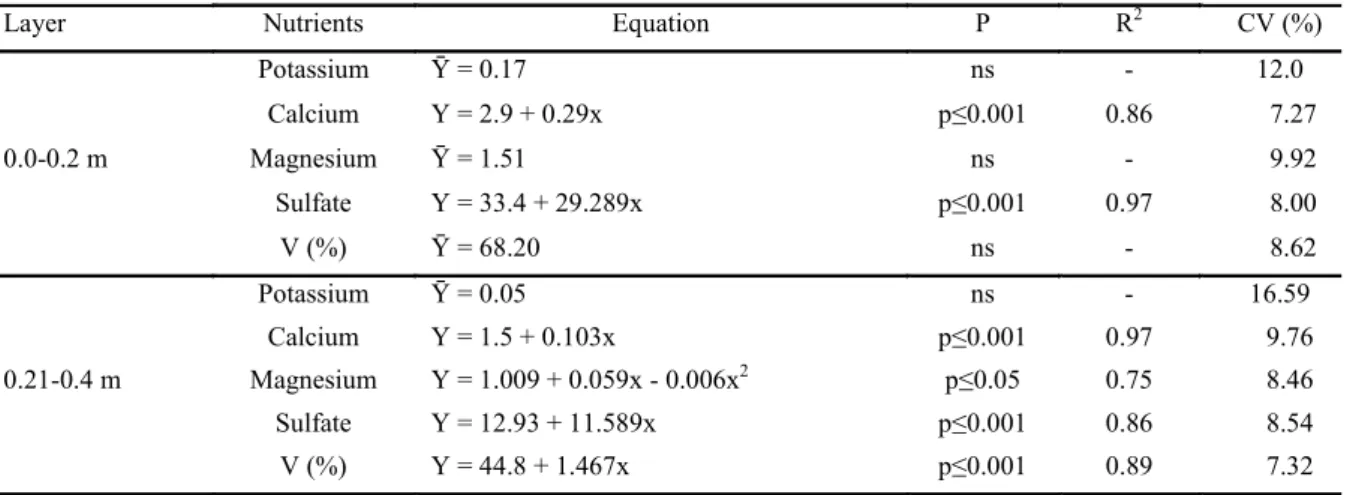
phosphogypsum increased the S-SO42-levels (Table
1). These results confirm those found by Caires, Feldhaus and Blum (2001), Caires et al. (2004), Michalovicz et al. (2014) and Pauletti et al. (2014). Increases in leaf S are usually directly related to the nutrient supply due to phosphogypsum application (RAIJ, 2011), as observed in this study.
Increase the soil sulfate content has various implications. Zambrosi, Alleoni and Caires (2007) studied ionic speciation involving sulfate and found
higher susceptibility to pair formation between SO42
-and Ca2+, however representing only 1% of the Ca2+
in solution, with more significant pair formation with
Mg2+, Al3+ and K+ (CAIRES et al., 2004; PAULETTI
et al., 2014).
The layer 0.0-0.2 m had no decrease in K+
contents with increasing phosphogypsum rates,
however, the soil Ca2+ content showed an increase
(Table 1).
Table 1. Regression equations fitted to K+, Ca2+, Mg2+ and S-SO
42- contents and base saturation (V%) of soil samples,
collected in the layers 0.0-0.2 and 0.21-0.4 m at the end of the experiment, depending on phosphogypsum rates.
Layer Nutrients Equation P R2 CV (%)
0.0-0.2 m
Potassium Ῡ = 0.17 ns - 12.0
Calcium Y = 2.9 + 0.29x p≤0.001 0.86 7.27
Magnesium Ῡ = 1.51 ns - 9.92
Sulfate Y = 33.4 + 29.289x p≤0.001 0.97 8.00
V (%) Ῡ = 68.20 ns - 8.62
0.21-0.4 m
Potassium Ῡ = 0.05 ns - 16.59
Calcium Y = 1.5 + 0.103x p≤0.001 0.97 9.76
Magnesium Y = 1.009 + 0.059x - 0.006x2 p≤0.05 0.75 8.46
Sulfate Y = 12.93 + 11.589x p≤0.001 0.86 8.54
V (%) Y = 44.8 + 1.467x p≤0.001 0.89 7.32
1
ns= not significant.Similar effects were observed by Carvalho et
al. (2013), who found increases in Ca2+ and sulfate
contents in the soil layers 0.0-0.2 m with the phosphogypsum application, and a consequent increase in base saturation (V%), which is directly
related to the displacement of hydroxyl (OH-) and
sulfate adsorption, enabling the formation of metal binders, increasing the cation exchange capacity
(CEC) predominantly related to the cation Ca2+
(RAIJ, 2011).
Linear increases in base saturation in the layer
0.21-0.4 m was found (Table 1), showing an improvement of fertility in the soil profile. Rampim and Lana (2015) and Soratto and Crusciol (2008) evaluated the application phosphogypsum rates and also found increases in base saturation in the soil
layer 0.21-0.4 m. Both studies showed the
Rev. Caatinga
availability of Mg2+ in soil layer 0.21-0.4 m.
The base saturation increased in the layer
0.21-0.4 m, and the Ca2+ contents increased in the
surface layer, however with small reductions in Mg2+
contents. Caires et al. (2004) found increases in corn
gain yield due to increase in CEC by Ca2+ saturation.
Rampim et al. (2011) found that an increase in saturation occurring due to the leaching and
neutralization of Al3+ to subsurface layers. In the
present work, the H++Al3+ contents presented no
changes in any of the phosphogypsum rates applied, probably due to the lime application.
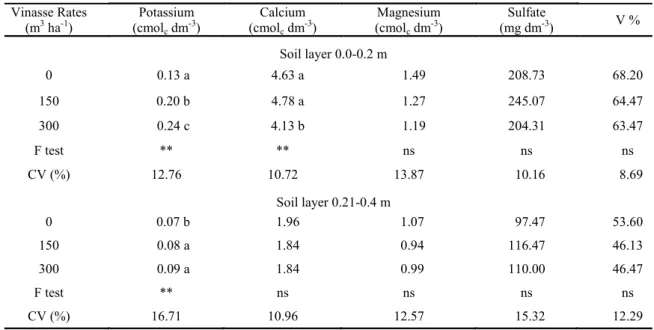
The application of vinasse increased the K+
content in the soil layers 0.0-0.2 m and 0.21-0.4 m
(Table 2) and was not affected by the phosphogypsum. Carvalho et al. (2013) found
different results, with reductions in K+ contents in a
soil of sandier texture, which differ from the soil of
the present study, which had around 400 g kg-1 of
soil. This difference in texture, may explain the difference in K contents, since, according to Brito (2009), who studied the K movement in the soil surface layers, differences in K contents are related to the soil texture.
Table 2. Analysis of variance of average potassium, calcium, magnesium, sulfate contents and base saturation (V%) of the soil layers 0.0-0.2 m and 0.21-0.4 m depending on vinasse rates.
Vinasse Rates (m3 ha-1)
Potassium (cmolc dm-3)
Calcium (cmolc dm-3)
Magnesium (cmolc dm-3)
Sulfate
(mg dm-3) V %
Soil layer 0.0-0.2 m
0 0.13 a 4.63 a 1.49 208.73 68.20
150 0.20 b 4.78 a 1.27 245.07 64.47
300 0.24 c 4.13 b 1.19 204.31 63.47
F test ** ** ns ns ns
CV (%) 12.76 10.72 13.87 10.16 8.69
Soil layer 0.21-0.4 m
0 0.07 b 1.96 1.07 97.47 53.60
150 0.08 a 1.84 0.94 116.47 46.13
300 0.09 a 1.84 0.99 110.00 46.47
F test ** ns ns ns ns
CV (%) 16.71 10.96 12.57 15.32 12.29
ns = not significant, * p≤0.05; **p≤0.01.
The K+ results differ from those found by
Rampim et al. (2011) who studied the effects of phosphogypsum rates in an Oxisol (eutropherric Red
Latosol - SiBCS) and reported a K displacement
from the soil surface layers to depths below 0.2 m, resulting in an increase in the subsurface layers. The K contents in the present work was similar to those found by Carvalho et al. (2013), who evaluated vinasse rates in a sugarcane crop. The vinasse rates application did not affected the contents of nutrients,
except calcium in the soil layer 0.0-0.2 m and
potassium in both layers. Andreotti et al. (2015) assessed the changes in the soil under vinasse
applications of up to 200 m3 and found similar
results, with the main effects related to the large amount of potassium present in the vinasse.
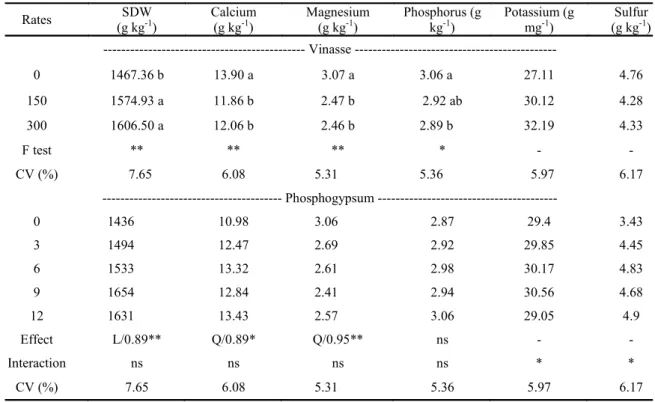
The SDW presented linear increases depending on the phosphogypsum rates, and did not
differ with vinasse rates of 150 and 300 m3 ha-1, both
surpassing the control (Table 3). Similar results of yield increases were observed in sugarcane by Silva, Bono and Pereira, (2014) and in maize by Caires et al. (2004), with vinasse and phosphogypsum application, respectively. According to Carvalho et
al. (2013), these increases are due to the
improvement of soil fertility with Ca2+ and S-SO
42 -(Table 1) by the phosphogypsum and the large quantities of potassium present in the vinasse (Table 2), both improving the soil conditions.
Leaf nutrient contents are usually correlated to increased yield, as reported by Paula, Carvalho and Nogueira (1992), who studied increasing rates of vinasse on onion crops and found for a maximum
yield the rate of 160 m3 per ha-1, which increased the
leaf K+, differing from the control which showed
nutrient deficiency symptoms and low yield.
The K and S contents presented significant interaction for the phosphogypsum and vinasse applications. The S contents increased with the increasing vinasse rates, and showed a quadratic fit to the phosphogypsum rates (Figure 1B). These results confirm those found by Moreira, Carvalho and Evangelista (1997), who reported increases in S content followed by a similar increase in dry weight,
however, the results of K+ were similar only to the
vinasse rate of 300 m3 ha-1, with no significant
Rev. Caatinga
Table 3. Analysis of variance of alfalfa shoot dry weight (SDW) and leaf nutritional content depending on vinasse (m3 ha-1)
and phosphogypsum (Mg ha-1) rates, using average values from four cuts.
Rates SDW
(g kg-1)
Calcium (g kg-1)
Magnesium (g kg-1)
Phosphorus (g kg-1)
Potassium (g mg-1)
Sulfur (g kg-1)
--- Vinasse ---
0 1467.36 b 13.90 a 3.07 a 3.06 a 27.11 4.76
150 1574.93 a 11.86 b 2.47 b 2.92 ab 30.12 4.28
300 1606.50 a 12.06 b 2.46 b 2.89 b 32.19 4.33
F test ** ** ** * - -
CV (%) 7.65 6.08 5.31 5.36 5.97 6.17
--- Phosphogypsum ---
0 1436 10.98 3.06 2.87 29.4 3.43
3 1494 12.47 2.69 2.92 29.85 4.45
6 1533 13.32 2.61 2.98 30.17 4.83
9 1654 12.84 2.41 2.94 30.56 4.68
12 1631 13.43 2.57 3.06 29.05 4.9
Effect L/0.89** Q/0.89* Q/0.95** ns - -
Interaction ns ns ns ns * *
CV (%) 7.65 6.08 5.31 5.36 5.97 6.17
ns= not significant. *p≤0.05; **p≤0.01. Means followed by the same letter in the column do not differ from each other by the Tukey test. SDW= 18.37x +1439.4, Ca= -0.025x2+0.47x+11.11, Mg= 0.0074x2-0.13x+3.05.
Figure 1. Potassium (A) and sulfur (B) contents in alfalfa leaves depending on three vinasse rates (0, 150 and 300 m3 ha-1)
and five phosphogypsum rates (0, 3, 6, 9 and 12 Mg ha-1), using average values from four cuts.
The vinasse application, especially at a rate of
300 m3 ha-1, increased the K content, which is related
to the phosphogypsum application, with linear increases in Ca and a quadratic response in Mg in the layer 0.21-0.4 m, probably promoting competitive
Rev. Caatinga
7.42 Mg ha-1, due to the large amount of Ca, the K
uptake decreases.
The increase in K contents with the lower phosphogypsum rates, according to Caires, Feldhaus
and Blum (2001), who studied barley (Hordeum
vulgare), is due the increase in Ca in the soil, which displace the K to the soil solution, making it available to absorption. According to Michalovicz et al. (2014), the leaf K content is related to its availability in the soil, and the phosphogypsum application can change this nutrient dynamic in the soil.
The leaf P showed no changes as a function of phosphogypsum rates, however, the Ca showed a quadratic response and maximum accumulation with
an estimated phosphogypsum rate of 4.5 mg ha-1.
These results differ from those reported by Vicensi et al (2016), who studied a soil with lower Ca contents
and found a linear fit up to 12 mg ha-1.
CONCLUSIONS
The phosphogypsum rates promoted linear increases of soil calcium and sulfate contents, however, did not change the potassium contents in the layer 0.0-0.4 m. The base saturation increased linearly and the magnesium contents showed a
quadratic response in the layer 0.21-0.4 m.
The vinasse rates increased only the soil potassium contents, up to the depth of 0.4 m. The increase in phosphogypsum rates promoted linear increases of alfalfa shoot dry weight (SDW), and its maximum production was reached with the vinasse rate of 150 m3 ha-1.
The calcium, magnesium and phosphorus contents were lower with vinasse application. Calcium contents showed a quadratic fit, with
maximum accumulation at 9.5 Mg ha-1, and
magnesium showed minimal accumulation at
8.7 Mg ha-1 of phosphogypsum. The contents of
sulfur in all vinasse rates and potassium at rate of
300 m3 ha-1 had maximum accumulation at near
9 Mg ha-1 of phosphogypsum.
REFERENCES
ANDREOTTI, M. et al. Acúmulo de nutrientes e decomposição do palhiço de cana em função de
doses de vinhaça. Bioscience Journal, Uberlândia,
v. 31, n. 2, p. 563-576, 2015.
BASSO, C. J. et al. Vinhaça como fonte de potássio:
resposta da sucessão aveia-preta/milho silagem/
milho safrinha e alterações químicas do solo na
Região Noroeste do Rio Grande do Sul. Ciência
Rural, Santa Maria, v. 43, n. 4, p. 596-602, 2013.
BLEY JUNIOR, C. et al. Agroenergia da Biomassa
Residual: perspectivas energéticas, socioeconômicas e ambientais. 2. ed. Foz do Iguaçu, PR: TECHNOPOLITIK, 2009. 140 p.
BRITO, F. L. ROLIM, M. M.; PEDROSA, E. M. R. Efeito da aplicação de vinhaça nas características químicas de solos da zona da mata de Pernambuco. Revista Brasileira de Ciências Agrárias, Pernambuco, v. 4, n. 4, p. 456-462, 2009.
CAIRES, E. F. et al. Alterações químicas do solo e resposta do milho à calagem e aplicação de gesso. Revista Brasileira de Ciência do Solo, Viçosa, v. 28, n. 1. p. 125-136, 2004.
CAIRES, E. F.; FELDHAUS, I. C.; BLUM, J. Crescimento radicular e nutrição da cevada em
função da calagem e aplicação de gesso. Bragantia,
Campinas, v. 60, n. 3, p. 213-223, 2001.
CAIRES, E. F.; JORIS, H. A. W.; CHURKA, S.
Long-term effects of lime and gypsum additions on
no-till corn and soybean yield and soil chemical
properties in southern Brazil. Revista Brasileira de
Ciência do solo, Viçosa, v. 27, n. 1, p. 45-53, 2011.
CARVALHO, J. M. et al. Produtividade de cana soca sem queima em função do uso de gesso e
vinhaça. Pesquisa Agropecuária Tropical, Goiânia,
v. 43, n. 1, p. 1-9, 2013.
EMBRAPA. Manual de análises químicas de solos,
plantas e fertilizantes. 2. ed. Brasília, DF: EMBRAPA INFORMAÇÃO TECNOLOGICA, 2009. 370 p.
FERREIRA NETO, M. et al. Atributos químicos do solo e estado nutricional de coqueiro anão fertigado
com nitrogênio e potássio. Revista Caatinga,
Mossoró, v. 27, n. 3, p. 30-40, 2014.
FUESS, L. T.; GARCIA, M. L. Implications of stillage land disposal: A critical review on the
impacts of fertigation. Journal of Environmental
Management, New York, v. 145, n. 1, p. 210-229. 2014.
LEITE, G. F. Avaliação econômica da adubação com vinhaça e da adubação mineral de soqueiras de
cana-de-açúcar na usina monte alegre Ltda. - Monte
Belo - MG. Revista da Universidade de Alfenas,
Alfenas, v. 5, n. 3, p. 189-181, 1999.
MALAVOLTA, E. Manual de nutrição mineral de
plantas. 1. ed. São Paulo, SP: EDITORA AGRONÔMICA CERES, 2006. 638 p.
Rev. Caatinga
princípios e aplicações. 2. ed. Piracicaba, SP: POTAFÓS, 1997. 319 p.
MICHALOVICZ, L. et al. Soil fertility, nutrition and yield of maize and barley with gypsum application
on soil surface in no-till. Revista Brasileira de
Ciência do Solo, Viçosa, v. 38, n. 5, p. 1496-1505, 2014.
MOREIRA, A.; CARVALHO, J. G.;
EVANGELISTA, A. R. Efeito de doses de enxofre na produção e composição mineral da alfafa. Pesquisa Agropecuária Brasileira, Brasília, v. 32,
n. 5, p. 533-538, 1997.
MOREIRA, A. et al. Fertilidade do solo e estado
nutricional da alfafa cultivada nos trópicos. 1. ed. São Carlos, SP: Embrapa Pecuária Sudoeste, 2007. 40 p.
PAULA, M. B; CARVALHO, V. D.; NOGUEIRA, F. D. Efeitos da vinhaça na produção e qualidade da cebola em solo de baixo potencial de produtividade. Pesquisa Agropecuária Brasileira, Brasília, v. 27, n. 3, p. 389-393, 1992.
PAULETTI, V. et al. Efeitos em longo prazo da aplicação de gesso e calcário no sistema de plantio
direto. Revista Brasileira de Ciência do Solo,
Viçosa, v. 38, n. 2, p. 495-505, 2014.
RAIJ, B. V. Fertilidade do solo e manejo de
nutrientes. 1. ed. Piracicaba, SP: IPNI, 2011. 420 p.
RAMPIM, L. et al. Atributos químicos de solo e resposta do trigo e da soja ao gesso em sistema
semeadura direta. Revista Brasileira de Ciência do
Solo, Viçosa, v. 35, n. 5, p. 1687-1698, 2011.
RAMPIM, L.; LANA, M. C. Ion mobility and base saturation after gypsum application in continuous
soybean-wheat cropping system under no-till.
Australian Journal of Crop of Science, Australia, v. 9, n. 6. p. 468-476, 2015.
SILVA, M. A. S., GRIEBELER, N. P., BORGES, L. C. Uso de vinhaça e impactos nas propriedades do
solo e lençol freático. Revista Brasileira de
Engenharia Agrícola e Ambiental, Campina Grande, v. 11, n. 1, p. 108-114, 2007.
SILVA, A. P. M.; BONO, J. A. M.; PEREIRA, F. A.
R. Aplicação de vinhaça na cultura da
cana-de-açúcar: Efeito no solo e na produtividade de
colmos. Revista Brasileira de Engenharia
Agrícola e Ambiental, Campina Grande, v. 18, n. 1, p. 38-43, 2014.
SORATTO, R. P.; CRUSCIOL, C. A. C. Produção
de fitomassa e acúmulo de nutrientes pela
aveia-preta em função da aplicação de calcário e gesso em superfície na implantação do sistema
plantio direto. Ciência Rural, Santa Maria, v. 38, n.
4, p. 928-935. 2008.
SOUZA, M. A. et al. Acúmulo de macronutrientes
na soja influenciado pelo cultivo prévio do capim-marandu, correção e compactação do solo.
Revista Ciência Agronômica, Fortaleza, v. 43, n. 4, p. 611-622, 2012.
SUMNER, M. Gypsum Improves Subsoil Root Growth. In: INTERNATIONAL SYMPOSIUM ROOT RESEARCH AND APPLICATIONS, 1.,
2009, Viena, Anais… Austria: BOKU, 2009, p. 1-4.
VICENSI, M. et al. Do rates and splitting of phosphogypsum applications influence the soil and
annual crops in a no-tillage system? Viçosa, Revista
Brasileira de Ciência do Solo, Viçosa, v. 40, n. 1, p. 1-17. 2016.
ZAMBROSI, F. C. B.; ALLEONI, L. R. F.; CAIRES, E. F. Aplicação de gesso agrícola e especiação iônica da solução de um Latossolo sob
sistema plantio direto. Ciência Rural, Santa Maria,