INTERNATIONALISATION AND THE NEW ROLE OF LOCAL
ACTORS IN INTEROPERABLE EUROPEAN NETWORKS
Marina Van Geenhuizen
Peter Nijkamp
Globalisation and networks: new challenges
It goes without saying that the European integration will never come into being, if there is not an efficiently operating network connecting all nodes of the European network economy. A network is not just a sum of links and nodes, but an infrastructure configuration operated to provide services through one or several operators. A netWork is thus a value added configuration taking advan-tage of an essentially passive infrastructure. The positive impacts of infrastruc-ture do not only derive from the mere creation of physical facilities, but from the services generated by operators. This evidence has sometimes been neglected because of the self-operated private car, but as far as freight road transport is concerned or any other mode the operator is a prerequisite to any value added network. This also means that infrastructure investment cannot create economic potential, but only develop it. Thus, a network employs passive infrastructure whose amount of added value is related to the efficiency of operators.
It is clear that a network has a geographic meaning and covers a given surface: no network without territory and no territory without networks. A network is related to a territory and has to be adopted by a territorial authority (which can be local, regional, national or European) whose position will be conditioned by the spatial impact of the network. It has long been recognised in economic development theory that growth in economic activity is enhanced by trade and hence by physical access to ever larger markets for products and raw materials. Infrastructure network weaknesses limit the realisation of this development potential and therefore territorial authorities should be very sensitive to the impact of infrastructure on spatial, regional and economic area development. So any strategic or political change in the territorial organisation has a consequence at the level of the infrastructure network. In this respect, Title XII of the Maastricht Treaty is the natural consequence of the single market and heralds the birth of the European Union characterized by Trans-European Networks.
In light of the strategic importance of networks, it is also clear that the evalu-ation of investment programmes related to a network should not be based on individual projects, but on the synergy created by network operators in an interconnected infrastructure. This means that an infrastructure network is a cohesive set of links (edges) between concentrations of population or economic activity centres (the so-called nodes), which serve to provide all services (trans-portation, communication) that are necessary for an efficient transport of persons, goods or information between nodes. The assessment and the evaluation of a network should therefore not only take account of the way such a network can be designed and developed but also operated.
lnternationalisation, reflected inter alia in global sourcing, has created inter-woven networks of international trading and industrial relations, in which firms in several countries produce different goods and service components of the same final product. In the last two decades, the globalisation and intensified competi-tion in world trade has not only emerged from the liberalisacompeti-tion of trade policies in many countries, but also from major advances in communication, transport and storage technologies. The <<extended» firm -or the network firm- including formal and informal links (merging or partnership) is mainly economic oriented and follows prevailing market forces, but falls short in including and considering environmental effects and socio-cultural impacts. Therefore, it is also necessary to introduce sustainable development criteria.
It is also noteworthy that infrastructure activities which create the most significant and durable benefits in terms of both production and consumption provide a degree of reliability and quality that is desired by paying users. Users charges should be based on economic prices reflecting both costs of supply and demand considerations (willingness to pay) as well as externalities. This means that new policies on network operations should be based on customer's preferences (and not modal interests), user charges and a third party access. This approach is called unbundling by the World Bank in its 'World Development Report 1994'. In this context much emphasis is placed on three principles: customer driven, user charges and third party access. Public services are provided through a combination of capital and management. Infrastructure is not only a matter of investment (or capital stock), but also a matter of operation
and management. The weaknesses and deficiencies in the infrastructure sector
are inherent in incentives produced by the current institutional and organisational arrangements. Production inefficiency is consequently built into organisations where outputs and inputs are not carefully measured, monitored and managed. Lack of maintenance is intertwined with political and institutional bias toward new investments. Traditionally, the interest in networks was instigated by supply side motives, but it is increasingly recognised that new competitive behaviour of firms in Europe requires to focus much more directly on those actors who coordinate, manage and operate flows in this network. Consequently, much more attention is needed for demand driven activities in the transport sector. But the way towards real value added networks based on interoperability, interconnectivity and
integrated chains is still very long and full of obstacles, as it also requires a
focus on competitive actors in the transport market.
Infrastructure has often been managed by means of a bureaucracy, not as
a service industry. This model is characterised by poor accounting for costs,
little relationship between revenues and costs or between revenue and service performance, and thus lack of accountability to the ultimate users as the <<custo-mers». Apart from the poor service quality which has often resulted from this approach, bureaucratic systems of infrastructure provision have given little regard to good management of assets (e. g. maintenance of roads, bridges, pipelines) which has often undermined their performance. Market instruments should contribute to a greater extent to the provision of infrastructure. Market instruments are here conceived of as competition and pricing. A commercial orientation (e. g., awareness of costs) and financial discipline are basic preconditions for the use
of these market instruments. In many infrastructure activities, the potential for applying competition and pricing has been enhanced by technological change, which has altered the nature of production and the services themselves.
For infrastructure activities which do not lend themselves to market instru-ments, other approaches are needed to ensure a satisfactory performance. A corollary of this is that governments must focus on, and perform more effective-ly, the functions which should remain their responsibility, in particular such as certain well defined tasks of planning and regulation. The planning and financing of national highways, for example, remains a public responsibility in virtually all countries; on the other hand, many countries have adopted the goal of at least partially privatising national railroads (e. g., by privatising railway operations).
As a result of various new market forces, the role of public (or semi-public) actors is declining and the importance of private operators is rising. Besides, in a long transport chain, the importance of transport and logistic costs may be rather significant, so that cost improvement in the transport sector is a necessary condition for reaping the fruits of an integrated European infrastructure network. This means that there is a need for a fresh look at European transport, in par-ticular since transport chains tend to exhibit complex webs of ramifications and interactions. This is, for instance, reflected in the dual phenomenon of a simultaneous rise in standard packaging units (containers, pallets etc.) and in specialized handling services (e. g., fast delivery services). Hub-and-spokes systems, new types of warehousing, just-in-time deliveries and many other phenomena illustrate the rich variety of modalities and configurations that are possible in modern transport activities. It is increasingly realized that the transport chain is increasingly governed by the wishes of the customer, so that ultimately the most important driving force in transport operations is executed by those integrators/actors who fulfil to a maximum degree the customers' wishes (in terms of costs, speed, reliability etc.).
Transportation planning is often associated with physical movement, with infrastructure configurations and with regulations. Far less attention is paid to the way the transport market is organized, and how this organization uses and shapes transport modalities. Especially the transaction theory of firms has shed new light on the interesting link between firm behaviour and network develop-ment (e. g., hub and spokes systems). Even though transport systems exhibit fragmented networks, various operators (e. g., forwarding agencies, logistics suppliers) -through multi-modal shipping, integral logistics and neo-fordist customized delivery - are able to exploit transport networks for generating added value, not only in a local-regional but also in an international context. Globalisa-tion of markets, new forms of competiGlobalisa-tion, more client orientaGlobalisa-tion, integraGlobalisa-tion of production and warehousing, and transport innovations are shaping new oppor-tunities for creative actors in the transport market reflected in joint ventures, 'filieres', vertical integration etc. These new operators may to a large extent be considered as integrating actors in a spatial transport system which can be typified according to:
The structure of the transport market (free competition, regulated market etc.);
The geographical coverage· (from local to global);
The quality of service (including scale and scope), and the tariff system; The sophistication of transportation technology (e. g., logistic platforms,
telematics, information systems);
The structure of the network (e. g., hierarchy, hub and spokes etc.); The territorial and modal policy competence on networks;
The barriers to a full performance of networks (e. g., regulations, conflict of competence etc.);
The integration with telecommunication (EDI, e. g.).
The role (change) of key actors in the global transport network - connec-ting localities with a global market- can be represented by way of illustration in the «inter-transport» matrix below. This matrix allows to clarify the integrating potential of networks as carried out by the actors/operators.
In this matrix interoperability refers mainly to operational and technical uni-formity which allows actors and operators to use and link various layers or components of a transport network. lnterconnectivity is in particular concerned with horizontal coordination of and access to networks of a different geographi-cal coverage. Finally, intermodality addresses the issue of a sequential use of different transport modes in the chain of transport. The Inter-Transport Matrix depicts essentially the integrating capabilities of various actors in the context of various ways of generating an added value in combined/coordinated network infrastructures.
Functions of «inter-actors»
«Inter-actors" lnteroperability lntereconnectivity tntermodality
Territorial authorities/ Safety norms environmen- Local/regional natio- Modal design. policy makers. tal standards. nai/European. Tariff system. Private or (semi-public) Pre-competitive research. Electronic data inter- Logistic suppliers.
operators or organi- change (EDI). Value added networks
sation. Integrated terminal or regulators.
transfer services.
lndustrialits or techni- (Pre-)standardisation in- Information techno- Just-in-time (JIT) design. cal research com- frastructure technology logy. Transshipment techno-munity. vehicle dimensions. Electronic customs. logy.
The inter-transport matrix
The inter-transport matrix is a useful vehicle for creating an operational typology of actors, their roles and their limitations in the emerging European network economy. Such a classification would concern both passengers and goods, while also information - as a complement or substitute for physical transport- may be included. For example, for passengers a distinction may be made into high speed business trips, short-range regional and local commuting
and social trips, and long-range tourist trips. Similarly, for freight transport we might distinguish between express delivery service, containers, swap bodies, bulk goods (short-range) and bulk goods (long-range).
It should be added that the transport function is increasingly shifting away from a purely physical shipment of goods and persons to a value added process through which in each step of the chain new services and economic values are added (for instance, assembly in nodal points, service delivery to train passengers in railway stations). This often implies also a transformation into goods or services of a higher market value. An illustrative example is the modern component assembly industry, where components are produced in low wage or cheap resource countries (primary production) and where the final product is assembled - after many transport activities- as close as possible to the final market (secundary production). It is foreseen that value added logistics will increasingly become a major feature of a modern post-fordist industrial nation. Consequently, in particular central nodes of a transport system tend to become places of strategic importance. As a result, the quality of the organization of transport as a material and immaterial process chain through links and nodes is becoming the new competitive feature of modes in a transport system.
The Common European transport policy has three main objectives. In the first place, the development of Transeuropean networks should be stimulated, a policy which should also favour the development of peripheral regions. Second, the transport markets should be liberalized to the maximum extent possible; market regulations should be equal in each member state and product markets would have to be opened for agents of each country. Finally, the transport sec-tor should also aim at achieving sustainable mobility.
Fusing the economic needs with ecological constraints may be fraught with many difficulties, though. Transport causes several externalities, like noise, stench and visual annoyance, segmentation of landscapes, local and global air pollution.
In the past decades, transport has continued to increase its consumption of non renewable energy sources, to lead to increasingly higher levels of congestion, and to emit substantial levels of gases (including greenhouse ga-ses). It is estimated that transport contributes about 25% to the overall emission of carbon dioxide for most Western European countries. On a global scale, the transport share of carbon dioxide has risen from 23 % to 28 % between 1973 and 1988 [1]. Within the transport sector, road transport is responsible for over 80 per cent of the impact in most Western European countries. Although the current contribution of air transport is small (about 10 %), the rapid growth of that mode makes it a matter of considerable concern.
This article aims to analyze the prospects for the adoption of various future transport technologies which contribute to energy efficiency and a reduction of air pollutants, in other words more sustainable forms of transport. Especially the greenhouse effect is nowadays a source of world-wide concern.
Major allies in coping with transport pollution and energy use are usually expected to be in behavioural changes (e.g. mobility and life style patterns), and changes in our geographical patterns of living, working and recreating [2, 3]. In addition, technological progress is usually considered an important means in
coping with the problems. Therefore, a systematic assessment of the opportunities offered by new transport technologies may bring to light new policy perspectives. This article will address the potential of such new technologies.
First of all, the technologies selected in the article exemplify good efforts to contribute to a sustainable transport, in terms of energy efficiency and emission of greenhouse gases. In addition, the focus will be on passenger transport because it is far larger than freight transport. Passenger transport in the European Community is three times as large as freight transport (3,500 billion pkm versus 1,150 billion tkm in 1990). A selection will also be made regarding the spatial scales at which the new technologies are used, i.e. Western Europe as the largest scale. Accordingly, various interesting technologies can be included, such as High-Speed Train and Hydrogen Aircraft, aside from technologies intended for use at lower spatial scales. In addition, the year 2030 is adopted as a broad landmark. In this way, both foreseeable developments with a relatively short lead time (conventional systems) and developments further away (advanced systems) can be included. Table 1 shows the technologies and the various spatial scale levels that will be taken into account. Of course, the list of options is not ex-haustive but mainly indicative.
TABLE I
Transport technologies and spatial scale
Technology
Conventional:
High-Speed Train o o o o o o o o o o o o o o o o o o o o o o o o o o o o o o o o o o o o o o o o • o o o o o o o o o o o o o o o o o o o o o o o Maglev Low-Speed oOOOOOOOoOoOooooooooOOOOOOOOOOooooo o o o o o o o o o o o OOoOoooooooOOOOO Maglev High-Speed 0 0 0 0 0 0 0 0 0 0 0 00 o o o o o o O O O O O o o o o o o o o o o o o o o o o o o o o o o o o o o o o o o o o O O O O O Improved Cars OoooooooOOOOOOOOOOOOoooooooOOOOOOOOOOOOOoooooOOOOOOOOOOOOoooooooOOOOO Advances:
Subterranean Systems 0 0 0 0 0 0 0 0 0 0 0 0 0 0 0 0 o o o o o o o o o o o o o o o o o o o o o o o o o o o o o o o o o o o o 0 0 0 0 Hydrogen Aircraft oooOO o o o o o o o o o o o o o o o o o o o o o o o o o o o o o o o o o o o O o o o o o o o o o o o o o o o o o o o o o o o Guided Vehicles 0 o o o o o o o o o o o o o o o o o o o o o o o o o o o o o o o o o o o o o o o o o O o O O o o o o o o o o o o o o o o o o o o o o
Transport and land use
Metropolitan X X X Spatial scale Interurban/ national X X X X X International X X X
The need for transport emerges where functionally dependent human activities are separated in space. In the 1960s and 1970s, when economic prosperity increased, the spatial separation of working and living was enlarged to an unprecedented degree. This suburbanization was primarily residential and caused therefore, a focussed pattern of long-distance commuting from suburbs and outer areas to central cities. Later developments were considerably more complex because the sprawl of living quarters was coupled with a substantial suburbanization of employment. This new development has increased cross-commuting as well as relatively short-distance intra-suburban cross-commuting trips.
Aside from living and working, also a separation of living and recreation took place in the past decades. This holds for outdoor recreation and summer and winter holidays. Whereas the separation of (daily) activities in space has increased, the number of hours in the day remained the same. Consequently, much effort has been put in increasing the speed of transport in the past decades [4].
Land use can be influenced to a certain degree by spatial planning. The role of spatial planning is generally limited in changing or reversing ongoing trends, due to the following circumstances:
A large inertia in the built environment (spatial inertia);
A large institutional inertia towards new frameworks of reference among politicians and planners;
A large variety of (often contradictory) aims of spatial planning, and a small effectiveness of spatial policy in reaching aims.
Regarding spatial planning for a reduction of transport, it should be emphasized that there is still a lack of knowledge of the underlying principles [5, 6]. Much research has focused on the relationship between urban form and passenger transport. Urban form in this context means size and density, and one of the major conclusions so far is that larger dense cities are associated with a high use of public transport and with a low gasoline consumption [7]. What however, also matters is where the interdependent workplaces, service centers and houses are located within the metropolitan area, particularly where populations with different life styles are living. In other words the socio-economic composition of the city is a crucial element [5].
One particular planning concept is important here, namely the «compact» city. Such a city is suggested to provide high-density housing and a concentration of employment in the central city-area and subcentres [8, 9]. In a decentralized city based upon an unlimited suburbanization, jobs and houses tend to disperse further in and beyond the metropolitan area, a process named counter-urbanization [1 0]. The compact city is currently adopted in Europe as a leading principle in urban planning [10, 11]. This concept generally assumes two major merits in terms of sustainable transport, namely short private journey lengths and good prospects for public transport. In contrast to this, the decentralized city is usually associated with large amounts of traffic. Various decentralized cities in Australia and the United States however, seem to undergo a very interesting development, namely a «spontaneous» relocation of jobs and houses leading to shorter commuting distances [12, 13]. The major question marks on the relationship between urban planning concepts and sustainable transport can be summarized as follows:
The relationship is very complex and difficult to understand because other factors are also at work, such as lifestyles, travel beha-viour and travel cost [14];
There is a lack of specification in concrete terms [5], i. e. more understanding is required of the range of appropriate forms and thresholds under which a reduction (stabilization) of transport can be achieved;
There is a shortage of integrated planning, i. e. of land use planning and transport planning, also including behavioural policies [5, 15].
In the light of the above discussion it is questionable whether there is sufficient ground to adopt the concept of a compact city as a leading planning principle.
Spatial influence on adoption and future urbanization
It is often - usually uncritically - argued that compact city design is favouring sustainable modes of transport. Transport and urbanization patterns exhibit however, a complex array of spatial force fields, so that simple solutions are not imminent.
Three types of factors influence the prospects for adoption of new transport technology (figure 1 ), namely:
1) Spatial inertia;
2) The technology's critical system features in view of specific conditions (thresholds, etc.) and impacts;
3) Future urbanization patterns on various spatial scales.
The most important barrier to adoption of new transport technologies seems to be spatial inertia. Once traffic infrastructure and other artefacts of human activity (such as houses, industrial premises and buildings) have been established, it will be used for a long time, at least the time needed to generate a sufficient return on investment. Spatial inertia holds particularly for historical buildings and structures in inner city areas.
Critical system features are the set of specific attributes of a transport
technology from a spatial perspective, including conditions for implementation as well as (un)desired impacts of this implementation. For example, a critical system feature of public transport modes is the need for a minimum amount of travel demand (threshold level).
FIGURE I
Spatial influences on the adoption of new transport technologies
NEW TRANSPORT TECHNOLOGY (critical system features)
SPATIAL THRESHOLD LEVELS SPATIAL UPPER LEVELS LOCAL AND REGIONAL IMPACS
CHANCE FOR ADOPTION
URBANISATION PATTERNS
Spatial threshold factors are concerned with the mrmmum amount of passengers between given points, necessary for a transportation mode to be in operation from an economic perspective. Barriers to adoption arise when threshold levels of demand for the advocated technologies are not reached, for example due to a low population density. Spatial upper level factors are different in that they usually relate to private modes. Spatial upper levels are concerned with the maximum distance particular vehicles can bridge. Barriers may arise when the distance in transport needs exceeds the upper level of spatial reach. This barrier holds for example, for particular types of electric car.
Critical system features also influence the nature of the impacts of the transport technology. The most common negative impacts are noise, emission of gas, danger of accidents (crashes) and vibration. These may constitute a barrier to adoption when an accepted maximum level of inconvenience is exceeded. New transport technology may also cause various positive impacts, such as a fluid traffic instead of congestion and emission-free zones. Positive impacts are often discussed within the framework of high-speed links. In this respect, there is the issue of causality mechanisms [16, 17]. For example, is an upswing in regional development a response to the implementation of new transport technology, or have new transport technologies merely helped what would have occurred anyway? It may nevertheless, be inferred that cities connected by new high-speed links will benefit from time and cost advantages, particularly in view of face-to-face contacts in business.
The way in which critical system features influence adoption, is very much dependent on the urbanization pattern that will develop in next decades. Because there is much uncertainty and complexity involved regarding the precise pattern, we need a specific approach in our assessment method. Future developments can be approached in three different ways, i. e. scenarios, forecasting methods and future perspectives [18]. Scenarios can be conceived of as hypothetical sequencies of events within a particular time-perspective, based on explicit assumptions [19]. As a policy tool, they serve to give insight into alternative choices and potential impacts. Scenarios are different from forecasting methods in that the latter are quantitative statements (such as statistical extrapolation) about the future, usually related to a (causal) model. In addition, scenarios have usually a higher complexity by incorporating more influences and qualitative data (such as expert judgement), leading to various (contrasting) developments. One can also distinguish future perspectives. These are coherent visions on the future, based upon explicit arguments and aimed at provoking discussion. It is the latter approach to future urbanization that will be used in our assessment of adoption of new transport technologies.
At the metropolitan scale we will take into account the previously discussed
Compact City (CC) and as a contrasting perspective, the Decentralized City (DC).
Their major characteristics are summarized in table 2. At the (inter)national scale, we will consider two contrasting perspectives designed by the Physical Planning Agency in the Netherlands [20], namely Specialization and Concentration (S + C)
and Chains and Zones (C
+
Z). The former articulates an ongoing concentrationof population as a result of the location of leading economic (world) functions in leading (large) cities. This process will enforce a hierarchy of functions and a hierarchy of locations (including metropoles at the top, followed by europoles
and smaller cities) which is likely to be associated with a hierarchy of transporta-tion systems (table 2). Accordingly, metropoles are the centre of a radial system that connects them with europoles, and the europoles are the centre of a radial system that connects them with smaller cities, etc. Metropoles have the main international airports (supported by regional airports) and main nodal centres of high-speed railway systems. In contrast with this, the model of Chains and Zones is weakly oriented toward a hierarchy of functions. Companies in various sectors (and levels) are increasingly footloose, in such a way that the concomitant spatial processes lead towards dispersion on various scale. This pattern is associated with a criss-cross character of main traffic and transport relationships, whereas (national) spatial strategies tend to focus on the bundling of these relationships (in chains). Each chain has one or several international mainports (air- and seaports) which directly connect to the transportation system of the chain.
TABLE 2
Future urbanization models
Metropolitan Compact City Decentralized City
Process ... Planning policy aimed at high Ongoing suburbanization. density living and jobs close
to public transport infrastruc-ture.
Functional structure ... Strong mix of living and wor- Separation of living and working. king.
Hierarchy of (sub)centres ... Flat structure. Traffic pattern ... Short and dense ... Criss-cross.
(lnter)national Specialization and Concentration Chains and Zones
Process ... Specialization and concentra- Sread over urban regions (po-tion in large urban centres. tentially some self-supporting). Functional structure ... Hierarchy of functions and Flat structure based on
in-hierarch of cities. creased footloseness. Traffic pattern ... Hierarchical radial ... Criss-cross (potentially bundled).
Adoption of new transport technologies
We will turn now in more detail to the specific critical system features of new transport technologies, and their influence on adoption. This influence will be valued indicatively as follows: very positive (+ +), positive (+), neutral, negative (-), and very negative (- -) (table 3). The analysis will follow a two-way categorization of new transport technologies into conventional and advanced transport systems.
TABLE 3
Influence of critical features of transport modes on adoption
Technology Critical System Features Influence (a)
Connects city-centres of densely populated
metro-politan areas ... . ++
HS Train ... . High threshold of demand ... . Partially compatible with existing rail infrastructure +
Noise and vibratrion ... . Damage to the landscape ... . Connects city-centres of densely populated
metro-politan areas ... . ++
Very high threshold of demand ... . Maglev ... . Need for new infrastructure ... . Need for land (inner city) ... . Aerodynamic noise ... . Damage to the landscape ... . Small distance range (BEVS) ... .
Improved Vehicles ... Emissionfree spaces (zones) ... + +
Need for additional land for fuel logistics (fuel-cell) Connects isolated cities or city-centres of densely Subterranean Systems ... . populated metropolitan areas ... . Very small use of land ... . High threshold of demand ... .
++ ++
Connects city-centres... + Need for additional land ... . Hyrogen Aircraft ... Need for new fuel supply infrastructure ... . Danger or crashes/esplosion ... . Damage to landscape ... . Guided vehicles: Small use of land ... . +
Physical . . . ... . . .. .. . .. .. . . .. . . Small distance reach ... . High threshold of demand ... .
Telectronic ... More efficient use of land and roads ... . ++
Conventional Transport Systems
This section will focus on three «competing>> transport technologies which are already adopted on a small scale and may be further adopted on the short term, i.e. High Speed (HS) Train, Maglev, and Improved Car [21].
In the literature, five different designs of HS Trains are described [22]. The most important are the French TGV, the German ICE and the Japanese Shinkansen [23, 24, 25]. Less mature systems are the Italian Pendolino ETR450 and the British IC225. In densely populated areas in Europe and Japan, HS train systems can very well compete with cars and jet aircraft between cities roughly 160 to 800 km apart.
The major positive feature of HS trains (in relation to adoption) is their smooth connecting of large metropolitan areas. At the same time, HS train is a transport mode with a relatively high threshold level of demand, i. e. the urban centres to be connected should be sufficiently large and sufficiently interdepen-dent. A further positive feature of HS train operation is its compatibility with existing rail systems, and its smooth integration into conventional hierarchical systems. However, the voltage (in e. g. TGV) is higher than provided on most conventional tracks. This means that high speed operation requires a separate track which cannot be used by other trains, or an adaptation of the power train. Further negative features include noise, vibration, and landscape damage in the case of new infrastructure.
It is foreseeable that the adoption of HS train technology will take place in a relatively large number of cases, provided that its spatial threshold level of demand is satisfied. When (inter)national urbanization patterns develop accor-ding to the C + Z model, the interdependent metropolitan areas need to be suffi-ciently large (around a few million inhabitants) and the distance in-between needs to be sufficiently long to take advantage of the high speed (table 4). When urbanization patterns develop according to the S
+
C model, there seems no restriction to adoption.Maglev systems make use of magnetiv levitation (either through electromagnetic or electrodynamic suspension) while propulsion of the trains is realized by means of a linear induction motor. Presently, there is one High Speed Maglev system available for commercialization, i. e. the German Transrapid 07 [26]. Low Speed Maglev systems have been developed in Japan, Great Britain (Maglev People Mover) and Germany (M-Bahn). Since 1985, the British system is in operation between Birmingham Airport and the national Exhibition Centre. In view of adoption, HS Maglev has clearly the positive feature of connecting city-centres of densely populated metropolitan areas in a fast and smooth way. It can however, only operate when there is a sufficiently high demand for transport, such as in Japan between Tokyo and Osaka, connecting metropolitan areas with thirty million and fifteen million people respectively [27]. A very critical feature of the (high and low speed) Maglev system is its need for a completely
new infrastructure for accommodating trains. This infrastructure is also totally incompatible with existing rail systems. A further important characteristic is the need for penetration of the new infrastructure deep into the city-hearts in order to be effective. Further negative features are concerned with local impacts, i.e. aerodynamic noise produced at high speed, and landscape impairment.
It is foreseeable that adoption of the HS Maglev will only take place in a limited number of cases, in view of its high spatial threshold level of demand. When national urbanization patterns develop according to the C + Z model, the interlinked metropolitan centres need to be sufficiently large and the distance in-between needs to be sufficiently long to take advantage of the high speed (table 4). In this model, adoption may be hindered when the corridors between the metropolitan centres lack easy available land for a new infrastructure. When future urbanization patterns develop according to the S
+
C model, adoption seems only realistic when there is a sufficiently large interdependency between the top metropolitan centres of a country. Similarly, the adoption of LS Maglevis dependent upon a high demand for transport. On the scale of the metropolitan area (region) therefore, adoption seems only to be realistic under conditions of a high-density compact city. However, here comes a further complication because land for new infrastructure will not be easily available in densely populated areas.
TABLE 4
Future urbanization and further conditions. for adoption of conventional technologies
Technology Spatial scale Urbanization model and Further conditions
C+Z, with sufficiently large cities and Interurban ... large distance in-between.
HS Train ... S + C: no further conditions. International ... C + Z, with sufficiently large cities.
S + C: no further conditions.
C +Z, with sufficiently large cities and large distance in-between, with land Maglev HS ... Interurban ... available for new infrastructure.
S + C: with sufficiently interdependent top urban centres, with land available for new infastructure.
«Compact» city, with land available for Maglev LS ... Metropolitan ... new infastructure.
Decentralization: not feasible.
Decentralization, when distances between employment and housing are becoming Metropolitan ... short.
Improved Cars (short range) «Compact» city, with sufficient attention to reads and parking at job sites. Interurban ... Not feasible.
Decentralization, no further conditions. Metropolitan ... , ... «Compact» city, with sufficient attention to Improved Cars (short range) reads and parking at job sites.
Interurban ... No restrictions.
The last conventional transport technology to be discussed here, is Improved Car. Apart from cars such as with Stirling engines and aerodynamic styling, more radical concepts can be distinguished. A major category in this respect is the electric car, based upon various energy devices such as an electric battery, a hybrid system and fuel cells. Battery-electric cars will soon be introduced to the market in a number of niches. The technology has the positive critical feature of contributing to emission-free spaces or zones, provided that also regulatory measures are taken. The range of battery"electric vehicles (BEVS) is however, limited to 70 to 1 00 km, whereas the top speed is about 100 km/h. The use of
BEVS will therefore, be limited to urban traffic. In addition, a large scale introduction of BEVS makes the establishment of public charging stations necessary, including investment in grid and facilities. A second type of electric cars, hybrid-electric vehicles (HEVS) may combine various benefits of electric contraction with the longer range, better performance and fast fuelling characte-ristics of conventional cars. The third type, fuel-cell powered vehicles, is simi-lar to HEVS in that they also have an electric drive train combined with an on-board power source. The power source in this case is a fuel-cell, i. e. an electro-chemical device which directly converts chemical energy from fuel into electrical energy.
Except for the hybrid-electric and perhaps also the fuel-cell vehicle, the most negative feature in view of adoption is the small maximum distance which can be bridged. When urbanization on the metropolitan scale develops according to the decentralized city, the option of improved cars with a short range seems only feasible on the condition that the dispersal of housing and jobs will lead to smaller distances of home-to-work trips (table 4). In the compact city, land use and transport planning largely favour public transport. When however, specific attention is given to road infrastructure and parking facilities at employment sites, the option of improved (small distance) cars may well be feasible in the compact city. The latter restriction also holds for the adoption of improved cars with a longer range, in view of both metropolitan and interurban scales.
Advanced Technology Systems
This section will discuss three transport options of which market adoption may only occur merely on the longer term, i. e. Subterranean Systems, Hydrogen Aircraft and Guided Vehicles [21].
Advanced Subterranean Systems are different from all other modes in that they aim at a drastic reduction in both environmental and energy cost, due to their (almost) vacuum tubes. There are currently two designs of such systems avalaible, i. e. the Dutch High Speed Tunnel Transport System (HSTT) [28] and the Swissmetro Project [29]. The Dutch concept of HSTT includes a network of tunnels in which a bullet-shaped vehicle is propelled by a linear motor. The maximum speed amounts to 500 km/h, while energy use will be extremely low. The HSTT system is designed for both passengers and freight transport, and is intended to compete with air and rail transport over distances exceeding a few hundred kilometers. A complementary feeder system ensures an efficient linkage with existing transport infrastructure. The Swissmetro Project is intended to connect the major Swiss cities, but different from the HSTT, it is only designed for passenger transport. This limited focus forms the basis for the major current criticism. By far the largest transport problem in Switzerland is the massive transit of goods, whereas Swissmetro gives no contribution to a solution [29].
Subterranean Systems have the potential of connecting major cities or city-systems, in a very fast and smooth way. In addition, land use is typically small. It involves only land entrance and exit, and stations for air-conditioning. Investment costs are certainly very high so that the technology is restricted to heavily
populated areas and corridors of very dense good transport. As a consequence, Subterranean Systems will be feasible on the interurban (national) and international level when the trajectories include a considerable number of large and strongly interdependent population and industrial centres. The presence of natural barriers, including water, mountains and valuable nature reserve area, may also justify long-distance tunneling. Unlike High Speed Train and Maglev it is far more difficult to assess in what urbanization scenario the prospects for adoption of Subterranean Systems are the best (table 5). The ideas about the spatial scale of the system, density of terminals, etc. are still too much speculative at present.
Our second example of advanced transport technology is Hydrogen Aircraft. Although aviation is currently responsible for 3 % of the world's carbon dioxide emission, it should be realized that this mode is very fast growing. The use of hydrogen is one of the very few options for reducing emission of carbon dioxide. A negative critical feature of Hydrogen Aircraft is that its introduction will require the construction of a completely new hydrogen production, storage and distribution infrastructure, which is incompatible with the existing infrastructure of kerosene. Because the life-time of airplanes is roughly 25 years, the penetration of the Hydrogen Aircraft will be slow. As a consequence, both kerosene and hydrogen fuel systems will have to be in operation simultaneously for a certain «transition» period. This requirement may put a too heavy pressure on land in and around airports. At the same time, strong safety measures for distribution and storage seem to be necessary on a permanent basis, which may ask for additional use of land.
Future urbanization models seem to have a low influence on the chance of adoption because existing airports may be used and frequency of flights can be scheduled according to travel demand.
The last advanced transport technology to be discussed is Guided Vehicles. This mode embraces two very different transport systems, namely physically guided vehicles and electronically guided autonomous road vehicles. Physically guided systems work by means of mechanical interaction (rails) or electromagnetic energy (Maglev). There are two variants, namely systems of inseparable vehicles and guideways, and systems in which the guided vehicles can also drive like normal passenger cars. A major example of the former is TAXI 2000 [30]. This urban transportation system operates under automatic control between stations in a network of narrow, unobtrusive guideways. Empty vehicles can be ordered continually so that they can anticipate demand and wait for people. Both passenger and freight vehicles may operate on the same network. A positive feature of this type of guided vehicles is the relatively small use of land. At the same time, the mode with inseparable vehicles is designed for short distances where sufficiently dense passenger flows are to be transported, such as in airports and large business centres. This circumstance indicates two negative factors for adoption, namely a limited reach and a high level of demand. Accordingly, when cities develop in a «compact•• way the systems may be feasible on particular high-density trajectories (table 5). The use of systems like TAXI 2000 seems to be unrealistic in decentralized cities and on higher spatial scale levels than cities, where distances are longer and passenger flows more diffuse.
Systems of electronically guided autonomous vehicles (navigation) may range from route information systems to fully automated route guidance [31, 32, 33]. Developments in electronic guidance are already taking place, for example in Europe in the DRIVE programme. When all vehicles are centrally controlled, distances between them can decrease and speed can increase, leading to avoidance of congestion. Electronic guidance systems contribute significantly to an efficient road use through the enforcement of rational driving behaviour and efficient route selection. In addition, these systems claim a small amount of extra land for infrastructure. From this point of view therefore, no restriction for adoption seems to be at work. When we come to the future pattern of urbanization on various scales, all patterns which generate traffic in relatively dense bundles may be subject to a fast introduction (table 5). On the metropolitan level, this means that compact cities have a higher chance for (a fast) introduction than decentralized cities where a more diffuse traffic· dominates. On the interurban (national) and international level, the future urbanization model may not be very important because heavy congestion may occur in all central parts of metropolitan areas.
TABLE 5
Future urbanization and further conditions for adoption of adoption of advanced systems
Technology Spatial scale Urbanization model and Further condition(s)
Interurban ... Very large interdependent cities and in-dustrial centres or natural barriers. Subterranean Systems ...
International ... Very large interdependent cities and in-dustrial centres or natural barriers. Hydrogen Aircraft ... International ... Additional land on airport.
New fuel supply infrastructure. Guided vehicles: Metropolitan ... CC, with dense traffic flows.
Physical ... DC: no feasible. Higher scales ... Not feasible.
Metropolitan ... CC: no further conditions. Electronic ... DC, with dense traffic flows.
Higher scales ... Trajectories with dense traffic flows.
Evaluation
The way to sustainable transport by means of technological solutions is stumbled with many blocks. However, the analysis in this article has revealed a large differentiation in opportunities for adoption between various transport technologies. In view of a transport policy it is therefore, necessary to classify
and arrange the available information on the technologies in such a way that
choices can be made on most probable developments. The technology options which are realistic alternatives in view of their time-perspective and spatial scale
(i. e. choice possibilities) are given in table 6. TABLE 6
Choice possibilities of new transport systems (examples)
Near future ...
Far future ...
(a) Short range. (b) Long range.
Metropolitan
Low Speed Maglev. Improved Cars (a).
-(tnter)national scale
High Speed Train. High Speed Maglev. Improved Cars (b). Subterranean Systems. Hydrogen Aircraft. Guided Vehicles.
This section aims to illustrate how multicriteria analysis can be used in transport policy problems marked by different (conflicting) objectives or criteria. To this purpose first, a rank of the transport technologies in view of their opportunities for adoption will be established. Secondly, the influence of future urbanization models on such ranking will be explored.
Multicriteria techniques enable to evaluate a discrete number of alternative options, by means of various explicitly formulated criteria. The evaluation criteria in the current analysis are purely spatial ones. Consequently, economic (cost) criteria or behavioural (attitudinal) criteria are excluded from the analysis. In fact, this multicriteria analysis serves a feasibility asssessment of new transport technologies not based financial but on spatial criteria. We distinguish six evaluation criteria as follows:
1) Spatial connection and range: the better the technology in terms of bridging distances in a fast (smooth) way, the larger the chance for adoption;
2) Spatial demand: the higher the threshold level of demand, the smaller the chance for adoption;
3) Infrastructure needs (spatial inertia): the smaller the needs for new (additional) infrastructure, the better the chance for adoption; 4) Efficiency of land use: the more efficient land (road) use, the larger
the chance for adoption;
5) Local positive/negative impacts on surrounding land: the less negative impacts (such as noise, vibration, danger for crashes), the larger the chance for adoption;
6) Landscape impairment: the less impairment, the larger the chance for adoption.
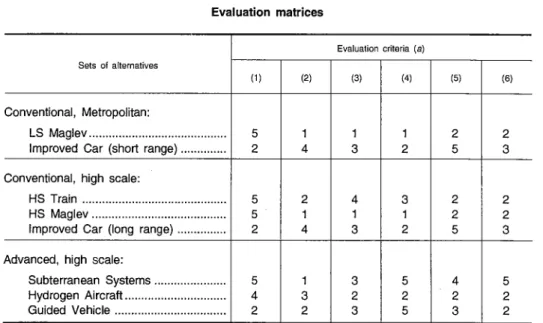
Further major characteristics of the analysis here are the following: equal criteria weighting (no priorities expressed) and use of a five point rank scale, the lowest score (1) representing a strongly negative influence.
Table 7 gives for each set of alternative options the evaluation matrix, i.e. the scores of the alternative transport systems on each criterion. The establishing of scores is consistent between the three sets of alternatives, although the amount of speculation is inevitably larger for advanced systems compared with conventional systems. The scores are based on the previous discussion of critical system features and conform the valuation in table 3.
TABLE 7 Evaluation matrices
Evaluation criteria (a) Sets of alternatives
(1) (2) (3) (4) (5) (6)
Conventional, Metropolitan:
LS Maglev ... 5 1 1 1 2 2
Improved Car (short range) ... 2 4 3 2 5 3
Conventional, high scale:
HS Train ... 5 2 4 3 2 2
HS Maglev ... 5 1 1 1 2 2
Improved Car (long range) ... 2 4 3 2 5 3
Advanced, high scale:
Subterranean Systems ... 5 1 3 5 4 5
Hydrogen Aircraft ... 4 3 2 2 2 2
Guided Vehicle ... 2 2 3 5 3 2
(a) The numbers correspond with the ones in the preceeding text.
The method of analysis of the evaluation matrix here, is concordance analy-sis [34]. This method deals with qualitative (ordinal) measurement scales and is very simple to apply. It is based on a pairwise comparison of all alternative opti-ons, and subsequent substractive summation. Of course, various more advanced techniques are available [34, 35, 36].
The overall results of the simple evaluation procedure used here, are given in Table 8 and can be summarized as follows. With respect to conventional technologies and metropolitan scale, Improved Car has clearly better opportunities for adoption than Low Speed Maglev. On higher spatial scales, again Improved Car (hybrid types with long range) has the best outlook for adoption, but it is closely followed by High Speed Train. Regarding advanced transport systems, the best chance for adoption is clearly for Subterranean Systems, leaving Hydrogen Aircraft and Guided Vehicles far behind.
It must be emphasized that our choice for equal weighting is an arbitrary one. A differential weighting of the various criteria seems necessary within a
framework of particular policy interests. A further point of consideration is the influence of the particular technique on the results of the evaluation. This article uses only one technique for illustration purposes, without a sensitivity analysis. However, there is usually a need to apply various alternative techniques to the same data so as to ensure the robustness of the results of the evaluation.
TABLE 8
Results of evaluation procedure
Sets of alternatives
Conventional, Metropolitan:
LS Speed Maglev ... . Improved Car (short range) ... .
Conventional, high scale:
HS Speed Train ... . HS Speed Maglev ... . Improved Car (long range) ... . Advanced, high scale:
Overall result -4 4 3 -7 4 Subterranean Systems ... ... ... .. .... ... .. .... 6 Hydrogen Aircraft ... .. ... ... ... ... - 5 Guided Vehicle... - 1 Future urbanization model CC DO -2 -2 2 4 S+C C+Z 4 2 -7 -7 3 5
A further aim of our multicriteria analysis is to investigate the influence of various urbanization models on the ranking of transport options. The evaluation matrices for each set of alternatives are given in Table 9. These matrices show that we express large differences in scores between urbanization models only on a few selected criteria. For example, we assume that the major difference in chances for adoption of Low Speed Maglev is based on spatial demand factors (criterion 2). In the compact city, a high level of spatial demand will contribute to adoption of this technology (score of 4), while in the decentralized city a low {diffuse) demand will clearly hamper the feasibility of the technology (score of 1). Although score differences like these are realistic and can be argued, there is nevertheless a certain amount of arbitrariness involved. The results of the analysis of the matrices are in table 8.
Regarding the options on the metropolitan scale, it appears that future· urbanization models do not lead to fundamental shifts in ranking. In both models, the outlook for adoption is better for Improved Car. The only shift is concerned with the amount of difference between the two options, i. e. smaller in the compact city. With respect to transport systems on higher scale levels, a basic difference in ranking is clearly found between the Specialization and Concentration model and the Chains and Zones model. In the former, High Speed Train appears
to be superior (albeit with a small difference) while in the latter, Improved Car has clearly the best outlook on adoption.
TABLE 9
Evaluation matrices regarding various perspectives on urbanization
Evaluation criteria (a) Sets of alternatives (1) (2) (3) (4) (5) (6) Conventional, Metropolitan:
cc model:
LS Maglev ... 5 4 2 Improved Car ... 2 4 3 5 3 DC model: LS Maglev ... 4 1 1 2 2 2 Improved Car ... 2 4 3 3 4 3Conventional, high scale: S+C model: HS Train ... 5 4 4 3 2 2 HS Maglev ... 5 3 1 2 2 2 Improved Car ... 3 4 3 3 5 3 C+Z model: HS Train ... 5 2 4 3 2 2 HS Maglev ... 5 1 1 2 2 2 Improved Car ... 2 4 3 3 4 3
(a) See table 7.
Figure 2 visualizes the evaluation scores for four individual technology systems, under the assumption of different future patterns of urbanization (table 9). Each axis in the figure represents one evaluation criterion and is scaled 1 to 5. For example, the figure clearly shows the superiority of Improved Cars over Low Speed Maglev, particularly a large score difference on demand factors (decentralized city), local impact factors (particularly compact city) and infrastructure needs (both urbanization models). The visualization by means of «spiders» makes the following information easily available:
1) The overall outlook on adoption: the larger the 'web' the higher the chance for adoption
2) The dominance of certain classes of criteria: an orientation (high scores) towards the left-hand side in the figure means a favourable outlook on adoption based upon environmental sustainability criteria. Multicriteria evaluation can be helpful in future studies on adoption of transport systems in various ways. It can form part of one of the rounds (spiral) in scenario writing, i. e. in the complex activity to create, register, discuss,
6
5
6
5
FIGURE 2
Conventional future modes and chance for adoption (equal weighting)
High Speed Train
4
Maglev Low Speed
Evaluation criteria:
7
/
(INTER)NATIONAL --=C+Z model - - - = S + C model 3 3 6 2 5 METROPOLITAN --=DC ---=CC 6 21) Spatial reach and connection; 2) Demand;
3) Need for new infastructure (spatial inertia); 4) Land use;
5) Local impacts; 6) Landscape.
Maglev High Speed
4 Improved Cars 4 2 3 2 3
synthesize, store, present, etc. information on a development process towards the future. One of the ingredients of such activity may be expett opinion within a multidisciplinary approach [19, 21, 37]. Accordingly, various experts can be invited to establish scores on chances of adoption similar to the method used in this article, including spatial and also economic, social, psychological, and institutional criteria. In concrete terms, this may lead to the design of packages of new transport systems for specific time horizons, which tune in to the spatial scale of the transport system and the future urbanization model expected.
Next decades are becoming crucial to the solving of traffic problems. This article has shown that the adoption of technical solutions in the market is strongly related to patterns of urbanization. This justifies a further investigation of this relationship, as well as strong policy attention.
REFERENCES
[1] ECMT (European Conference of Ministers of Transport), Transport Policy and Global Warming (Paris, OECD, 1993).
[2] R.H. Bilderbeek, W. Korver and J. Schot, lnnovaties in het personenverkeer en -vervoer; innovatie trajecten naar duurzame mobiliteit (Innovation in passenger transport; innovation trajectories towards sustainable mobility) (Apeldoorn, TNO-STB, 1993).
[3] M. Carley, «Settlement trends and the crisis of automobility», Futures, April 1992, 24 (2), pages 206-218.
[4] J. Whitelegg, Transport for a Sustainable Future. The Case for Europe (London, Belhaven Press, 1993).
[5] D. Banister and S. Watson, Energy Use in Transport and City Structure (london, Planning and Development Research Centre University College London, 1994).
[6] C. Wood, S. Watson and D. Banister, «The relationship between energy use in transport and urban form••, Paper for Universities Transport Studies Group Conference, 5-7th January 1994, University of Leeds.
[7] P.W.G Newman and J. F. Kenworthy, «Gasoline Consumption and Cities. A comparison of U.S. Cities with a Global Survey», Journal of the American Planning Association, 55, Winter 1989, pages 24-37. ·
[8] G. P. van Wee, Locatiebeleid en ruimtelijke ordening: de effecten van verkeer en vervoer (Location policy and spatial planning: impact of traffic and transport) (Bilthoven, RIVM, 1993). [9] M. Breheny, «The Contradictions of the Compact City: A Review», in: M. Breheny (ed.)
Sustainable Urban Development and Urban Form, (London, Pion, 1992) pages 138-159. [10] M. Breheny, «Counterurbanisation and sustainable urban forms», in: J. Brotchie, M. Batty, P.
Hall and P. Newton (eds.) Cities in Competition: The Emergence of Productive and Sustainable Cities for the 21st Century (Melbourne, Longman Cheshire) (forthcoming).
[11] CEC (Commission of the European Communities), Towards Sustainability: A European Community Programme of Policy and Action in Relation to the Environment and Sustainable Development (Brussels, CEC, 1992).
[12] J. F. Brotchie, M. Anderson and C. McNamara, «Changing Metropolitan Commuting Patterns», in: J. Brotchie, M.Batty, P. Hall and P. Newton (eds.) Cities in Competition: The Emergence of Productive and Sustainable Cities for the 21st Century (Melbourne, Longman Cheshire) (forthcoming).
[13] P. Gordon, H.W. Richardson and M. Jun, «The Commuting Paradox- Evidence from the Top Twenty», Journal of the American Planning Association, 57, Autumn 1991, pages 416-420.
[14] S. Owens, «Energy, Environmental Sustainability and Land-use Planning», in: M. Breheny (ed.) Sustainable Development and Urban Form (London, Pion, 1992) pages 79-105.
[15] S. Owens and P. Rickaby, «Settlements and Energy Revisited», Built Environment, 1992, 18 (4), pages 247-252.
[16] P. Rietveld and P. Nijkamp, Transport and Regional Development, in: J. Polak and A. Heertje (eds.) European Transport Economics (Oxford, Blackwell, 1993) pages 131-151.
[17] R.W. Vickerman, «Other Regions» Infrastructure in a Region's Development», in: R.W. Vickerman (ed.) Infrastructure and Regional Development (London, Pion, 1991) pages 61-74. [18] J. Den Draak (ed.), Van Blauwdruk naar Draaiboek (From Blueprint to Scenario) (Delft, Delftse
University Press, 1993).
[19] I. Masser, 0. Sviden and M. Wegener, «From growth to equity and sustainability», Futures, July/August 1992, 24 (3), pages 539-558.
[20] Physical Planning Agency, Perspectives in Europe; Exploring Options for a European Spatial Policy for North Western Europe (The Hague, Department of Housing, Physical Planning and Environment, 1991 ).
[21] P. Nijkamp, S.A. Rienstra and J.M. Vleugel, Comparative Analysis of Options for Sustainable Transport and Traffic Systems in the 21st Century (Amsterdam, Free University (ESI), 1994). [22] P. Hall and D. Banister, «The Second Railway Age», Built Environment, 1993, 19 (3/4), pages
157-162.
[23] B. Sands, «The German InterCity Express», Built Environment, 1993, 19 (3/4), pages 203-214.
[24] W.G. Streeter, «The French Train a Grande Vitesse», Built Environment, 1993, 19 (3/4), pages 184-202.
[25] M. Taniguchi, «The Japanese Shinkansen••, Built Environment, 1993, 19 (3/4), pages 215--221.
[26] B. Sands, «The German Magnetic Levitation Train», Built Environment, 1993, 19 (3/4), pages 244-256.
[27] M. Taniguchi, «The Japanese Magnetic Levitation Trains••, Built Environment, 1993, 19 (3/4), pages 235-243.
[28] P. Nijkamp, «Europe in motion. Is subterranean transport an appropriate strategy for coping with the European mobility drift?••, Proceedings «Transport; Europe on the Move» (Delft, Foundation Delft Transport, 1990) pages 143-155.
[29] Polyrama, «Neun Fragen zu Swissmetro•• February 1994, pp. 23-25.
[30] J. E. Anderson, «The TAXI 2000 Personal Rapid Transit System», Journal of Advanced Transportation, 1988, 22 (1), pages 1-15.
[31] P. Bonsai, «The influence of route guidance advice on route choice in urban networks», Transportation, 1992, 19 (1), pages 1-23.
[32] G.A. Giannopoulos, «Technological innovation in private road passenger transport••, in: G.A. Giannopoulos and A. Gillespie (eds.) Transport and Communications Innovation in Europe (London, Belhaven Press, 1993), pages 93-121.
[33] OECD, Route. guidance and in-car communication systems (Paris, OECD, 1988).
[34] H. Voogd, Multicriteria Evaluation for Urban and Regional Planning (London, Pion, 1983). In a simple ordinal concordance analysis, the frequency of dominance of each alternative over the others on all criteria is calculated and presented in a matrix. Then, the subtractive summation technique is used, meaning that the sum of the row values (dominance) is subtracted by the sum of the collumn values (non-dominance).
[35] P. Nijkamp, P. Rietveld and H. Voogd, Multicriteria Evaluation in Physical Planning (Amsterdam, North Holland, 1990).
[36] J. Whelan, «Assessing Urban Planning Schemes by means of Multi-criteria Evaluation Techniques: The Case of Pedestrianisation», Urban Studies, 1994, 31 (2), pages 309-328. [37] M. van Geenhuizen and P. Nijkamp, Sustainable Cities: Challenges of an Integrated Planning