Experience, expectation, and personal meaning: understanding the person-environment relationship in the context of a musical performance
James Edward Armstrong University of Surrey Abstract
The environment in which a musical performance takes place is influential over a musician’s playing beyond its acoustical properties (Byrne 2012), social settings (Bates 2012), and staging (Vad 2017). However, the individual’s relationship with their
environment is typically overlooked. An interdisciplinary approach combining the fields of music performance studies and environmental psychology has been developed in order to investigate the environmental attributes influential over a musician’s performance from their own perspective. Musicians are tasked with performing short instrumental excerpts of their choosing in a number of real-world and acoustically simulated environments. A semi-structured interview with participants is then conducted in order to gather qualitative data about their experiences during the study, otherwise unavailable through musical analysis alone. This paper presents the conclusive findings of an ongoing PhD research project, revealing the delicate interactions between a musician and their surroundings that form the person-environment relationship in the context of a performance. Elements of cultural significance, social expectation, behaviour-settings, and personal meaning are explored in depth. The impact of this study is important in understanding how different physical environments can affect a musician’s approach and attitudes towards performing on an emotional and psychological level.
Keywords: Music Performance Studies, Environmental Psychology, Acoustics, person-environment relationship, place attachment.
Background
Existing studies on music performance and the environment tend to focus on how various acoustical characteristics affect the way a musician will play. For example, it is well
established that the length of reverberation within a space will cause a reduction in tempo; also, that acoustical resonance requires changes in dynamic range to be made by the musician performing (Kalkandjiev and Weinzierl 2015). These studies take place under strictly controlled laboratory conditions, within anechoic chambers or similarly acoustically deadened rooms as a way of minimizing variables. Ueno, Kato, and Kawai (2010)
highlighted the use of anechoic chambers and simulated acoustic environments was preferred for such research projects as a way of removing any non-musical influences from their testing. Acoustical conditions are instead simulated in real-time, often using convolution reverberation as a way of emulating how a real-world environment would respond to a musician’s playing. A musician’s playing with and without the addition of simulated reverb is compared, allowing researchers to make guided assumptions as to how different spaces will likely affect a musician’s playing and performance. Rarely, are real-world performance spaces included in these studies.
There are a number of studies that acknowledge the effects of the environment beyond that of acoustics, and also hyper-controlled experiment settings may be detrimental to a participant’s emotional and psychological state. The unusual nature of anechoic chambers has been documented extensively by the likes of Trevor Cox (2014) and Gayle Wald (2011). Some researchers have called for the introduction and inclusion of real-world spaces to further the research in order to conduct their research on more conventional music performance environments (Sato, Kamekawa, and Marui 2011). Others advocate the investigation of environmental qualities beyond acoustical characteristics in order to engage in understanding the musician’s perceptions and relationship with their
surroundings in the context of a musical performance (Kalkandjiev and Weinzierl 2015). The Musical, Extra-musical, and Non-musical
Of the studies mentioned, it is possible to understand the effects of different acoustic spaces on the musical qualities within a performance, and therefore anticipate how a musician will respond to different acoustical responses through adjustments to their performance. These relate to the musical elements in a musician’s playing, such as tempo, dynamic range, articulation, and ornamentation. There are also studies that
consider the visual qualities of a musician’s performance, such as movement and physical gestures. These are referred to as the extra-musical qualities of a performance and extend to a musician’s self-presentation and interaction with an audience (Griffiths 2009). They are not musical by definition but are nonetheless an important part of a musical performance. If we are to consider the wider environmental qualities that can potentially influence a musician’s performance, a third area of interest is revealed: the non-musical. These factors are external to the musician, but for the surrounding environment, including behaviour-settings, cultural and social significance, expectation, and personal meaning. In order to explore these non-musical qualities, a new approach is required, and the input of eternal fields of research is highly beneficial.
Introducing Environmental Psychology: adapting theories and methods within music performance studies
As part of the study, an interdisciplinary study combining methods of music performance analysis with environmental psychology was developed. Firstly, what is environmental psychology? The discipline originates from social psychology but focuses on the built environment rather than active social situations. The role of an environmental psychologist is to understand how our surroundings affect our perceptions, attitudes, behaviour, and actions (Wells, Evans, and Cheek 2016: 203). Once this understanding is achieved, it can be used to improve the environment, and also our experiences within it (Gifford 1997: 2). When applied to the music performance environment, be it a stage, a studio, or a
rehearsal room, the aim is to understand how a musician’s surroundings influence their experience while performing, and what we can do to improve it. Such an interdisciplinary approach between music performance studies and environmental psychology is yet to be attempted outside of this PhD research project.
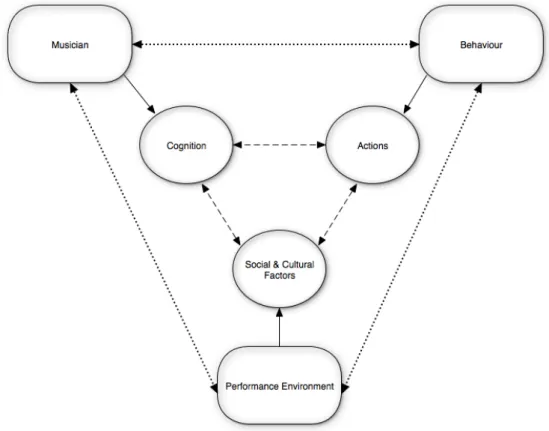
A long-standing approach that is integral in environmental psychology is that of Barker’s behaviour-settings theory (1968). Behaviour-settings theory suggests that a physical environment encourages specific behaviour and actions. This comes as a result of cultural significance, socio-normative expectation, personal meaning, and through the observation of others. From this information, it is possible to establish the person-environment
relationship; that is to understand how and why a person interacts with their surroundings in the way that they do. An adapted version of Bandura’s (1986) triadic reciprocatory model has been created (Figure 2) to provide graphical representation within this
Figure I. Breakdown of musical, extra-musical, and non-musical areas of consideration within a musical performance.
research, replacing person and environment with musician and performance environment respectively.
It has proven to be beneficial to use the example of a library when introducing behaviour-settings theory to those outside of psychology research fields. Upon entering a library, a person is expected to remain quiet, well behaved, and not to disturb others, even if there is no-one else nearby (Aarts and Dijkstehuis 2003). This is a behaviour setting and is important in defining the person-environment relationship. In addition to Barker’s behaviour-settings theory, this research project also approaches the topics of socio-cultural significance and personal meaning. Research methods used in environmental psychology are qualitative. Behaviour can typically be observed externally, although the intent behind a person’s behaviour may require clarification. However, whether an environment possesses a sense of social or cultural significance, or possibly personal meaning, input from the person would be required.
Methods
There are a number of different methodologies and approaches taken in this research. Figure II. Triadic reciprocatory model adapted to demonstrate the person-environment
on the effects of acoustic-focused studies by the likes of Sato, Kamekawa, and Marui (2011) and Ueno, Kato, and Kawai (2010), mentioned earlier in this paper. For this study, the participants consisted of eight guitarists, using their chosen variations of the acoustic guitar for consistency, grounds for comparison, and convenience throughout the
experiments. The participating musicians remained anonymous throughout the duration of the research project in accordance with the Ethics Committee guidelines at the University of Surrey, and are identified alphabetically in order of their involvement in the study, i.e. Guitarist A, Guitarist B, etc. Participating musicians were tasked with performing three short, instrumental excerpts of their choosing in: 1) a real-world environment, such as a church or a concert hall; 2) a simulated acoustic environment based on previous real-world environments; and 3) an unmediated recording studio.
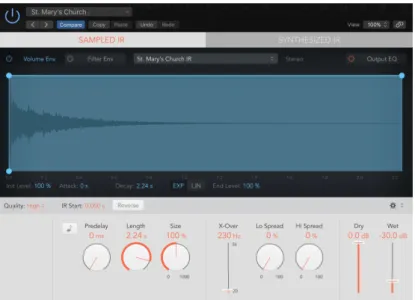
The methodology offers a much-needed replication of previous studies into the effects of acoustics over playing (Frieler et al. 2013), whilst also adding the real-world performance, answering the calls of previous studies. Each musician’s performances are compared in search of differences in musical playing, such dynamic range and tempo. The information gathered from this practical experiment reveals differences in playing between a real-world environment and its corresponding simulated reverb effect (Figure 3), suggesting acoustics conditions are not the sole variable in environmental influence. This encourages further considerations about the active influential factors within a music performance environment that are of a non-musical origin but affect a musician and their performance.
Figure III. Logic X's Space Designer convolution reverb effect, used for simulated acoustic environments during this project.
In order to explore the non-musical elements of a musical performance, post-experiment interviews were required. Following participation, a semi-structured interview was
conducted with each participating musician individually on the topic of their experiences within the different performance environments. Due to the individualistic nature of
personal and cultural influences, this information would otherwise be impossible to gather through observation and the analysis of a performance in a traditional manner.
Findings & Outcomes
At the beginning of this research project, the aim was to expand upon existing studies into the effects of space and environment on a musician’s performance. An understanding of how musicians respond and adapt their playing to suit the acoustics of a performance environment were already established. The inclusion of real-world performance
environments to the methods of so many studies before, was due to the belief that there is more to an environment than acoustics that are to be considered as influential factors in the context of a performance, especially from the perspective of the musicians
themselves. The findings of this research indicate a vibrant person-environment relationship between a musician and their surroundings in the context of a musical performance.
Like Aarts and Dijksterhuis (2003), the outcomes of this research project are more relatable to a wider audience if the example provided is of an environment that a majority of people will have experienced at some point in their lives. It is also important that the example environment includes a universally accepted and understood purpose, behavioural requirements, a place in societies and culture, and also holds a sense of personal meaning. It is for these reasons that a church is used to show the potential effects of a musician’s association with their surrounding environment can impact a musical performance.
A church is an environment built with the intent to provide a place of worship and prayer. Cassidy (1997) describes how “A church in physical terms is just another building. However, people tend to behave in a particular way in a curch because its function has been defined in social terms” (Cassidy 1997: 3). From an early age, we are taught to be quiet and respectful in a church, and that to misbehave would be frowned upon and disrupt those around us; the church as a behaviour-setting is established. Depending on the location of a church, its importance to society and culture may be evident. Calvert (2017), for example, discusses the positioning of Durham Cathedral, Durham, England, in relation to local historical tales used to validate the ‘holiness’ of the site. In terms of a sense of personal meaning, a church may provide a person with a dedicated place to
a facility that in which other interests may be explored, such as architecture or local history, without necessarily being specific to religion and the personal belief systems of the individual. For the musicians that participated in this study, the behaviour-setting remains in effect; they remained quiet and peaceful throughout, often with their heads bowed. Two of the participants, with no connections to each other in any way, both commented on their reluctance to play certain types of music in a church environment:
It’s the kind of environment that expects you to be calm. You know, these kinds of things, keeping calm, you don’t really get into the music. You just stay really calm. It doesn’t mean that you’re not in the music, but
physically speaking, you just keep things inside. (Guitarist A, personal communication, April 18 2016)
One of the songs is quite percussive and it didn’t even feel quite right playing it there. It’s about an attractive Latin lady, I was very conscious of what the environment wants of you. (Guitarist D, personal
communication, August 28 2016) Behaviour-Settings Theory
The first non-musical environmental attribute to be investigated is that of behaviour-settings theory; the approach that implies a physical environment has influence over a person’s behaviour and actions. One example is learning from an early age not to run and shout in a church, that one should act respectfully, and avoid the use of bad language. Interestingly, an instance of a behaviour-setting manifesting is that certain styles of music are deemed inappropriate to perform within a church. Of the musicians taking part in this study, two commented on their reluctance to play Flamenco style when inside a church, as the often-erotic nature of the genre was deemed disruptive for the church environment. Similar to the church environment, a concert hall is likely to encourage certain behaviour, such as formal self-presentation and the requirement to act with a sense of
professionalism. Cultural Significance
The concert hall is typically considered a place wherein the highest quality of musical performance is expected. Within the scope of this research project, the association with quality resulted in determination to deliver the most accurate performance; musicians also sat up straight and played with exaggerated physical gestures, similarly to how they would present themselves in the context of a live performance. This included gesturing towards an invisible audience, showing the effect of association when performing in an
environment that would feature an audience under normal performance situations. Other participants commented on a perceived sense of nervousness; performance anxiety induced by the formal expectations typically associated with performing in a concert hall
environment, this caused significant frustration if any mistakes were made. These findings indicate that performance environments where an audience would typically be in
attendance continue to elicit certain responses in musicians whilst performing, despite there being no audience present. This also challenges the notion that the music performance environment is entirely a social construct, as there is no significant social interaction taking place within the experiment.
Personal Meaning
The most individualistic element of this study has been investigating how elements of personal meaning contribute towards the person-environment relationship between a musician and their surroundings in the context of a performance. For each musician, past experiences within certain environments are unique, based on upbringing, socio-cultural background, and beliefs. For Guitarist C, the church setting represented a place for worship and self-reflection, whereas Guitarist G recalled times of mourning and sadness:
In the church, I think of times of mourning. That was probably the first thing that sprung to mind, and that affects you, because it’s a place where you’re meant to be quite sad, and therefore that’s definitely the way I felt in that environment. (Guitarist G, personal communication, September 28 2017)
Conclusion
In conclusion, this paper has covered existing research on the effects of environment and space on a musician’s playing, as well as indicated the gaps in the research as a result of methodology and the limitations of the field of music performance studies. The existing research calls for expansion that requires the input of other research fields as an
interdisciplinary study. In order to attend to these knowledge gaps, a combined approach between music performance studies and environmental psychology was designed and conducted. The outcome of this combination is not only important because it develops an understanding as to how environmental attributes beyond acoustical characteristics influence a musician’s playing; in addition, it allows for the person-environment
relationship between a musician and the place they are performing in to be considered as an active and affective factor in music performance situations. The impact of this study is of interest to all who operate within recording and performance professions, research fields, and education.
References
Aarts, Henk & Dijksterhuis, Ap (2003) “The Silence of the Library: Environment,
Situational Norm, and Social Behaviour”. Journal of Personality and Social Psychology, 84 (1), pp. 18-28
Barker, Roger Garlock (1968), Ecological psychology: concepts and methods for studying the environment of human behavior., Stanford (Calif.): Stanford University Press
Bates, Elliot. (2012), ‘What Studios Do’, Journal on the Art of Record Production, 7 (1), http://arpjournal.com/what-studios-do/. [accessed: 02/03/2018].
Blesser, Barry & Salter, Linda-Ruth (2007), Spaces Speak, Are You Listening? Experiencing Aural Architecture MIT Press
Byrne, David (2017), How music works, Three Rivers Press
Calvert, Arran. James. (2017) ‘Living with Durham Cathedral: understanding the dynamic relationships between a community and their cathedral’. Available at: https://research-repository.st-andrews.ac.uk/handle/10023/12034 [Date accessed: 17/03/2018].
Cassidy, Tony. (1997), Environmental psychology: behaviour and experience in context, Psychology Press
Frieler, Klaus et al. (2013), “Replication in music psychology”. Musicae Scientiae, 17 (3), pp. 265-276
Gifford, Robert (2002), Environmental psychology: principles and practice, Optimal Books Griffiths, Noola (2010), “’Posh music should equal posh dress’: an investigation into the concert dress and physical appearance of female soloists”, Psychology of Music, 38 (2), pp. 159-177
Guitarist A (2016, April 18), Personal Interview Guitarist C (2016, September 10), Personal Interview Guitarist D (2016, August 28), Personal Interview Guitarist G (2017, September 28), Personal Interview Guitarist H (2017, September 27), Personal Interview
Meyer, Jürgen (2009), Acoustics and the Performance of Music: Acoustic Considerations for Instrumentation and Playing Technique, Springer Science Business Media
Sato, Kamekawa, and Marui (2011), The Effect of Reverberation on Music Performance. USA, presented at the ‘131st Audio Engineering Society’, pp. 1-4
Schärer Kalkandjiev, Z. et al. (2015), “The Influence of Room Acoustics on Solo Music Performance: An Experimental Study”, Psychomusicology: Music, Mind, and Brain, 25 (3): pp. 195-207
Ueno, Kato, and Kawai (2010), “Effects of Room Acoustics on Musicians’ Performance, Part 1: Experimental Investigation with a Conceptual Model”. ACTA Acustica United With Acustica, 96, pp. 505-515
Vad, MIkkel (2017), “Perspectives from the Spatial Turn on the Analysis of Space in Recorded Music”, Journal on the Art of Record Production, 11 http://arpjournal.com/perspectives-from-the-spatial-turn-on-the-analysis-of-space-in-recorded-music/ [accessed 02/03/2018]
Wald, Gayle. (2011), ‘Black Music and Black Freedom in Sound and Space’, American Quarterly, 63:3, pp. 673-696
Wells, Evans, and Cheek (2016), “Environmental psychology” in Frumkin, Howard (ed.)