The Cristo Rei section (Lower Miocene)
Distal fluviatile environments in a marine series,
plants, vertebrates and other evidence, age
M. Telles Antunest-', J. Pais
2,A. Balbino
2,3,P. Mein
4and J.-P. Aguilar>
1 - Academia das Ciencias de Lisboa.
2 - Centro de Estudos Geol6gicos da UNL, Faculdade de Ciencias e Tecnologia, 2825-114 Caparica, Portugal; tel. (351)(I)2948573, fax (351)(I)2948556; [email protected] (M.Telles Antunes); [email protected] (LPais); [email protected] (A. Balbino). 3 - Departamento de Geociencias, Universidade de Evora, Apartado 94, 7000 Evora, Portugal.
4 - Centre des Sciences de la Terre, Universite Lyon I, Bd. du II Novembre, 69621 Villeurbanne, France; tel. (33) (4) 72448377, fax (33) (4) 72448382. 5 - Laboratoire de Paleontologic, UMR 5554, Universite Montpellier II, cc 064, 34095 Montpellier Cedex 5, France; tel. (33) (4) 67143251,
fax (33) (4) 67143610.
RESUMO
Palavras-chave: Miocenico inferior; Bacia do Baixo Tejo; Cristo Rei; idade; plantas; vertebrados; ecologia e ambientes.
o
corte de Cristo Rei permite observar camadas arenosas com lenticulas argilosas (divisao IVb). Correspondem a importante episodio de regressao (aprox. entre ca. de 17.6 e 17 Ma) e a uma posicao distal (em relacao as facies tipicamente fluviais representadas em Lisboa) e mais proxima do eixo da bacia. Os dados geologicos e a analise paleontologic a (plantas, peixes, crocodilos, mamiferos terrestres) permite reconstituir ambientes entao representados na area em causa: estuario com canais e ox-bows; a montante, areas ocupadas com aguas salobras onde se constituiram bancos deGryphaea griphoides; ainda mais acima, aguas doces, ladeadas de florestas proprias de areas humidas e de florestas subtropicais de baixa montanha, em condicoes de clima temperado quente e pluvioso, mas tambem por ambientes sazonahnente secos, com cobertura florestal ou arbustiva pouco densa, ou de estepe.ABSTRACT
Key words: Lower Miocene; Lower Tagus basin; Cristo Rei: datation; plant fossils; vertebrates; ecology and environments.
The section at Cristo Rei shows sandy beds with intercalated clayey lenses (IVb division from the Lisbon Miocene series) that correspond to a major regression event dated from between ca. 17.6 and 17 Ma. They also correspond to a distal position (relatively to the typical fluviatile facies in Lisbon), nearer the basin's axis. Geologic data and paleontological analysis (plant fossils, fishes, crocodilians, land mammals) allow the reconstruction of environments that were represented in the concerned area: estuary with channels and ox-bows; upstream, areas occupied by brackish waters whereGryphaea griphoidesbanks developped; still farther upstream, freshwaters sided by humid forests and low mountain subtropical forests under warm temperate and rainy conditions, as well as not far away, seasonally dry environments (low density tree or shrub cover, or steppe).
1. INTRODUCTION
Continental deposits are intercalated in the mainly marine Miocene infillings of the Lower Tagus Basin. These are of utmost stratigraphic
Ciencias da Terra (UNL), 13
Fig. 1. Position of the Cristo Rei section.
is a marked reduction in thickness of the more often dealt with marine levels. The latter are also shallower than southwards closer by the basin's main axis.
The Almada area (fig. 1) is closer to the deepest part of the basin. Marine facies prevail even more than in Lisbon. Continental influence is much lesser. There are not yet fully known but important lateral shifts of facies, owing to hiatuses between outcrops and to insufficient knowledge of borehole evidence (Antunes et al., 1996, fig. 6 / updated version).
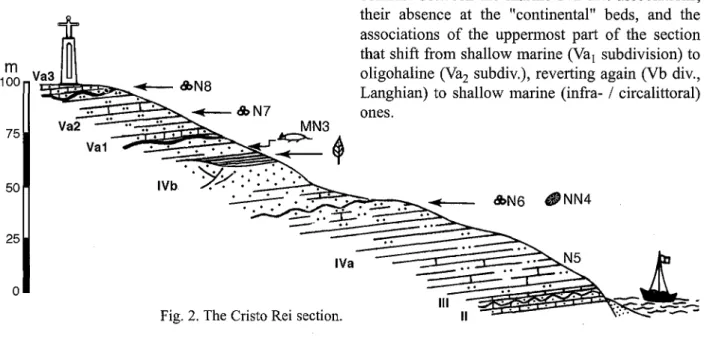
The best section where the Lower Miocene units outcrop is probably that at the Tagus' southern bank under the Cristo Rei monument, that was described in detail (Antunes et al., lac. cit.,
p. 62-65, fig. 2-3).
Continental influence is obvious as far as coarse sands with scattered valves of Gryphaea
Atlantic Ocean
&N6 "NN4
griphoides (IVb division of Lisbon's Miocene series, Burdigalian) are concerned. The upper part of the IVb unit shows some lenticular occurrences of silty clays with plant fossils. One of these lenses (ca. 100 meters W of the geodetic point at Pau da Bandeira), UTM coordinates MC 815.0 853.5, according to the Military map of Portugal 1: 25000, sheet n." 431 / Lisboa) yielded a large number of leave impressions.
Similar sands in Lisbon had been productive for small mammals research. Washing and sieving coupled with bromoform reconcentration yielded salt water fish, crocodilian and other vertebrate remnants, among which rodents are most inter-esting for marine / continental correlation.
Previous experience led us therefore to try at Cristo Rei (fig. 2). As prospections were positive, some cubic meters of sands were subsequently exploited for vertebrate remains, both under (level 1) and over (level 2) greenish, intercalated silty clays often rich in impressions of land plant leaves. However, age or other differences between these two levels - both with vertebrates - is minimal and all can be taken together. Vertebrate remnants are often reworked and somewhat abraded. An account of the small mammals has been given by J.-P. Aguilar (Aguilar, 1981).
The coarse sands overlie blue, pyritous silts and clays (IVa division) where the beautiful guide-fossil Pereiraia gervaisi occurs among many others. Planktic foraminifera indicate N5 (at the base) and N6 zones of Blow. Calcareous nanno-plankton seems to correspond to Martini's NN4. Evidence points out to Haq et al.'s 2.1 eustathic cycle.
The distribution of ostracoda shows a striking contrast between the marine IVa div. associations, their absence at the "continental" beds, and the associations of the uppermost part of the section that shift from shallow marine (Val subdivision) to oligohaline (Vaz subdiv.), reverting again (Vb div., Langhian) to shallow marine (infra- / circalittoral) ones.
Tagus River
-•• • " • MN3
:~"'.,.~~
~
IVb '.
y....:;/.. :::'. :. '. .... .
.:... .
:::.:;--=-~
".
~.~.~.
';;::.
~
..
~
. .'.
..:-:.:.=:i=-:.---"-';...'--.:"':''---..
--
..
.... ~&N8 ~&N7 Va2 Va1 Va3~
75 50 25m
100 IVao
..
'.
The data concerning the Cristo Rei section, coupled to data about other sections and to much progress of knowledge on Sr and K-Ar dating, biochronology and magnetostratigraphy, allow us to frame accurately in time the paleontologic and stratigraphic evidence.
General data are mostly based on a previous note (Antunes et al., 1996). Plant fossils were accounted for by J. Pais, fishes by A.Balbino and
M. T. Antunes, crocodilians by M. T. Antunes,
and mammals by P. Mein, J.-P. Aguilar and M. T. Antunes, who ensured the coordination and the redaction.
The characterization of a regression event rather accurately dated at 17.5 Ma (Antunes
et al., 1999) in the distal part of the basin and the
corresponding environments are our current aim.
2. PLANT REMNANTS (Plates I-III)
Except for the lack of cuticles, impressions of plant leaves are quite well preserved. These were ascribed to the following forms (table 1).
Table 1
Cristo Rei section, IVb unit (Fig. 2)
PLANT TAXA
Lygodium gaudiniHeer
Comptonia acutiloba(Unger) Saporta
Myrica cf.lignitum (Unger) Saporta (*)
Populus serrulatus(Heer) Pais
Ulmus bronniiUnger
Podogonium oeningense(Koenig) Kirchheimer
Zelko va zelkovaefolia (Unger) Buzek & Kotlaba (*)
Sapindus falcifolius (Braun) Braun
Magnolia oedipa(Heer) Pais
Daphnogene polymorpha (Braun) Knobloch & Kvacek
Cf.Engelhardtia orsbergensis (Wessel & Weber)
Jahnichen, Mai& Walther (*)
Gleditschia knorrii (Heer) Gregor
Some taxa are common in Central Europe but new as far as Portugal is concerned (*), i.e.Zelkova
zelkovaefolia, Myrica lignitum and cf.
Enge-lhardtia orsbergensis. Comptonia occurs in the
Plio-Pleistocene at Quinta do Jardim near Obidos (Teixeira, 1973; Teixeira & Pais, 1976, p.174) as well as in the upper Middle Miocene at Povoa de Santarem.
The commonest species is Podogonium
oehningense, followed by Populus serrulatus. The
remaining species are represented but by 2 or 3 specimens, and a few by a single fossil.
The analysis of foliar physiognomy shows, for the macroremains collected at the IVb unit, 5.6% leptophyll, 22% nannophyll, 61.1 % microphyll and 11.1% notophyll (Pais, 1981; 1989). On the other side, the leaves' morphology from the IVb unit shows a large (55%) majority of entire leaves. Stratigraphic correlation shows that the Cristo Rei plant fossils are younger than the already known plant sites from the lower part of the IVb unit in Lisbon (Quinta do Bacalhau and Quinta do Fidie, near Campo Grande) under the fluviatile
sands with mammals and other vertebrates. It
compares well in time with plant sites at Quinta das Pedreiras and Areeiro da Barbuda, Lisbon, both being a little later than the IVb sands. Anyway the time span between the lower and upper IVb plant sites is not great, nor are there any meaningful
differences as far as plant associations are
concerned.
These matters were accounted in a synthesis on the evolution of the vegetation and climate during Miocene times (Pais, 1986).
3. FISHES
Fish remnants (mostly teeth) belong to teleosteans as well as selachians.
Among the former, teeth from Sparidae
largely outnumber any other bony fish parts. One may assume that there is a huge majority of sea-breams. Among Sparids, a number of teeth can be reported toSparus, especially the larger molariform
ones. Determination of other teeth is more
uncertain, as they may belong to Sparus as well as to other genera, i.e. Pagrus, Pagellus or even
Sargus and allied forms. The presence ofSargus is
certain on the basis of its incisiviform anterior teeth. On the other side, barracudas (several species of
Sphyraena, common in other sites) are poorly
represented, as coral-eaters or reef-dwellers as
Batistesand Tetrodon.
Ciencias da TerrarUNL), 13
The corresponding environments may have been rich in benthic molluscs, whose shells would easily have been destroyed through intensive abrasion on sand bottoms under agitated waters coupled with CaC03chemical, diagenetic elimina-tion. Only the large and by far the more resistant oyster valves subsisted.
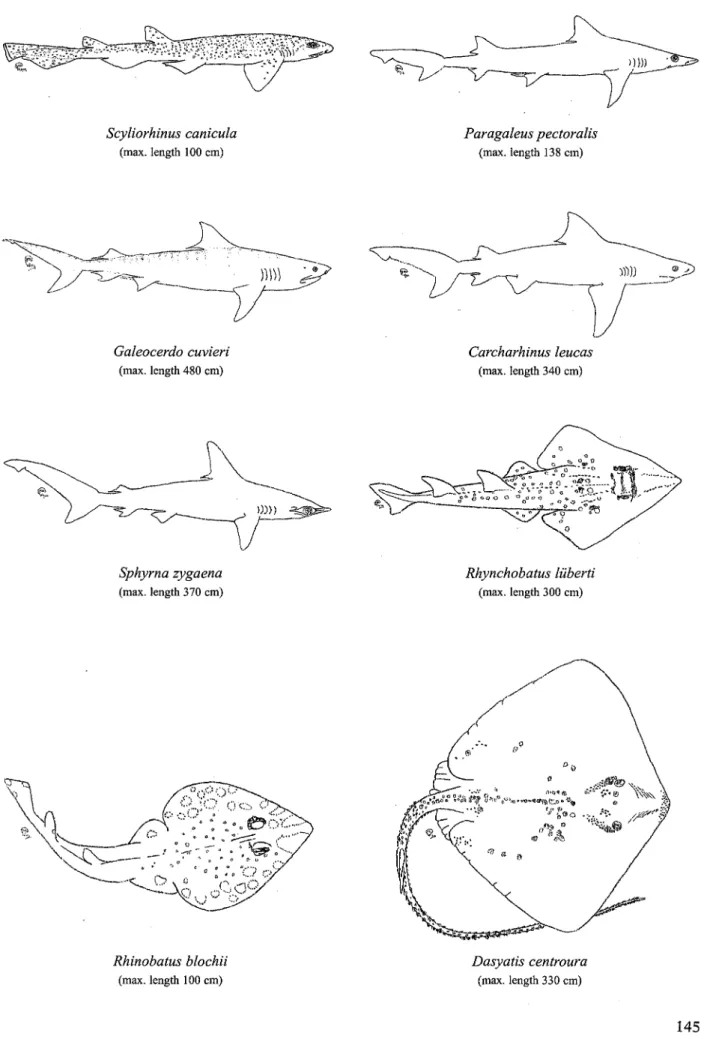
The selachian fauna is shown (table 2; see Fig. 3).
Table 2
Cristo Rei section, level with mammals(Fig.2)
SELACHIANS - SHARKS, SKATES AND RAYS (Number of teeth)
SQUALOMORPHII
Pristiophorus sp.(5)
GALEOMORPHII
Megascyliorhinus miocaenicus(Antunes& Jonet)(3)
Scyliorhinus joleaudiCappetta(23)
Paragaleus pulchellusJonet(24)
Hemipristis serra Agassiz(1)
Galeocerdo aduncus Agassiz(1)
Rhizoprionodonsp.(7)
Carcharhinus priscusAgassiz(92)
Sphyrna sp.(19)
BATOMORPHII
Rhynchobatus pristinusProbst(20)
Rhinobatos sp.(70)
Dasyatisgr. centroura Mitchill(123)
Dasyatisgr.gigas Gunther(194)
Myliobatis sp.(10)
Pteromylaeussp.(2)
Rhinopterasp. (3)
Even if numbers of teeth cannot be converted into numbers of individuals, they give indications about relative numbers. The sandy levels under study yielded teeth from nine shark taxa plus seven batoid ones, as well as several teleosts referred to above.
Two forms were known in the basin, but in much later (Serravallian and lower Tortonian) beds:
PristiophorusandMegascyliorhinus.
Small Carcharhinids (Carcharhinus priscus,
Paragaleus pulchellus) prevail along with
Scyliorhinus joleaudi. Hammer-heads (Sphyrna)
are rather common.
Larger Carcharhinids (Hemipristis,
Galeo-cerdo) are exceedingly rare. No Lamnifonns were
found, even the often very common sand sharks
(Carcharias). Other large-sized Lamnifonns (as
Carcharocles, Isurus, and Alopias) are
conspic-uously absent. Of course, granulometric selection may in part account for this, but it can be but a minor factor to reckon with.
The commonest batoids are Rhinobatos sp.,
Dasyatis gr. gigas, and Dasyatis gr. centroura.
Nearly all selachians point out to moderately warm waters. The sawshark Pristiophorus is the sole apparent discordance, to be discussed later. The rarity of the larger Carcharhinids as well as the absence of otherstenotherm, warmwater forms as lemon shark (Negaprion) and nurse-shark
(Ginglymostoma) may be related to very shallow
environments. That rarity does not point out to even wanner waters. On the other hand, temperate or cold water dwellers as Squaliforms (Squalus,
Deania)andRajaare unknown.
The selachians point out to very shallow waters. The sole exception (deeper environments, lower temperatures) is that ofPristiophorus, but its presence may result from upwelling currents that either displaced live animals or corpses. Its rarity is not enough to change the moderately warm water interpretation.
4. CROCODILIANS
Rare crocodilian teeth from the Cristo Rei section indicate the common association in littoral or estuarine areas during the Lower and early Middle Miocene of the basin (Antunes, 1987, 1994): this comprises a very large and heavy Tomistomine, Tomistoma lusitanica, probably a large-prey predator; and an also large-sized but very slender-snouted and sharp-teethed Gavialis sp., mainly ichthyophagous. Both genera seem to have immigrated from Asia into western Europe,
Tomistoma at least since the upper Oligocene
(Antunes & Cahuzac, 1999), and Gavialis in the lower Miocene. Migrations seem correlative of transgressive (and wanner) events.
Fig. 3. Sharks and Rays: some extant representatives of genera identified from the levels with mammals (see Fig. 2)
Scyliorhinus canicula
(max. length 100 em)
Galeocerdo cuvieri
(max. length 480 em)
Sphyrna zygaena
(max. length 370 em)
Rhinobatus blochii
(max. length 100 em)
Paragaleus pectoralis
(max. length 138 em)
Carcharhinus leucas
(max. length 340 em)
Rhynchobatus liiberti
(max. length 300 em)
Dasyatis centroura
(max. length 330 em)
Ciencias da Terra (UNL), 13 / r---~,\
(
)
\ (\
Pteromylaeus bovinus(max. length 150 em)
where temperatures fall under about 10 degrees at the coldest time of the year. Past evidence seems compatible with this. Furthermore, Tomistoma and
Gavialis are strictly tropical today, as most
probably they were before. Their decadence and local extinction during lower Upper Miocene in the concerned region is related to a marked temperature decrease during Middle Miocene times.
5. MAMMALS
As it can be recognized by correlation with the Lisbon area, the Cristo Rei sands (about 17.2 Ma) are a little higher stratigraphically than the IVb feldspathic sands (ca. 17.4 Ma) in Lisbon. The latter
yielded a mammalian fauna with Gomphotherium
angustidens (but still no Prodeinotherium), a
number of other medium to large forms and
especially the last Anthracothere, Brachyodus
onoideus (Antunes, 1984; for a full
check-list see Antunes in Antuneset al., 1996, Addendum, p. 72). No small mammals are known at exactly these deposits. There is only an hitherto unpub-lished minor locality just under the feldspathic sands at Avenida Professor Vieira de Almeida, in Lisbon, where a Glirid, Pseudo-dryomys
simpli-cidens,was collected.
The Cristo Rei mammalian taxa are as follows (table 3).
Rhinoptera javanica
(max. length 213 em)
Table3
Cristo Rei section MAMMALIAN TAXA
(List of rodents revised by I.-P.Aguilar, July 97)
ARTIODACTYLA
Cainotherium miocaenicum Crusafont & Villalta
(see Fig. 4-5)
?Lagomeryx ruetimeyeriThenius
LAGOMORPHA
Lagopsis peiiai (Royo)
RODENTIA
Pseudodryomys simplicidensde Bruijn
Pseudodryomys robustusde Bruijn
Peridyromys murinus(Pomel) oubiradiculusMayr
Ligerimys antiquus Fahlbusch (whose evolution
stade can be compared to those from Beaulieu and Moratilla)
Heteroxerus sp.
According to P. Mein, the association of small mammals points out to the MN3 mammal-unit, as all the IVb sites with large mammals.
The MN4 mammal-unit is represented by the fauna from the overlying Va2 subdivision at important sites as Quinta das Pedreiras (Lumiar) and Quinta do Pombeiro (Chelas), in Lisbon. It is
marked by the arrival of Amphicyon giganteus,
bavari-Fig. 4. Reconstitution ofCainotherium
Fig. 5. Reconstitution ofCainotherium skeleton
Ciencias da Terra (UNL), 13
cum, Megacricetodon primitivus and
Democri-cetodon hispanicus (for a full check-list see
Antunes, ibid.). Age is ca. 16.7 Ma. Hence the mammal-unit changed sometime in a span of about an half million years.
Cristo Rei mammals provide information of environmental interest (Antunes & Mein, 1986, p. 132-133; Antunes & Mein, 1992, p. 138-139):
?Lagomeryx ruetimeyeri, a small Cervid, probably
was a dweller of forest, or of forest with open spaces; Pseudodryomys simplicidens - terrestrial,
open spaces; Pseudodryomys robustus - maybe
terrestrial, open spaces; Peridyromys muri-nus ou
biradiculus - terrestrial, steppe environ-ments;
Ligerimys antiquus- forest; Heteroxerus sp. -
ter-restrial, forest with open spaces.
6. SYNTHESIS
The Cristo Rei fossils (plants, fishes,
mammals) from the sands with intercalated silty clays are older than the overlying Va marine unit dated at ca.17.2 Ma, the lower time limit being about 17.5 Ma. Evidence seems compatible with an estuary where there was an influx of coarse sands related to transportation by a large river.
Under a biogeographic viewpoint, plant affinities are asiatic (P. serrulatus, Z.zelkovaefolia,
cf. E. orsbergensis, ? S. falcifolius), american
(M. oedipa, C. acutiloba), and maybe african
(P. oehningense andM lignitum). Most fishes have
huge geographic distribution and hence are not characteristic. Crocodilians have asian affinities. Mammals are common in western Eurasia and thus not very characteristic either.
In comparison with extant data, foliar
physiognomy and foliar morphology point out to low mountain, subtropical forests under warm
temperate and rainy, or seasonally dry
environments. The plant association suggests warm temperate to subtropical conditions. It mostly reflects humid areas close or not far from a river,
and not far away low mountain subtropical forests under warm temperate and rainy (seasonally dry) conditions. More inland plants had poorer chances to be present in the clayey lenses.
The generalized small size of the fishes suggests that most were juvenile. This also seems to discard strictly marine, open environments. It points out to estuarine or close-by, very shallow waters. Transported, more or less abraded valves of
Gryphaea griphoides reveal the existance of oyster
banks in brackish waters not so far upstream. No deep sea fishes occur except perhaps
Pristiophorus, whose scarce remnants could mean
an eventual influence of upwelling. Large numbers of salt water fishes stress the greater proximity of the open sea than in Lisbon, where there are fluviatile, feldspathic sands in the IVb division. The ichthyologic fauna points out to at least moderately warm, very shallow, littoral or even estuarine salt water environments.
Crocodiles and especially the Tomistoma plus
Gavialis association are maybe the best thermal
indicators for a warm, never cold in the coldest season, climate and humid environments.
Mammals correspond to several ecological
niches. Some were forest dwellers (Cervid,
Ligerimys); this corroborates plant evidence of
forests. Others are terrestrial, living in forest with
open spaces (Heteroxerus), in open spaces
(Pseudodryomys spp.), or steppe (Peridyromys).
Mammals show that there were also more open ones with a less dense tree and shrub cover, or even steppe. Humid areas did not occupy the whole region.
The banks of the river and channels, as well as nearby areas were forested. Humid, freshwater areas were quite extended, hygrophyll plants as
Populusbeing very common. Shifting channels left
REFERENCES
Aguilar,I.-P. (1981) - Evolution des Rongeurs miocenes et Paleogeographie de la Mediterranee occidentale. These presentee
a
l'Universite des Sciences et Techniques du Languedoc pour obtenir Ie grade de Docteur d'Etat-Mention Sciences, 203 p. Montpellier.Antunes, M. T. (1984) - Essai de synthese sur les Mammiferes du Miocene du Portugal. Vol. d'Hommage au geologue G.Zbyszewski, Ed. Recherche sur 1es Civilisations, p. 301-323. Paris.
Antunes, M. T. (1989) - Miocene catfishes (Ariidae, Bagridae) from Lisbon: a Nilotic (or Sudanian) type fauna.Cienciasda Terra (UNL),Lisboa, 10: 9-22.
Antunes, M.T. (1987) - Affinities and Taxinomical Status of Miocene Longirostrine Crocodilians from Western Europe with Remarks on Phylogeny, Paleoecology and Distribution. Comun. Servo Geol. Portugal, 1987,73(1/2): 49-58.
Antunes, M. T. (1994) - On Western Europe Miocene Gavials (Crocodylia) their Paleogeography, Migrations and Climatic significance. Comun. Inst. Geol. e Mineiro,80: 57-69.
Antunes, M. T.& Cahuzac,B.(1999) - Crocodilian faunal renewal in the Upper Oligocene of Western Europe.C.R. Acad. Sci. Paris,Sciences de la Terre et des planetes, 328: 67-73.
Antunes, M.T.;Elderfield, H.; Legoinha, P.; Nascimento,A.& I.Pais (1999) - A Stratigraphic framework for the Miocene from the Lower Tagus Basin (Lisbon, Setubal Peninsula, Portugal). Depositional sequences, biostratigraphy and isotopic ages. Bol. Soc. Geol. Espana,Madrid, in press.
Antunes, M.T.,Legoinha, P., Nascimento,A. & Pais, J. (1996) - The Evolution of the Lower Tagus basin (Lisbon and Setubal Peninsula, Portugal) from Lower to early Middle Miocene. Geologie de la France, 4: 59-77. Orleans. [Including an Addendum by M. T. Antunes, Mammals from Lower to Middle Miocene of the Lower Tagus basin, p. 71-73].
Antunes, M. T.& Mein, P. (1986) - Petits Mammiferes du Burdigalien inferieur (Universidade Cat6lica, Avenida do Uruguay). Ciencias da Terra (UNL),Lisboa, 8: 123-138.
Antunes, M. T.& Mein, P. (1992) - Les plus anciens Mammiferes terrestres du Miocene marin de Lisbonne - Ie gisement du Km 10.Ciencias da Terra (UNL),Lisboa, 11: 127-140.
Balbino, A. C. (1995) - Selaceos (Pisces) do Miocenico terminal da bacia de Alvalade (Portugal). Sistematica, ecologia, paleoambientes, comparaciio com faunas actuais.Dissertacao de Doutoramento, Univ. de Evora, 200 p.
Hiirzeler, J. (1936) - Odteologie und odontologie der Caenotheriden.Abh. Schweiz. Paldont. Ges.,58-59: 1-111.
Pais, J. (1986) - Evolution de la Vegetation et du Climat pendant Ie Miocene au Portugal. Ciencias da Terra (UNL), Lisboa, 8: 179-191.
Pais,I.(1981) - Contribuicao para0 conhecimento da vegetacao miocenica da parte ocidental da bacia do Tejo. Dissertacao de Doutoramento, Universidade Nova de Lisboa, 328 p., 63 figs., 31 est.
Pais, J. (1986) - Evolution de la vegetation et du climat pendant Ie Miocene au Portugal.Ciencias da Terra (UNL),Lisboa, 8: 179--191,4 figs.
Pais, J. (1989) - Macrorrestes de vegetaux du Burdigalien superieur de Cristo Rei (Almada, Portugal).II European paleobotanical Conference(Madrid, Espanha, 3-7 de Setembro).
Teixeira, C. (1973) - Oreodaphne heeriGAUD., une nouvelle espece fossile du Pliocene de Rio Maior.Bol. Soc. Geol. Portugal, XVIII: 147-149.
Teixeira, C.& Pais,I.(1976) - Introducao
a
PaleobotanicaIAs grandes fases da Evolucao dos Vegetais. 2.aed. 211 p. Lisboa.ACKNOWLEDGEMENTS
Ciencias da Terra (UNL), 13
PLATE 1
(Scale in millimeters)
Fig. 1 Figs. 2, 3 Fig. 4 Fig. 5 Fig. 6 Fig. 7
- Lygodium gaudiniHeer
- Comptonia acutiloba(Unger) Saporta
- Sapindus falcifolius(Braun) Braun
- Zelko va zelkovaefolia(Unger) Buzek& Kotlaba
- Polpulus serrulatus(Heer) Pais
PLATE 1
4 3
1
Cit!l1cias da TerrarUNL), 13
PLATE 2
(Scale in mill imeters)
Fig. 8 Figs. 9, 10 Fig. 11 Figs. 12, 13
- Sapindu s fa lcifolius(Braun ) Braun
- Populus serrulatus(Heer) Pais
- Cf.Engelhardtia orsbergensis(Wessel& Weber) Jahnichen, Mai& Walther
PLATE 2
10
13
8
Ciencias da TerrarUNL) ,13
PLATE 3
(Scale in millimeters)
Figs. 14, 15 Fig. 16 Figs. 17, 18 Fig. 19 Figs. 20, 21
- Ulmus bronnii Unge
- Daphno gene polymorpha (Braun) Knobloch & Kvacek
- Podogonium oeningense(Koenig) Kirchheimer
- Gledits chia knorrii(Heer) Gregor
PLATE 3
19 20 16
17
18