
Universidade Nova de Lisboa - Faculdade de Ciências e Tecnologia
Department of Computer Science
Creation and Extension of Ontologies for
Describing Communications in the Context of
Organizations
by Ygor Couto Cardoso
Thesis submitted to Faculdade de Ciências e Tecnologia of the Universidade Nova de Lisboa, in partial fulfillment of the requirements for the degree of Master in Computer Science
Supervisors: PhD João Moura Pires PhD José Júlio Alferes
Resumo
O recurso a ontologias é, actualmente, uma área suficientemente sólida e madura para ser considerada uma alternativa eficiente na representação da informação e conhecimento. Com o advento da Web Semântica é expectável que essa alternativa venha a disseminar-se ainda mais num futuro próximo.
No contexto de uma colaboração encetada entre a FCT-UNL e o departamento de I&D de uma empresa de software nacional, foi desenvolvida uma nova solução de software intitulada ECC – Enterprise Communications Center, que visa a estruturação do processo de comunicação de uma organização de e para o exterior, e emprega processos de classificação automática e de pesquisa conceptual com base num repositório de comunicações. A especificidade é a chave da obtenção de resultados aceitáveis por parte destes processos e, como tal, o uso de ontologias torna-se fundamental na representação do conhecimento existente acerca de um determinado domínio de uma organização.
Este trabalho permitiu dotar esta aplicação de um conjunto de ontologias base que possuem a capacidade de exprimir o contexto geral das comunicações efectuadas no âmbito de uma organização, e de uma metodologia constituída por um conjunto de passos concretos que permitem uma eficaz extensibilidade destas ontologias a qualquer domínio de actividade. Através da aplicação destes passos, garante-se a minimização do esforço de conceptualização e
setup da plataforma em novas organizações e domínios de actividade.
Abstract
The use of ontologies is nowadays a sufficiently mature and solid field of work to be considered an efficient alternative in knowledge representation. With the crescent growth of the Semantic Web, it is expectable that this alternative tends to emerge even more in the near future.
In the context of a collaboration established between FCT-UNL and the R&D department of a national software company, a new solution entitled ECC – Enterprise Communications Center was developed. This application provides a solution to manage the communications that enter, leave or are made within an organization, and includes intelligent classification of communications and conceptual search techniques in a communications repository. As specificity may be the key to obtain acceptable results with these processes, the use of ontologies becomes crucial to represent the existing knowledge about the specific domain of an organization.
This work allowed us to guarantee a core set of ontologies that have the power of expressing the general context of the communications made in an organization, and of a methodology based upon a series of concrete steps that provides an effective capability of extending the ontologies to any business domain. By applying these steps, the minimization of the conceptualization and setup effort in new organizations and business domains is guaranteed.
Agradecimentos
À minha família, aos meus amigos, discos e livros. Às restantes fontes de inspiração.
À extrema paciência e compreensão revelada pela minha futura esposa, Irina Oliveira, e a imensurável força que só ela consegue me transmitir, dia após dia.
Aos meus orientadores João Moura Pires e José Júlio Alferes, de cujo gosto pelo ensino, polivalência e competência beneficiei durante estes findos dois anos de mestrado, e especialmente nesta fase final. É com orgulho e satisfação que posso dizer que fui orientado por estes dois professores, e constatar o imenso que aprendi.
Agradeço e congratulo toda a equipa da ITDS, pela excelente oportunidade de desenvolver
o nosso trabalho académico num aliciante projecto do “mundo real”. Agradeço em especial ao nosso elemento de ligação entre a ITDS e a faculdade, Rui Leal, pelo apoio e pela disponibilidade demonstrada.
ix
Index
Chapter 1 0BIntroduction ... 1
1.1. 7BContext ... 2
1.2. 8BMotivation ... 4
1.3. 9BObjective ... 4
1.4. Achievements ... 4
1.5. 10BThesis Structure ... 5
Chapter 2 1BState of the Art ... 7
2.1. 11BOntologies ... 9
2.1.1. 31BWhat Is an Ontology ... 9
2.1.2. 32BOntologies Languages and Vocabularies ... 11
2.2. 12BOntologies Repositories and Tools ... 18
2.2.1. Sesame ... 18
2.2.2. 34BProtégé ... 19
2.3. 13BMethodologies for Building Ontologies ... 23
2.3.1. 35BOntology Development Process ... 23
2.3.2. 36BUschold and King’s method ... 25
2.3.3. 37BGruninger and Fox’s Method ... 29
2.3.4. 38BMETHONTOLOGY ... 32
2.3.5. 39BOTK (On-To-Knowledge) ... 38
2.3.6. 40BGeneral Conclusions ... 42
2.4. 14BRe-engineering Non-Ontological Resources into Ontologies ... 44
2.4.1. 41BTypes of Non-Ontological Resources ... 44
2.4.2. 42BSoftware Re-engineering ... 48
2.4.3. 43BNon-Ontological Resource Re-engineering ... 48
2.4.4. 44BNon-ontological Resource Re-engineering Methods ... 50
2.4.5. 45BNeOn Method for Re-engineering Non-ontological Resources ... 56
2.4.6. 46BGeneral Conclusions ... 62
2.5. 15BRelational Databases to RDF ... 63
2.5.1. 47BGeneral Approaches ... 63
2.5.2. 48BD2RQ ... 64
2.5.3. 49BVirtuoso RDF Views ... 66
2.5.4. 50BR2O ... 68
2.5.5. 51BGeneral Conclusions ... 71
2.6. 16BOntology Learning from Unstructured Text ... 73
2.6.1. 52BNamed Entities Recognition ... 73
x
2.6.3. 54BMaedche and colleagues’ method ... 78
2.6.4. 55BGeneral Conclusions ... 79
Chapter 3 2BProposed Solution ...81
3.1. 17BRequirements ... 82
3.2. 18BCore Set of Ontologies and Vocabularies ... 83
3.3. 19BOntology Levels ... 84
3.3.1. 56BMotivation and Alternatives ... 84
3.3.2. 57BThe Meta Level ... 85
3.3.3. 58BThe Data Level ... 90
3.3.4. 59BMapping between the two levels ... 90
3.4. 20BMethodology ... 91
3.4.1. 60BKnowledge Elicitation ... 92
3.4.2. 61BDomain Lingo... 93
3.4.3. 62BCommunication Purposes ... 94
3.4.4. 63BOrganization’s Structure / Products and Services ... 95
3.4.5. 64BMapping between the two levels ... 96
Chapter 4 3BApplication ...97
4.1. 21BKnowledge Elicitation ... 98
4.2. 22BMeta Level ... 99
4.2.1. 65BModeling the Domain Lingo... 99
4.2.2. 66BModeling the Communication's Purposes ... 100
4.3. 23BData Level ... 101
4.3.1. 67BModeling the Organization's structure ... 101
4.3.2. 68BModeling the Organization's products and services ... 102
4.4. 24BMapping between the two levels ... 105
4.5. 25BImplementation Details ... 105
Chapter 5 4BEvaluation ... 107
5.1. 26BSatisfaction of Requirements ... 108
5.2. 27BResponse to Changes ... 109
5.2.1. 69BPredictable Changes ... 109
5.2.2. 70BChanges in the Requirements ... 110
5.3. 28BConsistency ... 111
5.3.1. 71BRule 1: Subclass inheritance ... 111
5.3.2. 72BRule 2: Mapping down to Data Level ... 112
5.3.3. 73BRule 3: Concepts Only in Meta Level ... 112
Chapter 6 5BConclusions and Future Work ... 113
6.1. 29BConclusions ... 114
6.2. 30BFuture Work ... 115
xii
List of Figures
Figure 1.1 XEO ECC General Functionality ... 2
Figure 1.2 Ontologies and their usage on the project ... 3
Figure 2.1 A Hierarchy – adapted from [85] ... 10
Figure 2.2 RDF Example ... 12
Figure 2.3 SKOS modelling example ... 15
Figure 2.4 - SPARQL Query ... 17
Figure 2.5 Sesame Server ... 18
Figure 2.6 Protégé-Frames editor ... 20
Figure 2.7 Protégé-Frames Query Interface ... 21
Figure 2.8 Protégé-OWL - Ontology Visualization Plugin - http://protege.stanford.edu/ ... 22
Figure 2.9 Protégé 4 - SKOSed plugin ... 22
Figure 2.10 Ontology Development Process Activities - adapted from [32] ... 23
Figure 2.11 Main processes of the Uschold and King's Method [32] ... 25
Figure 2.12 Processes in Gruninger and Fox's Methodology – adapted from [32] ... 30
Figure 2.13 Development process of METHONTOLOGY – adapted from [48] ... 33
Figure 2.14 Conceptualization activity according to METHONTOLOGY [35] ... 35
Figure 2.15 OTK Knowledge Meta Process [76] ... 38
Figure 2.16 Classification Schemes Data Models [78] ... 46
Figure 2.17 Non-Ontological Resources Categorization [83] ... 47
Figure 2.18 Non Ontological Resource Transformation Approaches [29] ... 49
Figure 2.19 Re-engineering Model for Non-Ontological Resources [83] ... 56
Figure 2.20 Re-engineering process for Non-Ontological Resources [78] ... 60
Figure 2.21 D2RQ Architecture [10] ... 64
Figure 2.22 D2RQ RDF Graph Mapping Example [10] ... 65
Figure 2.23 R2O Architecture [5] ... 68
Figure 2.24 Activities following in Maedche and colleagues method [32] ... 78
Figure 3.1 Core Set of Ontologies General Model ... 83
Figure 3.2 skos:Concept - defining a term ... 85
Figure 3.3 - Purpose Hierarchy ... 86
Figure 3.4 - Purpose as a Collection ... 87
xiii
Figure 3.6 Topic Map ...89
Figure 3.8 BPMO Classes ...90
Figure 3.7 Purpose Serialization ...89
Figure 3.9 Mapping between levels example...91
Figure 3.10 Non Ontological Resources ...92
Figure 3.11 Definition of SKOS properties in Protégé SKOSed Plugin ...93
Figure 3.12 Definition of purposes in Protégé SKOSed Plugin ...95
Figure 3.13 Employee Details ...96
Figure 4.1 - Domain Lingo Example 1 ...99
Figure 4.2 Domain Lingo Example 2 ...99
Figure 4.3 Domain Lingo Example 3 ... 100
Figure 4.4 Organization Structure Example ... 101
Figure 4.5 Insurance Products ... 103
Figure 4.6 Insurance Documents ... 103
Figure 4.7 "Apolice" Document Properties... 104
xv
List of Tables
Table 2.1 BMO Ontologies ...16
Table 2.2 ORSD Template –adapted from [87] ...40
Table 2.3 Pattern for Re-engineering Non-Ontological Resource Template [77] ...59
Table 3.1 ORSD Template –adapted from [87] ...83
1
Chapter 1
0B
Introduction
.
1.1
Context……….………….……….………….……….………..
2
1.2
Motivation……...………….……….……….………….…
..
……….……
4
1.3 Objective
………….……….………….………….…………
.
.……….
4
1.4 Thesis Structure
………….……….………..….………….………….….
4
This chapter presents the motivation, context and2
This chapter introduces the motivations behind the elaboration of this dissertation, namely the study of methodologies of creation and extension of ontologies. It is also shown the context of whereas this thesis has emerged, which is related to a new software solution, the ECC – Enterprise Communications Center, by the Portuguese company ITDS.
1.1.7BContext ITDS0F
1 is a Portuguese software company that has designed and developed the XEO Platform. XEO
stands for eXtensible Enterprise Objects and is a platform for business modeling and agile applications development that allows professional teams or business analysts to develop and maintain complex business applications, by modeling their real world’s business requirements in the
form of “business objects”.
One of the main components of this platform is called XEO Outcom. Outcom is basically a component that allows the management and structuring of the communication process of organizations, in terms of communications channels management, definition of communication templates and integration with a documental repository.
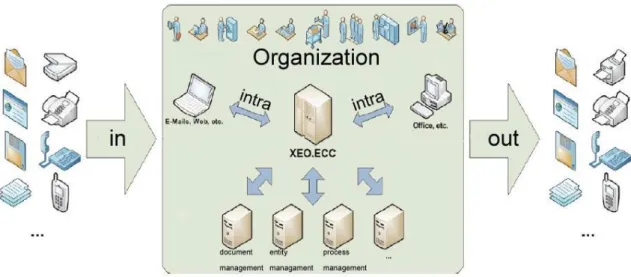
Inspired on the XEO Outcom, ITDS has decided to develop a whole new product called XEO ECC – Enterprise Communications Center, which has its general functionality illustrated in figure 1.1. This product is expected to provide an effective solution to manage and centralize all the communications that enter, leave or are made within an organization, as well as analyze and deal with the content they express.
1 www.itds.pt
2 http://dublincore.org/
3
Besides managing the organization’s communications, this program includes intelligent
classification of communications and search and navigation in the communications repository. To support these processes, the company has decided to rely on the use of ontologies.
The main goal is to provide an effective solution for a company to centralize and manage all the communications that enter or leave the organization, independently of the content expressed in the communications.
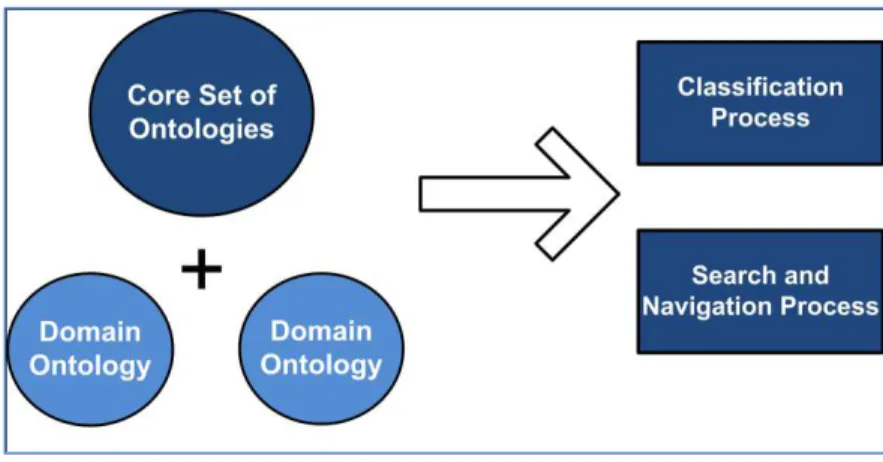
The ontologies are expected to model and express the communications, their interlocutors and respective roles within the organization, and the organization specific domain context.
Based on that model, the communications are annotated and classified according to the purpose illustrated by the communication content; this process serves as a basis to forwarding communications to each respective department in the organization, for example.
The annotated communications are made available in an archive, and there will be conceived a specific interface to search and navigate through it.
To support these functionalities, it is essential that the ontologies are able to be easily adaptable and extensible to any domain, as this guarantees that the effort of the setup process of the product in different customers is minimized, and the analysis of the communications content will be optimized for every particular case. This requires that a specific core set of ontologies is designed in such a way that its capacity of extensibility is guaranteed, and a comprehensive methodology of achieving that extension is described. Figure 1.2 illustrates the scenario described.
ITDS has obtained a QREN financial incentive to this project, and made an agreement with Faculdade de Ciências e Tecnologia – Universidade Nova de Lisboa to associate three MSc students to
4
it, with the theses themes of ontology development, automatic classification and search and navigation. This thesis is based on the first theme, and its aim is to create a methodology to develop and maintain the core set of ontologies the other processes rely upon.
1.2.8BMotivation
Ontology Engineering refers to the set of activities that concern the ontology development process, the ontology life cycle, the methods and methodologies for building ontologies, and the tool suites and languages that support them.
During the last few years, increasing attention has been paid to ontologies and Ontological Engineering, since they are now widely used in Knowledge Engineering, Artificial Intelligence and Computer Science, in general. It is now widely recognized that constructing a domain model, or ontology, is an important step in the development of knowledge based systems.
As such, one of the things that motivates me the most is the opportunity to deal with such an emerging and fascinating field of study, and to essentially understand the major issues involved in the ontologies development process; the other factor was the possibility of integrating this work into a motivating project, which allied to the company interest in maintaining and supporting its elements academic studies led me to believe that this work can potentially involve future applied research on this field.
1.3.9BObjective
The objective of this thesis is to propose a core set of ontologies and vocabularies that support the description of the organizations communications, as well as their internal structure, products and services they offer. Based on this core set, a methodology constituted by concrete steps is proposed in order to allow the extension of the ontologies to any specific domain.
1.4.Achievements
Prior to this work, the company had no knowledge-aware applications of any kind, and never had to address these kind of issues on their work. As such, it was with great satisfaction that we verified that this philosophy was well accepted and effectively implemented through this platform.
5
1.5.10BThesis Structure
The content of this thesis is structured in six chapters:
Chapter one (Introduction) presents the motivation, context and objectives of this thesis, followed by the thesis structure.
In chapter two (State of the Art) it is explained what is an ontology in this context, what are its main applications (with special emphasis on the Semantic Web), and some examples of existing ontologies are given. Further on, it is also explained what constitutes the life cycle of an ontology and all of its development process; this explanation serves as a basis for detailing some of the existing methodologies on the Ontology Engineering field, and to discuss the problem of re-engineering non-ontological resources into ontologies, with the particular cases of translating relational model schemas into RDF and using textual resources to extract ontology concepts.
Chapter three (Proposed Solution) presents the proposed solution for the core set of ontologies and the methodology developed to extend them to any specific domain. In chapter four (Application), these ontologies are exemplified and extended through a specific case of study.
In chapter five (Evaluation), an evaluation of this work is made in terms of satisfaction of requirements, consistency and response to future changes.
7
Chapter 2
1B
State of the Art
2.1 Ontologies……….. 8 2.2 Ontologies Repositories and Tools……….……….. 18 2.3 Methodologies for Building Ontologies……..……….. 23 2.4 Re-engineering Non-Ontological Resources into Ontologies………..……… 44
2.5 Relational Databases to RDF………..……… 63
2.6 Ontology Learning from Unstructured Text……….……… 73 This chapter presents the state of the art in the
8
This chapter is devoted to presenting what is an ontology in this context, what are its main applications, and to specify and analyze some methodologies that we have at our disposal to create and extend ontologies.
The first section (Ontologies) introduces some of the theoretical foundations of the ontology field, and presents vocabularies, main modeling components, design criteria and their suggested practical usage. This serves as a basis for the design of the core set of ontologies presented in chapter 3 of this document.
The second section (Ontologies Repositories and Tools) presents some tools and platforms that are used to build ontologies and that allow their usage on the Semantic Web. The usage of these tools is further exemplified in the implementation and application phases of this work, which are described on chapters 3 and 4 of this document.
The third section (Methodologies for Building Ontologies) discusses the ontology development process and the existing methods and methodologies that support the ontology construction from scratch, identifying and discussing specific activities that may emerge during the development process. These methodologies and activities were taken into consideration to develop the
methodology that is presented in chapter 3 of this document.
The fourth section (Re-engineering Non-Ontological Resources into Ontologies) deals with the particular field of the ontology engineering area which is related with reusing and re-engineering knowledge-aware resources for building ontologies, rather than building them completely from scratch. The aim of this section is to list and compare methods, techniques, and tools for reusing and re-engineering the terminology contained in the available knowledge-aware resources. This serves as a basis to identify what kind of resources can be gathered in the knowledge elicitation phase of the methodology, to minimize the effort of extending our core set of ontologies to specific domains, as illustrated in chapter 3 of this document.
9
2.1.11BOntologies
Ontologies are the main subject of this work. This section is devoted to presenting what does the concept of ontology mean in this context and where is this concept applied (section 2.1.1). In the second section (section 2.1.2), some examples of existing ontologies and vocabularies that can be used in this project are presented, as described in chapter 3.
2.1.1.31BWhat Is an Ontology
The term ontology originates from philosophy. In that context, it is used as the name of a subfield of philosophy, namely, the study of the nature of existence (the literal translation of the Greek word
Οντολογία), the branch of metaphysics concerned with identifying, in the most general terms, the kinds of things that actually exist, and how to describe them [85]. For example, the observation that the world is made up of specific objects that can be grouped into abstract classes based on shared properties is a typical ontological commitment.
However, in more recent years, ontology has become one of the many words hijacked by computer science and given a specific technical meaning that is rather different from the original one. Instead of "ontology" we now speak of "an ontology", in this context.
One of the first definitions of what an ontology is was given by Neches et al [60], who defined it as follows: "an ontology defines the basic terms and relations comprising the vocabulary of a topic area as well as the rules for combining terms and relations to define extensions to the vocabulary." This descriptive definition tells what to do in order to build an ontology, and gives us some vague guidelines: the definition identifies basic terms and relations between terms, identifies rules to combine terms, and provides the definitions of such terms and relations. Note that, according to Neches’s definition, an ontology includes not only the terms that are explicitly defined in it, but also the knowledge that can be inferred from it.
A few years later, in 1993, Gruber [34] stated that "An Ontology is an explicit specification of a conceptualization". This became the most quoted definition in the literature and by the ontology community. Based on Gruber's definition, many definitions of what an ontology is were proposed; for this work, we use Studer's [72] refinement of Gruber's definition: "An ontology is an explicit and formal specification of a conceptualization".
10
students, courses, lecture theaters, and disciplines are some important concepts, as depicted in figure 2.1.
The relationships typically include hierarchies of classes. A hierarchy specifies a class C to be a subclass of another class C' if every object in C is also included in C'. For example, all faculty are staff members. Figure 2.1 shows a hierarchy for the university domain.
Apart from subclass relationships, ontologies may include information such as:
Properties (X teaches Y);
Value restrictions (only faculty members may teach courses);
Disjointness statements (students and staff are disjoint);
Specifications of logical relationships between objects (every department must include at least ten faculty members).
11
2.1.2.32BOntologies Languages and Vocabularies
At present, the most important ontology languages for the Web are the following:
RDF is a data model for objects ("resources") and relations between them; it provides a simple semantics for this data model; and these data models can be represented in an XML syntax.
RDF Schema is a vocabulary description language for describing properties and classes of RDF resources, with a semantics for generalization of hierarchies of such properties and classes.
OWL is a richer vocabulary description language for describing properties and classes, such as relations between classes (e.g., disjointness), cardinality (e.g., "exactly one"), equality, richer typing of properties, characteristics of properties (e.g., symmetry), and enumerated classes.
74B
RDF
The Resource Description Framework [92] (RDF) is a W3C Recommendation to describe resources through statements. In RDF, a statement (or triple) is composed of three parts: A resource, a property and a property value. In the case where the statement is referred to as a triple, the component names are, respectively, subject, predicate and object.
A resource identifies an object through a URI (in RDF, any object is identified with a URI).
A property describes an attribute of a resource identified by a URI.
A property value, is the value a given property has. This value can be another resource, if a
URI is used.
As an example, to describe the title of the Martin Scorcese movie based on the novel by Dennis Lehane, “Shutter Island”, identifying the movie with the URI
“http://www.shutterisland.com/#/home” and the title property by the URI of the Dublin Core element title, “http://purl.org/dc/elements/1.1/title”, the following statement can be defined:
Resource (Subject): http://www.shutterisland.com/#/home
Property (Predicate): http://purl.org/dc/elements/1.1/title
Property Value (Object): Shutter Island
12
A root element “rdf” that must include the namespace declaration with the “rdf” prefix, mapped to the address “http://w3.org/TR/1999/PR-rdf-syntax-19990105#”. Children of this node can only be
elements of type “Description”.
As an example, the previous statement is depicted in Figure 2.2, in a RDF/XML serialization. It also includes some more information of the movie, including the movie director with the predicate “DC
Creator” and a film contributor with the predicate “DC Contributor” and defining them as references
to other elements (using the attribute rdf:resource) inside the same document.
In RDF, each predicate must be associated to a namespace [95], to make it possible to resolve ambiguities between predicates with the same name, but defined by different entities, and also to know where to search for the meaning of any given predicate.
Besides being designed as a data model to represent information about resources and to allow that information to be exchanged and processed among applications, RDF was also conceived as an appropriate representation formalism allowing for logical inference. This allows us to extract computationally logical consequences from the provided information.
75B
RDF Schema
RDF Schema [97] is a W3C recommendation for the construction of RDF based vocabularies. Essentially, it allows for the definition of classes, subclasses and properties of those classes, in a very similar way to most Object Oriented (OO) programming languages, such as Java. As such, it allows for
the creation of hierarchies of classes for the description of “objects”.
Just to state some of the elementary components of RDF and RDF Schema: in section 2.1.1, it is said that an ontology can have classes; these classes are resources denoting a set of resources, and
13 this can be specified in RDF by the mean of the property rdf:type (instances have property rdf:type valued by the class). Those sets of resources have by definition the property rdf:type valued by rdfs:Class. On the other hand, all properties (defined in the W3C recommendation or in any schema) have rdf:type valued by rdf:Property. At last, hierarchies of classes can be denoted by the property rdfs:subClassOf.
76B
OWL
The Web Ontology Language (OWL) [99] is a family of knowledge-representation languages to create ontologies. It was designed for usage by applications that need to process the content of information, instead of just presenting it to people. OWL promotes a better interoperability of web content, between machines, than what is supported by formats such as XML, RDF and RDF Schema, supplying an extended vocabulary as well as a formal semantics, allowing for the development of formal ontologies. In OWL we can express, for example, equality relationships between classes (owl:sameAs or owl:equilaventClass), class property restrictions (owl:allValuesFrom or owl:someValuesFrom) or richer properties between classes (owl:transitive, owl:symmetric or owl:inverseOf).
OWL is composed by three sub-languages, progressively more expressive: OWL Lite, OWL DL and OWL Full [85].
OWL Full allows for full expressiveness and syntactic freedom of RDF, using all the OWL language primitives. It also allows for the combination of these primitives in arbitrary ways with RDF and RDF Schema. This includes the possibility (also present in RDF) of changing the meaning of the predefined (RDF or OWL) primitives by applying the language primitives to each other. For example, in OWL Full, we can impose a cardinality constraint on the class of all classes, essentially limiting the number of classes that can be described in any ontology. The advantage of OWL Full is that it is fully upward-compatible with RDF, both syntactically and semantically: any legal RDF document is also a legal OWL Full document, and any valid RDF/RDF Schema conclusion is also a valid OWL Full conclusion. The disadvantage of OWL Full is that the language is so powerful that become undecidable, giving thus no guarantee at all about the end of computation.
In order to regain computational efficiency, OWL DL (short for Description Logic) is a sublanguage of OWL Full that restricts how the constructors from OWL and RDF may be used. Essentially, the
application of OWL’s constructors to each other is disallowed, thus ensuring that the language
14
will in general have to be extended in some ways and restricted in others before it is a legal OWL DL document. Every legal OWL DL document is a legal RDF document.
Finally, an even further restriction limits OWL DL to a subset of the language constructors. For example, OWL Lite excludes enumerated classes, disjointness statements, and arbitrary cardinality. The advantage of this is a language that is both easier to grasp (for users) and easier to implement (for tool builders). The disadvantage is, of course, a restricted expressivity.
77B
Dublin Core
The Dublin Core Metadata Initiative (DCMI)1F
2
is an organization dedicated to promoting the adoption of interoperability standards of metadata description of multimedia content such as documents, images, videos, websites, etc., having specifications of abstract models of description and a specific vocabulary scheme.
The Dublin Core standard includes two levels: Simple and Qualified. Simple Dublin Core comprises fifteen elements; Qualified Dublin Core includes three additional elements (Audience, Provenance and RightsHolder), as well as a group of element refinements (also called qualifiers) that refine the semantics of the elements in ways that may be useful in resource discovery.
The Simple Dublin Core Metadata Element Set (DCMES) consists of 15 metadata elements: title, creator, subject, description, publisher, contributor, date, type, format, identifier, source, language, relation, coverage and rights. Each Dublin Core element is optional and repeatable. There is no prescribed order in Dublin Core for presenting or using the elements. That grants some flexibility to the use we may give to the model.
The usage of these terms is very popular and nearly standardized for metadata descriptions, and implementations of Dublin Core typically make use of XML and are RDF based.
78B
Simple Knowledge Organization System
Simple Knowledge Organization System (SKOS)2F
3 is a family of formal languages designed for
representation of thesauri, classification schemes, taxonomies, subject-heading systems, or any other type of structured controlled vocabulary, relying on RDF and RDF Schema. SKOS has been designed to provide a low-cost migration path for porting existing organization systems to the Semantic Web. SKOS also provides a lightweight, intuitive conceptual modeling language for developing and sharing new KOS’s. It can be used on its own, or in combination with more-formal languages such as the Web
2 http://dublincore.org/
15 Ontology Language (OWL). SKOS can also be seen as a bridging technology, providing the missing link between the rigorous logical formalism of ontology languages such as OWL and the chaotic, informal and weakly-structured world of Web-based collaboration tools, as exemplified by social tagging applications.
The aim of SKOS is not to replace the original conceptual vocabularies in their initial context of use, but to allow them to be ported to a shared space, based on a simplified model, enabling wider re-use and better interoperability.
In KOS semantic relations play a crucial role for defining concepts. The meaning of a concept is defined not just by the natural-language words in its labels, but also by its links to other concepts in the vocabulary. Mirroring the fundamental categories of relations that are used in vocabularies such as thesaurus, SKOS supplies three standard properties:
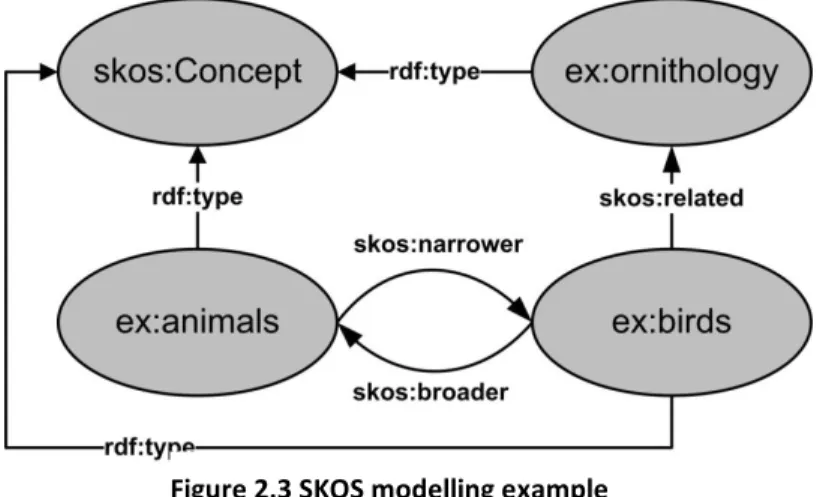
skos:broader and skos:narrower enable the representation of hierarchical links, such as the relationship between one genre and its more specific species, or, depending on interpretations, the relationship between one whole and its parts; an example is illustrated in figure 2.3, with the relation of the concepts “birds” and “animals”.
skos:related enables the representation of associative (non-hierarchical) links, such as the relationship between one type of event and a category of entities which typically participate in it. Another use for skos:related is between two categories where neither is more general or more specific; an example is illustrated in figure 2.3, with the relation with the concepts “birds” and “ornithology”.
SKOS has become a W3C Recommendation since 18th August 2009, being currently developed by the W3C Semantic Web Deployment Working Group.
79B
16
The Open Source Business Management Ontology (BMO)
The Business Management Ontology (BMO) is a framework developed by Jenz & Partner3F
4 in order
to provide a means for the semantically rich definition of business processes in a vendor and product neutral format. Separation of concerns has been one of the major factors in the design of the BMO architecture. The emphasis rests on the ability to combine ontologies in a flexible fashion, and ownership of each ontology may be individually assigned.
The generic business domain ontologies allow for the reuse of concepts in different contexts. For example, the "Role" concept is needed in the business process context (tasks are performed by roles) and in the organization-specific context, and potentially in one or more industry-specific context. In essence, the BMO architecture greatly enhances flexibility and facilitates reuse.
While, in principle, an ontology may contain definitions and data (instances), the BMO encourages the separation of model and data. A higher-level ontology may import one or more lower-level ontologies. The separation also prevents for unauthorized modification of ontologies, meaning that a user cannot modify imported ontologies.
At present, the BMO encompasses around 40 ontologies. Table 2.1 briefly describes the major BMO building blocks.
4 http://www.jenzundpartner.de/
17
80B
SPARQL
SPARQL [98] is a RDF document query language designed by the W3C, that since January 2008 is a W3C Recommendation; its name is a recursive acronym that stands for SPARQL Protocol and RDF
Query Language. SPARQL allows for querying multiple sources of information, whether that information is natively in RDF or is supplied by some middleware. The results of a query can be a RDF graph or a set of statements.
Most forms of SPARQL queries contain a set of triple patterns called a basic graph pattern. Triple patterns are like RDF triples except that each of the subject, predicate and object may be a variable. A basic graph pattern matches a sub-graph of the RDF data when RDF terms from that sub-graph may be substituted for the variables and the result is RDF graph equivalent to the sub-graph. SPARQL also allows for a query to consist of triple patterns, conjunctions, disjunctions, and optional patterns.
The example on figure 2.4 shows a simple SPARQL query to find the title of a book from the given data graph. The query consists of two parts: the SELECT clause identifies the variables to appear in the query results, and the WHERE clause provides the basic graph pattern to match against the data graph. The basic graph pattern in this example consists of a single triple pattern with a single variable (?title) in the object position.
Figure 2.4 - SPARQL Query
81B
SeRQL
18
SeRQL syntax is similar to that of RQL though modifications obtain an easier to parse language. Like RQL, SeRQL is based on a formal interpretation of the RDF graph, but SeRQL’s formal interpretation is based directly on the RDF Model Theory.
SeRQL supports generalized path expressions, boolean constraints and optional matching, as well as two basic filters: select-from-where and construct-fromwhere. The first returns the familiar variable-binding/table result; the second returns a matching (optionally transformed) subgraph.
SeRQL is implemented and available in the Sesame system, which has been used to accommodate the ontologies developed in this thesis.
2.2.12BOntologies Repositories and Tools
This section presents some tools and platforms that are used to build and maintain ontologies. The usage of these tools is further exemplified in the implementation and application phases of this work, as described on chapters 3 and 4 of this document.33B
2.2.1.Sesame
Sesame [101] is an open source java framework for storing, querying and reasoning with RDF and RDF schema. It can be used as a database for RDF and RDF Schema, or as a Java library for applications that need to work with RDF internally.
Sesame can be used as a Server in which client applications (or human users) can communicate over HTTP, as illustrated in figure 2.5. Sesame can be deployed as a Java Servlet Application in Apache Tomcat, a webserver that supports Java Servlets and JSP technology.
A central concept in the Sesame framework is the repository. A repository is a storage container for RDF. This can simply mean a Java object (or set of Java objects) in memory, or it can mean a relational database. However, whatever way of storage is chosen, it is important to realize that
19 almost every operation in Sesame happens with respect to a repository: when you add RDF data, you add it to a repository. When you do a query, you query a particular repository.
Sesame, as mentioned, supports RDF Schema inferencing. This means that given a set of RDF and/or RDF Schema, Sesame can find the implicit information in the data. Sesame supports this simply by adding all implicit information to the repository as well, when data is being added.
The framework includes a Web interface (openrdf-workbench), in order to allow access to repositories through a web browser. In this work, this interface was used to create the repository and to load and query the knowledge edited in Protégé.
When we create a Sesame repository, there are nine template choices for the repository configuration:
Memory: a memory based RDF repository
Memory-rdfs: a main-memory repository with RDF Schema inferencing
memory-rdfs-dt: a main-memory repository with RDF Schema and direct type hierarchy inferencing
Native Java Store: a repository that uses on-disk data structure
Native-rdfs Java Store: a native repository with RDF Schema inferencing
Native-rdfs-dt Java Store: a native repository with RDF Schema and direct type hierarchy inferencing
Postgre sql: a repository that stores data in a PostgreSQL database
MySql: a repository that stores data in a MySQL database
Remote RDF Store: a repository that serves as a proxy for a repository on a Sesame Server
On this work, as illustrated in section 4.5, a native-rdf java store repository was used. A memory based repository would not fit because of the large amount of data expected, and we did not felt the need to use an external database system.
2.2.2.34BProtégé
20
It has a customizable interface, so that a simple graphic application can be produced for the creation of ontologies (and populating them with information). Protégé can be extended with plugins and a Java API exists so that applications on top of (or connected to) protégé can be built [103].
The protégé platform is available as two products. Protégé-Frames and Protégé-OWL, explained in the subsections below. Additionally, it is also presented a specific plugin for Protégé version 4, the SKOSed plugin.
Protégé-Frames
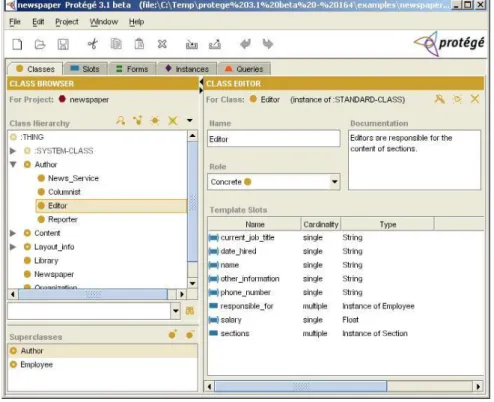
The Protégé-Frames editor provides the tools to easily create an ontology for any domain, as well as its maintenance and data input. Protégé implements a knowledge model that is compatible with the Open Knowledge Base Connectivity protocol (OKBC) [104]. In this model, an ontology is seen as a set of classes that can be organized in a hierarchy (to represent domain concepts in a very similar way as an object-oriented programming language does) and a number of “slots” can be associated to classes in order to describe its properties and relations. It is possible, after that step, to create instances of the ontology that are individual examples of classes that have specific (and distinct) property values.
The ontology creation process is eased by a simple graphic interface, as depicted in Figure 2.6. After creating non-abstract classes in an ontology, it’s possible to create instances of those classes, an action Protégé eases by generating specific forms to create those instances (the forms can be further
21 customized to make it even easier for users to interact with them). During the creation phase of ontologies (or of class instances) all rules are verified, including cardinality rules, relationship rules or restrictions to values of properties and the generated interfaces already have those restrictions into account [105].
Protégé-Frames supply a graphical interface to query instances of the ontology, and allow making selections based on criteria over the values of the slots of a class. Figure 2.7 depicts the interface for
querying, using “salary” as a criterion for the search.
Protégé-OWL
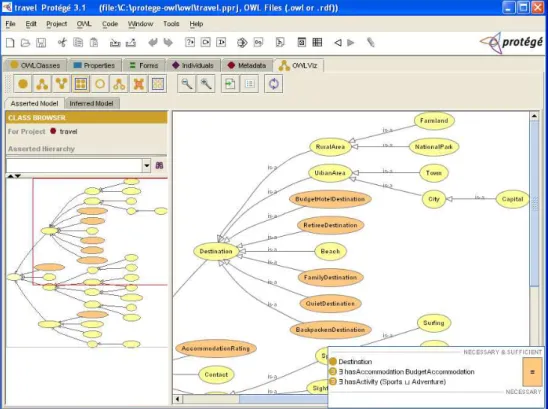
Protégé-OWL is an extension of Protégé that enables the creation of ontologies based on the Web Ontology Language [106]. Beyond the possibility of creating classes (and restrictions, instances, etc.) offered by Protégé-Frames, Protégé-OWL allows users to create, or load, their ontologies in the RDF/OWL format, allows for defining the properties of classes (specific of OWL) as well as use inference engines to extract new knowledge not explicitly in instances, but achievable through the semantic rules of the ontology. It also supplies an equally simple interface (supported by several plugins) that eases the graphical inspection of an ontology (among many other actions) such as depicted in Figure 2.8.
22 SKOSed
SKOSEd is a plugin for Protégé 4 that allows the user to create and edit thesauri (or similar artifacts) represented in the Simple Knowledge Organization System (SKOS).
This plugin provides some Protégé views and menu items that offer additional support to Protégé users wishing to work with SKOS. Central to the plugin is a SKOSEd tab, which is used to store the
Figure 2.8 Protégé-OWL - Ontology Visualization Plugin - http://protege.stanford.edu/
23 main available views. The main view is the Asserted Hierarchy View, which is used to expose the SKOS broader/narrower hierarchy; this view also has drag-and-drop capabilities and a set of convenience buttons for manipulating the hierarchy, as depicted in figure 2.9.
2.3.13BMethodologies for Building Ontologies
The ontology development process, as identified in the framework of the METHONTOLOGY methodology [48] and based on the IEEE standard for software development [43], consists basically in identifying which activities should be performed when building ontologies. This definition is followed to describe and illustrate the details about these activities, as it not only allows us to identify each activity, but also to group them into general stages of the ontology life cycle. As such, this is also used to contextualize each of the methodologies presented in sections 2.3.2 to 2.3.5, and to elaborate some general conclusions on section 2.3.6.
2.3.1.35BOntology Development Process
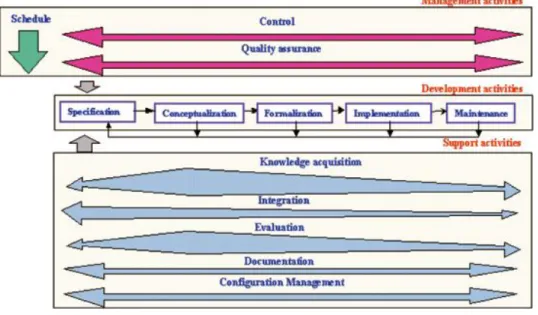
According to the previous definition, the activities of the ontology development process can be grouped into three different categories [32]: management activities (1), development oriented activities (2) and support activities (3). These activities are illustrated in figure 2.10 and described in detail as follows:
24
Ontology Management Activities
Ontology management activities include scheduling, control and quality assurance. The scheduling activity identifies which tasks must be performed, their arrangement, and the time and resources required for their completion. The control activity guarantees that scheduled tasks are completed in the intended manner to be performed. Finally, the quality assurance activity assures that the quality of each and every produced output (ontology, software and documentation) is satisfactory.
Ontology Development Oriented Activities
Ontology development oriented activities can be grouped into pre-development, development and post-development activities, as shown in figure 2.10.
During pre-development, an environmental study documents the ontology environment, regarding the platforms where the ontology will be used, the applications where the ontology will be integrated in, etc. Also during the pre-development activity, the feasibility study assesses whether it is possible and suitable to build the ontology.
Once in the development, the specification activity states the reasons why the ontology is being built, what are its intended uses and who the end-users are. The conceptualization activity structures the domain knowledge as meaningful models at the knowledge level [61]. The formalization activity transforms the conceptual model into a formal or semi-formal model. The implementation activity builds computable models in an ontology language.
During the post-development activity, the maintenance activity updates and revises the ontology, if required. Also during the post-development, the ontology may be (re)used by other ontologies or applications.
Ontology support activities
Finally, ontology support activities include a series of activities performed at the same time as the development-oriented activities, without which the ontology could not be built. They may include knowledge acquisition, evaluation, integration, merging, alignment, documentation and configuration management.
25 The evaluation activity [14] makes a technical judgment of the ontologies, of their associated software environments, and of the documentation. This judgment is made with respect to a frame of
reference during each stage and between stages of the ontology’s life cycle.
The integration activity is required when building a new ontology by reusing other ontologies already available.
Another support activity is merging [62], which consists of obtaining a new ontology starting from several ontologies on the same domain. The merging of two or more ontologies can be carried out either in run-time or design time.
The alignment activity establishes different kinds of mappings (or links) between the involved ontologies. Hence, this option preserves the original ontologies and does not merge them.
The documentation activity details, clearly and exhaustively, each and every one of the completed stages and products generated.
The configuration management activity records all the versions of the documentation and of the ontology code to control the changes.
2.3.2.36BUschold and King’s method
The first method for building ontologies was proposed by Uschold and King in 1995 [80], and consisted of some guidelines and requirements based on their experience in developing the Enterprise Ontology. The Enterprise Ontology was developed as a part of the Enterprise Project by the Artificial Intelligence Applications Institute at the University of Edinburgh with its partners IBM,
Lloyd’s Register, Logica UK Limited, and Unilever.
According to Uschold and King’s approach, the following stages must be carried out during the
ontology development process: (1) identify the purpose of the ontology, (2) build the ontology, (3) evaluate the ontology, and (4) document the ontology. These processes, as shown in figure 2.11, are:
26
Identifying the purpose and the scope
The goals of this step are to clarify why the ontology is being built and what its intended uses are, the characterization of the range of intended users and the identification of the relevant terms on the domain. The output of this step is a specification that fully outlines the range of information that the ontology must characterize. This may be done by using motivating scenarios and informal competency questions, as in TOVE [90] or by "brainstorming and trimming", i.e. producing a list of potentially relevant concepts and deleting irrelevant entries and synonyms.
Building the ontology
This step breaks into three activities: capturing the ontology (1), coding it (2), and integrating it into existing ontologies (3). The authors have decided to put the main emphasis on the ontology capture phase.
Activity 1: Ontology Capture
In this context, ontology capture is intended as:
identification of the key concepts and relationships in the domain of interest, i.e., scoping;
production of precise unambiguous text definitions for such concepts and relationships;
identification of terms to refer to such concepts and relationships;
agreeing on all of the above;
To identify the concepts in the ontology, Uschold and Gruninger pointed out three strategies: bottom-up, top-down, and middle out.
The bottom-up strategy involves identifying first the more specific concepts of the domain and then generalize them into more abstract concepts. This approach results in a very high level of detail, but has the drawbacks of increasing the overall effort, the difficulty of spotting commonality between related concepts, and the risk of inconsistencies.
In the top-down approach, we start by identifying the most abstract concepts, and then specialize them into more specific concepts. Using this approach results in a better control of the level of detail, however, starting at the top can result in imposing arbitrary and possibly not needed high level categories.
27 only when necessary, and avoiding some efforts. Starting first with core level concepts makes them appear naturally, and thus more likely to be stable.
Activity 2: Ontology Coding
In this context, coding is meant to be the explicit representation of the conceptualization captured in the above stage in some formal language; this involves committing to some meta-ontology, choosing a representation language and effectively writing the code.
The authors also discuss the possible merge of the capturing and coding activities into the same step. Ontologists, in some practical cases, may start to develop the conceptualization on the fly; they accept that this may be appropriate for some cases, but suggest that in general, it is more beneficial to separate the two.
To conclude the analysis of this activity, they indicate that the principles for designing ontologies enumerated by Gruber [86] should be present in any methodology. These principles are the following:
Clarity: An ontology should effectively communicate the intended meaning of defined terms. Definitions should be objective. While the motivation for defining a concept might arise from social situations or computational requirements, the definition should be independent of social or computational context. A formalism is a means to this end. When a definition can be stated in logical axioms, it should be. Where possible, a complete definition (a predicate defined by necessary and sufficient conditions) is preferred over a partial definition (defined by only necessary or sufficient conditions). All definitions should be documented with natural language.
Coherence: An ontology should be coherent: that is, it should sanction inferences that are consistent with the definitions. At least, the defining axioms should be logically consistent. Coherence should also apply to the concepts that are defined informally, such as those described in natural language documentation and examples. If a sentence that can be inferred from the axioms contradicts a definition or example given informally, then the ontology is incoherent.
28
on the existing vocabulary, in a way that does not require the revision of the existing definitions.
Minimal encoding bias: The conceptualization should be specified at the knowledge level without depending on a particular symbol-level encoding. An encoding bias results when representation choices are made purely for the convenience of notation or implementation. Encoding bias should be minimized, because knowledge-sharing agents may be implemented in different representation systems and styles of representation.
Minimal ontological commitment: An ontology should require the minimal ontological commitment sufficient to support the intended knowledge sharing activities. An ontology should make as few claims as possible about the world being modeled, allowing the parties committed to the ontology freedom to specialize and instantiate the ontology as needed. Since ontological commitment is based on consistent use of vocabulary, ontological commitment can be minimized by specifying the weakest theory (allowing the most models) and defining only those terms that are essential to the communication of knowledge consistent with that theory.
Activity 3: Integrating existing ontologies
This process refers to the decision of whether not to use already existing ontologies, and how to process their integration. This may be done in parallel with either or both the capture and the coding processes. At the time this methodology was presented, the authors identified this as a difficult problem and one of the biggest challenges in developing a comprehensive methodology, leaving it as an open issue.
Evaluating the ontology
The authors take the definition of evaluation from Gómez-Pérez et al [9] to affirm that:
"To make a technical judgment of the ontologies, their associated software environment, and
documentation with respect to a frame of reference (...) the frame of reference may be requirement specifications, competency questions, and/or the real world".
29
Documenting the ontology
The authors conclude that it may be desirable to have established guidelines for documenting ontologies, possibly differing according to the type and purpose of the ontology. These guidelines may be, for example, to locate similar definitions together or the create naming conventions, such as using upper or lowercase letters to name the terms, or writing the terms of the representation ontology in uppercase.
They cited Skuce [71], who pointed out that one of the main barriers to effective knowledge sharing is the inadequate documentation of existing knowledge bases and ontologies; he also argued that all important assumptions should be documented both about the main concepts defined in the ontology as well as about primitives used to express the definitions in the ontology.
Conclusions
This is an application independent method that focus in implementing an ontology from scratch. It does not include any ontology management activities, and the importance of ontology support activities are identified, but they are only mentioned superficially. Regarding development-oriented activities, the main drawback of this method is the lack of a conceptualization process before implementing the ontology. The goal of a conceptualization process is to provide a domain model less formal than the implementation model but more than the definition of the model in natural language. Problems provoked by this lack of a conceptualization process are [32] that:
Domain experts, human users, and ontologists have many difficulties in understanding ontologies implemented in ontology languages;
Domain experts are not able to build ontologies in their domain of expertise, so there is a bottleneck in knowledge acquisition.
2.3.3.37BGruninger and Fox’s Method
Based on the experience of the TOVE project (TOronto Virtual Enterprise) [90], which was developed at the University of Toronto, Grüninger and Fox [35] published a formal approach to build and evaluate ontologies. This methodology has been used to build the TOVE ontologies, which are the pillars of the TOVE Enterprise Design Workbench, a design environment that allows the user to explore a variety of enterprise designs.
30
into natural language questions that the ontology must be able to answer, which the authors call the competency of the ontology.
The second step involves defining a specific terminology for the ontology - its properties, attributes and formal axioms, thus providing the language that is used to express the definitions in the terminology and the constraints required by the application.
The third step is inspired by the development of knowledge based systems using first order logic; the definitions and constraints of the application are specified on the terminology, whenever possible, and those specifications are represented in first order logic and implemented in Prolog. The competency of the ontology is then tested, proving completeness theorems against the competency questions.
Figure 2.12 Processes in Gruninger and Fox's Methodology – adapted from [32]
The processes identified in this methodology, as shown in figure 2.12, are the following:
Identify motivating scenarios
The development of ontologies is motivated by scenarios that arise in the applications that will use
31
Elaborate informal competency questions
Given the set of informal scenarios found, a set of informal competency questions are identified. Informal competency questions are those written in natural language to be answered by the ontology once the ontology is expressed in a formal language. The competency questions play the role of a type of requirement specification against which the ontology can be evaluated. This methodology proposes to stratify the set of competency questions: an ontology is not well-designed if all the competency questions are simple queries, that is, if the questions cannot be decomposed or composed into more specific or general questions, respectively. Competency questions can be split off into more specific (or atomic) competency questions, and the answer to a question can be used to answer more complex questions. Each competency question is useful as a base for obtaining assumptions, constraints, the necessary input data, etc.
Specify the terminology using first order logic
Once informal competency questions have been posed, the ontologist must specify the terminology of the ontology, which will be formally represented by means of concepts, attributes and relations in a first-order logic language or equivalent. From the answers in natural language to the competency questions, the ontologist extracts the knowledge to be included in the formal definitions of concepts, relations, and formal axioms.
Write formal competency questions using first order logic
Informal competency questions are written as an entailment of consistency problems with respect to the axioms in the ontology. Such axioms are defined in the next process.
To specify axioms using first-order logic
The axioms in the ontology specify the definitions of terms in the ontology and constraints in their interpretation; axioms are defined as first-order sentences using the predicates of the ontology.
To specify completeness theorems
32
Conclusions
This is a very formal methodology that takes advantage of the robustness of classic logic and can be used as a guide to transform informal scenarios in computable models. It is a well-founded methodology for building and evaluating ontologies, even lacking some management and support activities and though the ontology life cycle is not completely specified.
2.3.4.38BMETHONTOLOGY
METHONTOLOGY [48] was developed within the Ontology Engineering Group at Universidad Politécnica de Madrid (UPM) , and enables the construction of ontologies at the knowledge level. It has its roots in the main activities identified by the software development process [43] and in knowledge engineering methodologies, and it is well suited for building ontologies either from scratch, reusing other ontologies as they are, or by a process of reengineering them.
The framework consists of: identification of the ontology development process with the identification of its main activities; a life cycle based on evolving prototypes; and the methodology itself, specifying the steps for performing the activities, the techniques used, the outcomes and their evaluation.
The ontology development process was proposed in the framework of this methodology and refers to those activities performed during ontology building. This process does not identify the order in which such activities should be performed: that is, the role of the ontology life cycle. METHONTOLOGY proposes an ontology building life cycle based on evolving prototypes because it allows adding, changing, and removing terms in each new version (prototype).
For each prototype, METHONTOLOGY proposes to begin with the schedule activity that identifies the tasks to be performed, their arrangement, and the time and resources needed for their completion. After that, the ontology specification activity starts and at the same time several activities begin inside the management (control and quality assurance) and support processes (knowledge acquisition, integration, evaluation, documentation, and configuration management). All these management and support activities are performed in parallel with the development activities (specification, conceptualization, formalization, implementation and maintenance) during the whole life cycle of the ontology.
33 of these activities, we can return to any of the previous activities to make modifications or refinements.
Figure 2.13 illustrates the ontology life cycle proposed in METHONTOLOGY, and summarizes the previous description. Note that the activities inside the management and support processes are carried out simultaneously with the activities inside the development process.
Related to the support activities, the figure also shows that the knowledge acquisition, integration and evaluation are greater during the ontology conceptualization, and that they decrease during formalization and implementation.
The reasons for this greater effort are:
Most of the knowledge is acquired at the beginning of the ontology construction.
The integration of other ontologies into the one we are building is not postponed to the implementation activity. Before the integration at the implementation level, the integration at the knowledge level should be carried out.
The ontology conceptualization must be evaluated accurately to avoid propagating errors in further stages of the ontology life cycle.
The relationships between the activities carried out during ontology development are called intra-dependencies, and they define the ontology life cycle.
34
METHONTOLOGY also considers that the activities performed during the development of an ontology may involve performing other activities in other ontologies already built or under construction. Therefore, METHONTOLOGY considers not only intra-dependencies, but also inter-dependencies. Inter-dependencies are defined as the relationships between activities carried out when building different ontologies. Instead of talking about the life cycle of an ontology, we should talk about crossed life cycles of ontologies. The reason is that, most of the times and before integrating an ontology in a new one, the ontology to be reused is modified or merged with other ontologies of the same domain.
So, basically, METHONTOLOGY starts by identifying the following activities involved in the development of an ontology:
Specification
This activity intends to identify the purpose of the ontology, its intended users, scenarios of use, level of formality and its scope, which includes the set of terms to be represented, its characteristics and granularity.
This specification must be illustrated in an informal, semi-formal or formal document written in natural language, using a set of intermediate representations or using competency questions.
Knowledge Acquisition
Although this is an independent activity in the ontology development process, it can occur in parallel with the other activities; in fact, most of the knowledge acquisition is made during the requirements specification activity, and decreases as the ontology development process moves forward.
In this activity any type of knowledge source and any elicitation method can be used, although the roles of expert interviews and analyses of texts are specifically discussed in the methodology specification.
Conceptualization
![Figure 2.1 A Hierarchy – adapted from [85]](https://thumb-eu.123doks.com/thumbv2/123dok_br/16532019.736332/26.892.177.694.267.589/figure-hierarchy-adapted.webp)
![Figure 2.10 Ontology Development Process Activities - adapted from [32]](https://thumb-eu.123doks.com/thumbv2/123dok_br/16532019.736332/39.892.187.730.597.958/figure-ontology-development-process-activities-adapted.webp)
![Figure 2.12 Processes in Gruninger and Fox's Methodology – adapted from [32]](https://thumb-eu.123doks.com/thumbv2/123dok_br/16532019.736332/46.892.143.722.393.688/figure-processes-gruninger-fox-s-methodology-adapted.webp)
![Figure 2.14 Conceptualization activity according to METHONTOLOGY [35]](https://thumb-eu.123doks.com/thumbv2/123dok_br/16532019.736332/51.892.219.718.94.511/figure-conceptualization-activity-according-to-methontology.webp)
