Lucas Gonçalves Rocha
Environmental engineer, Universidade Federal do Espírito Santo (UFES) – Vitória (ES), Brazil.Karinnie Nascimento
de Almeida
PhD student, UFES – Vitória, (ES), Brazil.
José Antonio Tosta
dos Reis
Professor, UFES – Vitória, (ES), Brazil.
Antonio Sergio
Ferreira Mendonça
Professor, UFES – Vitória, (ES), Brazil.
Fernando das Graças
Braga da Silva
Professor, Universidade Federal de Itajubá – Itajubá (MG), Brazil.
Correspondence address:
Karinnie Nascimento de Almeida – Avenida Fernando Ferrari, 514 – Goiabeiras – CEP: 29075-910 – Vitória (ES), Brazil – Email: [email protected]
Received on: 03/19/2020 Accepted on: 06/16/2020
ABSTRACT
Estimating efficiencies required for sewage treatment plants within a river watershed, where there are usually multiple sewage discharges and water withdrawals points in watercourses, presenting different quality conditions and sewage assimilation capacities, is a complex task. In this context, combined optimization techniques and water quality modeling can be important tools to support sewage treatment efficiencies appropriation processes. In the present paper, QUAL-UFMG water quality model and Nonlinear Programming (NLP) are jointly applied to sewage treatment levels selection for the river Pardo’s (watercourse located in Espírito Santo State, Southern region, Brazil) watershed different urban areas. Four different optimization models were tested for estimating the minimum organic matter removal efficiencies. The results indicate strong dependence between the estimated minimum organic matter removal efficiencies within the watershed and equity measures incorporated in the optimization models.
Keywords: optimization; optimization model; water quality; domestic sewage.
RESUMO
A estimativa de eficiências requeridas pelas estações de tratamento de esgoto constitui tarefa complexa no âmbito de uma bacia hidrográfica, onde habitualmente existem múltiplos lançamentos e captações em cursos d’água com diferentes condições de qualidade e capacidades de assimilação de despejos. Nesse contexto, as técnicas de otimização e a modelagem da qualidade de água, quando aplicadas de maneira combinada, podem constituir importante ferramenta de apoio ao processo de apropriação de eficiências de tratamento de esgotos. Neste trabalho, o modelo de qualidade de água QUAL-UFMG e a Programação Não Linear (PNL) foram conjuntamente aplicados para a seleção de níveis de tratamento de esgotos para os diferentes núcleos urbanos da bacia hidrográfica do Rio Pardo, curso d’água da porção sul do estado do Espírito Santo. Quatro diferentes modelos de otimização foram testados, quando da estimativa das eficiências mínimas de remoção de matéria orgânica. Os resultados indicaram a acentuada dependência entre as eficiências mínimas de remoção de matéria orgânica estimadas no âmbito da bacia e a incorporação de medidas de equidade nos modelos de otimização.
Palavras-chave: otimização; modelo de otimização; qualidade de água; esgotos domésticos.
SEWAGE TREATMENT EFFICIENCIES ESTIMATION FOR URBAN AREAS
LOCATED IN THE RIVER PARDO’S WATERSHED BY ASSOCIATING
NONLINEAR PROGRAMMING AND WATER QUALITY MODELING
ESTIMATIVA DE EFICIÊNCIAS DE TRATAMENTO DE ESGOTOS PARA OS NÚCLEOS URBANOS DA BACIA HIDROGRÁFICA DO RIO PARDO A PARTIR DA ASSOCIAÇÃO
INTRODUCTION
In the last century, the world population has grown rap-idly in a disorderly manner, resulting in agglomerations without infrastructure and quality of public services. Most Brazilian cities still release their sewage directly into watercourses, causing significant impacts on the receiving water bodies and imbalances to local ecology, posing risks to human health (CHO et al., 2013). Sewage treatment systems processes choice should be based on technical, economic, and environmental criteria analysis, considering each treatment system alternative characteristics (VON SPERLING, 2005). Usually, the main considered factors are treatment sys-tems installation land costs, syssys-tems’ operational costs, load of raw effluents and water quality standards to be attended by effluents (SOUZA, 1998). Other import-ant environmental factors in the effluent treatment systems selection process are related to the receiving water bodies capacities. Proper water bodies organic matter assimilation capacities consideration allows selection of simpler (constructively and operationally) and treatment plants which are economically more vi-able. Minimum pollutant removal efficiencies determi-nation is the starting point for sewage treatment sys-tems selection processes.
Sewage treatment efficiencies estimation, when ob-served from the watershed point of view, is often com-plex, due to numerous discharge points, with different loads in water bodies presenting varied assimilation capacities and water quality conditions (REIS; VALO-RY; MENDONÇA, 2015). In this context, water quality simulation models can help in water resources man-agement and sewage treatment systems selection processes (TEIXEIRA; PORTO, 2008; CALMON, 2015; ARRUDA; RIZZI; MIRANDA, 2015; MATEUS et al., 2015; CORRÊA et al., 2019; ROCHA; MESQUITA; LIMA NETO, 2019; FORTUNATO et al., 2020).
However, water quality mathematical simulation does not, necessarily, involve the analysis of the ide-al solution to sewage treatment efficiencies within a watershed estimation problem, because the multiple releases may require very large sewage treatment ef-ficiencies combinations analysis. In this context, the association between water quality models and opti-mization techniques can allow the determination of the optimal treatment efficiencies combination to be
adopted within a watershed (ANDRADE; MAURI; MEN-DONÇA, 2013). In this research line, different studies (VALORY et al., 2013; MANSHADI; NIKSOKHAN; ARDES-TANI, 2015; SANTORO; REIS; MENDONÇA, 2016; FAN-TIN; REIS; MENDONÇA, 2017; BRINGER; REIS; MEN-DONÇA, 2018; AGHASIAN et al., 2019; SÁ et al., 2019) have prioritized the association between water quality models and Genetic Algorithm (GA) metaheuristic opti-mization technique. According to Lacerda and Carvalho (1999), GAs have been employed in complicated prob-lems (where other optimization methods fail) and have several advantages, such as the possibility to work both with continuous and discrete parameters (or a combi-nation of them), several optimization variables, and complex optimization functions.
These authors note that GAs are not efficient for many problems and can be quite slow depending on values assumed for the initial population and options as-sumed for operators.
The present study’s main objective is to estimate minimum sewage treatment efficiencies within a watershed, with water quality mathematical model-ing and conventional Nonlinear Programmmodel-ing (NLP) optimization technique combination. According to Cirilo (2002), the main advantage of NLP is its com-prehensiveness, given that once the mathematical model that describes the system to be optimized is elaborated generally, no formulation simplification is needed, increasing the accuracy of obtained results. Cirilo (2002) notes that the uncertainty about obtain-ing the optimal solution weighs against NLP (possibil-ity of determining local optimal solutions values in-stead of the global optimum).
What is relevant to note in the present study is that water quality modeling and NLP are conduct-ed in a Microsoft Excel® spreadsheet environment,
a popular software usually more accessible than other software available for applying metaheuristic optimization techniques such as GA. Water quality mathematical model QUAL-UFMG, whose use has been popularized in Brazil, is employed and was in-troduced in an expeditious procedure, which aims to overcome, without significant computational de-mands, the difficulty arising from eventual optimal solutions appropriations.
MATERIALS AND METHODS
Study area
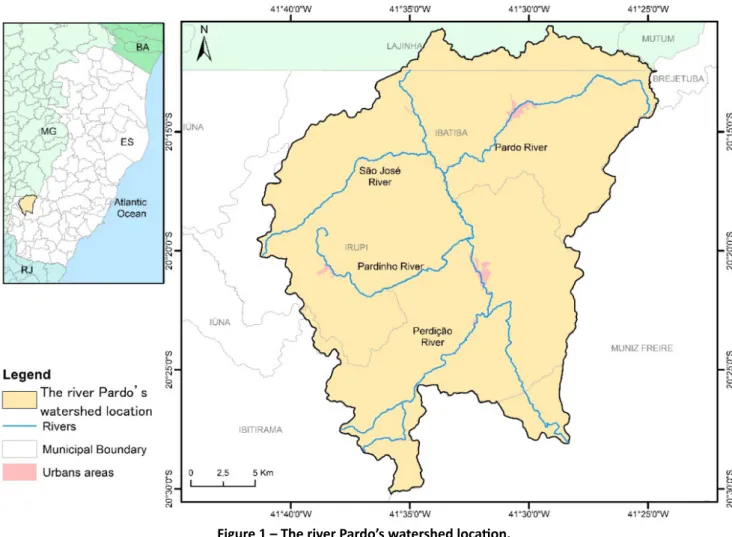
The study area considered in research is the river Par-do’s watershed (Figure 1). This river is an important tributary of Itapemirim River. Itapemirim is the main watercourse located in the Southern region of Espírito Santo State. The river Pardo’s watershed drainage area is approximately 611 km², distributed in the Ibatiba, Ir-upi, Iúna and Muniz Freire, all located in Espírito Santo State, and Lajinha, in Minas Gerais State.
The river Pardo’s watershed presents three cities (Ibat-iba, Iúna, and Irupi), and two villages (Santíssima Trin-dade and Nossa Senhora das Graças). The watershed does not have any sewage treatment plants being operated. Although the cities and towns in the hydro-graphic basin that are the focus of the present study
may have unitary treatment systems and final efflu-ent disposal, reducing the organic load released into the water bodies, the authors chose to consider that the entire organic load produced in the basin reaches the water bodies, modeling the most critical scenario. The river Pardo is the main raw domestic effluents re-cipient, receiving the sewage produced in Ibatiba and Iúna Cities. The river Pardinho and Ribeirão da Perdição stream are two tributaries of the river Pardo that also receive sewage discharges. The river Pardinho receives the sewage produced in Irupi City. Ribeirão da Per-dição stream receives the sewage produced in Santís-sima Trindade and Nossa Senhora das Graças villages. Ribeirão São José constitutes a Pardo’s tributary that does not receive any sewage.
Water quality model
QUAL-UFMG water quality computational-simulation model, developed in the Microsoft Excel®
spread-sheet computational environment, was applied to the studied water system. In the present paper, wa-ter quality was described exclusively as a function of biochemical oxygen demand (BOD5,20) and dissolved oxygen (DO) parameters modeling. These parameters are usually used for water bodies qualitative
charac-terization after sewage discharges. For simulating these parameters spatial variation, first order differ-ential equations were considered, covering deoxy-genation and atmospheric reaeration phenomena. The equations that describe DO and BOD5,20 param-eters variations, considering deoxygenation and re-aeration phenomena, are presented in detail by Von Sperling (2007).
Kinetic constants, hydrodynamic, and water quality information
The kinetic constants, hydrodynamic data, and wa-ter quality paramewa-ters adopted in this paper were obtained from research conducted by Calmon et al. (2016), when analyzing the use of water quality perma-nence curves to support the definition of water quality classes of the river Pardo’s watershed rivers.
In their study, Calmon et al. (2016) determined kinetic constants and hydrodynamic variables values for the river Pardo from the records available for Terra Corri-da Montante fluviometric station, installed and oper-ated on the river Pardo by the Brazilian Water Agency (Agência Nacional de Águas — ANA).
Due to the small drainage areas associated to the springs of water courses located in the study area, the flow rates of the first segments of the water courses considered in the modeling were zero. Calmon et al. (2016) estimated the incremental (diffuse) flows to Pardo river watershed watercourses by mass balance, considering the differences between the flows in the final simulated section and the respective headwater flows. Simulations performed in the river Pardo’s
wa-tershed assumed incremental flow of 3.53 Ls-1km-1, and
DO and BOD5.20 concentrations of 5 and 2 mgL-1,
respec-tively. These DO and BOD5,20 concentration values were assumed from Von Sperling (2007) propositions. The functional relations between flow (Q, m3s-1),
veloci-ty (U, ms-1), and depth (H, m), potential functions in the
QUAL-UFMG model, were established from flow mea-surement records carried out at the cited fluviometric station. Equations 1 and 2, established by Calmon et al. (2016), made it possible to estimate watercourses ve-locities and depths as functions of flows.
U = 0.1433.Q0,6305 (1)
H = 0.6076.Q0,2566 (2)
The average domestic effluents flow rates relative to the river Pardo’s watershed urban population and the corresponding organic loads are presented in Table 1.
Cities and Villages Average domestic sewage flow (Ls-1) Urban population (inhabitants) Raw Organic Load (kgd-1)
Ibatiba 24.33 18,125 840.84
Irupi 5.24 4,918 181.09
Iúna 19.90 14,821 687.74
Santíssima Trindade 0.32 301 11.06
Nossa Senhora das Graças 0.64 600 22.12
Table 1 – The river Pardo’s watershed urban population mean domestic sewage flow rates.
For urban domestic sewage, a concentration of 400 mgL-1 for BOD
5,20 was adopted, as well as
145 Lhab-1d-1 per capita yield, and return coefficient of
0.8. The adopted BOD5,20 concentration corresponds to the upper limit for the raw domestic sewage con-centration range indicated by Von Sperling (2005), and Jordão and Pessôa (2009). Raw domestic effluents DO concentrations were considered null.
Zero concentration for DO in raw and treated sewage was adopted in order to simulate discharges under more conservative conditions, by ignoring that certain sewage treatment systems may incorporate some DO in the treated sewage.
As proposed by USEPA (1985), and Thomann and Muel-ler (1987), Calmon et al. (2016) defined Kd (in d-1) as
a function of watercourse hydraulic characteristics (depth and flow), according to Equation 3.
(3) Equation 4 defines the kinetic constant that regulates the atmospheric reaeration process (K2), according to the original proposition by O’Connor and Dobbins.
(4) Substituting Equation 1 and Equation 2 in Equation 4, the result is the equation used to determine K2 in each river stretch (Equation 5).
K2 = 3.73.(0.1433.Q0.6305)0.5.(0.6076.Q0.2566)-1.5 (5)
Effluent disposal scenario
In the river Pardo’s watershed watercourses, the point sources are composed by the river Pardo’s trib-utaries (Ribeirão São José, Pardinho, and Ribeirão da Perdição, presenting extensions of 17.5, 19.9 and 18.5 km, respectively) and domestic effluents from five urban areas (Ibatiba, Irupi and Iúna cities, and
Santíssima Trindade and Nossa Senhora das Graças villages). The distributed sources are composed by incremental flows and BOD5,20 loads from the sewage produced by the rural population located in the riv-er Pardo’s watriv-ershed, evenly distributed throughout the water system.
Optimization models
The objective functions employed to estimate min-imum sewage treatment efficiencies for the river Pardo’s watershed were selected from the study de-veloped by Santoro, Reis and Mendonça (2016), and considered the following aspects:
• BOD5,20 removal efficiencies sum minimization re-ferring to the different treatment systems proposed for the river watershed;
• inequity minimization between different pro-posed treatment systems, imposing higher BOD5,20 removal levels for those receiving higher organic loads;
• conformity with environmental quality standards established for water bodies by the Brazilian Envi-ronmental Council Resolutions (Conselho Nacion-al do Meio Ambiente — CONAMA) 357/2005 and 430/2011 (BRASIL, 2005; 2011).
Considering the above guidelines, the following opti-mization models were used:
• Model 1, originally proposed by Valory, Reis and Mendonça (2016), seeks to minimize the sum of efficiencies (Ei) within the watershed (Equation 6);
• Model 2 introduces an equity measure in the objec-tive function (Equation 7), as established by Mulligan (1991), seeking to ensure that the efficiency in each station is proportional to its raw organic load (loadlanc);
• Model 3 employs an objective function that enforc-es an inequity between treatment systems measure minimization (Equation 8), as originally established by Marsh and Schilling (1994);
• Model 4 uses an objective function that imposes another inequity between treatment systems mea-sure minimization (Equation 9), as proposed by Burn and Yuliant (2001).
(6) (7) (8) (9)
All optimization models incorporate, as restrictions, the environmental quality standards set for DO and BOD5,20 (minimum DO 5 mgL-1 and maximum BOD
5,20 5 mgL-1)
for class 2 rivers. Class quality 2 as assumed for the Par-do river watershed watercourses due to legal frame-work absence, according to the guidelines established by CONAMA Resolution No. 357/2005 (BRASIL, 2005). Additional restrictions aimed at ensuring efficiencies non-negativity (Ei ≥ 1%) and the establishment of a lim-it for BOD5,20 removal by treatment systems (Ei ≤ 95%).
Nonlinear Programming application
NLP is suitable for problems that have nonlinearity in their objective function or constraints. The solu-tion, in general, is a vector of decision variables that optimizes the nonlinear objective function subject to nonlinear constraints (CIRILO, 2002). NLP is charac-terized by not presenting a general method for solv-ing all problems. In the present study, for obtainsolv-ing treatment efficiencies from the different optimization models selected, the Generalized Reduced Gradi-ents Method (GRG), available in the Microsoft Excel®
spreadsheet Solver macro, was employed. The GRG Method, originally proposed by Lasdon et al. (1978), deals with the solution of nonlinear optimization problems, in which the objective function and con-straints can present nonlinearities if the function is differentiable.
According to Cirilo (2002) and Albertin, Mauad and Dan-iel (2006), the main limitation in applying NLP to water management problems is that the technique does not necessarily provide the overall optimum, often reach-ing a partial optimum value. In research, seekreach-ing to cir-cumvent this limitation and maximize global optimum obtaining chances, a total of 150 initial efficiencies sets was randomly generated for each optimization model. These efficiencies set established the initial values from which the established NLP search process was conduct-ed. The search process operationalization occurred with the implementation of a computer program developed in Visual Basic for Applications (VBA) in the Microsoft Excel® spreadsheet environment, the code integrated
with the Solver macro and the QUAL-UFMG model. This integration allowed search process automation.
RESULTS AND DISCUSSION
Control scenario: raw effluent discharges
This section presents the results from raw effluents final disposal in the different river Pardo’s watershed watercourses simulations. Considering the river Par-do’s watershed does not present any sewage treatment plants installed and in operation, the results gathered in this section represent the currently expected condi-tion for the watershed, establishing a control scenario for subsequent discussions.
Ribeirão Perdição stream receives domestic effluents dis-charges from Santíssima Trindade and Nossa Senhora das Graças villages (with discharge rates of 0.3 and 0.6 Ls-1,
respectively). These discharges are small and have little impact on Ribeirão Perdição water quality. In this water-course, DO and BOD5,20 concentrations invariably respect the limits established by environmental quality standards.
Figure 2 shows the DO and BOD5,20 profiles for the riv-er Pardinho rivriv-er, which receives in kilometriv-er 5 the do-mestic effluents from Irupi City. Although not among the largest organic loads produced in the river Pardo’s wa-tershed, Irupi City domestic effluents disposal effect is relevant due to the river Pardinho’s low flow (0.18 m³s-1)
in the final disposal point. This condition gives the river Pardinho low organic loads assimilation capacity, leading to non-compliance with the BOD5,20 environmental qual-ity standard downstream effluent discharge point. Along the Pardo river, the largest watershed cities (Ibat-iba and Iúna) are located. Consequently, it is in this wa-ter system portion where the highest DO and BOD5,20 concentrations variability occurs (Figure 3). The large parameters variation observed in kilometer 16 of the
river Pardo is due to Ibatiba City’s domestic effluent final disposal (corresponding to the largest pollutant load in the watershed, with 24.3 Ls-1 raw sewage
dis-charge rate), and the limited river flow at the disdis-charge point (0.60 m³s-1). Thus, BOD
5,20 concentration exceeds
the environmental quality standard imposed for class-two rivers, reaching a 18.1 mgL-1 peak.
Ribeirão São José stream flows into the river Pardo ap-proximately 7 km downstream Ibatiba and provides a 0.62 m³s-1 flow increase to this river, improving water
quality downstream the affluence point. This affluence increases the main river dilution capacity for the re-mainder of its course, decreasing its BOD5,20
concentra-tion, attenuating Ibatiba effluent final disposal impact. The same happens for the river Pardinho, which flows into the river Pardo at km 30, with a 0.71 m³s-1flow.
Although this flow increase is greater than the corre-sponding to São José stream, the reduction in BOD5,20 concentration for the river Pardo is smaller due to the higher main river flow on the river Pardinho’s affluence and the higher river Pardinho’s BOD5.20 concentration (4.9 mgL-1) when compared to the corresponding
Ri-beirão São José stream (2 mgL-1).
At the kilometer 35 of the river Pardo, Iúna City’s domes-tic effluent is discharged, increasing BOD5,20 concentra-tion to a maximum value of 9.5 mgL-1, and reducing DO
Figure 2 – DO and BOD5,20 concentration profiles for the river Pardinho, considering the raw effluent final disposal.DO: dissolved oxygen; BOD5,20: biochemical oxygen demand.
DO: dissolved oxygen; BOD5,20: biochemical oxygen demand.
levels to a minimum value of 6.77 mgL-1. Downstream
Iúna, Ribeirão Perdição stream flows into the river Par- do, and as it happens for the other tributaries, main river water quality conditions improvement occurs.
Minimum sewage treatment efficiencies
Optimization Model 1 (Equation 6) seeks exclusively to comply with watercourses environmental quality standards and minimize the treatment efficiencies sum within the watershed. The main purpose of its applica-tion was to evaluate the difference between the esti-mated efficiencies considering models with and with-out equity measures incorporation.
The lack of an equity measure in the pursuit of sewage treatment systems efficiencies, within the watershed sum minimization, may mean that users located in the watershed downstream stretches need to treat their effluents with higher efficiencies, because the river Par-do’s water reaches their disposal locations with lower quality, as a result from upstream discharges. There is also the possibility that the river presents much higher flow downstream than upstream, due to incremental flow and tributary affluences. Consequently, sewage produced closer to headwater would require higher treatment efficiency even if its discharge load is like that discharged downstream (ALBERTIN, 2008).
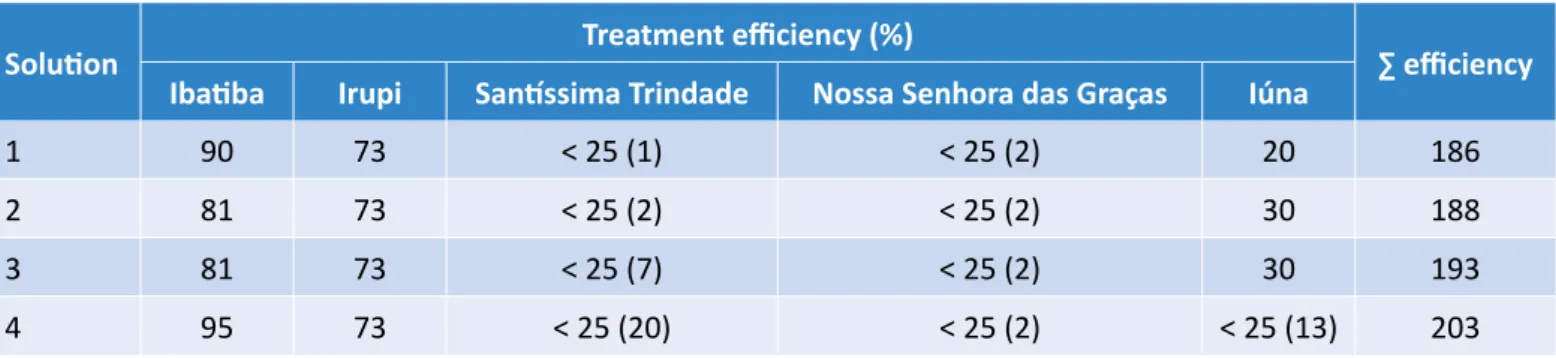
Primary sewage treatment systems present minimal BOD removal efficiency, usually of 25% (VON SPERLING, 2007). From this perspective, all estimated efficiencies with values lower than 25% are shown in parentheses in the following tables, next to the symbol < 25. Table 2 shows the estimated minimum BOD5,20 removal efficiencies values for the treatment systems associat-ed to the river Pardo’s watershassociat-ed urban areas, accord-ing to optimization Model 1.
Effluent discharges from Irupi City occurs near the river Pardinho’s headwater, where flow is still low. Hence, a more rigorous treatment for this effluent than the neces-sary for similar organic loads is required. The BOD5,20 peak concentration, when the treated effluent is discharged,
reaches the limit value acceptable for class-two rivers. In this context, treatment efficiency was 73% (Table 2), de-fined for Irupi effluent, which is the minimum required to maintain the river Pardinho’s water quality parameters re-specting class-two rivers limits under the boundary condi-tions that conformed the simulacondi-tions performed.
Considering that effluent discharges from Santíssima Trin-dade and Nossa Senhora das Graças villages in Ribeirão Perdição stream are small, they can be assimilated by the river without affecting maintenance of quality standards even if disposed without treatment (minimum allowable efficiency of 1%, imposed to guarantee non-negativity). Ibatiba effluent is released into a river Pardo’s section that presents low flow, a condition that imposes high treatment efficiency to the city effluents (95%, accord-ing to Table 3). For Iúna City, where Pardo river pres-ents higher flow, the required efficiency is considerably lower than that imposed for Ibatiba effluent (approx-imately 13%, according to Table 3), allowing simpler sewage treatment systems adoption.
Optimization Model 2 (Equation 7) sought to minimize the difference that point organic loads and estimat-ed efficiencies for treatment systems present among themselves. Table 3 presents the five best results relat-ed to optimization Model 2.
Optimization Model 3 (Equation 8) aimed to minimize inequities between adjacent discharge points, so that the relation of organic load over efficiency ratio be-tween two adjacent points would be as close as possi-ble, seeking to establish a common efficiency that was related not only to the organic load, but also consistent with its neighborhood, where the discharged effluent presents greatest influence. These results are summa-rized in Table 4.
Table 2 – Estimated minimum efficiency: optimization model 1.
Treatment efficiency (%)
∑ efficiency
Ibatiba Irupi Santíssima Trindade Nossa Senhora das Graças Iúna
The results of Model 3 indicate that the inequity mea-sure proposed by the model established a pattern sim-ilar to that obtained previously, with the urban areas that produce largest organic loads charged with apply-ing the highest efficiencies in their effluents treatment. In this model, however, greater rigor was observed for urban areas that contribute with higher loads, reducing the variations observed for optimization Model 2. BOD5,20 high removal levels suggested for Iúna effluent treatment was due to the fact that the inequity measure associated with optimization Model 3 considers discharges in the vi-cinity. By the fact that Iuna presents higher sewage load than the adjacent urban areas (Irupi and Nossa Senhora das Graças villages), NLP sought to minimize the ratio between loads discharges and treatment efficiencies for these locations, increasing Iuna treatment efficiency. Model 4 (Equation 9) aimed to minimize the relation between organic load and efficiency for each discharge point in relation to the ratio between average load and
efficiency in the watershed. The results from the appli-cation of this model are presented in Table 5.
The DO and BOD5,20 profiles produced considering the ef-ficiencies estimated with optimization Model 4 help are presented in Figures 4 (the river Pardinho), 5 (Ribeirão Perdição stream), and 6 (the river Pardo), and were con-formed with the use of efficiencies referred to the solu-tion presenting lowest efficiencies sum. These figures exemplify the profiles produced from the incorporation of efficiencies estimated by the optimization model. Similar figures were produced considering efficiencies estimated by other optimization models. Regardless of the efficiencies set for their production, these profiles present DO and BOD5,20 parameters variations that are established in accordance with the environmental qual-ity standards, since the environmental qualqual-ity standards constituted optimization models restrictions.
When comparing only the efficiencies sum obtained by the different optimization models, optimization Table 3 – Minimum estimated efficiencies: optimization model 2.
Solution Treatment efficiency (%) ∑ efficiency
Ibatiba Irupi Santíssima Trindade Nossa Senhora das Graças Iúna
1 90 73 < 25 (1) < 25 (2) 20 186
2 81 73 < 25 (2) < 25 (2) 30 188
3 81 73 < 25 (7) < 25 (2) 30 193
4 95 73 < 25 (20) < 25 (2) < 25 (13) 203
Table 4 – Minimum estimated efficiencies: optimization model 3.
Solution Treatment efficiency (%) ∑ efficiency
Ibatiba Irupi Santíssima Trindade Nossa Senhora das Graças Iúna
1 95 73 < 25 (1) < 25 (2) 95 266
2 95 73 < 25 (1) < 25 (6) 95 270
3 95 73 < 25 (1) < 25 (7) 95 271
4 95 73 < 25 (1) < 25 (9) 95 273
Table 5 – Minimum estimated efficiencies: optimization model 4.
Solution Treatment efficiency (%) ∑ efficiency
Ibatiba Irupi Santíssima Trindade Nossa Senhora das Graças Iúna
1 95 73 < 25 (2) < 25 (3) 95 268
2 95 95 < 25 (2) < 25 (3) 95 290
3 95 73 < 25 (2) 46 95 311
4 95 73 63 < 25 (4) 95 330
5 95 73 < 25 (2) 85 95 350
DO: dissolved oxygen; BOD5,20: biochemical oxygen demand.
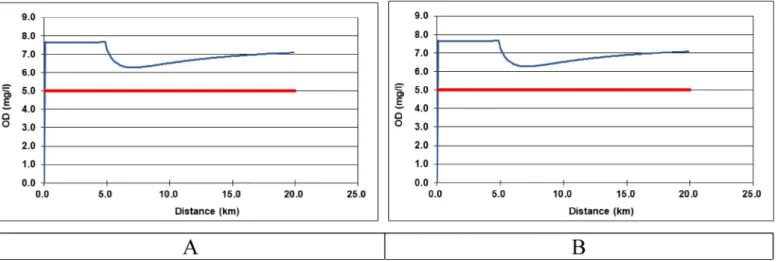
Figure 4 – The river Pardinho’s DO and BOD5,20 concentration profiles after minimum treatment efficiencies incorporation: optimization model 4.
DO: dissolved oxygen; BOD5,20: biochemical oxygen demand.
Figure 5 – Ribeirão Perdição stream’s DO and BOD5,20 concentration profiles after minimum treatment efficiencies incorporation: optimization model 4.
Model 1 produced the lowest BOD5,20 removal efficien-cies sum for the watershed. Optimization Models 2, 3, and 4, however, usually imposed considerably more ef-ficient treatments than those established with the aid of optimization Model 1.
Recurrently, sewage treatment efficiencies associated to the smaller urban areas (Nossa Senhora das Graças and Santíssima Trindade villages) were not significant, being lower than the efficiencies normally achieved by primary sewage treatment systems. Ibatiba and Irupi Cities, regardless of the optimization model employed, demanded higher treatment efficiencies, compatible with secondary or higher-level treatment systems. These urban areas are substantially more populous than Santíssima Trindade and Nossa Senhora das Graças villages, making their final sewage disposal in the upper portion of the rivers Pardo (Ibatiba) and
Pardinho (Irupi) stretches, in sections that present low flow rates for sewage dilution.
Model 2, among the optimization models that incorpo-rated equity measures in the objective functions, was the only one to present efficiencies sums close to those established by optimization Model 1.
The results achieved in the present study are sim-ilar to those found in Santoro, Reis and Mendonça (2016), Fantin, Reis and Mendonça (2017), and Bring-er (2017), who used GA as an optimization tool to de-termine minimum sewage treatment efficiencies for the river Pardo’s watershed. In this context, NLP has produced consistent and similar results to those ob-tained from the use of a metaheuristic optimization technique, which usually requires higher computa-tional demands.
CONCLUSION
QUAL-UFMG water quality mathematical model and NLP combined use is a versatile alternative for mini-mum sewage treatment efficiencies within a water-shed determination, allowing different optimization models and agile results.
The estimated efficiencies for the river Pardo’s water-shed with the aid of NLP were similar to those ob-tained with the use of the Genetic Algorithm, a meta-heuristic optimization technique that usually requires
computational demands substantially higher than those associated to conventional optimization tech-niques use.
The estimated minimum organic matter removal effi-ciencies within the river Pardo’s watershed were highly dependent on the incorporation of inequity measures into the optimization models. Sewage treatment effi-ciencies associated to Nossa Senhora das Graças and Santíssima Trindade villages were not significant, and DO: dissolved oxygen; BOD5,20: biochemical oxygen demand.
Figure 6 – The river Pardo’s DO and BOD5,20 concentration profiles after minimum treatment efficiencies incorporation: optimization model 4.
were usually lower than primary sewage treatment sys-tems organic matter removal efficiencies. Estimated ef-ficiencies for Ibatiba and Irupi cities were usually
high, regardless of the optimization model employed. These efficiencies are compatible with secondary or higher-level treatment systems.
REFERENCES
AGHASIAN, K.; MORIDI, A.; MIRBAGHERI, A.; ABBASPOUR, M. A conflict resolution method for waste load reallocation in river systems. International Journal of Environmental Science and Technology, v. 16, n. 1, p. 79-88, 2019. https://doi. org/10.1007/s13762-018-1993-3
ALBERTIN, L. L. Técnica de gerenciamento da qualidade hídrica superficial baseada na otimização multiobjetivo. 191f. Thesis (Doutorado em Hidráulica e Saneamento) – Escola de Engenharia de São Carlos, Universidade de São Paulo, São Carlos, 2008.
ALBERTIN, L. L.; MAUAD, F. F.; DANIEL, L. A. Uso de Simulação Computacional para Planejamento de um Sistema Hídrico: Estudo de Caso Qualitativo e Quantitativo. Revista Brasileira de Recursos Hídricos, v. 11, n. 4, p. 209-219, 2006. http:// dx.doi.org/10.21168/rbrh.v11n4.p209-219
ANDRADE, I. N.; MAURI, R. G.; MENDONÇA, A. S. F. A General Multiobjective model and a Simulated Annealing Algorithm for Waste-Load Allocation. Journal of Water Resources Planning and Management, v. 139, n. 3, p. 339-344, 2013. https://doi.org/10.1061/(ASCE)WR.1943-5452.0000257
ARRUDA, N.; RIZZI, N.; MIRANDA, T. Análise multivariada na avaliação da qualidade de água do reservatório de Foz do Areia, estado do Paraná. Revista Brasileira de Ciências Ambientais (Online), n. 37, p. 26-37, 2015. https://doi. org/10.5327/Z2176-947820159514
BRASIL. Resolução CONAMA nº 357, de 17 de março de 2005. Diário Oficial [da] República Federativa do Brasil, Brasília, 17 mar. 2005.
BRASIL. Resolução CONAMA nº 430, de 13 de maio de 2011. Diário Oficial [da] República Federativa do Brasil, Brasília, 13 maio 2011.
BRINGER, L. M. Seleção de Sistemas de Tratamento de Esgotos no Âmbito de Bacias Hidrográficas a partir do emprego de Modelagem de Qualidade, Otimização e da Análise Multiobjetivo. 209f. Dissertation (Mestrado em Engenharia Ambiental) – Universidade Federal do Espírito Santo, Vitória, 2017.
BRINGER, L. M.; REIS, J. A. T.; MENDONÇA, A. S. F. Wastewater treatment systems selection inside watersheds by using multiobjective analysis. Revista Brasileira de Recursos Hídricos, v. 23, e22, 2018. https://doi.org/10.1590/2318-0331.231820170140
BURN, D. H.; YULIANTI, J. S. Waste-load allocation using genetic algorithms. Journal of Water Resources Planning and Management, v. 127, n. 2, p. 121-129, 2001. https://doi.org/10.1061/(ASCE)0733-9496(2001)127:2(121)
CALMON, A. P. S. Metodologia para Suporte ao Processo de Enquadramento dos Cursos D’água Superficiais Considerando Curvas de Permanência de Qualidade e Processo de Autodepuração. 195f. Dissertation (Mestrado em Engenharia Ambiental) – Universidade Federal do Espírito Santo, Vitória, 2015.
CALMON, A. P. S.; SOUZA, J. C. S.; REIS, J. A. T.; MENDONÇA, A. S. F. Uso combinado de curvas de permanência de qualidade e modelagem da autodepuração como ferramenta para suporte ao processo de enquadramento de cursos d’água superficiais. Revista Brasileira de Recursos Hídricos, v. 21, n. 1, p. 118-133, 2016. https://doi.org/10.21168/rbrh. v21n1.p118-133
CHO, S.; PARK, S.; SEON, J.; YU, J.; LEE, T. Evaluation of thermal, ultrasonic and alkali pretreatments on mixed-microalgal biomass to enhance anaerobic methane production. Bioresource Technology, v.143, p. 330-336, 2013. https://doi. org/10.1016/j.biortech.2013.06.017
CIRILO, J. A. Programação Não Linear Aplicada à Recursos Hídricos. In: PORTO, R. L. L. (org.). Técnicas Quantitativas para o Gerenciamento de Recursos Hídricos. Porto Alegre: UFRGS, 2002.
CORRÊA, H.; RIEGEL, R.; ALVES, D.; OSÓRIO, D.; COSTA, G.; HUSSAIN, C.; QUEVEDO, D. Multivariate statistical analysis and use of geographic information systems in raw water quality assessment. Revista Brasileira de Ciências Ambientais (Online), n. 52, p. 1-15, 2019. https://doi.org/10.5327/Z2176-947820190431
FANTIN, L. L. D. O.; REIS, J. A. T.; MENDONÇA, A. S. F. Proposal of a methodology for pre-selection of sewage treatment systems within watersheds. Revista Brasileira de Recursos Hídricos, v. 22, e12, 2017. https://doi.org/10.1590/2318-0331.011716079
FORTUNATO, T. C. S.; REIS, J. A. T.; MENDONÇA, A. S. F.; SILVA, F. G. B. Behavior simulation of nitrogen compounds in rivers with uncertainty analysis. Ambiente e Água, v. 15, n. 3, e2449, 2020. https://doi.org/10.4136/ambi-agua.2449 JORDÃO, E. P.; PESSÔA C. A. Tratamento de Esgotos Domésticos. Rio de Janeiro: ABES, 2009.
LACERDA, E. G. M. de; CARVALHO, A. C. P. L. F. de. Introdução aos algoritmos genéticos. In: GALVÃO, C. de O.; VALENÇA, M. J. S. (orgs.). Sistemas inteligentes: 121 aplicações a recursos hídricos e ciências ambientais. Porto Alegre: Ed. Universidade/UFRGS, 1999. p. 99-150.
LASDON, L.; WAREN, A.; JAIN, A.; RATNER, M. Design and testing of a generalized reduced gradient code for nonlinear programming. ACM Transactions on Mathematical Software, v. 4, n. 1, p. 34-50, 1978. https://doi. org/10.1145/355769.355773
MANSHADI, H. D.; NIKSOKHAN, M. H.; ARDESTANI, M. A quantity-quality model for inter-basin water transfer system using game theoretic and virtual water approaches. Water Resources Management, v. 29, n. 13, p. 4573-4588, 2015. https://dx.doi.org/10.1007/s11269-015-1076-x
MARSH, M. T.; SCHILLING, D. A. Equity measurement in facility location analysis: A review and framework. European Journal of Operational Research, v. 74, n. 1, p. 1-17, 1994. https://doi.org/10.1016/0377-2217(94)90200-3
MATEUS, M.; GONÇALVES, J.; LOPES JUNIOR, G.; OKURA, M. Análise de incerteza e modelagem de qualidade da água do rio Uberaba, Minas Gerais. Revista Brasileira de Ciências Ambientais (Online), n. 37, p. 1-15, 2015. https://doi. org/10.5327/Z2176-947820159914
MULLIGAN, G. F. Equality measures and facility location. Regional Science, v. 70, n. 4, p. 345-365, 1991. http://dx.doi. org/10.1111/j.1435-5597.1991.tb01737.x
REIS, J. A. T.; VALORY, J. L.; MENDONÇA, A. S. F. Seleção de eficiências de tratamento de esgotos a partir da manutenção de equidade entre sistemas de tratamento - uma abordagem para o gerenciamento de bacias hidrográficas. Revista Brasileira de Recursos Hídricos, v. 20, n. 4, p. 862-871, 2015. http://dx.doi.org/10.21168/rbrh.v20n4.p862-871
ROCHA, S.; MESQUITA, J.; LIMA NETO, I. Análise e modelagem das relações entre nutrientes e fitoplâncton em reservatórios do Ceará. Revista Brasileira de Ciências Ambientais (Online), n. 54, p. 134-147, 2019. https://doi. org/10.5327/Z2176-947820190536
SÁ, G. L. N.; REIS, J. A. T. dos; MENDONÇA, A. S. F.; SILVA, F. G. B. Methodology for minimum nitrogen compounds removal efficiencies estimation and wastewater treatment systems pre-selection: a watershed approach. Revista Brasileira de Recursos Hídricos, v. 24, e41, 2019. http://dx.doi.org/10.1590/2318-0331.241920180173
SANTORO, M. C.; REIS, J. A. T. dos; MENDONÇA, A. S. F. Performance evaluation of optimization models in the determination of wastewater treatment efficiencies inside watersheds. Revista Brasileira de Recursos Hídricos, v. 21, n. 4, p. 694-706, 2016. http://dx.doi.org/10.1590/2318-0331.011616031
SOUZA, M. A. A. Um modelo para seleção de processos de tratamento de águas residuárias municipais. In: CONGRESSO INTERAMERICANO DE INGENIERÍA SANITÁRIA Y AMBIENTAL, 27., 1998, Lima. Anais... Lima: AIDIS, 1998. CD-ROM. TEIXEIRA, C.; PORTO, R. Avaliação da qualidade da água e autodepuração dos rios da bacia do Rio Piracicaba. Revista Brasileira de Ciências Ambientais (Online), n. 16, p. 20-31, 2008.
THOMANN, R. V.; MUELLER, J. A. Principles of surface water quality modeling and control. New York: Harper & Row, 1987.
UNITED STATES ENVIRONMENTAL PROTECTION AGENCY (USEPA). Rates, Constants and Kinetics Formulations in Surface Water Quality Modeling. Athens: EPA, 1985.
VALORY, J. P. L. Aplicação combinada de técnica de otimização e modelo de qualidade de água na determinação de eficiências de sistemas de tratamento de efluentes domésticos: uma abordagem para gerenciamento de bacias hidrográficas. 115f. Dissertation (Mestrado em Engenharia Ambiental) – Universidade Federal do Espírito Santo, Vitória, 2013.
VALORY, J. L.; REIS, J. A. T.; MENDONÇA, A. S. F. Combining Genetic Algorithms with a Water Quality Model to Determine Efficiencies of Sewage Treatment Systems in Watersheds, Journal of Environmental Engineering, v. 142, n. 3, 2016. http://dx.doi.org/10.1061/(ASCE)EE.1943-7870.0001048
VON SPERLING, M. Estudos e modelagem da qualidade da água de rios. Belo Horizonte: Departamento de Engenharia Sanitária e Ambiental; UFMG, 2007.
VON SPERLING, M. Introdução à qualidade das águas e ao tratamento de esgotos. Belo Horizonte: Departamento de Engenharia Sanitária e Ambiental; UFMG, 2005.