IS FREEMIUM A GOOD REVENUE MODEL FOR MOBAS? -
ANALYSIS OF SUCCESS FACTORS
Dinis António Silva Maia
Project submitted in partial fulfilment of the requirements for the degree of
Master of Science in International Management
Supervisor:
Prof. Dr. Waldemar Pförtsch
Co-Supervisor:
Prof. Dr. António Robalo
II
Table of Contents
List of Illustrations & Tables ... VI List of Abbreviations ... VII
1 Introduction ... 1
2 Personal Computer videogame industry – MOBA ... 3
3 Revenue models ... 5 3.1 Freemium ... 5 3.2 Premium ... 7 3.3 Subscription ... 8 4 MOBA ... 10 4.1 Origins ... 10 4.2 Nature ... 11 4.3 Player profile ... 12 5 Monetization of MOBA ... 15 5.1 Freemium games ... 16 5.1.1 League of Legends ... 17 5.1.2 Dota 2 ... 21 5.1.3 Smite ... 23
5.1.4 Heroes of the Storm ... 25
5.2 Freemium games monetization analysis ... 26
5.2.1 Currency systems ... 27
5.2.2 Playing Characters ... 28
5.2.3 Cosmetic items ... 29
5.2.4 Other items ... 31
5.3 Non-freemium games ... 32
III 6.1 Current competitors ... 36 6.2 New entrants ... 39 7 Conclusion ... 44 Bibliography ... 46 List of Appendices ... 51
IV
ABSTRACT
MOBAs for the personal computer generated $2.4 billion in 2014 and the user base in the genre has been growing exponentially in the last few years. With freemium being the revenue model of the leading MOBA titles and 75% of the overall MMOs, we set to investigate whether alternative revenue models or monetization strategies and which underlying game designs would make sense for MOBAs. We considered titles for the personal computer within the Western world market.
We try to determine how important user bases are to these games and how, by their never-ending, persistent nature, a sustainable approach should be preferred. We look specifically into the top four leading titles and how they monetize their offers. Furthermore, some light is shed into how current competitors and new entrants to the market can expect to achieve success: the former mainly by maintaining user bases and innovating within the boundaries of continuity whilst the latter by creating meaningful differentiation.
Keywords: MOBA, revenue model, freemium, monetization, game design, user base,
V
RESUMO
As MOBA para o computador pessoal geraram $2.4 biliões em 2014 e o número de utilizadores tem crescido exponencialmente nos últimos anos. Uma vez que o freemium é o modelo de receitas predominante nos MOBA e constitui 75% dos modelos de receita dos MMO em geral, foi tomado como ponto de partida para investigar da possibilidade de modelos de receita alternativos ou estratégias de monetização – bem como o game design subjacente – serem aplicáveis aos MOBA. Foram considerados apenas jogos para o computador pessoal no mercado Ocidental. Procurámos determinar o quão importantes são os utilizadores para estes jogos e como, pela sua natureza interminável e persistente, é preferível adoptar uma postura virada para a sustentabilidade. Foram tomados em consideração especificamente os quatro jogos de topo e a forma como monetizam as suas ofertas. Também foi tida em atenção a forma como os actuais ou futuros competidores poderão esperar alcançar o sucesso: os primeiros essencialmente pela manutenção dos utilizadores e pela inovação dentro das fronteiras da continuidade e os segundos através da criação de diferenciação significativa.
Palavras-chave: MOBA, modelo de receitas, freemium, monetização, game design,
VI
List of Illustrations & Tables
Figure 1: Total monthly active user base for MOBA genre, worldwide (source: Superdata) ... 3 Figure 2: Personal computer: revenue of free to play genres (client based) in North America (source: EEDAR) ... 4 Figure 3: League of legends audience demographics profile (source: Alexa.com) ... 13 Figure 4: Dota 2 audience demographics profile (source: Alexa.com) ... 13 Figure 5: Estimated worldwide MOBA (client based for personal computer and consoles) market share in 2016 (source: EEDAR) ... 15
VII
List of Abbreviations
AI Artificial Intelligence
ARPU Average Revenue per User
DLC Downloadable Content
DotA Defense of the Ancients
EEDAR Electronic Entertainment Design and Research
FPS First-person Shooter
HoN Heroes of Newerth
HotS Heroes of the Storm
HUD Heads-up Display
IP Influence Points
LAN Local Arena Network
LoL League of Legends
MIT Massachusetts Institute of Technology
MMO Massive Multiplayer Online
MMORPG Massive Multiplayer Online Roleplaying Game
MOBA Multiplayer Online Battle Arena
Mod Modification
NPC Non-playing Character
PC Playing Character
PvE Player versus Environment
PvP Player versus Player
RP Riot Points
RPG Roleplaying Game
RTS Real-time Strategy
SoDA Sins of a Dark Age
URF Ultra-rapid Fire
WoW World of Warcraft
1 numbers. These figures are expected to rise as videogames are associated with a younger population which means there is still potential for growth as generations are renewed and the younger populations adheres to the gaming industry as it seems to be adhering.
Hardware developers progressively tapped into the new possibilities offered by devices such as mobile phones or tablets. Furthermore, consoles further innovated with sensors enabling gaming first with the Nintendo Wii and then spreading to Sony and Microsoft platforms as well. Other hardware developers such as Oculus or HTC began prototyping “virtual reality” devices which promise to revolutionize gaming. All in all, game (and business) design is intimately tied to its revenue model. The question of “How to make money from a product/service?” cannot be dissociated from the very product or service offered. Thus, the design of such a product or service should keep in mind, from inception, how it is going to generate revenue.
In a similar manner, revenue models cannot be effectively assessed in dissociation from the products or services that enable them. This happens not just at an industry level, but also at the product/service level. To further clarify, this means that even the type of game and its specific characteristics – which also determine or significantly influence a target audience and intend to satisfy somewhat different needs within the industry – are crucial to understand how a revenue model works and how effective it can be.
We aim to study MOBAs and understand their revenue models and monetization mechanics as well the key elements, including game design, that make the path to success in the genre’s market. We will focus on the market for the personal computer in the western world (which could be mainly, if not entirely accurately, portrayed by Europe and the American continent). This distinction is important as player profile and user behavior differ in other regions, such as Asia, the most mature market (Weidemann, Dissecting League of Legends Monetization | Teut Weidemann, 2014).
2 As the predominant revenue model for MOBAs is the freemium one, we decided to take it as a starting point to explore other possibilities. In an effort to further focus our work in what we believe makes more sense for this genre, we decided to evaluate also the premium and the subscription models as the main revenue drivers. We aim to search for alternatives while highlighting what is most important to succeed both for current competitors in the market as well as for new entrants.
3
2 Personal Computer videogame industry – MOBA
According to Superdata (Superdata research, 2014), in 2014, the worldwide digital games revenue was a market worth $49 billion, from which only $6.4 billion were generated by the personal computer and only $2.4 billion by consoles. From the overall amount, Superdata estimates that roughly $10.5 billion – more than 20% – were generated by MMO games, including MOBAs. The genre generated an estimated $2.4 billion in 2014, for the personal computer. In fact, two titles within the genre made it to the top 10 list of MMOs per revenue generated, with League of Legends taking the top spot. The same two games featured in the top 10 list of MMOs by ARPU, but placed in eight and tenth (Superdata research, 2014). In 2014, still according to the same source, the freemium MMOs represented roughly 3 out of every 4 games.
Figure 1: Total monthly active user base for MOBA genre, worldwide (source: Superdata)
The total monthly active user base for the MOBA genre has seen an exponential increase since 2011, as can be seen on figure 1, and is estimated to have reached around 140 million monthly active users in early 2015. The genre has grown in popularity while others, such as MMORPG have been decreasing. Furthermore,
e-4 sports viewers keep growing worldwide boosted by MOBAs such as LoL and Dota 2: from 36.3 million in 2012 to an estimated 134 million in 2015 – an average yearly increase of 55%. Underlining this growth was Amazon’s acquisition, in 2014, of Twitch.tv, a major e-sports online broadcaster, for almost $1 billion.
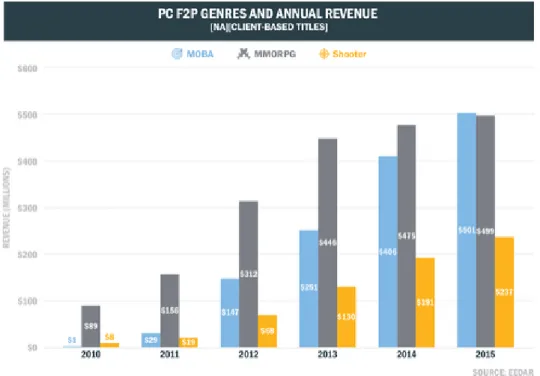
Figure 2: Personal computer: revenue of free to play genres (client based) in North America (source: EEDAR)
All in all, MOBAs are the driving force behind the growing market of personal computer and digital games, predicted to catch up to MMORPG, as seen on figure 2. (MMOSITE, 2015). Nevertheless, the MOBA market begins to show some signs of saturation making it increasingly interesting to understand how to succeed in it (Superdata research, 2015).
5
3 Revenue models
The three revenue models considered will be Freemium, Premium and Subscription. This has to do with how they have been used historically in the videogame industry and how, theoretically, they would fit personal computer videogames and the specific genre of MOBAs.
3.1 Freemium
Freemium was coined through the contraction of “free” and “premium”. It refers to a revenue model which enables consumers to have a certain product or service for free and getting revenue from additional features provided, usually to a small percentage of the user base. Thus, a general product or service is provided to a wider population with the revenue coming only from a reduced number of users within.
It should clearly be distinguished from a free trial or demo. In this case, the prospective customer can test the product or service before purchasing it. It should be also distinguished from other types of free products or services – namely: those not intending to monetize (e.g. based on donations, gifts); those who intend to use other forms of revenue such as advertising (in this case the revenue comes from a third party); those who give away something for free as part of a deal where the customer pays for another product or service (Freemium.org).
Freemium is more popular with digital goods which can be used by companies to provide their offer with residual to virtually no marginal costs. Providing a product or service for free is only sustainable and profitable if the costs to supply all interested users are lower than what paying users are paying for the service they are getting. This implies a clever design weighting what is given out for free, which should be interesting enough to attract a large user base, and what should be paid for, which should be interesting enough for a sufficient amount of users with specific needs. While its appeal will surely be related to what kind of offer is provided and how well it tends to the needs of an audience, being free is a solid and very attractive proposition in itself. A renowned and widely quoted MIT research (Ariely) illustrates this point quite eloquently. The study argues that something being free adds an extra value to it beyond the usual cost-benefit reasoning. The authors state their main finding being that “people «overreact» to free products, in a sense that in order to get a free product, people are eager to forgo an option that they «should» find preferable”.
6 The study was based in an experiment which consisted of offering a group of people the possibility to purchase either a quality chocolate at a higher price (14 cents) or a not so good chocolate at a lower price (1cent) - or even nothing. At first a larger percentage of people opted for the value for money proposition represented by the combination of the best chocolate and the 14 cents. In a second phase, as prices are decreased by the same amount – 1 cent – making the lower grade chocolate free, the percentage of people taking the lower value chocolate increased while the best chocolate saw its preference decrease. The authors thus conclude that a product becoming free makes it “not only cost less, but consumers act as if being free also adds intrinsic value to the product”.
In the videogame industry, Freemium has been a quite popular revenue model for products designed for mobile phones and internet browsers, sometimes coupled with social networks such as Facebook. These games usually focus on a certain social component involving getting a player’s friend to help him with the game, by adding certain benefits. In these cases, it holds true that the more friends are playing the game and actively helping the more progress can be achieved. The sense of progression seems to be fundamental in keeping users coming back to the game, which in turn is fundamental to increase the conversion rate. Other mechanisms include limiting playing sessions (for not so deep games) and/or offering daily bonuses to keep players coming back regularly. The idea is thus to maximize the transactions connected to the game aiming to generate a steady revenue flow. In many cases, this also means that the game should be periodically updated and potentially improved (Weidemann, Teut Weidemann - Beginnes's Intro to F2P, Aalto Game Monetization Design, 2014). The premium part of freemium videogames can generally fit into two categories: functional upgrade or cosmetic change. The former allows paying customers to have some sort of advantage in the game whilst the latter does not. This division is tied to one of the main issues free to play games have had in the western world, known as the “free to play stigma”. The stigma is based on the “perception that freemium is nothing more than a thinly veiled monetization scheme, designed to maximize micro-transactions from so-called whales rather than putting a focus first on fun” (Brightman, 2014). The reputation of these games as not sufficiently well designed for non-paying players was built upon a few pillars, namely: poor pricing, especially if it is too expensive; repetitive suggestions to purchase something during gameplay,
7 mixing the transactional part with the actual game; elements that allow paying players to have a very noticeable advantage over non-paying ones (Extra Credits, 2014) (Pocket Gamer - Comments and Opinions, 2015).
Western audiences don’t enjoy games which endorse a strong “pay to win” element, particularly in PvP games, where functional upgrades offer great advantage towards a win. (Weidemann, Dissecting League of Legends Monetization | Teut Weidemann, 2014) The general balancing act followed by developers to level the playing field is to contra pose time to money. Paying customers are offered either to progress at a faster pace or a certain advantage also available to non-playing users willing to invest enough time into the game. In light of this, some games function with a dual currency system. Hard currency is obtained only by putting money into the game and soft currency is only obtained through time spent in game or logons (or though other mechanism such as number of wins). Offers for sale can be priced then in one or both of these currencies, determining then what can be bought with money, with time or with either one or the other.
3.2 Premium
Premium is a revenue model basing income on a transaction with a given price which is agreed, and many times paid for, prior to getting the product or service. It is the most widespread form of revenue, coming from a simple trade. In most cases, price is not negotiable and is set by the seller with the prospective buyer having the option of purchase. It can be either with or without resorting to credit. It is the kind of transaction present in our daily life when shopping from groceries going to the restaurant or just from buying a coffee. Nowadays, as consumers pay more and more using the credit card, the money is perhaps not deduced from our accounts prior to getting the goods. Nevertheless, the business owners receiving this payment get the money instantly into their account thus being paid as they deliver the goods. In cases where we pay in the end, such as in a restaurant, the delay is not significant.
In the videogame industry, it was the traditional revenue model. More popular in the past, arcades allowed players to pay for iterations of the game. As games became more liberalized and available at home, they were purchasable for a one-time fee to be enjoyed as many times as wanted. At first they were only available this way in retail stores but lately digital copies have been made available and one can pay for game and just download it without even leaving the comfort of his or her home.
8 Historically, for the consumers, this generally had two implications. Firstly, it was usually the case that they would buy a game without testing it first. Although specialized magazines would offer insight into what the titles were about, they could not cover all games and they could only do it until a certain point. Still, this was not really getting access to the game before purchasing. This happened mostly through demos that were made available representing the game only partially as players could play only up to a certain point or only for a certain duration or even both. This provided some sampling but it was far from being available for all games.
Secondly, the product was sold “as is” and no additional free updates would be released. If patches were released it would have been to correct a main flaw in the game. Therefore, from the developer’s side it generally meant a quite low additional investment after release.
For games purchased as purely “pay to play”, the former changed remarkably with the advent of widespread internet usage, as demos became more and more available and reviewed content became available online. Furthermore, gameplay footage of several games can now be seen on sites such as You Tube for a feel of how they play prior to purchase. The latter, has only slightly changed. What is offered online in the form of patches is up to minimum and DLC is often paid for making it a new instance of the same game and not distant from the original concept of an expansion.
3.3 Subscription
Subscription is a revenue model based on periodic payments in return for a periodic or continuous service and/or product deliveries. Magazines and newspapers were probably the most known for using this kind of revenue model as consumers saw convenience in setting up a subscription to get a product they would get anyway without the hassle of several transactions. Instead they could just pay a yearly fee and get the publication delivered to their doorsteps. For the publishers, the costs of shipping their products were surpassed by a potential increase in sales as it guaranteed the fee or a given period, during which consumers may not have otherwise bought all editions. Moreover, it provided cash flow as they would receive the money beforehand and allowed for better planning as they could have a better understanding of the minimum copies they would need to print, for example.
9 In the videogame industry, it was pioneered by MMORPG. As a never-ending game with periodic updates and continuous maintenance it made sense, at least from the developer’s perspective, to keep a steady stream of revenue. These games differed from traditional offline games as they were not just a product but a product with services attached. Aside from server maintenance and keeping the game balanced and bug ridden, periodic updates were part of the core of the game. Furthermore, community management and support for players would also be in place.
After World of Warcraft (2004), arguably the most successful MMORPG, and still the market leader, some other games in the genre started with a subscription model, often coupled with a freemium component mimicking WoW. Many of those ended up going free to play as they were facing high churn levels and increasingly lower user bases. Players would initially come and test the game and realizing it offered no meaningful difference to the market leader’s offer they would revert back (Tedeev, 2015). New players to the genre would likely start with WoW anyway, as the most hyped game. Since the social aspect of the game is so strong that players would find themselves playing the game their friends were playing.
As it seemed that basing this sort of games mainly on a subscription revenue stream proved difficult to all the market leader challengers, the approach soon evolved. Some MMORPG like Eve Online (2003) and Wildstar (2014) employ a subscription revenue stream I their business model with the option of grinding to pay for the games periodic fee. As it allows players to use in-game currency to pay for the subscription fees, it puts the game closer to freemium model. Wildstar is a good example of a hybrid revenue model combining elements of premium, subscription and free to play: the game is available today for 29.99€ (44.99€ deluxe edition) (NCSoft), but requires a subscription to keep playing and it can be either paid for in real world currency or with in-game currency (NCSoft). This is probably as hybrid as it gets as a way to mix “free” and some form of payment. In fact, the game can only be “free” after paying for the initial fee. Replacing the real world paid subscription with in-game currency is a kind of approach similar to what has been done by some freemium games.
10
4 MOBA
A MOBA is a videogame genre, played in real time, where two teams fight for victory in a predefined map. The objective is generally to destroy a specific structure of the enemy team on the opposite side of the map. Each player controls a single character that “levels up”, becoming stronger as the match goes on. Several weaker AI controlled units are also usually part of such a game, even if the fewer player controlled characters are the ones decisively influencing the course of events (Kalor, 2015).
4.1 Origins
The origins of the genre can be traced back to Blizzard Entertainment’s Starcraft (released in April 1998). The renowned publisher and developer had released yet another RTS game, following their Warcraft series. This particular game, however, had an inbuilt editor that allowed players or fans to create their own maps and design their own mini games using StarCraft’s engine. One of these mods was “Aeon of strife”, which featured already many of the aspects that make up the genre today. In July 2002, Warcraft III: Reign of Chaos (Blizzard Entertainment) was released introducing a more powerful editor for players and fans to mod with. The concept previously seen on Starcraft was revamped, improved and renamed DotA. It grew popular within the community and when Warcraft III: The Frozen Throne (expansion to the aforementioned game) had been released in July 2003 the mod was already a phenomenon and one of the most played mods ever. Several improvements ensued with DotA achieving a considerable level of polish in par with the highest standards for commercial products at the time.
The mod required continuous maintenance as one of the key features for replay value was the sheer number of available playing characters to choose from. The mod developers ensured a steady flow of new characters as well as a healthy balance between their power levels so as to keep them all at some level of relevance. At this point, DotA had never been a commercial product. The game was only playable inside another game: players would have to own one of these Blizzard titles, download and install the mod and then play it.
By the end of 2008 there were already titles with similar principles available in the western market – such as the web browser game, Minions – but it was only in 2009,
11 with Demigod and League of Legends, that it became truly a commercial product. At that time new titles were announced and, what started as just a fan made mod, became a videogame genre in its own right with several titles to its name and played by millions worldwide (Machimina, 2012).
4.2 Nature
We would like to clarify the essence, the defining characteristics of games that would belong to this genre as we propose to analyze it. Furthermore, we would like to highlight these specific features for a better understanding of how these games work and how a revenue model could be design for them. It may encompass certain features which did not belong in the original mod or may remove others, as long as it keeps true to the general principles established and meanwhile taken into consideration as essential to being a MOBA. The acronym does help to a point, but we have to move beyond it to truly understand the nature of the genre. It is still a fairly new one, and some features could be open for debate but we tried to keep in mind the principles which are generally agreed to be part of it.
It should be, at its core, an online game. This does not mean that an iteration of a certain game played in LAN with others or even alone totally disconnected would stop it from being a MOBA. However, the core of the game should be played online. The game should be played in real time. Any kind of recreation of what traditionally would be a MOBA as, for example, a turn based game would make it more of a pure strategy game than an RTS or Action RTS. It is thus a face paced game which demands quick strategic decisions and a great deal of mechanic ability from players. These two combined features already stress the importance of a reliable internet connection. Both stability and reasonable ping are required for the best experience within matches. Although the access to the internet has become more and more widespread, there are still many locations, perhaps in smaller cities, in the Western world where connections are not as reliable or ensuring the best latency to play such a fast paced game.
At its core, the game should be designed to and played by several players. The multiplayer component is also essential. The game is also a team game and, to feel more like so, most MOBAs employ teams of at least 3 players and, traditionally, no more than two teams per match. This does not mean that a duel with the same
12 principles cannot be part of the genre, but the focus should remain on team play. Similarly, although some game mode can be PvE, in its essence, a MOBA should be PvP. These two features emphasize the social component of the genre and the way it can forge relationships as players learn to co-operate to achieve victory throughout the time they play matches together.
A MOBA is also a match played on a specific map (or set of maps, for different game modes) in which the objective is the destruction of the opposing team’s base. Some game modes in MOBAs having a “death match” kind of approach are fine as long as the core proposition of the title features a map, or maps, with the aforementioned objective, and, for example not that of defending a base – which is the proposition of tower defense games. The lanes (or a specific number thereof) are not mandatory even if many MOBA feature them.
PC generally become very strong to a point of decisively impacting the game, as they level up. This progression in the match is also a trademark of the genre, missing in some traditional RPG elements, like ability choices and upgrades. Usually, during matches players can acquires a certain currency enabling them to acquire items to make their PCs even stronger. It is very common to see periodically spawned NPC fight for each team.
4.3 Player profile
In order to understand how best to make money out of a game, like with any product or service, it is paramount to understand its audience: who are the people already playing this genre?
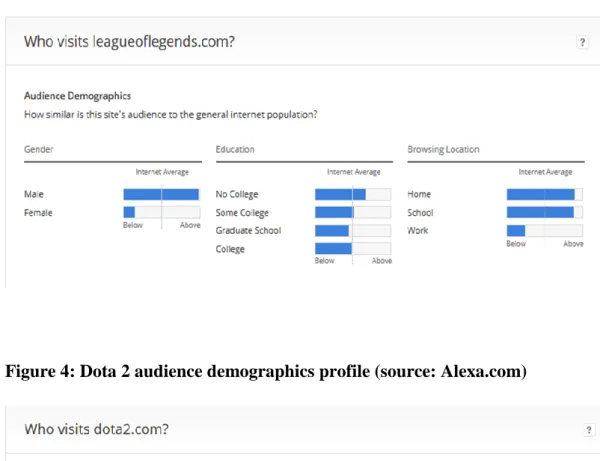
We have resorted to Alexa.com to get some information regarding the users flowing to the mains sites of two of the most popular MOBA games. The outcomes have to be taken with a pinch of salt as what we are getting is an estimation, based on a sample, of demographics regarding users that access the website. However, it is a fair assumption that people accessing the website, or a vast majority thereof, is actually playing the game. Furthermore, it is a method used by industry veterans such as Teut Weidemann as he dissects some games for their monetization mechanics.
13
Figure 3: League of legends audience demographics profile (source: Alexa.com)
Figure 4: Dota 2 audience demographics profile (source: Alexa.com)
Alexa.com compares data relative to the “general internet population”. As we can determine by analyzing figures 3 and 4, both League of Legends and Dota 2 the male population is greatly overrepresented (maximum visible on metrics) and the female one, greatly underrepresented.
As for level of education, visitors of LoL website come from a variety of levels of education, but there is a clear overrepresentation of people who did not go to college. As Teut Wiedemann suggests this is probably not because they did not have the ability to pursue their studies but it is rather representative of youngster still in high
14 school (under 18 years old). In fact, for LoL the pattern is that of a slight decline in visitors as the education level grows higher. This is underlined by the vast overrepresentation of accesses at school, which are as high as those made from home. On the other hand, visitors of the Dota 2 website are mostly those with a college education, followed by those with some college education, whom are most likely still in college (ca. ages 18-23). People who went to graduate school are already referred to by Alexa as “underrepresented”. Although work and school are but underrepresented as browsing locations, it is interesting to remark how “school” is really below what we see for LoL and how “work” is just slightly above.
Taking into consideration the above, we would describe the MOBA player population as being vastly male and young (taking into account “education” as also some indication of age groups). Teut Weidemann supports this point as he describes LoL gameplay as “very hardcore” and “not designed for women”. He further comments on the age as he mentions “most action based PvP games have a younger player base” as people between 16-30 years love a game which is “hard to learn and hard to master”. Mr. Weidemann further stresses this point as he says that for those “over 30 it is impossible to master”. (Weidemann, Dissecting League of Legends Monetization | Teut Weidemann, 2014)
It is curious to remark that Dota 2 players may be older than LoL. This could be explained perhaps by the differences in gameplay. Even if both games offer similar experiences, Dota 2 is a loyal and accurate depiction of the experience of the original Dota mod, thus attracting those that played it at the time.
15
5 Monetization of MOBA
As we look at a few specific titles we take into account their revenue models and monetization mechanics as well as the overall game design philosophy. However, as there are so many MOBAs out there, which should we take into account?
Since user base is probably the main success factor behind these games we looked into market shares to determine which titles we should focus our analysis on. A recent EEDAR study predicts the MOBA market share in 2016 (Zhao, 2015).
Figure 5: Estimated worldwide MOBA (client based for personal computer and consoles) market share in 2016 (source: EEDAR)
We can realize from figure 5 that four games make up 90% of the whole market and that one game alone, League of Legends owns two thirds of the whole market. The second player in the market, Dota 2 comes at only 14%, almost five times less than LoL. In spite of its recent launch and of being in beta development at the time of the study, Heroes of the Storm comes in as the third contender for market share in 2016.
16 According to the study, Smite, the fourth title in this list, would only achieve 2.5% of the market. EEDAR analyst, Edward Zhao, believes these two last games “succeed largely due to their innovative approaches” (Zhao, 2015).
The remainder 10% of the market comprises many titles of little impact. Of those, Infinite Crisis has been meanwhile forced to shut down ending its service on August 2015 (Infinite Crisis, 2015). It is not an isolated case as many of these titles feel the pressure to achieve a certain size and end up failing to live up to their expectations. Even titles backed up by giant publishers such as Electronic Arts’ Dawngate ended up being cancelled after significant investment and 18 months of beta development (Bromberg, 2014).
5.1 Freemium games
Freemium titles allow players to access the core game for free and then charge for some options. They can differ regarding what they give for free, what they make players pay for and how much is charged.
As the MOBA genre is complex and skill based, catering to hardcore gamers, it is generally averse to “pay to win” monetization mechanics in the western world. The challenge is then to provide a richer experience to paying customers – otherwise why would anyone pay? – while keeping a fair PvP game environment for all.
The key advantage in this regard is that games in the genre tend to generate, as Nicolas Lovell would put it, “superfans”. These became more players of a specific game, than of the genre or gaming in general. The game becomes their hobby and they are thus more likely to spend money on it and perhaps for things they would not consider spending money for in other games (Lovell, 2014).
The following games are ordered by release date as it is important to understand the development of newcomers to the market. According to analysts, these will be the top four games in 2016, reaching a combined market share of roughly 90%. League of legends is the first of these and is also the market leader. It slightly simplified the original Dota mod, making it accessible to a wider audience, and has been seen as a case of right product at the right time. For these reasons, many comparisons are made against this title. Dota 2 is the most faithful to the original mod and the one requiring more skill to play. Smite introduces afresh gameplay differentiation to the genre with its third person view. Heroes of the storm is interesting as it has been released very
17 recently in early June 2015 and showcases a big player’s approach to the genre, trying to cater to a more casual audience.
5.1.1 League of Legends
Riot Games developed a market leading game with the help of some of the staff that worked in the original mod. The most famous amongst them is probably Steve Feak, best known as “Guinsoo”. He had worked in the development of the original mod and had an in-match item named after him. “Guinsoo’s Scythe of Vyse” does not feature in the original mod’s sequel, but LoL has also an item named after him which is still in the game today.
Taking the experience from the original mod, Riot created a simplified version of the game with a more “cartoony” look and feel. At the time, competition was not as rampant but there were some games like Demigod or Heroes of Newerth. They both adopted a premium revenue model. It seems to have been no stranger to LoL’s success that the freemium approach was taken (Machimina, 2012).
As a new user starting the game, options are somewhat limited as players are restricted in the game modes and PC they can play. At first, only tutorials and PvE can be played, which is a good way for beginners to start learning a complex game. Nevertheless, PvP becomes soon available. More game modes become available through in game progression. There is no other way to unlock them but to actually play the game. A leveling up system rewards players as they reach certain thresholds gradually granting access to other game modes. In addition to game modes, there are two other key features gained by progression which allows for added advantages in each match: “masteries” and “summoner spells”. The former consists of a set of points, 30 at maximum level, which can be distributed at the start of each match amongst a series of options to fine tune a given PC. The latter unlocks a few abilities which are common to all PC.
Other limitations exist beyond those set by game progression. These features can be unlocked, according to the case, by spending Influence Points, Riot Points or either of those separately. This dual currency system employs IP as the soft currency earned by playing the game – at the end of each match, each player earns a quantity of points which varies according to the match result and time spent amongst other criteria; and RP as the hard currency, which can only be acquired by spending money.
18 Regarding IP we can only roughly estimate the amount gained per gameplay hour. If we assume 40 minute games (map: summoner’s rift 5v5), with a 50% win ratio, with no boosts enabled, we would come to roughly a 138.4 IP per gameplay hour. We will assume these calculations to provide an estimate on the gameplay time needed to acquire certain items.
For RP, the same number of points is required for a given in-game item purchase across all servers, but the amount purchasable per unit of currency differs in three ways. Firstly, it differs by server with different currencies; secondly, it varies according to the amount purchased thirdly, it changes according to payment method, as different charges apply. In the example above, taken from the European servers, each euro allows for getting between 140 to 165 RP. For purposes of roughly indicating a price in euro we will assume a 20€ purchase of RP was made, i.e. 162.5 RP per euro spent.
There are several types of in-game items purchasable with IP and/or RP. These include PC, runes, rune pages, skins (wards and PC skins), summoner icons, XP and IP boosts, server transfers and summoner name changes.
At the moment there are 125 PC in LoL, but they are not available from the start. Non-paying users have access to a set of 8 weekly rotating PC. These are selected as to ensure a certain level of diversity suited for the different roles generally assumed in matches. However, certain game modes are only available to players who own a minimum of 16 PC (excluding the free ones). Moreover, the availability of several PC allows for richer gameplay. They can be acquired by either IP or RP becoming cheaper as they have been available for longer as prices vary according to the time elapsed since their release date.
Runes are upgrades attachable to any PC to enhance its in-match capabilities, thus bringing gameplay advantages to players using them. They can only be acquired with IP and 3 tiers are available according to level progression. They open strategic options to players and although 68 types are available at tier 3 there is a maximum of 27 can used at the same time (of which a maximum of 9 of the same type). Prices for runes vary between 205 and 820 IP. A more powerful type of runes, the quintessence is available in 30 types, from which only 3 in total can be used per match. Prices vary between 1,025 (18 types) and 2,050 IP (12 types). Because runes are mostly used by
19 roles, that is, many PC in the same role can use the same runes appropriately, a player would not need all of these runes to reach a great level of suitability for his or her set of runes. Nevertheless, it could take as much as 12 days of gameplay to get to a very good and sufficiently diversified rune stash.
Runes have to be fitted into rune pages before matches in order to be used. At first only 2 rune pages are available and having more is important to being able to play diversified roles and strategies. Players can have a maximum of 20 rune pages.
Skins in LoL enable players to change the look of a ward (item used in matches) or a PC. Ward skins cost 640 RP and are quite few (16) when compared to the number of PC skins and the range in costs: 390 available ranging from 390 to 3,250 RP. To add to those available at this moment, others exist that have been taken out of the shop as they were only of limited availability or given at special events. Another cosmetic features showable in game but not inside a match are summoner icons. There are 31 available at the price of 250 RP each.
Available on the shop are also boosts. These enable, for a limited time or number of wins, either an increased intake of experience – needed for in-game progression until reaching maximum level – or IP. The IP boosts cost from 51 to 80 RP per boosted win and 116 to 290 RP per boosted day. The experience boost costs from 20 to 35 RP per boosted win to 74 to 150 RP per boosted day.
There are two additional services available to players. The server transfer allows a player to move his or her account with its unlocked features. While transfer to some severs may be free, transfer to most costs 2,600 RP. The summoner name change service allows for players to change their current in-game chosen name for a cost of 1,300 RP or 13,900 IP.
Most of these prices are quite stable. However, there are some seasonal offers and sales as well as bundles which allow players to unlock some of these features at a discounted price. Apart from those, every four days there are 3 PC and 3 PC skins made available at half their RP cost (but not half of their IP cost).
The game developers have made what are now common monetization options namely in the form of cosmetic upgrades such as skins. Other purchasing options focus rather on time: boosts allow for faster game progression/IP, but a player playing more games
20 can catch up and thus unlock several functional features via IP (runes, PC). It is a traditional tradeoff in freemium games to have the money/time dimensions as both ways to progress. Furthermore, there are two services which, at first seem to have lower indexes of recurrent use: the server transfer and the name change. The former aims also to save time, as it is possible to create multiple accounts one could simply start from the beginning in another server. The latter can also be acquired via IP and would seem less recurrent as players tend to keep a certain identity, although it can be used to insert a certain affiliation tag, which can then be changed again according to affiliation changes. There is, however, no enhanced support in terms of user interface to organizations of players such as guilds or clans.
League of Legends developers have also chosen to monetize on a key feature of the MOBA genre: the playing character diversity. This option allows for the players who keep playing the game for longer periods of time to spend money to speed up the rhythm at which they pick up new PC instead of grinding for IP to do so. As players discover the game and unlock new game modes, it soon is clear that the handful of them or the PvP aspect alone could not keep the “replaybility” value as high. In fact, the desire to keep playing the game is deeply tied to the strategic options open by being able to play diverse PC. The game gets more complex and fun and could get boring otherwise for fans of the genre.
If we take the example of PC, which can be acquired both via IP and RP, we quickly can understand that their IP price ramps up more considerably than their RP price. For instance, the amount of IP required for a tier 4 PC purchase is around 52% more than what is needed for a tier 3, whereas it is only around 12% more in RP. This makes it more cost efficient to acquire cheaper PC with IP and more expensive ones with RP. It seems to be common belief within the community that LoL is not a “pay to win” game as all purchasing options are either cosmetic and do not affect the match or can also be acquired with IP. Items and upgrades customizable outside matches such as runes and summoner spells cannot be bought and it is ultimately skill that makes the difference in a match without the amount of money spent being a factor.
Nevertheless, while there are no purchasing options inside a given match or none that can directly affect it, we should mention that it could take non-paying players a while to reach the same level of a player spending some money in either PC, rune pages or
21 boosts. What happens is that if non-payers are using their IP to purchase one item they will lag behind in other types of upgrades, whereas someone buying the boosts or PC will achieve a larger amount of game progression or IP and using the latter to buy runes. The possibility to “buy time” is one of the aspects we believe make the experience more enjoyable for paying users: it confers them an advantage – in progress, in time – which does not translate into a match advantage.
The other main aspect being the customization possibilities and the way they can be showed off, especially in matches. Differentiation and a certain “cool” effect show also how much players are fans of the game, of a particular character or theme. This is emphasized by the developers’ care in making some skins unavailable, ensuring that they were only available to a certain group of players. These include skins given at special events such as Gamescom or for as a reward for achieving a certain rank at the end of the year. Other skins are also just made unavailable and sometimes brought in for short periods of time as a promotion.
5.1.2 Dota 2
Valve enlisted one of the most iconic developers of the original mod. “Icefrog”, as he is known, was the lead developer behind “Dota allstars”, the latest and most polished version of the mod and had earned acclaim from the player base for his dedication and for bringing the mod to a high standard of quality in design and game balance. With Valve’s resources, Icefrog could achieve the superior quality experience in Dota 2, evolving the game to fit the freemium market without betraying the principles that made it great in the first place. Dota 2 is a faithful recreation of the original mod, with only slight changes and some added content namely to enable its monetization (Machimina, 2012).
In a market increasingly changing toward simplicity – to widen the reach of the genre – Valve’s game stands out as arguably one of the hardest in the genre. It is hard for beginners as there is no clear tutorial and information seems prepared for those already well acquainted with the genre. For veterans of other games it is also hard to get into such a rich game with a large amount of information to potentially explore since the beginning and with a few mechanics which reward player skill. It differs from LoL by being a more difficult game, with a couple more layers of complexity (denying, gold lost on death, day and night abilities, river runes, couriers, secret shops, more “juking” possibilities) and a gloomier look.
22 As most MOBAs it uses game progress as a way to unlock some game modes and features but not as much as LoL does. At first, players are limited to non-ranked play but all PC are accessible even if there are some recommended ones for beginners. As the account is leveled up, simply by playing the game, players can access ranked play sooner than in LoL.
This is a sign of a major difference in design philosophy. What is offered for free in Dota 2 is actually the full game in all its strategic options available. There is nothing like “runes” which can be acquired before matches granting advantages therein. All items sold are either accessory or are not functioning as a performance enabler in any way. There is no “pay wall” just normal game progress to unlock modes and such is has been a staple of video gaming for a very long time.
There are several types of items available in the shop, only purchasable with real money. Dota 2 makes available a plethora of item types including PC skins, HUD skins, screen savers, tournament tickets, player icons, tools, charms, treasures, couriers, announcers, music, and wards. It is, by far, the game we researched with the greatest variety of purchasable items despite PC being freely available.
To add to this diversity and complexity of the game, PC skins can be gained by pieces through playing the game. Pieces can be equipped separately and their variety also depends on the PC. Weapon, armguards or headgear are examples of these pieces allowing for partial customization of characters. Generally a full set would have between 4 to 8 pieces and these can be sometimes given as a reward at the end of a match. Alternatively, a whole set can be bought at the store. At the moment we write, and contrary to LoL, not all PC have skins available and Valve has engaged the community to submit their designs for skins, which get voted and can be later taken into the game.
The developers sell cosmetic upgrades connected to some game mechanics in matches such as skins for wards and couriers but also for many aspects involving the game such as HUD skins and player icons. They go a step further selling a limited assortment of music and announcing packs. These replace the standard in-match announcements with customized voices delivering the same information when certain events occur. A few other innovative items revolve take customization to a new level
23 as players can change not only their names but also the names of some items they play with.
There are two types of items which come with a sort of gambling angle. Treasures can be bought and give players one of a given set of possible skins, for different PC. Players cannot receive a skin they already own, but it is a very random way to acquire items as, usually, players would like a skin for a specific character. Charms feel also a bit like gambling as they serve to place a bet that the player’s team will be victorious in a match. If three correctly predicted victories are achieved before making two incorrect predictions, the player wins a given treasure.
Tournament tickets can be purchased to access live or recently played events in the Dota 2 e-sports scene. There is a great variety raging from world championships to regional or country specific tournaments.
5.1.3 Smite
Developer Hi-Rez had released Global Agenda in 2010, described as an MMO shooter and a free to play title, and Tribes Ascend, released in 2012, another free to play shooter. Therefore, in 2014, when Smite came out, Hi-Rez had already substantial experience in managing a freemium game. As they entered the MOBA genre they decided to do so by implementing a key feature of the FPS/Action titles previously developed: the third person view.
Gameplay is probably the cornerstone of a videogame and changing something as important as the top-down view MOBAs are characterized by, with success, is testament to the innovation capabilities of Hi-Rez. It is still considered within the genre as this is the key main feature changing. The maps, game flow and general principles were unchanged but the gameplay change gives it a totally different feel. This enabled appealing to a vaster audience, those already comfortable with FPS/Action games and their controls whilst challenging traditional MOBA players, familiar with the game flow and general principles, to try a new approach. The gambit seems to have paid off as analysts predict Smite to be within the top 4 MOBAs by market share in 2016.
24 In Smite, as players start the game with their level one account, they are limited in the game modes they can experiment with. After a few matches they can play most maps with the exception of ranked play. PC are not available at start and the game uses a weekly rotation for them making a few of them free to play for a given week. There is however a PvE practice mode where players can experiment with any of them. Another interesting design feature is masteries: players will accumulate “worshipers” per match played with a given PC which pretend to symbolize the level of mastery a player has with it. Mastery levels go up to 10 for each PC and special skins are available at levels 5 and 10 for players to purchase for each PC.
Smite uses a dual currency system, with favor being the soft currency and gems the hard currency. Favor is won for playing the game, increasing with the time spent in match and with wins providing more of it. It is also won while leveling up as part of the game’s progressing system or just by logging into the game. Gems on the other hand can be purchased or acquired via logging into the game. If the player logs in every day, gems are earned on the sixth and seventh days, at a low rate per week. This can be considered to make the hard currency a bit softer but in fact has reduced impact in what users can purchase with it: it takes four weeks of logging in every day in order to acquire a PC with gems earned this way.
Smite offers a few options to spend both favor and gems. There are no functional items available for sale apart from PC which can be considered functional only in the sense they extended the strategic options before a match. There are also boosters available but they are only relevant to acquire faster favor, thus having the option of unlocking PC faster without spending any real money.
PC can be acquired with one of the two currencies available. There are currently 65 PC in Smite, all having the same price in gems, and most of them (86%) having the same cost in favor. The best possible rate for gems is of 100 gems per euro spent, making PC available at 2€ each. There is also, however, a buyout option available, allowing users to purchase all current and future PC for a one-time fee of 23.99€. Boosters in turn are purchasable with gems and increase the experience (required for account progression), favor and worshipers won per match.
On strictly cosmetic items, Hi-Rez makes available a set of skins (PC and wards), emotes, player icons, voice packs and a name change option. Some items, namely
25 skins, are periodically offered for sale and there are always bundled goods available in the shop.
There are 13 ward skins available purchasable at 300 gems. PC skins vary a lot in price and there are some only purchasable with gems while others can be purchasable with the option of using either currency. Generally, emotes can be bought with either currency, with only a few being available with gems. Voice packs are only available to purchase with gems. The player icons are mostly available only to be purchased with gems while a few exceptions can also be bought with favor.
5.1.4 Heroes of the Storm
Blizzard’s title is currently in closed beta and leverages the strong branding of the publisher’s past titles such as Warcraft, Starcraft or Diablo to enter the MOBA genre. In fact, characters played in these games or belonging to the stories created at the time to support them are now available to play in Hots. The developer is highly acclaimed for the quality put into its products, spearheaded by World of Warcraft, which is still the market leader in MMORPG in the west.
On the other hand, Blizzard had already gained experience in designing a freemium title with the release of Hearthstone and with micro-transactions in general when it decided to make them available in World of Warcraft.
Hots is very interesting to analyze as it recently released in early June 2015. It is still in its early stages and more content is surely yet to be added and tweaked but there are sufficient hints on which direction Blizzard intends to further develop it.
At the moment, Hots features 7 maps which are all inspired by the original MOBA design, but with a bit of a twist. In matches players can interact with maps in different ways which grant bonuses that greatly facilitate victory. In fact, the general philosophy of laning and destroy enemy structure is present, but, since the specific map features are so powerful, players find themselves playing mini-games of collecting drops or zone control in order to achieve victory. These maps are available to test, but some game modes, such as ranked play, are only unlocked as players progress through their accounts.
Other features in the game can be unlocked either via gold, the soft currency earned by playing the game or simply by purchasing them with money. PC and boosters –
26 granting extra experience for account progression and extra gold per match – are the only borderline functional items available for purchase with money. In fact, there are no truly functional items and all other are purely cosmetic such as PC skins and mounts, both with chromatic variations.
Gold can be acquired through playing the game: income comes from leveling up the account, playing a match or completing quests. The first is a good way to give players a nice amount of gold from every couple of levels until level 10. After that, it becomes less every level and progression becomes slower. In total, 16,000 gold can be made from leveling until maximum level which is 40 and after that, nothing. Matches award 20 gold per win and 10 per defeat. Quests employ a similar system already tested with Hearthstone. They are the sustainable most prolific form of earning gold, awarding from 200 to 800 gold. Even if players are limited to one new quest per day, they can accumulate 3 at the same time. Although there are quests for winning games, most of them can be completed just by playing a certain amount of games, regardless of the outcome.
The currently 37 PC in the game are not available from the start, but Hots employs a weekly rotation of 5 of them, with 2 more available depending on account progression. They can be acquired either with gold (from 2,000 to 10,000) or with real money ranging from 3.99€ to 9.99€ each.
For now, there are about 2 or 3 skins available per PC ranging from 4.99€ to 14.99€. There is always a skin per PC which requires a certain number of matches played with it. Once a certain threshold is achieved, players can purchase a special skin for 10,000 gold. The mounts used in matches also have available skins with prices from 9.99€ to 19.99€. There is also one mount purchasable with gold only, standing at a whopping 20,000 gold. As players level up PC they get access to a couple more colors for the skins they have.
Developers have also introduced weekly sales on real-money prices and a few bundles are available.
5.2 Freemium games monetization analysis
As we look into our chosen games and what developers chose to monetize on, we quickly realize that the same they have the same core game, with the 5v5 map at the heart of it, and very similar features in terms of monetization mechanics. There is a
27 similar account progression and game modes and other features are unlocked as players progress. This allows for a bit of a natural selection in terms of those reaching the end game, i.e. ranked play. This is, generally, what is offered for free and in itself seems a very good proposition. The main difference from the original mod is that PC were all free to play. The cosmetic features enable the greatest offer of purchasable items in these titles.
The second note should be to stress that none of these titles has a strict “pay to win” feature, or is, in general, perceived as such by the community. There is no “super item” purchasable that enables greater advantages. Instead, although most monetize on PC, which add to the strategic diversity of the game, the bulk of options available for purchase are pure cosmetic upgrades. This happens most likely due to the hardcore and competitive nature of the genre coupled with the Western mentality that paying would confer an “unfair advantage” and those with more available income to spend on it would benefit and were more likely to come on top of ranked play.
5.2.1 Currency systems
Dota 2 is the only of the four games without a dual currency system. Items are made available for purchase using the steam platform and can be bought using real world currencies. The game sometimes issues drops at end of matches to reward players with some cosmetic items. These rewards are random and there is no soft currency system allowing players to trade it for an item of their choice. Hots uses a mix of soft currency and real world currency for in-game transactions allowing players to amass it and buy the item of their choosing, within some limitations as some items can only be acquired with real money. Both LoL and Smite employ a dual currency system that converts real world currency into a hard currency in-game. This coupled with the rewards given by buying hard currency in bulk – i.e. the more players buy the best value for their money they get – enables companies to potentially get revenue before they would otherwise get if players would buy an item at a time. Once purchased, hard currency seems “easier to spend” as there is no need to go through the hassle of entering credit card details, or other forms of payment, to buy an item and the relation between it and real money is less perceptible.
There is a difference speaking to game design and monetization mechanisms in how the soft currency is gained in the different games. In LoL it is only gained by playing games, winning more of it for a match win and for longer match duration. There is
28 also a one-time daily bonus for a win in any map. The underlying idea here is to reward skill, as perhaps 2 losses can earn players as much as one win, winners will earn IP at double the rate. Smite, on the other hand, uses not only the same ways to earn favor – with the added difference of enabling players to get the daily win bonus across all available PvP maps – but also rewards players simply by logging into the game. The underlying idea is to get an extra mechanism to reward the user base. By increasing significantly the amount of favor gained in subsequent logins during a week, it aims to keep players coming back to the game, even if they do not have time to play, so they can keep their bonus. Failing to login in a single day will break the streak and bring back players to “day 1” rewards. In Hots, gold is gained by playing matches and even if the amount earned per win is double that of a loss, it pales in comparison to the amount given by completing “quests”. These are related to playing games, but only one has the objective of actually winning the game. Others like “play X games” with a specific set of PC, are achievable regardless of the match result. The underlying idea is to reward casual play as grinding for gold when no quests are active is very time consuming in relation to the output gained.
5.2.2 Playing Characters
Dota 2 is the only game choosing not to monetize on PC. At first sight, it may be losing on some revenue by choosing so, but it can be an advantage to those wanting to play a MOBA in which they do not have to wait for a weekly rotation to make available more PC to play with. Furthermore, it appeals to purists and original mod players as they were used to several years of Dota with all PC being available and no strategic options denied: the was no doubt the game was all about skill from the start. On the other side of the spectrum both LoL and Hots do monetize on PC and in a similar way. Both of these titles price PC differently, enable a weekly rotation, make them available for both hard and soft currency. While in LoL price of PC varies according to how long they have been available, in HotS the criterion behind price differences is not clear. However, these differences result from the need of having stepping stones and allowing players to purchase PC at different price points. That they are available with both currencies also aims at prevent the games from being pay to win driven in what strategic options is concerned. The weekly rotation allows both players and developers to test PC.
29 Smite has gone for a middle of the road approach by offering a buyout possibility on PC. It makes the title no less free to play, but gives players the options of acquiring all PC, including future releases, for a one-time fee. This allows developers to potentially cash in faster: even if a player does not return to the game, it would have already made his or her contribution. Although this is not the ideal scenario for a “never ending” game in which player retention is fundamental, it also potentially raises the revenue over time of such a user higher when compared to others who purchased several PC at a slower rate. Even if less money was spent, it can be better, for cash flow reasons and value of money over time, to have a lump sum in the present than several micropayments in the future. Moreover, the micropayments for cosmetic are still available to be capitalized on in the long run. When compared to HotS or LoL, it represents the opportunity for players to purchasing the game as if it were a premium title. And from this perspective it open ups to a wider range of user preferences regarding revenue models. Players wanting to have all PC available form start would have to pay a relatively much higher amount for LoL and HotS than with Smite’s buyout option, especially taking into account that it includes any subsequent PC releases.
5.2.3 Cosmetic items
In any of the four titles we have studied, cosmetic items make up the largest amount of available items for sale, divided into a few categories. Unlike other freemium offers in other sectors, these games do not propose a functional part of their service as premium, but rather vow to engage users enough through their core proposition so that they buy these kinds of upgrades.
As PC are such an iconic part of each of games in this genre, they are the main focus for skins. Players have their favorite PC either because they look “cooler”, they favor their playstyle, because they can do a particularly exciting thing in a match or just because of the past experiences with it. There is often a mix of these involved: there is such an “emotional attachment”. Moreover, there is a social pull of seeing others with skins and being able to show off your own: a “cool effect”. Another factor connecting players to games is e-sports. MOBAs are an action packed PvP genre featuring considerable strategic diversity to lure the attention of viewers: users enjoy not only playing the game, but also watching matches, particularly at the highest levels of skill, team interaction and strategic depth. Watching professional players playing the game