
UNIVERSIDADE DE LISBOA
FACULDADE DE CIÊNCIAS
DEPARTAMENTO DE QUÍMICA E BIOQUÍMICA
p
-Cymene Based
Ruthenium Complexes as Catalysts
Joel David Avelino Fonseca
MESTRADO EM QUÍMICA TECNOLÓGICA
Especialização em Química Tecnológica e Qualidade
UNIVERSIDADE DE LISBOA
FACULDADE DE CIÊNCIAS
DEPARTAMENTO DE QUÍMICA E BIOQUÍMICA
p
-Cymene Based
Ruthenium Complexes as Catalysts
Joel David Avelino Fonseca
MESTRADO EM QUÍMICA TECNOLÓGICA
Especialização em Química Tecnológica e Qualidade
Dissertação de mestrado orientada pela
Professora Dra. Maria Helena Garcia
This project took place in the School of Chemistry of the University of Leeds, United Kingdom, under the scope of Erasmus Placements. It was co-supervised by Dr. Patrick C. McGowan and Dr. John A. Blacker
Acknowledgements
First, I would like to express my deepest gratitude to Professor Patrick C. McGowan for giving me the opportunity of doing my master placement in his work group, also for his mentorship, guidance, insightful discussions, continuous support, patience and encouragements during ten months at the University of Leeds.
Then I would like to thank Professor John A. Blacker for his valuable discussions and suggestions during my research.
My special thanks to Professor Maria H. Garcia for being so supportive in the decision of going abroad, for making this placement possible, for her mentorship, guidance and carefully reviewing the dissertation.
I would like to thank the European Commission for providing financial support, namely by giving me an ERASMUS Placement scholarship.
I am thankful to all the colleagues with whom I have shared the laboratory, namely from the McGowan and Halcrow groups, who have made my work days so pleasant. Special thanks to Andrea for her guidance and patience, to Steph for being meticulous and giving valuable advices, to David for being funny and helpful all the time and acquiring a valuable X-ray structure, to Rufeida for providing a good laugh everyday and being so supportive. Big thanks also to Chris, which I could not forget, for the valuable spectra analysis, for the insightful discussions, for being there whenever I needed. Thank you also to Ben, Rianne, Jonathan, Sara, Laura, Lawrence, Adi, Tom, Aida, Andrew and Warka.
To all the friends that I have made in Leeds I want to say a big thank you because they made this period very enjoyable.
Finally I want to thank my family for their support and encouragement throughout my study and my daily life.
Abstract
p-Cymene based ruthenium complexes were employed in the alkylation of
t-butylamine with phenethyl alcohol by redox neutral alkylation and in the reduction of acetophenone and benzaldehyde by transfer hydrogenation. A range of in situ generated catalysts formed by [RuX2(p-cymene)]2 dimers (X=Cl or I) with dppf, DPEPhos, dippf or
P(i-Bu)3 and a range of p-cymene ruthenium monomers, namely [RuCl(dppf)(p-cymene)]SbF6,
[RuI(dppf)(p-cymene)]SbF6, [RuCl(dppf)(p-cymene)]BF4, [RuCl(dppf)(p-cymene)]Cl,
[RuI(P(n-Bu)3)2(p-cymene)]SbF6, [RuCl(P(i-Bu)3)2(p-cymene)]SbF6, [RuCl2(P(n-Bu)3)2(p-cymene)],
[RuCl(P(CH3)3)2(p-cymene)]SbF6 have been employed in these reactions. These monomers
have been synthesised and characterized in this project and only [RuCl2(P(n-Bu)3)2
(p-cymene)] has been already reported in the literature.
Results were compared in terms of conversions and the best ones for the redox neutral alkylation were with the in situ generated catalyst formed by [RuI2(p-cymene) and
DPEPhos, giving 96% conversion for a catalyst/substrate ratio of 20 and with [RuI(dppf)(p-cymene)]SbF6 which gave 85% conversion for a catalyst/substrate ratio of 40. These
reactions have been run out in the open air without degassing or inert gas protection throughout which is not the typical approach found in the literature and that can be very appealing in the industrial point of view. The different halides incorporated in these complexes have been proved to have different effects in the catalytic activity, with iodine usually leading to more active catalysts. Some results and experiments that were performed allowed drawing some conclusions about the mechanism.
For the reduction of acetophenone and benzaldehyde by transfer hydrogenation it has been demonstrated that the dimers, the dimer-phosphine pairs and the ruthenium monomers mentioned before are not the most suitable pre-catalysts for these reactions. Overall, conversions up to 73% were obtained which lag far behind the 100% reported in the literature for several other complexes. Some conclusions were drawn about the mechanism and two catalytic cycles were proposed.
The brand new dimer [Ru2Cl3(DPEPhos)2(CH3CN)2]SbF6 has been serendipitously
synthesised andhas shown it forms catalytically active species in both the alkylation of t-butylamine and reduction of acetophenone giving moderate conversions.
Resumo
Neste projecto foram sintetizados complexos de ruténio e p-cimeno que foram posteriormente avaliados do ponto de vista catalítico em reacções de transferência de hidrogénio. Os complexos de ruténio e p-cimento têm demonstrado ser catalisadores/pré-catalisadores eficientes em várias reacções envolvendo compostos orgânicos e foi inicialmente sugerido para este projecto pela empresa biofarmacêutica Astra Zeneca o estudo da actividade catalítica do dímero [RuCl2(p-cimeno)]2 na presença das fosfinas
DPEPhos, dippf e P(i-Bu)3 em reacções de transferência de hidrogénio. Esta empresa
verificou que este dímero é extremamente activo na alquilação de morfolina com álcool benzílico na presença das fosfinas referidas (conversões acima de 97%).
No que respeita aos complexos sintetizados, levaram-se a cabo as sínteses dos dímeros de cloro e iodo de fórmula molecular [RuX2(p-cimeno)]2 em que X = Cl ou I e ainda
de monómeros utilizando os dímeros referidos como compostos de partida. A síntese do dímero de bromo foi também tentada mas este revelou-se muito difícil de obter e portanto não foi utilizado em sínteses posteriores nem nas reacções catalíticas. Para obter os monómeros foram ainda utilizadas fosfinas mono ou bidentadas, nomeadamente dppf, DPEPhos, dippf, P(i-Bu)3, P(n-Bu)3, P(CH3)3 ou PhPCl2 que originaram os seguintes complexos
neutros ou mono catiónicos: [RuCl(dppf)(p-cimeno)]SbF6, [RuI(dppf)(p-cimeno)]SbF6,
[RuCl(dppf)(p-cimeno)]BF4, [RuCl(dppf)(p-cimeno)]Cl, [RuCl(P(n-Bu)3)2(p-cimeno)]SbF6,
[RuI(P(n-Bu)3)2(p-cimeno)]SbF6, [RuCl(P(i-Bu)3)2(p-cimeno)]SbF6, [RuCl2P(n-Bu)3(p-cimeno)],
[RuCl2P(i-Bu)3(p-cimeno)], [RuCl(P(CH3)3)2(p-cymene)]SbF6 e [RuCl2PPh(OCH3)2(p-cymene)].
Entretanto foi ainda sintetizado, por acaso, o dímero [Ru2Cl3(DPEPhos)2(CH3CN)2]SbF6 numa
das tentativas de obter o monómero [RuCl(DPEPhos)(p-cymene)]SbF6. Estes compostos
foram caracterizados por 1H, 13C e 31P NMR, espectrometria de massa e análise elementar. Entre eles apenas os complexos neutros [RuCl2P(n-Bu)3(p-cimeno)] e [RuCl2P(i-Bu)3
(p-cimeno)] já tinham sido referenciados na literatura.
As reacções aos quais foram submetidos os complexos sintetizados envolvem todas elas, como foi dito, transferência de hidrogénio. Este tipo de reacções envolve normalmente a redução de cetonas ou iminas e a oxidação de álcoois ou aminas em que um catalisador transfere hidrogénio entre entre o substrato e o dador ou aceitador de hidrogénio, respectivamente. As reacções de transferência de hidrogénio que aqui foram testadas foram
a alquilação da t-butilamina com álcool feniletílico designada formalmente por “redox neutral alkylation” e a redução da acetofenona e do benzaldeído aos respectivos álcoois. O potencial catalítico dos complexos sintetizados para com as reacções mencionadas foi avaliado maioritariamente por 1H NMR pela percentagem de álcool de partida convertido a produto e num dos casos foi avaliado por cromatografia gasosa pela monitorização da concentração de produto ao longo do tempo. Nomeadamente foi avaliado o potencial catalítico dos dímeros, dos dímeros na presença de fosfinas e dos monómeros.
Na alquilação da t-butilamina os dímeros por si mesmo revelaram-se inapropriados uma vez que não foram obtidas conversões acima de 3%. Já no caso dos dímeros na presença de fosfinas os resultados foram significativamente melhores com o par [RuCl2
(p-cimeno)]2-DPEPhos a merecer lugar de destaque uma vez que apresentou 96% de álcool de
partida convertido a produto com uma proporção substrato/catalisador de 20. Este resultado foi mesmo o melhor de entre todas as reacções de alquilação levadas a cabo. Relativamente ao uso dos monómeros como pré-catalisadores, o monómero [RuI(dppf)(p-cimeno)]SbF6 apresentou o resultado mais promissor com 85% de conversão com uma
proporção substrato/catalisador de 40. Estes resultados tornam-se ainda mais interessantes se levarmos em conta de que estas reacções foram levadas a cabo em contacto com a atmosfera, sem desarejamento ou uso de gás inerte durante a reacção o que não é a abordagem normalmente encontrada na literatura e que pode ser muito apelativa do ponto de vista industrial. De uma maneira geral as fosfinas bidentadas levaram a resultados promissores tanto quando usadas em combinação com os dímeros tanto quando foram incorporadas nos respectivos monómeros. O mesmo não pode ser dito das fosfinas monodentadas. A fosfina P(i-Bu)3 quando na presença do dímero [RuCl2(p-cimeno)]2 levou a
uma conversão de álcool a amina de apenas 28% e quando incorporada no respecivo monómero [RuCl(P(i-Bu)3)2(p-cimeno)]SbF6 não foi além dos 9%. Os outros complexos
contendo fosfinas monodentadas e que foram testados nesta reacção de alquilação, nomeadamente o [RuI(P(n-Bu)3)2(p-cimeno)]SbF6, [RuCl2P(n-Bu)3(p-cimeno)], e o
[RuCl(P(CH3)3)2(p-cymene)]SbF6 não formaram qualquer espécia activa cataliticamente uma
vez que não foi detectada a formação de qualquer amina. Nesta reacção, para além da análise do efeito da fosfina, foi analisado o efeito do halogeneto e de uma maneira geral a presença de iodo em vez de cloro tanto nos dímeros como nos monómeros levou à obtenção de maiores precentagens de produto e/ou redução na quantidade de álcool por
reagir. Foi ainda analisado o efeito do contra-ião, nomeadamente entre os monómeros [RuCl(dppf)(p-cimeno)]SbF6, [RuCl(dppf)(p-cimeno)]BF4 e [RuCl(dppf)(p-cimeno)]Cl e o
monómero [RuCl(dppf)(p-cimeno)]Cl parece ser o melhor pré-catalisador apresentando 82% de amina obtida com uma proporção substrato/catalisador de 20. Os resultados sugerem ainda que os complexos de fórmula molecular [RuX(LL)(p-cimeno)]+ onde X = halogeneto e LL = ligando bidentado são os precursores catalíticos nas reacções em que são empregues os dímeros [RuX2(p-cimeno)]2 e fosfinas bidentadas.
Uma das reacções de alquilação, como dito anteriormente, foi monitorizada por cromatografia gasosa. Nesta reacção foi empregue o dímero [RuCl2(p-cimeno)]2 na presença
de dppf e a monitorização decorreu durante 24h, isto é, o tempo a que todas as alquilações foram submetidas. No entanto esta reacção apresentou concentrações de produto/ conversões muito abaixo das esperadas comparativamente à conversão obtida por 1H NMR para a mesma reacção. Apesar disso, o padrão de redução da concentração de álcool e o padrão de aumento da concentração de produto ao longo do tempo, corroboram uma das observações feitas acerca das conversões obtidas por 1H NMR, nomeadamente de que durante a reacção se está a formar um produto secundário, nomeadamente o éster PhCH2CH2O2CCH2Ph que resulta da reacção do aldeído formado cataliticamente com o álcool
remanescente em solução que ainda não reagiu. No entanto, dadas as incoerências encontradas a nível das concentrações, da avaria do cromatógrafo gasoso durante um largo período de tempo e de algumas questões relacionadas com o método, a monitorização por cromatografia gasosa foi abandonada.
Relativamente às reduções por transferência de hidrogénio, nomeadamente a redução da acetofenona e do benzaldeído estas demonstraram padrões de conversão muito semelhantes, nomeadamente os pré-catalisadores que apresentaram percentagens de conversão maiores foram os dímeros sem qualquer adição de fosfina, ao contrário do que aconteceu nas reacções de alquilação, e a presença de iodo nos pré-catalisadores não levou ao aumento, na grande maioria dos casos, da percentagem de produto obtido. No geral, não foram obtidas conversões acima de 73% o que é um resultado que fica muito aquém dos 100% já referenciados na literatura para uma larga gama de complexos. Ainda, mais uma vez, as fosfinas monodentadas parecem não ser apropriadas para serem incorporadas nos pré-catalisadores nas reacções de transferência de hidrogénio uma vez que o monómero [RuI(P(n-Bu)3)2(p-cimeno)]SbF6 não foi além dos 3% de acetofenona convertida ao respectivo
álcool ou além dos 12% no caso do benzaldeído. Apesar de tudo, os resultados obtidos permitiram especular um pouco acerca dos mecanismos reaccionais seguidos tendo sido propostos dois mecanismos, um para quando são empregues apenas os dímeros e outro para quando são empregues os dímeros na presença de fosfinas ou empregues os monómeros.
Quanto aos resultados obtidos pelo dímero [Ru2Cl3(DPEPhos)2(CH3CN)2]SbF6, este
formou espécies activas cataliticamente tanto nas alquilações como nas reduções obtendo-se conversões moderadas em ambos os casos, o que não deixa de obtendo-ser um resultado interessante uma vez que, tanto quanto se sabe, ainda não foi referenciado na literatura o uso de complexos com três pontes de cloro nas reacções em questão.
Contents
Acknowledgements ... i
Abstract ... ii
Contents ... vii
List of Figures ... xiv
List of Schemes... xvi
List of Tables ... xviii
Abbreviations ... xix
1. Introduction ... 1
1.1 Aims ... 1
1.2 Target molecules for catalysis ... 1
1.3 Ligand Effects in Catalysis ... 5
1.4 Ruthenium catalysts and Ruthenium Catalysed Reactions ... 7
1.5 Reactions of Interest for this Project ... 9
1.6 Mechanistic Features Common to the Reactions of Interest ... 13
2. Results and Discussion ... 18
2.1 Target Molecules with Regard to Catalytic Studies ... 18
2.2 Synthesis of the Ruthenium Precursors [RuX2(p-cymene)]2 (X=Cl, Br, I) ... 19
2.3 Synthesis of p-cymene ruthenium monomers ... 23
2.3.1 Synthesis of [RuCl(dppf)(p-cymene)]SbF6 (4)... 23
2.3.1.1 Method 1 ... 24
2.3.1.1 Method 2 ... 24
2.3.1.2 1H, 13C{1H} and 31P{H} NMR characterization for [RuCl(dppf)(p-cymene)]SbF6 (4) ... 25
2.3.2 Synthesis of [RuI(dppf)(p-cymene)]SbF6 (5) ... 29
2.3.3 Synthesis of [RuCl(dppf)(p-cymene)]BF4 (6) ... 30
2.3.4 Synthesis of [RuCl(dppf)(p-cymene)]Cl (7) ... 30
2.3.5 Synthesis of [Ru2(CH3CN)2(DPEPhos)2]SbF6 (8) ... 32
2.3.5.1 X-ray crystal structure analysis of complex 8 ... 32
2.3.6 Synthesis of [RuCl(P(n-Bu3))2(p-cymene)]SbF6 (9) ... 33
2.3.8 Synthesis of [RuCl(P(i-Bu3))2(p-cymene)]SbF6 (11) ... 34
2.3.9 Synthesis of [RuCl2P(i-Bu3)(p-cymene)] (12) ... 35
2.3.10 Synthesis of [RuCl2P(n-Bu3)(p-cymene)] (13) ... 36
2.3.11 Synthesis of [RuCl(P(CH3)3)2(p-cymene)]SbF6 (14)... 36
2.3.12 Synthesis of [RuCl2PPh(OCH3)2(p-cymene)] (15) ... 37
2.4 Catalytic Studies ... 37
2.4.1 Redox Neutral Alkylations (N-alkylations) ... 37
2.4.1.1 1H NMR Results ... 40
2.4.1.2 Gas Chromatography Analysis ... 46
2.4.2 Transfer hydrogenations ... 48 2.4.2.1 Reduction of Acetophenone ... 49 2.4.2.2 Reduction of Benzaldehyde ... 55 3. Conclusions ... 57 4. Future Work ... 59 5. Experimental Procedures ... 60
5.1 General Experimental Considerations ... 60
5.2 Synthesis of the complexes ... 61
5.2.1 Synthesis of [RuCl2(p-cymene)]2 – C20H28Cl4Ru2 (1) ... 61
5.2.2 Synthesis of [RuI2(p-cymene)]2 – C20H28I4Ru2 (2) ... 61
5.2.3 Synthesis of [RuBr2(p-cymene)]2 – C20H28Br4Ru2 (3) ... 62
5.2.4 Synthesis of [RuCl(dppf)(p-cymene)]SbF6 – C44H42P2ClFeRu(SbF6) (4) ... 62
5.2.4.1 Method 1 ... 62
5.2.4.2 Method 2 ... 63
5.2.5 Synthesis of [RuI(dppf)(p-cymene)]SbF6 – C44H42P2FeRul(SbF6) (5) ... 64
5.2.6 Synthesis of [RuCl(dppf)(p-cymene)]BF4 – C44H42P2ClFeRu(BF4) (6) ... 65
5.2.7 Synthesis of [RuCl(dppf)(p-cymene)]Cl – C44H42P2ClFeRu(Cl) (7) ... 66
5.2.8 Synthesis of [Ru2Cl3(DPEPhos)2(CH3CN)2]SbF6 – C76H62O2N2P4Cl3Ru2(SbF6) (8) .. 66
5.2.9 Synthesis of [RuCl(P(n-Bu)3)2(p-cymene)]SbF6 – C34H68P2ClRu(SbF6) (9) ... 67
5.2.10 Synthesis of [RuI(P(n-Bu)3)2(p-cymene)]SbF6 – C34H68P2IRu(SbF6) (10) ... 68
5.2.11 Synthesis of [RuCl(P(i-Bu)3)2(p-cymene)]SbF6 – C34H68P2ClRu(SbF6) (11) ... 69
5.2.12 Synthesis of [RuCl2P(i-Bu)3(p-cymene)] – C22H41PCl2Ru (12) ... 69
5.2.14 Synthesis of [RuCl(P(CH3)3)2(p-cymene)]SbF6 – RuC16H32P2Cl(SbF6)(14) ... 70
5.2.15 Synthesis of [RuCl2PPh(OCH3)2(p-cymene)] – [RuC18H25PO2Cl2] (15) ... 71
5.3 Catalytic Reactions ... 72
5.3.1 Redox Neutral Alkylations ... 72
5.3.1.2 Gas Chromatography Analysis ... 73
5.3.2 Transfer Hydrogenations ... 75
6. References ... 76
APPENDIX 1 – 1H NMR spectrum of [RuCl2(p-cymene)]2 (1) in CDCl3 ... a APPENDIX 2 – 1H NMR spectrum of [RuI2(p-cymene)]2 (2) in CDCl3 ... b APPENDIX 3 – 1H NMR spectrum of [RuBr2(p-cymene)]2 (3) in CDCl3 ... c APPENDIX 4 – 1H NMR spectrum of [RuCl(dppf)(p-cymene)]SbF6 (4) (method 1) in (CD3)2CO .. d APPENDIX 4.1 – 1H NMR spectrum of [RuCl(dppf)(p-cymene)]SbF6 (4) (method 1) in CDCl3 ... e APPENDIX 4.2 – 13C{1H} NMR spectrum of [RuCl(dppf)(p-cymene)]SbF6 (4) (method 1) in (CD3)2CO ... f APPENDIX 4.3 – DEPT 13C{1H} NMR spectrum of [RuCl(dppf)(p-cymene)]SbF6 (4) (method 1) in (CD3)2CO ... g APPENDIX 4.4 – HMQC NMR spectrum of [RuCl(dppf)(p-cymene)]SbF6 (4) (method 1) in (CD3)2CO ... h APPENDIX 4.5 – COSY NMR spectrum of [RuCl(dppf)(p-cymene)]SbF6 (4) (method 1) in (CD3)2CO ... i
APPENDIX 4.6 – 31P{1H} NMR spectrum of [RuCl(dppf)(p-cymene)]SbF6 (4) (method 1) in
(CD3)2CO ... j
APPENDIX 4.7 – Mass spectrum of [RuCl(dppf)(p-cymene)]SbF6 (4) (method 1) ... k
APPENDIX 4.8 – 1H NMR spectrum of [RuCl(dppf)(p-cymene)]SbF6 (4) (method 2) in CDCl3 ... l
APPENDIX 5 – 1H NMR spectrum of [RuI(dppf)(p-cymene)]SbF6 (5) in CDCl3 ...m
APPENDIX 5.1 – 13C{1H} NMR spectrum of [RuI(dppf)(p-cymene)]SbF6 (5) in CDCl3... n
APPENDIX 5.2 – 31P{1H} NMR spectrum of [RuI(dppf)(p-cymene)]SbF6 (5) in CDCl3 ... o
APPENDIX 5.3 – Mass spectrum of [RuI(dppf)(p-cymene)]SbF6 (5) ... p
APPENDIX 6 – 1H NMR spectrum of [RuCl(dppf)(p-cymene)]BF4 (6) in CDCl3 ... q
APPENDIX 6.1 – 13C{1H} NMR spectrum of [RuCl(dppf)(p-cymene)]BF4 (6) in CDCl3 ... r
APPENDIX 6.3 – Mass spectrum of [RuCl(dppf)(p-cymene)]BF4 (6) ... t
APPENDIX 7 – 1H NMR spectrum of [RuCl(dppf)(p-cymene)]Cl(7) in CDCl3 ... u
APPENDIX 7.1 – 31P{1H} NMR spectrum of [RuCl(dppf)(p-cymene)]Cl(7) in CDCl3 ... v
APPENDIX 7.2 – Mass spectrum of [RuCl(dppf)(p-cymene)]Cl(7) ... w
APPENDIX 8 – 1H NMR spectrum of [Ru2Cl3(DPEPhos)2(CH3CN)2]SbF6 (8) in CDCl3 ... x
APPENDIX 8.1 – 13C{1H} NMR spectrum of [Ru2Cl3(DPEPhos)2(CH3CN)2]SbF6 (8) in CDCl3 ... y
APPENDIX 8.2 – Mass spectrum of [Ru2Cl3(DPEPhos)2(CH3CN)2]SbF6 (8) ... z
APPENDIX 9 – 1H NMR spectrum of [RuCl(P(n-Bu)3)2(p-cymene)]SbF6 (9) in CDCl3 ... aa
APPENDIX 9.1 – 13C{1H} NMR spectrum of [RuCl(P(n-Bu)3)2(p-cymene)]SbF6 (9) in CDCl3 ...bb
APPENDIX 9.2 – 31P{1H} NMR spectrum of [RuCl(P(n-Bu)3)2(p-cymene)]SbF6 (9) in CDCl3... cc
APPENDIX 9.3 – Mass spectrum of [RuCl(P(n-Bu)3)2(p-cymene)]SbF6 (9) ...dd
APPENDIX 10 – 1H NMR spectrum of [RuI(P(n-Bu)3)2(p-cymene)]SbF6 (10) in CDCl3 ... ee
APPENDIX 10.1 – 13C{1H} NMR spectrum of [RuI(P(n-Bu)3)2(p-cymene)]SbF6 (10) in CDCl3 ... ff
APPENDIX 10.2 – Mass spectrum of [RuI(P(n-Bu)3)2(p-cymene)]SbF6 (10) ... gg
APPENDIX 11 – 1H NMR spectrum of [RuCl(P(i-Bu)3)2(p-cymene)]SbF6 (11) in CDCl3 ...hh
APPENDIX 11.1 – 13C{1H} NMR spectrum of [RuCl(P(i-Bu)3)2(p-cymene)]SbF6 (11) in CDCl3 ... ii
APPENDIX 11.2 – 31P{1H} NMR spectrum of [RuCl(P(i-Bu)3)2(p-cymene)]SbF6 (11) in CDCl3 ... jj
APPENDIX 11.3 – Mass spectrum of [RuCl(P(i-Bu)3)2(p-cymene)]SbF6 (11) ... kk
APPENDIX 12 – 1H NMR spectrum of [RuCl2P(i-Bu)3(p-cymene)] (12) in CDCl3 ... ll
APPENDIX 12.1 –Mass spectrum of [RuCl2P(i-Bu)3(p-cymene)] (12) ... mm
APPENDIX 13 – 1H NMR spectrum of [RuCl2P(n-Bu)3(p-cymene)] (13) in CDCl3 ...nn
APPENDIX 13.1 – Mass spectrum of [RuCl2P(n-Bu)3(p-cymene)] (13) ... oo
APPENDIX 14 – 1H NMR spectrum of [RuCl(P(CH3)3)2(p-cymene)]SbF6 (14) in CDCl3 ...pp
APPENDIX 14.1 – 31P{1H} NMR spectrum of [RuCl(P(CH3)3)2(p-cymene)]SbF6 (14) in CDCl3 ...qq
APPENDIX 14.2 – Mass spectrum of [RuCl(P(CH3)3)2(p-cymene)]SbF6 (14) ... rr
APPENDIX 15 – 1H NMR spectrum of [RuCl2PhP(OCH3)2(p-cymene)] (15) in CDCl3 ... ss
APPENDIX 15.1 – Mass spectrum of [RuCl2PhP(OCH3)2(p-cymene)] (15) ... tt
APPENDIX 16 – [Ru2Cl3(DPEPhos)2(CH3CN)2]SbF6 (8) Crystal Data ...uu
APPENDIX 17 – Labelled molecular structure of [Ru2Cl3(DPEPhos)2(CH3CN)2]SbF6 (8) ... vv
APPENDIX 18 – Selected Bond Lengths (Å) and Angles (deg) for [Ru2Cl3(DPEPhos)2(CH3CN)2]SbF6 (8) obtained by X-ray crystallography. ... vv
APPENDIX 19 – 1H NMR spectrum of the product from the N-alkylation of t-butylamine using [RuCl2(p-cymene)]2 (1)-dppf as pre-catalyst (S/C=20), in CDCl3 ... ww
APPENDIX 20 – 1H NMR spectrum of the product from the N-alkylation of t-butylamine using [RuCl2(p-cymene)]2 (1)-DPEPhos as pre-catalyst (S/C=20), in CDCl3 ... ww
APPENDIX 21 – 1H NMR spectrum of the product from the N-alkylation of t-butylamine using [RuCl2(p-cymene)]2 (1)-dippf as pre-catalyst (S/C=20), in CDCl3 ... xx
APPENDIX 22 – 1H NMR spectrum of the product from the N-alkylation of t-butylamine using [RuCl2(p-cymene)]2 (1)-P(i-Bu)3 as pre-catalyst (S/C=20), in CDCl3 ... xx
APPENDIX 23 – 1H NMR spectrum of the product from the N-alkylation of t-butylamine using [RuI2(p-cymene)]2 (2)-dppf as pre-catalyst (S/C=20), in CDCl3 ... yy
APPENDIX 24 – 1H NMR spectrum of the product from the N-alkylation of t-butylamine using [RuI2(p-cymene)]2 (2)-DPEPhos as pre-catalyst (S/C=20), in CDCl3 ... yy
APPENDIX 25 – 1H NMR spectrum of the product from the N-alkylation of t-butylamine using [RuI2(p-cymene)]2 (2)-dippf as pre-catalyst (S/C=20), in CDCl3 ... zz
APPENDIX 26 – 1H NMR spectrum of the product from the N-alkylation of t-butylamine using [RuCl(dppf)(p-cymene)]SbF6 (4) as pre-catalyst (S/C=40), in CDCl3 ... zz
APPENDIX 27 – 1H NMR spectrum of the product from the N-alkylation of t-butylamine using [RuCl(dppf)(p-cymene)]BF4 (6) as pre-catalyst (S/C=40), in CDCl3 ... aaa
APPENDIX 28 – 1H NMR spectrum of the product from the N-alkylation of t-butylamine using [RuCl(dppf)(p-cymene)]BF4 (6) as pre-catalyst (S/C=20), in CDCl3 ... aaa
APPENDIX 29 – 1H NMR spectrum of the product from the N-alkylation of t-butylamine using [RuCl(dppf)(p-cymene)]Cl(7) as pre-catalyst (S/C=40), in CDCl3 ... bbb
APPENDIX 30 – 1H NMR spectrum of the product from the N-alkylation of t-butylamine using [RuCl(dppf)(p-cymene)]Cl(7) as pre-catalyst (S/C=20), in CDCl3 ... bbb
APPENDIX 31 – 1H NMR spectrum of the product from the N-alkylation of t-butylamine using [RuI(dppf)(p-cymene)]SbF6 (5) as pre-catalyst (S/C=40), in CDCl3 ... ccc
APPENDIX 32 – 1H NMR spectrum of the product from the N-alkylation of t-butylamine using [Ru2Cl3(DPEPhos)2(CH3CN)2]SbF6 (8) as pre-catalyst (S/C=40), in CDCl3... ccc
APPENDIX 33 – 1H NMR spectrum of the product from the N-alkylation of t-butylamine using [RuI(P(n-Bu)3)2(p-cymene)]SbF6 (10) as pre-catalyst (S/C=40), in CDCl3 ... ddd
APPENDIX 34 – 1H NMR spectrum of the product from the N-alkylation of t-butylamine using [RuCl(P(i-Bu)3)2(p-cymene)]SbF6 (11) as pre-catalyst (S/C=40), in CDCl3 ... ddd
APPENDIX 35 – 1H NMR spectrum of the product from the N-alkylation of t-butylamine using [RuCl2(P(n-Bu)3)2(p-cymene)](13) as pre-catalyst (S/C=40), in CDCl3 ... eee
APPENDIX 36 – 1H NMR spectrum of the product from the N-alkylation of t-butylamine using [RuCl(P(CH3)3)2(p-cymene)]SbF6 (14) as pre-catalyst (S/C=40), in CDCl3 ... eee
APPENDIX 37 – 1H NMR spectrum of the product from the reduction of acetophenone using [RuCl2(p-cymene)]2 (1) as pre-catalyst, in CDCl3 ... fff
APPENDIX 38 – 1H NMR spectrum of the product from the reduction of acetophenone using [RuCl2(p-cymene)]2 (1)-dppf as pre-catalyst, in CDCl3 ... fff
APPENDIX 39 – 1H NMR spectrum of the product from the reduction of acetophenone using [RuCl2(p-cymene)]2 (1)-DPEPhos as pre-catalyst, in CDCl3 ... ggg
APPENDIX 40 – 1H NMR spectrum of the product from the reduction of acetophenone using [RuCl2(p-cymene)]2 (1)-dippf as pre-catalyst, in CDCl3 ... ggg
APPENDIX 41 – 1H NMR spectrum of the product from the reduction of acetophenone using [RuI2(p-cymene)]2 (2) as pre-catalyst, in CDCl3 ... hhh
APPENDIX 42 – 1H NMR spectrum of the product from the reduction of acetophenone using [RuI2(p-cymene)]2 (2)-dppf as pre-catalyst, in CDCl3... hhh
APPENDIX 43 – 1H NMR spectrum of the product from the reduction of acetophenone using [RuI2(p-cymene)]2 (2)-DPEPhos as pre-catalyst, in CDCl3 ... iii
APPENDIX 44 – 1H NMR spectrum of the product from the reduction of acetophenone using [RuI2(p-cymene)]2 (2)-dippf as pre-catalyst, in CDCl3... iii
APPENDIX 45 – 1H NMR spectrum of the product from the reduction of acetophenone using [RuCl(dppf)(p-cymene)]Cl(7) as pre-catalyst, in CDCl3 ... jjj
APPENDIX 46 – 1H NMR spectrum of the product from the reduction of acetophenone using [RuI(P(n-Bu)3)2(p-cymene)]SbF6 (10) as pre-catalyst, in CDCl3 ... jjj
APPENDIX 47 – 1H NMR spectrum of the product from the reduction of acetophenone using [Ru2Cl3(DPEPhos)2(CH3CN)2]SbF6 (8) as pre-catalyst, in CDCl3 ... kkk
APPENDIX 48 – 1H NMR spectrum of the product from the reduction of benzaldehyde using [RuCl2(p-cymene)]2 (1) as pre-catalyst, in CDCl3 ... kkk
APPENDIX 49 – 1H NMR spectrum of the product from the reduction of benzaldehyde using [RuCl2(p-cymene)]2 (1)-dppf as pre-catalyst, in CDCl3 ... lll
APPENDIX 50 – 1H NMR spectrum of the product from the reduction of benzaldehyde using [RuCl2(p-cymene)]2 (1)-DPEPhos as pre-catalyst, in CDCl3 ... lll
APPENDIX 51 – 1H NMR spectrum of the product from the reduction of benzaldehyde using [RuCl2(p-cymene)]2 (1)-dippf as pre-catalyst, in CDCl3 ... mmm
APPENDIX 52 – 1H NMR spectrum of the product from the reduction of benzaldehyde using [RuI2(p-cymene)]2 (2) as pre-catalyst, in CDCl3 ... mmm
APPENDIX 53 – 1H NMR spectrum of the product from the reduction of benzaldehyde using [RuI2(p-cymene)]2 (2)-dppf as pre-catalyst, in CDCl3... nnn
APPENDIX 54 – 1H NMR spectrum of the product from the reduction of benzaldehyde using [RuI2(p-cymene)]2 (2)-DPEPhos as pre-catalyst, in CDCl3 ... nnn
APPENDIX 55 – 1H NMR spectrum of the product from the reduction of benzaldehyde using [RuCl(dppf)(p-cymene)]Cl(7) as pre-catalyst, in CDCl3 ... ooo
APPENDIX 56 – 1H NMR spectrum of the product from the reduction of benzaldehyde using [RuI(P(n-Bu)3)2(p-cymene)]SbF6 (10) as pre-catalyst, in CDCl3 ... ooo
List of Figures
Figure 1.1 – Coordination sites for ligands in piano-stool complexes. ... 2 Figure 1.2 – Components of bonding in phosphine ligands. ... 3 Figure 1.3 – Electronic properties of halide ligands. ... 4 Figure 1.4 – Stabilization and destabilization arising from molecular orbital interactions for
an octahedral coordination geometry. ... 5
Figure 1.5 – Ruthenium complexes with different catalytic effects. ... 6 Figure 1.6 – “Privileged” phosphine ligands in catalysis. ... 7 Figure 1.7 – Examples of metal hydrides that have been isolated or proven to take place in
hydrogen transfer reactions. ... 14
Figure 1.8 – Original version of the MPV reduction. Direct hydrogen transfer through an
aluminium alkoxide using isopropanol reported in the early XX century.2 ... 14
Figure 2.1 – 1H NMR spectra of [RuCl2(p-cymene)]2 (1), [RuI2(p-cymene)]2 (2) and [RuBr2
(p-cymene)]2 (3) in CDCl3. ... 21
Figure 2.2 – Labelled diagram of [RuCl2(p-cymene)]2 (1) for 1H NMR purposes. ... 22
Figure 2.3 – Labelled diagram of [RuCl(dppf)(p-cymene)]SbF6 (4) for NMR purposes. ... 25
Figure 2.4 – Crystal structure of [RuCl(dppf)(p-cymene)]PF6 reported by M. Spicer et. al.43
The ligand phenyl protons and PF6 are omitted for clarity. ... 27
Figure 2.5 – 1H NMR spectrum of [RuCl(dppf)(p-cymene)]SbF6 (4) in (CD3)2CO with
expansions of the Cp and p-cymene peaks. ... 28
Figure 2.6 – 13C{1H} NMR spectrum of [RuCl(dppf)(p-cymene)]SbF6 (4) in (CD3)2CO with
expansions of the phenyl, Cp and p-cymene peaks. o= ortho, p = para, m= meta, q = quaternary carbon. ... 28
Figure 2.7 – Expansions of HMQC NMR spectrum of [RuCl(dppf)(p-cymene)]SbF6 (4) in
(CD3)2CO. a) phenyl protons region. b) Cp and aromatic p-cymene protons region. ... 29
Figure 2.8 – 1H NMR spectra of compounds [RuCl(dppf)(p-cymene)]SbF6 (4),
[RuCl(dppf)(p-cymene)]BF4 (6) and [RuCl(dppf)(p-cymene)]Cl (7) in CDCl3. X = p-cymene peak that
undergoes shifting according to the different counter-ion of the complex. ... 31
Figure 2.9 – Molecular structure of [Ru2(NCCH3)2(DPEPhos)2]SbF6 (8) obtained by X-ray
crystallography in this project. ... 33
Figure 2.11 – Molecular structure of [RuCl2PPh(OCH3)2(p-cymene)] (15). ... 37
Figure 2.12 – 1H NMR spectrum of the oily residue obtained after filtration of the reaction mixture through celite of the N-alkylation of tert-butylamine with phenethyl alcohol by [RuCl(dppf)(p-cymene)]Cl (7). Substrate:catalyst ratio of 40:1. (a), (b) and (c) are the peaks which integrals were used to calculate the product conversion. ... 40
Figure 2.13 – Variation of the product and alcohol concentration in an n-alkylation catalysed
by [RuCl2(p-cymene)]2 in the presence of dppf ligand. ... 47
Figure 2.14 – Schematic for the Radley’s carousel used for batch reactions. Adapted from J.
Williams and co-workers.27 ... 49
Figure 2.15 – 1H NMR spectrum of the oily residue obtained after evaporation of the reaction mixture of the conversion of acetophenone to 1-phenylethanol by transfer hydrogenation using [RuCl2(p-cymene]2(1)-dppf as pre-catalyst. The reaction scheme is also
depicted. (a) and (b) are the peaks which integrals were used to calculate the product conversion. ... 50
Figure 2.16 – BINOL-derived diphosphonites which have proven to be excellent ligands for
asymmetric olefin hydrogenation and other reactions.62 A = 1,1′-Bis[(11bR)-dinaphtho[2,1-d:1′, 2′-f][1,3,2]dioxaphosphepin-4-yl]ferrocene; B = (11bR, 11′bR)-4,4′-(Oxydi-2,1-phenylene)bis-dinaphtho[2,1-d:, 1′, 2′-f][1,3,2]dioxaphosphepin. ... 51
Figure 2.17 – 1H NMR spectrum of the oily residue obtained after evaporation of the reaction mixture of the conversion of benzaldehyde to benzyl alcohol by transfer hydrogenation using [RuCl2(p-cymene]2 (1)-DPEPhos as pre-catalyst. The reaction scheme is
also depicted. (a) and (b) are the peaks which integrals were used to calculate the product conversion. ... 55
Figure 2.18 – Comparison of the catalytic activities according to the substrate in the
List of Schemes
Scheme 1.1 – Enantioselective synthesis employing a ruthenium catalyst with a chiral ligand.8
Scheme 1.2 – Oxidation of an alcohol to an ester employing a ruthenium catalyst. ... 8
Scheme 1.3 – Oxidation of an alcohol employing a ruthenium catalyst and an oxidant. ... 9
Scheme 1.4 – Hydrogenation and transfer hydrogenation of carbonyl compounds using either the formic acid/triethylamine or isopropanol as hydrogen source. ... 10
Scheme 1.5 – General scheme for the asymmetric transfer hydrogenation of ketones using isopropanol as hydrogen donor. The resulting by-product is a molecule of acetone. ... 11
Scheme 1.6 – Borrowing Hydrogen Strategy in the alkylation of amines with alcohols.27 ... 12
Scheme 1.7 – Ruthenium-catalyzed N-alkylation of amines with primary alcohols by J. Williams et. al. showing the reaction yields.1 ... 13
Scheme 1.8 – Racemisation of an α-deuterated chiral alcohol in the dihydride mechanism.215 Scheme 1.9 – Racemisation of an α-deuterated chiral alcohol in the monohydride mechanism.2 ... 15
Scheme 1.10 – Inner-sphere pathway for monohydride mechanisms.2 ... 15
Scheme 1.11 – Outer-sphere concerted pathway for monohydride mechanisms.2 ... 16
Scheme 1.12 – ATH of ketones by isopropanol via Noyori’s metal–ligand bifunctional catalysis.19 ... 17
Scheme 1.13 – Mechanism for the hydride formation in the catalytic transfer hydrogenation of ketones under base-free conditions proposed by Carrión et. al.41 ... 18
Scheme 2.1 – Synthesis of [RuCl2(p-cymene)]2 (1). ... 19
Scheme 2.2 – Synthesis carried out to obtain [RuI2(p-cymene)]2 (2) and [RuBr2(p-cymene)]2 (3). ... 20
Scheme 2.3 – Synthesis of [RuCl(dppf)(p-cymene)]SbF6 (4). ... 24
Scheme 2.4 – Synthesis [RuCl(dppf)(p-cymene)]Cl (7). ... 31
Scheme 2.5 – Synthesis of [RuCl(P(n-Bu3))2(p-cymene)]SbF6 (9). ... 34
Scheme 2.6 – Synthesis of [RuCl2P(i-Bu3)(p-cymene)] (12). ... 36
Scheme 2.7 – N-alkylation of phenethyl alcohol with tert-butylamine. ... 38
Scheme 2.8 – Catalytic synthesis of 4-(phenylmethyl)morpholine by N-alkylation. ... 39
Scheme 2.9 – Proposed mechanism by J. Williams and co-workers1 of N-Alkylation Reactions Involving Enantiomerically Pure Substrates. ... 44
Scheme 2.10 – Hydrogen/Deuterium crossover study in Morpholine Alkylation by J. Williams
and co-workers.1 ... 44
Scheme 2.11 – Reaction between [RuCl(dppf)(p-cymene)]SbF6 (4)and pyridine (top left) and
between [RuCl2(p-cymene)(NC5H5)] and dppf (bottom left). ... 45
Scheme 2.12 – Proposed catalytic cycle in the present study for the reduction of
acetophenone (R=CH3) and benzaldehyde (R=H) employing ruthenium dimers in the absence
of any additional ligands. X = halide. ... 52
Scheme 2.13 – Proposed catalytic cycle in the present study for the reduction of
acetophenone (R=CH3) and benzaldehyde (R=H) employing ruthenium dimers in the
presence of biphosphine ligands or just employing diphosphine ruthenium monomers (33). X = halide. ... 54
List of Tables
Table 2.1 – 1H NMR chemical shift assignment of [RuCl2(p-cymene)]2 (1). ... 22
Table 2.2 – 1H and 13C{1H} NMR chemical shift assignment of [RuCl(dppf)(p-cymene)]SbF6 (4)
in (CD3)2CO. ... 26
Table 2.3 – Results for the N-alkylation of tert-butylamine with phenethyl alcohol.
Catalyst/ligand evaluation. ... 41
Table 2.4 – Alcohol and product concentrations over time in the N-alkylation catalysed by
[RuCl2(p-cymene)]2 (1) in the presence of dppf. ... 47
Table 2.5 – Results for the reduction of acetophenone to 1-phenylethanol by transfer
hydrogenation. The base employed is t-BuOK and the hydrogen source is isopropanolunless otherwise stated. ... 50
Table 2.6 – Results for the reduction of benzaldehyde to benzyl alcohol by transfer
Abbreviations p-cymene 1-Methyl-4-(1-methylethyl)benzene dppf 1,1'-Bis(diphenylphosphino)ferrocene dippf Bis(diisopropylphosphino)ferrocene DPEPhos (Oxydi-2,1-phenylene)bis(diphenylphosphine) dppb Diphenylphosphino butane dppp 1,3-Bis(diphenylphosphino)propane dcypb 1,4-bis(dicyclohexylphosphino)butane P(i-Bu3) Triisobutylphosphine P(n-Bu3) Trinbutylphosphine BINOL 1,1'-Bi-2-naphthol BINAP 2,2'-bis(diphenylphosphino)-1,1'-binaphthyl TsDPEN N-(p-toluenesulfonyl)-1,2-diphenylethylenediamine BINAP 2,2'-bis(diphenylphosphino)-1,1'-binaphthyl DIPAMP Ethane-1,2-diylbis[(2-methoxyphenyl)phenylphosphane] Tetralin 1,2,3,4-tetrahydronaphthalene Me-DuPhos 1,2-Bis(2,5-dimethylphospholano)benzene Et-DuPhos 1,2-Bis(2,5-diethylphospholano)benzene PHOX Phosphinooxazoline Bpz 2,2'-Bipyrazine
ATH Asymmetric Transfer Hydrogenation
GC Gas chromatography
NMR Nuclear Magnetic Resonance
1
H NMR Proton Nuclear Magnetic Resonance
13
C NMR Carbon Nuclear Magnetic Resonance
31
P NMR Phosphorus Nuclear Magnetic Resonance COSY Correlation Spectroscopy
DEPT Distortionless Enhancement by Polarization Transfer HMQC Heteronuclear Multiple Quantum Correlation
ESMS Electrospray Mass Spectrometry
s Singlet (NMR) d Duplet (NMR) t Triplet (NMR) m Multiplet (NMR) sept Septet (NMR) Et Ethyl Me Methyl
δ Chemical Shift Relative to Tetramethylsilane
J Coupling Constant
ppm parts per million
ee Enantiomeric excess r.t. Room temperature MHz Megahertz t-Bu Tert-butyl Ph Phenyl THF Tetrahydrofuran K Kelvin Cp η5-Cyclopentadienyl Cp* Pentamethylcyclopentadienyl m Meta p Para o Orto Ac Acetyl S/C Substrate/Catalyst COD 1,5-Cyclooctadiene
1. Introduction
1.1 Aims
This project is concerned about the synthesis and evaluation of the catalytic properties of p-cymene ruthenium (II) complexes towards a series of organic and pharmaceutical reactions of great industrial interest. These reactions are redox neutral alkylations and transfer hydrogenations. Both of them are applications of the transfer dehydrogenation/hydrogenation methodology. Hydrogen transfer reactions are mild methodologies for reduction of ketones or imines and oxidation of alcohols or amines in which a substrate-selective catalyst transfers hydrogen between the substrate and a hydrogen donor or acceptor, respectively.2 This methodology is increasing its importance and growing rapidly since it is contributing to more selective chemical processes with a minimum amount of waste (“green chemistry”). Unlike typical hydrogenations, it does not involve the use of molecular hydrogen which is explosive and the handling requires expensive and specialized equipment. Also, hydrogen gas is highly reactive, therefore showing low chemoselectivity towards other functional groups.3
The organometallic approach of using a molecular catalyst consisting of a metal atom or ion, phosphorus or nitrogen donor ligands and η6-arenes is the general approach for the purpose of the reactions mentioned above and it was the approach followed herein. These complexes are believed to have catalytic potential due to spectator benzene-substituted ring which provides steric protection for the ruthenium centre by blocking three adjacent coordination sites in an octahedral Ru coordination environment, leaving three sites with a
fac relationship for other functions.4 The ligands employed in this project were η6-arenes, phosphines and halides. The ruthenium chemistry is based on previous work in the McGowan’s research group.
1.2 Target molecules for catalysis
The complexes used/synthesized in this project were η6-arenes ruthenium derivatives, where the ruthenium centre adopts a half-sandwich structure. Complexes with
such structure are widely known as piano-stool complexes and are, without doubt, the most studied ones within the large family of η6-arene ruthenium complexes. This family of complexes possess a pseudo-octahedral geometry at the ruthenium (II) atom where the arene ligand occupies three coordinating sites (the seat) and the other ligands (the legs) occupies the other three places (figure 1.1). The coordinated aromatic ring introduces steric
Ru
X L L LL = diphosphines or 2 monodentate phosphines X = halidesFigure 1.1 – Coordination sites for ligands in piano-stool complexes.
and electronic properties, for instance it prevents the metal centre from being rapidly oxidised to ruthenium (III).5 These properties linked to those of the corresponding co-ligands, affect reactivity and if the one of the ligands is chiral, it affects mainly the enantioselectivity, and this is higher with substituted arenes, for example, than with simple benzene.6 Modifications in the arene moiety, for instance the introduction of different
substituents, provide ruthenium complexes with different solubility, reactivity, biological activity, immobilization potential, among others. These modifications can be achieved since the complexation of aromatic ligands by transition metal has a great effect on the reactivity of the arene. One major feature is the enhancement of the acidity of benzylic protons, which could lead to the alkylation and functionalisation of the methylated aromatic compounds. Arene ligands are relatively inert towards substitution reactions and consequently are often considered as spectator ligands.5
The other three coordinating sites available in the ruthenium complexes and are opposite to the arene ligands can be used to introduce a wide variety of ligands with N-, O-, S- or P-donor atoms.7 The resulting complexes are neutral, mono- or dicationic, and often these ligands are labile. In this project some monodentate and bidentate P-donor ligands (phosphines) were studied in catalytic reactions. Phosphine ligands have the general formula
PR3 where R = alkyl, aryl, H, halide etc., and are neutral two electron donors that bind to
transition metals through their lone pairs. A variety of chiral phosphine transition metal complexes have been reported in the literature
stereogenic and can function as stereospecific catalysts. Phosphines are easy to synthesise and are considered as excellent ligands for transition metals. As a
attributes of the phosphine ligand are easily controlled. This ability to control the bulk of the ligand permits one to tune the reactivity of the metal complex. For example, if the dissociation of a phosphine ligand is the first st
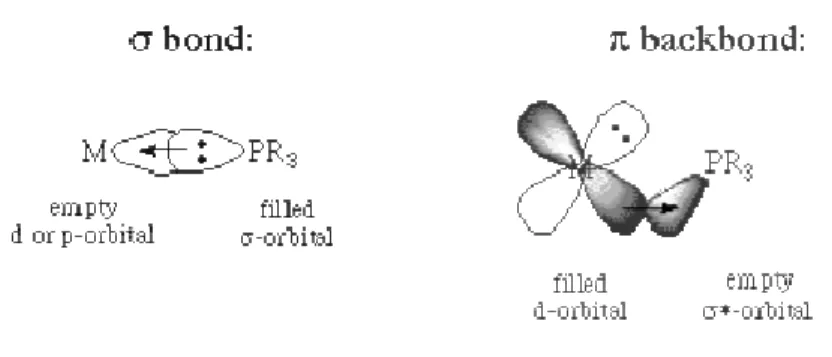
accelerated by utilizing a larger phosphine ligand. Likewise, if dissociation is a problem, then a smaller phosphine can be used. The bonding in phosphine ligands, like that of carbonyls can be thought of as having two
donation of the phosphine lone pair to an empty orbital on the metal. The second component is backdonation from a filled metal orbital to an empty orbital on the phosphine ligand (figure 1.2). This empty phosphorous orbital has been described as being either a d orbital or an antibonding sigma orbital; current consensus is that the latter is more
Figure 1.2 – Components of bonding in phosphine ligan
appropriate given the relatively high energy of a phosphorous d
withdrawing (electronegative) groups are placed on the phosphorous atom, the sigma donating capacity of the phosphine ligand tends to decrease. At the same time, the energy of the pi-acceptor (sigma-*) on phosphorous is lowered in energy, providing an increase in backbonding ability. Therefore, phosphines can exhibit a range of sigma donor and pi acceptor capabilities, and the electronic properties of a metal centre can be tuned by th substitution of electronically different but isosteric phosphines.
where R = alkyl, aryl, H, halide etc., and are neutral two electron donors that bind to transition metals through their lone pairs. A variety of chiral phosphine transition metal
reported in the literature;8 these
phosphine-stereogenic and can function as stereospecific catalysts. Phosphines are easy to synthesise and are considered as excellent ligands for transition metals. As a consequence, the steric attributes of the phosphine ligand are easily controlled. This ability to control the bulk of the ligand permits one to tune the reactivity of the metal complex. For example, if the dissociation of a phosphine ligand is the first step in a reaction, the reaction can be accelerated by utilizing a larger phosphine ligand. Likewise, if dissociation is a problem, then a smaller phosphine can be used. The bonding in phosphine ligands, like that of carbonyls can be thought of as having two important components. The primary component is sigma donation of the phosphine lone pair to an empty orbital on the metal. The second component is backdonation from a filled metal orbital to an empty orbital on the phosphine empty phosphorous orbital has been described as being either a d antibonding sigma orbital; current consensus is that the latter is more
Components of bonding in phosphine ligands.
given the relatively high energy of a phosphorous d
withdrawing (electronegative) groups are placed on the phosphorous atom, the sigma donating capacity of the phosphine ligand tends to decrease. At the same time, the energy
*) on phosphorous is lowered in energy, providing an increase in backbonding ability. Therefore, phosphines can exhibit a range of sigma donor and pi acceptor capabilities, and the electronic properties of a metal centre can be tuned by th substitution of electronically different but isosteric phosphines.
where R = alkyl, aryl, H, halide etc., and are neutral two electron donors that bind to transition metals through their lone pairs. A variety of chiral phosphine transition metal -metal complexes are stereogenic and can function as stereospecific catalysts. Phosphines are easy to synthesise consequence, the steric attributes of the phosphine ligand are easily controlled. This ability to control the bulk of the ligand permits one to tune the reactivity of the metal complex. For example, if the ep in a reaction, the reaction can be accelerated by utilizing a larger phosphine ligand. Likewise, if dissociation is a problem, then a smaller phosphine can be used. The bonding in phosphine ligands, like that of carbonyls important components. The primary component is sigma donation of the phosphine lone pair to an empty orbital on the metal. The second component is backdonation from a filled metal orbital to an empty orbital on the phosphine empty phosphorous orbital has been described as being either a d-antibonding sigma orbital; current consensus is that the latter is more
given the relatively high energy of a phosphorous d-orbital. As electron-withdrawing (electronegative) groups are placed on the phosphorous atom, the sigma-donating capacity of the phosphine ligand tends to decrease. At the same time, the energy
*) on phosphorous is lowered in energy, providing an increase in backbonding ability. Therefore, phosphines can exhibit a range of sigma donor and pi-acceptor capabilities, and the electronic properties of a metal centre can be tuned by the
Besides the coordinate phosphines, a third coordination position still available in the piano-stool complexes can be filled with halides. Indeed, halide ions are among the most common ligands found on transition metal catalysts and most of the available catalysts or pre-catalysts that can be found in the market are halo-complexes.9 Halides play the role of spectator or ancillary ligands in transition metal ligand-substitution reactions. Since most of the reactions with halo-complexes involve the removal of halides from the coordination sphere and replacement with weakly coordinating anions, halide ligands are often regarded as being of limited importance. Although, through a wise choice of the ancillary ligands it is often possible to alter the steric and electronic properties (influence both reactivity and selectivity) of the metal and therefore influence the course of many catalytic reactions.
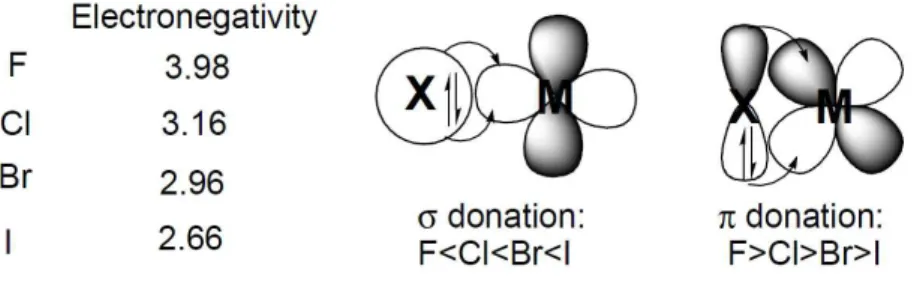
In reactions where the halide is cis to the reaction, the relative size of the halide can influence the easiness of the process. For example, as the steric bulk of a ligand increases, oxidative addition process can be slowed while reductive elimination may be favoured as means of reducing the steric interactions. The steric bulk of halide ligands increase down the group in terms of ionic radii, covalent radii, and cone angle. On the other hand, electronegativity increases up the group. Due to this electronegativity profile and availability of the s electrons, the ability to form σ bonds increases down the group (figure 1.3). In the
Figure 1.3 – Electronic properties of halide ligands.
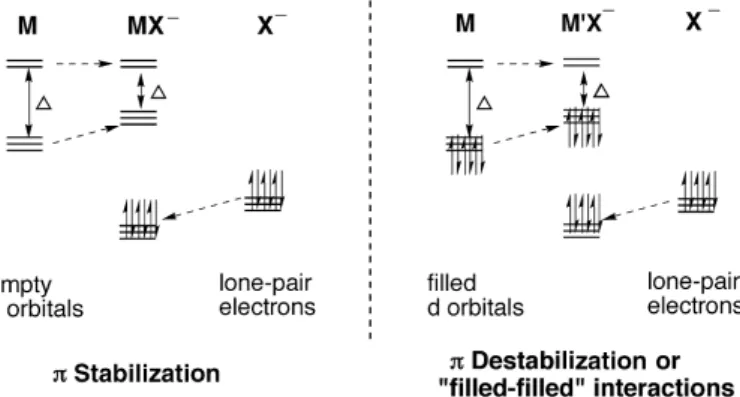
absence of other interactions, iodide is expected to form the strongest bonds and donate the most electron density to the metal. This is rarely the case, however, since π interactions commonly occur between the halide lone-pair electrons and the metal d orbitals. When π interactions predominate, the opposite trend in electron donation to that predicted by electronegativity can be observed, and fluorine is the strongest π donor. π interactions occur when there is a metal orbital of appropriate symmetry available to interact with halide lone
pairs. If this orbital is empty, a net stabilization can result. If the d orbital is fully occupied, a net destabilization termed “filled-filled” interactions will occur (figure 1.4).
Figure 1.4 – Stabilization and destabilization arising from molecular orbital interactions for an octahedral coordination geometry.
Another halide feature that should be mentioned is the polarizability. Halides relative polizaribility or softness is expected to increase down the group. It can be expected that as a transition metal becomes softer in character it will increasingly prefer to bind the heavier halides (other ligands present in the complex can influence this trend). Transition metals will become softer in character as its oxidation state is lowered, the further down the group it lies, and the further to the right in the transition metal series it is found.
1.3 Ligand Effects in Catalysis
Arene ruthenium complexes were shown to be catalytically active in hydrogenation, transfer-hydrogenation, Diels-Alder reactions, olefin metathesis, olefin cyclopropanation,
atom-transfer radical polymerisation and kinetic resolutions.5 In most cases, the ruthenium catalyst precursor possesses a hydrocarbon η6-arene ligand with nitrogen or phosphorus donor ligands. In general, the catalytic activities and selectivity are good and are strongly affected by the nature of the arene ligand.10 In most cases the mechanism of these catalytic reactions remains a debatable point, and the role of the arene ligand is unclear. For instance, in the transfer hydrogenation of ketones, the arene moiety is assumed to be a spectator ligand, while for olefin metathesis and atom-transfer radical polymerisation, the catalytic activity results from arene displacement. Therefore, in some cases it is crucial to form a
robust molecular arene ruthenium catalyst to avoid arene exchange, while in other cases arene displacement is an essential step in the catalytic cycle.
Arene ruthenium compounds were employed as catalysts in asymmetric synthesis. The three-legged piano-stool complexes with three different ligands possess metal-centred chirality and some research groups are using the arene ligand to introduce a second element of chirality, thus giving rise to diastereoisomers instead of enantiomers which are difficult to resolve. The first strategy is to use planar chirality as a second element of chirality while the second possibility is to introduce an enantiomerically pure auxiliary group tethered to the arene ligand.
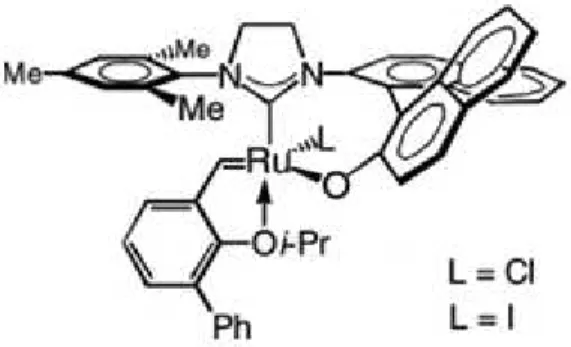
Apart from the aromatic ring, also halides have been reported as playing a significant role in some catalytic reactions. For example, D. Gillingham et. al. reported that the ruthenium iodide complex shown in figure 1.5 promotes ring-opening metathesis with significantly higher asymmetric induction than the chloride analogue, although being less active.11 They attempted the reaction with the chiral iodide complex depicted in figure 1.5 in order to obtain higher optical purity, what came to be true. They were inspired by a disclosure by Grubbs who reported that addition of NaI to a solution of a chiral Ru-dichloride phosphine complex in certain cases leads to enhancement in enantioselectivity of ringclosing metathesis.
Figure 1.5 – Ruthenium complexes with different catalytic effects.
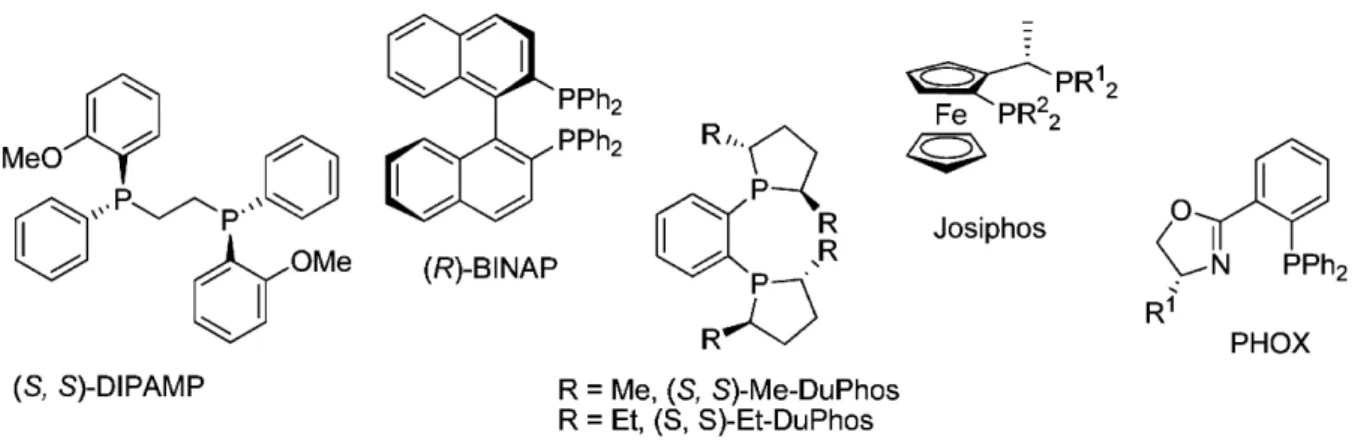
Phosphine ligands complexes of late transition metals have been widely used in almost every kind of C–H, C–C, and C–X bond-forming reactions, most notably asymmetric hydrogenation (Ru, Rh, Ir) and palladium catalysed processes.12 Many of the phosphine ligands developed for hydrogenation reactions also generate high selectivity over a broad
canvas of mechanistic unrelated reactions, and were subsequently termed as “privileged” ligands (figure 1.6). This has stimulated further development of ligands that contain similar structure elements.
Figure 1.6 – “Privileged” phosphine ligands in catalysis.
1.4 Ruthenium catalysts and Ruthenium Catalysed Reactions
Ruthenium has been playing a crucial role in catalysis. It is a widely used metal centre for catalytic complexes, employed in many different types of catalytic reactions at small and industrial scales. The reason for this is the large number of advantages that this metal presents. Since it has 4d75s1 electron configuration, it has the widest scope of oxidation states of all elements of the periodic table, varying from -2 in complexes like Ru(CO)42- to +8
in, for example, RuO4, and each of these oxidation states has a preferred coordination
geometry, like trigonal-bipyramidal or octahedral for Ru(0), (II) and (III) respectively.13 Ruthenium complexes have a variety of useful characteristics including high electron transfer ability, high Lewis acidity, low redox potentials and stabilities of reactive metallic species such as oxometals, metallacycles, and metal carbene complexes. Since many of them are air and moisture stable, they can be prepared easily at ambient conditions, frequently using RuCl3⋅nH2O as the starting material. Thus, a large number of novel, useful reactions
have begun to be developed using both stoichiometric and catalytic amounts of ruthenium complexes.
Ruthenium complexes have increased their importance in organic synthesis over the years. They have been used in reduction, oxidation, isomerisation and carbon-carbon bond formation. Some examples of reduction and oxidation reactions are shown bellow.
In reductions, ruthenium complexes have been used successfully in hydrogenations employing or not molecular hydrogen. Low-valent ruthenium complexes are excellent catalysts for these reactions because of their low redox potential and higher affinity toward heteroatom compounds. Ru-BINAP complexes serve as efficient catalysts for the asymmetric hydrogen transfer reactions of α,β-unsaturated carboxylic acids with formic acid (scheme 1.1). Combined use of ruthenium complexes with chiral amine ligands is proven to be highly effective for enantioselective synthesis.
Scheme 1.1 – Enantioselective synthesis employing a ruthenium catalyst with a chiral ligand.
Ruthenium complexes have also been successfully employed in oxidations. One of the typical oxidations is the transformation of primary alcohols to the corresponding esters (scheme 1.2). These reactions are initiated by the oxidative addition of O-H bond of alcohols to low-valent ruthenium complexes and the subsequent β-hydrogen elimination.
Scheme 1.2 – Oxidation of an alcohol to an ester employing a ruthenium catalyst.
Low-valent ruthenium complexes also catalyze the oxidation of alcohols and the related hydroxy compounds in combination with various oxidants such as t-BuOOH, AcOOH, H2O2
Scheme 1.3 – Oxidation of an alcohol employing a ruthenium catalyst and an oxidant.
1.5 Reactions of Interest for this Project
The target catalytic reactions of this project are transfer hydrogenations and redox neutral alkylations. These reactions are of great interest to the pharmaceutical industry and to the chemical industry in general because they allow: the obtainment of compounds otherwise not possible to obtain synthetically; an easiest (cheaper) way to obtain compounds already available in the market; and, on the other hand, they are considered as “green” technology since, usually, the by-products are harmless to the environment (e. g. water).
All the reactions that are being considered have several features in common, like all of them use similar transition metal catalysts composed by the metal and coordinating ligands and all of them proceed, in principle, through hydrogenations/dehydrogenations of ketones-alcohols, imines-amines or both, without the use of molecular hydrogen.14 These reactions are known as transfer hydrogenations where hydrogen atoms are transferred between an organic substrate and a hydrogen acceptor or donor. This occurs upon coordination of these molecules to the metal catalysts employed and they can proceed through different pathways. Bäckvall and co-workers2 conclude that for transition metals, routes involving the formation of a hydride intermediate are by far the most common. In some of these reactions, hydride intermediates have already been isolated.
Transfer hydrogenation using alcohol as the hydrogen source is a convenient method to reduce ketones and imines because of the simplicity in experimental aspects. In this project were studied the reductive transfer hydrogenation of acetophenone and aldehyde. The advantages of hydrogen transfer over other methods of hydrogenation comprise the use of readily available hydrogen donors such as isopropanol, the very mild reaction conditions, and the high selectivity15 (scheme 1.4).
Scheme 1.4 – Hydrogenation and transfer hydrogenation of carbonyl compounds using either the formic acid/triethylamine or isopropanol as hydrogen source.
In fact, isopropanol has been widely used in transfer hydrogenations. Employment of this solvent which is not toxic and is easy to handle requires an excess of alcohol to shift the
equilibrium to the desired product.16 This alcohol has been chosen instead of primary
alcohols like ethanol or methanol since it has a more favourable redox potential. Furthermore, the aldehydes resulting from primary alcohols are susceptible in basic media to deprotonation of the hydrogens of the α-CH group which leads to aldol condensation and
may also undergo decarbonylation reactions with deactivation of the catalysts.15 It is
well-documented that the presence of a strong base as a cocatalyst enhances the rate of these
reactions.17
Hydrogen transfer reactions have been used together with other reactions. Due to their reversibility, they have been exploited extensively in racemisation reactions in
combination with kinetic resolutions of racemic alcohols.15 This resulted in the so called
dynamic kinetic resolutions, kinetic resolutions of 100% yield of the desired enantiopure
compound. Hydrogen transfer reactions were also incorporated in reactions called redox neutral alkylations which were also studied in this project and are described later.
The interest over transfer hydrogenations has increased over time. The fact that contributed the most to this was the application of this methodology together with chiral catalysts in the dehydrogenation of prochiral ketones which allowed the obtainment of alcohols in high enantiopure form. This transformation is known as asymmetric transfer
hydrogenation (ATH) and has recently been the subject of intense study by a number of groups worldwide.18 It is among the most important transformations to prepare alcohols in high enantiopure form from ketones (scheme 1.5). Among small chiral molecules, chiral alcohols occupy a central place in the synthesis of pharmaceuticals, flavour, aroma and agricultural chemicals, and speciality materials.19
Scheme 1.5 – General scheme for the asymmetric transfer hydrogenation of ketones using isopropanol as hydrogen donor. The resulting by-product is a molecule of acetone.
The major contribution to ATH was provided by Noyori et. al.,20 who reported highly active and robust Ru(II) catalysts based on complexes of monotosylated diamines and amino alcohols in the decade of 90. Generally, the reaction rate and the enantioselectivity are dependent on the electronic properties of the substituents on the aromatic ring as well as the steric environment of the carbonyl group21. It has also been reported that reactions proceed faster with electron-withdrawing groups in the substrates, and this has been explained in terms of molecular orbitals, with lower LUMO values giving faster reactions.22, 23 Since ATH is an operational simple and versatile reaction, it has become one of the best reduction systems for both academia and industry.18
Redox neutral alkylations or N-alkylations are reactions that convert primary amines into secondary or tertiary amines using alcohols as alkylating agents.24 Amines are of significant importance for the bulk and fine chemical industry as building blocks for polymers, dyes, but also for the synthesis of new pharmaceuticals and agrochemicals.25 Previous methodology used alkyl halides as alkylating agent but it can give rise to poly-alkylation products and is unpleasant for the environment because alkyl halides can be toxic and generate wasteful salts as by-products.26 Another well-known method which has been developed as the most useful tool in the synthesis of various amines is the reductive amination of aldehydes and ketones. But, because it requires the use of strong reducing
agents or dangerous hydrogen gas, is not the best one to follow. Also this method is not always selective for monoalkylation of primary amines. The N-alkylation of amines with alcohols proceeds via a hydrogen borrowing strategy24 (scheme 1.6). This strategy combines the advantages of transfer hydrogenation with additional transformations. The hydrogen donor compound is not a waste compound such as isopropanol. Initially the alcohol borrows the hydroxilic proton to the catalyst and forms a carbonyl compound (oxidation by transfer hydrogenation), then the carbonyl compound reacts with the primary amine to give an imine, which is then converted to the final amine by reductive amination with the hydrogens borrowed by the alcohol through the catalyst.
The alkylation of amines by alcohol occurs with loss of water and has been proved to be a thermodynamically favored process where the loss of a C-O bond for a C-N bond is compensated by the gain of an O-H bond for an N-H bond.1
Scheme 1.6 – Borrowing Hydrogen Strategy in the alkylation of amines with alcohols.27
The first homogeneous catalysts for N-alkylation of amines with alcohols were introduced by Grigg et. al.28and Watanabe et. al.29in the early 1980s. Grigg and co-workers described the N-alkylation of primary and secondary alkyl amines with primary alcohols such as methanol or ethanol with the rhodium catalyst [RhH(PPh3)4] being the most active.
Watanable and co-workers reported the ruthenium-catalyzed N-alkylation of aniline with primary alcohols with [RuCl2(PPh3)3]. There have been several ruthenium30-33 and iridium34-36
catalysts reported subsequently. Many of these catalysts require forcing conditions which prevents their use with sensitive substrates. However, Yamaguchi and co-workers26 have
already employed milder conditions with Cp*IrCl2 as well as Beller‘s group using Ru3(CO)12
with bulky phosphines.37
The most active catalysts for these reactions have been proved to be those of iridium, like [Ir(COD)Cl]2 (COD = cyclooctadiene) or [Cp*IrI2]2, but ruthenium has also been
used due to more accessible costs.6
Recently, J. Williams et. al.24 have reported a high efficient in situ ruthenium catalyst
consisting of [Ru(p-cymene)Cl2]2 and dppf for the N-alkylation of amines with primary
alcohols. The reaction conditions are relatively mild and applicable to the alkylation of aryl aminesas well as cyclic aliphatic amines such as pyrrolidine (scheme 1.7)1, 24.
Scheme 1.7 – Ruthenium-catalyzed N-alkylation of amines with primary alcohols by J. Williams et. al. showing the reaction yields.1
As seen, N-allkylation is a very attractive method because (1) the overall reaction is atom efficient consuming all of the starting material; (2) it does not generate harmful by-products (only H2O) and (3) alcohols are environmentally benign as well as more readily
available than corresponding halides or carbonyl compounds in many cases.26, 27 Although these reactions have been frequently applied, there is no catalytic method available for functionalized and sensitive substrates (alcohols and amines) under milder conditions (<100 ˚C). It was because of this fact that this project was carried out in order to look for more active catalysts which allow a broader substrate scope.
1.6 Mechanistic Features Common to the Reactions of Interest
Several studies have been carried out in order to understand the mechanistic pathway in hydrogen transfer reactions. The reactions mentioned before use transition

![Figure 2.1 – 1 H NMR spectra of [RuCl 2 (p-cymene)] 2 (1), [RuI 2 (p-cymene)] 2 (2) and [RuBr 2 (p-cymene)] 2](https://thumb-eu.123doks.com/thumbv2/123dok_br/15208510.1019107/43.892.132.804.640.1053/figure-nmr-spectra-rucl-cymene-cymene-rubr-cymene.webp)
![Table 2.1 – 1 H NMR chemical shift assignment of [RuCl 2 (p-cymene)] 2 (1).](https://thumb-eu.123doks.com/thumbv2/123dok_br/15208510.1019107/44.892.155.784.431.573/table-h-nmr-chemical-shift-assignment-rucl-cymene.webp)
![Figure 2.3 – Labelled diagram of [RuCl(dppf)(p-cymene)]SbF 6 (4) for NMR purposes.](https://thumb-eu.123doks.com/thumbv2/123dok_br/15208510.1019107/47.892.229.700.462.890/figure-labelled-diagram-rucl-dppf-cymene-sbf-purposes.webp)
![Table 2.2 – 1 H and 13 C{ 1 H} NMR chemical shift assignment of [RuCl(dppf)(p-cymene)]SbF 6 (4) in (CD 3 ) 2 CO](https://thumb-eu.123doks.com/thumbv2/123dok_br/15208510.1019107/48.892.121.782.163.631/table-nmr-chemical-shift-assignment-rucl-dppf-cymene.webp)
