WEB X.0 TOOLS IN TEACHING-LEARNING: IMPLEMENTATION
AND EVALUATION OF MODEL VALIDATION
Nuno Miguel Cardoso Peixoto
1, Sónia Rolland Sobral
21
ISVOUGA – Instituto Superior de Entre o Douro e Vouga, Vila da Feira, Portugal
2Universidade Portucalense Infante D. Henrique, Porto, Portugal
Abstract
With the massification use of the Internet and its Web X.0 tools, teaching methodologies need to adapt to this new reality. Current student’s belongs to the new information society, dominated by digital technologies, need to be constantly connected to the world's largest information network, inside and outside of the learning context. This forces teachers to create more attractive and exciting methodologies so that students will be motivated and willing to learn. With this article we intend to put into practice a model validation web X.0 tools for teaching and learning, analyzed, designed and developed by the authors in previous investigations.
The implementation and evaluation of the model was based on the study of two separate cases, both performed by the author. In the first study, the target population consisted of 22 graduates of a modality of education and training for active life. In this study the reference training was in the area of education and training of computer sciences, with the process of education and training for installation and operation of computer systems, Level 2. The unit training that allowed to evaluate the model was computer architecture with a duration of 50h.
The second case study had the participation of 20 trainees from one modality of education and training for active life, whose reference training is in the area of education and training of trade. In this study, the process of education and training of technical / commercial Level 4. And the training unit that allowed us to assess the model was the English language with a duration of 50h. The purpose of the two case studies was to use a different methodology, never before used by trainers using web tools X.0 previously assessed by the model for the transmission of the content of the training reference.
The methodological approach used in this research is characterized by an explanatory purpose of the case study, with data collection procedures performed through two questionnaires. An initial questionnaire assessing knowledge and another Final evaluation of satisfaction, and the sources of information was quantitative.
As a final analysis of two case studies it is concluded that trainees positively rate experience and they learned the content more enjoyable way. Regarding the purpose of the study, it was found that the transmission of content implied a greater effort of the trainers, as they had to restructure sessions depending on the Web X.0 tools used. However, every effort was rewarded as the learning outcomes were great. Noted a greater commitment and motivation among learners, reaching these better results in the evaluation. The tools choice occurred through the appropriate model are reflected in the final for the satisfaction of trainees and their positive results. This study proved to be a contribution to the use of the model choosing the web X.0 tool for transmitting syllabus traditionally complicated modules to assimilate and understand, as has been the case with hardware and Business English.
As future implications for learning, we suggest the use of the model in other modular activities as a way of consolidating the study and allow the teacher to assess the degree of functionality of web tools X.0. Since many times these same tools are used by students outside the classroom context, enabling the use of them in learning a more efficient and enjoyable way for students. Keywords: Model; web tools; education; learning; training; validation
1 INTRODUCTION
The daily use of the internet has brought about profound changes either in how individuals access to information and knowledge and at the level of communication processes between students and between students and teachers [1].
The world's largest computer network is expanding, visible in the constant emergence of new web tools for collaboration, transformation, creation and sharing of content [2]. This evolution of the Internet enhances the connectivity of people and consequently the sharing of ideas and the collaborative creation of new forms of knowledge and learning [3].
This new concept of collaborative learning reformulates the traditional model of knowledge transmission, enabling greater communication and iteration among all members of the academic community, enhancing the construction of knowledge that is reflected in the earnings of all stakeholders [4]. Teachers cannot assume a passive role, waiting for the outcome of these events, but rather must recognize that the use of technology by students is a reality that must be placed at the service of pedagogy [5], forcing them to rethink their strategies and teaching methodologies.
Stakeholders from the education process changed radically and is not now the same students that the educational system was designed to teach [6], making web tools X.0 integral part of the evolution and growth of the internet process, these assume themselves as a strong alternative to teachers to create more attractive and exciting new methodologies where students feel motivated and willing to learn.
With this article we intended to put in place a model validation web X.0 tools in teaching and learning, analyzed, designed and developed by the authors in previous investigations [7] [8] [9]. The implementation and evaluation of the model is described in two case studies where different methodologies, never before used by trainers, using web tools X.0 previously assessed by the model for the transmission of the content of the training reference were used to. The two case studies were conducted with graduates of a modality of education and training for active life over 50h were confronted with these activities where the use of web tools were dominant part in the transmission of educational content. The research methodology, documentation of the entire project, the final conclusions and future considerations are explained in this article.
2 RESEARCH METHODOLOGY
2.1 Research question
According to Luc Van Campenhoudt and Raymond Quivy, you should seek state the research project as a starting question, through which the researcher tries to express as exactly as possible what you need to know, clarify, understand better [10].
Thus, to fit the correct methodology to study is necessary to identify the starting question, this study tried to find the answer to the following research question: - The use of the model will contribute to the most appropriate choice of tools Web X.0 in transmission of certain pedagogical content?
To clarify the previous question, materialized the following objectives of this study:
- Analyze the impact of the transmission of content with and without recourse to the use of web X.0 tools
- Identify the perception of trainees to understand the content was facilitated using the web X.0t ools
2.2 Characterization of the adopted methodology
Defined the main research question and the study objectives, the methodological approach to be used will be characterized by the explanatory purpose of the analysis of the two cases observed, enabling coordination between the various sources of information and fostering a deeper understanding of the phenomenon in study [11].
Techniques considered in the data collection procedure were made through two questionnaires. An initial questionnaire assessing knowledge and another Final evaluation of satisfaction. The sources of information was quantitative. This method is based on gathering observable and quantifiable data, the observation of facts, events and phenomena that occur independently of the investigator [12], a quantitative methodology based on the positivist model, studying the phenomena through observation and experimentation, quantifying the reality [13]. The two case studies will allow detailed observation of contexts and specific events [14] and according to the objectives of the present study, quantitative research is that better fits as it enables look for the development, validation and generalization knowledge.
3
RESEARCH
PROJECT
3.1 Structure of the project
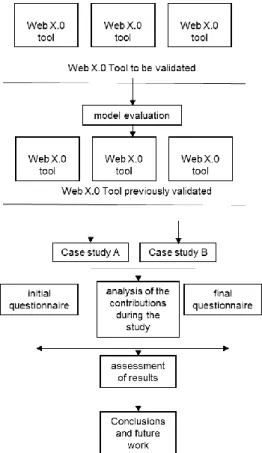
Initially we selected six web X.0 tools, candidates for evaluation of the model and subsequently used during the studies. With the evaluation of the model are chosen web tools that demonstrated higher degree of functionality for the transmission of educational content intended by the trainers. Analysis of the contributions throughout the project are assessed by two questionnaires, an initial assessment of knowledge and another end of satisfaction evaluation after evaluation of the results the study conclusions are made and future considerations, this whole project structure is planned in Fig.1.
3.2 Case Study
3.2.1 Sample characterization
The two studies fit in the context of training in the form of active life, or for young adults, subsidized or not, registered unemployed in the Employment Services of the Institute of Employment and Vocational Training (IEFP), regardless of educational qualifications. This modality is intended to make the adjustment between the Personal Employment Plans (EPP) and the potential and needs of each individual candidate, to improve their employability, claiming that it is also a way to maximize the return to the labor market through a rapid integration into shares of short-term training, allowing the acquisition of relevant skills, or enhancement of skills already held, providing, always, the continuity of the course qualification [15].
Both studies took place in the morning (08h00 - 13h00) from June 2 to June 19 with interruption on Saturdays and Sundays and on June 10, National (Day of Portugal, Camões and the Portuguese Communities [16], holiday).
In the first study (case Study A) the 22 graduates, 17 were female and five were male, the average age was between 22 and 64 years, which is 45 years, for the attainment average was between the 6th and the 12th year, and this year 8, Table 1 shows the average age and attainment by gender of the participants.
Number of trainees Age average Qualification average
Men 5 43 7º
Women 17 45 8º
Table 1 – Average ages and qualifications of graduates by gender (A).
In case study A, the reference training was in the area of education and training of computer sciences, with the process of education and training for installation and operation of computer systems, Level 2. The unit training (UF) that allowed us to assess was the model of computer architecture with a duration of 50h.
In the second study (Case Study B) of the 20 graduates, 11 were female and 9 male, the average age was between 21 and 55 years, which is 37 years, for the attainment average was between the 9th and the 12th year, and this year 10 table 2 shows the average age and attainment by gender of the participants.
Number of trainees Age average Qualification average
Men 9 39 10º
Women 11 35 10º
Table 2 – Average ages and qualifications of graduates by gender (B).
In case study B, the reference training was in the area of education and training of trade. In this study, the process of education and training of technical / commercial Level 4. The unit training that allowed us to assess the model was the English language - call with a duration of 50h.
3.2.2 Case Study A
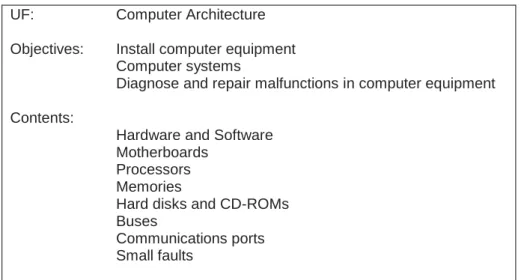
The syllabus of the UF Computer Architecture [17], table 3 (Simplified referential), consists of a theoretical part that although the total workload is not significant, but for graduates of technological nature that is a barrier to success and learning. For this reason and previous experiences where trainees demonstrated a certain reluctance to
learning of the theoretical content to boost sessions, it was decided to resort to the use of web X.0 tools.
UF: Computer Architecture Objectives: Install computer equipment
Computer systems
Diagnose and repair malfunctions in computer equipment Contents:
Hardware and Software Motherboards
Processors Memories
Hard disks and CD-ROMs Buses
Communications ports Small faults
Table 3 - Reference training (simplified) of Computer Architecture
To combat absenteeism in learning in this UF we select four web tools: three of sharing content (Youtube, Facebook and Google Drives / Google Docs) and one of research (Google). The choice of these tools became from the trainer and idealized by him for the transmission of theoretical content in which focused on viewing some videos on hardware and software and the development of a practical work using internet searches.
Evaluation of Model Validation Web X.0 Tools in Teaching and Learning, selected by the instructor for tools is documented in Table 4.
Youtube Facebook Google
Drives / Docs Google Communication (6%) Forum Chat Dialog 6% 6% 6% Learning Management (42%) Work glossary Questionnaire Wiki resources SCORM 21% 21% 35% 7% Evaluation (52%) Referendum Lesson Test Workshop 13% Functionality degree 𝒇(𝚾; 𝚩; 𝚼) 27% 27% 54% 7%
In the model evaluation, the tool with the highest degree of functionality was Google Drives / Docs, second Youtube and Facebook, and lastly Google. Starting from ideas designed by the trainer for the transmission of the contents of UF, he opted for Google Drives / Docs by Youtube. The first selected web X.0 tool was used to evaluate the assimilation of content using the tool as a way of disseminating and sharing the proposed work. This in addition to technical and initial exploratory observation finals held through online questionnaires that allowed comparing satisfaction, motivation and development of trainees. Youtube allowed to view short films about the Hardware and Software. Both tools have enabled not only compare the data obtained but also observe the evolution of learning of the syllabus.
In the first session, the students responded to an Initial Diagnosis of scouting knowledge that be addressed in this state and in particular about the web X.0 tools and their use in the transmission of the syllabus and other actions of its use by trainees. As this area of UF education and training of computer science, the questionnaire was put online on Google Drive, also opportunity for a first contact with this web tool.
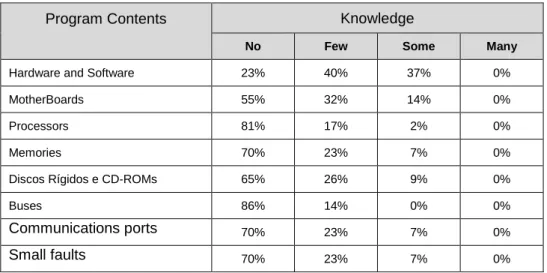
The questionnaire was organized in three parts, personal, complementary and related to the training data, this structured in a grid of knowledge evaluation, statistical data concerning the program content of UF are shown in table 5, the rest are presented following and it’s noted that all trainees said they were informed of the proposed framework.
Program Contents Knowledge
No Few Some Many
Hardware and Software 23% 40% 37% 0%
MotherBoards 55% 32% 14% 0%
Processors 81% 17% 2% 0%
Memories 70% 23% 7% 0%
Discos Rígidos e CD-ROMs 65% 26% 9% 0%
Buses 86% 14% 0% 0%
Communications ports 70% 23% 7% 0%
Small faults 70% 23% 7% 0%
Table 5 - Assessment of knowledge of the syllabus
Of the 22 graduates in the sample, over half (65%) reported not having any knowledge about the subject matter to be addressed by the educational content of UF, 25% have little knowledge and only 10% admitted to having a few, none of the respondents have assumed much knowledge. Expectations related to computer architecture are high (68%), with 27% and 41% are some and a lot, only 32% said not having any.
Regarding web X.0 tools and their use, all trainees said they had already worked with Youtube, Google, Wikipedia and Toad, only 86% worked with Facebook and Blogs, 45% with Google Drives / Docs, 14% with Moodle and Twitter, Secondlife was the only tool that never worked. In relation to its use in the transmission of the syllabus of UF, the majority (41%) found it interesting, 27% adequate, 5% and 27% not suitable without interest. As for its use in other actions by the trainees, 45% said they had ever used and 55% did not, who used (70% and 30%) found it interesting and adequate, none of them found uninteresting or inappropriate use.
The remaining activities along the UF were developed and redesigned based on the assumptions of the study objectives identified above. With the initial diagnosis was made known the programmatic content of UF, the proposed support this referential activities featured on the viewing short videos from Youtube and subsequent discussion at the end of each theme was proposed a little work on Google Drive as a form of continuous assessment of knowledge acquired. It is noteworthy that the use of web X.0 tools is merely descriptive, not being referred to the contents of which were used by not prove significant for the study in question, the ultimate statistical data obtained in the initial diagnosis and that are important and determinants for the completion of the study.
In the last session, students completed a Final Diagnosis evaluation of satisfaction regarding the syllabus and discussed the methodology used, as in the original questionnaire was placed online in Google Drive.
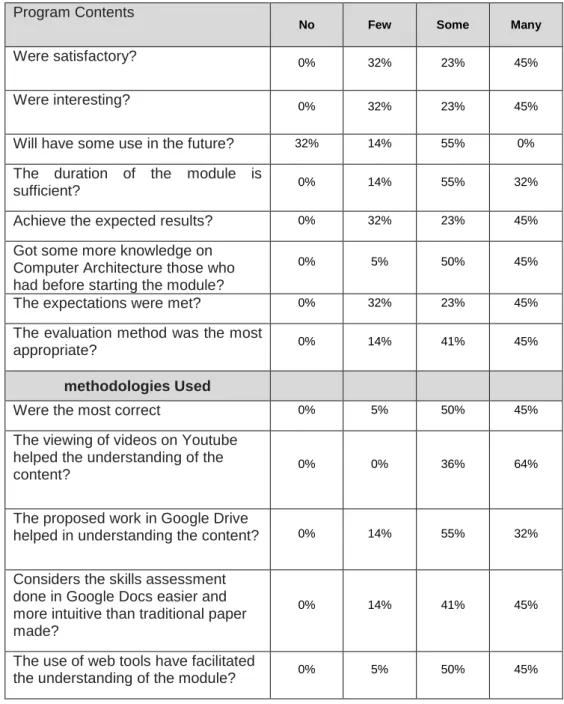
The questionnaire was organized this way in two parts, data regarding program content and data regarding the methodology used, both structured in a grid of evaluation of knowledge and represented in Table 6.
Program Contents
No Few Some Many
Were satisfactory? 0% 32% 23% 45%
Were interesting? 0% 32% 23% 45%
Will have some use in the future? 32% 14% 55% 0%
The duration of the module is
sufficient? 0% 14% 55% 32%
Achieve the expected results? 0% 32% 23% 45%
Got some more knowledge on Computer Architecture those who had before starting the module?
0% 5% 50% 45%
The expectations were met? 0% 32% 23% 45%
The evaluation method was the most
appropriate? 0% 14% 41% 45%
methodologies Used
Were the most correct 0% 5% 50% 45%
The viewing of videos on Youtube helped the understanding of the
content? 0% 0% 36% 64%
The proposed work in Google Drive
helped in understanding the content? 0% 14% 55% 32%
Considers the skills assessment done in Google Docs easier and more intuitive than traditional paper made?
0% 14% 41% 45%
The use of web tools have facilitated
the understanding of the module? 0% 5% 50% 45%
Table 6 - Evaluation of satisfaction of the syllabus and methodology
From 22 trainees in the sample relating to educational content and UF, more than half (74%) found satisfying, which includes 38% very and 36% some, only 4% and 22% nothing
unrewarding. The methodologies used, 93% is in agreement, with opinion split equally 46% by lot and some, only 7% and 0% was just nothing deal.
3.2.3 Study Case B
The syllabus of the UF English Language - Service [18], Table 7, uses a lot of technical listening, speaking, reading and writing in English language learning, content of care being
more complex to assimilate by their specific vocabulary and verbal communication. The English is not the mother tongue of learners and grammatically have some complexity, this UF is traditionally difficult to master. For this reason and previous experiences where learners demonstrated some difficulty in understanding and learning of the contents, to boost the sessions, it was decided to recourse to the use of web X.0 tools.
UF: English language - Service
Objectives: Apply specific vocabulary of the English language, verbal communication with
foreign customers during the service
contents:
Specific language applied to different stages of care, in oral and written aspects idioms
Table 7 - Reference English Language Training – Service
To combat the difficulties previously encountered, four web tools, three of sharing content (Youtube, Facebook and Google Drives / Google Docs), one research (Google) were selected. The choice of these tools came from the trainer and had to do with the idealized by him for the transmission of content in which UF focused on viewing some videos and the development of a practical work using internet searches.
By coincidence web tools selected by the trainer were the same as the previous study, so the assessment of Model Validation Tools Web X.0 in Teaching and Learning for the selected tools by the trainer refers to Table 4 previously analyzed. Starting from ideas designed by the trainer for the transmission of the contents of UF, in this case study opted for this web tool Google and Youtube.
The first web tool X.0 selected by the trainer not allowed to view films subtitled in English, enabling developing interpretation, production and interaction activities. Have the Google tool, served to elaborate research work proposed. Furthermore, being a non-UF technology area, the trainer opted to prepare the initial and final questionnaires in paper format. These two
diagnoses made possible not only compare the data obtained but also observe the evolution of learning of the syllabus.
In the first session, students completed the Initial Diagnosis scouting knowledge that iram be addressed in this state and in particular about the web X.0 tools and their use in the
transmission of the syllabus and other actions of its use by trainees.
The questionnaire was organized in three parts, personal, complementary and related to the training data, this structured in a grid of knowledge evaluation, statistical data concerning the program content of UF are shown in table 8, the remaining are presented following it is noted that all trainees said they were informed of the proposed framework.
Program Contents knowledge
No Few Some Many
Interpretation Listen 0% 15% 55% 30% Read 0% 50% 50% 0% Production Talk 0% 50% 50% 0% Write 0% 50% 50% 0% Interaction Listen 0% 15% 55% 30% Talk 0% 15% 55% 30% Write 0% 50% 50% 0% Customer
specific vocabulary 50% 45% 0% 5%
Verbal communication 50% 35% 0% 15%
Table 8 - Evaluation of knowledge of the syllabus
From the 20 graduates in the sample, 11% reported not having any knowledge about the subject matter to be addressed by the educational content of UF, 36% have little knowledge, most admitted having some knowledge of English (53%), and the remaining 12% have many. Expectations related to UF are high (85%), with 35% and 50% are some or a lot, only 15% have fewer.
Regarding web X.0 tools and their use, all trainees said they had already worked with Youtube, Google Blogs Toad and Wikipedia, 90% worked with Facebook, 85% with Google Drives / Docs, 70% with Twitter, 15% with Moodle, and only 5% with Secondlife. In relation to its use in the transmission of the syllabus of UF, the majority (55%) found it interesting and 47% adequate, anyone found not suitable or no interest. As for its use in other actions by the trainees, 75% said they had ever used and 25% did not, who used, 53% and 47% found it interesting adequate, none of them found uninteresting or inappropriate use.
The remaining activities along the UF were developed and redesigned based on the assumptions from study objectives identified above. With the initial diagnosis was made known the programmatic content of UF, the proposed support this referential activities featured on the viewing short videos from Youtube and subsequent discussion at the end of each theme was offered a job with little recourse to Google as a form of continuous assessment of knowledge acquired. It is noteworthy that the use of web X.0 tools is merely descriptive, not being referred to the contents of which were used by not prove significant for the study in question, the ultimate statistical data obtained in the initial diagnosis and that are important and determinants for the completion of the study.
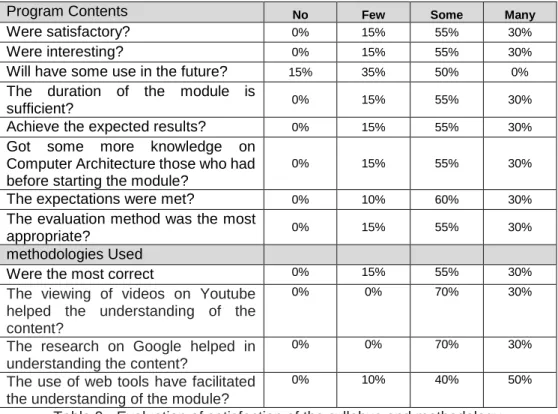
In the last session, students completed a Final Diagnosis evaluation of satisfaction regarding the syllabus and discussed the methodology used. The questionnaire was organized this way in two parts, data regarding program content and data regarding the methodology used, both structured in a grid of evaluation of knowledge and represented in Table 9.
Program Contents No Few Some Many
Were satisfactory? 0% 15% 55% 30%
Were interesting? 0% 15% 55% 30%
Will have some use in the future? 15% 35% 50% 0% The duration of the module is
sufficient? 0% 15% 55% 30%
Achieve the expected results? 0% 15% 55% 30%
Got some more knowledge on Computer Architecture those who had before starting the module?
0% 15% 55% 30%
The expectations were met? 0% 10% 60% 30%
The evaluation method was the most
appropriate? 0% 15% 55% 30%
methodologies Used
Were the most correct 0% 15% 55% 30%
The viewing of videos on Youtube helped the understanding of the content?
0% 0% 70% 30%
The research on Google helped in understanding the content?
0% 0% 70% 30%
The use of web tools have facilitated the understanding of the module?
0% 10% 40% 50%
Table 9 - Evaluation of satisfaction of the syllabus and methodology
found satisfying, 26% of which whose many and some 55%, only 2% and 17% nothing unrewarding. The methodologies used, 94% is in agreement, and of which 35% by lot and 59% some, only 6% and 0% was just nothing deal.
4 CONCLUSIONS
As a final analysis of two case studies it is concluded that trainees positively see the experience and they learned the content more enjoyable. Regarding the purpose of the study, it was found that the transmission of content implied a greater effort of the trainers, as they had to restructure sessions depending on the used tools Web X.0. However, every effort was rewarded as the learning outcomes were great. Noted a greater commitment and motivation among learners, reaching these better results in the evaluation. The choice of tools occurred through the appropriate model, reflecting the end the satisfaction of trainees and their positive results obtained in the case study A 74% found satisfying the use of web X.0 tools in understanding the content and in the case B 81%, values much above average.
This study proved to be a contribution to the use of the model in choosing the web X.0 tool for transmitting syllabus traditionally complicated modules to assimilate and understand, as has been the case with hardware and Business English.
5 FUTURE CONSIDERATIONS
As future implications for learning, we suggest the use of the model in other modular activities as a way of consolidating the study and allow the teacher to assess the degree of functionality of web X.0 tools. Since many times these same tools are used by students outside the classroom context, enabling the use of them in learning a more efficient and enjoyable way for students.
Referências
[1] G. Siemens, “Learning and Knowing in Networks: Changing roles for Educators and Designers,” ITFORUM, 2008. [Online]. Available: http://connectivism.ca/blog/2008/02/. [Accessed: 16-Sep-2014].
[2] S. Downes, “An Introduction to Connective Knowledge,” 2005. [Online]. Available: http://www.downes.ca/cgi-bin/page.cgi?post=33034. [Accessed: 16-Sep-2014]. [3] M. A. Chatti, M. Jarke, and D. Frosch-Wilke, “The future of e-learning: a shift to
knowledge networking and social software,” Int. J. Knowl. Learn., vol. Vol. 3, No, pp. 404–420, 2007.
[4] M. A. Chatti, “The future of e-learning: a shift to knowledge networking and social software,” FutureLab, p. 69, 2008.
[5] G. Solomon and L. Schrum, Web 2.0 – new tools, new schools, First Edit. International Society for Techonology in Education (ISTE), 2007, p. 260.
[6] M. Prensky, “Digital Natives, Digital Immigrants,” From On the Horizon - MCB University Press, Vol 9 No 5, 2001.
[7] N. Peixoto and S. Sobral, “Alicerces de Sustentabilidade de Parâmetros de Validação de Ferramentas Web X.0 no Ensino-Aprendizagem,” Aceite para publicação Revista do Departamento de Inovação Ciência e Tecnologia (DICT), 5, Porto, p. 13, 2014. [8] N. Peixoto and S. Sobral, “Parameters Validation Tools Web X.0 in Teaching and
Learning,” EDULEARN14, Barcelona Espanha, 2014. [Online]. Available:
http://iated.org/concrete3/paper_detail.php?paper_id=38440. [Accessed: 30-Sep-2014]. [9] N. Peixoto and S. Sobral, “Model Validation Tools Web X.0 in Teaching and Learning,”
18th International Conference on Circuits, Systems, Communications and Computers (CSCC2014), Santorini, Grécia, p. 6, 2014.
[10] L. Van Campenhoudt and R. Quivy, Manual de Investigação em Ciências Sociais. Gradiva Publicações, 2008, p. 276.
[11] R. K. Yin, Case Study Research: Design and Methods, vol. 3a Edição. Sage Publications, Inc., 2009, p. 220.
[12] M. F. Fortin, “O processo de investigação: da concepção à realização,” Lusociência, 1996.
[13] A. Latorre, D. Del Rincón, and J. Arnal, BASES METODOLÓGICAS DE LA INVESTIGACIÓN EDUCATIVA. Barcelona: Ediciones experiencia, 2003, p. 315. [14] R. Bogdan and S. Bilken, Investigação qualitativa em educação. 1994.
[15] Instituto do Emprego e Formação Profissional, “Vida Ativa,” 2014. [Online]. Available: https://www.iefp.pt/formacao-para-adultos. [Accessed: 19-Sep-2014].
[16] Calendarr, “Calendário - Dia de Portugal,” 2014. [Online]. Available:
http://www.calendarr.com/portugal/dia-de-portugal/. [Accessed: 19-Sep-2014]. [17] Agência Nacional para a Qualificação e Ensino Profissional, “Arquitetura de
Computadores,” Catálogo Nacional de Qualificações, 2008. [Online]. Available: http://www.catalogo.anqep.gov.pt/UFCD/Detalhe/735. [Accessed: 23-Sep-2014]. [18] Agência Nacional para a Qualificação e Ensino Profissional, “Língua inglesa -
Atendimento,” Catálogo Nacional de Qualificações, 2008. [Online]. Available: http://www.catalogo.anqep.gov.pt/UFCD/Detalhe/418. [Accessed: 23-Sep-2014].