João Pedro Gamito Taborda
Licenciado em Engenharia Informática e de Computadores
A Domain Specific Language for Domotic System
s
Dissertação para obtenção do Grau de Mestrado em Engenharia Informática
Setembro, 2014
Orientador: Vasco Amaral, Prof. Auxiliar, Universidade Nova de Lisboa
Co-orientador: Paulo Carreira, Prof. Auxiliar,Instituto Superior Técnico
Júri:
Presidente: Prof. Doutor Nuno Manuel Ribeiro Preguiça
Arguente: Prof. Doutor Fernando Manuel Pereira da Costa Brito e Abreu
i
A Domain Specific Language for Domotic Systems
© Copyright
João Pedro Gamito Taborda
ii
iv
A
CKNOWLEDGEMENTS
First and above all, I want to thank my soulmate for all the patience, dedication and support. Without her, it would have been much more difficult to write this document, since it was her perseverance that pushed me into doing more and better. Thank you Cátia for being always there, not only by your motivation, but also for all the opinions and useful comments on crucial moments of the thesis development.
To Prof. Dr. Vasco Amaral, who was a great advisor in several aspects of the work. His knowledge and guidance were essential for keeping the developing alive. I have appreciated very much all his opinions and directions, which significantly contributed for accomplishing the next stage. To Prof. Paulo Carreira, an appreciation note for organizing the meetings conducted at IST.
A very special word to my parents, who supported me through this period and sustained some absence in the more stressful moments.
vi
R
ESUMO
Seguindo as tendências de modernização, a necessidade de ter uma casa totalmente automatizada, tem sido um conceito que tem vindo a crescer ao longo dos anos à medida que a tecnologia evolui e as pessoas necessitam de soluções que lhes poupem tempo. Um sistema de automação fornece uma forma de simplificar algumas das rotinas diárias, permitindo-nos ter mais tempo livre para realizar actividades em que somos realmente necessários. Existem neste meio alguns sistemas que se destinam a este fim, mas este tipo de tecnologia ainda se encontra a dar os primeiros passos e portanto ainda está longe de fornecer ao utilizador o tão desejado controlo sobre uma habitação. A razão principal é que este tipo de sistemas não implementa alguns princípios importantes, tais como a adaptabilidade, a extensibilidade e a evolução.
Os sistemas mencionados, que são desenvolvidos usando uma abordagem ascendente, são mais adequados à utilização por parte de programadores e especialistas no domínio, descartando os utilizadores comuns aos quais apenas resta produtos difíceis de controlar ou com interfaces pouco flexíveis. Além disso, comportamentos mais complexos não são considerados, pois são bastante difíceis de implementar devido à necessidade de conjugar prioridades, conflitos e calibração dos dispositivos. Outra das desvantagens, é o facto de estas soluções só poderem ser adquiridas a um elevado custo, existindo ainda a limitação de serem de difícil configuração por pessoas que não são conhecedoras dos termos técnicos envolvidos, quando instalados e em funcionamento.
É por isso necessário criar uma ferramenta que permita sobretudo que o utilizador possa realizar as mais variadas acções no domínio da automação, sem que no entanto estas se tornem excessivamente complicadas. Também é desejável que essa ferramenta seja independente dos dispositivos, para que possa ser reutilizada, ou seja, que siga uma abordagem orientada a modelos (MDD). Uma vez que o domínio de automação tem alguns conceitos muito específicos, a utilização de modelos deverá ser aliada a uma linguagem específica de domínio (DSL), para que utilizadores desta área reconheçam facilmente os conceitos envolvidos. Através destes dois métodos, é possível criar uma solução que se encontra adaptada para o utilizador comum, mas que ao mesmo tempo possa ser utilizada por especialistas e programadores devido às várias camadas de abstracção que diminuem a complexidade de utilização.
O objectivo desta tese é a realização de uma linguagem específica de domínio (DSL) que utilize a abordagem de desenvolvimento por modelos (MDD), com a finalidade de suportar conceitos de automação doméstica. Nesta implementação, o desenvolvimento de cenários simples e complexos será uma das preocupações mais relevantes, sendo que o suporte a outro tipo de funcionalidades, como a possibilidade de agendamento de tarefas, será também tido em conta devido a ser uma funcionalidade limitada nas soluções actuais.
viii
A
BSTRACT
To cope with modernity, the interesting of having a fully automated house has been increasing over the years, as technology evolves and as our lives become more stressful and overloaded. An automation system provides a way to simplify some daily tasks, allowing us to have more spare time to perform activities where we are really needed. There are some systems in this domain that try to implement these characteristics, but this kind of technology is at its early stages of evolution being that it is still far away of empowering the user with the desired control over a habitation. The reason is that the mentioned systems miss some important features such as adaptability, extension and evolution.
These systems, developed from a bottom-up approach, are often tailored for programmers and domain experts, discarding most of the times the end users that remain with unfinished interfaces or products that they have difficulty to control. Moreover, complex behaviors are avoided, since they are extremely difficult to implement mostly due to the necessity of handling priorities, conflicts and device calibration. Besides, these solutions are only reachable at very high costs, yet they still have the limitation of being difficult to configure by non-technical people once in runtime operation.
As a result, it is necessary to create a tool that allows the execution of several automated actions, with an interface that is easy to use but at the same time supports all the main features of this domain. It is also desirable that this tool is independent of the hardware so it can be reused, thus a Model Driven Development approach (MDD) is the ideal option, as it is a method that follows those principles. Since the automation domain has some very specific concepts, the use of models should be combined with a Domain Specific Language (DSL). With these two methods, it is possible to create a solution that is adapted to the end users, but also to domain experts and programmers due to the several levels of abstraction that can be added to diminish the complexity of use.
The aim of this thesis is to design a Domain Specific Language (DSL) that uses the Model Driven Development approach (MDD), with the purpose of supporting Home Automation (HA) concepts. In this implementation, the development of simple and complex scenarios should be supported and will be one of the most important concerns. This DSL should also support other significant features in this domain, such as the ability to schedule tasks, which is something that is limited in the current existing solutions.
Keywords: Home Automation, Domotic, Automated systems, Automation scenarios, Domain Specific
x
C
ONTENTS
Acknowledgements ... iv
Resumo ... vi
Abstract ... viii
Contents ... x
List of Figures ...xiv
List of Tables ...xvi
List of Listings ... xviii
List of Acronyms and Abbreviations ...xx
1 Introduction ... 1
1.1 Motivation ... 2
1.2 Objectives and Problem statement ... 3
1.3 Solution overview ... 3
1.4 Expected contributions ... 4
1.5 Organization ... 4
2 Model Driven Development ... 5
2.1 Exploring MDD ... 5
2.2 MDD Benefits for Automation ... 6
3 State of the art ... 7
3.1 Commercial solutions for Home Automation ... 7
3.1.1 X10 ... 7
3.1.2 LonWorks ... 8
3.1.3 KNX/EIB ... 8
3.1.4 Custom solutions ... 9
3.1.5 Problems with commercial solutions ... 9
3.2 The standard languages for Automation ... 10
3.2.1 IEC 61131 ... 10
3.2.2 An MDD approach to the standard ... 11
3.3 MDD solutions for Home Automation ... 12
3.3.1 Domain Specific Languages ... 12
3.3.2 Languages for HA ... 13
xi
3.3.2.2 HAbitATION DSL ... 15
3.3.2.3 Potential for improvement ... 16
4 Technologies and formalisms ... 19
4.1 Automation formalism ... 19
4.1.1 Unified Modeling Language (UML) – State Diagrams ... 20
4.1.2 Petri nets ... 20
4.1.3 Usability comparison between State diagrams and Petri nets ... 21
4.2 Tools to develop the DSL ... 21
4.3 Modeling platforms for simulation ... 23
4.3.1 LabVIEW ... 25
4.3.2 Simulink ... 27
4.3.3 Comparison between LabVIEW and Simulink ... 28
4.4 Execution platform ... 29
5 DomATIC language framework ... 31
5.1 Domain Analysis ... 32
5.1.1 Understanding Home Automation ... 32
5.1.2 Sensors and Actuators ... 33
5.1.3 Personalize a behavior ... 33
5.1.4 Managing conflicts ... 34
5.1.5 Model definition ... 34
5.1.5.1 Feature Model ... 34
5.1.5.2 Domain Model ... 35
5.2 Design ... 35
5.2.1 Ecore and EMF Models ... 36
5.2.2 Concrete syntax ... 37
5.2.3 Well-formedness Rules ... 39
5.3 Implementation ... 41
5.3.1 Ecore and EMF Models ... 41
5.3.2 Well-formedness Rules ... 41
5.3.3 Code Generation ... 42
5.3.3.1 Simulation ... 42
5.3.3.2 Execution ... 47
5.3.4 Deployment ... 50
5.3.5 Tool layout ... 50
6 Language validation... 51
xii
6.2 Usability studies ... 52
6.2.1 Conducting the experience ... 53
6.2.2 Experience procedure ... 55
6.2.2.1 Presentation ... 56
6.2.2.2 Questionnaire ... 56
6.2.3 Results ... 57
6.2.3.1 Concrete syntax evaluation... 57
6.2.3.2 Comprehension of the tool ... 60
6.2.3.3 Readability ... 60
6.2.3.4 Problem solving ... 61
6.2.4 Threats to validity ... 62
6.2.5 Discussion ... 62
6.3 Comparison with other approaches ... 63
6.3.1 Case study ... 63
6.3.2 Comparison between DSLs ... 67
6.4 Discussion of the results ... 68
7 Conclusions ... 71
7.1 Contributions ... 71
7.2 Future work ... 72
8 References ... 73
9 Appendix... 77
9.1 Meetings with domain experts ... 77
9.1.1 Home Automation typical scenarios ... 77
9.1.1.1 Click dimmer ... 78
9.1.1.2 Occupancy sensor control ... 79
9.1.1.3 Daylight harvesting ... 79
9.1.1.4 Blind control ... 80
9.1.2 Concerns about the scenarios’ evolution ... 80
9.1.2.1 How important is the user? ... 80
9.1.2.2 Is there a need for a controller? ... 82
9.1.2.3 What is the impact of the user’s actions? ... 83
9.1.2.4 Is it possible to have scheduled actions? ... 84
9.1.2.5 Final conclusions ... 85
9.2 Heating room class diagram... 87
9.3 LabVIEW dashboard ... 88
xiii
9.4.1 Feature Model ... 89
9.4.2 Domain Model ... 90
9.5 Ecore diagram ... 91
9.6 EMF ... 92
9.7 EVL ... 97
9.8 EGL ... 103
9.8.1 Simulation code ... 103
9.8.2 Execution code ... 110
9.9 HAbitATION DSL ... 117
xiv
L
IST OF
F
IGURES
Figure 1 – Overview of the proposed solution ... 3
Figure 2 – Languages of the standard IEC 61131-3, taken from [18] ... 10
Figure 3 – The DSL implementation cycle ... 13
Figure 4 – DSLs for Home Automation, taken from [2](a), [35](b), [1](c) ... 14
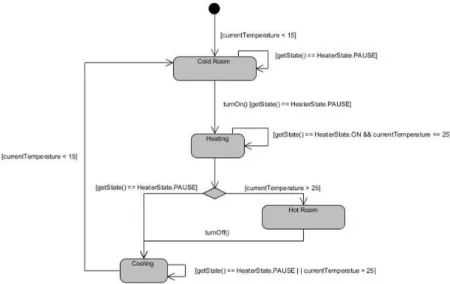
Figure 5 – State diagram of the Heating room scenario ... 20
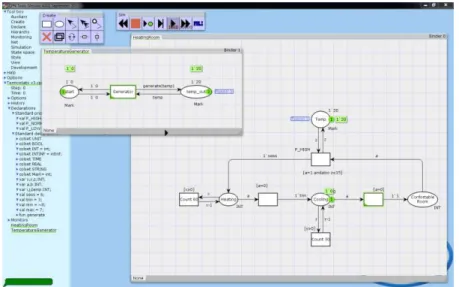
Figure 6 – Implementation of the Heating room scenario using Petri nets ... 21
Figure 7 – Epsilon's tools and languages overview ... 22
Figure 8 – Statechart that simulates the temperature sensor ... 25
Figure 9 – Statechart representing the heater ... 26
Figure 10 –Implementation of the transition’s guard ON->PAUSE condition ... 26
Figure 11 – Statechart representing the room controller ... 26
Figure 12 –Stateflow of the room’s states ... 27
Figure 13 – Stateflow of the heater ... 27
Figure 14 – General implementation on Simulink ... 27
Figure 15 – Domatica's implementation platform ... 29
Figure 16 – The DomATIC DSL detailed overview ... 31
Figure 17 – Example of a direct connection between a Sensor and an Actuator ... 33
Figure 18 – Example of a personalized control of an Actuator ... 34
Figure 19 – Example of the usage of a Decisor ... 34
Figure 20 – Definition of the StepUntilX class on Ecore ... 41
Figure 21 – Scheme of the EGL files for simulation ... 42
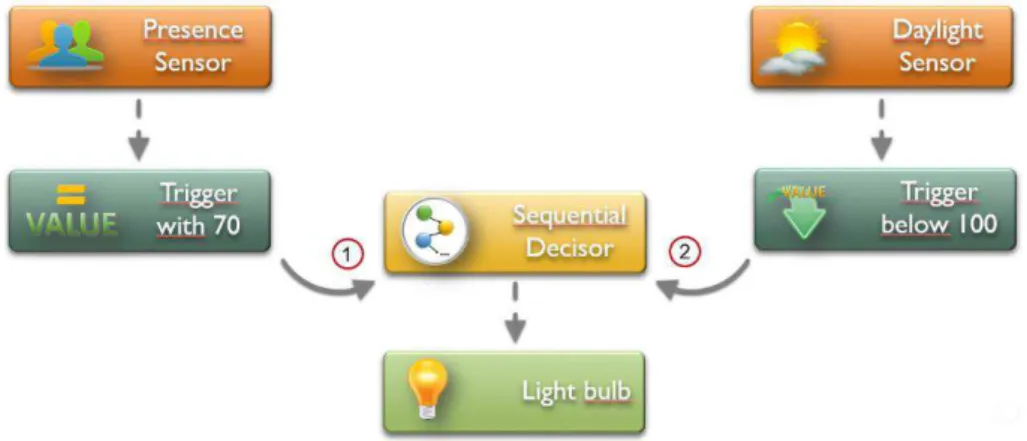
Figure 22 – Turn the light on with presence in DomATIC ... 44
Figure 23 – Turn the light on with presence in Simulink ... 44
Figure 24 – Scheme of the EGL files for execution ... 47
Figure 25 – Turn the light on with presence in DomATIC ... 48
Figure 26 – Layout of DomATIC ... 50
Figure 27 – Answers to the hardware prototyping experience of the users ... 54
Figure 28 – Answers about the experience with Simulation software ... 54
Figure 29 – Answers about the experience with Home Automation equipment ... 54
Figure 30 – Answers about the experience with Home Automation software ... 55
Figure 31 – General process for the DSL evaluation ... 56
Figure 32 – Graphic that represents the distribution of icons by category ... 58
Figure 33 – Participants' choices by icon ... 58
Figure 34 – Graphic that represents the readability results of Figure 1 of the questionnaire ... 60
Figure 35 – Graphic that represents the readability results of Figure 2 of the questionnaire ... 61
Figure 36 – A floor plant of a habitation with its Sensors and Actuators ... 64
Figure 37 – Garage sub-scenario implemented with HAbitATION ... 65
Figure 38 – Garage sub-scenario implemented with DomATIC ... 66
xv
Figure 40 – Living Room sub-scenario implemented with DomATIC ... 66
Figure 41 – Bedroom sub-scenario implemented with HAbitATION ... 67
Figure 42 – Bedroom sub-scenario implemented with DomATIC ... 67
Figure 43 – A possible room setup to be used in the scenarios ... 77
Figure 44 – Interaction between a sensor and an actuator ... 83
Figure 45 – Hierarchy of events in the system. More priority represented by the outside circle... 85
Figure 46 – Class diagram of the Heating room scenario ... 87
Figure 47 – Dashboard of the implementation in LabVIEW ... 88
Figure 48 – Feature Model ... 89
Figure 49 – Domain Model ... 90
Figure 50 – Ecore diagram of the DSL ... 91
Figure 51 – Catalogue of Services, taken from [36] ... 117
Figure 52 – Catalogue of Functional Units, taken from [36] ... 118
Figure 53 – Questionnaire, Part I, Page 1 ... 119
Figure 54 – Questionnaire, Part I, Page 2 ... 120
Figure 55 – Questionnaire, Part I, Page 3 ... 121
Figure 56 – Questionnaire, Part II, Page 1 ... 122
Figure 57 – Questionnaire, Part II, Page 2 ... 123
Figure 58 – Questionnaire, Part II, Page 3 ... 124
Figure 59 – Questionnaire, Part II, Page 4 ... 125
xvi
L
IST OF
T
ABLES
Table 1 – Commercial solutions' features against the concepts of Home Automation. ... 9
Table 2 – Comparison between Monaco and HAbitATION DSLs ... 17
Table 3 – Features supported by LabVIEW and Simulink ... 28
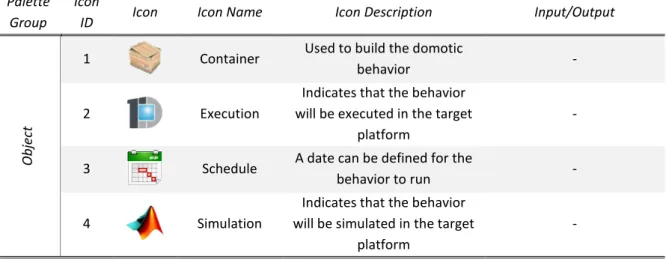
Table 4 – DSL icons with descriptions and how they work ... 37
Table 5 – Concerns of Home Automation covered by DomATIC in comparison with the previous DSLs ... 52
Table 6 – Participants' profile information ... 53
Table 7 – The concrete syntax icons considered poorly chosen ... 59
Table 8 – Answers about the capacity of the tool to perform two distinct behaviors ... 60
Table 9 – Summary of the results obtained from each task ... 61
Table 10 – Summary of the tasks execution by group ... 63
Table 11 – Element's positioning through the house ... 64
Table 12 – How A1 behaves when there is light outside ... 81
Table 13 – How A1 behaves when there is presence in the room ... 81
Table 14 – A1 behavior in response to S1 and S2 ... 81
Table 15 – A1 custom behavior in response to S1 and S2 ... 82
xviii
L
IST OF
L
ISTINGS
Listing 1 – Definition of the StepUntilX class on EMF ... 41
Listing 2 – The checkContainer EVL rule of the Container component ... 42
Listing 3 – The piece of code that generates the Light bulb ... 44
Listing 4 – The code necessary to generate the Presence Sensor ... 45
Listing 5 – The script generated for Simulink (does not correspond to the actual example) ... 46
Listing 6 – The XML code generated for iDom Framework ... 48
Listing 7 – Description of the metamodel concepts in the EMF file ... 92
Listing 8 – The well-formedness rules that constitute the EVL file ... 97
Listing 9 – Simulink_templates.egl... 103
Listing 10 – Simulink_Actuator_Generation.egl ... 106
Listing 11 – Script_Generation.egl ... 107
Listing 12 – Domatica_Sensor_Generation.egl ... 110
Listing 13 – Domatica_templates.egl ... 113
xx
L
IST OF
A
CRONYMS AND
A
BBREVIATIONS
AmI – Ambient Intelligence
DSL – Domain Specific Language
EGL – Epsilon Generation Language
EHS – European Home Systems Protocol
EIB – European Installation Bus
EMF – Eclipse Modeling Framework
EOL – Epsilon Object Language
ETL – Epsilon Transformation Language
EVL– Epsilon Validation Language
FBD – Function Block Diagram
GMF – Graphical Modeling Framework
GPL – General Purpose Language
GUI – Graphical User Interface
HA – Home Automation
IDE – Integrated Development Environment
IL – Instruction List
LD – Ladder Diagram
M2M – Model-to-model
M2T – Model-to-text
MARTE – Modeling and Analysis of Real-Time and Embedded Systems
MDD – Model Driven Development
OCL – Object Constraint Language
OMG – Object Management Group
PLC – Programmable Logic Controllers
xxi
RTES – Real-Time and Embedded Systems
SD – State diagrams
SFC – Sequential Function Chart
ST – Structured Text
1
1
I
NTRODUCTION
Home Automation (HA) has been lately within the focus of the general society’s interest, since the increasing proliferation of technology encourages people to automate several aspects of their daily life [1]. Such automation increases productivity, saves costs and even provides comfort to its users. However, several limitations have been hampering its wide adoption, namely, the cost of devices, lack of interoperability, and above all, the complexity of use and inadequate adaptation to non-technical people.
The perfect automated house, is generally idealized as a system that adapts itself to the users’ behavior and, when needed, interacts with them. That house would be composed by several devices that should provide a high degree of comfort, security and energy savings [1][2], since the aim of a HA
system is to “improve the quality of life of its inhabitants” [1]. In order to provide the best comfort,
the house should create the perfect room atmosphere accordingly to the users’ needs; the security is
achieved through warnings about devices that are on and could represent a risk; for energy saving, the house would be smart enough to turn off certain devices when they are not required. However, there is a need to make the necessary trade-offs between the inhabitants’ desires, the waste of energy and the generation of alerts about energy consumption [3][4]. Regrettably, the present technology cannot yet provide an affordable system like the one mentioned, but a path can be drawn towards it.
Introduction 1.1 Motivation
2
Despite the fact that those systems could be a solution to some people, one of the main problems in HA is the lack of consensus around a standard [1]. This fact leads to the problems that this area currently suffers, because it means that each company creates its own environment to program the devices, and once a user chooses a technology, all the devices that he acquires should be compatible with a specifc protocol created by that company for the comunication between devices.
1.1
M
OTIVATION
The development of HA applications is, nowadays, strongly platform dependent. With this in mind, one can be aware that the available solutions do not have the adaptation desired in this field, which is a limiting factor when we need to develop scenarios with great complexity. A possible way to solve this dependency and lack of flexibility is by introducing abstraction layers and promote the reuse of components in a systematic way. The Model Driven Development (MDD) methodology is a possible approach to achieve the desired degree of independency [6]. This method, splits up the specification of a system's functionality from the implementation of that functionality on a specific platform [7]. This means that with MDD, the code is generated from platform-independent models and one does not need to worry about implementation details, such as the platforms supported or the programming techniques used [2], which are properly treated at the different levels of abstraction.
To be effectively used on HA, the MDD approach should be combined with Domain Specific Languages (DSL) that are optimized to handle specific problems in a certain domain. This type of combination
provides an abstraction layer that will be used to isolate the system’s design from its implementation
details, which allows a separation of concerns that offers more flexibility to the designer of the HA system.
Since there still not exists a complete solution that handles the emergent problems in the HA domain, a DSL is a possible way to define a language that can be flexible enough to define complex behaviors, which are not supported by the technology that currently exists [8]. In HA there are two types of devices, the sensors that are meant to be aware of the environment’s occurrences and the actuators
that perform specific actions in response to the sensors’ activation.
A simple behavior could be defined as a situation where there is only a sensor and an actuator, and when the sensor is triggered, the actuator reacts. This type of behavior is currently supported by the systems previously mentioned, as the action has a straightforward execution. The problem lies in complex behavior, that is composed by more devices, and with more devices comes greater complexity.
A complex behavior is a situation where are several devices involved, for example, an actuator and two sensors that are connected to that actuator. A possible scenario is to consider the actuator as a light bulb and the sensors as a presence sensor and as a daylight sensor. The first sensor turns the light on, if there is someone in the room and the other, turns the light on if the light outside is scarce. The question is what happens if it is dark outside and there is no one in the room. The light should be off because there is no presence or should be on because it is night time?
There is no ideal answer to the question above, because it depends on the user’s decision. This means
Chapter 1
Introduction 1.2 Objectives and Problem statement
3
feature that have to be present in a system that is said to be automated, because the possibility to define a set of actions to run at a pre-defined time is a basic characteristic.
In a HA system, the complexity increases with the number of devices in that system, with the number of relations between them [2] and with the amount of functionalities it offers. To manage the connection between devices and the conflicts at the same time, the DSL choice stands as an effective possibility, since it can represent the elements in a graphical way, which increases the expressiveness and the usability that other solutions do not deliver. With a DSL, it is also possible to built complex behaviors, as its creation depends on the tools and the way the language is defined.
1.2
O
BJECTIVES AND
P
ROBLEM STATEMENT
The main goal of this thesis is to design a DSL for the development of HA systems that follows the MDD methodology. This DSL aims to be a language where the users can develop the desired automated behaviors, without having to be concerned about the platform or the devices. The ease of use and the bounding between elements, will be a point where a major effort is justified, since this DSL is intended to be used by non-programmers [9], so the research question is:
Is it possible to define a usable DSL for Home Automation that is able to deal with complex behaviors and devices’ conflicts? Additionally, can we schedule those behaviors to be active at a
specific time?
1.3
S
OLUTION OVERVIEW
To answer the research question, the Figure 1 was created and represents a possible solution.
Introduction 1.4 Expected contributions
4
In Figure 1, is possible to see the steps that will be followed towards the implementation of the DSL. In the DSL layer, there are several members of the DSL and some transformations between them. The DSL concrete syntax, should suffer a semantic verification to assess if the produced behavior is well-formed. To be deployed to the specific platforms, there is a model translation to the models of the platforms used. From those models, there is a model to text transformation that will produce text to be deployed into the chosen platforms.
1.4
E
XPECTED CONTRIBUTIONS
With this thesis and all the research work involved, we expect to contribute with the following:
State of the art about the available HA platforms;
A scenario catalogue to be used as a benchmark;
A DSL designed for the HA domain that is scalable in complexity, which has been validated by real users.
1.5
O
RGANIZATION
The remainder of this thesis is structured as follows:
Model Driven Development (Chapter 2) – Has a brief explanation about the more relevant concepts in the domain of HA.
State of the Art (Chapter 3) – Represents an overview about the work that has been made in the context of the HA domain.
Technologies and formalisms (Chapter 4) – The technologies and formalisms that were explored in order to implement the solution.
DomATIC Languge Framework (Chapter 5) – Details all the steps necessary to implement the DomATIC DSL.
Language Validation (Chapter 6) – All the steps that were followed to conduct the validation of the language.
Conclusions (Chapter 7) – The conclusion about the performed work, which includes the contributions and the future work.
References (Chapter 8) – The references used through this document.
5
2
M
ODEL
D
RIVEN
D
EVELOPMENT
Model Driven Development (MDD) is a methodology where models are the main object of the development process [10][11][12]. A model is a simpler representation of reality or, in other words, an abstraction of certain aspects of the real world [13]. The MDD approach is based on having several models on different layers of abstraction that are used to describe the system [14].
2.1
E
XPLORING
MDD
Each of the models is written in a specific language and they are transformed into another models of the same system. There are some examples of these transformations, like model-to-model (M2M) and model-to-text (M2T) [13]. The first one is used to make the translation between models of the same system, which makes them fully compatible [15]. M2T is used to convert the model into a textual representation of it and also to generate the code for a target platform, which will reproduce the created behavior [16].
The great advantage of this method lies in the fact that different aspects of the system can be represented with different models, which means that the system will have models in distinct levels of abstraction [14]. This not only contributes to a better understanding of the system itself, but also
provides a separation of concerns of the system’s functionality and its implementation on a specific
platform [6][17].
To implement a language based on MDD it is important to understand the different elements that compose its description [17][12]:
1. Abstract syntax – The concepts that inspired the creation of the models;
2. Concrete syntax – The specification of the previous concepts with concrete definition; 3. Static semantics (well-formedness rules) – Rules that establish if the concepts are being used
correctly;
4. Dynamic semantics (behavior semantics) – Description about what a model means in terms of real world concepts.
Model Driven Development 2.2 MDD Benefits for Automation
6
2.2
MDD
B
ENEFITS FOR
A
UTOMATION
In the previous section some hints about the benefits and advantages of MDD in the domain of automation were mentioned, which will be explained and summarized in this section.
The main benefit is the abstraction introduced by MDD [2][16]. Since it is a method based on models, each one of them can represent different parts of a system which provides several independent units. This means that a system can be modeled using different layers that represent distinct views of it [18][19]. Another advantage is the increase in productivity, because it is easier to implement separate parts of a problem, instead of taking the problem as a whole.
MDD also has the advantage to have reduced time to market, as it is a solution that can generate code faster. Besides this, models are the basis of MDD, having aspects of the real world represented in a simpler way. This fact makes them understandable by non-programmers, which is translated into an effective cost reduction, since specialists are not needed [13].
Regarding quality, it is proved that MDD leads to increased quality and it is much less error-prone than other solutions [20]. This obviously depends on the engine that does the conversion that should follow a correct-by-construction method, in other words, only correct executions can be defined. This is the aspect that should have more development time associated, to successfully support several types of model constructions without errors [9].
Chapter 3
State of the art 3.1 Commercial solutions for Home Automation
7
3
S
TATE OF THE ART
In this chapter there is an overview of the existing solutions which purpose is to solve problems in the Home Automation domain. The first section considers the most known commercial solutions that are currently being used. The section that follows describes the solutions based on the standard of automation IEC61131. The last section, comprises the most successful solutions based on the MDD methodology that share the characteristic of being domain specific.
3.1
C
OMMERCIAL SOLUTIONS FOR
H
OME
A
UTOMATION
One of the main reasons to do this thesis, is the absence of solutions in the domain of Home Automation (HA) that are platform independent. There are some commercial proposals that only work with specific devices compatible with specific protocols, and there are other platform independent proposals based on Model Driven Development (MDD). In this section, the commercial approaches will be explored to provide some outline about their attributes.
The solutions that are platform specific are commercial DSLs or custom home-made solutions. The most known are KNX/EIB1, LonWorks2 and X103, but there are also custom solutions that are based on
prototyping platforms like Arduino4 or RaspberryPI5.
3.1.1
X10
The X10 uses a communication protocol that is mostly used in medium houses and it is easy to install and configure. This protocol uses the Power Line Carrier (PLC) to send data and control the devices, which means that it takes the existing household electrical wiring as a form of communication for the devices. The data is sent at pulses of 120 KHz by 1 millisecond with a certain
1 http://www.knx.org/
2 http://www.echelon.com/technology/lonworks/ 3 http://www.eurox10.com/
State of the art 3.1 Commercial solutions for Home Automation
8
codification, which is composed by the address of the device and a command. The specific frequency signal and the address of the device, are the main information needed to send commands that reaches the devices compatible with this protocol [21].
The great advantage of X10 is also its great limitation. The fact that this protocol relies on PLC to communicate is error prone, because the electrical wiring is not stable. There could be signal attenuation, random signals (noise), electrical oscillation and all types of signal breaks. Additionally, an X10 system is not programmable, just configurable. In other words, it is easier for a user with less knowledge to use it, but if someone wants to further explore some functionalities or change a certain behavior, it cannot be done.
3.1.2
LonWorks
LonWorks is based on a network used to control not only buildings, but also to control small objects [22]. The communication protocol is called LonTalk and it is based in the OSI model (ISO/IEC 7498-1). There are two main components in a LonWorks network:
Neurons– They must be present in each of the devices that are to be used in the LonWorks network, since they contain the entire LonTalk protocol stack. Neurons can be considered like a complete system, because they are comprised of CPU, memory, I/O, communications port, firmware and operating system;
Transceivers– Devices that have a transmitter and a receiver. Their function is to connect the Neurons to the type of media that the user wants, like radio frequency (RF).
To implement a LonWorks network, one needs to acquire at least a device compatible with LonTalk protocol (a device with Neurons) and a Transceiver [23]. These two types of devices are expensive and there is another extra cost with the software needed to configure them. This means that the cost to develop LonWorks applications is higher than most of the commercial systems that exist, in terms of device cost and learning curve, since it is recommended to have some sort of training [22].
3.1.3
KNX/EIB
The European Installation Bus (EIB) is a system that provides the management and the control of electric devices in a building. It uses the electrical bus in the building, so the devices can send commands within that space. This system was later integrated in the Konnex (KNX) association, alongside other previous standards, like European Home Systems Protocol (EHS) and BâtiBUS.
The KNX/EIB is now a standardized protocol (EN 50090 and ISO/IEC 14543) that is fully compatible with the mentioned systems. It is a distributed system that does not require a main controller and all the devices connected to the data bus have their own microprocessor [24]. It supports many communication protocols besides the ones that are used in the electrical bus, like RF and Ethernet, and because of that, this is the most used protocol in Europe.
Chapter 3
State of the art 3.1 Commercial solutions for Home Automation
9
3.1.4
Custom solutions
Some experienced users reject the use of packaged solutions like the ones mentioned in the previous sub-sections, since they want to have more control above the system. Those, are users that use prototyping platforms that consist in a board with a microprocessor that is programmable, or at least, can execute instructions. A tiny device like this has the power to be the core of an HA system, since it can manage communication between the sensors and the actuators. The most known platforms are Arduino and RaspberryPI and their popularity has been increasing, since they are cheaper than a computer and easier to develop on.
These devices do not stand as a viable solution for non-programmers, because of the complexity when there is the need to create a HA system that has the characteristics mentioned in the previous chapters.
3.1.5
Problems with commercial solutions
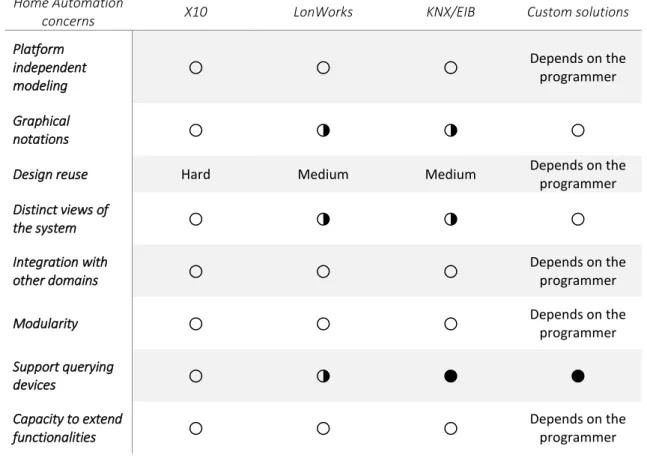
In this section, we have examined the most common solutions that are available nowadays. The presented solutions provide a way to control some elements in a house, but they do not offer an approach that allows to control the house as an integrated system. This means that the controlled components do not make part of an organized structure, since they are treated as individual parts.
The problem stated above, prevents the creation of more complex behaviors that are not possible to be defined when using the proprietary software that controls the devices. Also, the software is meant to be used by programmers or experts in the specific device, which excludes the end-users.
Table 1 – Commercial solutions' features against the concepts of Home Automation.
(● - Full implementation; ◑ - Partial implementation; ○- Not supported)
Home Automation
concerns X10 LonWorks KNX/EIB Custom solutions
Platform independent
modeling
○
○
○
Depends on the programmer
Graphical
notations
○
◑
◑
○
Design reuse Hard Medium Medium Depends on the programmer
Distinct views of
the system
○
◑
◑
○
Integration with
other domains
○
○
○
Depends on the programmer
Modularity
○
○
○
Depends on theprogrammer
Support querying
devices
○
◑
●
●
Capacity to extend
functionalities
○
○
○
State of the art 3.2 The standard languages for Automation
10
From theTable 1, there are several facts that are important to examine. The first one is the lack of independence between the platform dependent approaches and the devices they control. In the case of X10, there are not any separation between the platform and the devices, since this was the first platform created. LonWorks and KNX/EIB are really similar, but they are also very constrained by their proprietary connection to the devices. The custom solutions are very
dependent of the programmer’s choices, which could be simpler or more complex. Additionally,
as one can observe, those solutions do not follow almost any of the concepts of the HA domain.
A platform independent approach based on a DSL is the adequate solution to a HA system, because it supports the main concerns in this domain. This type of DSL does not require specific devices with proprietary protocols and offers the possibility to easily extend its functionalities, since it can work using modules that it combines. Moreover, it supports graphical interfaces that are appropriate for an intuitive use and reuse of previously defined systems. It can also have different views of the system, which makes it adaptable for most of people, being experts or non-experts.
3.2
T
HE STANDARD LANGUAGES FOR
A
UTOMATION
There are some solutions that are inspired in the automation standard IEC 61131 [25] to solve the problems in the automation domain that the devices presented in the Section 3.1 are not capable to surpass. This standard is a general framework for all Programmable Logic Controllers (PLC), so they can incorporate mechanical, electrical and logical aspects [26].
3.2.1
IEC 61131
The framework is composed by a group of five programming languages used to develop software for PLCs. Those languages, represented in Figure 2, are as follows [18][19]:
Figure 2 – Languages of the standard IEC 61131-3, taken from [18]
Chapter 3
State of the art 3.2 The standard languages for Automation
11
Ladder Diagram (LD) – Like FBD, it is another graphical language, but this one was inspired on the field of electromechanical relay systems. It is used to describe how the power flows through the network, since its representation is based on circuit diagrams;
Instruction List (IL) – It is a textual programming language that resembles assembly, since it is low-level and based on instructions. It works as an intermediate language to which the other languages are translated to;
Structured Text (ST) – It is another textual language like IL with a different purpose, because this one is treated as a high-level language. ST does not have machine oriented operators like IL and has a set of compound programming statements, which makes it comparable to PASCAL or C;
Sequential Function Chart (SFC) – It is a language that is both graphical and textual and it is used to divide a complex problem in smaller units. These units are programmed in the other languages of the standard, which means that SFC is used as a manager of communication between languages. SFC is not a programming language per se, because it is not possible to create a program with it only, however, it simplifies some aspects of the program. This language is based on a methodology of some well-known paradigms, like Petri-nets and state machines.
3.2.2
An MDD approach to the standard
With these presented languages, there was the need to have a way to associate them together. The point of this association is to avoid inconsistencies between the vendors and also to promote reusability [16][27]. There are two authors that try to achieve this through a MDD approach whose work is worth mentioning.
In [25], the authors try to apply the MDD approach to the automation standard IEC 61131 and IEC 61499, to assess if it is possible to make use of the reusable potential of the MDD approach. To do this, they developed an example that was called the Sorting Machine. The goal is to compare both techniques, using the current design methods and using a new modeling process based on MDD.
The conclusion was that using the current methods makes the generated code extremely hard to reuse. There is no separation between the logic and the implementation, which is reinforced with the lack of a clear place where the software logic ends and the hardware begins. The way they found to work around this problem was to map MDD to the standards, so they could have a concrete separation between the elements involved. This makes the reuse of components more clear and flexible for future applications and makes easier to identify the places where someone can implement specific modules.
State of the art 3.3 MDD solutions for Home Automation
12
As one could see, the MDD is being used in the automation field, specifically when dealing with the automation standard IEC 61131, because of the several advantages it provides. The abstraction layers have a huge importance when using this approach, since they potentiate the separation of concerns between the software and the hardware. This separation provides more variability in the hardware choices, since it is not necessary to pick only a specific vendor. Alongside this, the top layers do not need to be attached to hardware concepts, allowing constructions much more abstract and user oriented.
3.3
MDD
SOLUTIONS FOR
H
OME
A
UTOMATION
The MDD solutions mentioned in the Section 3.2are more oriented towards automation in general, while the commercial solutions shown in the Section 3.1 represent products that are used in the current industry. In the first one, we have the MDD approach to control the devices and in the second we have the companies that produce the devices. With those two information, there is the need to research about solutions that make usage of the MDD methodology to control the previously mentioned automation devices. We have seen that this approach is beneficial in many aspects of this domain, so those benefits would be the same for the sub-domains of automation.
The focus of this thesis is Home Automation (HA), which is a sub-domain of automation. A system of this domain has the control of devices at home and offers the possibility of defining programmed actions when certain events occur [28], meaning that the benefits of MDD previously mentioned can be applied. Generally, HA systems have a graphical interface that offers an intuitive usage to consumers that are not experts in this domain, and could also give the possibility to control the devices remotely [29].
The concept of a HA system goes beyond the simple device control, since nowadays, the main concerns are the comfort, the security and the energy savings [30]. A system should provide to its user the possibility to reduce the time spent doing a task; a way to monitor and prevent misfortunes within the house and also minimize the equipment energy consumption [31].
The difference between automation in general and HA, is that in HA we are addressing a particular domain that has elements specifically used there. To manage those elements, it is needed an additional abstraction layer that consists in a Domain Specific Language (DSL) to handle problems restricted to HA.
3.3.1
Domain Specific Languages
A Domain Specific Language (DSL) is a type of programming modeling language that is designed specifically for a domain. Opposing to a General-purpose Language (GPL) that is intended to be applicable across domains, a DSL is focused to express terms in the domain of the problem instead of terms of the computational solution. DSLs have emphasis on usability concerns, represent domain concepts and are used to raise the abstraction level [6][7].
Chapter 3
State of the art 3.3 MDD solutions for Home Automation
13
conclusions to make and they will be the starting point of the DSL next step, which is review all the steps knowing the results of the experiment [32][33].
From the above points, we can see that this process is an iterative one, since to be flawless, a DSL must be redesigned several times (Figure 3).
Figure 3 – The DSL implementation cycle
DSLs are becoming a concept with great importance in software engineering, since nowadays people want specific solutions for their needs, aiming to increase their productivity. With the increasing demanding for DSLs, the tools to develop them are improving as well, which means that is even easier to build a DSL.
In the particular case of HA, a DSL can be used to ease the implementation of a solution for this domain, as the Section 3.3.2 shows.
3.3.2
Languages for HA
There are some solutions for the HA domain, where the authors suggest the combination of the MDD methodology with DSLs.
For a general implementation of a DSL for HA, the work presented in [34] was considered, which consists in a case-study based on a smart home. In this example, Vöelter is focused in the two first steps of the development of a DSL (defined in Section 3.3.1), namely, the domain analysis and the definition of the metamodel. This work is purely anecdotal, because there is not an actually implementation of the DSL, however it is still interesting to study, since it presents in detail two of the first main steps.
State of the art 3.3 MDD solutions for Home Automation
14
Figure 4 – DSLs for Home Automation, taken from [2](a), [35](b), [1](c)
In the publication of Clemente, P., et al. [2], he follows practically the same steps as Vöelter. Their DSL is focused in HA and Ambient Intelligence (AmI) systems, and their approach also has a metamodel as basis. From the metamodel they make model transformations to create a systems’ back-end and front-end. The system is graphically represented by the DSL and it was developed to support the addition of more devices. The interest of this work lies in the usage of MDD methodology, the development of a DSL for HA purposes and also in the model transformations. The implementation is not fully functional and just tackles “the complexity of these kind of systems,
facilitating the specific domain elements and the rules required to model these systems” [2].
While the previous work is focused in testing what is the impact of the MDD methodology with DSLs, the next one presents the Monaco language [35]. The main purpose of it, is to develop a way to simplify the programming of automation devices, so it can be accessible to domain experts and end users.
Chapter 3
State of the art 3.3 MDD solutions for Home Automation
15
the implementation of a DSL for HA. While the focus of the Monaco language is to simplify the programming of automation devices, the goal of HAbitATION DSL is to provide a way for the domain experts to control the devices without programming them.
The opinion issued by each one of these authors is unanimous about DSLs. They help to raise the abstraction level to a point that it makes easier to manage a system and also for non-specialized people to build their own. Graphical DSLs are recommended, since they have a substantial gain in expressiveness and ease of use, even for people that do not have many experience in the use of personal computers for technical purposes. Other benefits of DSLs include the reduced time-to-market and their maintainability [37], which is a valuable point in the context of HA.
However, there are some problems when one is implementing a DSL for HA. The analysis of this domain is hard to perform and there is not a wide choice of tools to develop a DSL. To be successful, a DSL for HA has to be very clear about the aspects of the domain and how the results of the domain analysis can be used in the DSL design and implementation.
Both the Monaco and HAbitATION languages provide the most interesting work around the combination of MDD and DSLs. For this reason, it is important to analyze in more detail each of them, to study the techniques used and to identify the aspects that can be improved.
3.3.2.1
Monaco DSL
As mentioned before, this language aims to provide an easier way to program automation devices. To do this, the authors made an effort to keep the language simple, so it could be used by domain experts and end users [35].
This language is similar to Statecharts (Section 4.1.1) in terms of expressiveness, but it adopts an imperative notation, like procedural abstraction, synchronous procedure calls and high-level language syntax. The other features offered by this language are its asynchronous event handling mechanism, the hierarchical component and communication architecture and the static nature of its programs.
Although they claim it to be adequate for end users, the authors did not make any type of test that supports this statement. The language has a strong influence of the Statechart formalism, which contains programming concepts that are not appropriate to be used by non-technical people [38]. Despite this, the developed approach can be interesting to be used by domain experts at a level where they need to control some aspects of the hardware in a more abstract way.
3.3.2.2
HAbitATION DSL
The HAbitATION language is a well-developed example of the usage of DSLs in the HA domain. In this work, Buendía has followed all the steps required to make a DSL, beginning with an extensive analysis of this domain.
First of all, it is important to explain how he structured his solution. For Manuel Buendía, the devices are called Functional Units and they have parameters which define their behavior. To connect a Functional Unit to another, there are Services that can be the same for different Functional Units [36].
State of the art 3.3 MDD solutions for Home Automation
16
has two main groups: Passive Units and Controllers. Passive units are Sensors and Actuators. Controllers are elements that require some programming logic to implement a certain behavior.
Another relevant feature is the creation of Scenes, which are sequence of events that are triggered in order. Scenes are meant to aggregate a sequence of events allowing the user to reuse them as needed.
The solution of this author has also the support for different views of the system. He distinguishes between a view where the user can define the parameters of the Functional Units and a view where it is possible to identify the distribution of the Functional Units through the house.
The HAbitATION DSL represents a significant step towards the control of automation devices. However, the author identified some problems with his approach [1]. The first one is the overlapping effect that can occur when two opposite behaviors coexist. He solves this problem by classifying the devices by requirements, which is a vital task that is done manually by language experts and, therefore, error-prone. The other problem is the lack of a method to test the defined behavior without deploying it to the target platform. The author admits that a simulation platform/animator is something that could be extremely useful to validate the models beforehand.
3.3.2.3
Potential for improvement
Taking into account the two last languages detailed in the Section 3.3.2, one could see that they represent two distinct ways of controlling automation devices. The Monaco language is more oriented towards programmers and domain experts that are proficient in programming. Alternatively, HAbitATION is meant to be used also by domain experts, but they do not need to know about programming to control the devices. In both of the DSLs there is room for improvement, which does not mean that they are not valid languages. In fact, if the two of them are combined and some particular flaws are corrected, we eventually end up with a solution that is adapted to technical people, domain experts and possibly end users all together.
We have seen that the HAbitATION had the problem of not having a simulation platform to validate the models. On the other hand, the Monaco language provides a Statechart-like approach that proved to be appropriate to illustrate how devices work. Additionally, HabitATION is more oriented for domain experts only, due to the overlapping effect (Section 3.3.2.2), which is only avoided manually by the users of the DSL, who have to be specialists in the domain.
Chapter 3
State of the art 3.3 MDD solutions for Home Automation
17
Table 2 – Comparison between Monaco and HAbitATION DSLs
(● - Full implementation; ◑ - Partial implementation; ○- Not supported)
Concerns Monaco HAbitATION
HA concepts
●
●
Model reuse
◑
●
Graphical notations
◑
●
End-user oriented
○
●
Well-formedness rules
validation
○
○
Behavior simulation
○
○
Behavior deployment
●
●
State of the art 3.3 MDD solutions for Home Automation
19
4
T
ECHNOLOGIES AND FORMALISMS
In this chapter there is a discussion of the tools that can support the implementation of the DSL. There is the need to choose an adequate automation formalism that can support HA concepts. On the other hand, in order to implement the actual language, a set of tools are required to provide a GUI and the logic behind it; a simulation platform to evaluate the created behavior; an execution platform to test the behaviors in real life.
4.1
A
UTOMATION FORMALISM
The DSL that will be developed, requires a strong support model that should specify all the features that needs to be expressed, such as behaviors, conflicts, decisions and other concerns. Therefore, the chosen visual modeling formalism should provide a way to describe all the features needed in the HA domain.
The following scenario will be used throughout the following subsections, as a common denominator for the technologies:
Heating room Scenario
Sensor: Temperature sensor
Actuator: Heater
Description
Technologies and formalisms 4.1 Automation formalism
20
There is, however, a characteristic in this particular heater. It can only work for a while (e.g. a straight hour), and then it enters in a pause mode (e.g. thirty minutes) to cool down, even if the room has not reached the Comfortable state.
4.1.1
Unified Modeling Language (UML)
–
State Diagrams
UML is a general-purpose language that is widely used for the design of software systems [39]. This language is not domain specific, since it provides a syntax that is used to model all kinds of systems. To offer more specific tools, UML has profiles that are designated for a particular domain, like class structure, state based behavior or deployment [9]. However, these profiles are still general-purpose, since they just address a specific software domain and not an element specific domain.
To serve as basis for implementation of the State diagram, a Class diagram was created ( Appendix, Section 9.2, Figure 46)
State diagrams (SD) are “a set of concepts that can be used for modeling discrete behavior and reactive systems through finite state-transition models” [39]. The idea behind SD is that there is a controller that can be in different states. When this controller is in a particular state, there could be a set of triggered events that forces a transition to another state. This means that a sequence of events is used to progress from state to state [40].
Using a profile oriented for Modeling and Analysis of Real-Time and Embedded Systems (MARTE), it is possible to model a HA system using SD. The MARTE profile offers support for the development of Real-Time and Embedded Systems (RTES), which means that the notation used by MARTE can be used to model a SD for each device.
Figure 5 exemplifies the usage of a SD model in HA using the MARTE profile, based on the scenario defined in Section 4.1.
Figure 5 – State diagram of the Heating room scenario
4.1.2
Petri nets
Chapter 4
Technologies and formalisms 4.2 Tools to develop the DSL
21
defined arcs that run between places or transitions [39]. Another element of the Petri nets are the tokens that are used to simulate the dynamic and concurrent activities of systems.
An example of the usage of a Petri net is present in Figure 6.
Figure 6 – Implementation of the Heating room scenario using Petri nets
4.1.3
Usability comparison between State diagrams and Petri nets
Petri nets can be applied to a variety of applications, but there are some problems when one needs to describe a system/scenario. Petri nets offers several ways to model a system and because of that, there are many ways to interpret the result [41]. Another problem is the complexity of the models, as Petri nets become too large, even when representing a simple model [41]. When implementing the Heating room scenario, the perception is that Petri nets were too complex to be used in the domain of HA, since they can grow in unpredictable ways. This fact will difficult the entire process of developing a DSL, since it is desirable to ease the modelation process and keep it simple.
On the other hand, the usage of SDs was more intuitive, because the syntax provided is more than enough to represent the desired scenario and can be used to model the entire system. There is another advantage of using the UML notation, which is the compatibility with the tools that will be used to develop the DSL. This point will be more evident in Section 4.2, since they use a very similar notation that makes the transition from SD notation to the tools’ notation easier.
4.2
T
OOLS TO DEVELOP THE
DSL
There are several tools that support the development of a DSL, but there are some reasons to exclude them, which are detailed in the following list:
MetaEdit+6
This is a tool that supports many functionalities, such as multiple users, multiple projects and runs in several platforms. The main problem is that this tool is used for commercial purposes, therefore, there is the need to acquire a license. This limitation is enough to exclude this tool, since we do not want to use paid alternatives, unless it is absolutely necessary.
Technologies and formalisms 4.2 Tools to develop the DSL
22
GME7
GME stands for Generic Modeling Environment and is a modeling toolkit oriented for domain specific environments. The concerns about this tool is its platform dependency (just works on Microsoft Windows) and its lack of community support.
AtomPM8
This framework is a little bit different, since it permits the generation of DSLs that run in the cloud. Those DSLs are also made through a web interface, making it independent from the operating system. There are however some uncertainties about this tool, because it is very recent and has a reduced support community.
Epsilon
Epsilon proved to be the most complete platform, since it has several years of development and improvements, has a great community and is open source. Epsilon is a DSL development tool developed by the Eclipse Foundation9 and is a family of languages and tools that are oriented for code generation, M2M transformation, model validation and others (Figure 7).
Figure 7 – Epsilon's tools and languages overview
Since this platform is composed by several tools and languages, the following list has a selection of which ones are adequate to the implementation of the aimed DSL:
o The Ecore Model
It is a model that represents models in EMF. Ecore is an XML-scheme to define object models, which makes it one of the main concepts in Epsilon. All the languages and tools should work with Ecore, since it is the model that provides the compatibility between them.
o Eclipse Modeling Framework (EMF)
EMF is a modeling framework that is used to build tools and applications, based on a structured data model, which is defined in Ecore. EMF is another core feature of Epsilon, since it provides the interoperability with other tools and applications based on EMF.
Chapter 4
Technologies and formalisms 4.3 Modeling platforms for simulation
23
o Graphical Modeling Framework (GMF)
GMF is the same as EMF, but for graphical purposes and it even uses the EMF as a component for the definition of the application. To generate the rest of the necessary models for GMF, Epsilon provides EuGENia. This tool generates in an automatic way three types of models used by GMF: .gmfgraph, .gmftool and .gmfmap.
o Epsilon Object Language (EOL)
EOL is an imperative language that is used to create, query and modify EMF models. Because
it is an imperative language, EOL has some of the OCL’s features, as well as some of the
imperative singularities of Javascript.
o Epsilon Transformation Language (ETL)
ETL is a M2M transformation language, which offers the standard features provided by a general transformation language and even has the possibility to navigate through the models. This language provides the definition of rules and the execution of schemes and because it is based on EOL, can make use of imperative rules in complex models.
o Epsilon Generation Language (EGL)
EGL is a M2T language that generates code and other textual items from models. Like ETL, this language is built over the EOL, which means that it makes a reuse of some features, like making model inspection or controlling the program flow.
o Epsilon Validation Language (EVL)
EVL is also based on EOL and it is used to perform the validation of metamodels about their consistency and to make some repairs in case of necessity. This language can be combined with GMF/EMF, which means that the validation is done in the context of their editors and that the errors are generated as they should be.
With all the tools and languages detailed, it is possible to know how the DSL will be implemented. The GMF editor provides a front-end based on an Ecore model, modeled using the concepts of HA. The ETL language will be used to make a M2M transformation that could be useful if there are other tools involved in the process. The EGL language generates code that will run on the devices, based on the Ecore model. To assess if the models defined by the user are correct, the EVL is used, since it has a set of well-formedness rules to alert for possible errors.
4.3
M
ODELING PLATFORMS FOR SIMULATION
A DSL built for the purpose of HA should have a simulation platform as support for the verification of behaviors. That simulation platform can be a tool that is usually known for the purpose of modeling and simulation. If a solution is found with the usage of a tool that is acknowledged in the field of simulation, it is a better choice than develop the same functionality with general-purpose modeling languages [43].
Technologies and formalisms 4.3 Modeling platforms for simulation
24
This scenario has some features that makes it a good choice to implement using the two modeling mentioned tools, since the heater has a very particular mode of operation that has an impact in the whole simulation. The following values and specifications will be used in the implementation:
Heater implementation
The heater can be in one of three states (OFF, ON, PAUSE), so a state for each one of them was created.
The transitions from one state to another were implemented as follows:
OFF -> ON – To evolve from OFF to ON, the heater should be turned on explicitly. This fact means that some element should do this action. To accomplish it, it was created a shared Boolean variable (HeaterON), which is used by other elements that desires to turn the heater on.
ON -> PAUSE / ON -> OFF – The heater can only be turned on for an hour, so the transition has a guard that counts the elapsed time against one hour. The transition can occur when the time has passed or if the room evolves to the Hot state, where it should be turned off immediately.
PAUSE -> OFF –The heater must be in pause by half an hour, so the transition’s guard is only the verification of the time elapsed.
To simulate the evolution of the temperature, it was developed a temperature simulator that must know in which state the heater is, so it could raise or decrease temperature. It was created another shared variable (HeaterState), that is used to know if the temperature should raise (HeaterState = ON), or if it has to decrease (HeaterState = OFF/PAUSE).
Temperature sensor implementation
The temperature simulator was created within the temperature sensor to make the scenario implementation easier to understand. The temperature sensor has a shared variable (CurrentTemperature) that provides the information about the temperature detected at the moment. This variable will be important to define in which state the room has to be and what actions should be taken to make the room comfortable.
Room controller implementation
In the scenario description, it is considered that the room can only be in one of three states:
Cold – The temperature is below a minimum threshold.
Comfortable – The temperature is between a minimum and a maximum thresholds.
Hot – The temperature is above a maximum threshold.
The objective of this scenario is to have the room in the best possible condition and for the most possible time, that is, in the Comfortable state. There are, however, limitations about the heater, because it can only be on for a certain period of time and has to wait another period before it can be turned on again. To manage all these aspects, the room controller element was created.
, [35](b), [1](c)](https://thumb-eu.123doks.com/thumbv2/123dok_br/16535247.736507/36.892.204.709.111.776/figure-dsls-home-automation-taken-b-c.webp)