UNIVERSIDADE FEDERAL DE OURO PRETO
ESCOLA DE MINAS
DEPARTAMENTO DE GEOLOGIA
Ouro Preto, dezembro de 2014
DISSERTAÇÃO DE MESTRADO
WATER-PRESENT ECLOGITE MELTING
–
THE EFFECTS
OF THE PHENGITE AND WATER IN THE PARTIAL
MELTING OF BASALTIC ROCKS IN EARTH’S EARLY
CRUST DEVELOPMENT
Leonardo Azevedo Sá Alkmin
i
WATER-PRESENT ECLOGITE MELTING
–
THE EFFECTS OF
THE PHENGITE AND WATER IN THE PARTIAL MELTING OF
BASALTIC ROCKS IN EARTH’S EARLY CRUST
iii
FUNDAÇÃO UNIVERSIDADE FEDERAL DE OURO PRETO
Reitor
Marcone Jamilson Freitas Souza
Vice-Reitor
Célia Maria Fernandes Nunes
Pró-Reitor de Pesquisa e Pós-Graduação
Valdei Lopes de Araújo
ESCOLA DE MINAS
Diretor
Issamu Endo
Vice-Diretor
José Geraldo Arantes de Azevedo Brito
DEPARTAMENTO DE GEOLOGIA
Chefe
v
CONTRIBUIÇÕES ÀS CIÊNCIAS DA TERRA
–
VOL.77
DISSERTAÇÃO DE MESTRADO
Nº 364
WATER-PRESENT ECLOGITE MELTING
–
THE EFFECTS OF THE
PHENGITE AND WATER IN THE PARTIAL MELTING OF BASALTIC
ROCKS IN EARTH’S EARLY CRUST DEVELOPMENT
Leonardo Azevedo Sá Alkmin
Orientador
Cristiano de Carvalho Lana
Co-orientador
Gary Stevens
Tese apresentada ao Programa de Pós-Graduação em Evolução Crustal e Recursos Naturais do Departamento de Geologia da Escola de Minas da Universidade Federal de Ouro Preto como requisito parcial à obtenção do Título de Doutor Ciência Naturais, Área de Concentração:
Geologia Ambiental e Conservação de Recursos Naturais
vi Universidade Federal de Ouro Preto – http://www.ufop.br Escola de Minas - http://www.em.ufop.br
Departamento de Geologia - http://www.degeo.ufop.br/
Programa de Pós-Graduação em Evolução Crustal e Recursos Naturais Campus Morro do Cruzeiro s/n - Bauxita
35.400-000 Ouro Preto, Minas Gerais
Tel. (31) 3559-1600, Fax: (31) 3559-1606 e-mail: [email protected]
Os direitos de tradução e reprodução reservados.
Nenhuma parte desta publicação poderá ser gravada, armazenada em sistemas eletrônicos, fotocopiada ou reproduzida por meios mecânicos ou eletrônicos ou utilizada sem a observância das normas de direito autoral.
ISSN 85-230-0108-6
Depósito Legal na Biblioteca Nacional Edição 1ª
Catalogação elaborada pela Biblioteca Prof. Luciano Jacques de Moraes do Sistema de Bibliotecas e Informação - SISBIN - Universidade Federal de Ouro Preto
vii
xiii
Dedico esse trabalho a todos que contribuíram para seu desenvolvimento.
xv
Acknowledgements
I thank my family, my parents and my sister for the support.
I thank CAPES for the scholarship.
The colleges from post-grad program in UFOP and University of Stellenbosch for the reception, friendship and the academic discussions (and others not so much).
The post-grad program professors in UFOP and University of Stellenbosch for the teaching and guidance.
CAF (Central Analytical Facilities) for the reception and financial support during my period in Stellenbosch, especially prof. Gary Stevens and Mrs. Madelaine Freiburg.
The PhD. Marcos Garcia Arias for aiding with complementary analyses.
I especially thank the prof. Cristiano Lana for his patience and trust during the performance of this work.
xvii
Summary
ACKNOWLEDGMENTS ... ix
FIGURES INDEX ... xiii
TABLES INDEX ... xv
RESUMO... xvii
ABSTRACT ... xix
CHAPTER 1. INTRODUCTION ... 1
1.1.
General Staments
... 11.2.
Investigational approach
... 21.3.
Objectives
... 31.4.
Methods and methodology
... 31.4.1 – Experimental Petrology ... 3
CHAPTER 2. THE PRODUCTION OF TTG MELTS AND POTASSIC GRANITOIDS IN THE BARBERTON GREENSTON BELT ... 9
2.1.
BARBERTON GREENSTONE BELT
... 92.1.1 –
The Onverwacht Group
... 92.1.2 – The Fig Tree Group ... 10
2.1.3 – The Moodies Group ... 10
2.1.4 – The Evolution of the BGB ... 10
2.1.5 – The TTGs of the BGB ... 11
2.1.6 – Geochemistry and petrogenesis of the TTGs from the BGB ... 12
2.1.7 – Geochemistry and petrogenesis of the potassic granitoid clasts from the BGB .... ... 13
2.2.
THE COUCAL FORMATION IN THE EAST PILBARA CRATON
... 18CHAPTER 3. PRESENTATION OF THE SCIENTIFIC PAPER ... 19
3.1.
Introduction
... 203.2. Geological settings ... 21
3.3. Experimental and analytical procedures ... 22
3.3.1 – Starting material ... 22
3.3.2 – Experimental settings ... 25
xviii
3.4. Experimental results ... 28
3.4.1 – Equilibrium approach ... 29
3.4.2 – Experimental glass composition ... 32
3.4.3 – Melting reactions ... 32
3.4.4 – Further melt modeling ... 33
3.5 – Discussion ... 33
3.6 – Conclusion ... 35
CHAPTER 4. CONCLUSIONS ... 37
REFERENCES ... 38
APPENDIX... 43
xix
FIGURES INDEX
Figure 1.1 – Experimental set for the simulation of Earth’s thermodynamic conditions ... 4 Figure 1.2 – Scheme for the experimental set, showing all the components that go inside the pressure
vessel ... 6
Figure 1.3 – Zeiss EVO®MA15 SEM with the cryostage coupled and the computers for the software for analyses. ... 8
Figure 2.1 – Simplified geological map of the Barberton Greenston Belt (extracted from Sanchez-Garrido et al., 2011). ... 10
Figure 2.2 – Ages of the potassic granitoid clasts and felsic volcanism in comparison with the TTG plutons age from the BGB. ... 12
Figure 2.3 – Barberton Greenstone Belt map highlighting the TTG plutons and their ages in million years ... 13
Figure 2.4 – Binary and ternary diagrams showings the geochemistry characteristics of the three TTG groups and the potassic rocks ... 14 Figure 2.5 – Harker diagrams for major elements displaying the Moodies granites ... 15 Figure 2.6 – Ternary feldspar diagram from the clasts in the Moodies group and the Hooggenoeg
Formation ... 16 Figure 2.7 – Harker diagrams for some trace elements displaying the Moodies granites (orange squares)
and the Theespruit felsic schists ... 17 Figure 3.1 – Back-scatter electron (BSE) images of the run products... 30 Figure 3.2 – Major elements diagrams for the experimental glasses and starting material in comparison
xxi
TABLES INDEX
Table 1.1 - Compositions of Coonterunah F2 basalts and the first Starting Material XRF analyses ... 5 Table 3.1 - Experimental run conditions and products ... 23 Table 3.2 - Major element geochemistry of the starting materials ESM-1 and ESM-2 and averaged normalized anhydrous experimental glass major element compositions ... 24 Table 3.3 - Garnet compositions from ESM-1 starting material and experimental run products 26 Table 3.4 - Clinopyroxene compositions from ESM-1 starting material and experimental run products ... 27
xxiii
RESUMO
As suítes tonalíticas-trondjemíticas-granodioríticas (TTGs) de granidóides eram dominantes durante a formação da crosta oceânica félsica no Éon Arqueano. TTGs são granitóides caracterizados por alto teor de sílica (tipicamente superior a 68 wt.% SiO2) e sódio, com baixos valores das razões
potássio-sódio (Na2O ~4.65 wt.%; K2O/ Na2O ~0.4), baixas razões La/Yb (~48) e baixos valores de concentração
de Yb (~0.6 ppm). Laurie e Stevens (2012) demonstraram que magmas TTG com composição similar à média dos trondhjemitos arqueanos podem ser produzidos através da fusão parcial de rochas basálticas saturadas em água, sob condições de pressão e temperatura (PT) consistentes com a subducção arquena em fácies eclogíticas.
O Barberton Granite Greesntone Terrane (BGGT), localizado no oeste da África do Sul e leste de Swazilândia é uma das províncias crustais mais antigas preservadas na Terra e provê um laboratório ideal para os estudos da evolução planetária nos seus estágios mais precoces da formação de crosta continental. Esse terreno é formado por rochas supracrustais associadas a três eventos de magmatismo TTG datados em ca 3.55, 3.42 e 3.23 Ga. Existe ainda um estágio de magmatismo potássico tardio de afinidade granítica-monazítica-sienítica (GMS) , originado a partir da fusão parcial dos plutons TTG. Esse estágio potássico não está relacionado, entretanto, com alguns seixos e rochas vulcânicas documentadas em Sanchez-Garrido et al. (2011) e Diegaardt (2013). Tratam-se de clastos peraluminosos de granitóides que ocorrem na forma de conglomerados e vulcanismo félsico no greenstone belt e possuem idades 3.550±45 Ma, 3.460±34 Ma e 3.270±36 Ma. Eles se diferem de típicos granitóides tipo-S da suíte GMS por seu caráter pouco sódico (0.30 wt.% em média) e concentrações razoáveis de Sr (12 – 330 ppm). Para esses granitos foi proposta uma gênese através da anatexia de rochas sedimentares subductadas junto com a crosta oceânica e isso explicaria a produção contemporânea desses granitóides peraluminosos e dos magmas TTG.
xxv
ABSTRACT
The tonalite-trondhjemite-granidiorite (TTGs) suites of granitoid rocks were dominant during the formation of the felsic continental crust in the Archean. TTGs are granitoids characterized by high contents of silica (typically higher than 68 wt.% SiO2) and sodium, with low potassium-sodium ratios
(Na2O ~4.65 wt%; K2O/Na2O ~0.4), low La/Yb ratios (~48) and low Yb concentration (~0.6 ppm). It was
demonstrated by Laurie and Stevens (2012) that TTG melts with compositions similar to the average Archean trondhjemite can be generated through partial melting of water saturated basaltic rocks, under pressure and temperature (PT) conditions consistent with Archean subduction in the eclogite facies.
The Barberton Granite Greenstone Terrane (BGGT), located in west South Africa and east Swaziland is one of the oldest crustal provinces preserved on Earth and it makes an ideal laboratory to study the planetary early evolution. It comprises supralcrustal rocks associated to three TTG magmatism events dated at ca 3.55, 3.42 and 3.23 Ga. There is also a later potassic magmatism with granitic-monzonitic-syenitic affinity (GMS) stage, originated from the partial melting of the TTGs. This potassic stage is not related however to the older pebbles and volcanic rocks documented in Sanchez-Garrido et al. (2011) and Diegaardt (2013). These peraluminous granites which occur as clasts within conglomerates and felsic volcanism in the greenstone belt have ages of 3.550±45 Ma, 3.460±34 Ma and 3.270±36 Ma. They differ from typical S-type from the GMS suite rocks for they are characterized by very low CaO (0.30 wt% in average) and a reasonable concentration of Sr (12−330 ppm). It has been proposed that these granites formed by anatexis of sedimentary rocks subducted with oceanic crust as an explanation of the coeval production of peraluminous granite and TTG magmas.
CHAPTER 1
INTRODUCTION
1.1
–
GENERAL STAMENTS
Tonalite-Throndjemite-Granodiorite (TTG) suites are strongly sodic and represent the archetype of Archean rocks (Jahn et al., 1981; Martin et al., 1983; Schmidt et al., 2004; Moyen and Martin, 2012). They are a product of partial melting of oceanic slabs in an Archean hot subduction environment (Martin, 1986; Laurie and Stevens, 2012). Potassic granitoids, however, are associated with later granitic production (Shoene and Bowring, 2010; Lana et al., 2010; Sanchez-Garrido et al., 2011), coinciding with terrane amalgamation, also in the Archean (Martin et al., 2006). Nevertheless, in the Barberton Greenstonebelt (BGB), South Africa, it has been documented potassic granitoids of older age than the TTGs (Sanchez-Garrido et al., 2011; Diergaardt, 2013).
The models for the production of the TTGs do not take in account the direct association with the k-granitoids and calcium variability of these rocks. Schmidt et al. (2004) and Laurie and Stevens (2012) have shown that it is possible to generate significant volumes of TTG melts from partial melting of an eclogite starting material. The experimental work done within these assumptions provided information of the major, trace and rare earth elements (REE) of TTGs run products, which were then compared with the available data of the BGB granitoids and indicated a strong relationship concerning them. Furthermore, Schmidt et al. (2004) demonstrated that the partial melting of MORBs with slightly enrichment in potassium is capable of generating k-granitoids and that the phengite plays a major role for the potassium accommodation in high pressure conditions.
Alkmin, L.A.S., 2014. Water-present eclogite melting: The effects of phengite and water …
2
1.2
–
INVESTIGATIONAL APPROACH
The Barberton Greenstone Belt, located in South Africa and Swaziland, is one of the oldest and well preserved sections of Earth (Lowe and Byerly, 2007). The great extension of outcrops there provides enough resources for the investigation of the early crustal evolution and gives researchers a unique glance into the Archean. BGB is comprised of: a) supracrustal units (3.55 to 3.21 Ga), b) TTG (Tonalite-Throndjemite-Granodiorite) intrusions and c) the Granite-Monzonite-Syenite (GMS) suite. The supracrustal and TTGs are syngenetic while the GMS postdate the formation of the BGB (Lowe and Byerly, 2007).
The TTGs have a sodic signature, with high ratios of Na/K and Na/Ca and therefore they plot near the Albite vertices in Or-An-Ab diagram (Martin, 1994), far off the calc-alkaline series. The experimental petrology applied in the study of BGB rocks provided information concerning their origin and the results strongly suggest that the partial melting of eclogite subducting slabs is the best fit for it. The GMS group is, then, proposed to be formed by the partial melting of the TTG suite, after the formation of the BGB. The older potassic granitoids registered by Sanchez-Garrido et al. (2011) and Diergaardt (2013), on the other hand, could not be formed by the same process.
These k-granitoids were found as clasts in conglomerates of early supracrustal formations in the BGB. They are different from normal k-granitoids for their low content of CaO (< 0.05wt%). In this matter, the normal genetic models are not sufficient to explain this deficiency in CaO. For that reason, one could wonder about the possibility of having both granitoids (older k-granitoid and TTG) derived from the same source and these questions are yet to be answered:
1) Can an eclogite starting material, already demonstrate to generate a TTG put under subduction conditions, produce a previous potassic melt?
2) If so, does the CaO stay in the rock, generating a CaO depleted melt?
3) Is the melt peraluminous, K2O-Na2O rich, CaO deficient?
Contribuições às Ciências da Terra, Série M., vol. 77, 73p.
3
1.3
–
OBJECTIVES
This project is focused in providing better understanding for the influence of k-bearing phases in the partial melting of eclogites. The study is based on the partial melting of a synthetic starting material and have the accounted variables controlled in laboratory. The specific goals are:
• Produce a starting material (SM) resembling the oceanic crust/eclogite composition in the early Archean;
• Investigate the run products of the SM in conditions of subduction;
• Analyse and compare the results of the SM with the real rocks found in BGB.
1.4
–
METHODS AND METHODOLOGY
The Barberton Greenstone Belt provides insights of Earth’s early history and for that was chosen to be used as contrast for the experimental results. Although the TTG and the GMS groups outcrop extensively in South Africa and Swaziland and the k-granitoid clasts somewhat less, the BGB does not present a preserved unaltered Archean oceanic slab or an eclogite for that matter. Looking for a natural starting material candidate to be a TGG protolith would take a large amount of time. In order to achieve the objectives of this research in the proposed period, it was opted to use an analogous synthetic starting material. Before decide the best composition for the experimental work a wide range of bibliography and computer modeling was studied and tested.
1.4.1.
–
Experimental Petrology
Alkmin, L.A.S., 2014. Water-present eclogite melting: The effects of phengite and water …
4
The first thing to do is to determine what composition will be used in the starting material (SM). For this work, we assumed that the SM will have the composition of average Archean basalt, slightly enriched in potassium, documented in Smithies et al. (2009) in the east Pilbara Craton, Australia. These basalts are ~3.51 Ga old and part of the Coonterunah F2 series, within the Coucal Formation (Table 1.1).
From this point on, it is necessary to run computer models for the assemblage equilibria and verify the feasibility of the experiment. The program used was the Theriak-Domino (Capitani and Petrakakis, 2010). This program calculates the minimum energy of Gibbs found in a range of pressure vs. temperature and displays the mineral assemblage of each field according to the thermodynamic calculations. All the phases are based in a specific composition provided by the user and the interface of the software allows choosing amongst a database of minerals to contemplate.
Figure 1.1 –Experimental set for the simulation of Earth’s thermodynamic conditions. The set is composed by
A) a heater control that provides the assigned temperature; B) an oil piston to produce the pressure of desire; C)
the space for positioning the pressure vessel and D) the pressure vessel.
A
B
Contribuições às Ciências da Terra, Série M., vol. 77, 73p.
5
The crafting of the SM takes 3 days. With an established composition, a “gel” (white powder) is produced in the geochemistry lab. The ingredients used to achieve the composition of SM are TEOS (tetraethylorthosilicate) for the silica, TiO2 powder for the titanium, Al metal powder for aluminum, Fe2+
metal sponge and Fe2O3 powder for total iron, Mg powder for magnesium and carbonates of calcium,
potassium and sodium for their respective elements. Eventually, fayalite was used as source of iron and kaolinite for the proportional water content. The water was also introduced with a syringe after the gel was ready and sitting in a capsule. The components were processed, dried, grinded, mixed with acid and broken into cations so they would form a sort of gel, with the elements interacting with each other. The mix was then dried and grinded again. This “gel” was stored in a vacuum desiccator, isolated from the atmosphere until the performance of the experiment. 2 grams of the SM were analysed by XRF for the major elements (Table 1.1).
Once the composition of SM was adequate, it was transferred to a golden capsule and sealed with a welder. Before welding, the water, if kaolinite hadn’t been used in the gel making, was added via a syringe and corresponded to 10 wt% of the sample, so water saturated condition would be achieved. The water had to be cautiously introduced and the welding had to be done with the capsule in contact with a
Table 1.1 – Compositions of Smithies et al. (2009) basalts of Coonterunah F2 and the first Starting
Material XRF analyses.
–
Smithies et al. (2009) SM XRF analyses
SiO2 46.50 46.12
TiO2 2.00 2.09
Al2O3 15.00 15.34
FeO 13.80 14.51
MnO 0.20 0.00
MgO 7.20 6.76
CaO 9.20 9.54
Na2O 2.30 2.32
K2O 0.90 0.95
P2O5 0.14 -
LOI 2.20 -
Alkmin, L.A.S., 2014. Water-present eclogite melting: The effects of phengite and water …
6
barrel of water, so the wet gel wouldn’t dry out. Once sealed, the capsule was tested for holes and when approved, inserted into a piston with boron nitride powder. We added 1000 psi of pressure for a minute so the result was a boron nitride rod with the golden capsule inside, ready to be placed inside the experimental set.
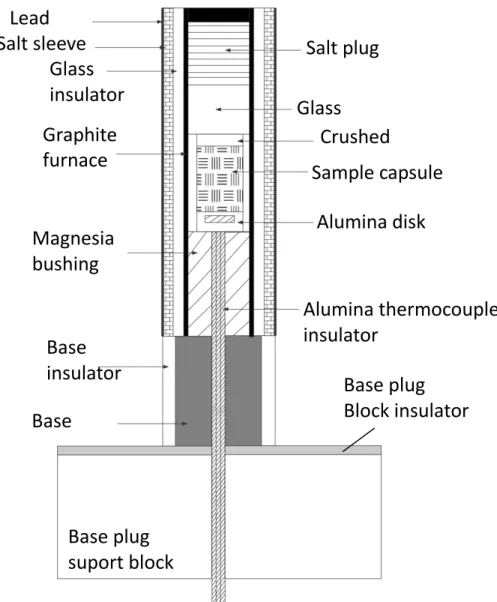
The experimental set is composed of a steel plug positioned in the base, a graphite furnace with a salt sleeve around it, a ceramic rod that goes on top of the steel plug and into the furnace, leading to half of its length, a thermocouple insulator (mullite) that goes through the ceramic rod, with two different wires, a ceramic rounded shape lid, the boron nitride rod with the golden capsule, a ceramic bar and a graphite lid, all covered with grease (Fig. 1.2). When all had been put together, we added the set into the pressure vessel and then positioned it to the pressure/temperature machine.
Lead
Salt plug
Glass
Crushed
Sample capsule
Alumina disk
Alumina thermocouple
insulator
Base plug
Block insulator
Base
Base plug
suport block
Base
insulator
Magnesia
bushing
Graphite
furnace
Salt sleeve
Glass
insulator
Contribuições às Ciências da Terra, Série M., vol. 77, 73p.
7
The whole idea is to make an experimental set with less space as possible in it, position the thermocouple as close as possible to the boron nitride rod with the golden capsule and avoid shear stress in the structure while applying the pressure.
The pressure is added first and then the temperature, in an isobaric condition. The experiment is left for 6 days in a lower temperature (~600°C) to stabilize and equilibrate the system and start producing minerals. Once that time has passed, the temperature is increased until the experimental conditions set for that capsule and left for 14 days. When the experiment is completed, the capsule is removed, mounted on a thin section, polished until the run products show and analysed in a Scanning Electron Microscope (SEM).
The samples were coated with carbon and analysed with a Zeiss EVO®MA15 Scanning Electron Microscope. Beam conditions during quantitative analyses were set to -20 kV. The working distance was set to 8.5 mm and beam current in approximately -20nA. The counting time was 15 seconds live-time. A cobalt standard was used to calibrate the equipment during initialization and periodically used to correct the detector drift. Secondary electron images and compositions were quantified by an Electron Dispersion Spectrometry (EDS), using Oxford Instruments® X-MAS 20m2 detector and Oxford INCA software (Fig. 1.3). The analyses of the molten glass were also done in the SEM but with a cryo stage. The temperature was drop to -180°C adding liquid nitrogen in the stage to diminish the mobility of the elements in this phase, especially Na.
Alkmin, L.A.S., 2014. Water-present eclogite melting: The effects of phengite and water …
8
Figure 1.3 – Zeiss EVO®MA15 SEM with the cryostage coupled and the computers for the software for analyses. The samples were coated with carbon and loaded in the SEM with mineral standards for quantification. Backscatter images were also taking during analyses.
9
CHAPTER 2
THE PRODUCTION OF TTG MELTS AND POTASSIC GRANITOIDS IN
THE BARBERTON GREENSTON BELT
2.1
–
BARBERTON GREENSTONE BELT
The Barberton Greenstone Belt (BGB) consists mostly of supracrustal rocks. It also displays a trondhjemite-tonalite-granodiorite (TTG) group dating from 3.55 to 3.21 Ga. These granitoids are also distinct by their Na-rich and K-poor character. The rocks of the BGB and the TTG plutons are syngenetic. Postdating both units there is a granite-monzonite-syenite (GMS) group, with ages between 3.14 and 3.10 Ga (Lowe and Byerly, 2007).
The rocks of the BGB form part of the Swaziland Supergroup and can be subdivided into three lithostratigraphic units: 1) the Onverwacht Group (> 3.547-3.260 Ma) at the base; 2) the Fig Tree Group (3.260-3.225 Ma) overlying the Onverwacht Group and 3) the Moodies Groups (3.260-3.225 Ma) at the top (Viljoen and Viljoen, 1969, Kröner et al., 1991; Byerly et al., 1996; Lowe and Byerly, 1999 – Fig. 2.1).
2.1.1
–
The Onverwacht Group
Alkmin, L.A.S., 2014. Water-present eclogite melting: The effects of phengite and water …
10
2.1.2
–
The Fig Tree Group
It overlays the Onverwacht Group and consists of interstratified clastic units and dacitic to rhyolitic volcanic and volcaniclastic rocks (Lowe and Byerly, 2007). It is interpreted to be deposit in deep to shallow marine environment.
2.1.3
–
The Moodies Group
It consists of coarse clastic sedimentary rocks such as sandstones, conglomerates and siltstones of lithic, feldispatic and quartzose composition. The Moodies Group was dated at 3.225-2.215 Ma. It is interpreted to be deposited during discrete contractional and extensional basins, reflecting an orogenic uplift (Lowe, 1999).
2.1.4
–
The Evolution of the BGB
Moyen et al. (2007) described four evolutionary stages for the BGB. Within the Onverwacht Group, two events can be recognized by and associated with two TTGs intrusions. The first stage is
Figure 2.1– Simplified geological map of the Barberton Greenston Belt, highlighting the A) area of sampling for felsic volcanic rocks in the Hooggenoeg Formation (Diergaardt, 2013) and B) a zoom in the Eureka syncline, where some potassic granitic clasts were found within the basal conglomerate in the Moodies Group (extracted from Sanchez-Garrido
Contribuições às Ciências da Terra, Série M., vol. 77, 73p.
11
marked by the production of mafic and subsequent felsic volcanism, forming the Theespruit Formation, which was then intruded by felsic volcanic layers at 3.55-3.50 Ga (Kröner et al., 1996). The geological settings are still unclear (Lowe and Byerly, 2007; Moyen et al., 2007). The second stage is represented by mafic, ultramafic and minor amounts of felsic magmatism that originated the Komati, Hooggenoeg and Kromberg Formations. The felsic layer is located in the Hooggenoeg Formation and was dated at 3.451 Ma (de Vries et al., 2006). Some clastic sediments and conglomerates can also be observed, what illustrate
that topography existed in this time of Earth’s history (Moyen et al., 2007). Furthermore, it was proposed that these rocks association represents an environment of oceanic arc (Lowe, 1999; Lowe and Byerly, 2007; de Vries et al., 2006).
The third evolutionary event was the amalgamation and suturing of tectono-stratigraphic suites to form a proto-continent, registered in the metamorphism and deformation of 3.230 Ma (Lowe and Byerly, 1999). The metamorphism reached high grade in the south and low-grade greenschist in the north of the BGB (Diener et al., 2005; Kisters et al., 2003; Moyen et al., 2006). The event is also represented by the 3.23-3.21 Ga TTG plutons (Kröner et al., 1991; de Ronde and Kamo, 2000) and sediments deposition of the Fig Tree (transition from deep to shallow marine – Lowe and Byerly, 2007) and Moodies Groups (terrigenous sandstones and conglomerates from the orogenic uplift – Lowe, 1999).
The last evolutionary stage of the BGB is characterized by intraplate thickening and compression, resulting in the crustal melting to form the GMS group at 3.216-3.100 Ma (Lowe, 1999).
The TTG plutons are very well preserved and contain valuable information concerning the development of the BGB, in particular constraints of the magma source conditions and its geodynamic setting. Some of these rocks formed at the same time as the felsic volcanic rocks (Fig. 2.2).
2.1.5
–
The TTGs of the BGB
TTG plutons are the main component of the Archaean continental crust today (Martin, 1994). They are sodic leucocratic igneous rocks dominantly formed by plagioclase (~60%) and quartz (15-20%). Biotite is subordinated and k-feldspar is absent or constituent of minor components. Mafic layers are represented by biotite (5-15%) with hornblend rarely showing. The accessory minerals are characterized by epidote, allanite, apatite, secondary chlorite and zircon (Moyen et al., 2007).
Alkmin, L.A.S., 2014. Water-present eclogite melting: The effects of phengite and water …
12
2.1.6
–
Geochemistry and petrogenesis of the TTGs from the BGB
The TTG formation is associated with a high pressure partial melting of hydrous mafic rocks such as amphibolites (Foley et al., 2002) or eclogites (Rapp et al., 2003; Laurie and Stevens, 2012). Experimental and geochemical research has strongly supported this theory (Moyen and Stevens, 2006).
The three generations of TTGs in the BGB have been subdivided into three geochemical types by Moyen et al. (2007) based on the K2O, Na2O, Al2O3, Sr and Eu content. The three groups are: 1) K2O-poor
with “low” or “high” amounts of Sr; 2) K2O-rich sub-series and 3) extremely low K2O, with a positive
Eu/Eu* ratio, lower Na2O and higher Al2O3 than those rocks in group 1, “melt depleted” sub-series
(Moyen et al., 2007).
It is possible to constrain the pressure conditions of TTG genesis considering which minerals are likely to retain Al2O3, Na2O, Sr, Y and Yb in the residuum during partial melting. Therefore the conditions
for high SiO2, Al2O3, Sr, Na2O and depleted HREE TTG melts can be theoretically recreated by
geochemical modelling (Diegaardt, 2013). For that, three groups can also be identified: Low Pressure (LP); Medium Pressure (MP) and High Pressure (HP) TTGs (Moyen, 2011 – Fig. 2.4).
Contribuições às Ciências da Terra, Série M., vol. 77, 73p.
13
2.1.7
–
Geochemistry of the potassic granitoid clasts from the BGB
In the Barberton Greenstone Belt there is a granite-monzonite-syenite (GMS) suite which corresponds to late felsic batholiths, emplaced after the BGB deformational events, at 3.210 Ma (Schoene
et al., 2008; de Ronde and de Wit, 1994). It is interpreted to be synchronous to the terrane amalgamation.
Nevertheless, it has been documented a potassic granitoid older than most of the TTGs, but chronocorrelated to them (Sanchez-Garrido et al., 2011,; Sanchez-Garrido et al., 2012; Diegaardt, 2013 – Fig. 2.2).
These potassic granitoids have low contents of CaO (0.05 wt% in average) despite displaying reasonable values of Sr (12−330 ppm). They fit into the S-type granites (Fig. 2.5). Schmidt et al. (2004) demonstrated that a felsic magma rises from the partial melting of a MORB slightly enriched in
Figure 2.3– Barbeton Greenstone Belt map highlighting the TTG plutons and their ages in million years Ma (modified from Toulkeridis et al., 2010, based on the ages from Moyen et al., 2011 and
Alkmin, L.A.S., 2014. Water-present eclogite melting: The effects of phengite and water …
14
potassium, although in their experimental results the CaO content is quite high (>2 wt%). The amount of experimental work done taking in account the phengite component of the eclogite is still little.
Figure 2.4– Binary and ternary diagrams showings the geochemistry characteristics of the three TTG groups and the potassic rocks studied by Moyen (2011). In all diagrams, the LP (low pressure) group corresponds to white symbols (and the distribution of the data points is outlined by a dashed field); MP (medium pressure) group grey symbols and a grey outline; and HP (high pressure) group correspond to black symbols with black outline. The
Contribuições às Ciências da Terra, Série M., vol. 77, 73p.
15
Alkmin, L.A.S., 2014. Water-present eclogite melting: The effects of phengite and water …
16
The potassic granitoid pebbles were dated at three different ages: 1) 3.55 Ga; 2) 3.43 Ga and 3) 3.23 Ga (Sanchez-Garrido et al., 2011). They are all, in general, older than the TTG plutons. They are however time correlated.
The granitic pebbles from the basal conglomerate of Moodies Group, documented by Sanchez-Garrido (2011), are dominated by K-feldspar and albite. The most Ca-rich plagioclase displays An12. The
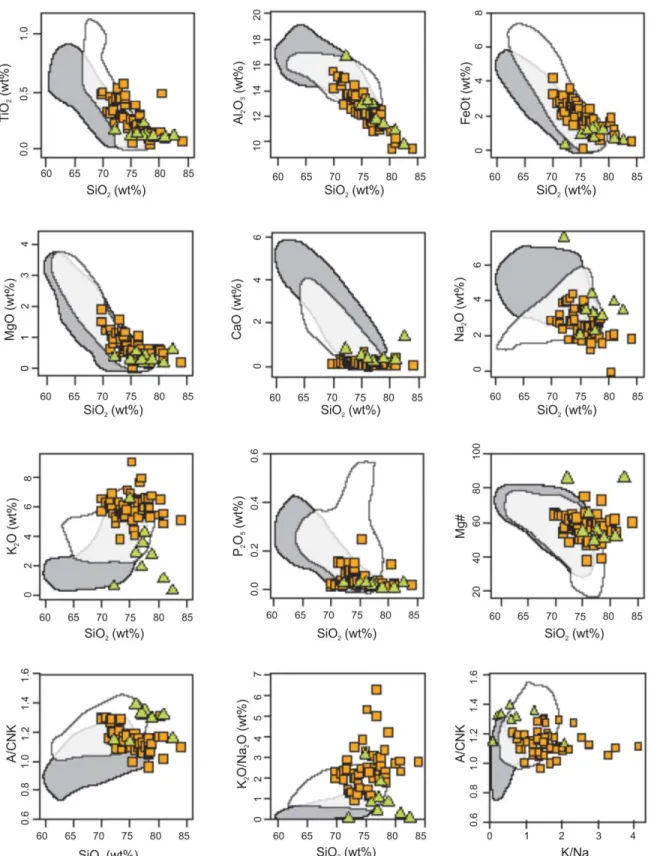
feldspars show occasionally zoning from the core towards the rim. It also has exsolutions of k-feldspar in albitic plagioclase. It is stated that two feldspars were probably present during crystallization. The whole rock analyses for these clasts have shown that they are silica rich (69.86-84.02 wt.%) and potassium rich (3.78-9.02 wt.%) (Fig. 2.5). They all plot in the granitic field within the An-Ab-Or ternary diagram (Sanchez-Garrido et al., 2011 – Fig. 2.6).
The big difference of these k-rich granitoids from normal ones is their relatively broad range of SiO2, the anomalous low values of CaO and P2O5 and the negative trend of the A/CNK
(Al2O3/CaO+Na2O+K2O) vs. SiO2. They have low Rb and high Sr content for a S-type granite and thus
plot closer to the TTG field, showing some affinity to those rocks. The Ba and Y values, however, are significantly higher and indicate a strong S-type granite correlation (Fig. 2.7). According to this data, the
Contribuições às Ciências da Terra, Série M., vol. 77, 73p.
17
granitic clasts from Sanchez-Garrido et al. (2011) can be classified as S-type granites, but their chemical particularities would support a different origin for them. One possibility is the partial melting of k-rich sediments subducted with the ocean slab.
The rhyolites from Hooggenoeg Formation documented by Diegaardt (2013) are very similar. They are dominated by k-feldspar (up to 61%) and quartz and subordinately, albite (Fig. 2.6). The whole rock analyses provided high contents of SiO2 (66.09-76.49 wt.%) and K2O (0.45-9.69 wt.%) whereas the
CaO has values often bellow 1 wt.%. It shows high contents of Light Rare Earth Elements (LREE) and low Heavy Rare Earth Elements (HREE).
Alkmin, L.A.S., 2014. Water-present eclogite melting: The effects of phengite and water …
18
2.2
–
THE COUCAL FORMATION IN THE EAST PILBARA CRATON
The East Pilbara Terrane is dominated by Paleo to Mesoarchean granite-greenstones. The lowest stratigraphic unit is Warrawoona Group which is a 3.53-3.42 Ga volcanosedimentary succession dominated by pillowed tholeiitic and komatiitic basalt (Van Kranendonk et al., 2007). Felsic volcanic and volcaniclastic rocks regionally comprise less than 15% of the succession, but locally form andesite to rhyolite-dominated sequences. They were dated at 3.47 Ga (Duffer Formation) and 3.43 Ga (Panorama Formation – Jahn et al., 1981; Hickman, 1983). The oldest is the Coucal Formation, comprised of basalts and andesites to dacitic volcanic and volcaniclastic rocks. This formation is 3.53-3.50 Ga (Buick et al., 1995; Smithies et al., 2007). Two groups can be individualized representing a series of mafic to felsic volcanic rocks: the Coonterunah F1 and F2. The Coonterunah F2 ranges from basalt to andesite, with a silica varying from 48 to 58 wt.%. Both groups have low to medium values of potassium, with a K2O/Na2O range between 0.05 and 0.45 which shows no evolutionary trend to higher K2O.
Contribuições às Ciências da Terra, Série M., vol. 77, 73p.
19
CHAPTER 3
SCIENTIFIC PAPER PRESENTATION
WATER-PRESENT ECLOGITE MELTING
–
THE EFFECTS OF PHENGITE AND
WATER IN THE PARTIAL MELTING OF BASALTIC ROCKS IN EARTH’S EARLY
CRUSTAL DEVELOPMENT
Leonardo Azevedo Sa Alkmin1,2, Gary Stevens2, Cristiano de Carvalho Lana1
Abstract: The tonalite-throndjemite-granidiorite (TTGs) suites of granitoid rocks were dominant during the formation of the felsic continental crust in the Archean. TTGs are granitoids characterized by high contents of silica (typically higher than 68 wt.% SiO2) and sodium, with low potassium-sodium ratios (Na2O ~4.65 wt%; K2O/Na2O ~0.4), low La/Yb ratios (~48) and low Yb concentration (~0.6 ppm)
(Smithies et al., 2009). It was demonstrated by Laurie and Stevens (2012) that TTG melts with compositions very similar to the average Archean trondhjemite can be generated through partial melting of water saturated eclogitic rocks, under pressure and temperature (PT) conditions consistent with Archean subduction. Within the Barberton greenstone belt, TTG magmatism occurred at ca 3.55, 3.42 and 3.23 Ga. Sanchez-Garrido et al. (2011) and Diegaardt (2013) documented potassic and peraluminous granites which occur as clasts within conglomerates and felsic volcanism in the greenstone belt to have ages of 3.550±45 Ma, 3.460±34 Ma and 3.270±36 Ma. These granites differ from typical S-type granites in that they are characterized by very low CaO (0.30 wt% in average), despite having reasonable Sr (12−330 ppm). Sanchez-Garrido et al. (2011) proposed that these granites formed by anatexis of sedimentary rocks subducted with oceanic crust as an explanation of the coeval production of peraluminous granite and TTG magmas. This study has experimentally investigated the possibility that the TTG and S-type granite magmas were produced by the same source as a consequence of high pressure melting. The experiments have used the composition proposed by Smithies et al. (2009) for Archean oceanic crust, in conjunction with PT conditions consistent with the Archean subduction zone thermal structure proposed by Laurie et al. (2012). Experiments conducted demonstrate that at relatively low temperature (800°C to 850°C at 2.5 GPa) the mafic source produces peraluminous granitic melts with low CaO contents (0.88 wt% in average).
Alkmin, L.A.S., 2014. Water-present eclogite melting: The effects of phengite and water …
20
3.1
–
Introduction
The TTG suite (trondhjemite-tonalite-granodiorite) is the main archetype of Archean rocks and lies in the very core of what we understand today as Earth’s early crustal development. They have a sodic leucocratic character, showing high ratios of Na:K and Na:Ca (Martin, 1994; Martin and Moyen, 2002). It has been consensual that the origin of these rocks is associated with the partial melting of oceanic slabs under eclogite facies conditions (Moyen and Stevens, 2006; Laurie and Stevens, 2012). Moyen (2011) has defined three different settings for the rising of TTG magmas: low pressure (LP) (<1.5 GPa), medium pressure (MP) (1.5 – 2.0 GPa) and high pressure (HP) (>2.0 GPa). The HP-TTGs are dominantly trondhjemitic with high Sr content (>300 ppm) and low Nb-Ta ratios (<7 ppm Nb; <0.5 ppm Ta). This is interpreted to indicate the absence of plagioclase in the residuum as well as the presence of rutile (Foley et
al., 2002; Martin and Moyen, 2002; Schmidt et al., 2004). HP-type Archaean TTGs also display high
Mg#s compared to other leucocratic magmas (Martin and Moyen, 2002). Production of magma at reasonable temperatures needs water in the source (Tuttle and Bowen, 1958; Wyllie and Tuttle, 1961; Clemens, 1984). Considering the high pressure of partial melting required so the plagioclase would be absent in the residuum, it possibly indicates that HP-type TTG magmas form by anatexis of the upper portions of oceanic slabs within Archaean subduction zones (Condie, 1981; Martin, 1999; Smithies and Champion, 2000; Foley et al., 2002; Rapp et al., 2003; Smithies et al., 2003, Laurie and Stevens, 2012). TTG magmas generated by this process have been considered to be a product of fluid-absent melting of amphibole (Moyen and Stevens, 2006). However, water drives the Phanerozoic arc magmatism (e.g. Schmidt and Poli, 1998; Connolly and Petrini, 2002) and it could have played a major role in the Archean subduction environment. Laurie et al. (2012) has demonstrated how water can make oceanic slabs fertile and therefore attain partial melting on their upper part.
The TTGs are usually associated with postdated potassium granitoids (e.g. Lowe and Byerly, 2007; Lana et al., 2013). These granitoids are interpreted to be a byproduct of the partial melting of continental crust during the terrane amalgamation and cratonization stage and are, in general, younger than the TTGs. However, an exception was documented in the Barberton Greenstone Belt (BGB) by Sanchez-Garrido et al. (2011, 2012) and Diegaardt (2013). Potassic granitoid pebbles and felsic volcanic rocks were found in basal conglomerates and felsic layers. These rocks are not the typical felsic magmatism with granite-monzogranite-syenite (GMS) series. Firstly, they are older than the TTGs that outcrop along with them and secondly, they have a distinctive geochemistry signature. The whole rock analyses show that they are K-rich (3.5 to 9.0 wt%) and Ca-poor (averages <1 wt% - Sanchez-Garrido et
al., 2011; Diegaardt. 2013). They also exhibit relatively high amounts of Sr and Cr and low amounts of
Contribuições às Ciências da Terra, Série M., vol. 77, 73p.
21
The genesis of these potassium-rich rocks have been attributed to sedimentary rocks coupled to the subducting slab which would undergo partial melting in high pressure conditions, above the plagioclase stability field. The potassium would then be concentrated in a phengite component. This proposition is nonetheless yet to be tested and thorough investigation needs to be performed in the process that drives the partial melting in high pressure conditions of Archean rocks. Schmidt et al. (2004) have successfully produced a felsic run product from partial melting a MORB starting material. The result, however, has a significant concentration of CaO that does not match the older felsic rocks. This study aims to investigate the possibility to produce a felsic magma from partial melting a slightly enriched oceanic slab in the eclogite facies condition, previously to the process which would rise the TTG magmas.
3.2
–
Geological settings
The Barberton Greenstone Belt, located in east South Africa and west Swaziland preserve some of the oldest rocks on Earth and is therefore an ideal laboratory to study the early process of continental crustal development. The rocks there are TTG- or GMS-like granitoids and supracrustals from the Swaziland Supergroup. This supregroup can be divided into three units: 1) the Onverwacht Group; 2) the Fig Tree Group and 3) the Moodies Group. The Onverwacht Group is constituted of mafic to ultramafic rocks, interpreted to be deposited in a shallow marine environment between 3.55 to 3.25 Ga (Viljoen and Viljoen, 1969, Kröner et al., 1991; Byerly et al., 1996; Lowe and Byerly, 1999, 2007) and is subdivided into 6 formations. The Hooggenoeg Formation is one of them and comprises a succession of tholeitic basalts and volcaniclastic rocks, conglomerates, sandstones and some felsic intrusive rocks dated at 3.451 Ma and 3.445 Ma (Diegaardt, 2013). These rocks are remarkable for their different geochemistry character in comparison of normal felsic granitoids. The Fig Tree Group consists of interstratified clastic units and dacitic to rhyolitic volcanic and volcaniclastic rocks deposited in deep to shallow marine environment (Lowe and Byerly, 2007). The Moodies Group comprises coarse clastic sedimentary rocks such as sandstones, conglomerates and siltstones of lithic, feldspatic and quartzose composition. It is interpreted as a discrete contractional and extensional basin deposited during an orogenic uplift at 3.225 Ma to 2.215 Ma (Lowe, 1999). In a basal conglomerate of the Moodies Group in the Eureka syncline, Sanchez-Garrido
et al. (2011) documented granitoids pebbles with a particular geochemistry composition. They are
potassium-rich and calcium-poor, although they fit into the S-type granites geochemistry (Sanchez-Garrido et al., 2011). They were found mainly as clasts, spatially oriented according to a shear zone and to the regional trend, included in the foliation of the hosting conglomerate.
Alkmin, L.A.S., 2014. Water-present eclogite melting: The effects of phengite and water …
22
to 3.216 Ma (Kamo and Davis, 1994; Schoene et al., 2008; de Ronde and de Wit, 1994; Kisters et al., 2010). Potassic granitoid plutonism in the BGB occurred between 3.236 Ma and 3.100 Ma. It is represented by the Usutu suite (Schoene and Bowring, 2010), the Dalmein pluton (Lana et al., 2010), and the granodiorite-monzogranite- syenogranite (GMS) batholiths (Schoene et al., 2008; de Ronde and de Wit, 1994). This magmatism coincides with the 3.210 Ma terrane amalgamation (Moyen et al., 2006). The exceptions are the pebbles found in the Moodies Group basal conglomerate (Sanchez-Garrido et al., 2011) and the felsic volcanism from the Hooggenoeg Formation (Diegaardt, 2013).
The BGB had four evolutionary stages (Moyen et al., 2007). Within the Onverwacht Group, two events can be recognized associated with two TTG intrusions. The first stage is marked by the production of mafic and subsequent felsic volcanism, which was then intruded by felsic volcanic layers at 3.55-3.50 Ga (Kröner et al., 1996). The geological settings are still unclear (Lowe and Byerly, 2007; Moyen et al., 2007). The second stage is represented by mafic, ultramafic and minor amounts of felsic magmatism. Some clastic sediments and conglomerates were also documented, evidencing an ancient topography (Moyen et al., 2007). Furthermore, it was proposed that these rocks association represents an environment of oceanic arc (Lowe, 1999; Lowe and Byerly, 2007; de Vries et al., 2006). The third evolutionary event was the amalgamation and suturing of tectono-stratigraphic suites to form a proto-continent, registered in the metamorphism and deformation of 3.230 Ma (Lowe and Byerly, 1999). The last evolutionary stage is characterized by intraplate thickening and compression, resulting in crustal melting to form the GMS group at 3.216-3.100 Ma (Lowe, 1999).
3.3
–
Experimental and analytical procedures
Water-present partial melting experiments were first equilibrated at 2.5 Ga and 600°C for 6 days and then conducted at 2.5 Ga and between 790 and 850°C for extra 14 days. The experimental conditions are summarized in Table 3.1.
3.3.1
–
Starting Material
Contribuições às Ciências da Terra, Série M., vol. 77, 73p.
23
starting material (~30 wt.%) is according to the conventional metamorphic modelling that suggests that garnet proportions of more than 30% are common in MORB compositions within the high pressure range (Deer et al., 1997).
The suitable starting material can only be found in collisional zones with exhumation of oceanic crust, so the composition would be low in K2O and Mg# (Moyen and Stevens, 2006). The bulk
compositions of average N-MORB and basaltic rock from Pilbara Craton in Australia (Smithies et al., 2009) have been interpreted as a possible source for the TTGs granitoids. These rocks are found in the Coucal Formation (C-F2b) and its composition was used to craft two different gels, one water saturated and the other subsaturated (Table 3.2).
The starting material ESM-1 was crafted using TEOS (tetraethylorthosilicate) for the silica, TiO2 powder for the titanium, Al metal powder for aluminum, Fe2+ metal sponge and Fe2O3 powder for total
iron, Mg powder for magnesium and carbonates of calcium, potassium and sodium for their respective elements. The carbonates, Mg and Al powder were added to a beaker with nitric acid (HNO3 1:1 distilled
water) and heated in a hot plate until all the elements were dissolved. The solution was then left to evaporation until near dryness. The solid nitrates were diluted with deionized water. Then, a mixture of TEOS and ethanol was added (vol. TEOS = vol. ethanol = vol. deionized water). Ammonium hydroxide (NH4OH) was slowly added until a stiff gel was acquired and then the whole beaker was left to dry in an
oven at 110°C for a whole day. In the end, the mixture was heated in a Bunsen beak until all the NO2 fumes were dismissed and put in a furnace at 1000°C so the remaining nitrates would turn into oxydes.
Table 3.1 - Experimental run conditions and products. Exp.
run Starting Material P (Gpa) Dev. T (°C) Dev. Duration (days) H(wt.%)2O a Mineral Assemblageb ESM-1
1 2.5 0.1 600 1 10 10 Cpx, Gt, Wm, Qz, Rt, (Ilm)
2 2.5 0.1 800 1 21 10 Cpx, Gt, Bt, Rt, (Ilm), glass, vapour
3 2.5 0.1 850 2 21 10 Cpx, Gt, Bt, Rt, (Ilm) glass, vapour ESM-2
4 2.5 0.1 790 1 21 1.1 Cpx, Gt, Wm, Bt, (Fa), glass
5 2.5 0.2 820 1 16 1.1 Cpx, Gt, Wm, Bt, Rt, (Fa), glass
a
H2O represents the weight percentage of distilled water added to the experimental capsule before it was sealed. The values are maximum concentrations.
b
Phases in brackets occur as relict phases; Grt—garnet; Cpx—clinopyroxene; Rt—
Alkmin, L.A.S., 2014. Water-present eclogite melting: The effects of phengite and water …
Contribuições às Ciências da Terra, Série M., vol. 77, 73p.
25
The Ti and Fe were added in the end and the starting material “gel” was stored within a vaccum desiccator. Water was added later. For the ESM-2, the same procedures were used, but for the iron and water sources, fayalite and kaolinite respectively were added in the end of the gel making.
The starting materials ESM-1 and ESM-2 are both characterized by their eclogitic composition. They were heat up at 600°C and 2.5 GPa so the gel would attain equilibria. The mineral assemblage at this setting is Omp (~50%) + Gt (~30%) + Phg (~17%) + Qz (~2%) + Rt (~1%) (mineral abbreviations according to Kretz, 1983). Representative garnet and clinopyroxene compositions are provided in Table 3.3 and Table 3.4. The garnet in ESM is almandine-rich (61-68% alm, 18-27% grs, 11-20% prp – Table 3.3). The clinopyroxene is omphacitic but less sodic than the peak metamorphic omphacite (2.0 – 4.0 wt.% Na2O – Table 3.4).
3.3.2
–
Experimental settings
Alkmin, L.A.S., 2014. Water-present eclogite melting: The effects of phengite and water …
Contribuições às Ciências da Terra, Série M., vol. 77, 73p.
Alkmin, L.A.S., 2014. Water-present eclogite melting: The effects of phengite and water …
28
3.3.3
–
Analytical methods
The minerals and glasses from the run products and the starting materials were analysed under a Zeiss Evo MA 15 Electron Microscope (SEM), by a quantitative EDS (Energy Dispersive X-ray Spectrometry) and WDS (Wavelenght Dispersive X-ray Spectrometry). Major elements were determined using EDS, through Oxford Instruments® X-MAS 20 m2 detector and Oxford INCA software. The glasses were quantified with WDS. The beam conditions during analyses were 20 kV, working distance of 8.5 mm and current around -20 nA. The live time counting was 15 s. Natural mineral and metals standards were used for standardization during analyses. The error range from ±0.6 to 0.1 wt.% for major elements on EDS and ±0.01 to 0.03 wt.% on major and trace elements on WDS. High resolution images were taken at the same time. When the glasses were analysed a cryo stage technique was used (e.g. Diener et al., 2005; Moyen and Stevens, 2006) and the sample was cooled to -180°C. This way, the mobility of elements in a hydrous aluminous silicate glass became less likely. For Na2O this is especially true (e.g.
Vielzeuf and Clemens, 1992).
3.4
–
Experimental results
Garnet and clinopyroxene coexisted with the melt in all the experiments performed and their composition is shown in Tables 3.3 and 3.4. In the water saturated experiments, quartz and phengite were consumed to produce the melt whilst they were still present in underwater saturated experiment (Fig. 3.1). The clinopyroxene in the run products are more sodic (Na2O 4.2 – 4.7 wt.%), calcic (CaO 13 – 15 wt.%)
and slightly more magnesian (MgO 8.5 – 10.2 wt.%). The garnet crystal have grown rapidly in the early stages of the experiments and kept a core slightly different than the rims. Most of these relicts are iron particles (ilmenite) trapped and kept unreactant to the gel components. The newly formed garnet are more calcic (CaO ~8.0 wt.%), magnesian (MgO 5.4 – 7.4 wt.%) and aluminium-rich (Al2O3 20.0 – 21.7 wt.%).
They have less titanium (TiO2 0.6 – 1.4 wt.%) and less iron (FeO 22.0 – 25.0 wt.%). One exception is the
Contribuições às Ciências da Terra, Série M., vol. 77, 73p.
29
segregation because in its crimped ends there is a large devoid of starting material powder where the melt can migrate into. In the low temperature and sub-saturated water experiments, the glass is almost exclusively interstitial, rarely forming small ponds. EDS analyses of interstitial, pooled and garnet-surrounded glass indicate that there is no segregation of the elements and no systematic compositional variation.
3.4.1
–
Equilibrium approach
The investigations of run products display features that appear to have reached a reasonable equilibrium. Core and rim compositions of garnets and clinopyroxene do not show significant systematic variances, nor does the glass accumulated in different areas of the capsules. The new phases formed corresponded to the increase in temperature as expected. The presence of ilmenite in the garnet cores shows that the equilibrium was not completely attained. These features, however, are not rare in almost all near-solidus partial melting experiments (Tepley et al., 2000). It may be attributed to a persistent large iron grain, unable to react to the other elements that rather registered the deformation of the process under some shear stress.
Table 3.5 - Calculated phase proportion by major element squared mass balance for the 2.5 Gpa – 800°C and 2.5 GPa – 850 °C run products.
P (Gpa) 2.5 2.5
T (°C) 800 850
Melt 0.11 0.12
Gt 0.44 0.44
Omp 0.33 0.32
Bt 0.10 0.09
Rt 0.01 0.02
Ilm 0.01 0.01
Sum 1.00 1.00
SSR 0.50 0.40
SSR – Sum of Square Residuals; Gt – Garnet; Omp – Omphacite; Bt – Biotite; Rt
Alkmin, L.A.S., 2014. Water-present eclogite melting: The effects of phengite and water …
30
Contribuições às Ciências da Terra, Série M., vol. 77, 73p.
31
a
b
c
Figure 3.2 –Major elements diagrams. The red stars represent the experimental glasses from the ESM-1 starting material (water-saturated condition). The yellow stars represent the experimental glasses from the ESM-2 starting material (under water-(water-saturated conditions). Orange circles are equivalent to the potassic granitoids documented by Sanchez-Garrido et al. (2012) and Diegaardt
(2013). The blue circles represent the experimental TTG glasses from Laurie et al. (2012). The green squares are equivalent to the
starting materials of this study despite water-saturation. The black squares represent the archean basalts of the Coucal Formation (Smithies et al., 2009). The purple square represents the starting material from Laurie et al. (2012). The dark grey area represent
Alkmin, L.A.S., 2014. Water-present eclogite melting: The effects of phengite and water …
32
3.4.2
–
Experimental glass composition
Two different glasses were attained in function of the water saturated and the phengite component. The first glasses obtained from ESM-1 water saturated experiment have composition of a peraluminous granite (4.3 – 5.6 Na2O/CaO)(1.3 – 1.5 A/NK; 1.1 – 1.3 A/CNK) (Fig. 3.2) (Table 3.2).
They are silica rich (73.8 – 77.2 wt.% SiO2; >1.2 wt.% MgO + MnO + FeO + TiO2). They have
moderate K2O:Na2O ratios (0.6 – 1.1) and low Mg# (~28.4 – when magnesium was found in the glass).
The high K2O reflects the slightly enriched starting material (1.0 wt.% K2O) and the breakdown of the
phengite component. The results shown in Table 3.2 are anhydrous equivalents of normalized analyses. The water content was estimated from the raw data, assuming that the deviation analyses of the glass from the 100% total is due to the non-measurement of the water by the SEM. The water content for the ESM-1 glasses is quite high (16.4 – 18.3 wt.% H2O) as expected for high pressure melts. The second glasses
obtained from ESM-2 were under water saturated conditions (1.1 wt% H2O) and have the composition of
a peraluminous trachyandesitic rock (7.9 – 9.1 Na2O + K2O wt.%)(53.6 – 54.2 wt.% SiO2). They are rich
in ferros (~10.6 wt.% TiO2 + FeO + MgO + MnO), K2O (6.2 – 7.8 wt.% K2O) and MgO contents (5.7 –
5.8 wt.% MgO). Consequently, they have relatively high K2O:Na2O rations (2.1 – 3.6) and Mg# (78.1 –
78.9) (Table 3.2).
3.4.3
–
Melting Reactions
The evidences in this study suggest that clinopyroxene, quartz and phengite are the principal reactants in the wet melting. The clinopyroxene was consumed along with quartz, the phengitic white mica and some minor garnet to produce a potassic granitic melt. A relatively sodium-rich pyroxene was formed as the main solid product of the reaction. Some new garnet and biotite were also formed. The quartz and phengite were completely consumed and incorporated into the melt.
The reactions at 2.5 GPa and 800°C and 850°C respectively are both characterized by:
1) Omp1 + Gt1 + Qz + Phg = Melt + Omp2 + Gt2 + Bt
In the sub-water saturated conditions (ESM-2), the evidence shows that the reaction was anhydrous. The main reagents were the clinopyroxene and garnet. Phengite was incorporated to the melt with increasing temperature. The clinopyroxene and garnet were the solid products of the reaction. The clinopyroxene is, again, sodium-rich and similar to the ones found in ESM-1 experiment. The garnet in the other hand is magnesium-rich and depleted in iron in comparison with the starting material. The reaction at 790 °C and 820°C 2.5 GPa is characterized by:
Contribuições às Ciências da Terra, Série M., vol. 77, 73p.
33
At 790°C the phengitic component is not completely incorporated into the melt and is present as relitic mineral, whilst at 820°C it is completely consumed. Quartz is present throughout the whole process but does not take part in the melting thus the glass show low values of SiO2 wt.%.
3.4.4
–
Further melt modeling
The experimental work has produced potassic glasses by incorporating the phengite in the partial melting reaction. The granitic run product glass is derived from a fertile source in function of the water. The absence of water for the reaction produces an anhydrous silica-deficient melt with trachyandesitic affinity, far off the compositions of TTGs from the Archean. The extraction of the potassic melt and further modeling of the behavior of the rock in the eclogite facies condition (Fig. 3) provides insights about the new process of partial melting that takes place in the ongoing subduction. They suggest that for the high pressure conditions (~2.5 GPa) the new residuum formed after extraction of the potassic melt still holds enough amounts of water (Laurie and Stevens, 2012) and hence kept the source fertile for further melting. They also show that the residual phases are similar to the normal eclogite assemblage at high pressure (Gt + Omp) and resembles the residuum found in Laurie and Stevens (2012). If the conditions are sustained, the new bulk rock is likely to produce a TTG melt.
3.5
–
Discussion
TTG granitoid’s composition have been interpreted to have petrogenetic significance (Moyen and Stevens, 2006; Moyen et al. 2007; Laurie and Stevens 2012). The HP-type TTG, Na-rich, reflect the partial melting of a metabasaltic source. Laurie and Stevens (2012) demonstrated quite convincingly that TTG melts can arise from the partial melting of basaltic-like rocks in eglogite facies conditions.
However, when the basaltic source is slightly enriched in potassium, the phengite component plays an important role in the wet partial melting. The potassium in high pressures is mostly retained in a phengitic white mica. When water is present, the phengite, although little in comparison to the other phases in the starting material, is completely absorbed into the reaction along with quartz and partitioned into the melt and biotite. Thus, the first melt produced was a peraluminous granite with a potassic character. The melt obtained within these conditions has a very similar composition to the granitic pebbles and rhyolitic volcanic rocks documented in Sanchez-Garrido et al. (2011, 2012) and Diegaardt (2013) respectively (Table 3.2). They are also older than the TTGs and are in accordance with the early production of a potassic melt predating the TTG generation.
The absence of water in the same bulk rock composition and the same conditions for a basaltic starting material has provided a very different melt. The glass obtained is a K2O-rich trachyandesite.
Alkmin, L.A.S., 2014. Water-present eclogite melting: The effects of phengite and water …
34
incorporated to the melt and produce a high potassic silica-depleted glass. Although this process deviate from the TTG and potassic granitoid genesis, it shows that to achieve rocks with high silica contents from a basaltic starting material in high pressure conditions, the presence of water is of essence.
Figure 3.3 – Pseudosection of the new bulk rock composition after extracting the potassic melt. The modeling suggests that the residuum is similar to the one found in Laurie et al. (2012). The melt composition also resembles
Contribuições às Ciências da Terra, Série M., vol. 77, 73p.
35
3.6
–
Conclusion
Alkmin, L.A.S., 2014. Water-present eclogite melting: The effects of phengite and water …
37
CHAPTER 4
CONCLUSIONS
The experimental work done with the basaltic rocks provided insights about the partial melting in high pressure conditions simulating the Archean subduction thermal structure. The phengite-presence in the potassium-enriched protolith has shown that melting takes a different path throughout the subduction process. The water also determines the SiO2 concentration in the liquid phase.
The experiments ran with ESM-1 at 2.5 GPa, 800 and 850°C in water saturated conditions produced a peraluminous granite similar to the potassic pebbles documented in Sanchez-Garrido et al. (2011) from the basal conglomerate in the Moodies Groups and also to the felsic volcanic-volcanoclastic rocks from the Hooggenoeg Formation (Diegaardt, 2013). This work has taken into account the potassium-restriction to the phengite phase from the protolith. In the run products, the phengite and quartz are consumed along with pyroxene and garnet in the presence of water to produce a felsic potassic melt. The residuum is characterized by garnet, omphacite and biotite, also similar to the Archean basaltic potassium-depleted rocks. The modelling suggests that the ongoing process could produce a TTG melt from the new potassium-depleted bulk rock. The restricted outcroping of the k-granitoids however support a local concentration of potassium as the main reason for the peraluminous potassic-melt production. Areas without this enrichment should produce TTG melts instead. Thus, the k-granitoids rocks might have formed earlier than TTGs for the phengite is incorporated in the melted first and then, in a similar environment, the increasing temperature should give rise to the most common TTG melt.
The experiments ran with ESM-2 at 2.5 GPa, 790 and 820°C in water subsaturated conditions have produced a trachyandesitic melt. This outcome has shown the importance of water to the production of potassic granitoids as well for the TTG melts. The anhydrous to water subsaturated environment does not provide the conditions for the typical Archean rocks generation.
The water determines the amount of SiO2 in the melt, as the phengite presence and concentration
determine the path of partial melting evolution, either for a fractional partial melting with a potassic stage previously to the TTG or for a partial melting resulting in the Archean TTGs. As for the Barberton Granite Greenstone Terrane (BGGT), the low-CaO high-K2O granitoids could have been produced previously than