Revista Gaúcha
de Enfermagem
Association between Manchester Triage System
discriminators and nursing diagnoses
Associações entre discriminadores do Sistema de Triagem de Manchester e diagnósticos de enfermagem
Asociación entre el Sistema de Triage Manchester y el diagnóstico de enfermería
Betina Francoa,b
Lurdes Busina,b
Tânia Couto Machado Chiancac
Vítor Monteiro Moraesa,b
Ananda Ughini Bertoldo Piresa,b
Amália de Fátima Lucenaa,b
ABSTRACT
Objective: To analyze the association between Manchester Triage System flowchart discriminators and nursing diagnoses in adult patients classified as clinical priority I (emergency) and II (very urgent).
Method: Cross-sectional study conducted in an emergency department in southern Brazil between April and August 2014. The sample included 219 patients. Data were collected from online patient medical records and data analysis was performed using Fisher’s exact test or the chi-square test.
Results: 16 discriminators and 14 nursing diagnoses were identified. Associations were found between seven discriminators and five problem-focused nursing diagnoses, including the discriminator Cardiac pain and the diagnosis Acute pain. Three discriminators were asso-ciated with four risk nursing diagnoses, among these Acute neurological deficit with the diagnosis Risk of ineffective cerebral tissue perfusion.
Conclusion: Significant associations were found between Manchester Triage System discriminators and the nursing diagnoses most frequently established in the emergency department.
Keywords: Emergency nursing. Triage. Nursing process. Nursing diagnosis. Nursing care. Terminology.
RESUMO
Objetivo: Analisar associações entre discriminadores do Sistema de Triagem de Manchester e Diagnósticos de Enfermagem em pacientes adultos, classificados com prioridade clínica I (emergência) e II (muito urgente).
Método: Estudo transversal realizado na unidade de emergência do sul do Brasil, entre abril e agosto de 2014. Amostra de 219 pacientes. Os dados foram coletados no prontuário online e analisados estatisticamente, com teste exato de Fisher ou qui-quadrado.
Resultados: Encontrou-se 16 discriminadores e 14 diagnósticos de enfermagem. Houve associação entre sete discriminadores e cin-co diagnósticin-cos de enfermagem do tipo focin-co no problema, dentre Dor precin-cordial ou cardíaca cin-com o diagnósticin-co Dor aguda. Também houve associação entre três discriminadores com quatro diagnósticos de enfermagem de risco, dentre Déficit neurológico agudo com o diagnóstico Risco de perfusão tissular cerebral ineficaz.
Conclusão: Existem associações significativas entre discriminadores do Sistema de Triagem de Manchester e diagnósticos de enfer-magem mais frequentemente estabelecidos na Unidade de Emergência.
Palavras-chave: Enfermagem em emergência. Triagem. Processo de enfermagem. Diagnóstico de enfermagem. Cuidados de en-fermagem. Terminologia.
RESUMEN
Objetivo: Analizar asociaciones entre los discernidores del Sistema Triaje de Manchester y los Diagnósticos de Enfermería en pacien-tes adultos con prioridad clínica I (emergencia) y II (muy urgente).
Método: Estudio transversal realizado en la unidad de emergencia del sur de Brasil, entre abril y agosto de 2014, con la muestra de 219 pacientes. La colecta de datos fue realizada en el prontuario online de los pacientes. El análisis estadístico fue realizado con el uso del Test Exacto de Fisher o chi-cuadrado.
Resultados: Fue identificado el uso de 16 discernidores y 14 diagnósticos de enfermería. Hubo una asociación entre siete discerni-dores y cinco diagnósticos de enfermería del tipo foco en el problema, entre estos Dolor precordial o cardíaca y Dolor agudo. También hubo asociación entre tres discernidores y cuatro diagnósticos de enfermería de riesgo, entre estos Déficit neurológico agudo con el diagnóstico Riesgo de perfusión tisular cerebral ineficaz.
Conclusión: Existen asociaciones significativas entre los discernidores del Sistema Triaje de Manchester y los diagnósticos de enfer-mería más frecuente establecidos en la Unidad de Emergencia.
Palabras clave: Enfermería de urgência. Triaje. Proceso de enfermería. Diagnóstico de enfermería. Atención de enfermería. Terminología.
How to cite this article:
Franco B, Busin L, Chianca TCM, Moraes VM, Pires AUB, Lucena AF. Association between Manchester Triage System discriminators and nursing diagnoses. Rev Gaúcha Enferm. 2018;39:e2017-0131. doi: https://doi.org/10.1590/1983-1447.2018.2017-0131.
a Universidade Federal do Rio Grande do Sul (UFRGS), Escola de Enfermagem. Porto Alegre, Rio Grande do Sul, Brasil.
b Hospital de Clínicas de Porto Alegre (HCPA). Porto Alegre, Rio Grande do Sul, Brasil.
INTRODUCTION
The Manchester Triage System (MTS) was created in Manchester, United Kingdom, in 1994, and has since been used as a valid, safe, and reliable triage protocol at many emergency departments (EDs) across different countries worldwide, including Brazil(1-2). The MTS is structured into presentational flow charts and discriminators. Flow charts represent the most common complaints with which pa-tients present to the ED; each flow chart contains specific signs and symptoms that usually accompany the present-ing problem (discriminators). The selection of the most appropriate flowchart and the most relevant discriminator leads health professionals to determine the patient’s clinical priority of care. Each priority level indicates a severity lev-el, represented by a color, and corresponds to a maximum waiting time for care(3). Clinical priority I corresponds to the severity level “emergency”, is represented by the color red, and requires immediate care; clinical priority II corresponds to the severity level “very urgent”, is represented by the color orange, and requires care within 10 minutes; clinical priority III corresponds to the severity level “urgent”, is rep-resented by the color yellow, and requires care within 60 minutes; clinical priority IV corresponds to the severity level “standard”, is represented by the color green, and requires care within 120 minute; and, finally, clinical priority V cor-responds to the severity level “non-urgent”, is represented by the color blue, and requires care within 240 minutes(3). Clinical priority is assigned according to the patient’s chief complaint (obtained from the patient or relatives) and to a nurse-led evaluation of the patient’s health status through history and a brief physical examination, in order to select the appropriate MTS flowchart and discriminators(4).
Similarly to patient assessment by the MTS, the nursing process (NP) also guides nurses’ clinical judgment and deci-sion-making on the basis of patient data collection (history and physical examination), which constitutes the first step of the NP, with the purpose of establishing a nursing diag-nosis (ND)(5).
Based on this premise, nurses use the NP when they classify patient risk at the ED through the Manchester Sys-tem, although rapidly and succinctly due to the very nature of ED care; because nurses are required to collect data to identify patient signs, symptoms, and risk factors, this leads them to think critically and to make a clinical judgment about each situation. Thus, it can be hypothesized that the MTS may support the second step of the NP, i.e., ND. In this context, a study conducted at a Brazilian ED to identify possible NDs in patients classified as clinical priority I and II according to the MTS concluded that the System may
facilitate identification of defining characteristics and re-lated/risk factors that support the establishment of NDs(6). However, the NDs listed in this study were not obtained in the real-world care setting, but were rather described ret-rospectively as possible NDs on the basis of expert review of patient records.
To the best of our knowledge, no published studies have sought to test for associations between MTS flow chart discriminators and NDs, an assessment that might contribute valuable evidence to enhance clinical judgment and decision-making by nurses in urgent and emergency care settings. Within this context, and considering the hy-pothesis that the MTS might provide nurses the opportu-nity of identifying defining characteristics, related factors, and risk factors for selection of NDs, we designed the pres-ent study to analyze whether associations exist between MTS flow chart discriminators and NDs according to the NANDA-I taxonomy in adult patients classified as clinical priority I (emergency) or II (very urgent) in a real-world ED.
METHODS
This cross-sectional study was conducted at the ED of a major, university-affiliated, Joint Commission-accredited hospital in southern Brazil. The study sample included all the medical records of adult patients seen in the ED be-tween April and August 2014 and classified according to the MTS. Sample size was calculated on the basis of the to-tal number of patients seen in January–April 2013 (n=503) and classified as clinical priority I (emergency) or II (very ur-gent), respecting the proportions of each category (0.6% of patients classified as clinical priority I and 3.9% of patients as clinical priority II). Therefore, the sample comprised 219 patients, 66 of which were classified as clinical priority I and 153 as clinical priority II, considering a 5% margin of error and a 95% confidence interval.
The inclusion criteria were age ≥18 years, classification as clinical priority I (emergency) or II (very urgent) on the MTS as noted in medical records, and having had NDs es-tablished within the first 24 hours of hospital admission. The exclusion criteria were admission to the ED by one of the investigators; arrival at the ED through previous con-tact with medical staff, e.g., those referred from outside fa-cilities; and patients who were referred from the hospital’s own outpatient services or who were seen more than once during the data collection period.
nurs-es during the patient’s clinical course. It bears strnurs-essing that both the MTS and NDs use standardized language, which reduces the risk of interpretation bias.
A data collection instrument was designed specifically for this study to collect sociodemographic and clinical data, chief complaints, MTS flow charts and discriminators used, and the NDs listed by nurses after seeing the patient in the ED, together with the defining characteristics (signs and symptoms) and/or risk factors for these NDs. At the hos-pital where the study was conducted, NDs (and all other stages of the NP) are an integral part of the electronic hos-pital record, and are filled in daily despite the challenges of ED practice. The collected data were entered, codified, and stored in a database created using Microsoft Excel for Windows. Data were analyzed with the Statistical Package for the Social Sciences (SPSS), version 21.0. The cutoff point for which MTS discriminators and which NDs should be tested for association was determined by descriptive statis-tics, considering the frequency of occurrence of both vari-ables, since no previous studies have provided evidence on the most appropriate method to analyze this association. Therefore, our analysis included the 10 MTS discriminators
most frequently selected in the ED, as well as the five prob-lem-focused NDs and the four risk NDs most frequently es-tablished in this setting. Fisher’s exact test (given the small, independent samples) or the chi-square test were used as appropriate for analysis of association, considering a sig-nificance level of 5% (p<0.05). Prevalence ratios (PR) and their 95% confidence intervals were estimated via Poisson regression to measure the strength of association.
The study protocol was approved by the institutional Research Ethics Committee (opinion no. 140145). All inves-tigators committed to preserving the confidentiality of the collected data by signing a Data Use Agreement.
RESULTS
A total of 219 patients were included in the study, 110 (50.2%) of which were male, with a mean age of 62.3 ± 15.3 years. The most common presenting complaints were dys-pnea (37%) and pain (35.6%). The most prevalent comor-bidities were systemic arterial hypertension (54.3%) and diabetes mellitus (28.3%), as shown in Table 1.
Table 1 – Sociodemographic and clinical characteristics of emergency patients classified as clinical priority I and II. Porto Alegre, RS, Brazil, 2015
Variable n = 219
Age (years) * 62.3±15.3
Male gender† 110 (50.2)
Educational level† ‡
Incomplete elementary school 69 (31.5)
Complete high school 25 (11.4)
Complete elementary school 21 (9.6)
Illiterates 10 (4.6)
Higher education degree 5 (2.3)
Incomplete high school 3 (1.4)
Incomplete higher education 2 (0.9)
Morbidities†
Systemic hypertension 119 (54.3)
Diabetes mellitus 62 (28.3)
History of ischemic heart disease 44 (20.1)
Neoplasms 43 (19.6)
Chronic obstructive pulmonary disease 35 (16.0)
Smoking 32 (14.6)
Stroke 30 (13.7)
Source: Research data, 2015.
Twenty different presenting complaints were identified in the study sample; the most common were shortness of breath (37%) and pain (35.6%). Fourteen different MTS flow-charts were identified, the most frequent of which were Dys-pnea in adults (71/32.4%), Malaise in adults (51/23.3%), and Chest pain (45/20.5%). From these flowcharts, 16 discrimina-tors were identified (Table2).
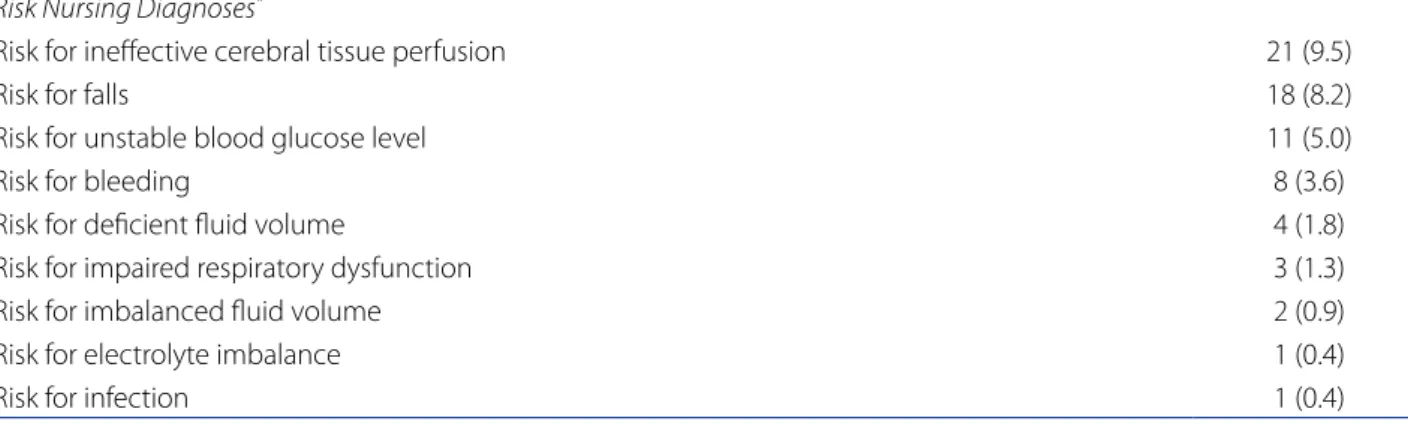
Fourteen problem-focused NDs and nine risk NDs were also identified (Table 3).
Analysis of the association between the 10 most fre-quent MTS discriminators and the five most frefre-quent problem-focused NDs revealed a significant association between seven discriminators and the five most frequent NDs, as demonstrated by the prevalence ratios, which measure the strength of association between variables.
Table 2 – MTS discriminators used in the care of emergency patients classified as clinical priority I and II. Porto Alegre, RS, Brazil, 2015
Discriminators n=219
Cardiac pain 41 (18.7)
Very low SpO2 32 (14.6)
Inadequate breathing 31 (14.2)
Abnormal pulse 25 (11.4)
Acute neurological deficit 20 (9.1)
Hypoglycemia 13 (5.9)
Shock 12 (5.5)
Altered conscious level 12 (5.5)
Severe pain 10 (4.6)
Currently fitting 9 (4.1)
Vomiting blood 4 (1.8)
Unable to talk in sentences 3 (1.4)
Passing fresh or altered blood per rectum 3 (1.4)
Exhaustion 2 (0.9)
Others 2 (0.9)
Source: Research data, 2015. *Data expressed in n (%).
Table 3 – Actual Nursing Diagnoses established for emergency patients classified as clinical priority I and II. Porto Alegre, RS, Brazil, 2015
Problem-Focused Nursing Diagnoses* n=219
Ineffective breathing pattern 62 (28.3)
Acute pain 49 (22.3)
Decreased cardiac output 12 (5.4)
Impaired comfort 12 (5.4)
Unilateral neglect 10 (4.5)
Ineffective tissue perfusion cardiopulmonary 6 (2.7)
Impaired spontaneous ventilation 6 (2.7)
Acute confusion 6 (2.7)
Ineffective airway clearance 3 (1.3)
Chronic pain 3 (1.3)
Deficient fluid volume 3 (1.3)
Impaired gas exchange 2 (0.9)
Imbalanced nutrition: less than body requirements 1 (0.4)
The discriminators Cardiac pain (p < 0.001; PR 4.17; 95%CI: 2.68–6.47) and Intense pain(p < 0.001; PR 3.49; 95%CI: 2.49-4.89) were significantly associated with the ND Acute pain. Similarly, Cardiac pain was associated with the ND Impaired comfort (p=0.008; PR 4.38; 95%CI: 1.47– 13). The discriminators Very low O2 Sat(p < 0.001; PR 3.12; 95%CI: 2.27–4.30) and Inadequate breathing (p < 0.001; PR 2.51; 95%CI:1.80–3.50) were significantly associated with
the ND Ineffective breathing pattern, whereas the discrim-inator Abnormal pulse was significantly associated with the ND Decreased cardiac output (p=0.030, PR 3.40; 95%CI: 1.13–10.4). The discriminators Acute neurological deficit (p<0.001; PR 36.85; 95%CI: 11–119) and Altered conscious level (p=0.024; PR 4.91; 95%CI: 1.24–19.4) were significantly associated with the ND Unilateral neglect, these results can be seen in Figure 1.
Risk Nursing Diagnoses*
Risk for ineffective cerebral tissue perfusion 21 (9.5)
Risk for falls 18 (8.2)
Risk for unstable blood glucose level 11 (5.0)
Risk for bleeding 8 (3.6)
Risk for deficient fluid volume 4 (1.8)
Risk for impaired respiratory dysfunction 3 (1.3)
Risk for imbalanced fluid volume 2 (0.9)
Risk for electrolyte imbalance 1 (0.4)
Risk for infection 1 (0.4)
Source: Research data, 2015. *Data expressed in n (%).
Discriminators
Precordial chest pain
Intense pain
Very low O2 Sat
Inadequate breathing
Abnormal pulse
Acute neurological deficit
Sudden change of
consciousness
Nursing diagnosis
Acute pain (p<0,001 - RP 4,17)
Impaired comfort (p=0,008 - RP 4,38)
Acute pain (p<0,001 - RP 3,49)
Ineffective breathing pattern (p<0,001 - RP 3,12)
Ineffective breathing pattern (p<0,001 - RP 2,51)
Decreased cardiac output (p=0,030 - RP 3,40)
Unilateral neglect (p<0,001 - RP 36,2)
Unilateral neglect (p=0,024 - RP 4,91)
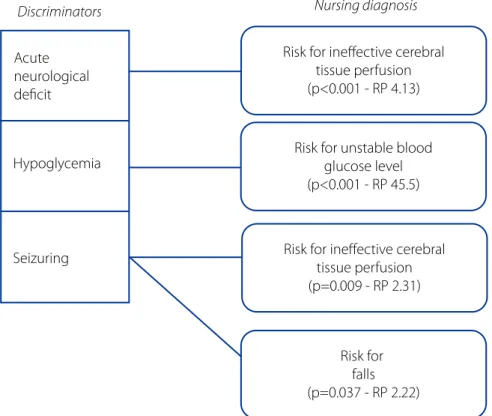
There was also a significant association between three of the 10 most frequent MTS discriminators and four of the most frequent risk NDs.
The discriminators Acute neurological deficit (p<0.001; PR 4.13; 95%CI: 2.37–7.19) and Seizuring (p=0.009; PR 2.31; 95%CI: 1.23–4.34) were significantly associated with the ND Risk for ineffective cerebral tissue perfusion. The discrimi-nator Seizuring was also significantly associated with the
ND Risk for falls (p=0.037; PR 2.22; 95%CI: 1.05– 4.71). Con-versely, the discriminator Hypoglycemia was significantly associated with the ND Risk for unstable blood glucose level (p < 0.001; PR 45.5; 95%CI: 6.47– 319). Only the dis-criminator Shock was not significantly associated with any NDs. Similarly, the ND Risk for bleeding was not significant-ly associated with any of the discriminators. These results can be seen in Figure 2.
Discriminators
Acute neurological deficit
Hypoglycemia
Seizuring
Nursing diagnosis
Risk for ineffective cerebral tissue perfusion (p<0.001 - RP 4.13)
Risk for unstable blood glucose level (p<0.001 - RP 45.5)
Risk for ineffective cerebral tissue perfusion (p=0.009 - RP 2.31)
Risk for falls (p=0.037 - RP 2.22)
Figure 2 - Significant associations between MTS discriminators and risk NDs. Porto Alegre, RS, Brazil, 2015. Source: Research data, 2015.
DISCUSSION
The findings of the present study show a significant as-sociation between MTS discriminators and the NDs most frequently established in an ED, demonstrating a corre-spondence between them and reinforcing the hypothesis that the data collected during triage also provide important clues for establishing NDs. In both processes (MTS and ND), the nurse bases the patient’s evaluation on an interpretation of data collected in a systematized manner, focused on the chief complaint and on the patient’s physical examination. This process facilitates identification of defining character-istics, risk factors, and related factors to support the clinical reasoning, both to classify the patient’s priority of care and to help establish NDs during the course of the encounter.
sensation, and/or epigastric pain, and the discriminator Intense painis defined as an unbearable, lacerating pain, usually described as never experienced before, and with an intensity ranging from 8-10(3). In the present study, pa-tients assigned the discriminator Cardiac pain had a four-fold prevalence of the ND Acute pain, and those assigned the discriminator Intense pain had a threefold prevalence of this ND, thus corroborating the hypothesis of our study. In line with these findings, an investigation on the frequen-cy of NDs and their defining characteristics in patients with cardiovascular diseases observed that acute pain was the most prevalent ND (70.7%), with the defining characteristic verbal report of pain being present in 100% of the cases(7).
The discriminator Cardiac pain was also significantly associated with the ND Impaired comfort, which has the following defining characteristics, among others: anxiety, crying, inability to relax, moaning, uneasiness and feeling of discomfort(5). Precordial pain is usually associated with acute coronary syndrome(8). Nurses should pay attention to certain aspects of pain, such as location, intensity and du-ration, as well as to its risk, triggering and relieving factors, to ensure proper assessment and care of patients treated at the ED. It is also important to highlight that, although precordial or cardiac pain may be found in different flow charts, this discriminator will always be classified into clin-ical priority II (very urgent), regardless of the flow chart used, which may explain its high prevalence in the present study and in previous studies(9). Our results also reveal that patients assigned the discriminator Cardiac pain were four times more likely to present with the ND Impaired comfort, which corroborates the accuracy of the discriminator.
Another common clinical manifestation found in the present study and widely described in the literature is dys-pnea(10). A study that analyzed the demand of patients clas-sified according to the MTS also identified Very low O2 Sat and Inadequate breathing as prevalent discriminators. Of note, the discriminator Very low O2 Sat is defined as an SaO2 below 95% in patients receiving supplemental oxygen therapy or below 90% on room air, and the discriminator Inadequate breathing is defined as the patient’s inability to breathe enough to maintain adequate oxygenation, pos-sibly leading to increased work of breathing, signs of inad-equate breathing, or exhaustion(3). These definitions are in line with the defining characteristics of the ND Ineffective breathing pattern, namely abnormal breathing pattern (rate, rhythm, depth), bradypnea, tachypnea, dyspnea, nasal flaring, use of accessory muscles to breathe, and pursed-lip breathing(5). Our study showed that patients assigned the discriminator Very low O2 Sat were three times more likely to present with the ND Ineffective breathing pattern, and
those with the discriminator Inadequate breathing were twice as likely to present with this ND, again confirming our hypothesis that MTS discriminators support NDs and constitute an important element for critical thinking and diagnostic reasoning. Moreover, the discriminator Inade-quate breathing is found in different MTS flow charts, be-cause it may lead to life-threatening risk for the patient, and determines clinical priority I (emergency), which explains its high prevalence in our study.
In this context, a validation study of Nursing Outcome Classification (NOC) for the ND Ineffective breathing pat-tern considered the indicator Respiratory status: airway patency as priority(10-11). This finding corroborates those of the present study, since airway patency involves the as-sessment of the discriminators Very low O2 Sat and Inade-quate breathing. Therefore, it is worth stressing that patient screening should focus on signs of respiratory distress or failure so that nurses are able to implement early interven-tions to keep the patient’s airways open.
The present study also revealed that the discriminators Acute neurological deficit, defined as any loss of neuro-logical function, such as changes in or loss of sensitivity, limb weakness (transient or permanent), and Altered con-scious level, defined as a change in Glasgow Coma Scale scores during the last 12 hours compared with previous status(3), are in line with the defining characteristics of the ND Unilateral neglect. This ND has the following defining characteristics, among others: alteration in safety behav-ior on neglected side, failure to move trunk, and failure to move limbs in the neglected hemisphere(5), which shows that the above-mentioned discriminators support this ND. We found that patients assigned the discriminator Acute neurological deficit were 36 times more likely to present with the ND unilateral neglect, and those assigned to the discriminator Altered conscious level were four times more likely to present with this ND. It is worth highlighting that the institution where the study was conducted is a referral center for the treatment of patients with ischemic stroke, which may have influenced our results.
fail-ure(12). Thus, heart rate and rhythm should be assessed by nurses during physical examination, since the ND Abnor-mal pulse may manifest as palpitations, syncope, precordial pain, and even sudden death. One of the resources that may help nurses to detect arrhythmias is the 12-lead electrocar-diogram, which should be performed as soon as possible. Our results showed that patients with Abnormal pulse were three time more likely to present with the ND Decreased car-diac output, a finding that should be considered by nurses.
Other significant associations were also found between MTS discriminators and risk NDs. The discriminators Acute neurological deficit and Seizuring and the ND Risk for inef-fective cerebral tissue perfusion. This ND refers to the risk for a decrease in cerebral tissue circulation(5), which may be demonstrated by various neurological abnormalities, including seizures(3). A previous study of the NOC validated 18 clinical indicators of the ND Risk for ineffective cerebral tissue perfusion(13), including impaired neurological reflex-es and reduced level of consciousnreflex-ess, elements similar to those that nurses evaluate when using the MTS discrimina-tor Acute neurological deficit. Moreover, the discriminadiscrimina-tors Acute neurological deficit and Altered conscious level are frequently associated with ischemic stroke, a clinical con-dition in which the patient has ineffective cerebral tissue perfusion and one of the leading causes of morbidity and mortality worldwide(14). Thus, nurses must recognize risk factors, signs, and symptoms of this health problem and pay special attention to the time since onset of symptoms, which is a determining factor to define clinical priority and patient prognosis, as earlier treatment is associated with greater therapeutic benefits. Additionally, in this study, pa-tients assigned the discriminator Acute neurological defi-cit had a fourfold prevalence of the ND Risk for ineffective cerebral tissue perfusion, while patients assigned the dis-criminator Seizuring had a twofold prevalence of this ND. The discriminator Seizuring was also significantly associat-ed with the ND Risk for falls, risk factors for which include alteration in cognitive functioning, acute illness, and vascu-lar disease(5). All of these factors are in line with the clinical status demonstrated by seizures, which translates into an increased vulnerability to falls.
The discriminator Hypoglycemia, defined as blood glu-cose levels below 55 mg/dL(3), was associated with the ND Risk for unstable blood glucose level. This ND is defined as a vulnerability “to variation in blood glucose/sugar levels from the normal range which may compromise health”, which may manifest by such signs as tremor, pallor, sleep-iness, mental confusion, difficulty in motor coordination, and nausea. In the present study, patients assigned this discriminator, which is found in different MTS flow charts
and is always assigned clinical priority I (emergency), were 45 times more likely to present with the ND Risk for unsta-ble blood glucose level.
Among the 10 discriminators selected, only one was not associated with problem-focused NDs, and only two were not associated with risk NDs. We infer that these as-sociations were not found for different reasons, including possible rapid changes in clinical condition, inadequate assessment or use of a discriminator, and/or establishment of an inaccurate ND. The absence of association may also be due to the fact that some NDs have very similar defining characteristics. Further studies are needed to address this.
In addition to this limitation, the present study also did not include any records of pediatric patients. This was a deliberate choice, as there are specific MTS flow charts as well as signs and symptoms in this age range, which would have required a different sample and a longer study period.
However, the discriminators associated significantly with NDs in the adult patients evaluated in this study all repre-sent high-priority clinical situations from the standpoint of nursing care, as they reflect potentially life-threatening conditions requiring support of physical, neurologic and ho-meostatic functions. These associations reveal that use of the MTS, although originally designed as a protocol to identify patient care priority, also facilitates identification of the de-fining characteristics, related factors, and risk factors under-lying NDs and, consequently, the interventions needed to obtain positive outcomes. Thus, it is understood that use of the information collected through the MTS not only organiz-es the prioritiorganiz-es of patient care in the ED, but also facilitatorganiz-es the clinical reasoning process that characterizes all phases of the NP, in which the nurse recognizes clues and evidence of the situation at hand and distinguishes it from similar situa-tions to establish the most accurate ND and/or intervention.
CONCLUSION
Corresponding author: Amália de F. Lucena
E-mail: [email protected]
Received: 06.22.2017 Approved: 10.03.2017 Decreased cardiac output, while Acute neurological deficit
and Altered conscious level were associated with the ND Unilateral neglect. The discriminators Acute neurological deficit and Seizuring were associated with the ND Risk for ineffective cerebral tissue perfusion; the discriminator Hy-poglycemia was associated with the ND Risk for unstable blood glucose level; and Seizuring was also associated with the ND Risk for falls.
One limitation of this study was its single-center design, which may preclude generalization of findings. Further-more, the absence of previous studies addressing MTS and NDs in the field of urgent and emergency care may have restricted discussion of our findings. Thus, we again empha-size the need for further studies of MTS discriminators and NDs in other contexts of care to explore new possible asso-ciations and strengthen the results presented herein.
The findings of study contribute to the expansion of nursing knowledge in the field of urgent and emergency care, by providing data that bring theory closer to prac-tice, facilitating discussions on the topic and contributing to the development of clinical judgment skills. From the standpoint of nursing research, this study is both a novel possibility and an input for future investigations, as it was the first to assess possible associations between MTS flow chart discriminators and the NANDA-I in a real-world clinical environment. From the standpoint of care, the associations tested and found to be statistically significant can help nurs-es expand their knowledge base and shed new light on the search of diagnostic accuracy in emergency settings.
REFERENCES
1. Azeredo TRM, Guedes HM, Almeida RAR, Chianca TCM, Martins JCA. Efficacy of the Manchester Triage System: a systematic review. Int Emerg Nurs. 2015[cited 2016 Jun 20];23(2):47-52. Available from: http://www.sciencedirect.com/sci-ence/article/pii/S1755599X14000512.
2. Santos AP, Freitas P, Martins HM. Manchester triage system version II and re-source utilization in the emergency department. Emerg Med J. 2014[cited 2016 Jun 20];31(2):148-52. Available from: http://emj.bmj.com/content/ emermed/31/2/148.full.pdf.
3. Mackway-Jones K, Marsden J, Windle J. Sistema Manchester de Classificação de Risco: classificação de risco na urgência e emergência. 1. ed. Belo Horizonte (MG): Grupo Brasileiro de Classificação de Risco; 2010.
4. Acosta AM, Duro CLM, Lima MADS. Activities of the nurse involved in triage/ risk classification assessment in emergency services: an integrative review. Rev Gaúcha Enferm. 2012[cited 2016 Jun 4];33(4):181-90. Available from: http:// www.scielo.br/pdf/rgenf/v33n4/en_23.pdf.
5. Heardman TH, Kamitsuru S. NANDA International Nursing Diagnoses: definitions & classification, 2015-2017. 10th ed. Oxford: Wiley Blackwell; 2014. 6. Souza CCC, Mata LRF, Carvalho EC, Chianca TCM. Nursing diagnoses in
pa-tients classified as priority level I and II according to the Manchester pro-tocol. Rev Esc Enferm USP. 2013 [cited 2016 jun 26]; 47(6):1318-24. Available from: http://www.scielo.br/pdf/reeusp/v47n6/en_0080-6234-reeusp-47-6-01318.pdf.
7. Pereira JMV, Cavalcanti ACD, Santana RF, Cassiano KM, Queluci GC, Guimarães, TCF. [Nursing diagnoses for inpatients with cardiovascular diseases]. Esc Anna Nery. 2011[cited 2016 Jun 26];15(4):737-45. Available from: http://www.scie-lo.br/pdf/ean/v15n4/a12v15n4.pdf . Portuguese.
8. Christ M, Dorman H, Enk R, Popp S, Single S, Müller C, et al. Chest pain units or chest pain algorithm?. Med Klin Intensivmed Notfmed. 2014[cited 2016 Aug 4];109(7):495-503. Available from: https://link.springer.com/article/10.1007 %2Fs00063-013-0342-z.
9. Guedes HM, Almeida AGP, Ferreira FO, Vieira Júnior G, Chianca TCM. [Risk clas-sification: portrait of a population using a Brazilian emergency service]. Rev Enf Ref. 2014[cited 2016 May 29];4(1):37-44. Available from: http://www.scielo. mec.pt/pdf/ref/vserIVn1/serIVn1a05.pdf. Portuguese.
10. Diniz AS, Silva AP, Souza CC, Chianca TCM. Clinical demand in an emergency care unit according to the Manchester triage system. Rev Eletrôn Enferm. 2014[cited 2016 Aug 26]; 16 (2):312-20. Disponível em: https://www.fen.ufg.br/fen_re-vista/v16/n2/pdf/v16n2a06.pdf.
11. Canto DF, Almeida MA. Nursing outcomes for ineffective breathing patterns and impaired spontaneous ventilation in intensive care. Rev Gaúcha Enferm. 2013[cited 2016 Aug 6];34(4):137-45. Available from: http://www.scielo.br/ pdf/rgenf/v34n4/en_18.pdf.
12. Galvão PCC, Gomes ET, Figueirêdo TR, Bezerra SMMS. Nursing diagnosis applied to patients with decompensated heart failure. Cogitare Enferm. 2016[cited 2017 mar 15];21(2):1-8. Available from: http://revistas.ufpr.br/cogitare/article/ view/44646/28161.
13. Almeida MA, Silva MB, Panato BP, Siqueira APO, Silva MP, Engelman B, et al. Clinical indicators to monitor patients with risk for ineffective cerebral tissue perfusion. Invest Educ Enferm. 2015[cited 2016 Aug 30];33(1):155-63. Avail-able from: http://www.scielo.org.co/pdf/iee/v31n1/v33n1a18.pdf.
14. Gonzalez MM, Timerman S, Oliveira RG, Polastri TF, Dallan, LAP, Araújo S, et al. I Guideline for Cardiopulmonary Resuscitation and Emergency Cardiovascular Care – Brazilian Society of Cardiology: executive summary. Arq Bras Cardiol. 2013[cited 2016 Aug 3];100(2):105-13. Available from: http://www.scielo.br/ pdf/abc/v100n2/en_v100n2a01.pdf.
15. Franco B. Analysis of the Manchester Triage System as Subsidy for Nursing Diag-noses [dissertation]. Porto Alegre (RS): School of Nursing, Universidade Federal do Rio Grande do Sul; 2015 [citado 2016 mai 10]. Available from: http://www. lume.ufrgs.br/handle/10183/129598.