ISSN 0100-2945 http://dx.doi.org/10.1590/0100-29452016448
CONTROL OF GRAPEVINE DECLINE WITH
THE USE OF DRAINS AND RIDGES
1RemI NatalIN DamBRoS2, maRco aNtoNIo DalBó3,
cRIStIaNo João aRIolI4, mIltoN Da VeIga5
ABSTRACT – the incidence of grapevine decline and dye back is quite severe in grapevine-growing regions of southern Brazil, especially in the midwest of the State of Santa catarina. Field studies on problematic areas
identified the presence of the Brazilian ground pearl or margarodes (Eurhizococcus brasiliensis Hempel) and
soil fungi (Cylindrocarpon, Fusarium and others) associated with the disease. Soil characteristics such as high clay content and poor aeration were associated with the problem. to evaluate the effect of pre-planting tillage in reducing the incidence of grapevine decline, an experiment was carried out with two rootstocks and
three pre-planting tillage (regular plowing, drains, and ridges) in an area where high plant mortality had been
previously observed. Pre-planting tillage with the use of ridges along the rows gave the best results with a drastic reduction in the decline incidence. the number of ground pearl cysts was unaffected by pre-planting tillage and did not relate with the incidence of decline and death of plants.
Index terms: Vitis sp., rootstocks, black foot disease, ground pearl.
CONTROLE DO DECLÍNIO DA VIDEIRA COM
O USO DE DRENOS E CAMALHÕES
RESUMO – a incidência de declínio e morte de plantas de videira é bastante comum nas regiões vitícolas do Sul do Brasil, especialmente no Vale do Rio do Peixe-Sc. estudos de campo realizados em áreas com
grande incidência identificaram a presença de pérola-da-terra (Eurhizococcus brasiliensis Hempel) e fungos
de solo (Cylindrocarpon, Fusarium e outros) associados à doença. Observou-se também que características
de solo, como alta percentagem de argila e deficiência de aeração, estavam associadas ao problema. Para avaliar o efeito de sistemas de preparo do solo em pré-plantio na redução do declínio e morte de plantas de
videira, implantou-se um experimento fatorial com dois porta-enxertos e três sistemas de preparo do solo em
pré-plantio (preparo regular e confecção de drenos e camalhões) em área com histórico de alta mortalidade de plantas. A confecção de camalhões na linha de plantio proporcionou os melhores resultados, com redução significativa da incidência de declínio. O número de cistos de pérola-da-terra foi pouco afetado pela confecção de drenos ou de camalhões e não se correlacionou com a incidência de declínio e morte de plantas.
Termos para indexação: Vitis sp., porta-enxerto, pérola-da-terra, pé-preto.
1(Trabalho 028-15). Recebido em: 09-01-2015. Aceito para publicação em: 17-08-2015. 2 Pesquisador da Epagri – Estação Experimental de Videira-SC. E-mail: [email protected] 3Pesquisador da Epagri – Estação Experimental de Videira-SC. E-mail: [email protected]
2
INTRODUCTION
the incidence of decline and death of vine plants is one of the most serious problems of viticulture in Brazil, having been responsible for the elimination of many vineyards in the main
producing regions (SCHUCK et al., 2001; BOTTON et al., 2000; GARRIDO et al., 2004a). The causes
of this problem seem to be multiple, including the attack of the Brazilian ground pearl or margarodes
(Eurhizococcus brasiliensis Hempel), soil fungi and other causes of stress for plants. the problem shows itself particularly serious in young plants, which prevents the establishment of new vineyards in some places.
the decline and death of young plants have been reported in several countries and attributed mainly to the attack of fungi from the genus Cylindrocarpon (“black-foot”), Phaeoacremonium and Phaeomoniella (Petri disease) (HALEEN et al.,
2006; GUBLER at al., 2004). In these locations,
environmental factors causing plant stress, such as problems of handling and compaction or poor-draining soil are related to the disease development
(HALEEN et al., 2007). These factors are also associated with vine decline in Brazil (GARRIDO
et al., 2004b).
In the Vale do Rio do Peixe region, in the midwest of the State of Santa catarina, there is also evidence that the physical conditions of the soil are related to the decline of the vine, but with the added
difficulty that the presence of ground pearl apparently
enhances the action of pathogenic fungi because of
damage caused in the roots (DALBÓ et al., 2012).
In this region, the smooth plain soils with higher
clay content (Oxisols) are showing higher rates of mortality, whereas in gravelly soils (Cambisols),
with better natural drainage, problems are generally smaller. another feature observed in the vineyards of this region is that even in deep soil, the root system is very shallow, with a small percentage of roots exceeding 40 cm in depth. the lack of aeration is the most likely cause for restriction to deep root system
growth (DALBÓ et al., 2011).
measures that have been used to reduce the vine decline primarily involve the use of neonicotinoid insecticides applied to the soil for control of the ground pearl. this practice has
satisfactory efficiency only in the case of young plants (BOTTON et al., 2010). The use of more
resistant rootstocks against decline has been a way
to reduce the problem (BOTTON; COLLETA, 2010; DALBÓ et al., 2012). Another measure that
has proved effective is preparing the ground for
pre-planting with the use of trenches or drains, which improves the conditions of drainage and soil aeration
(DALBÓ et al., 2007). These three alternatives were
studied at different locations in the Vale do Rio do Peixe, Sc, and all of them had some effect in reducing the incidence of vine decline. Notwithstanding, none of the alternatives provided satisfactory results when
isolated (DALBÓ et al., 2007).
more intensive soil preparation systems in pre-planting have been used to circumvent the problem, for instance, the opening of trenches in the rows with the help of bulldozers. However, the
opening of trenches is difficult and costly to run and
can result in water accumulation inside when not associated with subsurface drainage. making ridges along the row is an alternative soil preparation that can provide similar results to the opening of trenches by the fact that it increases the volume of soil with good drainage and aeration, which would act as a safe zone for the roots. the ridges are recommended both to facilitate the cultivation of the vine in areas with drainage problems and to increase the depth of shallow soils or with other physical or chemical
restraints in the basement (KIRCHHOF et al., 1991; MYBURGH and MOOLMAN, 1991; CONRADIE et al., 2002; WHEATON et al., 2008). Veiga et al. (2012) observed improvements in chemical and
physical properties with different depths in the ridges, which were attributed to moving the surface layer of soil between rows to the crop row. this provided greater uniformity in attributes between layers sampled down to 40 cm depth.
this study was conducted to assess the effect of making drains and/or ridges on the development and incidence of decline in two vine rootstocks in areas where high incidence of plant mortality had been previously observed.
MATERIAL AND METHODS
the experiment was conducted in the area of the epagri - Videira experiment Station,
Videira, SC (27o02’24” S, 51o08’05” W, and
altitude 834 m). The soil is classified as Dystrophic
Red latosol according to the Brazilian System of
Soil Classification (EMBRAPA, 2004), an Oxisol according to Soil Taxonomy (SOIL SURVEY STAFF, USDA, 2006), and presented at the site of
conduction of the experiment fertilizations correction and maintenance were performed according to the recommendation for the crop.
treatments consisted of four soil tillage systems before planting, applied in main plots and
two grapevine rootstocks (VR 043-43 and Dog
Ridge) applied as sub-plots. the tillage systems were:
WP – without preparation; DR – making drains 80 cm deep, separated by a band of three meters; RI –
making ridges along the row 40 cm high and 90 cm
wide; and DRRI – making of drains and ridges. The
experimental design was a randomized split plot
design with five replications.
crop management consisted of weeding along the rows of culture and mowing between rows. Periodic spraying with fungicides was also made to control anthracnose. the experiment was installed in august 2007 and conduced for three vegetative cycles. the plants were pruned in august of each year, to 50 cm from ground level. In october / November of each year, we evaluated the percentage of dead plants or with characteristic foliar symptoms of decline. Here we present only the results of the evaluation performed in the last year, which can be considered the cumulative effect of the treatments. at the end of the third growing season, in June, 50x50 cm square and 20 cm high soil monoliths were collected at layers 0-20 and 20-40 cm deep in a pit open alongside a representative portion of the plant to determine the dry mass of roots after drying in an oven with forced air circulation at 70 °c for 48 h and the presence of cysts of ground pearl associated with the roots. the results were subjected to the
analysis of variance, and when significant differences
observed for the F test, means were compared by
the “t test” (p<0.05). Roots from plants showing decline symptoms were collected for identification
of pathogenic fungi present in the samples. the basic
methodology is described in Garrido et al. (2004b).
RESULTS AND DISCUSSION
the cultivation on ridges significantly reduced the incidence of plants with symptoms of
decline in both rootstocks studied (Table 1), but no significant effect was observed when treatment
involved only drains. this result is probably related to the improvement in chemical and physical soil attributes and greater uniformity in values in depth with the making of ridges, creating more favorable conditions for root growth in the deeper layers
(VEIGA et al., 2012). This can be proven by the
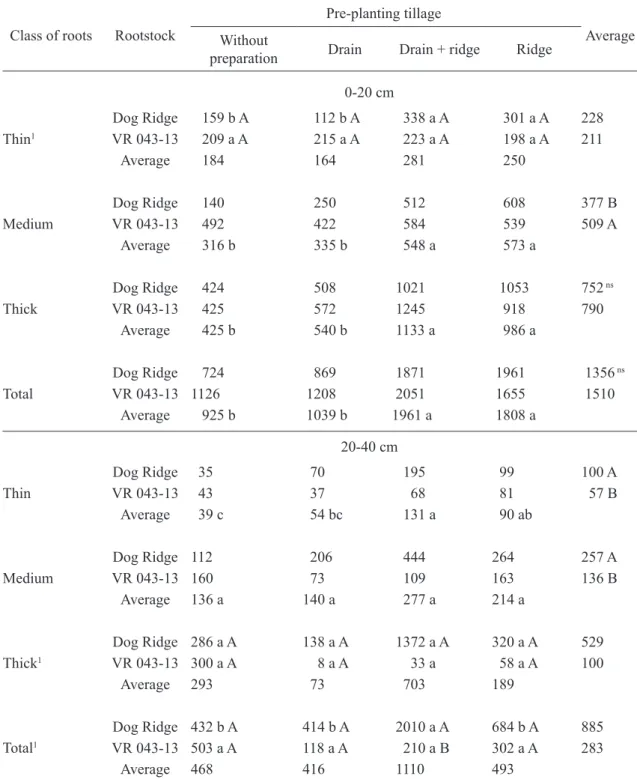
greater dry mass of roots observed in this system in
both layers sampled (Table 2). This effect was more
pronounced on the middle diameter roots in the 0-20
cm layer, higher in rootstock VR 043-43, and on fine
and medium diameter roots in the 20-40 cm layer, higher in the rootstock Dog Ridge, demonstrating a differential effect on rootstocks. the differences between the rootstocks root distribution is probably due to the root habit of each rootstock, since the VR 043-43 has greater tendency to concentrate the roots
in the surface layers (DALBÓ et al., 2011). The same
was observed in this experiment, where the amount
of roots in the bottom layer (20-40 cm) was higher
in the Dog Ridge relative to VR 043-43 in most root
classes analyzed (Table 2).
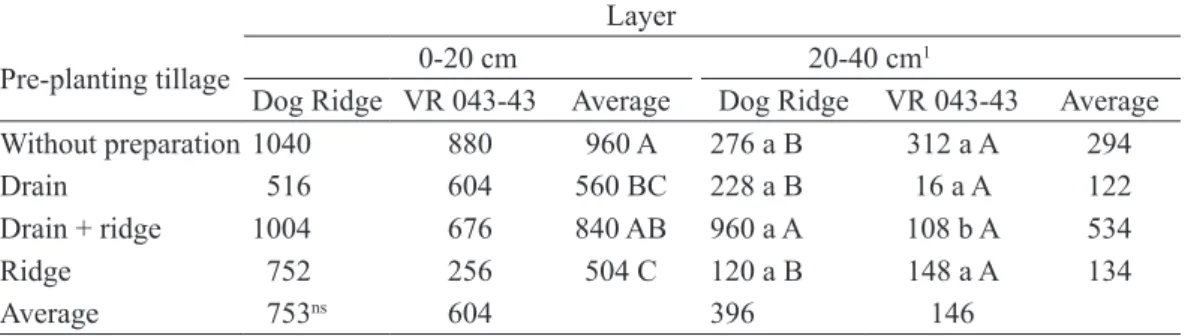
Significant differences were observed in the
number of cysts of ground pearl depending on the
tillage systems, rootstocks and layers (Table 3). Such
differences can be associated with the occurrence of
a significant positive correlation between the number
of cysts and the mass of medium, large and whole
classes of roots (Table 4). There was, for some classes
of roots, greater root growth provided by making ridges or drains, which should have favored the multiplication of this pest, but without result in loss of vigor and appearance of vine decline. thus, the
number of cysts of ground pearl had no significant
correlation with the incidence of decline and death of plants under the conditions studied.
the incidence of decline and death of vine plants is associated, in addition to the ground pearl presence, to fungi and other soil stress factors for
plants (CAVALCANTI et al., 2013; GARRIDO et al., 2004b; DALBÓ et al., 2007). In the present experiment, the symptoms of “black foot” caused
by Cylindrocarpon destructans (or Neonectria liriodendri according to Haleen et al., 2007), characterized by the blackening of the roots of the exchange region, were quite common in plants showing symptoms of decline. Root samples analyzed in the laboratory allowed the isolation of some pathogenic fungi, especially Fusarium oxysporum, Cylindrocladium and Cylindrocarpon. garrido et al.
(2004b) found fungi of the genus Cylindrocladium, Phaeoacremonium, Botryosphaeria, Verticilium, Fusarium, Graphium, and Cylindrocarpon present in plants with symptoms of decline in vineyards of the
“Serra Gaúcha” region. Thus, it is likely that more
than one species of pathogenic fungus is contributing to the degradation of the vine root system.
the symptoms of vine decline occurring in southern Brazil are in many respects similar to
diseases internationally known as “black foot”,
caused by Cylindrocarpon sp., and the “Petri
4
Phaeoacremonium and Phaeoamoniella. these diseases have been reported in several countries,
such as South Africa (HALEEN et al., 2006), New Zealand (MUNDY; MANNING, 2010), United States (GUBLER et al., 2004; SCHECK et al.,
1998) and others, attacking mainly young plants. In general, these diseases are unimportant under normal growing conditions, but tend to appear in marginal soil conditions and plants subjected to some form of stress. these same fungi were found in Brazil
associated with decline (GARRIDO et al., 2004a).
It is likely that, in our conditions, damage to roots by the attack of the ground pearl, associated with
deficiencies of aeration due to the clayey soil texture
and high rainfall, are factors that enable the attack of pathogenic fungi that leads to the destruction of the root system. thus, the most likely hypothesis is that soil preparation on ridges reduces the incidence of decline because of the unfavorable conditions for the fungi causing the disease without having a direct action on ground pearl.
In recent years several new vineyards in the State of Santa catarina have been planted with ridges along the rows with the objective to reduce the incidence of grape decline problems. It has been observed that it has limited effect when traditional rootstocks are used, such as Paulsen 1103 or 101-14. However, when associated with more resistant rootstocks, such as VR 043-43, it was an effective technique to reduce the incidence of decline, which
confirms the results obtained in this study. Benefits
of planting on ridges are expected for the same type of soil in which the experiment was conducted. In the case of less developed, gravelly soils, with high macroporosity, ridges are possibly unnecessary. However, most of the new vineyards are being established in areas more suitable for mechanization, where soils usually have high clay content and poor aeration. In these conditions, planting on ridges can be considered an important measure to reduce problems of plant mortality in the establishment of new vineyards in the midwest of the State of Santa catarina and others areas with similar soil conditions.
TABLE 1- Incidence of plants with symptoms of decline in two grapevine rootstocks according to the soil tillage in pre-planting.
Pre-planting tillage Dog Ridge VR 043-43
Plants with symptoms of decline (%) Whithout preparation 84 a a 56 b a
Drain 32 b a 72 a a
Drain + ridge 4 a B 12 a B
Ridge 0 a B 4 a B
- Means followed by the same small letters in lines (between rootstock) and capital letters in columns (among tillage systems) do not differ by t-test for multiple comparisons of means (LSD).
TABLE 2- Dry mass of roots (g m-3) of rootstocks Dog Ridge and VR 043-43 at layers of 0-20 and 20-40 cm deep, according to the soil tillage in pre-planting.
class of roots Rootstock
Pre-planting tillage
average
Without
preparation Drain Drain + ridge Ridge
0-20 cm
thin1
Dog Ridge 159 b a 112 b a 338 a a 301 a a 228
VR 043-13 209 a a 215 a a 223 a a 198 a a 211
average 184 164 281 250
medium
Dog Ridge 140 250 512 608 377 B
VR 043-13 492 422 584 539 509 a
average 316 b 335 b 548 a 573 a
thick
Dog Ridge 424 508 1021 1053 752 ns
VR 043-13 425 572 1245 918 790
average 425 b 540 b 1133 a 986 a
total
Dog Ridge 724 869 1871 1961 1356 ns
VR 043-13 1126 1208 2051 1655 1510
average 925 b 1039 b 1961 a 1808 a
20-40 cm
thin
Dog Ridge 35 70 195 99 100 a
VR 043-13 43 37 68 81 57 B
average 39 c 54 bc 131 a 90 ab
medium
Dog Ridge 112 206 444 264 257 a
VR 043-13 160 73 109 163 136 B
average 136 a 140 a 277 a 214 a
thick1
Dog Ridge 286 a a 138 a a 1372 a a 320 a a 529
VR 043-13 300 a a 8 a a 33 a 58 a a 100
average 293 73 703 189
total1
Dog Ridge 432 b a 414 b a 2010 a a 684 b a 885
VR 043-13 503 a a 118 a a 210 a B 302 a a 283
average 468 416 1110 493
- Means followed by the same small letters in lines (among pre-planting tillage) and capital letters in columns (between rootstocks within each root class) do not differ by t-test for multiple comparisons of means (LSD). 1: interaction between pre-planting tillage and rootstock; ns: no significant differences.
- SD for 0-20cm layer: Thin: SD plots= 20.2%; SD subplots= 18.8 %; Medium: SD plots= 23.9%; SD subplots= 22.6%; Thick: SD plots= 31.3%; SD subplots= 30.1%; Total: SD plots= 21.9%; SD subplots= 21.8%.
6
TABLE 3- Number of ground pearl cysts associated with the roots of two grapevine rootstocks according to the soil tillage in pre-planting and layer sampled.
layer
Pre-planting tillage 0-20 cm 20-40 cm
1
Dog Ridge VR 043-43 average Dog Ridge VR 043-43 average
Without preparation 1040 880 960 a 276 a B 312 a a 294
Drain 516 604 560 Bc 228 a B 16 a a 122
Drain + ridge 1004 676 840 aB 960 a a 108 b a 534
Ridge 752 256 504 c 120 a B 148 a a 134
average 753ns 604 396 146
- Means followed by the same small letters in lines (between rootstocks within each pre-planting tillage) and capital letters in columns (among pre-planting tillage) do not differ by t-test for multiple comparisons of means (LSD). 1: interaction between pre-planting tillage and rootstock; ns: no significant differences.
- 0-20cm layer: SD plots= 29.9%; SD subplots= 32.3%; 20-40cm layer: SD plots= 57.5%; SD subplots= 67.1%
TABLE 4- Pearson correlation coefficients (r) between dry weight of roots and number of ground pearl cysts
associated with classes of roots of rootstock Dog Ridge at layers of 0-20 and 20-40 cm deep.
Root class layer sampled
0-20 cm 20-40 cm
thin 0.0387ns 0.2349 ns
medium 0.0213 ns 0.5053 **
thick 0.1083 ns 0.4430 **
total 0.1011 ns 0.5655 **
**: significant at 1% level (p<0.01); ns: not significant.
CONCLUSIONS
the making of ridges reduces the incidence of decline and death of plants of grapevine
rootstocks in a clayey Oxisol;
Root growth of rootstocks is favored by
making ridges and / or drains;
the number of ground pearl cysts is little affected by the making of drains or ridges in pre-planting of rootstocks, and is not correlated with the incidence of decline and death of plants.
REFERENCES
BOTTON M.; COLLETA, V.D. Avaliação da
resistência de cultivares de Vitis rotundifolia à
perola-da-terra (Hemiptera: Margarodidae) na região sul do
Brasil. Acta Scientiarum Agronomy, maringá, v. 32, n. 2, p. 213-216, 2010.
BOTTON, M.; HICKEL, E.R.; SORIA, S.J.;
teIXeIRa, I. Biologia e controle da pérola-da-terra Eurhizococcus brasiliensis (Hempel, 1922) (Hemíptera: margarodidae) na cultura da videira.
Bento Gonçalves: Embrapa Uva e Vinho, 2000. 23 p. (Circular Técnica, 27).
BOTTON, M.; TEIXEIRA, I.; BAVARESCO, A.; PASTORI, P.L. Use of soil insecticides to control the Brasilian ground pearl (Hemiptera: Margarodidae) in
vineyards. Revista Colombiana de Entomologia, Bogotá, v. 36, n. 1, p. 20-24, 2010.
CAVALCANTI, F.R.; BUENO, C.J.; ALMANÇA, M.A.K. Declínio e Morte de Plantas de Videira.
Bento Gonçalves: Embrapa Uva e Vinho, 2013. 40p. (Documentos, 82).
CONRADIE, W.J.; CAREY, V.A.; BONNARDOT, V.; SAAYMAN, D.; SCHOOR, H. Effect of
DALBÓ, M.A.; ARIOLI, C.; LOPES DA SILVA, M.; ANDRADE, E.R. Resistência de
porta-enxertos ao declínio e morte de plantas de videira. In: coNgReSSo BRaSIleIRo De
FRUTICULTURA, 22., 2012, Bento Gonçalves.
Anais... Bento Gonçalves: Sociedade brasileira de
fruticultura, 2012. v. 1.
DALBÓ, M.A.; PERUZZO, E.L. SCHUCK, E.
alternativas de manejo para o controle do declínio da Videira. Agropecuária Catarinense, Florianópolis,
v. 20, n.1, p. 58-61, 2007.
DALBÓ, M.A.; VEIGA, M.; GARDIN, J.P.P.
Desenvolvimento do sistema radicular de videira
em função de porta-enxertos e de atributos físicos
e químicos do solo. Agropecuária Catarinense,
Florianópolis, v. 24, n. 1, p. 59-63, 2011.
emBRaPa - empresa Brasileira de Pesquisa agropecuária. centro Nacional de Pesquisa de Solos.
Solos do Estado de Santa Catarina. Rio de Janeiro:
EMBRAPA/CNPS, 2004. 1 CD-ROM.; mapa color. (Boletim de Pesquisa e Desenvolvimento, 46).
GARRIDO, L.R., SÔNEGO, O.R.; URBEN, A.F.
Cylindrocarpon destructans, causador do “pé-preto” da videira no Rio grande do Sul. Fitopatologia Brasileira, Brasília, v. 19, n. 5, p. 548-550, 2004a.
GARRIDO, L.R., SÔNEGO, O.R; GOMES, V.N.
Fungos associados com o declínio e morte de videiras
no estado do Rio grande do Sul. Fitopatologia
Brasileira, Brasilia, v. 29, n. 3, p. 322-324. 2004b.
GUBLER, W.D.; BAUMGARTNER, K.; BROWNE, G.T.; ESKALEN, A.; ROONEY LATHAM, S.; PETIT, E.; BAYRAMIAN, L.A. Root diseases
of grapevines in california and their control.
Australasian Plant Pathology, murdoch, v. 33, n. 2, p. 157-165, 2004.
HALEEN, F.; FOURIE, P.H.; CROUS, P.W. A review
of black foot disease of grapevine. Phytopathologia Mediterranea, Firenze, v. 45, n. 1, p. 55-67, 2006.
HALEEN, F.; SCHOEURS, H.F.; GROENEWALD, J.Z.; REGO, C.; OLIVEIRA, H.; CROUS, P.W.
Neonectria liriodendri sp. nov., the main causal agent of black foot disease of grapevines. Studies in Micology, Utrech, v. 55, n. 1, p. 227-234, 2007.
KIRCHHOF, G.; BLACWELL, J.; SMART,
R.e. growth of vineyard roots into segmentally ameliorated acidic subsoils. Plant and Soil, crowley, v. 134, p. 121-126, 1991.
MUNDY, D.C.; MANNING, M.A. Ecology and
management of grapevine trunk diseases in New Zealand: a review. New Zealand Plant Protection, auckland, v. 63, p. 160-166, 2010.
MYBURGH, P.A.; MOOLMAN, J.H. Ridging - a
soil preparation practice to improve aeration of vineyard soils. South African Journal of Plant and Soil, Stellenbosch, v. 8, n. 4, p. 189-193, 1991.
MUNDY, D.C.; MANNING, M.A. Ecology and
management of grapevine trunk diseases in New Zealand: a review. New Zealand Plant Protection, auckland, v. 63, p. 160-166, 2010.
SCHECK, H.; VASQUEZ, S.; FOGLE, D.; GUBLER, W.D. Grape growers report losses to black foot and
grapevine decline. california agriculture, Richmond, v. 52, n. 4, p. 18-23, 1998.
SCHUCK, E.; DALBÓ, M.A.; ROSIER, J.P.; DUCROQUET, J.P. Porta-enxertos para a cultura
da Videira. In: IV enfrute, Fraiburgo, Sc. anais.
Caçador-SC, Epagri, 2001. p. 122-132.
SOIL SURVEY STAFF. Keys to Soil Taxonomy. 10th ed. Washington: US Department of Agriculture
- Natural Resources conservation Service, 2006.
VEIGA, M.; DALBÓ, M.A.; DAMBROS, R.N.;
PaNDolFo, c.m. atributos químicos de um
Nitossolo Vermelho seis anos após a confecção de camalhões e drenos para implantação de porta-enxertos de videira. In: Reunião Sul-Brasileira de
ciência do Solo, 2012, lages. Resumos. lages: SBcS-NRS, 2012. p. 429-431. In: http://www.sbcs-nrs.org.br/rsbcs/docs/IX_RSBcS_2012_anais.pdf
WHEATON, A.D.; MCKENZIE, B.M.; TISDALL,