Rev. Bras. Saúde Matern. Infant., Recife, 17 (1): 27-42 jan. / mar., 2017 27 REVIEW
http://dx.doi.org/10.1590/1806-93042017000100003
Factors associated to nipple trauma in lactation period: a systematic review
Janaína Silva Dias 1
Tatiana de Oliveira Vieira 2
Graciete Oliveira Vieira 3
1-3Departamento de Saúde. Universidade Estadual de Feira de Santana. Av. Universitária, s.n. Km 03 BR 116. Campus Universitário. Feira de Santana, BA, Brasil. CEP: 44.031-460. E-mail: [email protected]
Abstract
Objectives: To identify the characteristics associated to nipple trauma in nursing mothers and propose a theoretical model explaining in hierarchical levels its determining factors.
Methods: a systematic review of the literature based on the search of epidemiological studies of factors associated to nipple trauma in the databases of Medical Literature Analysis and Retrieval System Online/Pubmed, Literatura Latino-Americana and Caribe em Ciências da Saúde (Latin American Literature and Caribbean Health Sciences) and ScienceDirect. The conduct on searching articles occurred until June 2016.
Results: 17 articles were selected which investigated 27 variables and found a signifi-cant association between 16 of these variables and nipple trauma. The factors associated to nipple trauma reported in two or more studies were: mother of race/color white or yellow, primiparity, inadequate position between mother and child during breastfeeding and handling the infant incorrectly to the mother’s breast. Guidance received on handling and positioning the infant during prenatal care was a protective factor against nipple trauma.
Conclusions: in the theoretical model explaining the factors associated to nipple trauma in hierarchical levels, the variables classified at the proximal level were the most investi-gated and were identified as risk factors in selected studies, indicating that in the postpartum care period is an important protective factor against nipple trauma.
Rev. Bras. Saúde Matern. Infant., Recife, 17 (1): 27-42 jan. / mar., 2017 28
Introduction
It is documented that maternal breastfeeding (MB) confers large benefits to the mother and child’s health.1-4 However, some problems are faced by
nursing mothers during breastfeeding, the example is nipple trauma and may contribute to lower preva-lence of maternal breastfeeding. Intervention measurements against its determining factors are necessary for the prevention of diseases.5-9
Nipple traumas are characterized by erythema, edema, cracks, fissures, blisters, abrasions and ecchymoses.10-12In relation to the types of nipple
injuries, there is no consensus as regarding to the degree of impairment of the tissue layer on the nipple-areola region.13,14
The lack of clinical definition for nipple trauma results in disagreements, up to a point that its diag-nosis and treatment may be compromised.14 It is
suggested that in the context of assisting nursing mothers, nipple trauma may be defined as an alte-ration in the normal anatomy of the nipple skin with the presence of a primary lesion caused by the modi-fication of the color or thickness and not only as a solution of continuity on the skin.14
The location of the lesion is observed in the upper part of the body and around the base of the nipple, more often found at the tip of the nipple10,12,15involving dermis and epidermis with
the presentation in the form of linear ulceration or curved.13The woman presents symptoms of severe
pain on the nipples during breastfeeding.15
Often nipple traumas are a gateway for patho-genic microorganisms, as mastitis,11,16-18 a Staphylococcus19infection and as major
complica-tions nipple candidiasis.20,21A study was carried out
during the national vaccination campaign formed by mothers of children under the age of one, and found that lactational mastitis was more prevalent among women who had nipple fissure.22
Among the various approaches for the preven-tion of nipple trauma, there is an attenpreven-tion in the relation to the positioning and the adequate handling of the infant to the mother’s breast,22-24as the injury
has been related to the strong pressure exerted on the nipple or the friction of the child's mouth during the suction, this may come as a result of inadequate handling.15
The survey on factors associated to nipple injury is the utmost importance basis on clinical practice for health professionals, as well as for directing intervention measurements and consequently increasing the duration of maternal breastfeeding. This current study aimed to identify the factors
asso-ciated to nipple trauma, through a systematic review of literatures, additionally to propose a theoretical model explaining its determinants in hierarchical levels.
Methods
This is a systematic review of literatures on the factors associated to nipple trauma in the lactational period, in which a pre-established protocol was used for the search, the selection and data collection, based on Preferred Reporting Items for Systematic Reviews (PRISMA) guidelines for meta-analysis studies and systematic review.25
The review was based on searches of indexed publications in the following databases: Medical Literature Analysis and Retrieval System Online
(MEDLINE)/PubMed, through the National Center for Biotechnology Information(NCBI)26platform at
http://www.ncbi.nlm.nih.gov/pubmed, Literatura Latino-Americana e do Caribe em Ciências da Saúde (Latin American Literature and Caribbean Health Sciences) (LILACS), by the Biblioteca Virtual em Saúde (Virtual Health Library) (BVS)27 at
http://regional.bvsalud.org and ScienceDirect28
data-base at http://www.sciencedirect.com/science/ search. As a complementary form of bibliographic search, the strategy of comparing the references cited in each reviewed article with the bibliography has been adopted to obtain the aforementioned above.
In order to ensure the searches, Descritor em Ciências da Saúde (Descriptor in Health Sciences) (DeCS) was consulted. The terms used in the search were: "(((trauma [Title/Abstract]) or sore [Title/Abstract]) or breastfeeding [Title/Abstract]) and nipple [Title/Abstract])))". There was no delimi-tation in the publication period or language restric-tion. On ScienceDirectdatabase, a filter was used "trauma or sore or breastfeeding and nipple [All Sources (Medicine and Dentistry, Nursing and Health Professions, Psychology, Social Sciences)]" to view the studies of interest. The conduct of searching articles occurred until June 2016.
Rev. Bras. Saúde Matern. Infant., Recife, 17 (1): 27-42 jan. / mar., 2017 29 Factors associated to nipple trauma in lactation period
selected. The inclusion of the articles and data extraction in the review were also conducted inde-pendently, the compared results and the disagree-ments were solved consensually between both reviewers. In the event of non-agreement between the peers, a third reviewer was consulted.
The appraisal of the quality of the studies were performed based on the type of study, presence of a structured abstract, introduction with background and justification; method on population recruitment; selection of the population/sample; data collection instrument; non-response informed rate; inter-viewers’ training; performance on statistical analysis; study limitation and considered biases; interpreted results according to evidence and general results. The qualification criteria will correspond to a scale29 adapted for this study with a maximum
score of 29 points for each article. "Score zero" was considered when the information was not specified in the text, or did not meet the minimum criteria for the classification of quality.
The data extraction was performed by means of the structured form. Once completed the form, the data entry was performed, including: the reference of the article (with the last name of the first author, journal and the year of publication); the study site and the year of data collection; type of study and numbered sample assessed; the objective of the study; statistical analysis applied; prevalence/inci-dence of the outcome in the study population; factors associated to nipple trauma, as well as the factors that did not obtain the statistical significance level determined.
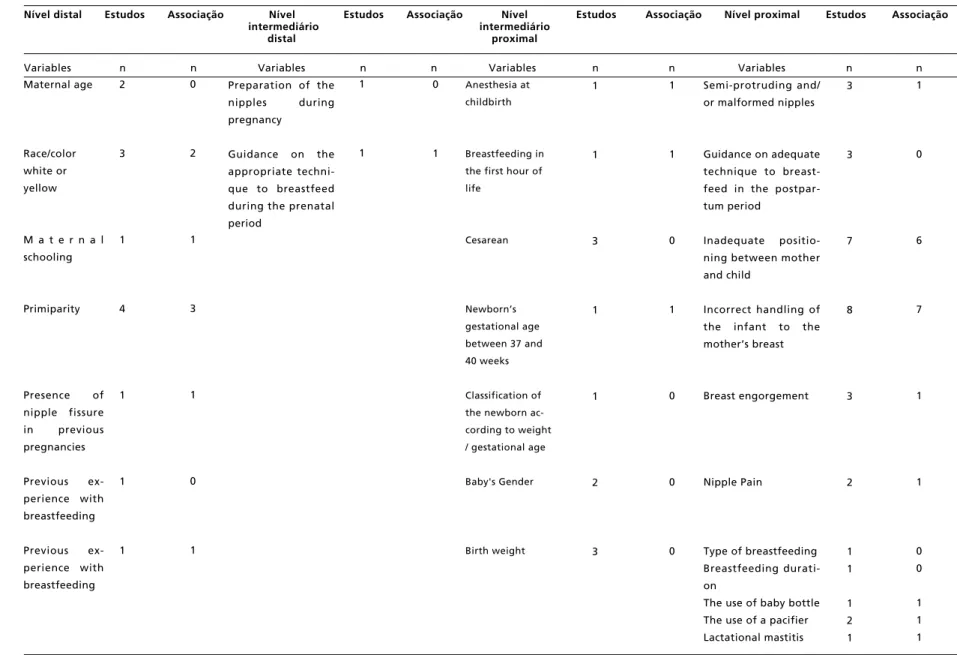
Aiming to build a theoretical model, the associa-tion found between the factors investigated and nipple trauma were analyzed individually, high-lighting and quantifying the following aspects: in how many studies were these factors used and how many identified the association to the outcome.
The last step of the study was the construction of a hierarchical model with the organization of the factors listed in the systematic review in levels according to the proximity of the outcome. Four levels of determinants were proposed: 1- distal (indi-vidual maternal characteristics and family, related to the characteristics prior to the pregnancy); 2- distal intermediaries (characteristics of prenatal care); 3-proximal intermediaries (characteristics related to childbirth care); 4- proximal characteristics (maternal characteristics of neonates and health care services, related to postpartum and the process of maternal breastfeeding).30,31
Results
In the electronic search 531 articles were found and removed six repeated articles. Evaluated 525 titles and summaries, which 493 references were excluded for not meeting the pre-established criteria and 32 articles were selected for full text reading. Two arti-cles were considered as loss due to the unavailability of the acquisition of the work and five articles were added from the lists of references from the selected articles, resulting in a total of 35 papers that were read thoroughly (Figure 1).
After reading 18 references, three articles used a specific population of premature neonates and seropositive women for the Human Immunodeficiency Virus(HIV), two study pilots, a case study and 12 references for not assessing nipple trauma as an outcome were excluded. At the end of this process, 17 studies met the inclusion criteria (Figure 1).
As for the quality of the studies, no evaluated article obtained the maximum score of 29 points, according to the reference standard applied. The result of the methodology qualification from the selected articles was between 11 to 21 points (Table 1). In relation to the research outline, six studies were cross-sectional, three cohort studies, two case-controls and six intervention studies. 10 studies were conducted in South America (Brazil, Chile and Uruguay), two in Europe (Italy and Denmark), one in Africa (Libya) and four in Australia. The smaller sample was comprised of 60 women and the largest constituted of 1,020 participants (Table 2).
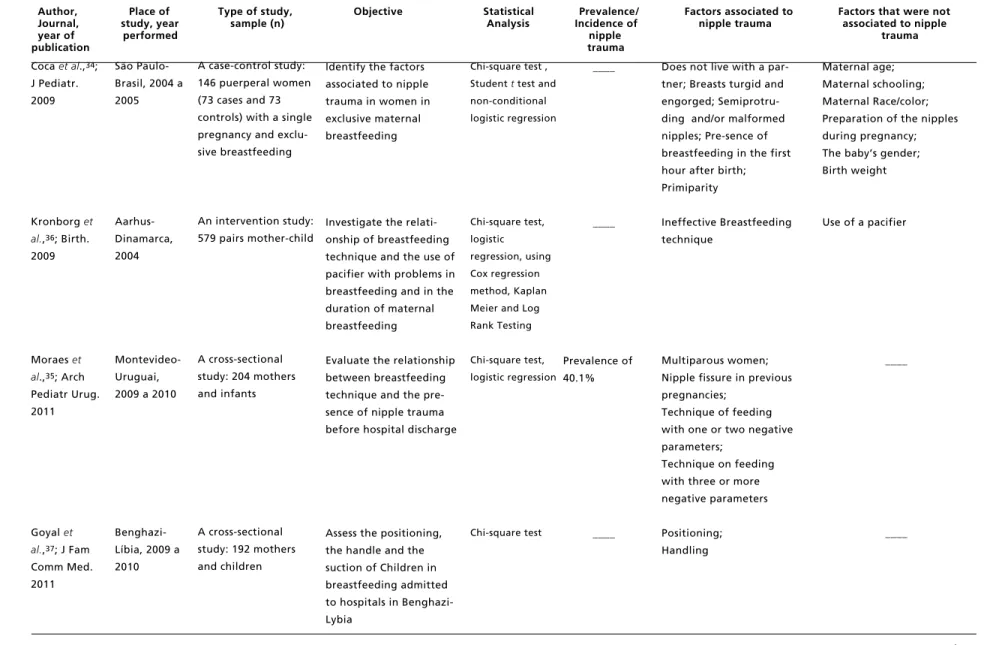
The prevalence of nipple trauma found in the studies was between 26.7% to 52.75% and the inci-dence of 16% to 100%. Among the methods of analysis used, four studies used the logistic regres-sion as a multivariate method. In Table 2 shows the variables associated to nipple trauma and the va-riables with no statistical significance. In Table 3 outlines the number of times each variable was investigated and associated to the outcome of the study.
The factors associated to nipple trauma were organized in the respective hierarchical model levels, constructed from the variables studied (Figure 2). At the distal level, which included the individual maternal characteristics and family, it is understood: mother´s race/color white or yellow,32,33
primiparity,32,34,35 presence of nipple fissure in
previous pregnancies35 and mother does not live
Rev. Bras. Saúde Matern. Infant., Recife, 17 (1): 27-42 jan. / mar., 2017 30
Dias JS et al.
Figure 1
Flowchart of the selection process of studies included in the systematic review on factors associated to nipple trauma in lactational period.
Identification
Electronic search
MEDLINE/Pubmed: 423, LILACS: 24, ScienceDirect: 84
(N= 531 references)
Repeated titles excluded (n=6)
References excluded (n=493) -Absence of abstract: 16
-Article review on treatment and/or prevention of nipple trauma: 6 -Other outcomes: 471
Losses: Full article not available
(n=2)
Obtained studies on references of selected articles
(n=5)
Studies excluded (n=18) -Specific population (premature
neonates and seropositive
women for Human
Immunodefi-ciency Virus(HIV): 3 - Study Pilot: 2 -Case study: 1
-Other outcomes (nipple pain; evaluation of breastfeeding tech-nique; nipple problems; and duration of maternal breastfeed-ing): 12
Studies included in the review (n=17)
Articles selected for evaluation of the full text
(n=35)
Included Eligibility
Tracking
Articles selected (n=32)
Evaluated titles and summaries (n=525)
Rev. Bras. Saúde Matern. Infant., Recife, 17 (1): 27-42 jan. / mar., 2017 31 Factors associated to nipple trauma in lactation period
Table 1
Qualification of selected studies according to the criteria and scores
*The score equal to zero when the information was not specified in the text or when did not meet the defined criteria.
Source: adapted from Vieiraet al.29
Du ff y et al ., 2 31 9 9 7 C e n to u ri et al ., 3 91 9 9 9 He n d e rs o n et al. , 5 82 0 0 1 We ig e rt et al ., 3 82 0 0 5 Sh im o d a et al ., 3 22 0 0 5 Ab rã o et al. , 4 02 0 0 5 O li ve ir a et al ., 5 72 0 0 6 C o ca et al ., 72 0 0 9 C o ca et al ., 3 42 0 0 9 Kr o n b o rg et al ., 3 62 0 0 9 M o ra e s et al ., 3 52 0 1 1 Go ya l et al ., 3 72 0 1 1 P ri e to -Go m é z et al ., 4 72 0 1 3 B u ck et al ., 5 52 0 1 4 Sh im o d a et al. , 3 32 0 1 4 Sh im o d a et al ., 92 0 1 5 T h o m p so n et al ., 1 22 0 1 6 5 1 1 1 1 3 1 1 1 1 1 1 18 5 * 1 1 1 1 1 * 1 * 1 1 13 5 1 1 1 1 3 1 * 1 1 1 1 17 4 1 1 1 5 3 1 1 1 1 1 1 21 2 * 1 1 1 1 1 1 1 * 1 1 11 2 * 1 1 1 3 * 1 1 * 1 1 12 5 * 1 1 5 3 1 1 1 1 1 1 21 3 1 1 1 1 1 * 1 1 1 1 1 13 3 * 1 1 1 1 * 1 1 * 1 1 11 5 1 1 1 1 3 1 1 1 1 1 1 18 2 1 1 1 1 3 * 1 1 * 1 1 13 2 1 1 1 1 3 1 1 1 1 1 1 15 2 1 1 1 1 3 * 1 * * 1 1 12 4 1 1 1 1 1 1 1 1 1 1 1 15 2 * 1 1 1 1 1 1 1 * 1 1 11 5 1 1 1 1 1 1 1 * 1 * 1 14 4 1 1 1 1 1 * 1 1 1 1 1 14 Types of study: Intervention=
5; Cohort= 4; Case-control= 3; Cross sectional= 2; Case study= 1
Structured abstract= 1
Introduction with background and justification= 1
Population recruitment: National= 3; Local residents= 2; users of units= 1
Selection of the
population/sample: Census= 6; simple random= 5; systemati-cally= 4; stratified= 3; by con-glomerates= 2; convenience= 1
The data collection instru-ment: validated and standar-dized= 3; validated= 2; stan-dardized= 1
Non-response informed rate = 1
Interviewers’ training= 1
Performed statistical analysis= 1
Study limitations and conside-red biases= 1
Interpreted results according to evidence= 1
Scale of general results: any-where in the world= 5; conti-nents= 4; the same country= 3; the same geographical region= 2; specific popula-tion= 1
Maximum score= 29
R
e
v
. B
ra
s.
S
a
ú
d
e
M
a
te
rn
. I
n
fa
n
t.
, R
e
ci
fe
, 1
7
(
1
):
2
7
-4
2
ja
n
. /
m
a
r.
, 2
0
1
7
3
2 Dia
s
JS
e
t
a
l
.
Table 2
Characteristics of the studies on the factors associated to nipple trauma included in the systematic review.
Author, Place of Type of study, Objective Statistical Prevalence/ Factors associated to Factors that were not Journal, study, year sample (n) Analysis Incidence of nipple trauma associated to nipple year of performed nipple trauma publication trauma
continue Source: Adapted from Boccolini.31
Duffyet al.23;
Midwifery, 1997
Centouri et al.,39;
J Hum Lact, 1999
Henderson et al.,58; Birth,
2001
Weigertet al.,38; J
Pediatr. 2005 Perth-Austrália, 1995
Trieste-Itália, 1996-1997
Adelaide-Austrália, 1999
Porto Alegre-Brasil, 2003
Intervention study: convenience sample with 70 primiparous (35 in the control group and 35 in the intervention group)
Intervention study: 219 mothers (96 in the control group and 123 in the intervention group)
Intervention study: 160 mothers
Cohort study:
211 mothers and babies
To evaluate the effect of prenatal orientation in positioning and handling the breast in relation to duration of breastfeeding, pain and nipple trauma
Determine the inci-dence of nipple injury and duration of breast-feeding
To evaluate the effect of educational program and placement for breastfeeding in primiparous women on the onset of nipple trauma
To investigate the influence of breast-feeding technique on nipple injuries on the first month of lactation
ANOVA,
chi-square test
ANOVA and
Kruskal-Wallis,
Fisher test, the
Chi-square test,
Mantel-Haesnzel
Fisher test,
Chi-square, student t
test
Pearson's
chi-square test or
chi-square test
with Yates
correction,
Student ttest
Incidence in the experimental group= 53%; in the control group= 100%
Incidence in the experi-mental group= 73%; in the control group= 76%
Incidence in the Experimental Group= 17%; in the control group= 16%
Incidence of 43.6%
Guidance on the positioning and adequate handling to the mother’s breast
The use of baby bottle; The use of pacifier
____
Handling the baby: mouth slightly open; Symmetrical handling
____
Prevalence of exclusive maternal breastfeeding at 4 months
Guidance on the correct positioning between mother-child in the postpartum
R
e
v
. B
ra
s.
S
a
ú
d
e
M
a
te
rn
. I
n
fa
n
t.
, R
e
ci
fe
, 1
7
(
1
):
2
7
-4
2
ja
n
. /
m
a
r.
, 2
0
1
7
3
3
F
a
ct
o
rs
a
ss
o
ci
a
te
d
t
o
n
ip
p
le
t
ra
u
m
a
in
la
ct
a
ti
o
n
p
e
ri
o
d
Table 2 continuation
Characteristics of the studies on the factors associated to nipple trauma included in the systematic review.
Author, Place of Type of study, Objective Statistical Prevalence/ Factors associated to Factors that were not Journal, study, year sample (n) Analysis Incidence of nipple trauma associated to nipple year of performed nipple trauma publication trauma
continue Source: Adapted from Boccolini.31
Shimoda et al.,32; Rev
Bras Enferm. 2005
Abrão et al.,40; Acta
Paul Enferm. 2005
Oliveira et al.,57; J Hum
Lact. 2006
Cocaet al.,7;
Rev Esc Enferm USP. 2009
São Paulo-Brasil, 2000
São Paulo-Brasil, 1996 a 1997
Porto Alegre-Brasil, 2003
São Paulo-Brasil, 2004 a 2005
A cross-sectional study: 1,020 medical records of puerperal women and newborns
A analytic descriptive study: 124 puerperal women and newborns in maternal breastfeeding
An intervention study: 211 pairs (mother and child) at 7 and 30 days after postpartum (74 in the intervention group and 137 in the control group)
A case-control study: 146 binomials mother and child (73 cases and 73 controls) in the first week of postpartum in maternal breastfeeding
Check the occurrence of the nipple accor-ding to the characteri-tics of the newborn and the puerperal
Identify and Validate defining characteristics of diagnosis on ineffec-tive breastfeeding
Evaluate the impact of an intervention of breastfeeding technique about nipple problems during the first month after postpartum
Identify factors related to the position of the child during breastfeeding and apprehension of the nipple
Chi-square test
and two
measurement
test
Chi-square test,
Cochran G test
Pearson's
chi-square test or
the chi-square
test with Yates
correction,
Student t-Test
Chi-square,
student t -test,
univariate
analysis and
correspondence
analysis
Prevalence of 52.75%
Prevalence of 30.6%
7 days inciden-ce of 43.2% in the control group and 48.9% in the intervention group
____
7 days incidence of 43.2% in the control group and 48.9% in the intervention group
____
____
Mother/baby positioning: Position of the child not alignment.
Handling of the baby: Chin away from the breast;
Lip facing inward
Type of nipple; Type of childbirth;
Baby’s gender; Baby’s weight
Incorrect handling of the nipple-areola region; Parity;
Malformed nipples
An intervention on adequate orientation on breastfeeding technique
R
e
v
. B
ra
s.
S
a
ú
d
e
M
a
te
rn
. I
n
fa
n
t.
, R
e
ci
fe
, 1
7
(
1
):
2
7
-4
2
ja
n
. /
m
a
r.
, 2
0
1
7
3
4 Dia
s
JS
e
t
a
l
.
Tabela 2 continuation
Qualificação dos estudos selecionados segundo os critérios e escores.
Author, Place of Type of study, Objective Statistical Prevalence/ Factors associated to Factors that were not Journal, study, year sample (n) Analysis Incidence of nipple trauma associated to nipple year of performed nipple trauma publication trauma
continue Source: Adapted from Boccolini.31
Coca et al.,34;
J Pediatr. 2009
Kronborg et al.,36; Birth.
2009
Moraes et al.,35; Arch
Pediatr Urug. 2011
Goyal et al.,37; J Fam
Comm Med. 2011
São Paulo-Brasil, 2004 a 2005
Aarhus-Dinamarca, 2004
Montevideo-Uruguai, 2009 a 2010
Benghazi-Líbia, 2009 a 2010
A case-control study: 146 puerperal women (73 cases and 73 controls) with a single pregnancy and exclu-sive breastfeeding
An intervention study: 579 pairs mother-child
A cross-sectional study: 204 mothers and infants
A cross-sectional study: 192 mothers and children
Identify the factors associated to nipple trauma in women in exclusive maternal breastfeeding
Investigate the relati-onship of breastfeeding technique and the use of pacifier with problems in breastfeeding and in the duration of maternal breastfeeding
Evaluate the relationship between breastfeeding technique and the pre-sence of nipple trauma before hospital discharge
Assess the positioning, the handle and the suction of Children in breastfeeding admitted to hospitals in Benghazi-Lybia
Chi-square test ,
Studentttest and
non-conditional
logistic regression
Chi-square test,
logistic
regression, using
Cox regression
method, Kaplan
Meier and Log
Rank Testing
Chi-square test,
logistic regression
Chi-square test
____
____
Prevalence of 40.1%
____
Does not live with a par-tner; Breasts turgid and engorged; Semiprotru-ding and/or malformed nipples; Pre-sence of breastfeeding in the first hour after birth; Primiparity
Ineffective Breastfeeding technique
Multiparous women; Nipple fissure in previous pregnancies;
Technique of feeding with one or two negative parameters;
Technique on feeding with three or more negative parameters
Positioning; Handling
Maternal age; Maternal schooling; Maternal Race/color; Preparation of the nipples during pregnancy; The baby’s gender; Birth weight
Use of a pacifier
____
R
e
v
. B
ra
s.
S
a
ú
d
e
M
a
te
rn
. I
n
fa
n
t.
, R
e
ci
fe
, 1
7
(
1
):
2
7
-4
2
ja
n
. /
m
a
r.
, 2
0
1
7
3
5
F
a
ct
o
rs
a
ss
o
ci
a
te
d
t
o
n
ip
p
le
t
ra
u
m
a
in
la
ct
a
ti
o
n
p
e
ri
o
d
Table 2 concluded
Characteristics of the studies on the factors associated to nipple trauma included in the systematic review.
Author, Place of Type of study, Objective Statistical Prevalence/ Factors associated to Factors that were not Journal, study, year sample (n) Analysis Incidence of nipple trauma associated to nipple year of performed nipple trauma publication trauma
Source: Adapted from Boccolini.31
Prieto-Goméz et al.,47; Rev
Colombiana Obstetr Ginecol. 2013
Buck et al.,55;
Breastfeed Med. 2014
Shimoda et al.,33; Rev
Min Enferm. 2014
Shimoda et al.,9; JBI
Database System Rev Implement Rep. 2015
Thompson et al.,12;
Women Birth. 2016
Temuco-Chile, 2010 a 2011
Melbourne-Australia, 2009 a 2011
São Paulo-Brasil, 2000
São Paulo-Brasil, 2013
Melbourne-Australia, 2001 a 2007
A cross-sectional study: 343 postpartum women for convenien-ce sampling
A cohort study: 340 primiparous women
A cross-sectional study: 60 women
An intervention study: 196 women and newborns
A cohort study: 653 women
To determine the
prevalence of nipple fissure in mothers in the early puerperium, and practices of health professionals in relation to breastfeeding
To describe the nipple pain/ injury and its rela-tion to the type of childbirth
Check the association between the persistence of nipples injuries and breastfeeding conditions
Evaluate the implementa-tion impact of the Assess-ment Form on breastfee-ding, to observe and guide the mother in the postnatal period, on the rates of nipple trauma
Describe the characteristics of women who partici-pated in the service of breastfeeding and explore the potential risk factors for nipple trauma and breast engorgement
Descriptive
analysis with
prevalence
calculation
Chi-square test
Fisher test
Descriptive
analysis with
incidence
calculation
Chi-square test,
logistic
regression
Prevalence of 46.1%
Incidence of 58%
Prevalence of 26.7%
Incidence of 67.3%
Incidence of 62.9%
____
____
Color of the nipple-areola region little pigmenta-tion; Nipple pain; Impro-per handling of the new-born to the mother's breast
____
Asymmetric handling infants’ facialmandibu-lar in relation to the bre-ast; Positioning: techni-que cross-cradle; hand in "scissors" to hold the bre-ast; Lactational mastitis
Maternal age; Type of childbirth; Parity; Classifi-cation of the newborn according to weight/ gestational age; Previous experience with breast-feeding; Presence of pain
Type of childbirth
Type of breast feeding; Breast engorgement. Nipple type
Guidance on maternal breastfeeding and breastfeeding technique during the postpartum period
R
e
v
. B
ra
s.
S
a
ú
d
e
M
a
te
rn
. I
n
fa
n
t.
, R
e
ci
fe
, 1
7
(
1
):
2
7
-4
2
ja
n
. /
m
a
r.
, 2
0
1
7
3
6 Dia
s
JS
e
t
a
l
.
Table 3
Factors investigated in the evaluated studies and the number of times that were associated to nipple trauma, organized by hierarchical level.
Nível distal Estudos Associação Nível Estudos Associação Nível Estudos Associação Nível proximal Estudos Associação intermediário intermediário
distal proximal
Variables n n Variables n n Variables n n Variables n n
Source: Adapted from Boccolini. 31
Maternal age
Race/color white or yellow
M a t e r n a l schooling
Primiparity
Presence of nipple fissure in previous pregnancies
Previous ex-perience with breastfeeding
Previous ex-perience with breastfeeding
2
3
1
4
1
1
1
Preparation of the nipples during pregnancy
Guidance on the appropriate techni-que to breastfeed during the prenatal period
Anesthesia at
childbirth
Breastfeeding in
the first hour of
life
Cesarean
Newborn’s
gestational age
between 37 and
40 weeks
Classification of
the newborn
ac-cording to weight
/ gestational age
Baby's Gender
Birth weight
1
1
3
1
1
2
3
1
1
0
1
0
0
0
Semi-protruding and/ or malformed nipples
Guidance on adequate technique to breast-feed in the postpar-tum period
Inadequate positio-ning between mother and child
Incorrect handling of the infant to the mother’s breast
Breast engorgement
Nipple Pain
Type of breastfeeding Breastfeeding durati-on
The use of baby bottle The use of a pacifier Lactational mastitis 0
2
1
3
1
0
1
1
1
0
1
3
3
7
8
3
2
1 1
1 2 1
1
0
6
7
1
1
0 0
R
e
v
. B
ra
s.
S
a
ú
d
e
M
a
te
rn
. I
n
fa
n
t.
, R
e
ci
fe
, 1
7
(
1
):
2
7
-4
2
ja
n
. /
m
a
r.
, 2
0
1
7
3
7
F
a
ct
o
rs
a
ss
o
ci
a
te
d
t
o
n
ip
p
le
t
ra
u
m
a
in
la
ct
a
ti
o
n
p
e
ri
o
d
Figure 2
The theoretical hierarchy model of risk factors for nipple trauma.
Source: Adaptado de Boccolini.31
Distal model
Maternal characteristics
- Maternal Age
- Maternal race/color
- Maternal schooling
- Parity
-Presence of nipple fis-sure in previous preg-nancies
-Prior experience with breastfeeding
Family characteristics
- Lives with a partner
Distal intermediate model
Characteristics of prenatal care
-Preparation of the nipples during preg-nancy
-Prenatal guidance in positioning and adequate handling of the infant to the mother’s breast
Proximal intermediate model
Characteristics of childbirth care
- Anesthesia at child-birth
-Breastfeeding in the first hour of life
- The type of child-birth
- Newborn’s gesta-tional age
-Classification of the newborn according to weight/age
- Baby's gender
- Birth weight
Proximal model
Characteristics of postpartum and
breastfeeding process
- Nipple type
-Guidance on han-dling and positioning
-Positioning between mother and child
-Handling of the
mother’s breast
- Breast engorge-ment
- Nipple pain
- Type of breastfeed-ing
- Breastfeeding dura-tion
- The use of baby bot-tle
- The use of a pacifier
-Lactational mastitis
N
ip
p
le
t
ra
u
m
Rev. Bras. Saúde Matern. Infant., Recife, 17 (1): 27-42 jan. / mar., 2017 38
At the distal intermediate level which refers to the characteristics of prenatal care, the guidance received on handling and adequate positioning of the infant to the mother’s breast was considered as a protective factor for nipple trauma.23At the
pro-ximal intermediate level constituted by the charac-teristics of childbirth care, an association to nipple injury was observed: the use of anesthesia at child-birth,32gestational age between 37 and 40 weeks32
and the presence of breastfeeding in the first hour of life.34
At the proximal level constituted of maternal and newborns characteristics and the health care services related to postpartum and the process of maternal breastfeeding, the variables identified as factors associated to nipple trauma were: semi-protruding and/or malformed nipples,32inadequate positioning
between mother and child during breast-feeding,7,12,35-37incorrect handling of the infant to
the mother’s breast,7,12,33,36-38presence of breast
engorgement,34nipple pain,33lactational mastitis,12
baby bottle feeding39and/or pacifier.39
Discussion
This systematic review investigated epidemiological studies on nipple trauma. The selected studies demonstrated differences in prevalence rates between 26.7% to 52.75%, as well as in the esti-mated incidences that ranged from 16% to 100%. The variability of the measurements found can be explained, among other reasons, by special features in the definition of the outcome, by the study design, different sample sizes or losses on the follow-ups registered in some studies.
The first week after childbirth, it was the period of the greatest appearance of nipple injuries.32,34,39,40Corroborating with this finding to
other studies,41,42that identified a higher incidence
of nipple injury between the second and third day of postpartum. However, teaching the technique of breastfeeding within the first few days after child-birth and the observation of breastfeeding are essen-tial for the prevention and reduction of nipple trauma.
The incorrect handling of the infant to the mother’s breast and the inadequate positioning between mother and child were associated to nipple trauma in most number of studies, followed by pri-miparity and mother ‘s race/color white or yellow. In the adequate handling to the breast, the child must be with the lips facing out, mouth wide open, the appearance of rounded cheeks, the presence of more
areola above the child’s mouth (asymmetric handling) and the chin touching the mother's breast. In the proper placement during breastfeeding, the child’s body is near and facing the mother, the head and body aligned, the mouth is the same height as the nipple and the infant’s buttocks supported.43,44
Regarding to the infant’s handling, studies have identified as unfavorable parameters of the child’s chin away from the breast,34the bottom lip facing
in,34the mouth a little opened38and absence of the
asymmetrical handling.38However, in another study,
the criterion of asymmetric handling was not a suffi-cient parameter for defining this, because in the assessment of breastfeeding some mothers had a small areola circumference and for this reason all the nipple-areola region remained covered by the neonate’s lips, hindering the view on the observation of breastfeeding.33
Inadequate technique in breastfeeding, including the handling and the positioning between mother and child was also associated to breast problems in other studies.12,35-37In this aspect, intervention actions are
essential to prevent the appearance of nipple injuries.34,36,38
In this current study, the set of variables that has been identified as potential predictors were classi-fied in hierarchical levels, according to the proximity of the factor exposure with the outcome. At the pro-ximal level, which refers to the characteristics of the postpartum and breastfeeding process, in addition to the incorrect handling of the infant and the inade-quate positioning between mother and child were also considered as predictors of nipple trauma, the nipple type was not favorable, the presence of breast engorgement, nipple pain, the use of baby bottle and pacifier. The occurrence of lactational mastitis was also included in this level.
It was observed that nursing mothers with breasts engorgement presented a greater chance to occur nipple trauma.7In these cases, the complex
area of the nipple-areola region is flatten so more distortion of the anatomy of the breast, a fact that makes it difficult to handle the infant correctly, leading to nipples injuries.45,46 Women with
malformed nipples also presented greater chances to occur injuries when compared to breastfeeding women with protruding nipples format.32
The nipple injury was associated to pain,33 a
common symptom that may occur in the first few hours of maternal breastfeeding47and is indicated as
inadequacy of handling the infant to the mother’s breast.24 Women who experienced pain during
nique.24 The diagnosis and early treatment of
handling and inadequate positioning can reduce the consequences generated by the women, among all of this, the interruption of maternal breastfeeding.47
In relation to the use of baby bottles and/or paci-fier, children can present a pattern of inadequate suction of the mother’s breast by distorting the movements of the tongue, causing the so-called "nipple confusion". In the usual behavior on the suction of a baby bottle, children use the tongue to control the flow of the milk from the tip of the latex nozzle, while the correct suction on the mother’s breast, is the tongue moving in waving motion to remove the milk, protecting the nipple from frictions and injuries.48,49Studies have reported an
associa-tion between pacifier use and the technique of inade-quate breastfeeding.48,50However, a review of 14
articles found little evidence of the causal relation-ship between the use of pacifiers and baby bottles and nipple confusion.51
The local or general lactational mastitis is joined to nipple trauma.12 The authors emphasized this
because it is a retrospective study and they did not allow the determination of cause and effect. Other studies have related nipple fissure to the develop-ment of lactational mastitis.11,16,17,18,22,52
At the proximal intermediate level were identi-fied as factors associated to nipple trauma, the use of anesthesia during childbirth, neonates’ gestational age between 37 and 40 weeks and breastfeeding in the first hour of life. There was a significant associa-tion between epidural anesthesia received by women for a cesarean section or episiotomy in the vaginal delivery having nipple injury. The presence of discomfort and pain in the surgical incision can compromise the positioning of the puerperal to breastfeed her child, resulting in the appearance of nipple injury.32
Mothers who had cesarean sections were more likely to have problems related to breastfeeding, including nipple fissure, in comparison to women who had vaginal delivery.53,54However, there were
no relationship observed between nipple injury with the type of childbirth in a cohort study conducted in Australia with 340 primiparous women.55
The incidence of nipple injury in mothers with newborns at term (37 to 40 weeks of gestation) was higher when compared to preterm infants of 32 to 37 weeks.32 It may be inferred that the strongest force
of suction and a better application of the breast tissue during breastfeeding of children born at term have contributed for nipple injury.
Breastfeeding in the first hour of life was identi-fied as a risk factor for nipple injury,34 which
according to the authors, the result found is probably related to the handling and the incorrect positioning of the child to be placed for breastfeeding and this is not the strategy of breastfeeding in the first hour of life, as recommended for early establishment in maternal breastfeeding.56
At the distal intermediate level, it was noted that guidance received during prenatal care on the tech-nique of breastfeeding was a protective factor against the occurrence of nipple trauma, reflecting on the importance of the completeness care during this period to prevent nipple injuries and its possible consequences, although only one study has evalu-ated this feature.23Women who have had prenatal
guidance presented less pain and nipple trauma during the first four days after childbirth, in addition to a higher prevalence of maternal breastfeeding within the six weeks after childbirth.23
Educational programs in prenatal care can provide necessary knowledge, as well as contribute to increase the mother’s confidence in her ability to breastfeed, important characteristics to initiate breastfeeding. The synergism of actions developed during the gestation and after the birth of the child is fundamental to prevent nipple injuries. A study performed with the puerperal women between the second and the fourth day postpartum showed that only 60% of women remembered about the guidance they received on breastfeeding during the prenatal period.47Similar to the guidance on breastfeeding
technique performed only in the postpartum period which did not determine a positive effect in preventing nipple problems.9,57
At the distal level of the hierarchical model of this study, nipple trauma was considered as risk factors for mothers’ race/color white or yellow, primiparity, presence of nipple fissure in previous pregnancies and mothers who did not live with a partner.
Nursing mothers’ race/white or yellow color were related to nipple injury.32,33 Dark skinned
women are less likely to present nipple injuries during breastfeeding due to the greater amount of melanin and consequently the increase of skin resis-tance to nipple trauma caused by the infants’ suction.32However, in a case-control study,
breast-feeding women’s skin color is not self-referred as a determinant factor for the appearance of nipple trauma.7
The primiparity is a factor that independently can be associated to nipple trauma. A study with puerperal women on exclusive maternal breast-feeding showed that primiparous women have a greater chance to develop nipple injury when
Rev. Bras. Saúde Matern. Infant., Recife, 17 (1): 27-42 jan. / mar., 2017 40
comparing those with more than one child.7
The educational program to correct positioning during the postpartum period did not show statistical significance in preventing nipple trauma in an inter-vention study with primiparous women.58 The
results of another study37indicated that most
multi-parous women presented satisfactory parameters in relation to the positioning and handling, which could be a result of the previous experience in the practice of maternal breastfeeding. It should be noted that primiparous women need different approaches to establish breastfeeding.
The presence of nipple fissure in previous gesta-tion was associated to the appearance of nipple injuries in 204 women evaluated before hospital discharge.35 In this study, it considered only the
history of breast complications, no information about the characteristics of the skin and the nipple.
Nipple trauma was associated to the absence of the partner.34The authors discussed that the lack of
the partner could leave the woman more insecure, making the practice of breastfeeding difficult. The lack of emotional and social support could interfere in the process of maternal breastfeeding and the occurrence of nipple injuries.47
The mother's age, the schooling level, previous experience with breastfeeding, preparing the nipples during the gestation, the type of childbirth, classifi-cation of the newborn according to weight and gesta-tional age, the child’s gender, birth weight, guidance on positioning the child in the postpartum period, type and duration of maternal breastfeeding, there were no determinate factors for nipple trauma among the selected studies. However, the hierarchical model was kept due to the understanding of the biological plausibility of these characteristics as possible factors associated to nipple trauma.
There were no studies identifying the contextual level approach in respect to the factors related to the support actions and protection on maternal breast-feeding within the location (city/town), so this level will not be included in the hierarchical model proposed.
Regarding to the limitations of this present study, there is the possibility of not identifying and selecting some studies about the topic addressed and,
for not entering in the search criteria that was esta-blished. Another limitation was observed regarding the methodological quality of the studies found, however, only four used the logistic regression as a multivariate analysis, limiting the possibility to iden-tify confounders and effect modifiers. Furthermore, in virtue of the heterogeneity of the studies listed, it was not possible to employ the use of quantitative synthesis of the results by means of meta-analysis.
Final Considerations
Nipple trauma is a common problem among women in the lactational period, which can start immediately after the delivery. The main risk factors identified were: the incorrect handling of the infant to the mother’s breast, the inadequate positioning between mother and child, primiparity and maternal race/color defined as white or yellow, characteristics observed, respectively in seven, six, three and two reviewed studies.
Other factors were identified as determinants for nipple trauma in at least one study: the presence of nipple fissure in previous gestations, mothers who did not live with a partner, the use of anesthesia during delivery, newborn’s gestational age between 37 and 40 weeks, semi-protruding and/or malformed nipples, presence of breast engorgement, nipple pain, lactational mastitis, the use of baby bottle and/or pacifier. The guidance received on handling and appropriate positioning during the prenatal care was shown as a protective factor for nipple trauma.
The characteristics related to postpartum and maternal breastfeeding, classified in the proximal hierarchical level were the most investigated and identified as risk factors, indicating that the preven-tive actions aiming to reduce nipple trauma should be developed mainly in the postpartum period, with teaching techniques of breastfeeding. Although the results analyzed by different levels contribute to the understanding of the processes involved in the occurrence of nipple injuries, the current study does not have a definitive conclusion, since the practice of MB is the result of the interaction of multiple individual and contextual determinants.
Dias JS et al.
References
1. Gartner LM, Morton J, Lawrence RA, Naylor AJ, O'Hare D, Schanler RJ, Eidelman AI. Breastfeeding and the use of human milk. Pediatrics. 2005; 115(2):496-506.
Rev. Bras. Saúde Matern. Infant., Recife, 17 (1): 27-42 jan. / mar., 2017 41 Factors associated to nipple trauma in lactation period
3. Brasil. Ministério da Saúde. Secretaria de Atenção à Saúde. Departamento de Atenção Básica. Saúde da criança-nutrição infantil: aleitamento materno e alimentação complementar. Brasília, DF; 2009.
4. WHO (World Health Organization). Infant and young child feeding: Model chapter for text books for medical students and allied health professionals. Geneva; 2009.
5. Riordan J, Bibb D, Miller M, Rawlins T. Predicting breast-feeding duration using the LATCH breastbreast-feeding assess-ment tool. J Hum Lact. 2001; 17 (1): 20-3.
6. Ahluwalia IB, Morrow B, Hsia J. Why do women stop breastfeeding? Findings from the pregnancy risk assess-ment and monitoring system. Pediatrics. 2005; 116 (6): 1408-12.
7. Coca KP, Gamba MA, Silva RSE, Abrão ACFV. Factors associated with nipple trauma in the maternity unit. J Pediatr. 2009; 85 (4): 341-5.
8. Vieira GO, Martins CC, Vieira TO, Oliveira NF, Silva LR. Factors predicting early discontinuation of exclusive breast-feeding in the first month of life. J Pediatr. 2010; 86 (5): 441-4.
9. Shimoda GT, Soares AV, Aragaki IMM, Mcarthur A. Preventing nipple trauma in lactating women in the University Hospital of the University of Sao Paulo: a best practice implementation project. JBI Database System Rev Implement Rep. 2015; 12 (13): 212-32.
10. Ziemer MM, Pigeon JG. Skin changes and pain in the nipple during the 1st week of lactation. J Obstet Gynecol Neonatal Nurs. 1993; 22 (3): 247-56.
11. Giugliani ERJ. Common problems during lactation and their management. J Pediatr. 2004; 80 (5): 147-54.
12. Thompson R, Kruske S, Barclay L, Linden K, Gao Y, Kildea S. Potential predictors of nipple trauma from an in-home breastfeeding programme: a cross-sectional study. Women Birth. 2016; 29 (4): 336-44.
13. Coca KP, Abrão ACFV. Avaliação do efeito da lanolina na cicatrização dos traumas mamilares. Acta Paul Enferm. 2008; 21 (1): 11-6.
14. Cervellini MP, Gamba MA, Coca KP, Abrão ACFV. Injuries resulted from breastfeeding: a new approach to a known problem. Rev Esc Enferm USP. 2014; 48 (2): 346-56.
15. WHO (World Health Organization). La alimentación del lactante y del niño pequeño. Geneva; 2010.
16. Foxman B, D'Arcy H, Gillespie B, Bobo JK, Schwartz K. Lactation mastitis: occurrence and medical management among 946 breastfeeding women in the United States. Am J Epidemiol. 2002; 155: 103-14.
17. Giugliani ERJ. Lack of scientific evidence for the treatment of nipple traumas. J Pediatr. 2003; 79 (3): 197-8.
18. Cullinane M, Amir LH, Donath SM, Garland SM, Tabrizi SN, Payne MS, Bennett CM. Determinants of mastitis in women in the CASTLE study: a cohort study. BMC Fam Pract. 2015; 16 (1): 181.
19. Livingstone VH, Willis CE, Berkowitz J. Staphylococcus aureus and sore nipples. Can Fam Physician. 1996; 42: 654-9.
20. Amir LH. Candida and the lactating breast: predisposing factors. J Hum Lact. 1991; 7 (4): 177-81.
21. Tanguay KE, Mcbean MR, Jain E. Nipple candidiasis among breastfeeding mothers. Case-control study of predis-posing factors. Can Fam Physician. 1994; 40: 1407-13.
22. Vieira GO, Silva LR, Mendes CMC, Vieira TO. Mastite lactacional e a Iniciativa Hospital Amigo da Criança, Feira de Santana, Bahia, Brasil. Cad Saúde Pública. 2006; 22(6): 1193-200.
23. Duffy ER, Percival P, Kershaw E. Positive effects of an antenatal group teaching session on postnatal nipple pain, nipple trauma and breast feeding rates. Midwifery. 1997; 13: 189-96.
24. WHO (World Health Organization). Technical consultation on postpartum and postnatal care. Geneva; 2010.
25. Moher D, Liberati A, Tetzlaff J, Altman DG, Prisma Group. Reprint-Preferred Reporting Items for Systematic Reviews and Meta-Analyses: The PRISMA Statement. Phys Ther. 2009; 89(9): 873-80.
26. NCBI (National Center for Biotechnology Information). [acesso em 2016 jun 16]. Disponível em: http://www.ncbi. nlm.nih.gov/pubmed.
27. BVS (Biblioteca Virtual em Saúde). [acesso em 2016 jun 18]. Disponível em: http://regional.bvsalud.org.
28. ScienceDirect. [acesso em 2016 jun 18]. Disponível em: http://www.sciencedirect.com/science/search.
29. Vieira TO, Vieira GO, Martins CC, Santana GS, Silva L. Intenção materna de amamentar: revisão sistemática. Ciênc Saúde Coletiva. 2016; 21 (12): 3845-58.
30. Boccolini CS, Carvalho ML, Oliveira MIC, Vasconcellos AGG. Fatores associados à amamentação na primeira hora de vida. Rev Saúde Pública. 2011; 45 (1): 69-78.
31. Boccolini CS. Aleitamento materno: determinantes sociais e repercussões na saúde infantil [tese]. Rio de Janeiro: Ministério da Saúde- Fundação Oswaldo Cruz- Escola Nacional de Saúde Pública Sérgio Arouca; 2012.
32. Shimoda GT, Silva IA, Santos JLF. Characteristics, frequency and factors present in nipples damage occurence in lactating women. Rev Bras Enferm. 2005; 58 (5): 529-34.
33. Shimoda GT, Aragaki IMM, Sousa CA, Silva IA. Associação entre persistência de lesão de mamilos e condições de aleitamento materno. Rev Mineira Enferm. 2014; 18 (1): 68-74.
34. Coca KP, Gamba MA, Silva RSE, Abrão ACFV. Does breast feeding position influence the onset of nipple trauma? Rev Escola Enferm USP. 2009; 43 (2): 446-52.
35. Moraes M, Silva L, Faliú B, Sosa C. Técnica de alimentación a pecho y aparición de trauma del pezón previo al alta hospitalaria. Arch Pediatr Urug. 2011; 82 (1): 10-17.
Rev. Bras. Saúde Matern. Infant., Recife, 17 (1): 27-42 jan. / mar., 2017 42
37. Goyal RC, Banginwar AS, Ziyo F, Toweir AA. Breastfeeding practices: Positioning, attachment (latch-on) and effective suckling – A hospital-based study in Libya. J Fam Comm Med. 2011; 18 (2): 74-9.
38. Weigert EML, Giugliani ERJ, França MCT, Oliveira LD, Bonilha ALL, Espiríto Santo LC, Köhler CV. The influence of breastfeeding technique on the frequencies of exclusive breastfeeding and nipple trauma in the first month of lacta-tion. J Pediatr. 2005; 81 (4): 310-6.
39. Centuori S, Burmaz T, Ronfani L, Fragiacomo M, Quintero S, Pavan C, Davanzo R, Cattaneo A. Nipple care, sore nipples, and breastfeeding: a randomized trial. J Hum Lact. 1999; 15 (2): 125-30.
40. Abrão ACFV, Gutierrez MGR, Marin HF. Diagnóstico de Enfermagem Amamentação Ineficaz - Estudo de identifi-cação e validação clínica. Acta Paul Enferm. 2005; 18 (1): 46-55.
41. Espiríto Santo LC, Oliveira LD, Giugliani ER. Factors associated with low incidence of exclusive breastfeeding for the first 6 months. Birth. 2007; 34: 212-9.
42. Abou-Dakn M, Fluhr JW, Gensch M, Wöckel A. Positive Effect of HPA Lanolin versus Expressed Breastmilk on Painful and Damaged Nipples during Lactation. Skin Pharmacol Physiol. 2011; 24: 27-35.
43. UNICEF (United Nations Children's Fund). Breastfeeding management and promotion in a babyfriendly hospital: an 18-hour course for maternity staff. New York; 1993.
44. UNICEF (United Nations Children's Fund). Breastfeeding management and promotion in a babyfriendly hospital: an 20-hour course for maternity staff. New York; 2009.
45. Cotterman KJ. Reverse pressure softening: a simple tool to prepare areola for easier latching during engorgement. J Hum Lact. 2004; 20 (2): 227-37.
46. WHO (World Health Organization), UNICEF (United Nations Children's Fund). Baby-Friendly Hospital Initiative: revised, updated and expanded for integrated care. Geneva: World Health Organization; 2009.
47. Prieto-Gómez R, Baeza-Weinmann B. Lactancia materna: Prevalencia de grietas y dolor en mujeres que amamantan, región de la araucanía, Temuco, Chile. 2010-2011. Rev Colombiana Obstetr Ginecol. 2013; 64 (3): 229-33.
48. Righard L. Are breastfeeding problems related to incorrect breastfeeding technique and the use of pacifiers and bottles? Birth. 1998; 25: 40-4.
49. Tait P. Nipple pain in breastfeeding women: Causes, treat-ment, and prevention strategies. J Midwifery Women’s Health 2000; 45(3); 2012-5.
50. Howard CR, Howard FM, Lanphear B, Blieck EA, Eberly S, Lawrence RA. The effects of early pacifier use on breast-feeding duration. Pediatrics. 1999; 103 (3): E33.
51. Zimmerman E, Thompson K. Clarifying nipple confusion. J Perinatol. 2015; 35 (11): 895-9.
52. Kvist LJ, Hall-Lord ML, Larsson BW. A descriptive study of Swedish women with symptoms of breast inflammation during lactation and their perceptions of the quality of care given at a breastfeeding clinic. Int Breastfeed J 2007; 2:2
53. Boskabadi H, Ramazanzadeh M, Zakerihamidi M, Rezagholizade OF. Risk factors of breast problems in mothers and its effects on newborns. Iran Red Crescent Med J. 2014; 16 (6): 8582.
54. Suresh S, Sharma KK, Saksena M, Thukral A, Agarwal R, Vatsa M. Predictors of breastfeeding problems in the first postnatal week and its effect on exclusive breastfeeding rate at six months: experience in a tertiary care centre in Northern India. Indian J Public Health. 2014; 58 (4): 270-3.
55. Buck ML, Amir LH, Cullinane M, Donath SM. Nipple pain, damage, and vasospasm in the first 8 weeks postpartum. Breastfeed Med. 2014; 9 (2): 56-62.
56. WHO (World Health Organization). Evidence for ten steps to successful breastfeeding. Geneva: WHO/CHD/98.9; 1998.
57. Oliveira LD, Giugliani ER; Espírito Santo LC, França MC, Weigert EML, Kohler CV, Lourenzi Bonilha AL. Effect of Intervention to Improve Breastfeeding Technique on the Frequency of Exclusive Breastfeeding and Lactation-Related Problems. J Hum Lact. 2006; 22 (3): 315-21.
58. Henderson A, Stamp G, Pincombe J. Postpartum positioning and attachment education for increasing breastfeeding: a randomized trial. Birth. 2001; 8 (4): 236-42.
Dias JS et al.
______________
Received on August 31, 2016
Final version presented on February 8, 2017