2010 Jul-Aug; 18(4):716-24 www.eerp.usp.br/rlae
Corresponding Author: Emilia Campos de Carvalho
Universidade de São Paulo. Escola de Enfermagem de Ribeirão Preto Av. Bandeirantes, 3900
Bairro Monte Alegre
CEP: 14040-902 Ribeirão Preto, SP, Brasil E-mail: [email protected]
Infusion of Hematopoietic Stem Cells: Types, Characteristics,
Adverse and Transfusion Reactions and the Implications for Nursing
1Ana Carolina de Jesus Vieira Curcioli
2Emilia Campos de Carvalho
3Hematopoietic stem cell infusion is an important procedure in Hematopoietic Stem Cell
Transplantation (HSCT). This study identifies transfusion and other adverse reactions that can
occur during infusion and the nursing care related to the procedure. This epidemiologic study
used transplantations performed between 2006 and 2008. A total of 166 transplantations
were performed: 114 were autologous, 47 allogeneic and five haploidentical. Three
transfusion reactions and 96 adverse reactions were observed. Adverse reactions were
related to the presence of cryoprotectant, though the infusion rate and quantity of infused
cryoprotectant were not related to the occurrence of reactions. The products were fresh and
infused within the recommended time when transfusion reactions occurred. In regard to
cell source, lower engraftment time was found in peripheral blood. Nursing documentation
is relevant for patients’ safety as well to planning an infusion in order to minimize the
occurrence of reactions.
Descriptors: Hematopoietic Stem Cell Transplantation / Adverse Effects; Blood Component
Transfusion; Nursing.
1 Paper extracted from Master’s Thesis “Reações adversas e transfusionais na infusão de células-tronco hematopoéticas: implicações
para a enfermagem” presented to Escola de Enfermagem de Ribeirão Preto, Universidade de São Paulo, WHO Collaborating Centre for Nursing Research Development, SP, Brazil.
2 RN, M.Sc. in Nursing. E-mail: [email protected].
3 RN, Ph.D. in Nursing, Full Professor, Escola de Enfermagem de Ribeirão Preto, Universidade de São Paulo, SP, Brazil. E-mail:
Infusão de células-tronco hematopoéticas: tipos, características, reações adversas e transfusionais e implicações para a enfermagem
A infusão de células-tronco hematopoéticas é importante procedimento no transplante de
células-tronco hematopoéticas. Este estudo se propôs a identiicar as reações adversas
e transfusionais que podem ocorrer durante a infusão e os cuidados de enfermagem
inerentes ao procedimento. Trata-se de estudo epidemiológico em transplantes, ocorridos
entre os anos 2006 e 2008. Ocorreram 166 transplantes, sendo 114 autólogos, 47
alogênicos e 5 haploidênticos. Observaram-se três reações transfusionais e 96 reações
adversas. As reações adversas estão ligadas à presença do crioprotetor. No entanto,
velocidade de infusão e quantidade do crioprotetor infundido não tiveram relação com
a ocorrência das reações. Nas reações transfusionais, os produtos eram frescos e
infundidos na velocidade preconizada. Quanto às fontes de células, houve menor tempo
de enxertia no sangue periférico. A documentação de enfermagem é relevante tanto
para a segurança do paciente como para o planejamento da infusão, a im de minimizar
a ocorrência das reações.
Descritores: Transplante de Células-Tronco Hematopoéticas / Efeitos Adversos; Transfusão
de Componentes Sanguíneos; Enfermagem.
Infusión de células madre hematopoyéticas: tipos, características, reacciones adversas y de transfusión y sus implicaciones para la enfermería
La infusión de las células madre hematopoyéticas es un importante procedimiento en
el trasplante de células madre hematopoyéticas. Este estudio se propuso identiicar las
reacciones adversas y de transfusión que pueden ocurrir durante la infusión y los cuidados
de enfermería inherentes al procedimiento. Se trata de un estudio epidemiológico
en trasplantes ocurridos en los años de 2006 a 2008. En ese período ocurrieron 166
trasplantes, siendo 114 autólogos, 47 alogénicos y 5 haploidénticos. Se observaron
tres reacciones de transfusión y 96 reacciones adversas. Las reacciones adversas están
ligadas a presencia del crioprotector. Sin embargo, la velocidad de infusión y la cantidad
del crioprotector infundido, no tuvieron relación con la ocurrencia de las reacciones. En
las reacciones de transfusión, los productos eran frescos e infundidos con la velocidad
preconizada. En cuanto a las fuentes de células, hubo menor tiempo de injerto en la
sangre periférica. La documentación de enfermería es relevante tanto para la seguridad
del paciente como para la planiicación de la infusión, a in de minimizar la ocurrencia
de las reacciones.
Descriptores: Trasplante de Células Madre Hematopoyéticas / Reacciones Adversas;
Transfusión de Componentes Sanguíneos; Enfermería.
Introduction
Bone marrow is the traditional source of
hematopoietic stem cells but is currently being replaced by
hematopoietic progenitor cells, especially for autologous
transplantations, which is also found in peripheral blood;
another source is umbilical cord blood.
Being aware of the condition and measures adopted
during the entire process of reception and storage of
bone marrow can contribute to a safe infusion, in
preventing, identifying, minimizing or intervening in
potential intercurrences or complications. In the context
of a Bone Marrow Transplantation (BMT) unit, the
presence of a nurse is essential because a nurse, when
Given the complexity of care delivered to these
patients, the Brazilian Federal Board of Nursing (COFEN)
enacted Resolution 200/1997(2). It determines the
competencies necessary for BMT nurses and one of
these refers to speciic technical procedures related to
the aspiration and infusion of bone marrow, umbilical
cord and peripheral blood hematopoietic precursors as
well as planning and implementing actions aimed to
reduce risks and optimize treatment results. Later, after
reviewing and updating of this resolution, Resolution
COFEN 306/2006(3) was published, which sets the rules
for the work of nurses in hemotherapy.
Due to the risks inherent to the transfusion practice,
one must know the incidents related to it and their
frequency so that corrective and preventive measures
are implemented to increase transfusion safety, which is
the main objective of a blood-surveillance system(4).
Patients might present reactions similar to those
of a blood transfusion(5-6) when cells are from the bone
marrow. Transfusion reactions are negative health
conditions that occur during or after blood transfusions.
These can be classiied as immediate or delayed,
according to the time elapsed between the transfusion
and the reaction(4). The ANVISA (Brazilian National
Health Surveillance Agency) understands an immediate
transfusion reaction to be one that occurs during
transfusion or up to 24 hours later; and a delayed
reaction one that occurs 24 hours or more after the
transfusion. The most frequent signs and symptoms
are: malaise, tremors, chills, fever (above 38º C),
sweating, skin discoloration, myalgia, tachycardia,
cyanosis, nausea and vomiting, among others(7).
The Hematopoietic Stem Cells (HSC) used in
autologous transplantations are usually cryopreserved
because the patient undergoes cell collection, on
average, 15 days prior to hospitalization for the
transplant, a phase known as mobilization. Hence,
due to the prolonged time of storage and the need to
maintain cell viability, cryopreservation is necessary. The
complications of an infusion with HSC of cryopreserved
marrow or peripheral blood include cardiac alterations,
dyspnea, nausea, vomiting, allergic reactions,
hypotension, hypertension, tremors, fever, chest pain,
feeling of constriction in the larynx, abdominal cramps,
and exhalation of a characteristic odor for 24 to 36
hours. Some centers administer pre-infusion medication
such as diphenhydramine or hydrocortisone in order to
minimize discomfort(5,8).
Adverse events after graft infusion are reported in
about 80% of patients(9), while nausea and vomiting are
the most common ones(10). A study comparing reactions
among recipients of autologous cryopreserved bone
marrow and fresh allogeneic marrow found statistical
signiicance for a higher incidence of nausea, vomiting
and fever for the former(11). In another study, 67.36%
of patients presented allergic and gastrointestinal
reactions and respiratory symptoms. These occurrences
might be associated with age, the volume infused, level
of DMSO, total nucleated cell count and total number of
granulocytes(12).
Dimethyl sulfoxide (DMSO) cryoprotectant is
known for its toxic reactions, but other factors can also
cause reactions. Thus, during infusion, nurses must
monitor vital signs, oxygen saturation, symptoms of
luid overload, acute hemolytic reaction, reaction to the
DMSO, allergic or anaphylactic reaction. If a reaction
is perceived, the nurse must reduce or cease infusion,
immediately report to the physician, and administer
medication and oxygen if necessary(13).
Nurses should be informed about the source of
cells, ABO compatibility, storage regimen, treatment
provided to the cells and strategies of transplantation in
order to promote high quality care.
Based on these aspects, this study was developed
with the following objectives: to identify the types of
transplantations performed in the studied period; to
characterize the transplantations performed in regard
to the donors’ and recipients’ gender, kinship, blood
type, ABO incompatibility, and RH factor incompatibility,
the recipients’ age, HSCT type, the cell source, interval
between HSC collection and infusion, time for bone
marrow engraftment, HSC treatment, quantity of
infused DMSO, transfusion reactions, plasmapheresis in
patient and infused volume; a goal, as well, is to identify
the relationships among transfusions and acute adverse
reactions and the HSCT type, HSC sources, quantity of
infused DMSO and the volume infused.
Method
This retrospective and descriptive study collected
data from transplantations performed from 2006 to
2008 through records in patients’ medical iles and
databases of a university hospital and a transfusion unit
in the interior of São Paulo, Brazil, after authorization of
the involved institutions and approval from the Research
Ethic Committee was obtained. Data refer to the days
hematopoietic stem cell infusion was performed.
The following inclusion criteria were used:
Curcioli ACJV, Carvalho EC.
regardless of age; autologous transplantations for
self-immune and hematological diseases; allogeneic
transplantations with bone marrow or peripheral blood
sources; transplantations with HSC, cryopreserved or
not; transplantations performed between 2006 and
2008. Documental information of transplantations with
simultaneous infusion of marrow and peripheral blood
was excluded.
The data collection instrument, tested for face and
content validity by ive judges, contained the following
items: donor’s gender; recipient’s gender; recipient’s
age; kinship; HSCT type; ABO/RH incompatibility; HSC
source; HSC treatment; infused DMSO; transfusion
reactions; plasmapheresis in patient; volume/weight
relation; volume/weight/time relation; donor’s blood
type and recipient’s blood type.
Information in the medical ile of each patient
was analyzed in relation to both clinical and nursing
development, observing the presence of reactions
during cell infusion over the irst 24 hours. Adverse or transfusion reactions due to HSC were identiied in the
documentation of the hemotherapy service.
A database containing all studied variables was
developed in MS Excel; variables were examined using
descriptive statistics.
Results
According to the studied variables, the distribution of
the types of transplantations evidenced 166 transplantations
from relatives in the studied units between 2006 and 2008:
114 (68.67%) autologous, 47 (28.31%) allogeneic and
ive (3.01%) haploidentical transplantations (Table 1).
Table 1 – Distribution of donors’ characteristics (gender and blood type) and recipients’ characteristics (gender, age,
blood type) according to HSCT type. Ribeirão Preto, Brazil 2009
Variable
HSCT type
Allogeneic Autologous Haploidentical
Donor’s gender
1: Male 29 (61.70%) - 0
2: Female 18 (38.30%) - 5 (100.00%)
3: Not applicable 114 (100.00%)
Recipient’s gender
1: Male 23 (48.94%) 71 (62.28%) 3 (60.00%)
2: Female 24 (51.06%) 43 (37.72%) 2 (40.00%)
Recipient’s age
1: up to 11 years old 1 (2.13%) 0 1 (20.00%)
2: 12 to 18 years old 4 (8.51%) 11 (9.65%) 2 (40.00%)
3: 19 to 40 years old 22 (46.81%) 53 (46.49%) 1 (20.00%)
4: 41 to 59 years old 19 (40.43%) 38 (33.33%) 1 (20.00%)
5: ≤ than 60 years old 1 (2.13%) 12 (10.53%)
Kinship
1: Siblings 44 (93.62%) - 0
2: Parents 3 (6.38%) - 4 (80.00%)
3: Others - 1 (20.00%)
4: Does not apply 114 (100.00%)
Donors’ blood type
1: A 19 (40.43%) - 2 (40.00%)
2: B 3 (6.38%) - 0
3: AB 1 (2.13%) - 0
4: O 24 (51.06%) - 3 (60.00%)
5: Does not apply 114 (100.00%) 0
Recipient’s blood type
1: A 16 (34.04%) - 3 (60.00%)
2: B 6 (12.77%) - 1 (20.00%)
3: AB - 0
4: O 25 (53.19%) - 1 (20.00%)
5: Does not apply 114 (100.00%) 0
Most donors in allogeneic transplantations were
male. Females predominated in the case of haploidentical
transplantations; mothers are the preferred donors
rejection. There was a slight predominance of female
recipients in the case of allogenic transplantations; while
males predominated in haploidentical and autologous
transplantations. Ages between 19 and 40 years old
predominated for recipients both in the autologous and
allogenic transplantations. However, the most frequent
age range in the haploidentical transplantation was
between 12 and 18 years old; the remaining ages were
similar.
In relation to kinship observed in the allogeneic
transplantation, the majority were siblings and the
remaining were parents; mothers predominated in
haploidentical transplantations. A high percentage of
family members is observed in this service because it
only performs HSCT among relatives. In regard to the
donors’ blood type, type A and type O prevailed among
the allogenic and haploidentical transplantations. In
relation to the recipients’ blood type, type A and type O
were more frequent in allogeneic transplantations. Type
A was more frequent in haploidentical transplantations,
equally followed by type B and O.
In the relation between HSCT and the collection
process, time of storage and infusion rate (Table 2), the
following were considered: storage regime, choice of the
donor and cells source, which were deined based on the
underlying disease and the patient’s clinical condition.
It is observed that some of the autologous infusions
did not present DMSO, while HSC were washed. There
is a preference of infusing fresh products in the case
of allogeneic and haploidentical HSCT. This is possible
because marrow collection is scheduled for the same
day of infusion, which is expected to diminish the chance
of reactions.
In regard to cell source, there was a slight
predominance of peripheral blood in the case of
allogenic transplantations, and bone marrow in
the case of haploidentical transplantations. Most of
the infusions were performed with fresh products
in allogenic transplantations, and similarly with
the haploidentical transplantations. In the case of
autologous transplantations, HSC were frozen due to the
time required between collection and hospitalization for
transplantation. Some products were washed during the
autologous and allogenic transplantations, taking into
account the patient’s clinical condition, usually due to a
compromised renal function. The erythrocyte depletion
and deplasmatization processes that occurred in the
allogenic and haploidentical transplantations (Table 2)
were performed due to ABO system incompatibility. Almost
no patient in this study underwent plasmapheresis.
Table 2 – Distribution of HSCT types according to DMSO quantity; HSC sources, time of collection and treatment;
plasmapheresis; volume/time and volume/weight/time. Ribeirão Preto, Brazil 2009
Variable
HSCT Source
Allogeneic Autologous Haploidentical
DMSO
1: up to 0.39g 6 (12.77%) 82 (71.93%) 1 (20.00%)
2: 0.40 to 0.69g 0 17 (14.91%) 0
3: 0.70 to 1.0g 0 6 (5.26%) 0
4: Not mentioned 0 6 (5.26%) 0
5: Nothing 41 (87.23%) 3 (2.63%) 4 (80.00%)
HSC sources
1: Peripheral blood 25 (53.19%) 114 (100.00%) 1 (20.00%)
2: Bone Marrow 22 (46.81%) 0 4 (80.00%)
HSC collection time
1: < q. 24h 38 (80.85%) 0 4 (80.00%)
2: 25 to 48h 2 (4.26%) 0 0
3: > 49h 7 (14.89%) 114 (100.00%) 1 (20.00%)
HSC treatment
1: Cryopreservation 6 (12.77%) 111 (97.37%) 1 (20.00%)
2: Erythrocyte depletion 6 (12.77%) 0 0
3: Washed 2 (4.26%) 3 (2.63%) 0
4: Deplasmatization 1 (2.13%) 0 2 (40.00%)
5: None 32 (68.09%) 0 1 (20.00%)
6: Mixed treatment 0 0 1 (20.00%)
Plasmapheresis
1:Yes 4 (8.51%) 1 (0.88%) 0
2:No 43 (91.49%) 113 (99.12%) 5 (100.00%)
Curcioli ACJV, Carvalho EC.
Table 2 - Continuation
Variable
HSCT Source
Allogeneic Autologous Haploidentical
Volume/time
1: up to 10 ml/min. 2 (4.26%) 67 (58.77%) 0
2: > 11 ml/min. 3 (6.38%) 37 (32.46%) 1 (20.00%)
3: Does not apply 42 (89.36%) 10 (8.77%) 4 (80.00%)
Volume/weight/time
1: up to 6ml/Kg/h 36 (76.60%) - 3 (60.00%)
2:> 7 ml/Kg/h 1 (2.13%) - 0
3: Does not apply 10 (21.28%) 114 (100.00%) 2 (40.00%)
It was observed that most of the HSC infusions
occurred within the recommended time. It is important
to note that the infusion rate must be controlled
according to the characteristics of the product to be
infused and also according to the patient’s clinical
condition.
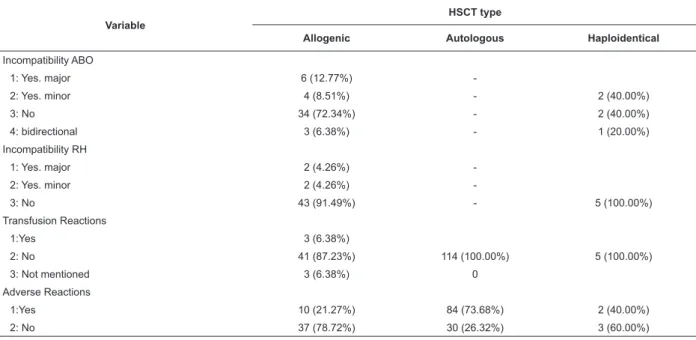
In regard to the distribution of incompatibilities
and occurrence of reactions (Table 3), although
there was a relative percentage of ABO and RH
incompatibility, the number of transfusion reactions
was small. It is important to keep in mind that these
reactions were reported to the hospital transfusion
agency by the hematologist physician present at the
time. Adverse reactions that occurred in the infusion
of cryopreserved products were reported by the
physician responsible for the transfusion agency in
a speciic form from the service or by the physician
of the bone marrow transplantation unit. There was
12.77% of major incompatibility in the allogenic
transplantations. RH incompatibility, both major
(4.26%) and minor (4.26%), occurred in the allogenic
HSCT. In this situation, the marrow bag needs to be
deplasmatized to withdraw the antibody supernatants
from plasma.
Variable
HSCT type
Allogenic Autologous Haploidentical
Incompatibility ABO
1: Yes. major 6 (12.77%)
-2: Yes. minor 4 (8.51%) - 2 (40.00%)
3: No 34 (72.34%) - 2 (40.00%)
4: bidirectional 3 (6.38%) - 1 (20.00%)
Incompatibility RH
1: Yes. major 2 (4.26%)
-2: Yes. minor 2 (4.26%)
-3: No 43 (91.49%) - 5 (100.00%)
Transfusion Reactions
1:Yes 3 (6.38%)
2: No 41 (87.23%) 114 (100.00%) 5 (100.00%)
3: Not mentioned 3 (6.38%) 0
Adverse Reactions
1:Yes 10 (21.27%) 84 (73.68%) 2 (40.00%)
2: No 37 (78.72%) 30 (26.32%) 3 (60.00%)
Table 3 – Distribution of the HSCT type according to ABO and RH incompatibility, transfusion and adverse reactions
in cell infusion. Ribeirão Preto, Brazil 2009
We opt for considering adverse reactions as those
reactions presented during the cryopreserved HSC
infusion due to the association with the cryoprotectant.
Although such reactions also occurred during allogenic
HSCT (21.27%), they were more frequent (73.68%)
in autologous HSCT. It was observed that transfusion
reactions occurred with fresh products, while 66.67%
were from bone marrow source, with infusion up to 6
Table 4 – Distribution of transfusion and adverse
reactions according to DMSO quantity, HSC sources,
relation volume/weight/time and volume/time of
infusion. Ribeirão Preto, Brazil 2009
Variable Transfusion
Reaction Adverse Reaction
DMSO
1: up to 0.39g - 66 (68.75%)
2: 0.40 to 0.69g - 15 (15.62%)
3: 0.70 to 1.0g - 5 (5.20%)
4: Not mentioned - 5 (5.20%)
5: Nothing 3 (100.00%) 5 (5.20%)
HSC sources
1: Peripheral blood 1 (33.33%) 47 (67.61%)
2: Bone Marrow 2 (66.67%) 23 (32.39%)
Volume/weight/time
1: up to 6ml/Kg/h 3 (100.00%)
-2: > 7 ml/Kg/h 0
-Volume/time
1: up to 10 ml/min. - 50 (52.08%)
2: > 11 ml/min. - 33 (34.37%)
3: Does not apply - 13 (13.54%)
Among the adverse reactions, 68.75% occurred
in infusions with smaller quantities of DMSO. A total of
96.84% of patients whose cell source was peripheral blood
had adverse reactions; reactions were also observed in
patients whose cell source was bone marrow.
In regard to the infusion rate, even patients
(52.08%) with autologous transplantation who were
infused at a rate of up to 10ml/min presented adverse
reactions; 34.37% of patients had a faster rate of
infusion and also developed such reactions.
Discussion
The distribution of transplantation types observed
in this study is corroborated by data from the Brazilian
Registry of Transplantation, which indicates that the
number of autologous transplantations was greater than
the number of the allogenic type in the irst quarter of
2009. Transplantation from relatives is still prevalent
when compared to non-relative transplantation,
which has increased in recent years(14). The recipients’
characteristics concerning age range and gender are
related to their pathology.
Findings regarding the donors’ gender are similar
to national(14) ones and to those of one study carried out
in Turkey with a marked prevalence of male recipients in
autologous transplantations(15).
The obtained incidence of blood type derives
from data from the Brazilian Association of Organ
Transplantation (ABTO) in which type O occurs in 49%
of cases and type A occurs in 33% of organ and tissue
donors (Table 1).
In the case of ABO incompatibility between donor
and recipient, transplantation is subject to some
complications: acute hemolysis, delayed erythropoiesis,
late hemolysis, among others(8); and depletion of red
blood cells should be considered in order to minimize the
occurrence of hemolytic reactions(16). The inheritance of
blood group antigens does not depend on inheritance of
majorhistocompatibility antigen (HLA). Incompatibility of
the ABO system does not deine transplantation success
because the clinical importance lies in HLA compatibility.
The HSC donor and recipient can have different blood
groups and still present HLA compatibility(8).
Major incompatibility was identiied in this study
in a discreet number of allogenic transplantations
and minor incompatibility in some haploidentical
transplantations (Table 3). Major ABO incompatibility
is relevant information for nurses who will perform
cell infusions. In this type of transplantation, the bag
erythrocyte depletion occurs and nurses must verify the
inal number of red blood cells at the time s/he receives
the product. This volume can trigger the occurrence of
a transfusion reaction if not within the permitted limits,
that is, less than 0.5ml/kg of the recipient’s weight(17). In
the event of minor ABO incompatibility, the marrow bag
has to be deplasmatized so that antibody supernatants
are withdrawn from the plasma.
Incompatibility involving the Rh system can lead
to late alloimmune hemolysis (major incompatibility)
and hemolysis in 10% to 15% of patients (minor type).
Rh incompatibility was not observed in almost all
transplantations.
The occurrence of reactions during HSC infusion
can also be related to its source, total volume, cell
treatment, use of cryoprotectant (DMSO), ABO
compatibility and infusion rate. In this study (Table 2)
the major source of stem cells for the autologous and
allogenic transplantations was peripheral blood, with
time of collection less than 24 hours before the infusion
for the allogenic and haploidentical transplantations and
more than 49 hours before infusion for the autologous
transplantations; cells were not treated in most of
the allogeneic transplantations; cryopreservation was
performed in almost all the autologous transplantations;
deplasmatization and cryopreservation were observed
in some haploidentical transplantations; there was no
plasmapheresis in the majority of patients in the allogeneic
transplantations; infusion rates were up to 10ml/min
Curcioli ACJV, Carvalho EC.
up to 6ml/kg/hour in the allogenic and haploidentical
transplantation.
One hypothesis for the development of adverse
reactions related to the infusion of thawed graft is the
amount of DMSO administered; in products in which
DMSO was depleted, this relation of HSC volume infused
is attributed to the residual amount of DMSO and to the
number of granulocytes presented(14).
In this study, data of transfusion or adverse reactions
in relation to the presence of DMSO, the volume infused
and cell source, indicated that the three transfusion
reactions occurred with the use of products without
DMSO, when peripheral blood or marrow cells were the
source, when the infusion rate was up to 6ml/kg/hour.
The adverse reactions occurred predominantly with the
use of products with up to 0.39g of DMSO, peripheral
blood and in infusions of up to 10ml/hour (52.08%)
(Table 4). The concentration of DMSO generally used,
between 5% and 10%, ensures the viability of cells
and graft capacity. The maximum recommended dose
of DMSO to be infused is 1g/kg or 10ml/kg of DMSO
solutions at 10%(18).
Given the severity and high incidence of adverse
reactions, one possible preventive measure is washing
the cells with cell washers in order to remove DMSO,
free hemoglobin and cellular debris. In this study,
washed cells were used in ive transplantations due to
the patients’ clinical conditions and the cryoprotectant’s
potential toxicity. The plasmapheresis procedure aims
to reduce the anti-A or anti-B hemagglutinins presence
in the recipient’s plasma. The antibody titer in the
patient’s blood is usually high in the case of multiple
transfusions. The major disadvantage of this method
is the risk of transfusion reactions due to the use of
fresh frozen plasma in replacing the volume of removed
plasma(19).
During cell infusion, products containing HSC
cannot be irradiated or transfused with equipment with
leukoreduction because these procedures can harm or
eliminate cells. In addition, it is necessary to minimize
the contact of cells with DMSO, which would lead to a
faster infusion. To determine infusion rate, the volume
of cells in relation to the patient’s volume of blood,
quantity of DMSO in the product and the product’s
temperature should be taken into account. The
recommended infusion for products with DMSO at 10%
is between 5 to 20ml/min(6). For patients that receive
non-frozen bone marrow, the following parameters are
recommended since transfusion reactions common to
other blood products can develop(12). In this study, a
slight majority of patients who presented adverse
reactions were infused at up to 10ml/min. The infusion
of blood products is performed at a rate of 3 to 6 ml/
kg/hour, though it can be slower in the case of more
vulnerable individuals, at 1ml/kg/hour(17). All the
patients who presented transfusion reactions were
infused at up to 6 ml/kg/h (Table 4).
The conclusion regarding the occurrence of
transfusion reactions is that these occurred in infusions
with fresh products (without DMSO), of peripheral blood
and bone marrow sources, while infusion rate followed
the recommendations in the literature. Most adverse
reactions occurred in autologous transplantations,
all from peripheral blood sources. A larger number of
reactions occurred with smaller quantities of DMSO and
in infusions in which the infusion rate was performed as
recommended.
Being aware, trained and attentive to prevent,
identify, address and treat potential transfusion reactions
is the duty of all health professionals dealing with
transfusions(4,8). In addition to the service organization(20),
the importance of the organization of care is highlighted,
especially in relation to the documentation of information
and organization of clinical data. These aspects favor
the eficient recording of rational and objective
decision-making, revealing care appropriate to the needs of
patients(21), as well as promoting the prevention or early identiication of other adverse events related to the
devices used in transfusions such as the central venous
catheter whose rate of adverse events, though rare in
the hospital setting(22), can compromise the cell infusion
procedure. From this perspective, this study supports
nurses’ clinical rationale in improving the safety of
patients in the context of transfusion care because it
identiies variables of interest in HSCT situations and
related adverse and transfusion reactions.
Final Considerations
As evidenced in this study, reactions can occur
with fresh or cryoprotectant products, originating from
peripheral or bone marrow sources, even when infused
within the recommended rate. The adoption of strategies
that lead nurses to know the conditions of the process
of collection, treatment and storage of products to be
infused promotes the observation of adverse and/or
transfusion reactions and facilitates their identiication.
In addition, recording the entire infusion process enables
understanding nursing care delivery and favors control
References
1. Lacerda MR, Lima JBG de, Barbosa R. Prática de enfermagem em transplante de células tronco hematopoiéticas. Rev Eletr Enferm. 2007; 9(1):242-50.
2. Conselho Federal de Enfermagem, Resolução COFEN 200/1997. Regulamento da atuação dos Profissionais de Enfermagem Hemoterapia e transplante de medula óssea. Rio de Janeiro: COFEn; 1997.
3. Conselho Federal de Enfermagem, Resolução COFEN 306/2006. Normatiza a atuação do enfermeiro em hemoterapia. Rio de Janeiro: COFEn; 2006.
4. Agência Nacional de Vigilância Sanitária. Hemovigilância: manual técnico para investigação das reações transfusionais imediatas e tardias não-infecciosas [homepage na internet] 2007 [acesso em: 24 fev 2008]. Disponível em: http://www. anvisa.gov.br.
5. Bonassa EMA, Santana, TR. Enfermagem em terapêutica oncológica. 3ª ed. São Paulo (SP): Atheneu; 2005.
6. Sauer-heilborn A, Kadidlo D, Mccullough J. Pacient care curing infusion of hematopoietic progenitor cells. Transfusion. 2004; 44 (6):907-16.
7. Ludwig L, Zilly A. Reações transfusionais ligadas ao sistema ABO. NewsLab. 2007; 84 (1):102-12.
8. Ortega ETT, Kojo TK, Lima DH de, Veran MP, Neves MI. Compêndio de enfermagem em transplante de células tronco hematopoiéticas – Rotinas e procedimentos em cuidados essenciais e em complicações. Curitiba (PR): Maio; 2004. 9. Larghero J, Rea D , Esperou H , Biscay N , Maurer MN , Lacassagne MN. ABO-mismatched marrow processing for transplantation: results of 114 procedures and analysis of immediate adverse events and hematopoietic recovery. Transfusion., 2006; 46 (3):398-402.
10. Kim DH, Jamal N, Saragosa R, David Loach D, Wright J, Gupta V, Kuruvilla J, Lipton JH, Minden M, Messner HA. Similar outcomes of cryopreserved allogeneic peripheral stem cell transplants (PBSCT) compared to fresh allografts. Biol Blood Marrow Transplant., 2007; 13(10):1233-43.
11. Stroncek DF, Fautsch SK, Lasky LC, Hurd DD, Ramsay NK, McCullough J. Adverse reactions in patients transfused with cryopreserved marrow. Transfusion., 1991; 31(6):521-6.
12. Cordoba R, Arrieta R, Kerguelen A, Hernandez-Navarro F. The occurrence of adverse events during the infusion of autologous peripheral blood stem cells is related to the number of granulocytes in the leukapheresis product. Bone Marrow Transplant. 2007; 40(11):1063-7.
13. Rodriguez AL, Tariman JD, Enecio T, Estrella SM. The role of high-dose chemotherapy supported by hematopoietic stem cell transplantation in patients with multiple myeloma: implications for nursing. Clin J Oncol Nurs. 2007; 11(4):579-89.
14. Associação Brasileira de Transplantes de Órgãos. J Bras Transplantes [homepagen na internet] 2009 [acesso em 25 março 2009]. Disponível em: http://www.abto.org.br
15. Donmez A, Tombuloglu M, Gungor A, Soyer N, Saydam G, Cagirgan S. Clinical side effects during peripheral blood progenitor cell infusion. Transfus Apheresis Sci. 2007; 36(1):95-101. 16. Castro JrCG, Gregianin LJ, Brunetto AL. Transplante de medula óssea e transplante de sangue de cordão umbilical em pediatria. J Pediatr. 2001; 77 (5):345-60.
17. Universidade de São Paulo. Faculdade de Medicina de Ribeirão Preto. Hospital das Clínicas. Centro Regional de Hemoterapia. Manual de medicina transfusional (MMT). Ribeirão Preto: USP/ FMRP/HC; 2007.
18. Mendrone A Jr, Arrais CA, Saboya R, Velasques RD, Junqueira PL, Dulley FL. Neurotoxicity associated with dimethylsulfoxide-preserved hematopoietic progenitor cell infusion. Bone Marrow Transplant. 2008; 41(1):95-6.
19. Mendrone A Jr. Incompatibilidade ABO no transplante de medula óssea [Internet] 1997 [acesso em 17 março 2007]. Disponível em: URL:http://www.hemonline.com.br
20. Riul S, Aguiar OM. Contribution to the organization of the service of bone marrow transplantation and nurse’s performance. Rev. Latino-Am. Enfermagem. 1997; 5(1):49-58.
21. Santos SR, Paula AFA, Lins JP. Nurses and their perception about the manual recording system in patients’ files. Rev. Latino-Am. Enfermagem. 2003; 11(1):80-7.
22. Nascimento CCP, Toffoletto MC, Gonçalves LA, Freitas WG, Padilha KG. Indicators of healthcare results: analysis of adverse events during hospital stays. Rev. Latino-Am. Enfermagem. 2008; 16(4):746-51.
Received: Jul. 19th 2009