GROUP PROCESSES WITH FAMILY MEMBERS:
THE PERCEPTION OF UNDERGRADUATES
IN SPEECH AND LANGUAGE PATHOLOGY
Processos grupais com familiares:
percepção de graduandos de fonoaudiologia
Nádia Giulian de Carvalho (1),Regina Yu Shon Chun (2), Rita de Cássia Ietto Montilha (2)
(1) Programa Saúde da Criança e do Adolescente – Centro de
Investigação em Pediatria (Ciped) da FCM/UNICAMP, Uni-versidade Estadual de Campinas, Campinas, São Paulo, Brasil.
(2) Curso de Graduação em Fonoaudiologia e Mestrado
Saúde, Interdisciplinaridade e Reabilitação da FCM/UNI-CAMP, Universidade Estadual de Campinas, Campinas, São Paulo, Brasil.
Study conducted in the Undergraduate Course in Speech and Language Pathology at the School of Medical Sciences of the University of Campinas, Campinas, São Paulo, Brazil, with the scholarship of the Scientiic Initiation Program – PIBIC, granted by the National Council for Scientiic and Technological Develo-pment (CNPq).
Conlict of interest: non-existent
1930s, initially for the purpose of socialization of the
mentally ill. This approach is present in some Health
areas such as in Speech and Language Pathology
and Occupational Therapy (OT). In the history of OT, group processes have been intensiied as a form of treatment, considering that group experi -ences have gained greater sense and meaning,
such as the therapeutic efect1. In Brazil, the Speech
and Language Pathology interventions with groups began to be used in the 1980s, considered initially as a way to absorb the great demand of users and to reduce the waiting lists, particularly in public
health services. However, from the 1990s, with the expansion of studies in relation to group practices,
the establishment of groups gained more strength, such as the possibility of therapeutic interventions, and they now have a preventive and educational
INTRODUCTION
The use of activities with groups was system -atically employed in the United States after the
ABSTRACT
Purpose: to verify the perception of speech and language therapy graduates as to the conduct of family members groups and analyze the selection process, conduct of activities and the impact of the group in the therapeutic process. Methods: it is a cross-sectional study and qualitative approach, the
sample consisted of 19 students of the fourth year of graduation. To collect data, there were three focus groups with diferent participants, using guiding questions. The groups were recorded for subsequent
transcription and analysis according repetition and relevance criteria and categories were established following the objectives of the research. Results: the indings evidence that diferent issues emerged
during the group discussions in the perception of undergraduate students, which involved the change of feelings, the development of analytical view, knowledge of the therapeutic setting as meanings and subjectivities reconstruction space, the meaning of the activities as resources to achieve the objectives, supervision as a clarifying questions of space, self-assessment of performance in group dynamics, and the contribution of information shared group in the therapeutic process of the subject in attendance. Conclusion: the selection, development and management of the activities with family members, discussed the interface between speech and language therapy and occupational therapy, aggregate values during training and evidence the importance of process for the graduates. Consider the family members, through the groups in the learning process still in graduate can contribute to training in a perspective of integral and humanized care.
the participants and not just between the therapist and patient. In this sense, it is important for the therapist to promote the establishment of a frame that allows the construction of relations between
its members and the possibility of a signiicant
listening8. This issue deserves to be emphasized in the training of the undergraduate, which justiies the interface between the Occupational Therapy and
the Speech and Language Pathology regarding the discussion of the analysis of activities carried out in the group space with a view to a training guided by completeness.
Completeness assumes, among other aspects,
the expansion and development of the care
dimension in the performance of health profes-sionals, which will contribute to the training of agents that are more accountable, welcoming and able to build relationship with the target population and the health service actions5.
Given the above, the objectives of this research are to verify the perception of undergraduates in Speech and Language Pathologyin relation to the management of family groups and to analyze the process of selection, management of activities and repercussions of the group in the therapeutic process.
METHODS
Study design and composition of the sample
This study is linked to the research “Speech and
Language Pathology intervention in family group of children with language disorders” approved by the Research Ethics Committee (CEP) of FCM/
UNICAMP, under number 179/2009. The research was explained to the subjects and the consent and
signature of the informed consent was requested.
This is a qualitative cross-sectional study, whose
sample was constituted of 19 undergraduates in speech and language pathology, FCM/UNICAMP.
Inclusion criteria were: being a regular student of the fourth year of the undergraduate course in Speech and Language Pathology and having managed family groups of children with language
disorders. Exclusion criteria included students from
other years of the undergraduate course at the time
of data collection and students with experience
managing adult groups in speech therapy monitoring.
For the identiication of the participants, we used the symbol P (Participant) followed by 1 to 19 (ex:
participant 1 – P1), thus ensuring the ethical aspects
of conidentiality of the identity of the subjects
pursuant to Resolution 196/96 of CONEP. nature, in order to favor language and to promote
health2.
The group constitutes a space where diiculties, needs and expectations may emerge and feelings
may be shared in order to promote greater autonomy and confrontation of the problems by the subjects2.
In this sense, one of the possibilities of the group work is focused on the families of subjects in
therapeutic monitoring. The work with the family has
been highlighted in the therapeutic work because a group formed by family members is a social support
network that encourages dialog, relection and
discussion about the needs of those in the thera-peutic process, while it enables the participation and contribution of the family in the improvement of the quality of work – Speech and Language Pathology work in this case – and improvement of the results3.
The Speech and Language Pathology group is
also a practice with little description in the literature of the area, and we may observe a limited number of publications, mainly involving family groups4.
This therapeutic activity allows caregivers to
know the singularities of the subjects in a group monitoring, as well as the needs common to
the participants. The knowledge of the other is
important for the development of intervention strat-egies, as provided by article 43 of the Brazilian Law
of Guidelines and Bases (LDB). It provides that the Higher Education system should, among its
purposes, stimulate the knowledge on the problems of the world today, providing specialized services to the population and establishing with them a recip-rocal relationship5.
The performance of undergraduates from the Health area with groups may contribute to the
analytical development of the ability to understand subjects and their demands and to establish a space of trade with the user6. As this author points out “the
look is not limited to see the visible. It questions, researches, penetrates and interferes with things
and their movements. The look creates sense to
what it looks at and gives back this sense.”
So that a group can low and develop as such,
it is essential that the therapist is able to develop a therapeutic setting that meets the peculiarities
of the group itself. It is a space that is inluenced
by the intrinsic characteristics of the professional that coordinates it, which therefore must be able to manage the group and to develop relevant activities, in addition to build new possibilities along the group,
so that this space can efectively become a thera -peutic tool1,7.
It is also important to consider in the
management of groups the diferences between
that the family members shared in each group meeting, i.e. those perceived as meaningful by the
facilitators during the groups. They were discussed under supervision when the next meeting was
planned seeking to propose activities that were of interest to family members, so that the goals could be more easily achieved.
Some of the topics of the activities worked in
these groups are exempliied here: ways to handle the children given the diiculties of communication,
oral functions and the role of play in the development of language. All topics were discussed from the preparation of activities in which the family members were responsible for building the answers through the mediation of therapists.
Form of data analysis
The focus groups were videotaped and
transcribed. Categories were established according to the objectives of the research and analyzed according to the criteria of repetition and relevance. From the criterion of repetition, we grouped what was common among the subjects, that is, repeated placements are highlighted. From the criterion of
relevance, we selected the data that are signiicant
in content for the researcher for the purposes of the research10.
We read several times the transcribed material, which allowed us to highlight several aspects for viewing and understanding the productivity and contribution of the groups in this study, which, in turn, led to the establishment of categories of analysis, as follows:
• Feelings of the undergraduates when managing a family group
• Process of selection and management of activities
• Contribution of the selection, development and management of the activities on the training as speech therapists
• The trainee’s role in managing the group
• The repercussion of the group in the therapeutic
process
RESULTS
Below, we show the results by category of analysis.
a) Feelings of the undergraduates when managing a family group
In this category, eight of the 19 students have put their feelings when managing the family group, although this was not an issue mentioned by the mediators. It was observed that the undergraduates
Procedures for data collection
For data collection, we performed three focus groups with distinguished undergraduates, respecting the training of the groups in which they
were part. Two groups were constituted of six under -graduates each and one group with seven, managed by two professors/supervisors, one occupational therapist and one speech therapist, having as an observer another researcher, a undergraduate student at the time, signatory of this work. A meeting was held with each group, with an average duration of 60 minutes.
The essence of the focal group consists in the
interaction between participants and coordinator in order to gather data from the discussion focused on
speciic topics, according to understanding of the diferent perceptions and attitudes about a fact or
practice9.
In the focus groups, we used guiding questions to know how the students evaluate the process of selection, development and management of activities in family groups as well as the role of the groups and of this process during their professional training. Below we show the guiding questions:
1 – How do you assess the selection of activities
carried out in the groups of parents/family members that you managed?
2 – How do you asses this process in the training
as speech therapists?
3 – Tell us a little about the role of guiding the group
of caregivers/family members.
4 – Tell us a little about the process of selection
of the activities developed in the group of caregivers/family members.
The activities developed in the family groups
The activities mentioned in this study refer to the
therapeutic resources used by the undergraduates, prepared in order to provide greater involvement and understanding of the issues of the children that were accompanied by the family members in the speech clinic as well as to provide a favorable environment
for the establishment of dialogs and relections. The proposed activities were intervention tools
mediated by the facilitators of the group in order to answer the questions of family members. Such proposals were elaborated by trainees of Speech and Language Pathology and guided by the supervisors of the area of Speech and Language
Pathology and Occupational Therapy. The groups,
which happened monthly, were managed at each date by a couple of trainees.
groups is not an easy task, neither is the selection
of the activities to be developed. In Table 1 we show the main feelings expressed by the subjects.
demonstrated the need to address this issue in front of the subject.
The feelings shared among students were
similar, indicating that the management of family
Table 1 – Feelings of the undergraduates at the beginning of the management of family groups
Participants Feelings
P3 Fear/Afraid of speaking at the wrong time
P4 Fear of not knowing what to say/Anxiety
P5 Fear of silence
P6 Fear of being scrutinized and judged
P9 Fear of not knowing how to answer the question
P15 Insecurity and fear of silence
P16 Insecurity/Fear of not knowing how to answer the question
P18 Fear of not knowing how to answer the question/fear of not knowing how to handle anxieties
We can note that in the participants, even after having received theoretical training in class as subsidy to the group intervention, feelings such as fear of failing and failing to achieve the goals are
present in their speech. It is signiicant to note that
such feelings are ameliorated only over time, from
the experience gained in the experience with groups. Such indings indicate that to start this experience
at the undergraduate course is relevant for a more solid formation in the intervention with groups.
The change of feelings during the process of management of groups, from the experiences had, is
mentioned by several participants. Below, we show
two examples illustrating this trajectory followed by
the undergraduates.
“I found it very interesting what the parents bring, how we behave in the group ... at
irst I didn’t know much what to say, what to express, I felt this way in the irst group.” (P4).
“In the beginning it was very diicult because
there are several parents and you are there among them, and then you have to think about everything; if they ask me something,
what do I say? And so, the most important
thing I learned is that there’s no point in
programming everything, you have to program the activity, the general content, and
let it low because a lot depends on what the
parents will bring ...” (P9)
The indings show, in addition to the initial anxiety,
changes in attitudes and the development of an
analytical look from the experience with groups, as
shown in the statement of one of the subjects:
“When we start to participate in a group of parents, we are very worried about what
we’re going to do, you know? What I’ll say,
and if there is silence, what do I say, you
know? How am I supposed to manage it?
What subject I’ll approach? And we end up focusing a lot on our attitude there during the
group, and that’s something that we realize
with time, as we participate in the group,
we realize that we don’t need to talk all the
time, as we participate more we have more sensitivity of what time to talk, what we have
to say and what we don’t have to ...” (P5)
b) The selection process and the management of activities
The undergraduates generally characterize
the activities as a resource to facilitate the
devel-opment of the group. The statement of subject P16,
in a sense, summarizes the position of the other students regarding the role of the activity:
“So, I guess that the activity has this purpose
of encouraging the relection, it helps, fosters, it’s the basis of the discussion.”(P16)
c) Contribution of the selection, development and management of the activities on the training as speech and language pathologist
The students express the contribution of acting with groups, highlighting the value of this experience:
“I think the importance for our training is how to form a group, why we should do it, at what
point to do it, how to managethis group, what
activities we prepare and why we prepare
these activities.” (P9)
“The opportunity to have participated in these groups that year was a very rich experience and certainly helped us feel safer in our professional life when managing groups,
leading groups.” (P11)
On the speech of this same subject, we can verify the importance of acting with the family in the therapeutic process:
“I think we come out with a training that goes far beyond the theoretical content that we have to apply; we have to think that this subject is inserted in an environment and this
environment will inluence him; in the case, the family will inluence a lot.Thus, we need to be together, participate, guide so that we can bring them to work together with us.”
(P11)
In addition, the results show that the practice contributes to the training as the undergraduates
gain a distinctive look through the experience
acquired; they are more attentive to the other, as
the following statements exemplify:
“I think that every internship is about practice, we start getting the hang of it ... it stops
being mechanic, becomes something you’re
thinking more about the other, the patient, the parents, in the case of the group, than in your
attitudes ...” (P1)
“The importance of the group was really
fundamental and we wouldn’t know this if it happened only in therapy, because it’s very
natural how they speak ... the information that the group brings is vital for us to think, sometimes rethink and plan a few things in our therapy and so I think it was vital in our
training, we’re learning to handle the parents,
we watch them from another point of view,
also hear them diferently...” (P7)
necessary to the group, because they were issues observed by the speech therapy trainees or were proposals from the family, and also the meaning
in itself of preparing the activities. Here are some examples of the undergraduates in relation to it,
which represents the lines repeated in the group, relevant to the understanding of this subject.
“We always thought of an activity which prioritized some discussion that we wanted to
propose there ...” (P16)
“You’re going to let a little of what you think
about your own activity ...” (P19)
“I think that at the time to prepare the activities we sought to bring what the parents had brought as doubt or some curiosity that they have ... sometimes, they will act in unexpected ways and we have to learn to know, be prepared to handle it at the moment,
you know?...” (P11)
“It’s nice that this preparation opens our
eyes to something else, we can remember to prepare something that has to do with the subject, if the family is quiet, if it has heard
about it, if it is impulsive. I think even the
preparation is a professional learning for us
to analyze this family ...” (P14)
The indings highlight the process of selection of
activities by the undergraduates aimed at encour-aging and promoting the discussion between the
members of the family group. They show that the
subjects consider the activity as important for the beginning of the discussion, and they also show that, by being chosen, it demonstrates that the therapist wants to work and achieve results. In addition, the
undergraduates express that the expected goals
and results do not always happen, since family members can bring other needs at the time of the group, which promotes a new direction in the devel-opment of the activities.
Such perceptions of the subject allows us to highlight that, in the period of training, the students are being prepared to elaborate topics relevant to the demands of the families, since these are part of the therapeutic process of any subject in a Speech and Language Pathology, and the frustrations that in a few moments the preparation of the activities did not occur as anticipated are important for the formation of therapists who know how to handle biases, which
must be taken as signiicant and relevant, and thus
supervision – talking less and listening more,
sometimes that’s all that matters.” (P13)
d) The trainee’s role in group management
Along with the exposure of feelings experienced
when managing a family group and the process of selection, development and management of
activ-ities as presented, the students also relected on the
role lived as responsible for the group.
From the experiences in the internship, the
students could address in focus groups their role before the management of the family groups, which refers to the importance of the training of
profes-sionals able to welcome and meet the context
of a group dynamics, aware of the role they must assume and the importance of developing activities, so that answers are not given in a pre-established
format but built together with the subjects. The testi -monials below summarize, in general, the recurring statements of the students:
“It’s not because you’re a professional that you’re there, that you know the theory that
you have to speak more or show that you know. Sometimes, the listening is enough;
that’s what this group showed us ... I think that the listening involves everything: it’s the
listening, the observing of small gestures, small details, because sometimes even the act of not saying anything is a sign that says
something ...” (P13)
“Our role is a joint construction ... you are
bringing something ready to show; you’re
going to build it with them. So, our role is
not to bring the solution or deliver something ready, but to instigate the construction of
something ...” (P15)
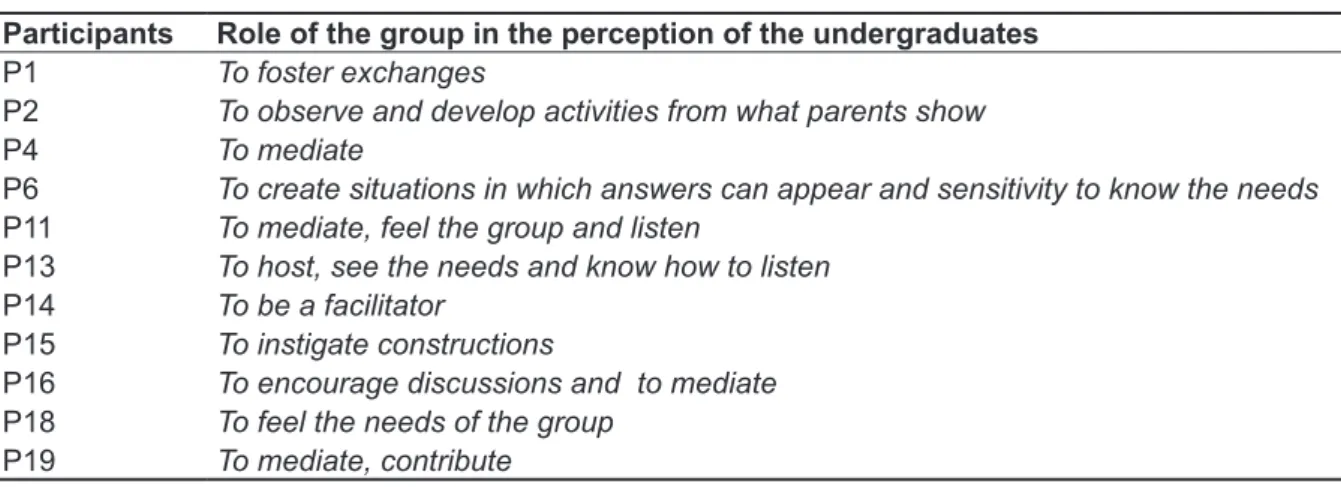
Below, the expressions used in the speech of
the participants are illustrated, which represent the role of the speech therapist in relation to a group
(Table 2):
Another aspect addressed by one of the subjects concerns the contribution of the self-assessment process that the management of the group provides:
“I evaluate myself every time I leave the group, I know when I did the right thing and when
that didn’t work, we evaluate ourselves.” (P4)
We can observe that the self-assessment is closely related to how much the undergraduate managed to contribute to the production of the
group, which involves relection about the attitudes developed and the activity chosen. The P4 partic -ipant complements as follows:
“Everything that we had, we learn here to learn as a professional speech therapist and in life, because we understand how the speech has meaning, has a lot of impact on the patient, we learn that there are certain things that we should not speak close to the patient, or that there are certain things that we need to talk about, this sensitivity to have
the right time to talk.” (P4)
Another issue fairly addressed by the undergrad-uates as an agent for assistance in the selection, development and management of the activities, as well as in the professional training, was in relation to supervision. For them, the supervision contributed
to clarify questions and encouraged relection, as
shown in the following statements:
“I think that the supervisions really helped, when we work the feelings we had and the
attitudes, it helps a lot.” (P3)
Family Group in the therapeutic process of their children:
“They bring things to the group that they would not bring to us when talking individually ... the information that the group brings is vital for us to think, sometimes rethink and plan a
few things on our therapy ...” (P7)
“This family group is a job that helps a lot in the therapeutic environment, because only
individual therapies don’t account for the
complexity of the subject.” (P19)
The statements also show that the group, in
addition to encouraging children in therapy, also favors their family and, in this way, favors the construction of a relation of partnership between
interns and caregivers. The testimonials below illus -trate this issue:
“The story of a father, that he put the importance of the group as a welcoming moment for them, that they also felt important;
so it isn’t just a therapeutic space for the
children, but a space for parents to talk about
them.” (P9)
“A speciic work with the family is vital, you can’t separate the child from the family, the
elderly from the caretaker; they are always a set, and there is no point in working here and then the family goes against everything
you’ve done, or they aren’t your ally ... it is
essential that you have them as allies, and
then the patient will always be beneited.And
for us it was very good, it’s another vision,
As we can see, the students put themselves as agents of mediation, that is, as facilitators of discussion among the members of the group, created from observing and listening, attentive to
the language group, which is expressed both in the
oral and nonverbal forms, when carrying out the
activities in the group context.
e) The repercussion of the group in the therapeutic process
The following statements illustrate the speech
of the students in relation to the importance of the group in the Speech and Language Pathology as a
space for exchange of experiences and placing of desires and anxieties:
“It’s fundamental to have this moment for
the parents to tell what they think and what they feel, to show questions and discover
our work and their work at home.I think this
open space allows this exchange, where we can learn more about the family, the child, our
patient.” (P8)
“The chance to meet other parents who experience the same situation can help those who did not adhered completely to the therapeutic process of the child to have
a diferent look in relation to the therapeutic
process... some parents have changed their opinion throughout the year, have changed the way they act; I think it was fundamental
for the individual that is being cared for.” (P11)
In addition, the subjects discuss the contribution and participation of parents and caregivers in the
Table 2 – Role of the speech therapist in the management of groups according to the perception of the undergraduates
Participants Role of the group in the perception of the undergraduates
P1 To foster exchanges
P2 To observe and develop activities from what parents show
P4 To mediate
P6 To create situations in which answers can appear and sensitivity to know the needs
P11 To mediate, feel the group and listen
P13 To host, see the needs and know how to listen
P14 To be a facilitator
P15 To instigate constructions
P16 To encourage discussions and to mediate
P18 To feel the needs of the group
development of actions that meet the needs of the group.
From the knowledge of the other, they manage
the group through activities deined as a resource
to mediate issues, and the activity is the basis to promote discussion; it is the starting point for
relections. The subjects studied expose in their
testimonials that the activities chosen are what they
themselves are thinking in relation to the group. This
statement is also present in the literature, in which the characteristics of the professional who
coordi-nates the group will relect on the group setting1.
Another important point put by the students is that when they manage an activity the route planned
by them may not always occur, diferently directing
according to the intrinsic needs of the group.
The contribution of the selection, development
and management of activities in the training as speech therapists is perceived as a construct that already begins in the theoretical disciplines and in the supervision of the internship. According to the students, it is a space in which they can clarify their
doubts and relect with colleagues and professors
how to form a group, how to manage it, what activ-ities should be developed to meet the goals of the family group, since, as pointed out in the literature13,
it is not easy to select appropriate and meaningful activities, and it is necessary a careful analysis of the activity to adapt it to each particular case, acting with an integral vision of the subject.
In addition to these aspects, the indings show that, with the experience in the group, the students
feel that the development of a group goes through the theoretical content learned, and only with
experience it is possible to develop a posture of
a therapist with the family members, seeing them
diferently, and especially when self-assessing themselves. The self-assessment action should be
used as a contribution towards a humane training with positive repercussions in the professional and personal development14.
This inding corroborates with another described
in the literature11, in which students who
coordi-nated group activities demonstrated changes in feelings and attitudes in relation to the group, such as responsibility, evolution of insecurity to safety,
sensitivity, afection, self-knowledge, and more able to understand the complexities involving the care of
the family.
The indings highlight the importance of the
group welcoming in the life of family members, the
experience of managing groups in the training of
undergraduates, as well as the repercussions in the therapeutic process of the child in the speech
therapy monitoring. Such relexes reiterate the
statement that if the family is not regarded as an
it’s not just going in there and taking care of them, there’s a family that also needs to be
taken care of.” (P13)
DISCUSSION
We can verify that when they share their feelings
in relation to expectations when managing Family Groups, the undergraduates express that it is not a task experienced with tranquility and that internal changes occur from the experience gained in their
training with the management of groups. Feelings of fear and apprehension were also found in the
reports of nursing students who have experienced
in their training the care of family members11. The students brought the diiculty in handling the over-exposure of the feelings of the family members that
appeared on the group dynamics, mentioning, as
an example, the crying, which left them aware and
concerned about what attitude to take in relation to these shared issues and reactions.
The feelings are transformed as the students
discover their potential and the role in the group, in addition to the goal in itself, as evidenced by the
results. The undergraduates no longer worry about
their performance, with the need to talk and clarify doubts and they start to look more to the other.
The subjects say that it is their role to act as facilitators and mediation agents. Therefore, it is important to exercise the listening and observation
and to capture and value the language relevant
to the group. Such indings show the maturation of the students, as expressed by their statements
regarding the management of the group.
The aim of working with family members, taken by the students, conirms other studies, which
reiterate the importance of group activities with family members beyond the simple transmission of guidelines, being important the reconstruction of senses and subjectivities that often are hidden in the family members12.
This maturity provided in the training contributes
to students to acquire the true meaning of a family group as a space in which they can monitor the
therapeutic process of the care of children. This way, through dialog and relections, a network of social support is formed that will relect the possibilities of participation of the family in the child’s daily life,
enriching the speech therapy work and enhancing the results3.
Regarding the process of selection and
management of activities, the indings show that
to needs of the family members shown in each meeting, were an important resource in the group itself and also in the therapeutic process of the children, in addition to favoring the training of future speech therapists, prepared to develop a therapeutic setting suitable for the management of groups.
In this study, the selection, development and management of activities in a family group, when discussed in the interface between speech and language pathology and occupational therapy, aggregate values during the training and shows that
the undergraduates seemed to be conident and
prepared to manage groups. Consequently, there is a favoring in the training of more humane profes-sionals aware when choosing activities that meet the needs of each group, giving particular importance to the knowledge of each family in the speech clinic.
The undergraduates also stressed the importance
of the groups in the therapeutic processes of the monitored children.
The approach of a health education that considers
the family members in the learning process in the undergraduate education is required for a proper training in the health area, which includes public policies, appropriate environments and reorien-tation of health services beyond clinical and curative treatments, as well as liberating pedagogical proposals committed with the development of solidarity and citizenship, abandoning informational communicational strategies and adopting a dialogic communication18.
The results presented in this study reiterate the
importance of Undergraduate Courses in Speech and Language Pathology in propitiating training in group processes to undergraduates, since the participation of the family and the bond established are fundamental tools for the therapeutic success in a perspective of comprehensive and humane care.
CONCLUSION
The results evidence that diferent issues
emerged during group discussions in the perception of the undergraduates, which involved change of feelings, development of an analytical view, knowledge of the therapeutic setting as a space to reconstruct meanings and subjectivities, the meaning of activities as resources to achieve objec-tives, supervision as a space to clarify questions, self-assessment of the performance in group dynamics, and the contribution of the information shared in the group in the therapeutic process of the subject.
The selection, development and management
of the activities in a family group, discussed on the interface between Speech and Language Pathology integral part of the process, therapeutics can fail,
since both the family and the child require care, thus
being a center of afection and inclusion12.
On the perception of the students about the constitution of the group setting, the family members could learn more about the work developed with
children in the therapy and relect about the activities
at home, so that actions can go beyond the clinic space.
Family members bring information to the group that leads students to rethink their therapeutic
practice. This exchange in the group activity generates positive efects in the therapeutic process of the children, as in the experience of the subjects
in society and in the family the aspects of their subjectivity are closely related to their language3.
The importance in managing groups, in order
to encourage a humane training, is addressed by several authors, who argue that the process of professional training is still centered in the technical
and individualized learning, and there must exist a relection regarding this process, with a view to
humane proposals in the health area, favoring professionals that are critical, creative and sensitive
to the construction of an eicient practice to users
and their family members11.
The indings refers to another study on the experi -ences of groups on the internship, in which the share
of the knowledge arising from experiences with
groups impact on the professional training because the students develop better conditions to handle more closely the collective needs and demands of various social groups, strengthening them as social subjects and citizens15.
The results also corroborate another work with
a family group. According to the author, in the group care, the time of the family member which before was dedicated to waiting is now rescued as subject with personal projects, and the role assumed by the therapist is to listen, look, facilitate participants in occupying an active place, and the activities developed are important in the support of the group16. It was also observed the emergence
of aspects of relations of the participants with their children in the group, which indicates changes in the rehabilitation process; these issues are also discussed in this study.
Recent studies on groups in Speech and
Language Pathology indicate that, from the experi
-ences in various contexts and areas of expertise
(voice, breastfeeding, written language), the group showed to be important as a therapeutic instrument, solving and/or easing the social impact of distur-bances of communication17-20.
ACKNOWLEDGEMENTS
We thank the National Council for Scientiic and Technological Development – CNPq – for funding
this research.
and Occupational Therapy, aggregate values during
the training and evidence the importance of the group process for the group studied.
The consideration of family members through
groups in the learning process still in the under-graduate course may contribute to a professional training in a perspective of integral and humane care.
REFERENCES
1. Ballarin MLGS. Abordagens Grupais. In:
Cavalcanti A, Galvão C, organizadores. Terapia
ocupacional: fundamentação e prática. Rio de Janeiro: Guanabara Koogan; 2007. P. 38-43.
2. Machado MLCA, Berberian AG. A terapêutica grupal na clínica fonoaudiológica voltada à linguagem escrita. In: Santana AP; Berberian AP, Guarinello AC, Massi, G, organizadores.
Abordagens grupais em fonoaudiologia: contextos e aplicações. São Paulo: Plexus; 2007. P. 58-79. 3. Penteado RZ, Panhoca I, Siqueira D, Romano
FF, Lopes P. Grupalidade e família na clínica
fonoaudiológica: deixando emergir a subjetividade. Distúrb Comun. 2005;17(2):161-71.
4. Ribeiro VV, Panhoca I, Dassie-Leite AP, Bagarollo
MF. Grupo terapêutico em fonoaudiologia: revisão de literatura. Rev CEFAC. 2012;14(3):544-52. 5. Ceccim RB, Feuerwerker LCM. Mudança
na graduação das proissões de saúde sob o eixo da integralidade. Cad Saúde Pública.
2004;20(5):1400-10.
6. Lima EMFA. A análise de atividade e a construção
do olhar do terapeuta ocupacional. Rev Ter. Ocup.
Univ. 2004;15(2):42-8.
7. Caldeira VA, Montilha RCI, Nobre MIRS. Grupo de espera no processo de reabilitação de pessoas
com deiciência visual: contribuições da terapia ocupacional. Cad de Ter. Ocup. da UFSCar.
2003;11(2):95-105.
8. Machado MLCA, Berberian AP, Santana AP. Linguagem escrita e subjetividade: implicações do trabalho grupal. Rev CEFAC. 2009;11(4):713-9.
RESUMO
Objetivos: veriicar a percepção de graduandos de fonoaudiologia quanto à condução de grupos
de familiares e analisar o processo de escolha, condução das atividades e a repercussão do grupo no processo terapêutico. Métodos: trata-se de estudo de corte transversal e abordagem qualitativa, cuja amostra se constituiu de 19 alunos do quarto ano de graduação. Para a coleta de dados, foram realizados três grupos focais com participantes distintos, utilizando-se questões norteadoras. Os gru-pos foram gravados para gru-posterior transcrição e análise segundo critérios de repetição e relevância e criação de categorias conforme objetivos da pesquisa. Resultados: os achados evidenciam que diversos aspectos emergiram durante a condução dos grupos na percepção dos graduandos, os quais envolvem a mudança de sentimentos, o desenvolvimento do olhar analítico, o conhecimento
do setting terapêutico como espaço de reconstrução de sentidos e subjetividades, o signiicado das
atividades como recursos necessários para o alcance dos objetivos, a supervisão como um espaço esclarecedor de dúvidas, a autoavaliação da atuação na dinâmica grupal, e a contribuição de infor-mações compartilhadas em grupo no processo terapêutico do sujeito em atendimento. Conclusão:
a escolha, desenvolvimento e condução das atividades com familiares, discutidas na interface entre
a Fonoaudiologia e a Terapia Ocupacional, agregam valores durante a formação e evidenciam a
importância do processo para os alunos. Considerar os familiares, por meio dos grupos, no processo de aprendizagem ainda na graduação pode contribuir para uma formação em uma perspectiva de atenção integral e humanizada.
DESCRITORES: Atividades Humanas; Relações Proissional-Família; Saúde de Grupos Especíicos;
15. Penteado RZ, Fedosse E. Formação em Fonoaudiologia: organização de grupos de Estágios. Saúde Rev. 2007;9(21):49-56.
16. Takatori M. Atenção às famílias de crianças com deiciência: A experiência do grupo de atividades. In: Rocha EF. Reabilitação de pessoas com deiciência.
São Paulo: Roca; 2006. P.238-50.
17. Souza APR, Crestani AH, Vieira CR, Machado
FCM, Pereira LL. O grupo na fonoaudiologia: Origens clínicas e na saúde coletiva. Rev CEFAC. 2011;13(1):140-51.
18. Santana MCCP, Goulart BNG, Chiari BM,
Melo AM, Silva EHAA. Aleitamento materno em
prematuros: atuação fonoaudiológica baseada nos pressupostos da educação para promoção da saúde. Ciênc. saúde coletiva. 2010;15(2):411-7.
19. Schneider ACB, Souza APR, Deuschle
VP. Intervenção fonoaudiológica com gêneros
textuais em um grupo de escolares. Rev CEFAC.
2010;12(2):337-445.
20. Penteado RZ, Stenico E, Ferrador FA, Anselmo NC, Silva PC, Pereira PFA et al. Vivência de voz com
proissionais de um hospital: relato de experiência.
Rev CEFAC. 2009;11(3):449-56. 9. Lervolino AS, Pelicioni MCF. A utilização do grupo
focal como metodologia qualitativa na promoção da saúde. Rev. esc. enferm USP. 2001;35(2):115-21.
10. Turato ER. Tratado da metodologia da
pesquisa clínico-qualitativa: construção teórico-epistemológica, discussão comparada e aplicação nas áreas da saúde e humanas. 2ª ed.Petrópolis: Vozes, 2003.
11. Fernandes CNS, Andraus LMS, Munari DB.
O aprendizado do cuidar da família das crianças hospitalizadas por meio de atividades grupais. Rev eletr. Enferm. 2006;8(1):1-17.
12. Domingues AR. Família e serviços de reabilitação: ressigniicando essa relação. In:
Rocha EF, organizadora. Reabilitação de pessoas
com deiciência: a intervenção em discussão. São
Paulo:Roca; 2006. P. 230-7.
13. Molina PD. La Actividad como herramienta en Terapia Ocupacional. In: Lopes BP, Molina PD, Arnaiz
BN, organizadores. Conceptos Fundamentales de
Terapia Ocupacional. Madri: Panamericana; 2001.
P.153-8.
14. Damas KCA, Munari DB, Siqueira KM. Cuidando do cuidador: relexões sobre o aprendizado dessa
habilidade. Rev Eletrônica Enferm. 2004;6(2):272-8.
Received on: July 02, 2014 Accepted on: January 08, 2015 Mailing address:
Nádia Giulian de Carvalho
Rua Dr. Alves do Banho, 666, apto. 101ª,
bairro São Bernardo Campinas – SP – Brasil CEP: 13030-580