Original Article
Artigo Original
Use of FM System in cochlear implant
Uso do Sistema FM em implante coclear
Joice de Moura Silva1Luzia Maria Pozzobom Ventura Pizarro2 Liège Franzini Tanamati2
Keywords
Cochlear Implant Noise Questionnaires FM System
Descritores
Implante Coclear Ruído Questionários Sistema FM
Correspondence address:
Joice de Moura Silva
Rua Silvio Machione, 3-20, Vila Universitária, Bauru (SP), Brazil, CEP: 17012-900.
E-mail: [email protected]
Received: March 22, 2016
Accepted: July 15, 2016
Study carried out at Multiprofessional Residency Program in Hearing Health, Audiological Research Center – ARC, Cochlear Implant Section, Hospital of Rehabilitation of Craniofacial Anomalies – HRAC, Universidade de São Paulo – USP - Bauru (SP), Brazil.
1 Hospital of Rehabilitation of Craniofacial Anomalies – HRAC, Universidade de São Paulo – USP - Bauru (SP), Brazil.
2 Center for Audiological Research, Cochlear Implant Section, Hospital of Rehabilitation of Craniofacial Anomalies – HRAC, Universidade de São Paulo – USP - Bauru (SP), Brazil.
Financial support: nothing to declare. Conlict of interests: nothing to declare.
ABSTRACT
Purpose: To verify the use of the Frequency Modulation System (FM) and its beneit for cochlear implant users. Methods: Analysis of medical records of 113 users of Cochlear Implants (CI) adapted with FM System kits between September 2013 and September 2015 after publication of the Administrative Rule 1.274 of 6/25/2013, regarding the results of the speech perception tests (SPT) and the Listening Inventory For Education - Revised (LIFE-R) and Classroom Participation Questionnaire (CPQ). Results: The use of the FM System in the classroom was effective for 47.15% of the patients, while 21.42% did not use it. There was no correlation between the use of the FM System and the age group of patients. The results of the SPT regarding noise were statistically better with the use of FM System. Regarding the questionnaires, the score obtained in the LIFE-R in the situation “after use of the FM System” was statistically better for the item “listening situations in the classroom” and in the CPQ, for the items “teacher understanding” and “positive aspects”, when compared to the situation “without using the FM System”. Conclusion: Patients beneitting from the concession of the FM System made use of
the device in the classroom and improvement in both speech perception in noisy environments and subjective impression of the understanding of teachers’ speech in the classroom was observed after the use of the FM System.
RESUMO
Objetivo: Veriicar o uso do Sistema de Frequência Modulada (FM) e o benefício deste dispositivo em usuários
de implante coclear. Método: Análise de prontuários dos 113 usuários de Implante Coclear (IC), adaptados com kits de Sistema FM, entre setembro de 2013 e 2015, após publicação da Portaria 1.274 de 25/6/2013, referentes aos resultados dos testes de percepção de fala (TPF) e dos questionários Listening Inventory For Education – Revised (LIFE-R) e Classroom Participation Questionnaire (CPQ). Resultados: O uso do Sistema FM em sala de aula foi efetivo por 47,15% dos pacientes, enquanto 21,42% não o utilizaram. Não houve correlação entre o uso do Sistema FM e a faixa etária dos pacientes. Os resultados nos TPF no ruído foram estatisticamente melhores com o uso do FM. Em relação aos questionários, a pontuação obtida na situação “após uso do Sistema FM”, no questionário LIFE-R, foi estatisticamente melhor para o item “situações de escuta em sala de aula” e, no questionário CPQ, para os itens “compreensão dos professores e aspectos positivos”, quando comparada a da situação “sem uso do Sistema FM”. Conclusão: Os pacientes beneiciados com a concessão do Sistema FM izeram uso do dispositivo em sala de aula e mostraram melhora tanto na percepção da fala no ruído quanto na
INTRODUCTION
The beneits of the use of hearing devices such as the cochlear implant (CI) and the hearing aid (HA) for hearing and oral language development are already known. Although these devices are determinant for these abilities, their users may present dificulties in understanding speech in certain situations and environments. The presence of competitive noise in the environment and factors such as reverberation and distance from the sound source may impair the relationship between the speech signal and noise(1,2).
The classroom setting is an example in which factors such as student numbers per class, reverberation, distance between the speaker and the listener, acoustics and excessive noise can hamper listening comprehension and generate educational losses. In this sense, the Frequency Modulation System (FM) is considered one of the most effective technological resources in order to remedy such dificulties, contributing to the improvement of speech perception(2-5).
Studies show that the use of the FM system favors the positive signal/noise ratio in more than 20 dBNA, due to the proximity of the microphone from 6 to 8 cm from the teacher’s mouth, directly inluencing the improvement of speech perception(2,3,6).
In Brazil, the right of the hearing impaired to the beneit of Assistive Technologies was assured by the Law of Directives and Bases of Education - LDBN/9394/96, enacted in 1996 and Law no. 5296 of 12/02/2004. More recently, on 6/25/2013, the ordinance no. 1.274 was published, which now includes the personal FM device as an auxiliary of hearing in the table of Procedures, Medications, Orthoses, Prostheses and Special Materials (OPM) of the Uniied Health System (SUS). For the adaptation of the device, the ordinance considers the following indication criteria(7,8):
I. To have a hearing impairment and be a user of an Individual Hearing Aid (HA) and / or Cochlear Implant (CI); II. Possess mastery of oral language or in the development phase; III. Be enrolled in Elementary School I or II and / or High School; and IV. Present performance in evaluation of speech recognition in silence. It is suggested, when possible, a PSRI (Percentage of speech recognition index) better than 30% in the situation of silence. In the case of children in oral language development, when the PSRI or the use of word tests due to age is not possible, the speech detection threshold (SDT) equal or less than 40 dBNA should be considered (with an HA or CI).
In addition to assessing the beneit of the FM System for speech perception, the monitoring of its use through reviews, interviews and evaluation questionnaires stands out as an effective measure for identifying situations capable of interfering with or preventing the use of this device and consequent elaboration of strategies able to solve eventual intercurrences(6,9).
The dispensing of the individual FM kits, via SUS, has favored opportunities for further studies regarding this device. However, there is still a lack of national research regarding the use of the FM System and the beneit generated by it due to the recent implementation of the public policy that regulates the dispensing of the device by the SUS. Therefore, the present
study aimed to verify the use of the FM System and the beneit provided by this device in cochlear implant users.
METHODS
The present research was approved by the Research Ethics Committee of the Hospital of Rehabilitation of Craniofacial Anomalies of the University of São Paulo (HRAC/USP), with Certiicate of Presentation for Ethical Assessment n. 42447015.2.0000.5441/2015. Since this was a descriptive and retrospective study based on the medical records of patient users of CIs, there was no need to present the informed consent form to each patient. However, the data collected in the medical records were previously authorized by the patients or caregivers, using the institution’s own form, allowing the use and disclosure of the results of the procedures performed within the routine of care for research purposes.
To collect data, information was selected about adaptations of the FM System kits performed between September 2013 and September 2015, constituting the irst group of CI users of this institution to receive the FM System kit, after publication of Administrative Rule 1.274 of 06/25/2013 of the Ministry of Health.
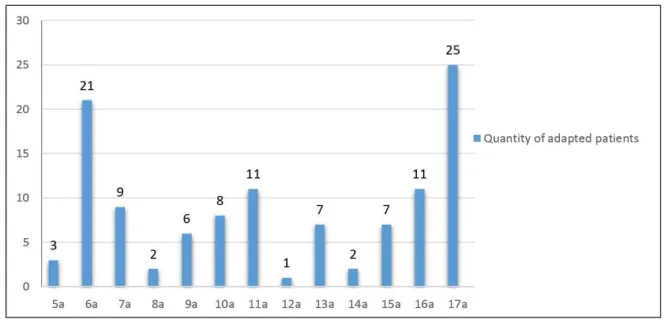
A total of 113 medical records were analyzed, comprised of 58 female patients and 55 male patients, all users of CIs and adapted with the personal FM System kit, considering the indication criteria for adaptation and follow-up contemplated in the Ordinance. Patients selected in the series were aged between 5 years and 17 years and 11 months (Figure 1).
The analysis of the medical records consisted of the collection of information documented by the speech therapist responsible for the care of the CI user in two different moments: 1º) on the day of adaptation of the FM System Kit; and 2) in return for monitoring the use of the FM System.
At the time of adaptation of the FM System Kit, the protocol for adaptation and monitoring of the FM System was performed in the HA and/or CI users, consisting initially of the interview with the CI device user and the responsible; Evaluation of the speech processor of the CI device, transmitter and receiver programming of the FM system and selection of the transmission channel; FM system test coupled to a speech processor and component synchronization check; Guidelines on the use/operation and care related to the FM System and supply of speciic materials regarding the use of the FM System in the classroom(10,11).
Next, the speech perception evaluations were performed by means of the tests: List of recorded sentences and List of recorded disyllabic words.
The tests were performed in the free ield, in an acoustically treated cabin, under two conditions: in silence and with competitive noise in order to simulate the classroom reality. During the test, the transmitter microphone of the FM System remained positioned approximately 15 cm from the center of the speaker.
Participants who had the ability to refer to classroom dificulties related to auditory performance and speech comprehension completed the Classroom Participation Questionnaire (CPQ) at the time of adaptation and in the return for monitoring. This questionnaire has the purpose of subjectively evaluating the participation and beneit of the student adapted with the FM System in the classroom, and the answers are directed to 28 auditory situations, divided into subscales: teacher comprehension, student comprehension, positive aspects and negative aspects. The results are scored according to the scale: 1 (almost never), 2 (sometimes), 3 (usually) and 4 (almost always). Higher scores are desirable, except for the “negative aspects” scale, in which the inverted score is expected(6).
For those CI users who did not have suficient skills to refer to the dificulties encountered in the classroom, the Listening Inventory for Education - Revised (LIFE-R) was delivered to the caregivers, an assessment tool for hearing skills in a real classroom situation through teachers’ perceptions(12).
Composed of 15 questions related to the different situations of listening in the classroom, the score of this test varies from: 1 - dificulty in 100% of situations; 2 - dificulty in 75% of situations; 3 - dificulty in 50% of situations; 4 - dificulty in 25% of situations; and 5 - absence of dificulty. The evaluation of student performance for listening situations is deined according to the sum of the points obtained for each question. Each student can achieve a total of 15 to 75 points, taking into account the two divisions of the questionnaire: “listening situations in the classroom” and “patient’s goals related to autonomy”(12).
Those responsible for the patients were instructed to deliver the questionnaire to the teacher and instruct him to respond in two moments: at the time of delivery and after at least one month of effective use of the FM System in the classroom. The stipulated period serves for the student to have the opportunity to experience
and beneit from the device after the acclimatization period, showing the teachers reliable results.
In the adaptations, the CI user and the caregiver were advised as to the return visit to monitor the FM System, to be performed after three months of the adaptation date in order to verify the use and beneit related to the FM System.
The routine of procedures in the return visit to follow the use of the device consisted of the following procedures: interview with the CI user and the caregiver; evaluation of the speech processor of the CI device; evaluation of the FM System kit; FM system test coupled to a speech processor and component synchronization check; questionnaires to evaluate the beneit of the FM System: application of the CPQ questionnaire (after use of the FM System) or receipt of the LIFE-R questionnaire illed out by the teacher of the CI user and guidelines(10,11).
Table 1 presents the information regarding the return period for follow-up of the patients adapted with the FM System. Of the 113 patients adapted with the FM kit, 70 were present on the return visit until the inal collection date. With these, the analysis of both the use and the beneit of the FM System was performed through the speech perception tests and questionnaire responses.
For the 29 patients adapted between August/2015 and September/2015, only the FM System beneit analysis was performed through the speech perception tests applied at the time of the FM System kit adaptation. The information on the use and questionnaires were collected in the return visit for the follow-up of these patients in a period after the date of completion of the collection of the present study.
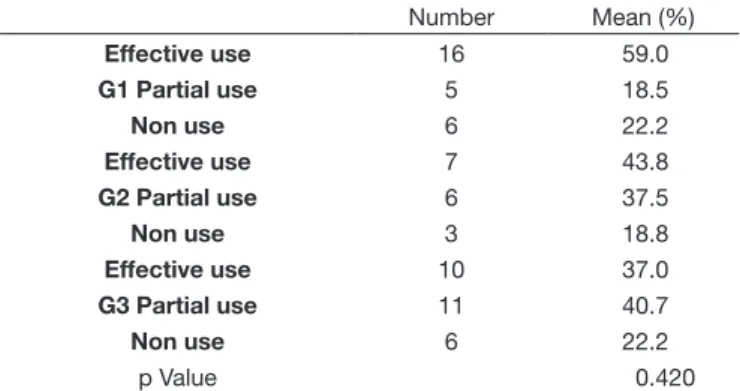
In order to verify a possible correlation between the effectiveness of the use of the FM System in the classroom and the age group of adaptation, the patients who participated in the return visit were divided into three groups, G1: adapted patients with ages between 5 and 9 years (27 patients), age range
Caption: a = years
corresponding to Elementary School 1; G2: adapted patients aged 10-14 years (16 patients), referring to Elementary School 2; and G3: adapted patients aged 15-17 years (27 patients), equivalent to high school.
For the statistical analysis, the following tests were used: Chi-square in order to establish the comparison between the use of the FM System and the different adapted age groups, and the paired t-test for the results of speech perception in noise with and without the use of the FM System and in the comparison of the answers of the CPQ and LIFE-R questionnaires, in the pre and post use situations of the FM System. The level of signiicance of ≤ 0.05 (5%) was adopted.
RESULTS
Use of the FM System
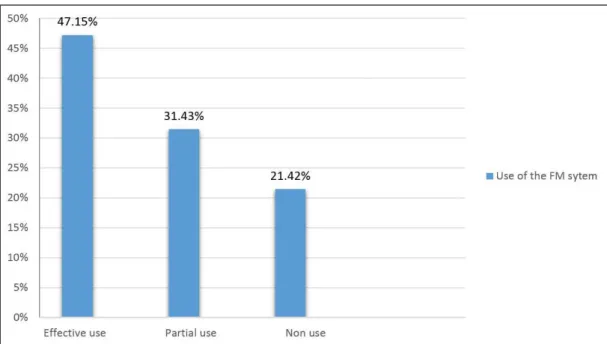
Figure 2 shows the Frequency of use of the FM System in the classroom referred by the patients themselves. The partial use described in the igure corresponds to the weekly use, but not daily in the classroom. One patient chose to return the FM System kit with the justiication that they had decided not to
use the device because of the shame in asking the teachers to use it during the lessons.
The justiications reported by the patients for the partial use or non-use of the FM System in the classroom are described in Table 2. Regarding the analysis of the correlation between the effectiveness of use and the age range of adaptation, there was no statistically signiicant difference in the comparison of the “no use” of the FM System in the different groups (Table 3).
Table 4 shows the data referring to the functioning of the device of the 70 patients who returned to follow up the FM System. One of the adapted patients did not bring the kit in the return visit for evaluation.
Beneit of the FM System
In Figure 3, we can observe a statistically signiicant increase in the results of the speech perception tests in the situation of competitive noise with the use of the FM System.
As for the questionnaires, among the 36 LIFE-R questionnaires delivered at the time of adaptation, only 9 respondents brought the questionnaire answered. Through statistical analysis, a signiicant difference was observed in the questions aimed at reducing dificulties in the classroom, in the moments before and after adaptation of the FM System kit. In the questions related to increased autonomy and instruction in school activities, there was no statistically signiicant difference, as shown in Figure 4.
Regarding the CPQ, of the 34 patients who received the questionnaire and returned for the follow-up, 21 responded correctly, 11 responded incorrectly and 2 did not respond. Figure 5 shows the statistical analysis applied to the four subscales contained in the CPQ questionnaire, establishing a comparison between the responses obtained in the pre and post adaptation of the FM System kit. A statistically signiicant difference was found
Figure 2. Use of the kit FM system in the classroom (n = 70) Table 1. Number of patients according t the return period for follow up
Return for follow-up N (patients)
3 months 33
5 months to a 1 year 31
Over 1 year 6
between the results in the subscales “teacher understanding” and “positive aspects”.
DISCUSSION
Use of the FM System
Figure 2 shows that, of the 113 patients adapted between September/2013 and September/2015, 70 patients returned for the follow-up. Of these, most of them reported using the FM System in the classroom. Taking into account the fact that individuals with hearing loss present signiicant dificulties in understanding speech in noisy situations, as in the case of classrooms, with consequent negative interferences on the learning processes, adherence to the effective use of the FM System becomes and is fundamental to the development of the educational processes of these students(2,13).
The percentage of patients who did not use the FM System corresponded to 21.42% (Figure 2). However, most of the adapted patients who had partial or non-use of the device in the classroom reported beneiting from the FM System kit in other situations, for example, listening to music.
The restricted use of hearing aids in children and adolescents may be related to the presence of negative self-concept, psychosocial changes and high resistance, conirming the most common complaints expressed by some of the patients in the present study who made partial use of or did not use the FM System. They are: shame, lack of beneit and dificulties of acceptance (Table 2)(14). However, although the literature suggests
greater resistance among adolescents compared to children in relation to the use of hearing aids, the data collected in the present study did not show a correlation between the non-use of the FM System and the adapted age group (Table 3)(14,15).
Regardless of age, the fact that some patients did not use the FM System due to shame points to the importance
Table 2. Justification attributed to the partial use/non-use of the FM System
Justification N (patients)
Shame 7
Teacher’s Body Noise 2
Questions on handling 2
Fear of taking the kit to school 2 Difficulty of acceptance 5 Feeling of lack of benefit 4 Reduced perception of other colleagues’ speech 3 Loss of receiver/malfunction of components 12
Table 3. Number and percentage of patients in groups 1, 2 and 3 due to the use of the FM System
Number Mean (%)
Effective use 16 59.0
G1 Partial use 5 18.5
Non use 6 22.2
Effective use 7 43.8
G2 Partial use 6 37.5
Non use 3 18.8
Effective use 10 37.0
G3 Partial use 11 40.7
Non use 6 22.2
p Value 0.420
Caption: G=group; Chi-square statistical test with p Value at a significance
level of ≤ 0.05
Table 4. Complaints and difficulties encountered in evaluating the operation of the FM system
Complaints and difficulties N (patients)
No complaints 37
Questions on handling 20 Malfunction (oxidation, flashing, noise) 8
Loss of componentes 4
Caption: * = Statistical test = paired t-test with p value at significance level of ≤ 0.05
of psychosocial support directed to these patients who need ancillary hearing resources for the full development of auditory, language, communication and learning(14,15).
Other justiications for the partial or non-use of the FM System were excessive teacher noise and the fear of taking the device to school. Regarding these complaints, the teachers’ understanding of the correct use of the FM System and its inluence on the non-effectiveness of the use of the device in the classroom, as well as the importance of orientation to these professionals, is questioned.
In response to this need, the “Modulated Frequency System for Teachers” website was developed, an initiative of Dr. Maria Cecília Bevilacqua, Professor of the Department of Speech and Hearing Therapy at the Bauru School of Dentistry, University of São Paulo (FOB/USP), and the collaborating team in order to compose all the requirements during the process of granting FM System kits via the SUS(16).
Regarding the operation of the FM System kit, some of the problems presented by the patients / companions were related to the use and handling of the kit, which was solved with new
Caption: * = Statistical test = paired t-test with p value at significance level of ≤ 0.05
Figure 4. Results of the LIFE-R questionnaire, in the pre and post-adaptation moments of the FM system kit
Caption: * = Statistical test = paired t test with p value at significance level of ≤ 0.05
guidelines. Other complaints were associated with misuse, such as loss of receptors and oxidation of components.
In order to improve access and quick resolution of problems, a page has been developed in the Babies Portal (website developed by the Bauru School of Dentistry of the University of São Paulo - FOB/USP, with information on Dentistry and Speech Therapy), focused on explanations on the use, care and handling of the FM System kits(17).
Other possibilities for more didactic orientations with the support of visual content materials are necessary in order to disseminate information in a fast and self-explanatory way, facilitating the understanding of the reader through a clear, simple and easy to understand language.
Beneit of the FM System
Regarding the results in the speech perception tests in noise (Figure 3), there was a statistically signiicant difference in the conditions with and without the FM System. A study that investigated the perception of speech in noise in 14 participants of CI patients, aged between 7 and 17 years, showed signiicant results in relation to the FM System beneit, and veriied a better performance in children aged 10 years and over(5).
International authors provide evidence on the effectiveness of noise perception speech performance with the use of the FM System and show that routine use of the classroom device improves the signal-to-noise (S/N) relationship with remarkable success, if compared to the use of an unilateral CI(18,19).
These results support the indication of the FM system described in several international studies, which point to the device as an essential resource for hearing impaired children, especially in the school environment(1,9,20-25).
Associated with objective assessments, subjective measures can contribute to the effectiveness for the indication of hearing devices as well as their beneit. The LIFE-R evaluation questionnaire is an effective way of acquiring information about the school performance of the child adapted with the FM System, based on the teacher’s observation(26,27).
In the present study, the statistical analysis showed a signiicant improvement regarding the irst item “listening situations in the classroom”. In the second item, “patient’s goals related to autonomy”, there was no statistically signiicant difference, and it can be justiied by several questions not applied to the classroom routines.
A study of 12 teachers and a speech therapist responsible for adapting the FM System in children aged 7 to 13 years showed signiicant positive differences between the conditions with and without FM, both in the evaluation with the teachers and in the evaluation with the speech therapist(4).
Another research aimed at comparing the perception of speech therapists and teachers about the modiication of the school performance of children adapted with the FM System showed a signiicant difference in the responses obtained in the LIFE-R questionnaire answered after the adaptation of the FM System, with the best response values obtained with the use of the device(6).
However, it is worth mentioning that the application of the LIFE-R questionnaire did not reach the objectives proposed,
since there was no expected adherence to the instrument, and only nine patients presented the questionnaire correctly answered. In addition, the parents of the patients reported dificulty in understanding the questionnaire by the teachers when completing it.
Regarding the CPQ questionnaire, the statistical analysis showed a signiicant improvement in two items evaluated through the questionnaire: “teachers´understanding” and “positive aspects.” There was no statistically signiicant difference in “student understanding” and “negative aspects.”
It was possible to observe dificulties related to completing the questionnaire. Although it appeared that patients were able to respond to the test, many responded in the wrong way due to dificulties with language, absence of experiences related to the situations questioned and lack of understanding of their own feelings and perceptions regarding the situations in question. The impact of such dificulties when punctuating each question should be considered by the evaluators during the guidelines for the application of the questionnaires.
In agreement with the data obtained, national and international studies revealed positive differences in the responses of the CPQ questionnaire performed with the use of the FM System, as well as the evident improvement in the aspects of auditory accessibility, autonomy and independence of children in the classroom(6,28-30).
CONCLUSION
The follow-up of the patients who received the FM kits dispensed by the SUS allowed the evaluation of the use, beneit and eventual problems related to the operation of this device. In the present study, it was concluded that the majority of patients with cochlear implants showed an expressive adherence to the use of the FM System. In addition, the results demonstrated the beneit and effectiveness of this device in improving speech perception in noisy environments, such as the classroom.
The importance of materials that help teachers in the use of this technology and measures for parents to collaborate in the adaptation process are also emphasized. It is hoped that future research can be developed so that greater knowledge is obtained in this area.
ACKNOWLEDGEMENTS
To my advisor Luzia Maria Pozzobom Ventura Pizarro and co-advisor Liège Franzini Tanamati for the assistance in the construction of the present work, and to the Multiprofessional Residency in Hearing Health, Hospital of Rehabilitation of Craniofacial Anomalies of the University of São Paulo (HRAC/USP) Bauru - SP/Brazil for the opportunity to carry out the present research.
REFERENCES
2. Bertachini AL, Pupo AC, Morettin M, Martinez MA, Bevilacqua MC, Moret, AL, et al. Sistema de frequência modulada e percepção de fala em sala de aula: revisão sistemática de literatura. CoDAS. 2015;27(3):292-300. PMid:26222948.
3. Wolfe J, Schafer EC. Optimizing the benefit of sound processors coupled to personal FM systems. J Am Acad Audiol. 2008;19(8):585-94. PMid:19323350. http://dx.doi.org/10.3766/jaaa.19.8.2.
4. Jacob RTS, Molina SV, Amorim RB, Bevilacqua MC, Lauris JRP, Moret ALM. FM listening evaluation for children: adaptação para a língua portuguesa. Rev Bras Ed Esp. 2010;16(3):359-74. http://dx.doi.org/10.1590/ S1413-65382010000300004.
5. Davies MG, Yellon L, Purdy SC. Speech-in-noise perception of children using cochlear implants and FM systems. Aust N Z J Audiol. 2001;23(1):52-62. http://dx.doi.org/10.1375/audi.23.1.52.31096.
6. Jacob RT, Alves TK, Moret AL, Morettin M, Santos LG, Mondeli MF.
Participação em sala de aula regular do aluno com deficiência auditiva: uso do Sistema de frequência modulada. CoDAS. 2014;26(4):308-14.
PMid:25211690.
7. Brasil. Decreto nº 5.296 de 2 de dezembro de 2004. Regulamenta as Leis nos 10.048, de 8 de novembro de 2000, que dá prioridade de atendimento às pessoas que especifica, e 10.098, de 19 de dezembro de 2000, que estabelece normas gerais e critérios básicos para a promoção da acessibilidade
das pessoas portadoras de deficiência ou com mobilidade reduzida, e dá outras providências [Internet]. Diário Oficial da União; Brasília; 2004 [citado em 2015 Nov 07]. Disponível em: http://www.planalto.gov.br/
ccivil_03/_ato2004-2006/2004/decreto/d5296.htm
8. Brasil. Ministério da Saúde. Portaria nº 1.274, de 25 de junho de 2013.
Inclui o Procedimento de Sistema de Frequência Modulada Pessoal (FM)
na Tabela de Procedimentos, Medicamentos, Órteses, Próteses e Materiais
Especiais (OPM) do Sistema Único de Saúde [Internet]. Diário Oficial da União; Brasília; 2013 [citado em 2015 Nov 07]. Disponível em: http://
bvsms.saude.gov.br/bvs/saudelegis/gm/2013/prt1274_25_06_2013.html 9. Thibodeau L. Benefits of adaptive FM systems on speech recognition in
noise for listeners who use hearing aids. Am J Audiol. 2010;19(1):36-45. PMid:20220201. http://dx.doi.org/10.1044/1059-0889(2010/09-0014). 10. American Academy of Audiology. Clinical practice guidelines: remote
microphone hearing assistance technologies for children and youth from
birth to 21 years [Internet]. 2011 [citado em 2015 Nov 7]. Disponível
em: http://www.audiology.org/resources/documentlibrary/Documents/ HAT_Guidelines_Supplement_A.pdf
11. Bucuvic EC, Tanamati LF, Araujo PGV, Paccola ECM, Moret ALM. Elaboração de um protocolo para a seleção e adaptação do Sistema de
Frequência Modulada Pessoal. In: VII Seminário de “Políticas Públicas,
Serviços e Sistemas em Saúde Auditiva. Momento atual da política
governamental voltada à pessoa com deficiência auditiva”; 2014 Set
25-26; Bauru. Anais. Bauru: USP; 2014.
12. Brazorotto JS, Souza KT. Validação do protocolo “Listening Inventory for Education Revised - (L.I.F.E. R)”. In: 27º Encontro Internacional de Audiologia, 2012; Bauru. Anais. Bauru: USP; 2012.
13. Jokura PR, Melo TM, Bevilacqua MC. Evasão dos pacientes nos acompanhamentos nos serviços de saúde auditiva: identificação sobre o motivo e resultados pós-adaptação de aparelho de amplificação sonora individual. Rev CEFAC. 2013;15(5):1181-8. http://dx.doi.org/10.1590/ S1516-18462013005000022.
14. Zugliani AP, Motti TFG, Castanho RM. O autoconceito do adolescente deficiente auditivo e sua relação com o uso do Aparelho de Amplificação Sonora Individual. Rev Bras Ed Esp. 2007;13(1):95-110. http://dx.doi. org/10.1590/S1413-65382007000100007.
15. Boscolo CC, Costa MPR, Domingos CMP, Perez FC. Avaliação dos benefícios proporcionados pelo AASI em crianças e jovens da faixa
etária de 7 a 14 anos. Rev Bras Ed Esp. 2006;12(2):255-68. http://dx.doi. org/10.1590/S1413-65382006000200008.
16. USP: Universidade de São Paulo [Internet]. Curso de Sistema de Frequência Modulada para professores. 2016 [citado em 2016 Mar 22]. Disponível
em: http://cursofm.fob.usp.br/
17. USP: Universidade de São Paulo. Faculdade de Odontologia de Bauru.
[Internet]. Portal dos bebês. 2016 [citado em 2016 Mar 22]. Disponível
em: http://portaldosbebes.fob.usp.br/portaldosbebes
18. Schafer EC, Kleineck MP. Improvements in speech recognition using cochlear implants and three types of FM systems: a meta-analytic approach. J Educ Audiol. 2009;15(1):4-14.
19. Eiten L, Lewis D. Verifying frequence-modulated system performance: it’s the right thing to do. Semin Hear. 2010;31(3):233-40. http://dx.doi. org/10.1055/s-0030-1262328.
20. Schafer EC, Thibodeau LM. Speech recognition performance of children using cochlear implants and FM systems. J Edc Audiol. 2003;11(1):15-26. 21. Schafer EC, Thibodeau LM. Speech recognition abilities of adults
using cochlear implants interfaced with FM system. J Am Acad Audiol. 2004;15(10):678-91. PMid:15646666. http://dx.doi.org/10.3766/jaaa.15.10.3. 22. Gagné J-P, Audiovisual FM system is found more beneficial in classroom than auditory-only. Hear J. 2001;54(1):48-51. http://dx.doi.org/10.1097/01. HJ.0000294497.09787.13.
23. Lewis D, Individual FM. System for children. Where are we now? Perspect Hear Disorder Child. 2010;20(1):56-62. http://dx.doi.org/10.1044/ hhdc20.2.56.
24. Bootroyd A, Ilglehart F. Experiments with classoroom FM amplification. Ear Hear. 1998;19(3):202-17. PMid:9657595. http://dx.doi.org/10.1097/00003446-199806000-00004.
25. Schafer EC, Huynh C, Romine D, Jimenez R. Speech recognition and subjective perceptions of neck-loop FM receivers with cochlear implants. Am J Audiol. 2013;22(1):53-64. PMid:22992447. http://dx.doi.org/10.1044/1059-0889(2012/11-0032).
26. Jacob RTS, Bevilacqua MC, Molina SV, Queiroz M, Hoshii L, Lauris JRP, et al. Sistema de frequência modulada em crianças com deficiência auditiva: avaliação de resultados. Rev Soc Bras Fonoaudiol. 2012;17(4):417-21.
27. Gabbard AS. The use of FM technology for infants and young children. In: Fabry D, Johnson CD. I Internacional FM Conference. Acess: achieving clear communication employing sound solutions; 2004; Great Britain. Proceedings. Great Britain: Cambrian Printers; 2004. p. 93-9.
28. McCain KG, Antia SD. Academic and social status of hearing, deaf, and hard of hearing students participating in a co-enrolled classroom. Comm Disord Q. 2005;27(1):20-32. http://dx.doi.org/10.1177/15257401050270 010201.
29. Antia SD, Sabers DL, Stinson MS. Validity and reliability of the classroom participation questionnaire with deaf and hard of hearing students in public schools. J Deaf Stud Deaf Educ. 2007;12(2):158-71. PMid:17114595. http://dx.doi.org/10.1093/deafed/enl028.
30. Antia SD, Jones PB, Reed S, Kreimeyer KH. Academic status and progress of deaf and hard-of-hearing students in general education classrooms. J Deaf Stud Deaf Educ. 2009;14(3):293-311. PMid:19502625. http://dx.doi. org/10.1093/deafed/enp009.
Author contributions