Fe-Doping Efect on the Bi
3Ni Superconductor Microstructure
Silvio Henrique Gonsalvesa, João Frederico Haas Leandro Monteiroa, Adriane Consuelo Da Silva Leala, André Vitor Chaves de Andradea, Gelson Biscaia de Souzaa, Ezequiel Costa Siqueiraa,
Francisco Carlos Serbenaa, Alcione Roberto Jureloa*
Received: July 15, 2016; Revised: January 19, 2017; Accepted: February 18, 2017
The substitution efects of Fe ion on the structure of the intermetallic Bi3Ni1-xFex (0 ≤ x ≤ 0.10)
superconductor were studied. The morphology of samples consists of an inhomogeneous laminar slab-like microstructure. The main phase corresponds to Bi3Ni1-xFex with an orthorhombic structure
(Pnma), but with very small quantities of impurities of BiNi and Bi as revealed by X-ray difraction. SEM and AFM reveal that the Bi3Ni1-xFex phase consists of two regions. One region is Bi richer and
Ni and Fe poorer than the other region. Raman spectroscopy revealed two phonon modes at room temperature. No signiicant changes were observed in the spectra with Fe doping and in diferent regions of the Bi3Ni1-xFex phase. Superconductivity is observed below a transition temperature TC = 4 K
and regardless of iron doping.
Keywords: Bi3Ni, Superconductor, Intermetallic alloys, Iron
* e-mail: [email protected]
1. Introduction
The coexistence of superconductivity and magnetism is a phenomenon of great interest in condensed matter physics. In almost all materials, these two fundamental states are highly competitive and destroy the superconductivity. Compounds based in Bi-Ni, such as LaO1-δNiBi1, CeNiBi
2 2 and Bi
3Ni
3, present this
complex phenomenon. In the superconductor Bi3Ni compound,
with critical temperature TC around 4.1 K3, the coexistence
of superconductivity and ferromagnetism is observed, with superconductivity emerging in the ferromagnetically ordered phase4.
The stoichiometric Bi3Ni is described as an intermetallic
alloy with an orthorhombic crystallographic structure of CaLiSi2-type, 16 atoms per unit cell and space group Pnma
5.
Ruck et al. studied the crystal structure of Bi3Ni using quantum chemical calculations. According to their results, the Ni atoms have a capped trigonal prismatic coordination of Bi atoms with strong bonds Ni-Bi and Ni-Ni6. Besides the Ni-Bi phase
diagram, others phase diagrams such as Rh-Bi7-8 and Co-Bi9
have been explored to search for new superconductors. For RhBi4 and Rh3Bi14, superconductivity was observed at a
critical temperature TC of 2.8 K and 3.2 K, respectively. For the CoBi3 compound, synthesized using a high-pressure and
high-temperature technique, TC is around 0.5 K.
Although the Bi3Ni compound is known as a superconductor
since 19483, there were few reports about this material. Pineiro
et al. studied the possible coexistence of superconductivity and magnetism in Bi3Ni and showed that it presents a
ferromagnetic characteristic up to 750 K, well above the Ni Curie temperature10. Herrmannsdorfer et al. demonstrated
the coexistence of ferromagnetic and superconducting states in Bi3Ni nanostructures. Superconductivity conined in Bi3Ni
emerges in the ferromagnetically ordered phase and is stable up to high magnetic ields4. Zhu et al. investigated anisotropy
in superconducting and normal state properties of Bi3Ni single
crystals11. They demonstrated from electron spin resonance that
ferromagnetic luctuations exist on the surface of the crystal below 150 K.
In this study, we describe the substitution efects of Fe ion in the structure of the Bi3Ni1-xFex (x = 0.00, 0.05 and 0.10)
superconductor. The samples were prepared by the solid-state reaction method and characterized by X-ray difraction, optical and scanning electron microscopy with energy dispersive spectroscopy, atomic force microscopy and Raman spectroscopy. It was observed that the main phase corresponds to Bi3Ni1-xFex,
but with small quantities of BiNi and Bi as impurities. From SEM and AFM, two regions were observed in all samples: white and gray. The white region is richer in Bi and poorer in Ni and Fe than the gray region. Observations from atomic force microscopy experiments, in magnetic mode, showed the presence of magnetic interactions in the range of 500 nm. Raman spectra were obtained and two phonon modes were observed, with no peak shift dependence with Fe doping.
2. Experimental Details
Polycrystalline samples of Bi3Ni1-xFex (0 ≤ x ≤ 0.10)
were prepared by the solid-state reaction method using Bi
a Departamento de Física, Universidade Estadual de Ponta Grossa - UEPG, Av. Gen.
pieces and Ni and Fe powders. Appropriate amounts were mixed with help of a pestle and mortar for around one hour. Then, the product was pelletized and encapsulated in an evacuated quartz tube for melting. Samples were heated at 1000 ºC for 24 h and slowly cooled to room temperature. The characterization was performed by X-ray difraction (XRD), optical and scanning electron microscopy (SEM) with energy dispersive spectroscopy (EDS), atomic force microscopy (AFM) and Raman spectroscopy. XRD experiments were carried out using a Rigaku difractometer with CuKα radiation and XRD patterns were collected from 5º to 120º in the 2θ range with 0.006 step and 6 s counting time. The unit cell parameters were reined by the Rietveld-Le Bail method using the GSAS+Expgui software12-13. Samples
were also characterized in air and at room temperature using a commercial AFM system (SPM-9600 Shimadzu) in non-contact and magnetic modes. The images were processed to remove the low-frequency noise. The images were obtained with silicon cantilever with a magnetized cobalt coating (MFMR-10 from Nano World Innovative Technologies). The probe was Al-coated on the detector side. The cantilevers had a resonant frequency of approximately 75 kHz, with nominal spring constant of 2.8 N/m. Unpolarized confocal Raman measurements were performed with a Bruker Senterra R200-532 spectrometer equipped with an Olympus optical microscope and with a thermo-electrically cooled CCD detector equipped with a solid state laser with λ = 532 nm. A 50X objective microscopic lens was used at diferent regions of the samples. A circular pin-hole of 50 µm was used with an estimated spot size of 2 µm at sample surface. Acquisition times were around 20 s with an incident laser power density below 60 x 104 W/cm2 in order to avoid
sample heating. The magnetic properties were measured by using a physical property measurement system (PPMS, Quantum Design) and a vibrating sample measurement system (VSM). DC magnetization measurements were performed as a function of temperature under zero-ield-cooling (ZFC) and ield-cooling (FC) conditions.
3. Results and Discussion
The X-ray powder difraction patterns at room temperature of polycrystalline Bi3Ni1-xFex samples with x = 0.00, x = 0.05
and x = 0.10 are displayed in Figure 1. It was observed that the main phase corresponds to Bi3Ni1-xFex with orthorhombic
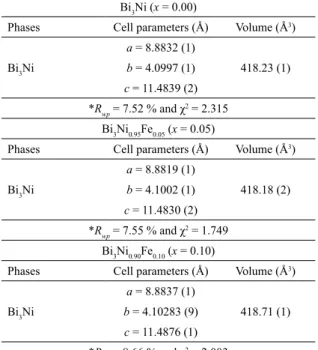
structure (Pnma) and with small quantities of impurities of BiNi and Bi. No Ni as impurity was detected. The unit cell parameters, atomic factor parameters and agreement factors obtained by Rietveld-Le Bail method are summarized in Table 1. Speciically for Bi3Ni1-xFex samples, the behavior of
lattice parameters as a function of iron doping can be seen in Table 1. The value of the lattice parameter a is approximately constant with 8.8832 (1) Å for x = 0.00 and 8.8837 (1) Å for x = 0.10. On the other hand, b and c increase with iron
doping. The b parameter increased from 4.0997 (1) Åfor x = 0.00 to 4.10283 (9) Å for x = 0.10 while the c parameter increased from 11.4839 (2) Å to 11.4876 (1) Å. Also, the unit cell volume increases from 418.23 (1) Å3 for x = 0.00
to 418.71 (1) Å3 for x = 0.10. The lattice parameters and
unit cell volume for pure Bi3Ni (x = 0.00) derived from
least squares reinement are in agreement with the published result obtained in another study14. Also, from Table 1, we can
observe that Rwp (R – weighted pattern) and CARACTER 1 (goodness-of-it) are small and therefore reliable.
Figure 1. XRD patterns taken at room temperature of polycrystalline
Bi3Ni1-xFex sample.
Table 1. Lattice parameters a, b, c and unit cell volume V for polycrystalline Bi3Ni1-xFex samples. Numbers in parentheses indicate
the standard deviation.
Bi3Ni (x = 0.00)
Phases Cell parameters (Å) Volume (Å3)
Bi3Ni
a = 8.8832 (1)
418.23 (1) b = 4.0997 (1)
c = 11.4839 (2)
*Rwp = 7.52 % and χ2 = 2.315
Bi3Ni0.95Fe0.05 (x = 0.05)
Phases Cell parameters (Å) Volume (Å3)
Bi3Ni
a = 8.8819 (1)
418.18 (2) b = 4.1002 (1)
c = 11.4830 (2)
*Rwp = 7.55 % and χ2 = 1.749
Bi3Ni0.90Fe0.10 (x = 0.10)
Phases Cell parameters (Å) Volume (Å3)
Bi3Ni
a = 8.8837 (1)
418.71 (1) b = 4.10283 (9)
c = 11.4876 (1)
*Rwp = 8.66 % and χ2 = 2.003
/ R
Rwp e
2
| =
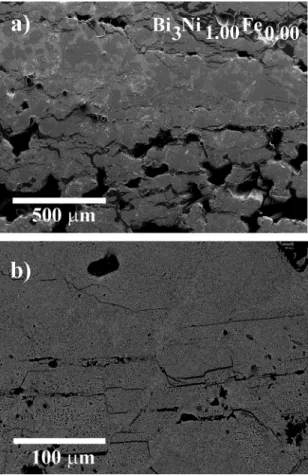
Figures 2(a) and 2(b) show the microstructure of the polycrystalline Bi3Ni1.00Fe0.00 sample as revealed by SEM
white and gray regions. The same structure is observed for all samples. Their composition measured by EDS will be discussed later. Figure 2(b) shows in higher magniication several microcracks that are aligned approximately parallel to a horizontal direction in the photograph. The origin of these cracks may be due to thermal expansion anisotropy as observed in REBa2Cu3O7-δ (RE = rare earth)
15 or due to
weak bonding between the laminar grains as observed in iron-based superconductors16.
Figure 2. (a) Backscattered electrons SEM image of the polycrystalline
of Bi3Ni1.00Fe0.00 (x = 0.00) sample. The stacked lamellar structure is shown in more detail in (b).
Figure 3 show the microstructure of polycrystalline samples of Bi3Ni1-xFex with (a) x = 0.00 and (b) x = 0.10 in
more detail. Two regions, labeled white and gray, are clearly observed. If the same image of the polycrystalline sample with x = 0.00is observed by optical microscopy, two regions are also distinguished in the upper inset. In the lower inset, the surface morphology of the polycrystalline Bi3Ni0.90Fe0.10
sample was analyzed with atomic force micrograph in phase mode using a Si probe and revealed also two regions, one darker on the right side and another white on the left side of the igure. We cannot distinguish each of these two regions corresponds to the two regions observed by SEM, but they maybe correlated.
Figure 3. Backscattered electrons SEM micrographs for a polycrystalline
sample of Bi3Ni1-xFex with (a) x = 0.00 and (b) x = 0.10. We can
clearly observe two regions, labeled white and gray. Upper inset: optical image of the polycrystalline of Bi3Ni sample. Lower inset:
atomic force micrograph of a polycrystalline Bi3Ni0.90Fe0.10 sample in phase mode using a Si probe.
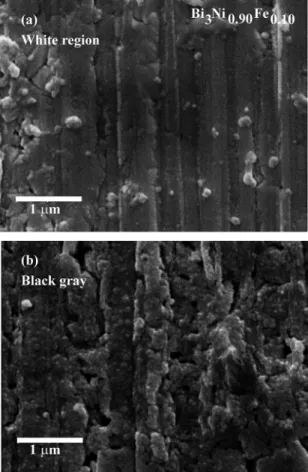
If Figure 3(b) is magniied, several lamellae are observed in both white (Figure 4(a)) and gray (Fig. 4(b)) regions. Their thickness is around 500 nm and they are aligned across several grains. While in the white region the porosity appears to be low, in the gray regions, the porosity is higher. Also the pores appear to be aligned parallel to the lamellae in the gray region. It is possible to observe also in Figs. 3(b) and 4 that this microstructure runs across several white and gray regions, leaving the possibility our samples to be textured.
In view of the diferent regions observed from X-ray and SEM at diferent samples, we decided to analyze the chemical composition using energy dispersive spectroscopy (EDS). Local composition of the Bi3Ni and Bi3Ni0.90Fe0.10
samples was determined by EDS in diferent positions on the sample surface and in using areas of 4 x 4 μm2. Table 2 shows
ambient conditions in (a) phase mode and (b) topographic mode using a magnetized Co-coated probe for the same region. In the upper inset, image (a) is shown in more detail. While Figs. 5(a) and 5(b) show diferent regions in respect of the interaction between the AFM probe and the sample surface with no clear observed pattern, in the inset of Fig. 5(b) it is observed several magnetic fringes with a width of approximately 500 nm. These results may show that our sample is magnetically inhomogeneous. The structure was observed in all samples with Fe concentration equals to x = 0.00, x = 0.05 and x = 0.10. The x = 0.00 and x = 0.10 samples were rotated 90o degrees and the observed
magnetic fringe pattern did not change orientation with the sample. We do not think that this observed magnetic fringe pattern is related with the lamellae structure observed in Figs. 4 since this pattern was also observed in samples with x = 0.00 (Fig. 4(a)).
Figure 4. SEM micrograph of polycrystalline sample of Bi3Ni0.90Fe0.10
for (a) white and (b) gray regions.
showed that there is variation in the chemical composition between the white and gray regions. This chemical composition diference is smaller in the Bi3Ni than in the Bi3Ni0.90Fe0.10.
The white region is richer in Bi and poorer in Ni than the gray region for Bi3Ni samples. When Fe is added, its solubility
is higher in the gray region (14 %) than in the white region (8 %). Also, the ratio between Bi/Ni is constant (10) for the gray phase for the Bi3Ni and Bi3Ni0.90Fe0.10 samples.
For the white region, this ratio increases when Fe is added. The XRD experiment shown in Figs. 1(a-c) revealed that the white and gray regions have the same atomic structure, despite of the slight diferent chemical composition due to the diferent solubility of the elements revealed in the SEM.
Figure 5 show AFM images of 10 x 10 μm2 area for
Bi3Ni0.90Fe0.10 sample. Both images were obtained under
Table 2. Local composition of the Bi3Ni and Bi3Ni0.90Fe0.10 samples, as determined by EDS in diferent positions on the sample surface. The EDS analyses were performed in areas of 4 x 4 μm2.
Samples
Composition (wt.%) Region
White Gray
Bi (%) Ni (%) Fe (%) Bi (%) Ni (%) Fe (%)
Bi3Ni1.00Fe0.00 95.2 4.7 0.0 91.0 9.0 0.0
Bi3Ni0.90Fe0.10 90.5 1.6 7.9 78.0 7.8 14.2
Raman spectroscopy is a powerful tool to detect changes at the microscopic level. Then, the search for speciic features in the Raman spectra could shed new light in the efect of iron substitution in Bi3Ni1-xFex samples. We probed the samples
with diferent power densities, from 6 to 60 x 104 W/cm2
(applied power from 2 to 20 mW) at room temperature in order to investigate possible suppression or enlargement of active Raman modes as a function of the laser power density. Diferent locations on the sample surface were probed in order to assure spectra representability.
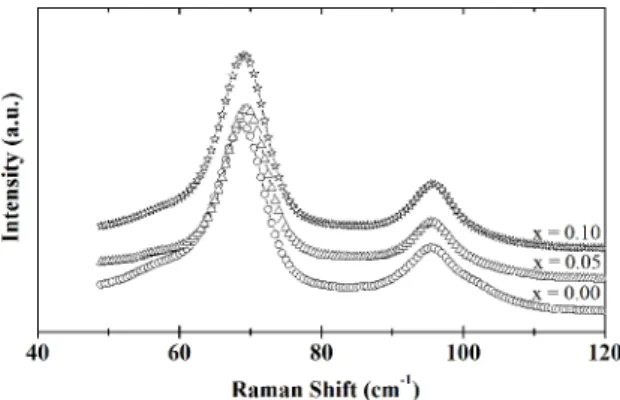
Figure 6 shows Raman spectra of Bi3Ni1-xFex samples with
x = 0.00, x = 0.05 and x = 0.10 obtained at room temperature with an applied power of 10 mW (30 x 104 W/cm2). This
power had the best signal-to-noise ratio with well resolved Raman peaks. The Raman spectra showed 2 Raman modes at 69 ± 1 and 96 ± 1 cm-1. The line observed in 69 cm-1 is
the most prominent, while a weaker band is observed at 96 cm-1. The phonon modes observed in this study show typical
Lorentzian line shapes without asymmetry. The two peaks were not identiied with any speciic displacement mode and to the best of our knowledge, there is no mode identiication for this material in the literature. No signiicant changes were observed in the spectra with Fe doping.
Figure 6. Room temperature Raman spectra of polycrystalline
Bi3Ni1-xFex samples.
To study the efect of sample inhomogeneity in the Raman spectra modes, we sampled the polycrystalline Bi3Ni0.95Fe0.05, with measurements performed at diferent
locations across the sample 50 µm apart. A power of 10 mW was used. The positions taken for the spectra are displayed in Fig. 7(a) and the corresponding Raman spectra are shown in igure 7(b). The peak positions of the spectra do not change with the location on the sample, despite the presence of the inhomogeneities (white and gray regions, apart from BiNi and Bi impurities) present in the samples. On the other hand, the intensity of the peaks varied with the position. Therefore, it can be concluded that the presence of small inhomogeneities does not shift the Raman peaks but change their intensities.
Figure 7. (a) Mapping of Bi3Ni0.95Fe0.05 sample for a laser power of 10 mW. Measurements were performed in 3 steps spaced by 50 μm starting from the top (1) and (b) the corresponding Raman spectra measured at room temperature.
Magnetization as a function of temperature of Bi3Ni1-xFex
samples with x = 0.00, x = 0.05 and x = 0.10 is shown in Figure 8. Figure depicts the DC magnetic susceptibility in zero-ield-cooled (ZFC) situation in the temperature range 3-5 K and at an applied ield H = 10 Oe. Superconductivity is observed below a transition temperature TC = 4 K and regardless of iron doping. This is an important aspect of this study and more detailed investigations of the iron doping efects on the intermetallic Bi3Ni1-xFex (0 ≤ x ≤ 0.10)
superconductor is needed. One important aspect is the coexistence of superconductivity and magnetism for low concentrations of iron17.
Figure 8. Magnetization as a function of temperature in ZFC situation
at H = 10 Oe for samples with x = 0.00, x = 0.05 and x = 0.10.
From the phase diagram of Bi-Fe, Bi3Fe samples may not
be formed18. In this study, we did not observe any diference
concentrations. SEM showed only small diferences in stoichiometry of the Bi3Ni1-xFex phase for all Fe concentrations.
Also, the Raman spectra were the same for samples with diferent Fe concentrations, even for the white and gray regions. Therefore, we conclude that Fe completely substitute Ni for all concentrations studied (up to x = 0.10).
4. Conclusions
Polycrystalline Bi3Ni1-xFex (0 ≤ x ≤ 0.10) superconductor
was synthesized by the solid-state reaction method. Samples’ morphology consisted of laminar slab-like crystals. From XRD, it was observed that the main phase corresponds to Bi3Ni1-xFex with small quantities of BiNi and Bi as impurities.
From SEM observations, two regions were observed. One region is richer in Bi and poorer in Ni and Fe than the other. Raman spectra were obtained and two phonon modes were observed, with no peak shift dependence with Fe doping. It was also observed that Bi3Ni1-xFex show superconductivity
below a transition temperature TC = 4 K.
5. Acknowledgements
This work was partially inanced by CNPq under contract nº 472.746/2013-8.
6. References
1. Kozhevnikov VL, Leonidova ON, Ivanovskii AL, Shein IR, Goshchitskii BN, Kar’kin AE. New superconductor with a layered crystal structure: Nickel oxybismuthide LaO1-dNiBi. JETP Letters.
2008;87(11):649-651. DOI: 10.1134/S002136400811012X.
2. Jung MH, Lacerda AH, Takabatake T. Magnetic and transport properties of the antiferromagnetic Kondo-lattice compound CeNiBi2. Physical Review B. 2002;65(13):132405-132410.
DOI: 10.1103/PhysRevB.65.132405.
3. Alekseevskii N. Superconductivity of bismuth compounds. Journal of Experimental and Theoretical Physics. 1948;18:101-102. 4. Herrmannsdörfer T, Skrotzki R, Wosnitza J, Kohler D, Boldt
R, Ruck M. Structure-induced coexistence of ferromagnetic and superconducting states of single-phase Bi3Ni seen via
magnetization and resistance measurements. Physical Review B. 2011;83(14):140501-140504. DOI: 10.1103/PhysRevB.83.140501.
5. Fjellvåg H, Furuseth S. Structural properties of Ni1-tRhtBi3.
Journal of the Less Common Metals. 1987;128:177-183. DOI: 10.1016/0022-5088(87)90204-9.
6. Ruck M, Söhnel T. Transmission-Optimized Single-Crystal Structure Determination and Electronic Structure of Bi3Ni.
Zeitschrift für Naturforschung B. 2006;61(7):785-791. DOI: 10.1002/Chin.200641005.
7. Fujimori Y, Kan S, Shinozaki B, Kawaguti T. Superconducting and normal state properties of NiBi3. Journal of the Physical
Society of Japan. 2000;69(9):3017-3026. DOI: 10.1143/ JPSJ.69.3017.
8. Weitzer F, Schnelle W, Gil RC, Hofmann S, Giedigkeit R, Grin Y. Phase-relationship and superconductivity in the Bi-rich part of the binary system Rh-Bi. Calphad. 2009;33(1):27-30. DOI: 10.1016/j.calphad.2008.07.016.
9. Tencé S, Janson O, Krellner C, Rossner H, Schwarz U, Grin Y, et al. CoBi3–the irst binary compound of cobalt with bismuth:
high-pressure synthesis and superconductivity. Journal of Physics: Condensed Matter. 2014;26(39):395701. DOI: 10.1088/0953-8984/26/39/395701.
10. Martinez Piñeiro EL, Ruiz Herrera BL, Escudero R, Bucio L. Possible coexistence of superconductivity and magnetism in intermetallic NiBi3. Solid State Communications.
2011;151(6):425-429. DOI: 10.1016/j.ssc.2011.01.005.
11. Zhu X, Lei H, Petrovic C, Zhang Y. Surface-induced magnetic luctuations in a single crystal NiBi3 superconductor.
Physical Review B. 2012;86(2):24527-24531. DOI: 10.1103/ PhysRevB.86.024527.
12. Larson AC, Von Dreele RB. GSAS General Structure Analysis System. Los Alamos: Los Alamos National Laboratory; 1994. 13. Toby BH. EXPGUI, A graphical user interface for GSAS.
Journal of Applied Crystallography. 2001;34:210-213. 14. Kumar J, Kumar A, Vajpayee A, Gahtori B, Sharma D,
Ahluwalia PK, et al. Physical property and electronic structure characterization of bulk superconducting Bi3Ni. Superconductor
Science Technology. 2011;24(8):85002-85009. DOI: 10.1088/0953-2048/24/8/085002.
15. Foerster CE, Serbena FC, Jurelo AR, Ferreira TR, Júnior Rodrigues P, Chinelatto AL. Mechanical properties of REBa2Cu3O7-δ
superconductor with RE obtained from xenotime mineral. IEEE Transactions on Applied Superconductivity. 2011;21(2):52-59. DOI: 10.1109/TASC.2010.2099656.
16. Dias FT, Pinheiro LBLG, Souza GB, Serbena FC, Silva SA, Jurelo AR, et al. Nanoscratch and indentation fracture toughness in superconductor Ba-Fe-As single crystals with lamellar structure. Tribology International. 2014;79:84-91. DOI: 10.1016/j.triboint.2014.05.026.
17. Gonsalves SH, Opata YA, Pinheiro LBLG, Leal ACS, Monteiro JFHL, Siqueira EC, et al. Superconductivity and magnetism in intermetallic Bi3Ni1-xFex superconductor. Solid State
Communications. 2016;242:6-10. DOI: 10.1016/j.ssc.2016.05.005.